


 Mean Stack Development
 Vue JS Development
 Javascript Development
 React JS Development
 Angular JS Development
 Next JS development
 Java Development
 Python Development
 Django Development
 Cherrypy Development
 C# Development
 ASP.NET Development
 NodeJS Development
 Laravel Development
 CodeIgniter Development
 Zend Development
 Ruby on Rails Development
 CakePHP Development
 PHP Website Development
 Symfony Development
 Drupal Development
 Joomla Development
 Wordpress Development
 .NET Nuke Development
 Kentico
 Umbraco
 .NET MAUI Development
 Xamarin Application Development
 iOS Application Development
 Android Application Development
 Android Wear App Development
 Ionic Development
 iBeacon Application Development
 Universal Windows Platform (UWP)
 Kotlin Application Development
 Swift Application Development
 Flutter Application Development
 PWA Application Development
 Flutter Health Tech & Wearable App Development Company
 React Native Health Tech Wearable App Development
 Offshore Software Development
 Custom Application Development
 Front-End Development
 Full Stack Development
 AI & Machine Learning
 Custom CRM Solutions
 Flask Software Development
 Electron JS Development
 ChatGPT Development
 Veterinary Telemedicine App Development
 Build Smart Telemedicine Platform
 Beauty & Salon App Solutions
 Hire Workato Experts
 Magento Development
 Magento 2.0 Development
 Magento Enterprise
 Shopping Cart Development
 Prestashop Development
 Shopify Development
 Open Cart Development
 WooCommerce Development
 BigCommerce Development
 NopCommerce Development
 Virto Commerce Development
 AspDotNetStorefront Development
 .NET Application Development
 Microsoft Dynamics CRM
 VB .NET Development
 Sharepoint Migration
 ASP.NET Core Development
 ASP.NET MVC Development
 AJAX Development
 Agile Development
 Microsoft Bot
 Microsoft Blazor
 Microsoft Azure Cognitive
 HTML 5
 UI/UX Design
 Graphic Design
 Adobe Photoshop
 XML Application Development
 Cloud Computing Solutions
 Azure Cloud App Development
 AWS Development
 Google Cloud Development
 Certified AWS IoT Services Developers
 DevOps Consulting & Development
 Kubernetes Consulting & Services
 SQL Programming Development
 MySQL Development
 MongoDB Development
 Big Data
 Robotic Process Automation
 Social Media Marketing
 Search Engine Optimization
 QA Testing
 Software Testing
 Software Security
 Maintenance And Support
 I.T. Consulting Services
 Business Intelligence
 YII Development
 Data Analysis
 Alexa Skills Development
 On Demand App for Mobile repairing services
 On Demand App for Car Service Booking
 On Demand App for Cleaning Services
 On Demand App for Pharmacy
 On Demand Dedicated Developers
 On Demand Lawyer App Development








 Nuki Smart Lock
 Salto Smart Lock
 TTlock Smart Lock
 NFC App Development
 Custom IOT Enabled Smart Lock
 Smart Locker Solutions
 Hospital Smart Lock Systems
 Hotel Smart Lock Systems
 Smart Home & Office Locks
 Smart Access for Schools & Colleges
 Unloc Smart Lock Integration
 Yale & August Smart Lock Integration
 Populife Smart Lock Integration
 Smart Lock Hardware Development
 Dairy IoT Solutions
 Agri IoT & AI Solutions
 Weather & Climate Solutions
 Water & Waste Management Solutions
 RaspBerry Pi
 Firmware Software Development
 ESP 32 Software Development
 Embedded Development
 Internet of Things
 Smart IoT Development
 IoT Sensor Integration & Development Solutions
 Smart IoT System Development for HVAC
 Tuya IoT App Development
 Particle IoT SDK
 IoT Development with AI
 Smart Pet GPS Tracker
 Dairy GPS Tracking Solutions
 GPS Fleet Management Software
 Car Rental & Subscription Solutions
 Car Buy & Sell Marketplace Development
 AI-Powered Car Wash App Development
 PCB Design & Fabrication
 IoT AC Automation
 AI–IoT Painting Solutions
 IoT Wearable Hardware & App Development
 HVAC Automation & AI Control Systems
 Smart Home IoT Engineering
 AI Embedded Systems
 AI Hardware Design Service
 Advanced IoT Hardware & Firmware Development
 Device Driver Development Services
 NXP i.MX RT Firmware & Hardware Services
 Microchip PIC & AVR Development
 Hire IoT Architects
 IoT Cloud & Infrastructure Solutions
 Infineon XMC / AURIX Development Services
 Matter & Thread IoT Services
 Native IoT Mobile App Development (BLE & Wi-Fi)
 Snapdragon IoT Firmware Development
 Renesas RA/RX Firmware Services
 Silicon Labs EFR32 Development Services
 Smart Wearable App Development
 Smart IoT Meters
 Smart Healthcare Wearable App Development
 Health Care Monitoring System
 Fitness Tracking App Development
 Smart Home Automation Apps
 nRF PCB Design
 ESP32 PCB Design
 Embedded Wearables Engineers
 Rental Property Management System
 Building Management System
 Smart Lighting Development
 Infineon Semiconductor Firmware Development Services
 Custom Camera Development: Hardware, Firmware & PCB Prototyping
 Smart Security Camera SDK
 Nordic Semiconductor SDK
 Infineon SDK
 Arduino SDK
 NFC Lock Integration
 Kerong Lock Integration
 IoT & AI Solutions for Manufacturing
 Smart Inventory & Logistics Solution
 Food & Beverage Industry Solutions
 Smart Hospitality Solutions
 Smart Property Management
 Custom Smart Home IOT SDK
 Smart IoT & AI in Healthcare
 AI-Powered Security Solutions
 Smart Home Safety & AI
 Veterinary Clinic Management (AI)
 Pet Care System (AI & IoT)
 Pet Training & Adoption (AI)
 Healthcare IoT Development
 Event Management Software
 Money Remittance App
 Money Lending App Development
 Utility and Bill Payment App
 IoT Mobile App Development (Flutter & React Native)
 AI & IoT Retail Solutions
 Smart EV App Development
 Smart Solar IoT & AI Solutions
 IoT-Based Energy Systems
 Smart Energy & Utilities Solutions
 6G Solutions
 IoT Security Solutions
 AI-Powered Lottery App Development
 AI-Sports Fitness Club Management
 Travel
 Real Estate
 Medical & Healthcare
 e-Learning
 Consumer Products
 Finance
 Automobile
 Media & Entertainment
 Billing Software
 Enterprise Resource Planning (ERP)
 Augumented & Virtual Reality
 Point of Sale(POS) Development
 Learning Management System
 EV Charging Solutions
 About Us
 Partners & Certifications
 Quality Assurance
 Our Clients & Testimonials
 Development Process
 Our Products
 Social Responsibility
 Work Ethics
 Vision & Mission
 Awards
 Live Project Demos
 Contact Us
 Case Studies
 Portfolio
 Blog
IoT Security Development Services for Connected Devices
Adequate Infosoft provides IoT security development services for organizations developing, upgrading, or managing their IoT products.
Such services include embedded device security, secure boot, firmware signing, secure device provisioning, secure key storage using hardware, IoT identity management, certificate-based authentication, encrypted data exchange, signed updates, rollback protection, cloud access control, security monitoring, and lifecycle management of the product.
We operate in the entire range from the device to the cloud.
This is important, as IoT security cannot be implemented via the cloud dashboard alone.
The security of the IoT product depends on the coherent set of decisions about the processor, PCB, bootloader, firmware, communication protocols, production process, cloud infrastructure, mobile apps, update service, and management model.
Our experts will be glad to help you implement the required security functionality for a new IoT device, analyze your current architecture, upgrade an acquired firmware platform, implement the secure update mechanism, or integrate an existing product into a more secure device and cloud management systems.
Let's Work Together!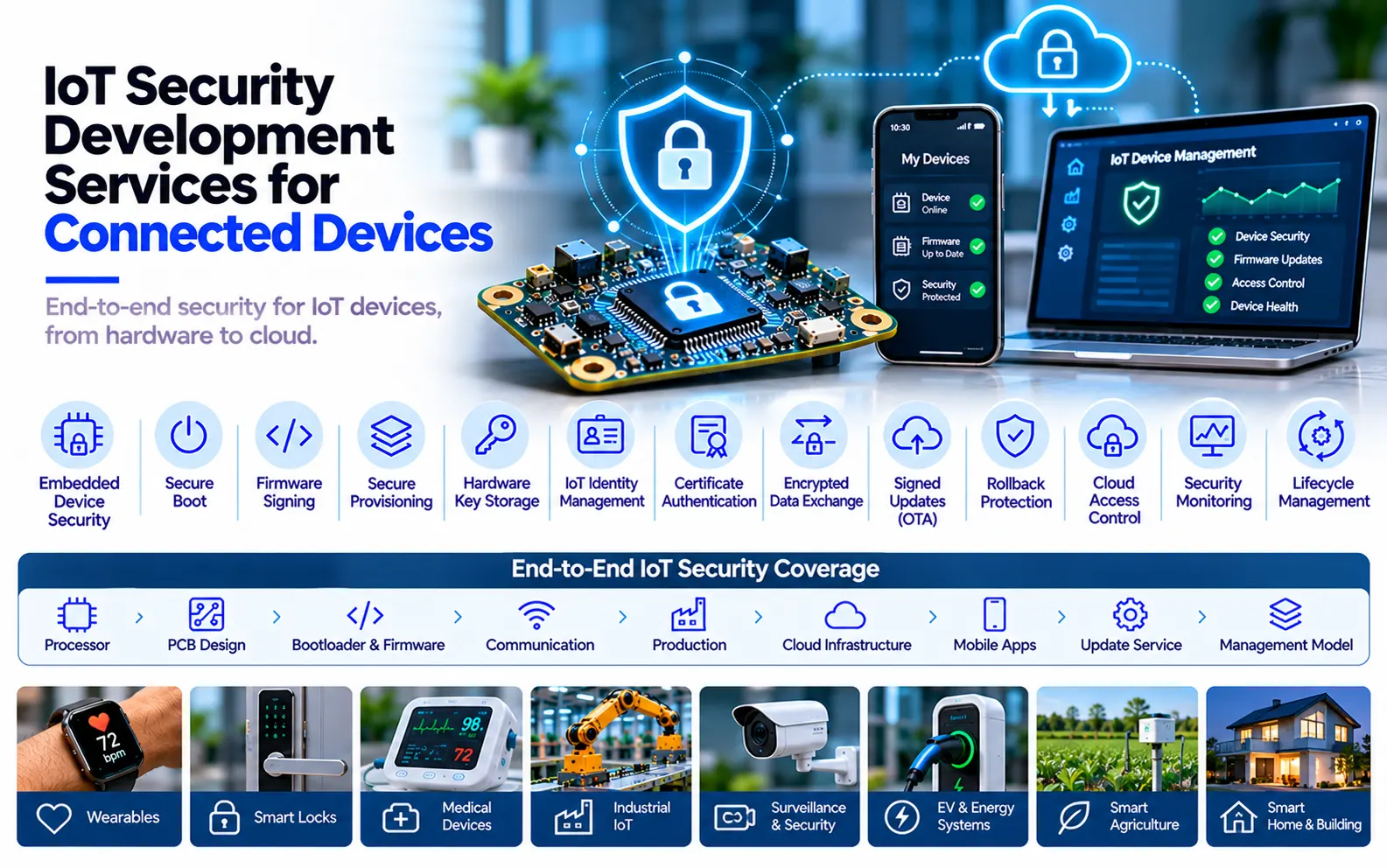
End-to-End IoT Security Development Services
Security needs vary widely among industrial gateways, medical devices, wearables, smart locks, energy controllers, cameras, consumer goods, and battery-operated sensors.
We need to gather knowledge about the device, the possible threats, physical access, information sensitivity, ways to connect to the network, processor capabilities, place of deployment, support time, and market requirements.
IoT security services include, but are not limited to:
The final scope is determined by the level of risk of the product and the technical limitations. Measures concerning security have to be appropriate for the device and its application and not a standard check box for each product.
Case Study: Secure STM32 Industrial IoT Gateway from Fieldbus to Cloud
Secure STM32 Industrial IoT Gateway from Fieldbus to Cloud
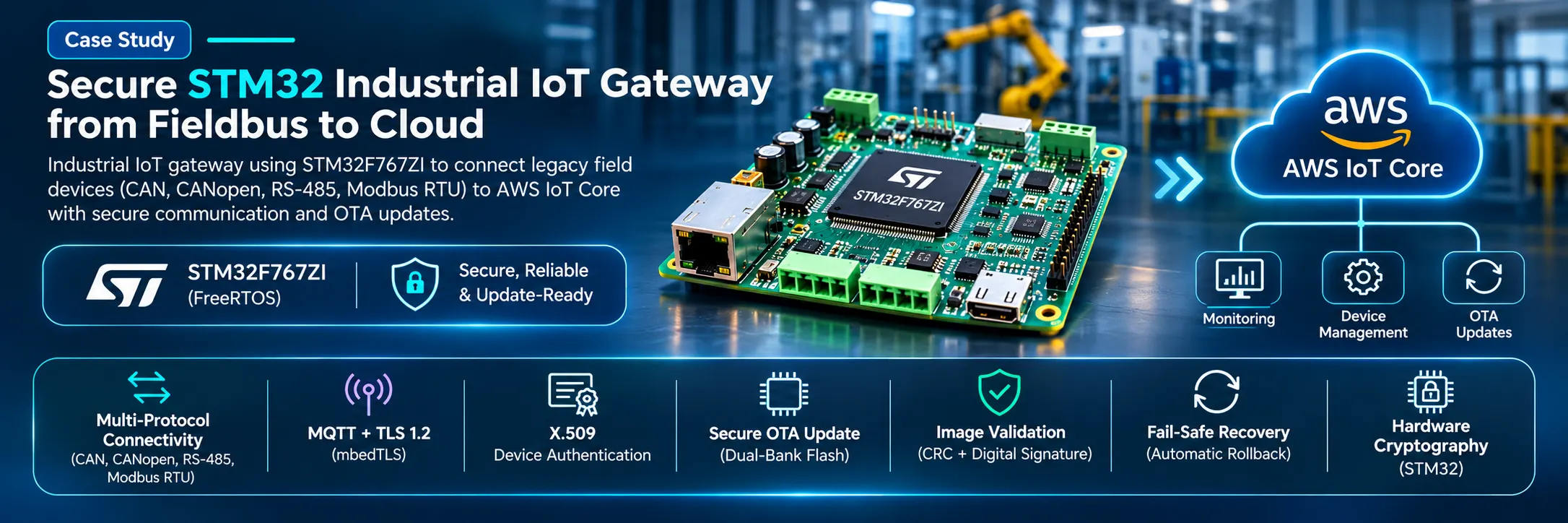
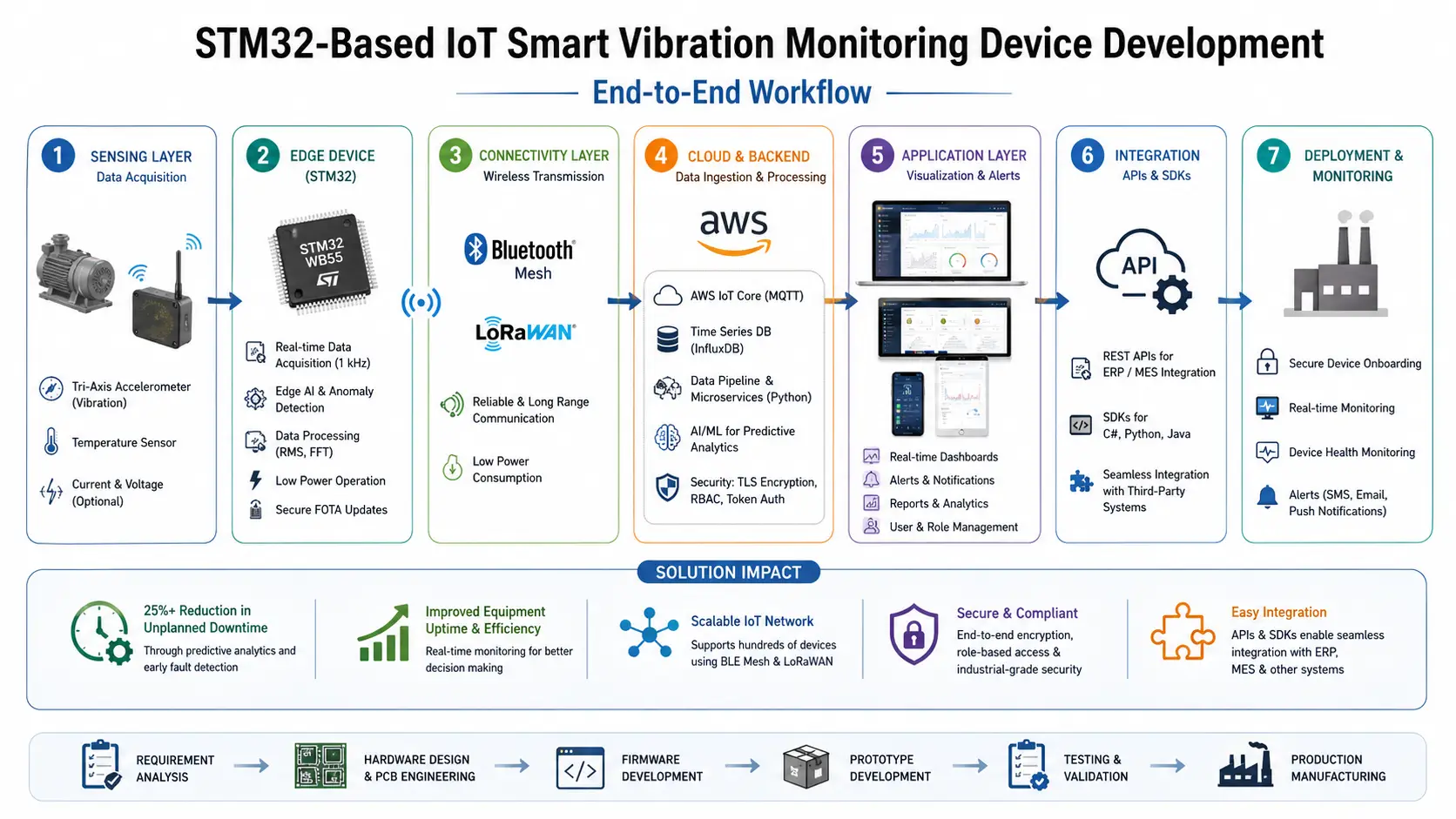
Using STM32F767ZI microcontroller, Adequate Infosoft has developed an industrial IoT gateway that has enabled legacy field equipment to perform with an advanced cloud platform.
This gateway gathered information from device protocols such as CAN, CANopen, RS-485, and Modbus RTU, streamlined the data, and sent it back to the AWS IoT core through Ethernet. The primary focus on architecture was ensuring communication security and recovery of software updates as operational devices were connected to an external network.
The embedded software has been developed on FreeRTOS, which provides unique responsibilities for Ethernet, CAN, RS-485, protocol transformation, cloud connection, and OTA updates. The introduction of this separation has simplified communication and update diagnostics.
Communication between devices and cloud employed MQTT protocol along with TLS version 1.2 through mbedTLS library. The gateway was authenticated using an X.509 certificate issued by the certificate authority root. This ensured that the cloud broker verified the authenticity of the gateway before receiving the telemetry information from it.
MQTT keep alive and last will message were used for monitoring the connectivity. Device state and cloud commands were communicated via controlled topics and not via an open-ended messaging model.
The OTA solution involved a modified bootloader residing in a secure section of the flash memory. Prior to running the application firmware, the bootloader validated the image through CRC and digital signature verification.
Using the dual-bank flash technology, the STM32F767 allows for both currently in use application and the incoming update to be stored in two separate banks, each on. With the incoming application being transferred via HTTPS and stored in the inactive bank, the activation was scheduled after the newly downloaded version was verified.
In case of the failure to validate the new application, the bootloader simply does not execute the new code. While the gateway continues existing functions and allows for another update being installed via either Ethernet or UART interface.
To implement all the cryptographic functions properly, the STM32W has its hardware-assisted cryptographic functions used in this work. There were also tests of the TLS protocol and fuzz testing of the MQTT parser done in the framework of the project.
This case study is an example of security at many levels: individual device authentication, cloud communication encryption, message filtering, signed firmware, image validation, separation of flash banks, recovery process, and protocol testing.
At the same time, this case study proves that security of Internet of Things cannot be split into two independent activities: cloud and firmware security. The certificate inside the device, TLS client, cloud authorization policy, update service, bootloader, and recovery all should work as one system.
Full case study: stm32-industrial-iot-gateway-ethernet-can-rs485-development
Related IoT Security Projects
Platform-Specific IoT Security Services
This page provides the complete IoT security architecture. The following specialized services cover platform-specific implementation.
Custom Bootloader Development and OTA
Custom bootloader development for embedded devices through BLE, Wi-Fi, Ethernet, mobile networks, CAN, RS-485, USB, LoRa etc.
Explore serviceNordic MCUboot and DFU
Secure boot, integration of MCUboot, signing firmware images, Nordic DFU, multi-image updates, rollback, and using mobile devices to send over the firmware for Nordic Semiconductor solutions.
Explore serviceNXP Secure Boot, OTA and EdgeLock Integration
NXP-based security which involves secure boot and signing of reliability updates with EdgeLock functionality, keyed storage, device identification and many more features offered by the chosen chip.
Explore serviceSTM32 Bootloader and OTA
STM32-based bootloaders with signing of the firmware, update in twin banks, rollback, secure provisioning, transport of updates over Ethernet, Wi-Fi, BLE, cellular and CAN.
Explore serviceGlobal IoT Cybersecurity Regulations Tracker
Our regulations and standards resource summarizes important IoT cybersecurity requirements and guidance across markets. Requirements must be verified for the product, market, sector, and date of release.
Open trackerEmbedded Device Security
Embedded security starts prior to the connecting the device to the cloud. Hardware and software has to be able to determine what code is trustworthy, where the credentials are kept, what interface is available and how it will work once verification has failed.
Secure Boot
Secure boot creates a trust chain through the inflexible and/or protected first-stage boot service and down to the application firmware.
At boot time, the bootloader confirms that the firmware image is both authentic and intact, before it allows it to run. In case the verification is unsuccessful, the device may reject this image, go to a special recovery mode, or run a good-known image following the specification.
The secure boot process design may involve the following:
Secure boot does not ensure that the firmware has no vulnerabilities, but it guarantees that the specific firmware which has passed through the signing process is being accepted.
Secure Storage of Keys and Credentials
Credentials that are hardcoded as readable constants within application firmware may be disclosed via firmware extraction, debugging, source code disclosure, and other means.
Depending on the hardware platform, sensitive keys may be secured using secure elements, trusted execution environment, one-time programmable memory, secured flash memory locations, hardware security modules, or MCU-specific security capabilities.
Key generation, injection, use, rotation, revocation, backup (where applicable), and ensuring keys do not appear in application logs or source repositories must all be defined by the architecture.
Protection of Interfaces
Unused or unrestricted interfaces can expose firmware, memory, configuration, and credentials.
A security review may cover:
Interfaces required for manufacturing or maintenance can be authenticated, restricted, disabled after production, or separated into controlled service modes.
Secure Device Provisioning and Identity
Every connected device should have an identity that the backend can authenticate.
Using the same credential across an entire product fleet creates unnecessary exposure. If one shared key is compromised, attackers may be able to impersonate multiple devices.
We develop provisioning workflows using:
The provisioning process must consider manufacturing partners, test fixtures, installers, end users, replacement devices, returned products, lost units, and end-of-life handling.
A technically secure credential can still be mishandled if the manufacturing and support workflows are not designed to protect it.
IoT Firmware Security
Firmware security covers more than encryption. It includes how code is developed, built, configured, updated, diagnosed, and supported.
Services may include:
When a vulnerability is discovered, the product also needs a practical way to identify affected versions and distribute a corrected firmware image. This connects firmware security directly with device inventory and OTA management.
Safe Boot and Verified OTA Updates
OTA updates are critical in the support of connected goods and a breach of a weak update scheme might give intruders a good chance to change the way a device works.
What does a secure OTA solution involve?
A bootloader must check an image before its execution. An update service should be able to track what version was uploaded to which device, whether an update was successful, and if the device was rolled back to the previous version.
For devices that are highly sensitive from safety or operational perspectives, the tasks of approving updates, release of an update to users, and establishment of maintenance schedule and recovery measures must be completed prior to the beginning of the process of producing updates.
Device-to-Cloud Security
The connection between an IoT device and its backend requires authentication, confidentiality, integrity, and controlled authorization.
Our device-to-cloud security services can cover:
A valid certificate should not automatically give a device unrestricted access to the entire IoT environment. Permissions can be limited so a device publishes and receives information only through its authorized resources.
IoT Identity and Certificate Management
Certificate management is an operational lifecycle rather than a one-time development task.
A production architecture should consider:
We can integrate certificate workflows with AWS IoT, Microsoft Azure, private public-key infrastructure, manufacturing systems, and custom device-management platforms.
IoT Products We Can Help Secure
Our services can support:
Frequently Asked Questions
They can include threat modeling, secure boot, firmware signing, device identity, provisioning, key storage, secure communications, certificates, secure OTA, cloud authorization, security logging, testing, and lifecycle planning.
Usually, yes. But the range of possible protections will depend on processor, memory, boot structure, firmware, hardware security capabilities, connectivity, and the limits of the deployed product. Our starting point is a technical evaluation.
The first checks firmware before its execution; the latter manages the process of authentication, delivery, storage, installation, activation, monitoring, and recovery of an image. An effective design requires both.
Yes. Depending on the platform, the identities can be based on per-device keys, X.509 certificates, secure elements, hardware-provided keys, and secured MCU storage.
Yes, we can combine our solutions with AWS, Azure, or another cloud platform.
No company that does responsible engineering can guarantee the invulnerability of any IoT product. The process of cybersecurity helps to minimize risks at the stage of proper architecture design, implementation, validation, monitoring, updating, and contingency planning.
No. Whether the product is compliant or not is the responsibility of the complete product, its documentation, testing, market, industry, organization, and regulations. We can implement necessary technical measures and do engineering validation within the scope defined in the contract, but we do not issue certification or legal advice.
We recommend starting security planning during product architecture. Processor selection, flash memory layout, selection of secure elements and interfaces, provisioning, and recovery of update processes become costly or impossible to implement after manufacturing the hardware.
Technical and Regulatory References
NIST IoT Cybersecurity Guidance & NISTIR 8259 Series
NIST IoT Device Cybersecurity Capability Core Baseline
NIST Foundational Cybersecurity Activities for IoT Product Manufacturers
ETSI EN 303 645 Consumer IoT Cybersecurity Standard
European Union Cyber Resilience Act