















 Mean Stack Development
 Vue JS Development
 Javascript Development
 React JS Development
 Angular JS Development
 Next JS development
 Java Development
 Python Development
 Django Development
 Cherrypy Development
 C# Development
 ASP.NET Development
 NodeJS Development
 Laravel Development
 CodeIgniter Development
 Zend Development
 Ruby on Rails Development
 CakePHP Development
 PHP Website Development
 Symfony Development
 Drupal Development
 Joomla Development
 Wordpress Development
 .NET Nuke Development
 Kentico
 Umbraco
 .NET MAUI Development
 Xamarin Application Development
 iOS Application Development
 Android Application Development
 Android Wear App Development
 Ionic Development
 iBeacon Application Development
 Universal Windows Platform (UWP)
 Kotlin Application Development
 Swift Application Development
 Flutter Application Development
 PWA Application Development
 Flutter Health Tech & Wearable App Development Company
 React Native Health Tech Wearable App Development
 Offshore Software Development
 Custom Application Development
 Front-End Development
 Full Stack Development
 AI & Machine Learning
 Custom CRM Solutions
 Flask Software Development
 Electron JS Development
 ChatGPT Development
 Telemedicine App Development
 Build Smart Telemedicine Platform
 Beauty & Salon App Solutions
 Hire Workato Experts
 Magento Development
 Magento 2.0 Development
 Magento Enterprise
 Shopping Cart Development
 Prestashop Development
 Shopify Development
 Open Cart Development
 WooCommerce Development
 BigCommerce Development
 NopCommerce Development
 Virto Commerce Development
 AspDotNetStorefront Development
 .NET Application Development
 Microsoft Dynamics CRM
 VB .NET Development
 Sharepoint Migration
 ASP.NET Core Development
 ASP.NET MVC Development
 AJAX Development
 Agile Development
 Microsoft Bot
 Microsoft Blazor
 Microsoft Azure Cognitive
 HTML 5
 UI/UX Design
 Graphic Design
 Adobe Photoshop
 XML Application Development
 Cloud Computing Solutions
 Azure Cloud App Development
 AWS Development
 Google Cloud Development
 Certified AWS IoT Services Developers
 DevOps Consulting & Development
 Kubernetes Consulting & Services
 SQL Programming Development
 MySQL Development
 MongoDB Development
 Big Data
 Robotic Process Automation
 Social Media Marketing
 Search Engine Optimization
 QA Testing
 Software Testing
 Software Security
 Maintenance And Support
 I.T. Consulting Services
 Business Intelligence
 YII Development
 Data Analysis
 Alexa Skills Development
 On Demand App for Mobile repairing services
 On Demand App for Car Service Booking
 On Demand App for Cleaning Services
 On Demand App for Pharmacy
 On Demand Dedicated Developers
 On Demand Lawyer App Development









 Nuki Smart Lock
 Salto Smart Lock
 TTlock Smart Lock
 NFC App Development
 Custom IOT Enabled Smart Lock
 Smart Locker Solutions
 Hospital Smart Lock Systems
 Hotel Smart Lock Systems
 Smart Home & Office Locks
 Smart Access for Schools & Colleges
 Unloc Smart Lock Integration
 Yale & August Smart Lock Integration
 Populife Smart Lock Integration
 Smart Lock Hardware Development
 Dairy IoT Solutions
 Agri IoT & AI Solutions
 Weather & Climate Solutions
 Water & Waste Management Solutions
 RaspBerry Pi
 Firmware Software Development
 ESP 32 Software Development
 Embedded Development
 Internet of Things
 Smart IoT Development
 IoT Sensor Integration & Development Solutions
 Smart IoT System Development for HVAC
 Tuya IoT App Development
 Particle IoT SDK
 IoT Development with AI
 Smart Pet GPS Tracker
 Dairy GPS Tracking Solutions
 GPS Fleet Management Software
 Car Rental & Subscription Solutions
 Car Buy & Sell Marketplace Development
 AI-Powered Car Wash App Development
 PCB Design & Fabrication
 IoT AC Automation
 AI–IoT Painting Solutions
 IoT Wearable Hardware & App Development
 HVAC Automation & AI Control Systems
 Smart Home IoT Engineering
 AI Embedded Systems
 AI Hardware Design Service
 Advanced IoT Hardware & Firmware Development
 Device Driver Development Services
 NXP i.MX RT Firmware & Hardware Services
 Microchip PIC & AVR Development
 Hire IoT Architects
 IoT Cloud & Infrastructure Solutions
 Infineon XMC / AURIX Development Services
 Matter & Thread IoT Services
 Native IoT Mobile App Development (BLE & Wi-Fi)
 Snapdragon IoT Firmware Development
 Renesas RA/RX Firmware Services
 Silicon Labs EFR32 Development Services
 Smart Wearable App Development
 Smart IoT Meters
 Smart Healthcare Wearable App Development
 Health Care Monitoring System
 Fitness Tracking App Development
 Smart Home Automation Apps
 nRF PCB Design
 ESP32 PCB Design
 Embedded Wearables Engineers
 Rental Property Management System
 Building Management System
 Smart Lighting Development
 Infineon Semiconductor Firmware Development Services
 Custom Camera Development: Hardware, Firmware & PCB Prototyping
 Smart Security Camera SDK
 Nordic Semiconductor SDK
 Infineon SDK
 Arduino SDK
 NFC Lock Integration
 Kerong Lock Integration
 IoT & AI Solutions for Manufacturing
 Smart Inventory & Logistics Solution
 Food & Beverage Industry Solutions
 Smart Hospitality Solutions
 Smart Property Management
 Custom Smart Home IOT SDK
 Smart IoT & AI in Healthcare
 AI-Powered Security Solutions
 Smart Home Safety & AI
 Veterinary Clinic Management (AI)
 Pet Care System (AI & IoT)
 Pet Training & Adoption (AI)
 Healthcare IoT Development
 Event Management Software
 Money Remittance App
 Money Lending App Development
 Utility and Bill Payment App
 IoT Mobile App Development (Flutter & React Native)
 AI & IoT Retail Solutions
 Smart EV App Development
 Smart Solar IoT & AI Solutions
 IoT-Based Energy Systems
 Smart Energy & Utilities Solutions
 6G Solutions
 IoT Security Solutions
 AI-Powered Lottery App Development
 AI-Sports Fitness Club Management
 Travel
 Real Estate
 Medical & Healthcare
 e-Learning
 Consumer Products
 Finance
 Automobile
 Media & Entertainment
 Billing Software
 Enterprise Resource Planning (ERP)
 Augumented & Virtual Reality
 Point of Sale(POS) Development
 Learning Management System
 EV Charging Solutions
 About Us
 Partners & Certifications
 Quality Assurance
 Our Clients & Testimonials
 Development Process
 Our Products
 Social Responsibility
 Work Ethics
 Vision & Mission
 Awards
 Live Project Demos
 Contact Us
 Case Studies
 Portfolio
 Blog
Blog
STM32 Secure Bootloader & OTA Firmware Update Development
A firmware update changes the code controlling a device. Weak trust choices, firmware flashing, or recovery processes can result in a remote avenue for attack and pose a system-wide risk for efficiency.
Although TLS safeguards transport, it does not guarantee the verification of the image for that device or inhibit the installation of unsafe firmware.
Adequate Infosoft provides STM32 bootloader development services for products with the requirements of trusted boot, dependable upgrade, and regulated recovery.
We design the boot chain, image type, signing process, downloading application, flash configuration, rollback strategy, backend and verification as a single process.
We work in the field of industrial IoT, medical and wearable electronics, control systems of buildings, measuring devices, gateways and energy devices. The updates can use Wi-Fi, Ethernet, mobile connection, BLE, USB, CAN, LoRaWAN or local service tools, but it is always necessary to verify its authenticity before running.
Let's Work Together!
What Does a Secure STM32 Bootloader Do?
A secure bootloader operates prior to the application and transfers control exclusively to an authorized image. Depending on MCU and threat model, it authenticates signatures, integrity, compatibility and security version; safeguards important assets; downloads images; and commences specified recovery process.
A production OTA system should answer five questions with evidence:
| Security or reliability property | Required behavior |
|---|---|
| Authenticity | Install only firmware signed by an authorized release key |
| Integrity | Detect altered, incomplete or corrupted images before execution |
| Compatibility | Reject images for the wrong product, board, memory map or hardware revision |
| Freshness | Enforce the approved downgrade or anti-rollback policy |
| Recoverability | Return to a known-good image or service mode after interruption or failed health checks |
Encryption can protect firmware confidentiality but does not replace signatures. A checksum detects accidental corruption, not an authorized publisher.
One STM32 Family Does Not Define Every Security Architecture
STM32 security varies by series and part. Building blocks may include cryptographic accelerators, unique identity, random generation, TrustZone, secure storage, readout protection and protected boot. Reference approaches include X-CUBE-SBSFU and, on applicable platforms, MCUboot, Trusted Firmware-M or OEMiROT examples.
The architecture is the same in case of MCU, flash, external memory, connectivity, production state and security. Designs based on STM32F4 cannot be applied to STM32H5 or U5 without reference manuals, option bytes and guidance on security.
Our Secure Bootloader Development Services
Threat model and trust-boundary design
We specify the attackers, the exposed interfaces, the access and the assets of failure. The boundaries of trust involve Boot ROM, initial code, anchors of trust, counters, metadata, external flashes, and signing activities.
We specify the attackers, the exposed interfaces, the access and the assets of failure. The boundaries of trust involve Boot ROM, initial code, anchors of trust, counters, metadata, external flashes, and signing activities. Thus, the weaknesses, such as debug ports and writing tables of keys, are revealed.
In this way, the specification gives states of images and authentication of versions and failures, as well as the fact of signing key possession.
Boot chain and image verification
We implement the bootloader, linker scripts, vector relocation, memory protection and handoff. Headers can carry product, hardware, version, size, digest, signature and dependency data.
We implement the bootloader, linker scripts, vector relocation, memory protection and handoff. Headers can carry product, hardware, version, size, digest, signature and dependency data. Verification uses vetted libraries or supported vendor components.
Checks occur before untrusted code runs. Bounds, addresses and lengths prevent malformed metadata from causing unsafe flash access. Boot time, watchdog and fault handling are measured on hardware.
OTA layout and installation strategy
Layout follows flash, image size, power-loss risk and availability. Common designs include A/B slots, swap or scratch, download then install, and single-slot service update.
Layout follows flash, image size, power-loss risk and availability. Common designs include:
A/B slots: separate active and candidate images for confirmation and rollback, using more storage; swap or scratch: use smaller temporary storage with more complex power-fail state management; download then install: stage an image in external flash before authenticated installation; and single-slot service update: only where recovery and interruption risks are controlled.
Flash boundaries, wear, cache, ECC and external-memory trust are addressed. Brownout during erase, copy or metadata update must produce a deterministic next boot.
Transport and device-to-cloud integration
We build the downloader for HTTPS, MQTT or another channel, including chunking, resume, retry, manifests, bandwidth controls and staged rollout.
We build the downloader for HTTPS, MQTT or another channel, including chunking, resume, retry, manifests, bandwidth controls and staged rollout. BLE may use phone-assisted transfer; CAN needs a service protocol; LoRaWAN FUOTA must respect airtime, memory and energy.
The backend can manage cohorts, eligible versions, signed manifests, rollout percentage, windows, status and alerts. Update authorization remains separate from telemetry permissions.
Products with multiple processors or radio coprocessors need dependency-aware releases. We define compatible version pairs, installation order and recovery behavior so an application update does not leave the main MCU, connectivity firmware and shared data format out of sync.
Signature, Key and manufacturing process of supply
Compromised release keys cannot be substituted for highly secured devices. Controlled signing includes the use of a different production key and development key for signing process.
Compromised release keys cannot be substituted for highly secured devices. Controlled signing includes the use of a different production key and development key for signing process, obtaining approvals, maintaining audit logs, and timely key revocation. All private keys remain outside the source code repository and Continuous Integration logs.
The manufacturing process consists of installing the device security settings via an auditable process. Provisioning records may include serial number, revision, firmware version, identifiers for keys used, and byte code settings. Debugging means that the support model is used, and also that physical threats are accounted for.
Legacy bootloader audit and remediation
For products that are live, we analyze memory structure, the parser, authentication processes, version comparisons, flash programming and reset recovery.
For products that are live, we analyze memory structure, the parser, authentication processes, version comparisons, flash programming and reset recovery. Any necessary improvements will likely involve either a compatible bootloader update, an intermediate release or a new piece of hardware.
In instances where the bootloader is unable to authenticate its successor, we will record this limitation.
The Update Lifecycle We Test
Secure OTA works as a state machine instead of a download button so we thoroughly check the entire process.
The device acquires an authenticated manifest and determines whether the product, hardware, and versions are suitable for installation. The device downloads chunks through finite writing and ensures that the entire file is correct. The bootloader validates the file before installation and booting. The new system completes the required health checks. The firmware confirms that the process was successful; if the firmware does not work or it keeps resetting, the rollback or recovery starts. The device informs fleet operators of the final result so that they can determine if it is a success, delay, or failure.
Invalid signatures, incorrect product, truncation, altered headers, downgrade, filled memory, dropped out of the net, brownout for every flash stage, watchdog resetting, and unattended confirmation belong to negative tests. We also conduct repeated campaign tests and evaluation of recovery limits.
The tracing and logging provide the cause of the reset, slot state and version transition. The report provides conditions and assumptions for testing and does not claim that "fail-safe" is applicable without any evidence of interruptions.
Relevant Adequate Infosoft Case Studies
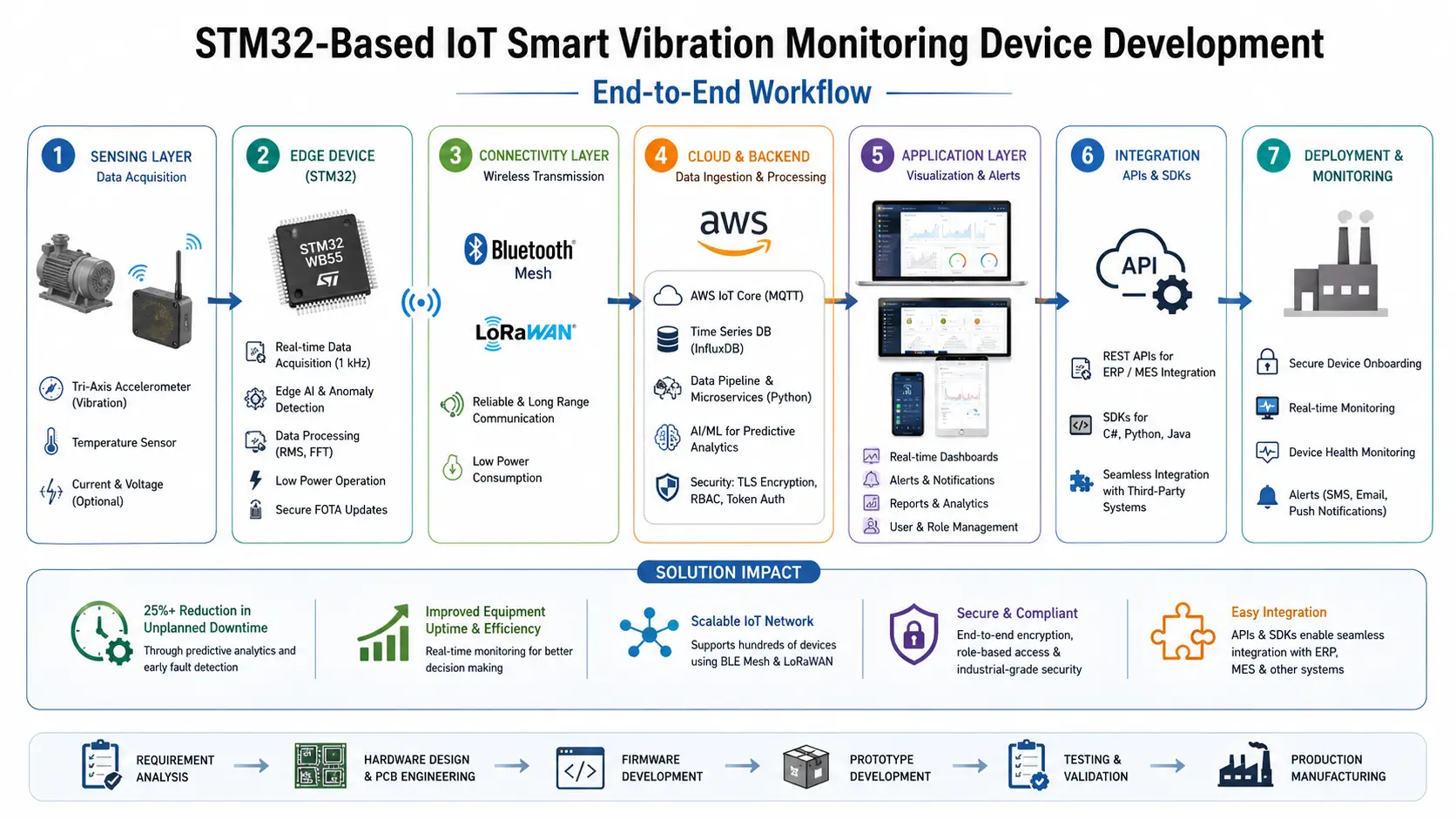
STM32 industrial vibration monitoring with FOTA
Our STM32 vibration monitoring case study describes STM32 firmware, local processing, wireless networking, cloud telemetry and FOTA.
Its relevance is system coordination: updates must coexist with real-time acquisition, constrained connectivity, battery management and remote diagnostics. The case does not claim every secure-boot option on this page.
Read Case Study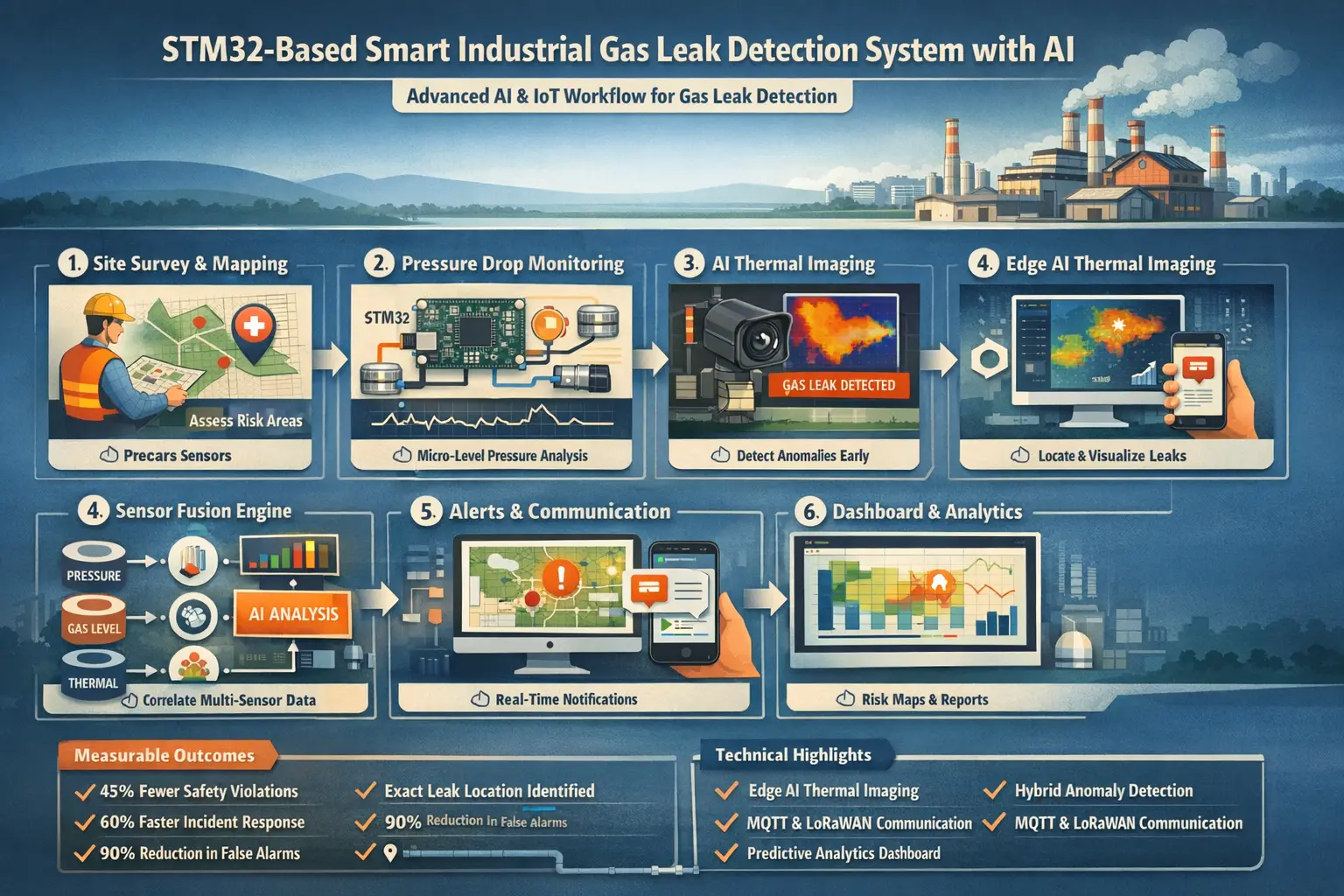
STM32L4 gas detection and secure field updates
The STM32 industrial gas leak detection case study used STM32L4, calibrated sensors, edge detection, LoRaWAN, BLE Mesh, Azure IoT and secure OTA.
It shows safety-oriented operations where alarms must continue locally and updates respect sensing and power duties. It is related field-update experience, not certification evidence for another product.
Read Case StudyThese examples show why bootloader engineering cannot be isolated from device behavior. A reliable update preserves the product's sensing, safety, power and communication responsibilities before, during and after installation.
Deliverables and Engineering Handover
The list of deliverables includes threat model, boot flow, memory map, bootloader and downloader software source code, code-signing tools, cloud integration, provisioning utility, automated tests, power-off matrix, release process and recovery manual.
The source code has version history, and the build process is repeatable. We take an inventory of components and separate configuration from secrets, provide explanation of non-reversible MCU configuration, and record limitations. The customer gets a workable update system rather than just a demonstration.
Frequently Asked Questions
OTA provides a device with firmware. In contrast, secure boot evaluates the trustworthiness of firmware before execution. A device may support one without the other, but secure remote upgrade systems generally include both as well as recovery and key management.
No. Signing authenticates the publisher when the verification key is trusted, but the system must also check compatibility, control downgrade, protect state and survive interruption.
Often yes, depending on the current bootloader, free flash, transport, fleet access and ability to establish a trust anchor. We audit these first.
A/B slots provide for easy rollback but consume a lot of storage. A swap or external staging can lower internal flash requirement while increasing state and trust complexity. The answer depends on image size, memory, downtime and recovery needs.
Editorial Resources