












 Mean Stack Development
 Vue JS Development
 Javascript Development
 React JS Development
 Angular JS Development
 Next JS development
 Java Development
 Python Development
 Django Development
 Cherrypy Development
 C# Development
 ASP.NET Development
 NodeJS Development
 Laravel Development
 CodeIgniter Development
 Zend Development
 Ruby on Rails Development
 CakePHP Development
 PHP Website Development
 Symfony Development
 Drupal Development
 Joomla Development
 Wordpress Development
 .NET Nuke Development
 Kentico
 Umbraco
 .NET MAUI Development
 Xamarin Application Development
 iOS Application Development
 Android Application Development
 Android Wear App Development
 Ionic Development
 iBeacon Application Development
 Universal Windows Platform (UWP)
 Kotlin Application Development
 Swift Application Development
 Flutter Application Development
 PWA Application Development
 Flutter Health Tech & Wearable App Development Company
 React Native Health Tech Wearable App Development
 Offshore Software Development
 Custom Application Development
 Front-End Development
 Full Stack Development
 AI & Machine Learning
 Custom CRM Solutions
 Flask Software Development
 Electron JS Development
 ChatGPT Development
 Telemedicine App Development
 Build Smart Telemedicine Platform
 Beauty & Salon App Solutions
 Hire Workato Experts
 Magento Development
 Magento 2.0 Development
 Magento Enterprise
 Shopping Cart Development
 Prestashop Development
 Shopify Development
 Open Cart Development
 WooCommerce Development
 BigCommerce Development
 NopCommerce Development
 Virto Commerce Development
 AspDotNetStorefront Development
 .NET Application Development
 Microsoft Dynamics CRM
 VB .NET Development
 Sharepoint Migration
 ASP.NET Core Development
 ASP.NET MVC Development
 AJAX Development
 Agile Development
 Microsoft Bot
 Microsoft Blazor
 Microsoft Azure Cognitive
 HTML 5
 UI/UX Design
 Graphic Design
 Adobe Photoshop
 XML Application Development
 Cloud Computing Solutions
 Azure Cloud App Development
 AWS Development
 Google Cloud Development
 Certified AWS IoT Services Developers
 DevOps Consulting & Development
 Kubernetes Consulting & Services
 SQL Programming Development
 MySQL Development
 MongoDB Development
 Big Data
 Robotic Process Automation
 Social Media Marketing
 Search Engine Optimization
 QA Testing
 Software Testing
 Software Security
 Maintenance And Support
 I.T. Consulting Services
 Business Intelligence
 YII Development
 Data Analysis
 Alexa Skills Development
 On Demand App for Mobile repairing services
 On Demand App for Car Service Booking
 On Demand App for Cleaning Services
 On Demand App for Pharmacy
 On Demand Dedicated Developers
 On Demand Lawyer App Development






 Nuki Smart Lock
 Salto Smart Lock
 TTlock Smart Lock
 NFC App Development
 Custom IOT Enabled Smart Lock
 Smart Locker Solutions
 Hospital Smart Lock Systems
 Hotel Smart Lock Systems
 Smart Home & Office Locks
 Smart Access for Schools & Colleges
 Unloc Smart Lock Integration
 Yale & August Smart Lock Integration
 Populife Smart Lock Integration
 Smart Lock Hardware Development
 Dairy IoT Solutions
 Agri IoT & AI Solutions
 Weather & Climate Solutions
 Water & Waste Management Solutions
 RaspBerry Pi
 Firmware Software Development
 ESP 32 Software Development
 Embedded Development
 Internet of Things
 Smart IoT Development
 IoT Sensor Integration & Development Solutions
 Smart IoT System Development for HVAC
 Tuya IoT App Development
 Particle IoT SDK
 IoT Development with AI
 Smart Pet GPS Tracker
 Dairy GPS Tracking Solutions
 GPS Fleet Management Software
 Car Rental & Subscription Solutions
 Car Buy & Sell Marketplace Development
 AI-Powered Car Wash App Development
 PCB Design & Fabrication
 IoT AC Automation
 AI–IoT Painting Solutions
 IoT Wearable Hardware & App Development
 HVAC Automation & AI Control Systems
 Smart Home IoT Engineering
 AI Embedded Systems
 AI Hardware Design Service
 Advanced IoT Hardware & Firmware Development
 Device Driver Development Services
 NXP i.MX RT Firmware & Hardware Services
 Microchip PIC & AVR Development
 Hire IoT Architects
 IoT Cloud & Infrastructure Solutions
 Infineon XMC / AURIX Development Services
 Matter & Thread IoT Services
 Native IoT Mobile App Development (BLE & Wi-Fi)
 Snapdragon IoT Firmware Development
 Renesas RA/RX Firmware Services
 Silicon Labs EFR32 Development Services
 Smart Wearable App Development
 Smart IoT Meters
 Smart Healthcare Wearable App Development
 Health Care Monitoring System
 Fitness Tracking App Development
 Smart Home Automation Apps
 nRF PCB Design
 ESP32 PCB Design
 Embedded Wearables Engineers
 Rental Property Management System
 Building Management System
 Smart Lighting Development
 Infineon Semiconductor Firmware Development Services
 Custom Camera Development: Hardware, Firmware & PCB Prototyping
 Smart Security Camera SDK
 Nordic Semiconductor SDK
 Infineon SDK
 Arduino SDK
 NFC Lock Integration
 Kerong Lock Integration
 IoT & AI Solutions for Manufacturing
 Smart Inventory & Logistics Solution
 Food & Beverage Industry Solutions
 Smart Hospitality Solutions
 Smart Property Management
 Custom Smart Home IOT SDK
 Smart IoT & AI in Healthcare
 AI-Powered Security Solutions
 Smart Home Safety & AI
 Veterinary Clinic Management (AI)
 Pet Care System (AI & IoT)
 Pet Training & Adoption (AI)
 Healthcare IoT Development
 Event Management Software
 Money Remittance App
 Money Lending App Development
 Utility and Bill Payment App
 IoT Mobile App Development (Flutter & React Native)
 AI & IoT Retail Solutions
 Smart EV App Development
 Smart Solar IoT & AI Solutions
 IoT-Based Energy Systems
 Smart Energy & Utilities Solutions
 6G Solutions
 IoT Security Solutions
 AI-Powered Lottery App Development
 AI-Sports Fitness Club Management
 Travel
 Real Estate
 Medical & Healthcare
 e-Learning
 Consumer Products
 Finance
 Automobile
 Media & Entertainment
 Billing Software
 Enterprise Resource Planning (ERP)
 Augumented & Virtual Reality
 Point of Sale(POS) Development
 Learning Management System
 EV Charging Solutions
 About Us
 Partners & Certifications
 Quality Assurance
 Our Clients & Testimonials
 Development Process
 Our Products
 Social Responsibility
 Work Ethics
 Vision & Mission
 Awards
 Live Project Demos
 Contact Us
 Case Studies
 Portfolio
 Blog
Blog
Nordic Secure Boot, MCUboot & Signed DFU Development
A wireless firmware update is privileged code delivery. If the device cannot prove who signed an image, reject an older vulnerable release, recover from interrupted writes, and report the installed version, an over-the-air update feature can become a permanent field failure or an attack path.
Adequate Infosoft provides Nordic secure DFU development using nRF Connect SDK and Zephyr.
We design boot chains, integrate MCUboot, implement signed BLE or IP updates, connect mobile and cloud delivery, plan key custody, and test recovery.
Work covers nRF52, nRF53, nRF54L and nRF91 products, nRF5 SDK migrations, and unreliable field-update systems.
Let's Work Together!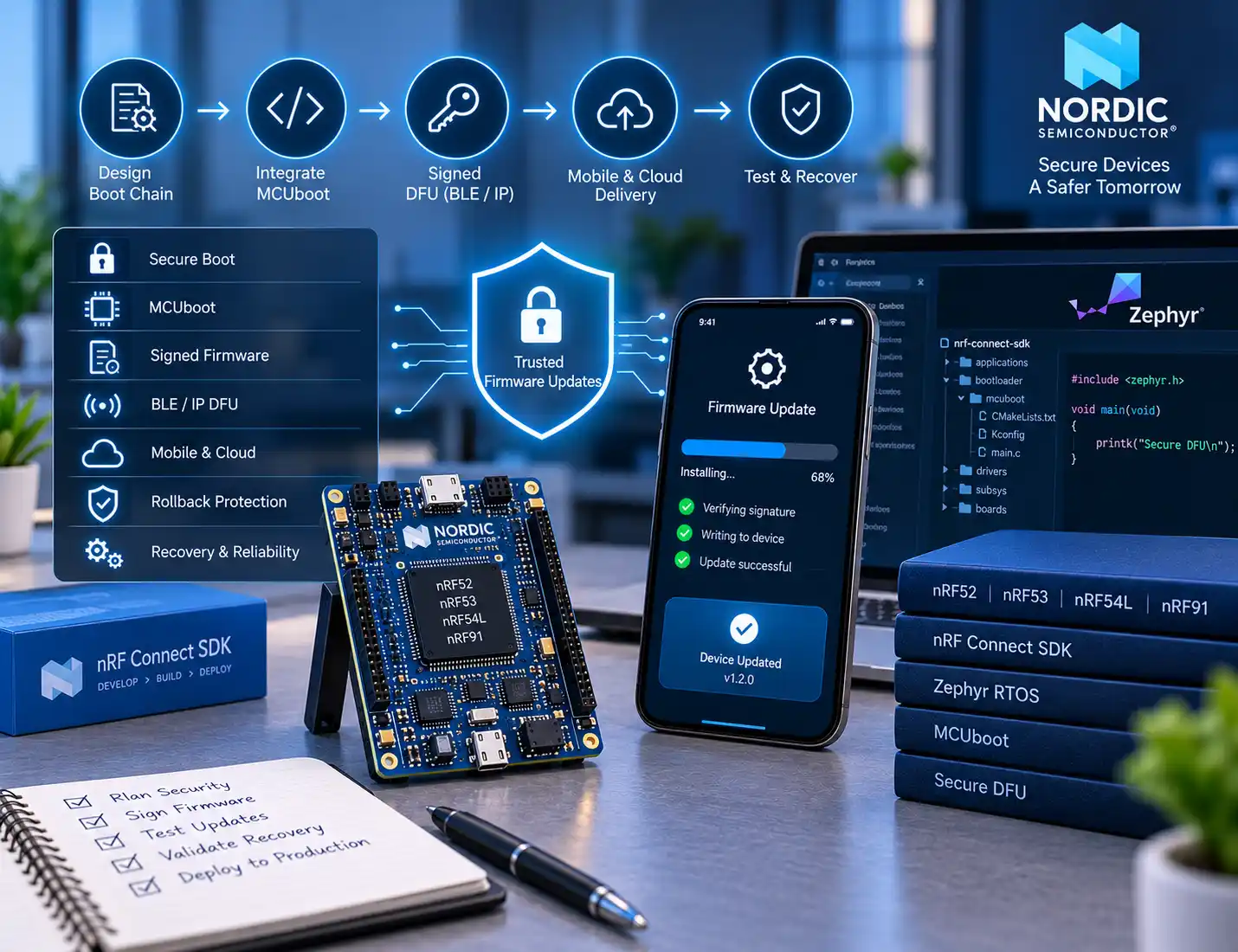
Secure DFU Starts with a Threat Model
"The firmware is signed" is not a complete requirement. We outline who is allowed to issue releases, which devices have the right to upgrade, how lost account details are restored, whether downgrading is allowed, and how different types of failures are avoided. There are four controls that are regularly confused, though.
| Control | What it protects | What it does not guarantee |
|---|---|---|
| Cryptographic signature | Image authenticity and integrity | Confidentiality of firmware bytes |
| Image encryption | Confidentiality at rest or in transit | That the plaintext was approved |
| Secure transport | Update delivery session | Safety of the image after download |
| Anti-rollback policy | Known-vulnerable version downgrade | Correct operation of a newer image |
A solution may need all four. We document trust boundaries, public-key placement, private-key custody, recovery, debug policy, factory provisioning, version rules, and responses to unauthorized or interrupted updates.
What MCUboot Does in a Nordic Product
MCUboot serves as the standard bootloader for various applications created with the nRF Connect SDK. It covers all aspects of image metadata and behavior of flash-slot, performing actions such as validating candidates, signing them and determining what can actually run.
In a dual slot configuration, the active image stays in the main slot and its replacement is stored in the second slot.
Once the update is confirmed, it gains permanence. In case of a test update, it is necessary to have the actual application code verify the validity of the update, otherwise, MCUboot will reverse the process after the power cycle. This limits damages from genuine firmware which fails during execution.
MCUboot does not transfer files. MCUmgr and Simple Management Protocol can deliver local updates, while FOTA Download and DFU Target support connected workflows. Separating transport, image management, verification, and application health improves testability.
Relevant Adequate Infosoft Nordic Case Studies
The projects mentioned here contain a Nordic product engineering aspect. We do not mean that each case study employs MCUboot or uses sign DFU technology unless it is stated specifically in the case study.
Their applicability lies in the areas of device firmware, BLE insecurity, hardware, and the field lifecycle of devices.
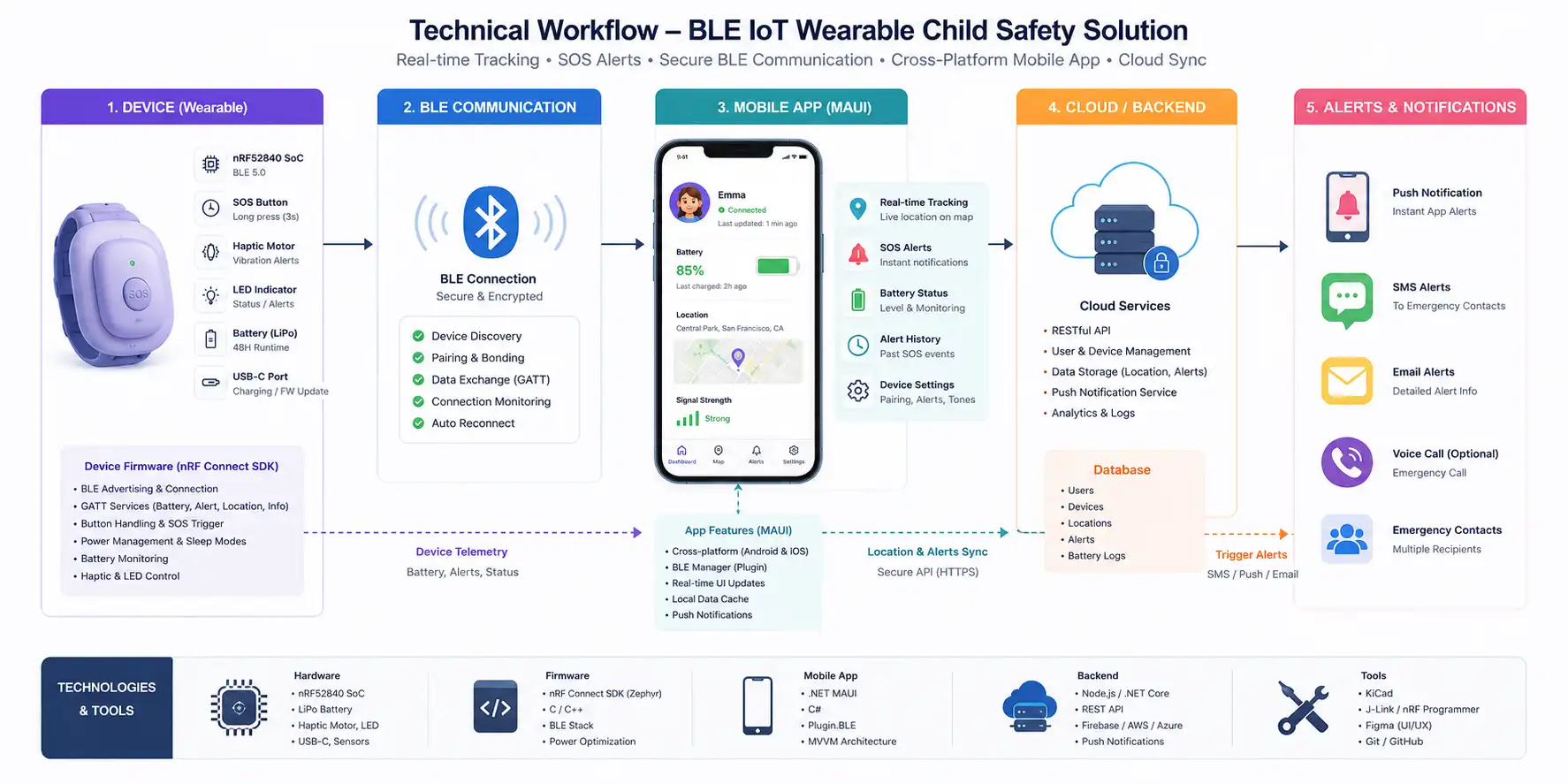
nRF52840 child-safety wearable with Zephyr and a MAUI app
Adequate Infosoft delivered a small-scale nRF52840 wearable device with personalized PCB and Zephyr firmware that consists of BLE services, battery management, USB-C charging, haptic feedback as well as a .NET MAUI application.
The case shows an example of device and mobile integration for commercial BLE DFU process including discovery, pairing, version visibility, reconnecting and full source handover.
Read Case Study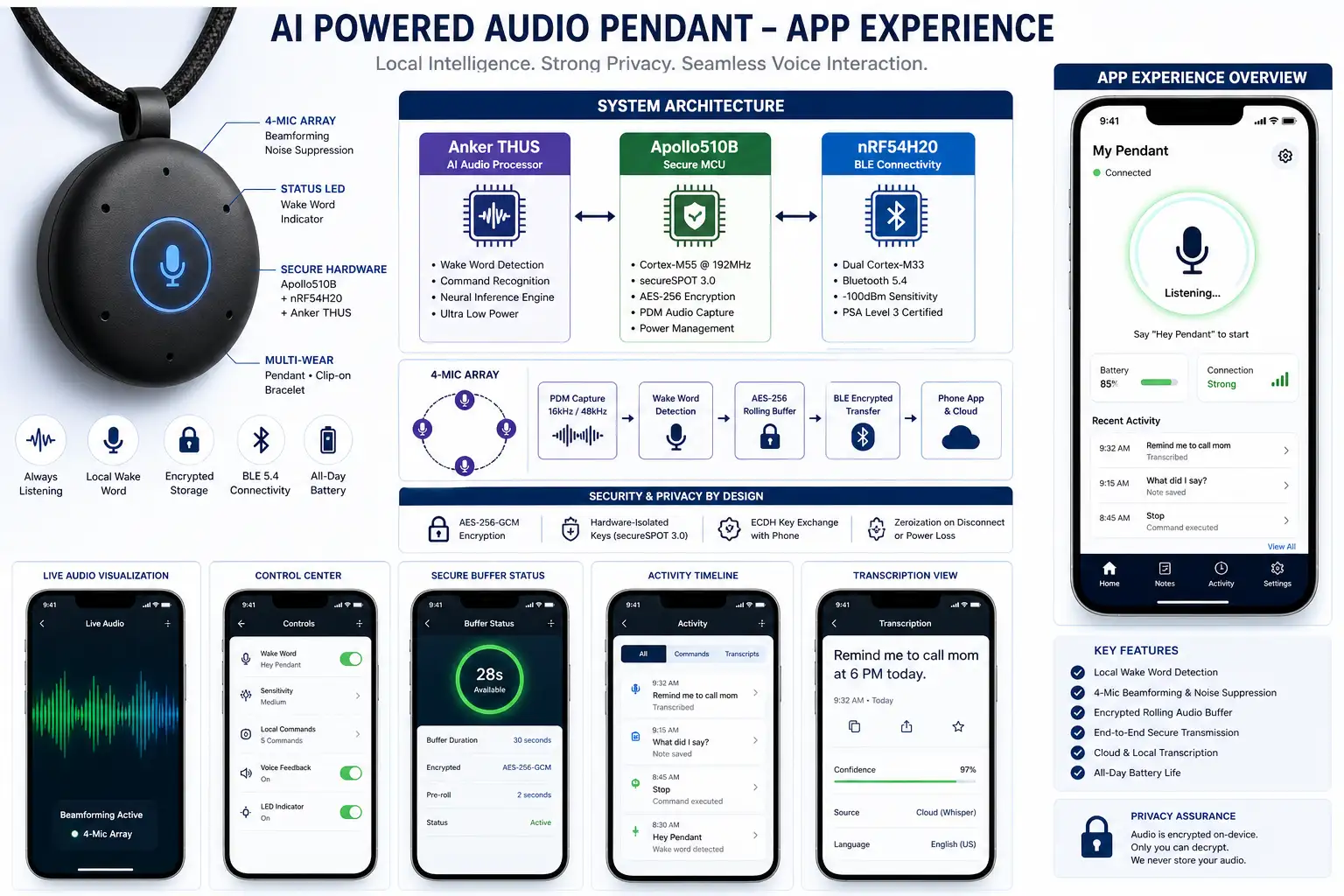
nRF54H20 privacy-first AI audio pendant
This wearable combines an Apollo510B application processor with Nordic nRF54H20 connectivity, local wake-word processing, a four-microphone pipeline, encrypted audio buffering, BLE, and cloud transcription.
Its relevance is the security architecture of a complex multi-processor product: protected data, controlled interfaces, component compatibility, and production testing. Secure update implementation must follow the current nRF54H20 platform model.
Read Case Study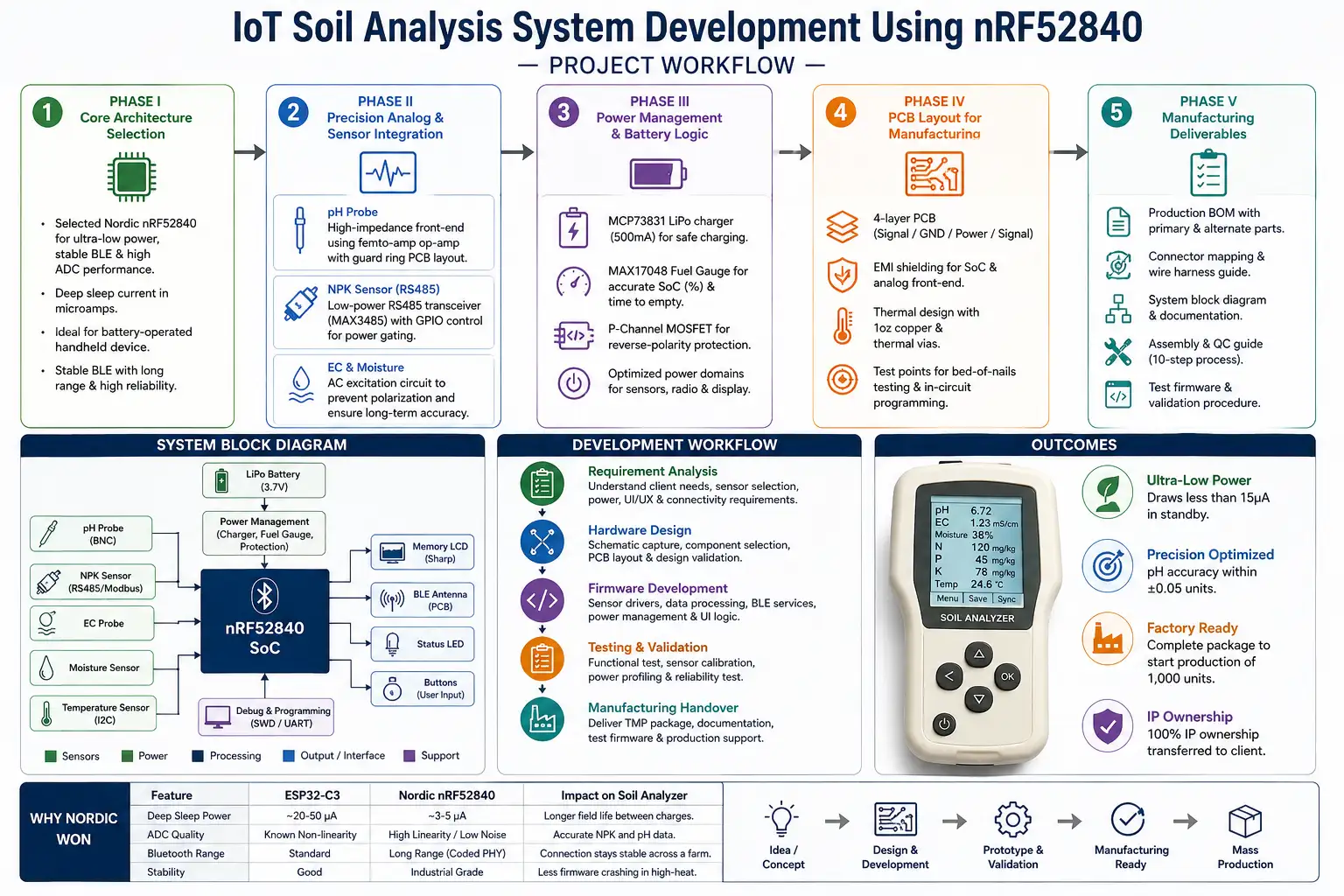
nRF52840 handheld soil-analysis system
The nRF52840 system architecture of the battery-operated agri-tool combines BLE along with accurate pH/NPK/EC sensors, boards and systems for controlling power, PCB layout, and manufacturing outputs.
Moreover, case study shows that the assemblage develops an integral lifecycle concept broadening the scope of firmware development, bringing in such factors as identity and calibration, non-volatile settings, access to production and field maintainability of the device.
Read Case StudyOur Nordic Secure Boot Engineering Scope
Boot-chain and flash architecture
We have chosen the SoC architecture, the memory, the size of the update, the boot time, and the goal of availability. This work includes sysbuild, MCUboot, device tree, partitions, image slots, applicable swap space, storage of settings, alignment, trailer, and recovery interface.
We have chosen the SoC architecture, the memory, the size of the update, the boot time, and the goal of availability. This work includes sysbuild, MCUboot, device tree, partitions, image slots, applicable swap space, storage of settings, alignment, trailer, and recovery interface.
Development-kit layout may fail while the firmware is growing or the external flash is exposed to the brownout phenomenon. We have budgeted for signing overhead, reserved for growth, checked erase geometry, and tested production memory. The strategies for overwriting, swapping, and direct execution were evaluated based on recovery guarantees.
Image signing and release keys
We integrate supported signing with west, sysbuild, and MCUboot tooling. Development and production keys remain separate. Production private keys should not enter source control or developer laptops; signing can run through a controlled service, hardware security module, or cloud key manager.
We integrate supported signing with west, sysbuild, and MCUboot tooling. Development and production keys remain separate. Production private keys should not enter source control or developer laptops; signing can run through a controlled service, hardware security module, or cloud key manager.
Release controls can include approvals, reproducible builds, manifests, hashes, version metadata, provenance, audit history, and separation of duties. We plan key rotation and incident recovery before deployment.
Rollback and version policy
Version numbers are security components that determine how semantic versions, MCUboot security counters, hardware revisions, versions and release channels interact. If a device receives an image not suitable for the board or a release below the required security level, it will ignore the image.
Version numbers are security components that determine how semantic versions, MCUboot security counters, hardware revisions, versions and release channels interact. If a device receives an image not suitable for the board or a release below the required security level, it will ignore the image.
Rollback protection is sometimes a one-way street. This means that tests have to be done in stages, and there has to be a documented recovery route.
BLE DFU, Mobile Apps, and Cloud FOTA
For local updates, we implement MCUmgr/SMP over Bluetooth LE and validate with nRF Connect Device Manager. We can integrate DFU into native iOS, Android, Flutter, React Native, or .NET MAUI apps.
The client obtains an authorized release, selects the hardware package, transfers it safely, activates, reconnects, and reports the version.
Signing images does not obviate the need for BLE bonding, and having a signed image does not mean that all phones are eligible for updates. We implement access control, rate limiting, maintenance mode, consent, and recovery mechanisms.
For products like the nRF91, firmware can be delivered over HTTPS. The cloud services handle cohort assignments, the staged rollout, reporting, and inventory management. We integrate AWS, Azure, the nRF cloud, or any other software seen fit for the device management.
Learn more about our custom firmware development services.
Multi-Core and Multi-Image Update Planning
nRF5340 and nRF91 products can contain independently versioned application, network-core, modem, bootloader, or companion images. Updating one without compatible partners may leave a device that boots but cannot communicate.
The concepts of compatibility, dependencies, order of update, verification, and recovery are outlined, wherein CI gives rise to one defined release package.
The candidates under consideration undergo testing on erased devices, devices operating with updated versions, field baseline devices as well as supported revised hardware.
Nordic generations differ. The nRF54H20 has an isolated security subsystem and newer update model, so we follow its current secure-domain tooling rather than reusing an nRF52 recipe.
Verification: Try to Break the Update Before Release
Our acceptance plan covers valid installation as well as hostile and accidental failure. Tests can include:
modified payloads, headers, signatures, versions, and board identifiers; images signed by an unauthorized, expired, or rotated key; loss of power or radio link during erase, write, swap, and confirmation; full flash, corrupted settings, external-memory errors, and watchdog reset; unconfirmed test images and automatic reversion; repeated update requests, replay attempts, downgrade attempts, and wrong-device packages; low battery, poor RSSI, interrupted mobile apps, and backend timeouts; recovery through approved wired, wireless, or factory service paths.
We record hashes, boot logs, reset reasons, transfer results, active slot, security counter, and post-boot health. Repeated cycles expose wear, timing, and state-machine defects.
From Security Requirements to Production Handover
An engagement begins with the target SoC, current SDK, memory map, update transports, deployed versions, manufacturing process, cloud and mobile architecture, and security obligations.
We then produce a threat model and update state diagram, prove the boot path on representative hardware, integrate delivery, and run destructive fault testing.
Handover may encompass programming code, system-building and partition-setting, signing directives, materials for public keys, CI incorporation, specifications of release packages, mobile or cloud application, the provisioning method, recovery manuals, test schedules, confirmation of proofs, and operational manuals of key management. The private production key will nevertheless be under the client's control.
Frequently Asked Questions
MCUboot may be used in encrypted-image configurations. Nevertheless, signing and encryption are two processes that are not the same. Each of them is used independently, depending on the needs in terms of authenticity, confidentiality, memory, performance, and key management.
Yes. We inventory deployed bootloader and application versions, SoftDevice dependencies, keys, flash layout, mobile workflow, and recovery options. Migration may require a carefully staged bridge release; it is not always a direct package replacement.
Yes. We can find a way to integrate the necessary Nordic device management library (or protocol) into the app and connect the app to release APIs, as well as add package selection and other functions to it.
Editorial Sources