













 Mean Stack Development
 Vue JS Development
 Javascript Development
 React JS Development
 Angular JS Development
 Next JS development
 Java Development
 Python Development
 Django Development
 Cherrypy Development
 C# Development
 ASP.NET Development
 NodeJS Development
 Laravel Development
 CodeIgniter Development
 Zend Development
 Ruby on Rails Development
 CakePHP Development
 PHP Website Development
 Symfony Development
 Drupal Development
 Joomla Development
 Wordpress Development
 .NET Nuke Development
 Kentico
 Umbraco
 .NET MAUI Development
 Xamarin Application Development
 iOS Application Development
 Android Application Development
 Android Wear App Development
 Ionic Development
 iBeacon Application Development
 Universal Windows Platform (UWP)
 Kotlin Application Development
 Swift Application Development
 Flutter Application Development
 PWA Application Development
 Flutter Health Tech & Wearable App Development Company
 React Native Health Tech Wearable App Development
 Offshore Software Development
 Custom Application Development
 Front-End Development
 Full Stack Development
 AI & Machine Learning
 Custom CRM Solutions
 Flask Software Development
 Electron JS Development
 ChatGPT Development
 Telemedicine App Development
 Build Smart Telemedicine Platform
 Beauty & Salon App Solutions
 Hire Workato Experts
 Magento Development
 Magento 2.0 Development
 Magento Enterprise
 Shopping Cart Development
 Prestashop Development
 Shopify Development
 Open Cart Development
 WooCommerce Development
 BigCommerce Development
 NopCommerce Development
 Virto Commerce Development
 AspDotNetStorefront Development
 .NET Application Development
 Microsoft Dynamics CRM
 VB .NET Development
 Sharepoint Migration
 ASP.NET Core Development
 ASP.NET MVC Development
 AJAX Development
 Agile Development
 Microsoft Bot
 Microsoft Blazor
 Microsoft Azure Cognitive
 HTML 5
 UI/UX Design
 Graphic Design
 Adobe Photoshop
 XML Application Development
 Cloud Computing Solutions
 Azure Cloud App Development
 AWS Development
 Google Cloud Development
 Certified AWS IoT Services Developers
 DevOps Consulting & Development
 Kubernetes Consulting & Services
 SQL Programming Development
 MySQL Development
 MongoDB Development
 Big Data
 Robotic Process Automation
 Social Media Marketing
 Search Engine Optimization
 QA Testing
 Software Testing
 Software Security
 Maintenance And Support
 I.T. Consulting Services
 Business Intelligence
 YII Development
 Data Analysis
 Alexa Skills Development
 On Demand App for Mobile repairing services
 On Demand App for Car Service Booking
 On Demand App for Cleaning Services
 On Demand App for Pharmacy
 On Demand Dedicated Developers
 On Demand Lawyer App Development








 Nuki Smart Lock
 Salto Smart Lock
 TTlock Smart Lock
 NFC App Development
 Custom IOT Enabled Smart Lock
 Smart Locker Solutions
 Hospital Smart Lock Systems
 Hotel Smart Lock Systems
 Smart Home & Office Locks
 Smart Access for Schools & Colleges
 Unloc Smart Lock Integration
 Yale & August Smart Lock Integration
 Populife Smart Lock Integration
 Smart Lock Hardware Development
 Dairy IoT Solutions
 Agri IoT & AI Solutions
 Weather & Climate Solutions
 Water & Waste Management Solutions
 RaspBerry Pi
 Firmware Software Development
 ESP 32 Software Development
 Embedded Development
 Internet of Things
 Smart IoT Development
 IoT Sensor Integration & Development Solutions
 Smart IoT System Development for HVAC
 Tuya IoT App Development
 Particle IoT SDK
 IoT Development with AI
 Smart Pet GPS Tracker
 Dairy GPS Tracking Solutions
 GPS Fleet Management Software
 Car Rental & Subscription Solutions
 Car Buy & Sell Marketplace Development
 AI-Powered Car Wash App Development
 PCB Design & Fabrication
 IoT AC Automation
 AI–IoT Painting Solutions
 IoT Wearable Hardware & App Development
 HVAC Automation & AI Control Systems
 Smart Home IoT Engineering
 AI Embedded Systems
 AI Hardware Design Service
 Advanced IoT Hardware & Firmware Development
 Device Driver Development Services
 NXP i.MX RT Firmware & Hardware Services
 Microchip PIC & AVR Development
 Hire IoT Architects
 IoT Cloud & Infrastructure Solutions
 Infineon XMC / AURIX Development Services
 Matter & Thread IoT Services
 Native IoT Mobile App Development (BLE & Wi-Fi)
 Snapdragon IoT Firmware Development
 Renesas RA/RX Firmware Services
 Silicon Labs EFR32 Development Services
 Smart Wearable App Development
 Smart IoT Meters
 Smart Healthcare Wearable App Development
 Health Care Monitoring System
 Fitness Tracking App Development
 Smart Home Automation Apps
 nRF PCB Design
 ESP32 PCB Design
 Embedded Wearables Engineers
 Rental Property Management System
 Building Management System
 Smart Lighting Development
 Infineon Semiconductor Firmware Development Services
 Custom Camera Development: Hardware, Firmware & PCB Prototyping
 Smart Security Camera SDK
 Nordic Semiconductor SDK
 Infineon SDK
 Arduino SDK
 NFC Lock Integration
 Kerong Lock Integration
 IoT & AI Solutions for Manufacturing
 Smart Inventory & Logistics Solution
 Food & Beverage Industry Solutions
 Smart Hospitality Solutions
 Smart Property Management
 Custom Smart Home IOT SDK
 Smart IoT & AI in Healthcare
 AI-Powered Security Solutions
 Smart Home Safety & AI
 Veterinary Clinic Management (AI)
 Pet Care System (AI & IoT)
 Pet Training & Adoption (AI)
 Healthcare IoT Development
 Event Management Software
 Money Remittance App
 Money Lending App Development
 Utility and Bill Payment App
 IoT Mobile App Development (Flutter & React Native)
 AI & IoT Retail Solutions
 Smart EV App Development
 Smart Solar IoT & AI Solutions
 IoT-Based Energy Systems
 Smart Energy & Utilities Solutions
 6G Solutions
 IoT Security Solutions
 AI-Powered Lottery App Development
 AI-Sports Fitness Club Management
 Travel
 Real Estate
 Medical & Healthcare
 e-Learning
 Consumer Products
 Finance
 Automobile
 Media & Entertainment
 Billing Software
 Enterprise Resource Planning (ERP)
 Augumented & Virtual Reality
 Point of Sale(POS) Development
 Learning Management System
 EV Charging Solutions
 About Us
 Partners & Certifications
 Quality Assurance
 Our Clients & Testimonials
 Development Process
 Our Products
 Social Responsibility
 Work Ethics
 Vision & Mission
 Awards
 Live Project Demos
 Contact Us
 Case Studies
 Portfolio
 Blog
Blog
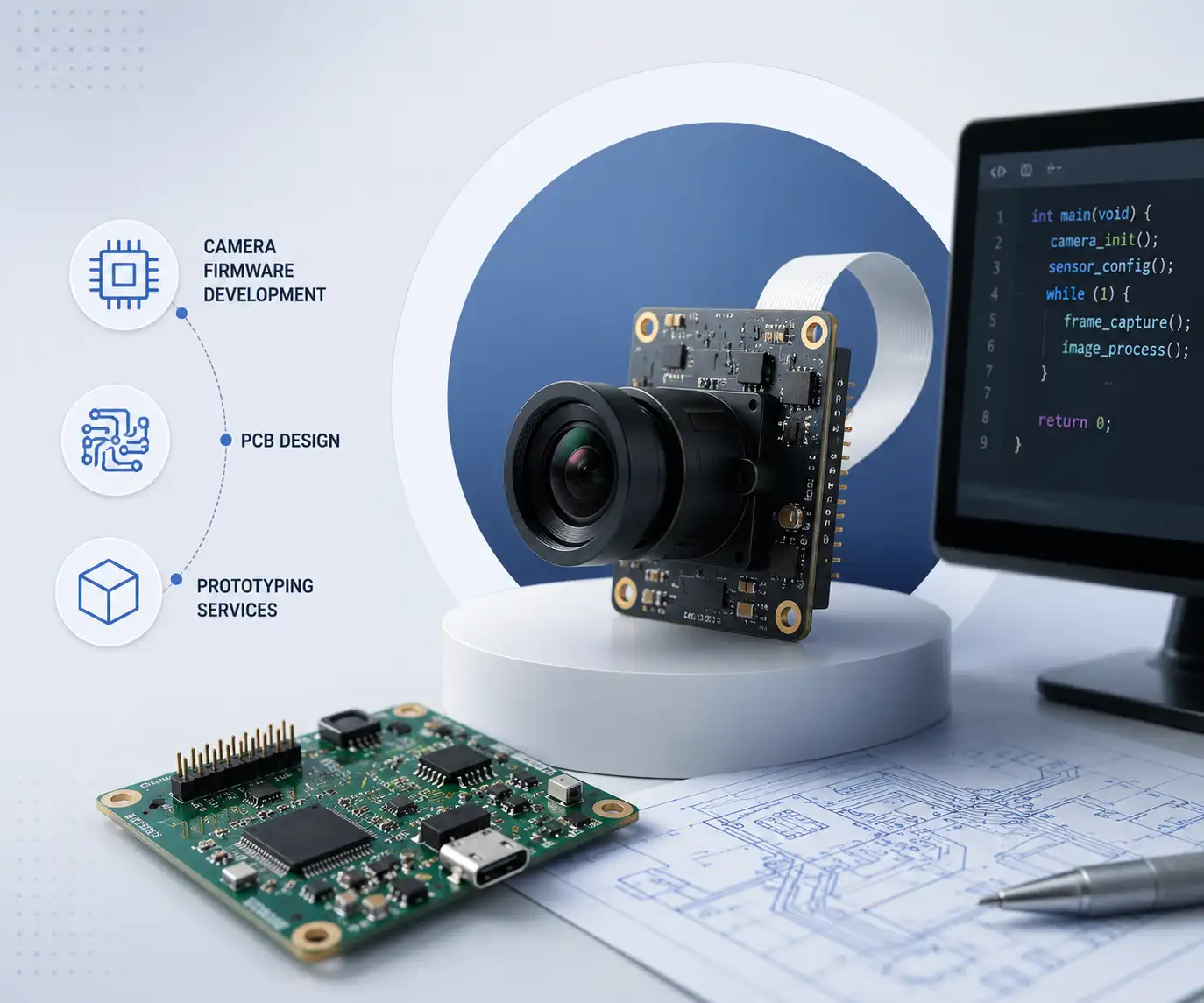
Camera Firmware Development, PCB Design & Prototyping Services
Adequate Infosoft helps businesses design and develop custom smart cameras, AI-powered imaging systems, and connected surveillance products.
We provide end-to-end engineering services, supporting clients from initial concept and prototyping through production and deployment.
We have a team of engineers that specialize in developing camera firmware, designing printed circuit boards (PCBs), developing hardware, integrating with cloud technologies, implementing Artificial Intelligence (AI) at the edge, and bringing your prototypes into a fully manufacturable/marketable product.
In addition to providing advanced consulting services, we provide full-service solutions for OEM and ODM camera manufacturers, offering assistance in hardware optimization, enclosure design, prototype development, testing support, certification assistance, and production engineering.
We also offer flexible hiring models for experienced firmware engineers, embedded developers, hardware designers, and PCB specialists for companies that want to manage their projects internally.
We work closely with your team as an extension of your organization, providing assistance with the rapid development of AI cameras, IoT cameras and the next generation of surveillance systems.
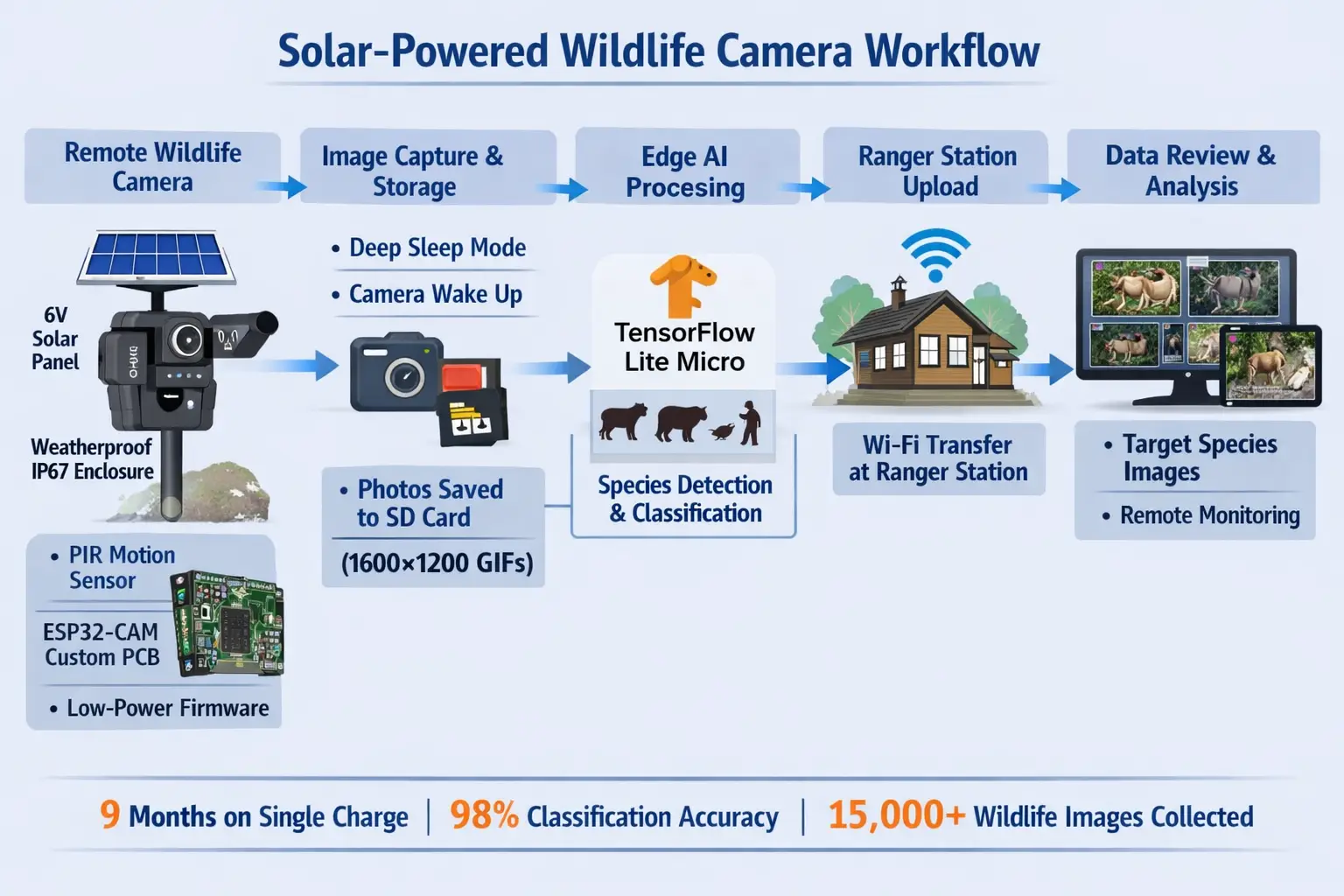
Case Study: Custom Solar-Powered Wildlife Camera
In this case study, we discuss how Adequate Infosoft built a custom solar-powered wildlife camera with low-power firmware, custom PCB design, night vision, remote monitoring and weather-proof enclosure for reliable outdoor wildlife tracking and surveillance.
Challenge: Use 50 remote cameras in a national park to monitor endangered species. No power from the grid, no cell coverage, bad weather.
Solution by Adequate Infosoft:
Adequate Infosoft's solution consists of the following components:
- Custom PCB with solar charge controller based on ESP32-CAM (6V solar panel → 3.7V Li-ion battery)
- Deep sleep mode (5µA): wake up by moving or via timer (6x/day) to capture GIFs (1600x1200) and save them onto SD Card. Pictures uploaded via Wi-Fi only at the ranger station
- 4-layer PCB (RF shield); conformal coating (moisture resistance); thermal management for hot desert days
- IP67 enclosure (weatherproof) with IR-cut filters that switch from day to night
- Edge AI: TensorFlow Lite Micro is used to classify species (deer, bear, coyote, human). Only pictures of target species will be uploaded.
Deliverables:
- Custom PCB Gerber + assembly files
- Production-ready firmware with OTA capability
- 10 working prototypes for field testing
- Manufacturing documentation for 500-unit run
Result: 9 months of cameras on a single battery charge. 98% classification accuracy, 15,000+ wildlife images collected. Client awarded grant for expanded deployment.
Our End-to-End IoT Camera Development Cycle
Custom IoT cameras are the core of modern connected solutions, from smart surveillance and industrial inspection to wildlife monitoring and agricultural automation.
Custom cameras rarely meet the need for specialized applications with unique requirements such as size, power, environment or specific sensor integration.
Concept & Requirements Definition
In order to start the design process, we work with you to create the following deliverables:
- What is the use case or environment? Indoor or outdoor? Water, extreme temperatures or very low light?
- What will your image requirement be? Resolution? (VGA to 4k). Frame Rate? (1fps to 60fps). Mono or colour or thermal?
- How will the device be powered? Battery for days, weeks or months or powered from mains?
- How will the device connect to the internet? Wi-Fi, BLE, Ethernet, 4g/5g or LORA?
- What are the processing requirements? Edge AI? Motion detection? Image compression?
- What form factor and size do you need? Plus, do you have any mounting constraints?
- Do you need the device to comply with regulations? FCC, CE, IP rating or medical (IEC60601) as appropriate?
Hardware Design & PCB Layout
Our hardware team designs custom PCBs tailored to your specific sensor, processor, and connectivity requirements.
PCB Design Capabilities:
- Layer count: 2 to 16+ layers (depending on complexity)
- Board types: Rigid, flexible (FPC), rigid-flex hybrids
- High-speed design: MIPI CSI-2, USB 3.0, Ethernet, DDR memory routing
- RF design: Antenna matching, impedance control (50Ω/100Ω), EMI shielding
- Power management: Low-noise power delivery, battery charging circuits, power sequencing
- Design tools: Altium Designer, KiCad, Cadence Allegro, Eagle
Camera-Specific Design Expertise:
- Integration of Image Sensors: Sony (IMX Series), OnSemi (AR Series), OmniVision (OV Series)
- Difficulties with Breakout of Fine pitch BGA's – Non-standard BGA footprints resulting in complicated routing
- MIPI CSI-2 Differential Pairs: Controlled impedance of 100 ohms, matching lengths and skew
- Decoupling Power Supplies: LDO's close to the sensor with solid ground planes
- Thermal Management: Thermal vias and copper pour contacts
- EMI/EMC Considerations: Shielding of high frequency clocks and RF sections
Direct Image Sensor Integration: For ultra-low Z-height applications, we support direct chip-on-board (COB) sensor mounting with cleanroom assembly through our manufacturing partners.
Firmware & Embedded Software Development
The "brains" of your IoT camera live in the firmware. Our embedded engineers write efficient, reliable, and feature-rich firmware for a wide range of processors.
Supported Processor Platforms:
- ESP32 / ESP32-S3 – Wi-Fi/BT connected cameras, streaming IP cameras
- ESP32-CAM modules – Low-cost, compact designs with integrated camera
- Raspberry Pi / Compute Module – High-performance, Linux-based camera systems
- STM32 series – Industrial, low-power, or RTOS-based cameras
- Nordic nRF52/nRF54 – BLE-connected, ultra-low-power cameras
- FPGA (Intel/Altera, Xilinx) – High-speed, multi-sensor, or custom ISP processing
- NVIDIA Jetson – Edge AI / deep learning camera applications
Firmware Development Includes:
- Connectivity protocols: Wi-Fi provisioning, BLE, MQTT, HTTP/HTTPS, WebSockets, RTSP streaming
- Power management: Multiple power modes, deep sleep, PIR wake, timer-based captures
- Over-the-air (OTA) update capabilities for remote firmware upgrades
- Edge AI/inference: TensorFlow Lite Micro for object recognition, motion classification, license plate detection
- Image storage: microSD card or cloud with FIFO queue buffering
Case Example: Low-Power Wildlife Camera Firmware – Deep sleep optimization with ESP32-CAM under 10uA between captures, wakes on PIR motion, captures image, sends over HTTP/ESP-NOW, returns to sleep in 2 seconds. Battery life: months on 2 x AA cells.
Prototyping & Bring-Up
The purpose of prototyping is to determine how well your theory works in practice. We are set up to allow for rapid testing and iteration.
- Developing a reference platform: Evaluation boards or development kits (ESP32-CAM, OV5640 development boards)
- Custom PCB fabrication: Small batch (5-50 pieces) for initial testing
- Hardware bring-up: Power-on tests, clock verification, peripheral sensor communication
- Firmware debugging: JTAG/SWD debugging, logic analyzers, serial console logging
- Thermal and power measurements: Real-world power and thermal data from your hardware
Production Layout & Manufacturing Handoff
We will have everything needed to begin volume production as soon as the prototype is confirmed to work. Tasks to prepare for mass production include:
- Design for Manufacture (DFM) Analysis: PCB meets assembly house requirements (traces, spacing, via-in-pad, solder mask)
- Design for Testing (DFT): Test points, Bed of Nails access, firmware for self-testing
- Bill of Materials (BOM) Optimization: Sourcing, lead time management, second source parts
- Gerber and Assembly Files: Complete Manufacturing package (Gerber, centroid, BOM, Pick and Place files)
- Finalization of Firmware: Binary for production with serial number provisioning and calibration data
- Quality assurance plan: ICT, Functional testing, and Burn-in
Common IoT Camera Architectures We Build
Wi-Fi IP Camera (Streaming)
Use Case: Baby monitor, pet camera, home security Architecture:
Architecture:
- Processor: ESP32 / ESP32-S2
- Sensor: OV2640, OV5640 or OV3660 (2MP ~ 5MP)
- Connectivity: 2.4GHz Wi-Fi (client or AP)
- Features: Web browser live streaming (HTTP), Motion detection, microSD recording, Night vision (IR LEDs)
- Power: 5V USB or 3.7V Li-ion battery
Reference Implementation
The classic ESP32-CAM IP camera project provides a web UI to view live video, configure the camera, and browse memory. With the correct firmware it can stream up to 1600x1200.
Ultra Low-Power Battery-Powered Camera (Triggered Capture)
Application area Wildlife camera, Trail camera, Remote Monitoring, Security Surveillance (property)
Architecture
- Processor - ESP32-CAM (AI-Thinker module)
- Camera sensor - OV2640 (or) OV3660
- Wake up sources: PIR motion sensor (GPIO13), timer, external trigger
- Communication: Wi-Fi (HTTP upload), ESP-NOW (local), or LTE-M (cellular)
- Power supply: 2x AA batteries (3.0V), Li-ion 18650
- Deep sleep current - <10uA
- Active current - ~180mA (Capture & Transmit)
- Estimated battery life: weeks or months (dependent on activity)
Significant Features
Automatic voltage monitor (GPIO14 and voltage divider), chunked ESP-NOW for large image transfer, optional AI usage (Ollama AI) for wildlife identification/notification.
Multipurpose / Industrial Grade Camera with Multiple Sensor (High-Performance camera)
Applications - Machine Vision, Quality Control, Autonomous Vehicles
Architecture:
- Processing - FPGA (Intel Agilex 5 and/or Xilinx Zynq) and ARM HPS
- Sensor - 4K Multi-Sensor (Sony IMX & OnSemi)
- Connection Options - MIPI CSI-2, GMSL, USB 3.0 and GigE Vision
- Capabilities - Real-Time ISP, AI Inference Capability (Object Detection, Object Segmentation) and Display Port Output
- Power Input - 12V - 24V industrial power supply
Reference Design
Intel's latest 4KP30 Multi-Sensor camera reference design uses an Agilex 5 FPGA with MIPI D-PHY input, ISP pipeline and AI processor - Running on LINUX OS via the HPS and a Web Based Control UI.
Underwater/Ruggedized Camera Application
Use Cases:
Marine Research / ROV Inspection, Water Tower Maintenance / ROV Applications / Solid-State Lighting
Architecture:
STM32 or i.MX RT processor (Low Latency), + Time-of-Flight (ToF) FPGA, all housed in a waterproof enclosure rated for depth to allow for the above use cases.
Connectivity:
Ethernet (via penetrator cables) or Optical Modem
Special Considerations for Underwater Ruggedized Cameras:
Thermal Management (using Aluminum Core PCBs), Use of Corrosion Resistant Connectors, and Lens Domes.
Reference Example:
Carnegie Mellon's Underwater ToF camera project utilizes custom two-layer FR4 PCB for LED drivers (for ToF Cameras) and uses Aluminum Core PCBs for thermal management. The underwater camera is housed in a waterproof enclosure with an acrylic lens dome.
Edge AI Camera (On-Device Intelligence)
Edge AI Cameras leverage onboard processing power to allow inference and decision-making at the time of capture and are mostly used in retail, traffic management, license plate recognition, and ensuring safety compliance.
An architecture would typically include:
- An NVIDIA Jetson Nano/Orin processor or a Raspberry Pi and Google Coral processor or an ESP32-S3 with TensorFlow Lite.
- AI models, such as YOLO (for detecting objects), FaceNet (for recognizing people), PaddleOCR (for reading text and license plates).
- Real-time inference and metadata streaming using MQTT, with others having low bandwidth operations.
- Utilizing powered devices from 5V to 12V, which is higher than the other architectures.
For example, a traffic camera that captures license plates, recognizes them locally, and sends only the license plate number and time to the cloud rather than sending all video, thereby saving 95% in bandwidth and 95% of the cost of that traffic camera in the cloud.
Hire Firmware & Hardware Developers for Camera Projects
Adequate Infosoft employs a team of full-time firmware engineers, hardware designers, PCB specialists, and IoT professionals dedicated to custom HD camera and video surveillance development.
Our certified Azure IoT and cloud experts have extensive industry experience building scalable connected camera solutions, edge AI devices, and embedded systems for commercial and industrial applications.
From concept validation and rapid prototyping to hardware design, firmware development, testing, manufacturing support, and deployment, we provide end-to-end product development services worldwide.
Our engineering team is supported by experienced industry leaders and technical consultants who have contributed to globally recognized camera, IoT, smart home, and embedded technology products.

R&D Engineer at Hitachi Energy Microsoft Certified Azure IoT Developer Certified nRF Connect SDK Fundamentals Credential ID 7019A867111D452-7019A866AEE559D-11EFA0106DC1BB_32 -
Certified nRF Cellular IoT Fundamentals ID 7019A867111D57F-7019A866B3B8A6E-11EFA0106DC1BB_32 IoT Solutions Architect & Developer Embedded Systems & Firmware Engineer Wireless Connectivity & Edge Device Specialist Industrial IoT and Smart Device Development

25+ Years in Hardware & Platform Engineering Smart Home & IoT Expert Edge AI & Connected Devices Specialist Engineering Leader at Arlo, Ring & Wyze Architect of Arlo Camera Platform Scaled Products to Millions of Users Consumer Electronics & IoT Innovator

IoT Product Development & Program Management AWS Certified Professional Microsoft Azure Certified Professional Wireless Communication Specialist Video Imaging & Surveillance Systems Expert System Controls & Embedded Solutions HVAC Industry Experience

Machine Learning Certified (Credential ID: 3631122) Python Certified Embedded Software Engineer IoT & Connected Devices Specialist Board Support Package (BSP) Development Camera Firmware Development Device Driver Development Image Signal Processing (ISP)

Senior Technical Leader – AI, IoT & Cameras AI Product Management Expert IoT Solutions & Strategy Camera Systems Specialist
Our Engagement Model
We offer flexible engagement options based on your needs:
| Model | Best For | What's Included |
|---|---|---|
| End-to-End Product Development | Full product from concept to production | Requirements → Architecture → PCB Design → Firmware → Prototyping → Manufacturing handoff |
| Firmware-only Development | You have hardware, need software | Driver development, connectivity, OTA, testing |
| PCB Design & Layout Service | You have schematic, need layout | Component placement, routing, DFM, Gerber generation |
| Hardware + Firmware Consulting | Your team needs expert guidance | Design reviews, optimization, troubleshooting |
| Prototype-to-Production | Working prototype needs manufacturing prep | DFM analysis, BOM optimization, test fixture design |
Frequently Asked Questions About Custom Camera Development Services
Off-the-shelf camera modules provide standard features, while custom cameras are designed with tailored hardware and firmware to meet specific requirements for performance, size, connectivity, AI processing, or environmental conditions.
A basic camera prototype typically takes 6–10 weeks, while a fully custom camera with dedicated PCB design usually requires 14–20 weeks. Certifications and production readiness may extend the timeline.
Camera firmware is commonly developed using C and C++. Python is often used for AI model development, testing, and image analysis automation.
Edge AI enables cameras to process and analyze images locally, allowing real-time object detection, lower latency, reduced bandwidth usage, and improved privacy.
Yes. Custom medical cameras can be developed to comply with FDA, MDR, ISO 13485, IEC 60601, and other medical device standards.
ONVIF compliance ensures that IP cameras can seamlessly integrate with a wide range of video management systems (VMS), NVRs, and security platforms.
Get In Touch
Adequate Infosoft has the expertise to deliver from low-power wildlife cameras to high-speed industrial inspection systems, edge AI security cameras or custom sensor boards with image capture.
Turn your IoT camera idea into a production-ready reality. Call Adequate Infosoft today for a free consultation and technical assessment.
Get Free Consultation