















 Mean Stack Development
 Vue JS Development
 Javascript Development
 React JS Development
 Angular JS Development
 Next JS development
 Java Development
 Python Development
 Django Development
 Cherrypy Development
 C# Development
 ASP.NET Development
 NodeJS Development
 Laravel Development
 CodeIgniter Development
 Zend Development
 Ruby on Rails Development
 CakePHP Development
 PHP Website Development
 Symfony Development
 Drupal Development
 Joomla Development
 Wordpress Development
 .NET Nuke Development
 Kentico
 Umbraco
 .NET MAUI Development
 Xamarin Application Development
 iOS Application Development
 Android Application Development
 Android Wear App Development
 Ionic Development
 iBeacon Application Development
 Universal Windows Platform (UWP)
 Kotlin Application Development
 Swift Application Development
 Flutter Application Development
 PWA Application Development
 Flutter Health Tech & Wearable App Development Company
 React Native Health Tech Wearable App Development
 Offshore Software Development
 Custom Application Development
 Front-End Development
 Full Stack Development
 AI & Machine Learning
 Custom CRM Solutions
 Flask Software Development
 Electron JS Development
 ChatGPT Development
 Telemedicine App Development
 Build Smart Telemedicine Platform
 Beauty & Salon App Solutions
 Hire Workato Experts
 Magento Development
 Magento 2.0 Development
 Magento Enterprise
 Shopping Cart Development
 Prestashop Development
 Shopify Development
 Open Cart Development
 WooCommerce Development
 BigCommerce Development
 NopCommerce Development
 Virto Commerce Development
 AspDotNetStorefront Development
 .NET Application Development
 Microsoft Dynamics CRM
 VB .NET Development
 Sharepoint Migration
 ASP.NET Core Development
 ASP.NET MVC Development
 AJAX Development
 Agile Development
 Microsoft Bot
 Microsoft Blazor
 Microsoft Azure Cognitive
 HTML 5
 UI/UX Design
 Graphic Design
 Adobe Photoshop
 XML Application Development
 Cloud Computing Solutions
 Azure Cloud App Development
 AWS Development
 Google Cloud Development
 Certified AWS IoT Services Developers
 DevOps Consulting & Development
 Kubernetes Consulting & Services
 SQL Programming Development
 MySQL Development
 MongoDB Development
 Big Data
 Robotic Process Automation
 Social Media Marketing
 Search Engine Optimization
 QA Testing
 Software Testing
 Software Security
 Maintenance And Support
 I.T. Consulting Services
 Business Intelligence
 YII Development
 Data Analysis
 Alexa Skills Development
 On Demand App for Mobile repairing services
 On Demand App for Car Service Booking
 On Demand App for Cleaning Services
 On Demand App for Pharmacy
 On Demand Dedicated Developers
 On Demand Lawyer App Development











 Nuki Smart Lock
 Salto Smart Lock
 TTlock Smart Lock
 NFC App Development
 Custom IOT Enabled Smart Lock
 Smart Locker Solutions
 Hospital Smart Lock Systems
 Hotel Smart Lock Systems
 Smart Home & Office Locks
 Smart Access for Schools & Colleges
 Unloc Smart Lock Integration
 Yale & August Smart Lock Integration
 Populife Smart Lock Integration
 Smart Lock Hardware Development
 Dairy IoT Solutions
 Agri IoT & AI Solutions
 Weather & Climate Solutions
 Water & Waste Management Solutions
 RaspBerry Pi
 Firmware Software Development
 ESP 32 Software Development
 Embedded Development
 Internet of Things
 Smart IoT Development
 IoT Sensor Integration & Development Solutions
 Smart IoT System Development for HVAC
 Tuya IoT App Development
 Particle IoT SDK
 IoT Development with AI
 Smart Pet GPS Tracker
 Dairy GPS Tracking Solutions
 GPS Fleet Management Software
 Car Rental & Subscription Solutions
 Car Buy & Sell Marketplace Development
 AI-Powered Car Wash App Development
 PCB Design & Fabrication
 IoT AC Automation
 AI–IoT Painting Solutions
 IoT Wearable Hardware & App Development
 HVAC Automation & AI Control Systems
 Smart Home IoT Engineering
 AI Embedded Systems
 AI Hardware Design Service
 Advanced IoT Hardware & Firmware Development
 Device Driver Development Services
 NXP i.MX RT Firmware & Hardware Services
 Microchip PIC & AVR Development
 Hire IoT Architects
 IoT Cloud & Infrastructure Solutions
 Infineon XMC / AURIX Development Services
 Matter & Thread IoT Services
 Native IoT Mobile App Development (BLE & Wi-Fi)
 Snapdragon IoT Firmware Development
 Renesas RA/RX Firmware Services
 Silicon Labs EFR32 Development Services
 Smart Wearable App Development
 Smart IoT Meters
 Smart Healthcare Wearable App Development
 Health Care Monitoring System
 Fitness Tracking App Development
 Smart Home Automation Apps
 nRF PCB Design
 ESP32 PCB Design
 Embedded Wearables Engineers
 Rental Property Management System
 Building Management System
 Smart Lighting Development
 Infineon Semiconductor Firmware Development Services
 Custom Camera Development: Hardware, Firmware & PCB Prototyping
 Smart Security Camera SDK
 Nordic Semiconductor SDK
 Infineon SDK
 Arduino SDK
 NFC Lock Integration
 Kerong Lock Integration
 IoT & AI Solutions for Manufacturing
 Smart Inventory & Logistics Solution
 Food & Beverage Industry Solutions
 Smart Hospitality Solutions
 Smart Property Management
 Custom Smart Home IOT SDK
 Smart IoT & AI in Healthcare
 AI-Powered Security Solutions
 Smart Home Safety & AI
 Veterinary Clinic Management (AI)
 Pet Care System (AI & IoT)
 Pet Training & Adoption (AI)
 Healthcare IoT Development
 Event Management Software
 Money Remittance App
 Money Lending App Development
 Utility and Bill Payment App
 IoT Mobile App Development (Flutter & React Native)
 AI & IoT Retail Solutions
 Smart EV App Development
 Smart Solar IoT & AI Solutions
 IoT-Based Energy Systems
 Smart Energy & Utilities Solutions
 6G Solutions
 IoT Security Solutions
 AI-Powered Lottery App Development
 AI-Sports Fitness Club Management
 Travel
 Real Estate
 Medical & Healthcare
 e-Learning
 Consumer Products
 Finance
 Automobile
 Media & Entertainment
 Billing Software
 Enterprise Resource Planning (ERP)
 Augumented & Virtual Reality
 Point of Sale(POS) Development
 Learning Management System
 EV Charging Solutions
 About Us
 Partners & Certifications
 Quality Assurance
 Our Clients & Testimonials
 Development Process
 Our Products
 Social Responsibility
 Work Ethics
 Vision & Mission
 Awards
 Live Project Demos
 Contact Us
 Case Studies
 Portfolio
 Blog
Blog
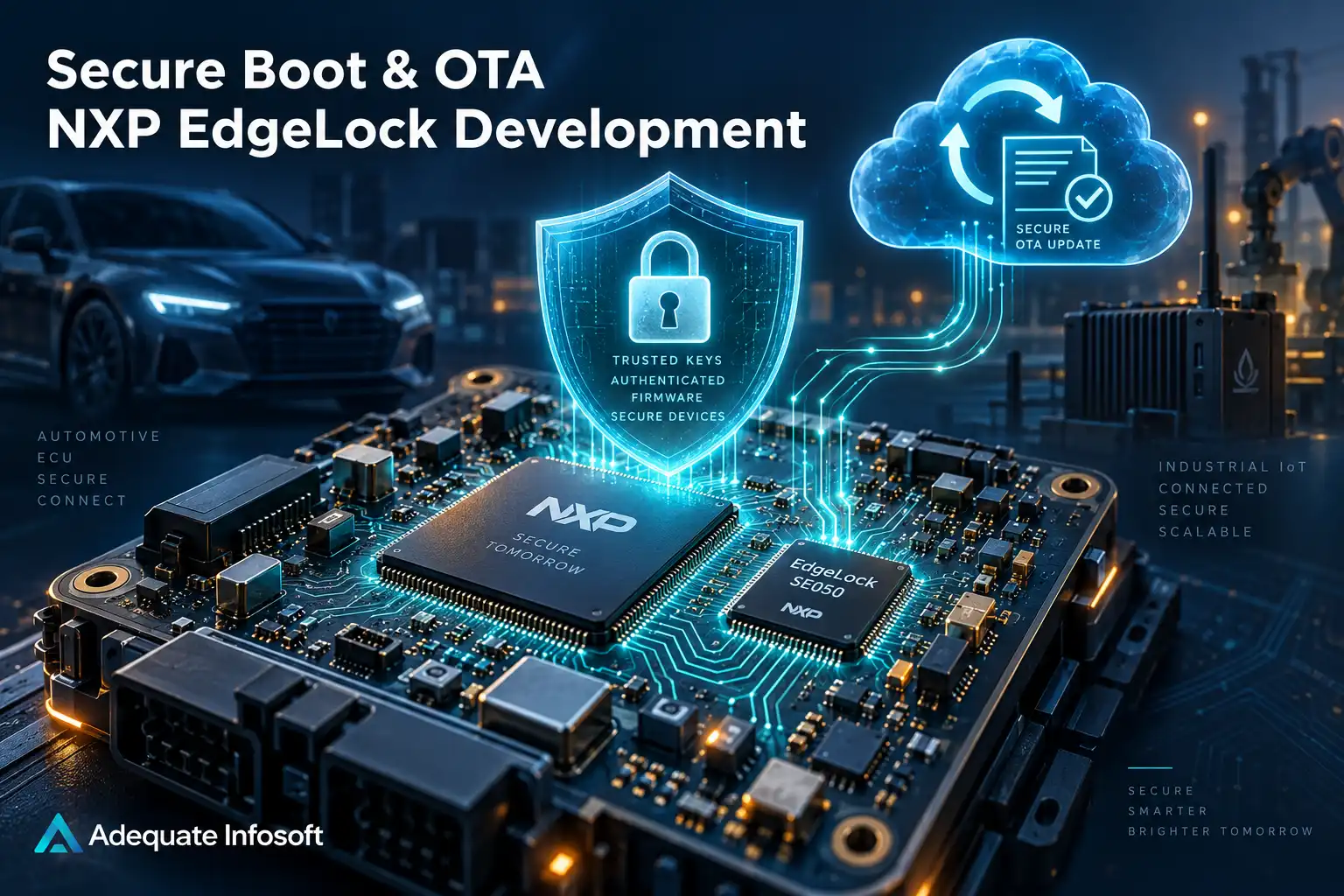
Secure Boot, OTA and NXP EdgeLock Development Services
Connected products need clear answers: Is the firmware authentic? Is an update authorized? What happens if power fails during installation?
Adequate Infosoft develops secure boot, OTA and NXP EdgeLock solutions for automotive controllers, industrial IoT equipment and connected devices.
We support S32K3, i.MX RT and other suitable platforms, EdgeLock SE050, device provisioning and cloud update services.
The aim is to have a system that is recoverable, auditable and manageable throughout the lifecycle of the product in operation.
Signed images cannot solve the problems related to the exposed keys, unrestricted access to the debug process, dangerous downgrading and wrong back-end authorization.
The Device Trust Chain We Build
A reliable security architecture links manufacturing, boot, communication, updates and retirement. Each stage depends on the previous one.
| Lifecycle stage | Security objective | Typical control |
|---|---|---|
| Manufacturing | Give each legitimate device a protected identity | Controlled provisioning and unique credentials |
| Boot | Run only an approved software chain | Immutable trust anchor and signature verification |
| Operation | Authenticate the device and protect traffic | Device certificates, keys and TLS |
| Update | Accept authorized, compatible firmware | Signed manifests, image verification and version policy |
| Recovery | Remain usable after an interrupted or faulty update | A/B images, recovery loader or fail-safe partition |
| Retirement | Prevent abandoned credentials from remaining trusted | Revocation, decommissioning and data handling |
Implementation depends on MCU capabilities, flash, safety requirements, connectivity and cost. We do not force one bootloader onto every device.
Relevant NXP Project Experience
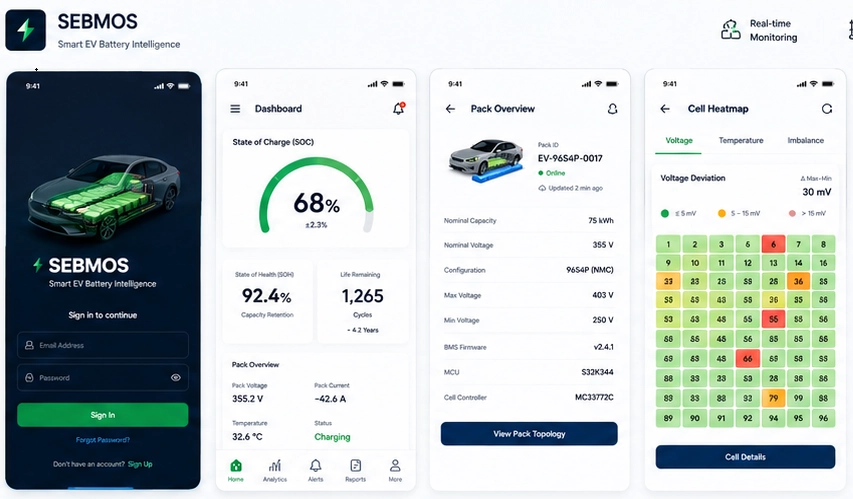
EV Battery Management System with S32K344 and SE050
The connected EV battery-management approach was based on NXP S32K344 as system controller and MC33772C for cell monitoring.
It featured EdgeLock SE050 for safeguarding calibration data and state-of-health model data and ensured CAN communication, cell and temperature measurement, battery cells balance control and contactor management.
The case connects calibration integrity, automotive communication, high-voltage hardware, firmware state and remote monitoring.
Read the NXP EV battery-management case study
Secure Boot Development for NXP Platforms
Secure boot ensures that the software is validated before executing it. It involves a hardware-based trust anchor which validates the next software stage or application being run. In the event of a failed validation, it initiates a predetermined recovery action instead of executing an unauthorized code.
Our scope may cover things such as signatures, public key, flash layout, boot-state records, anti-rollback, debug parameters, and recovery. We track which stage of the process verifies which component throughout the ROM, bootloader, application, and secondary firmware used in the process.
NXP mechanisms differ. S32K3 provides a Hardware Security Engine supporting secure boot, protected keys and cryptographic services. Supported i.MX RT devices use another boot architecture and MCUXpresso provisioning tools. We verify the part, revision and boot source before defining production.
OTA Firmware Update Architecture
OTA needs trusted release, device targeting, safe transfer, local verification, controlled installation and confirmation of the outcome.
We can develop:
-
Signed firmware images and update manifests -
Device, model and hardware-revision targeting -
Full-image or suitable differential update strategies -
Encrypted transport with authenticated endpoints -
Local download buffering and integrity checks -
A/B partitions or dedicated recovery firmware -
Installation progress and boot confirmation -
Version, dependency and downgrade policies -
Phased rollout, pause and cancellation controls -
Fleet reporting and failed-update diagnostics
Devices should verify authenticity before activation even with TLS. Transport secures the session; signing proves who authorized stored or relayed firmware.
Designing for Power Failure and Update Failure
It is possible that power could go off during downloading, flashing, programming or initial start-up time period. Network could send partial or repeated messages, while the signed download could contain defects.
States of updates must either resume or fail safely. Design may keep known good image, have secured recovery firmware or require confirmation of health status. We test watch dogs, boot count and rollback in forced interruption.
In order to prevent downgrading, it might create obstacles in recovery; unrestricted downgrading might help in launching vulnerabilities afresh. The proper version policy with specified authorized recovery path is defined.
NXP EdgeLock SE050 Integration
EdgeLock SE050 is a discrete secure element providing an IC-level trust anchor, protected credential storage and cryptographic operations. It can separate application firmware from long-lived secrets and support cloud onboarding or device authentication.
The integration process may encompass various aspects including hardware, middleware, key arrangement, certificates, TLS authentication, and signing and verification. Other considerations may include hosting authentication, recovery from errors, and behavior in the absence of a secure element.
The certification of SE050 applies to the module and determined scope of assessment. To add SE050 does not mean that the product is certified, unsafe application code is fixed, and provisioning is controlled automatically.
S32K3 HSE and EdgeLock SE050: Different Roles
The S32K3 HSE is integrated into supported MCUs; SE050 is an external secure element. A design may use either or both for distinct responsibilities.
| Building block | Position | Suitable responsibilities |
|---|---|---|
| S32K3 HSE | Inside the automotive MCU | Secure boot, MCU key services and cryptographic operations |
| EdgeLock SE050 | Separate secure-element IC | Device identity, certificates, protected secrets and cloud authentication |
Choice depends on threats, interfaces, manufacturing and cost. We document each component’s role and avoid duplicating ungoverned secrets.
The Importance of Key Management and Security Provisioning
Even the best hardware will not be effective if signing keys are left on common computers or single credentials are used incorrectly.
We would like to provide you with the definitions of key-related actions such as ownership, generation, storage, approval, rotation, revocation and recovery .
An organization can designate key ownership through manufacturing without sharing the private data. The EdgeLock 2GO, private customer PKI or centralized key management may be useful.
Provisioning information is linking identity and hardware versions without giving secret information away. Test credentials are stored separately from the rest, and if some hardware device is lost, the key has to be revoked.
OTA Backend Security and Fleet Management
At Backend, we are the team behind building device registries, firmware repositories, campaigns, rollout rules, audit logs, and dashboards. To set up a release, creation and approval can use two separate permissions.
The rollout can start with a canary group and go step by step. Operators need the states of downloaded, installed, confirmed, reverted, and unreachable; having the state of “sent” is not an indicator of successful installation.
Security Verification
Tests include altered images, wrong signatures, unauthorized credentials, incompatible targets and replayed manifests , blocked networks, full storage and power loss. We inspect recovery and logging, not only cryptography.
Code review, static analysis and dependency tracking support implementation. Independent laboratories can perform product-specific penetration testing or certification.
How We Approach a Security Project
We identify assets, dangers, boot sequence, trust limits, OS and log in user. A demo proves untenable conduct before final commitment.
Realization consists of boot, program, server, provisioning and error detection. Transfer may form source, important roles, signature method, instructions on resetting and proof of data with no exposure of production keys.
Frequently Asked Questions
Most of the time, yes, however, certain limitations in terms of hardware interface, required space on the circuit board, middleware, and the provisioning process should exist. The first step is to understand which operations or secrets should be moved to the secure element itself.
Possibly. Feasibility depends on the existing bootloader, flash layout, boot controls, connectivity and available recovery path. Some limitations cannot be corrected without physical service or a hardware revision.
No. TLS protects transfer between authenticated endpoints. Devices should also verify that the stored image is authorized, compatible and permitted by version policy before activation.
Not truly. Secure boot protects an important execution boundary. Nevertheless, application vulnerabilities, key exposure, physical interfaces, backend user authorization procedures, and human mistakes still require protection measures.
Discuss Your NXP Security Requirements
If you need secure boot, a recoverable OTA system, S32K3 HSE integration or EdgeLock SE050 provisioning, share your MCU, hardware state, connectivity and manufacturing model with Adequate Infosoft.
We can define the trust architecture and identify the highest-risk assumptions before implementation.
Further Reading