




 Mean Stack Development
 Vue JS Development
 Javascript Development
 React JS Development
 Angular JS Development
 Next JS development
 Java Development
 Python Development
 Django Development
 Cherrypy Development
 C# Development
 ASP.NET Development
 NodeJS Development
 Laravel Development
 CodeIgniter Development
 Zend Development
 Ruby on Rails Development
 CakePHP Development
 PHP Website Development
 Symfony Development
 Drupal Development
 Joomla Development
 Wordpress Development
 .NET Nuke Development
 Kentico
 Umbraco
 .NET MAUI Development
 Xamarin Application Development
 iOS Application Development
 Android Application Development
 Android Wear App Development
 Ionic Development
 iBeacon Application Development
 Universal Windows Platform (UWP)
 Kotlin Application Development
 Swift Application Development
 Flutter Application Development
 PWA Application Development
 Flutter Health Tech & Wearable App Development Company
 React Native Health Tech Wearable App Development
 Offshore Software Development
 Custom Application Development
 Front-End Development
 Full Stack Development
 AI & Machine Learning
 Custom CRM Solutions
 Flask Software Development
 Electron JS Development
 ChatGPT Development
 Telemedicine App Development
 Build Smart Telemedicine Platform
 Beauty & Salon App Solutions
 Hire Workato Experts
 Magento Development
 Magento 2.0 Development
 Magento Enterprise
 Shopping Cart Development
 Prestashop Development
 Shopify Development
 Open Cart Development
 WooCommerce Development
 BigCommerce Development
 NopCommerce Development
 Virto Commerce Development
 AspDotNetStorefront Development
 .NET Application Development
 Microsoft Dynamics CRM
 VB .NET Development
 Sharepoint Migration
 ASP.NET Core Development
 ASP.NET MVC Development
 AJAX Development
 Agile Development
 Microsoft Bot
 Microsoft Blazor
 Microsoft Azure Cognitive
 HTML 5
 UI/UX Design
 Graphic Design
 Adobe Photoshop
 XML Application Development
 Cloud Computing Solutions
 Azure Cloud App Development
 AWS Development
 Google Cloud Development
 Certified AWS IoT Services Developers
 DevOps Consulting & Development
 Kubernetes Consulting & Services
 SQL Programming Development
 MySQL Development
 MongoDB Development
 Big Data
 Robotic Process Automation
 Social Media Marketing
 Search Engine Optimization
 QA Testing
 Software Testing
 Software Security
 Maintenance And Support
 I.T. Consulting Services
 Business Intelligence
 YII Development
 Data Analysis
 Alexa Skills Development
 On Demand App for Mobile repairing services
 On Demand App for Car Service Booking
 On Demand App for Cleaning Services
 On Demand App for Pharmacy
 On Demand Dedicated Developers
 On Demand Lawyer App Development





 Nuki Smart Lock
 Salto Smart Lock
 TTlock Smart Lock
 NFC App Development
 Custom IOT Enabled Smart Lock
 Smart Locker Solutions
 Hospital Smart Lock Systems
 Hotel Smart Lock Systems
 Smart Home & Office Locks
 Smart Access for Schools & Colleges
 Unloc Smart Lock Integration
 Yale & August Smart Lock Integration
 Populife Smart Lock Integration
 Smart Lock Hardware Development
 Dairy IoT Solutions
 Agri IoT & AI Solutions
 Weather & Climate Solutions
 Water & Waste Management Solutions
 RaspBerry Pi
 Firmware Software Development
 ESP 32 Software Development
 Embedded Development
 Internet of Things
 Smart IoT Development
 IoT Sensor Integration & Development Solutions
 Smart IoT System Development for HVAC
 Tuya IoT App Development
 Particle IoT SDK
 IoT Development with AI
 Smart Pet GPS Tracker
 Dairy GPS Tracking Solutions
 GPS Fleet Management Software
 Car Rental & Subscription Solutions
 Car Buy & Sell Marketplace Development
 AI-Powered Car Wash App Development
 PCB Design & Fabrication
 IoT AC Automation
 AI–IoT Painting Solutions
 IoT Wearable Hardware & App Development
 HVAC Automation & AI Control Systems
 Smart Home IoT Engineering
 AI Embedded Systems
 AI Hardware Design Service
 Advanced IoT Hardware & Firmware Development
 Device Driver Development Services
 NXP i.MX RT Firmware & Hardware Services
 Microchip PIC & AVR Development
 Hire IoT Architects
 IoT Cloud & Infrastructure Solutions
 Infineon XMC / AURIX Development Services
 Matter & Thread IoT Services
 Native IoT Mobile App Development (BLE & Wi-Fi)
 Snapdragon IoT Firmware Development
 Renesas RA/RX Firmware Services
 Silicon Labs EFR32 Development Services
 Smart Wearable App Development
 Smart IoT Meters
 Smart Healthcare Wearable App Development
 Health Care Monitoring System
 Fitness Tracking App Development
 Smart Home Automation Apps
 nRF PCB Design
 ESP32 PCB Design
 Embedded Wearables Engineers
 Rental Property Management System
 Building Management System
 Smart Lighting Development
 Infineon Semiconductor Firmware Development Services
 Custom Camera Development: Hardware, Firmware & PCB Prototyping
 Smart Security Camera SDK
 Nordic Semiconductor SDK
 Infineon SDK
 Arduino SDK
 NFC Lock Integration
 Kerong Lock Integration
 IoT & AI Solutions for Manufacturing
 Smart Inventory & Logistics Solution
 Food & Beverage Industry Solutions
 Smart Hospitality Solutions
 Smart Property Management
 Custom Smart Home IOT SDK
 Smart IoT & AI in Healthcare
 AI-Powered Security Solutions
 Smart Home Safety & AI
 Veterinary Clinic Management (AI)
 Pet Care System (AI & IoT)
 Pet Training & Adoption (AI)
 Healthcare IoT Development
 Event Management Software
 Money Remittance App
 Money Lending App Development
 Utility and Bill Payment App
 IoT Mobile App Development (Flutter & React Native)
 AI & IoT Retail Solutions
 Smart EV App Development
 Smart Solar IoT & AI Solutions
 IoT-Based Energy Systems
 Smart Energy & Utilities Solutions
 6G Solutions
 IoT Security Solutions
 AI-Powered Lottery App Development
 AI-Sports Fitness Club Management
 Travel
 Real Estate
 Medical & Healthcare
 e-Learning
 Consumer Products
 Finance
 Automobile
 Media & Entertainment
 Billing Software
 Enterprise Resource Planning (ERP)
 Augumented & Virtual Reality
 Point of Sale(POS) Development
 Learning Management System
 EV Charging Solutions
 About Us
 Partners & Certifications
 Quality Assurance
 Our Clients & Testimonials
 Development Process
 Our Products
 Social Responsibility
 Work Ethics
 Vision & Mission
 Awards
 Live Project Demos
 Contact Us
 Case Studies
 Portfolio
 Blog
Blog
Solar Monitoring App Development Company | IoT, AI & Energy Analytics
The solar installation should not be a mystery to the owners, installation team, and the operating team. They should have complete knowledge about energy generation, performance of the installation, and potential faults in the installation that may need immediate attention. Additionally, they should know how much energy is produced by solar panels.
Adequate Infosoft develops custom solar monitoring platforms that connect field devices, inverters, meters, batteries, mobile apps, and cloud dashboards. We build systems for residential solar providers, commercial and industrial sites, energy-management companies, installers, and renewable-energy startups.
Our solutions are designed around practical operations: giving an end user an easy view of production and savings, while giving installers and support teams the deeper data they need to identify issues before they become long periods of lost generation.
Let's Work Together!
Smart Solar Monitoring: Why Is It Important?
We've often observed that in many solar plants, whether small or large, issues are detected only after power generation has already declined.
Dust on a panel, an inverter malfunction, or a small component failure can gradually lead to significant financial losses over time.
What if your solar plant could tell you when and where it needs help? That's exactly what our IoT-based monitoring system does.
It gathers real-time data from your entire plant, covering panel performance, inverter status, temperature, and weather conditions.
We process it on a cloud-based platform, and with the help of AI, we instantly identify anomalies that humans would spend hours searching for and allow you to send the maintenance team directly to the point where it is needed, thereby reducing your operational expenses (OpEx) and maximizing power production.
Our Live Project: "The SunSystem", Powering Excellence for Over 10 Years
We've done several solar monitoring projects, but one particularly special one is SunSystem. This solution was developed for a Danish client, where all their solar installations are connected to a central IoT platform.
SunSystem's mobile app is available on both iOS (App Store link) and Android (Play Store link). The app allows users to view live data for each panel.
Real-time energy production and usage monitoring Sunlight intensity and weather impact tracking Solar panel efficiency and performance analysis CO₂ reduction and environmental impact report Fault detection with instant alerts and notifications Energy consumption and savings summary AI-based predictive maintenance insights Mobile app dashboard for Android and iOS Secure cloud data storage and analytics Multi-site and panel-level monitoring system
We've integrated AI algorithms into these systems that enable data self-analysis. For example, if a panel's output suddenly drops, the system automatically suggests the possible cause, such as dust accumulation, connection issues, or weather-related impacts.
Read full case study
Relevant Solar, Energy, and IoT Case Studies
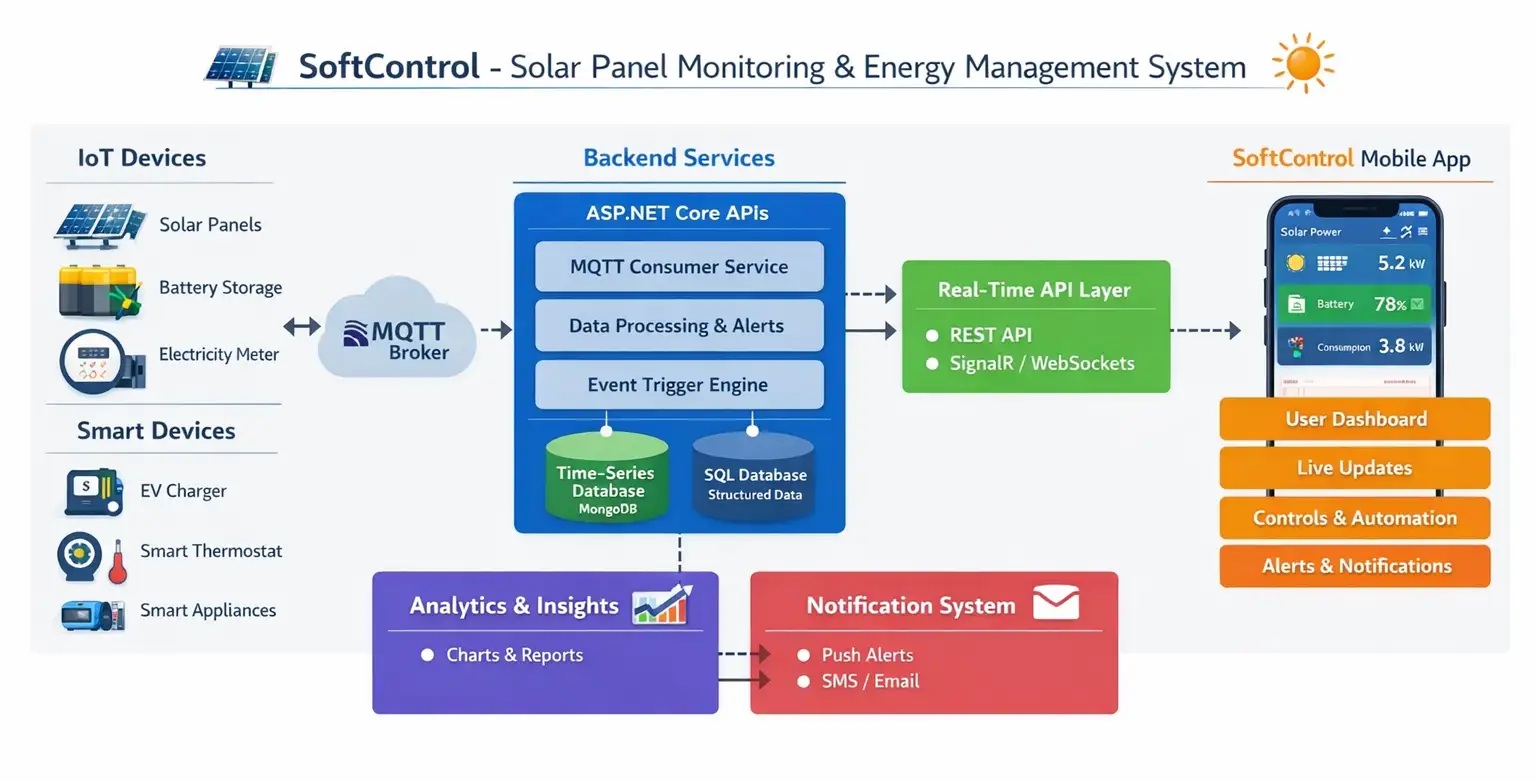
SoftControl Solar Panel Monitoring and Energy Management App
SoftControl is a solar monitoring platform that is enabled by Internet of Things (IoT) technology. It offers users live updates about solar generation, battery performance, electricity consumption, and system status. The solution comprises of mobile applications, connectivity services, data analytics, and operational alerts that can be useful for solar users.
Read Case Study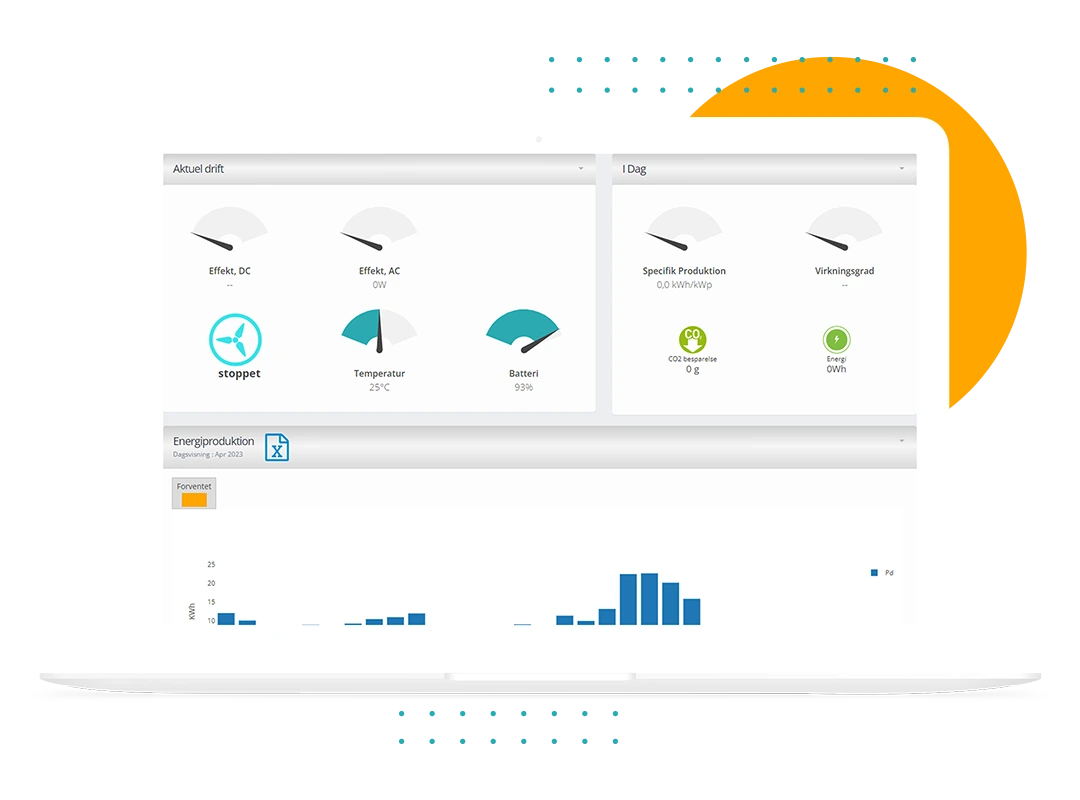
Solar Energy Monitoring and Control Platform
We created a solar energy monitoring and control software platform which was built using cloud technology, Flutter mobile apps, C# backend services, IoT connectivity, and real-time dashboards. This case study illustrates our expertise in creating successful solar software.
Read Case Study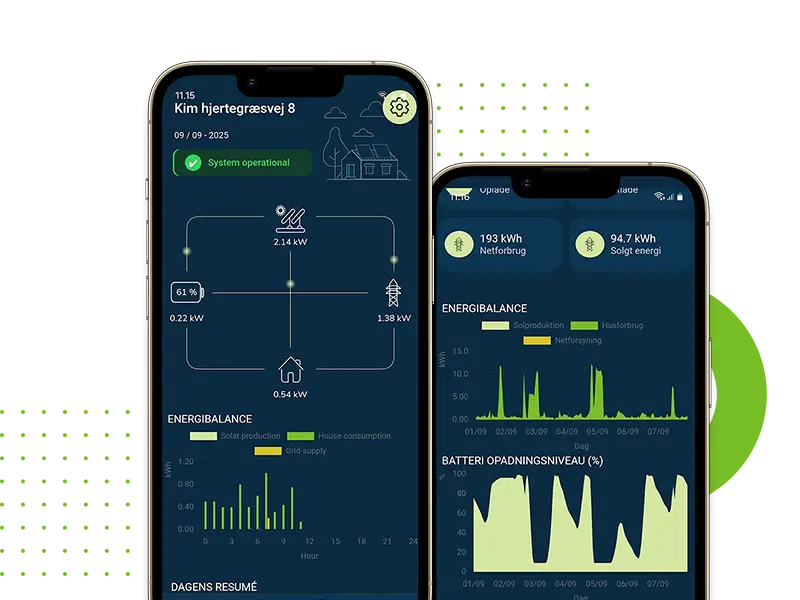
Solar and Home Battery Monitoring Platform
The solution exemplifies how solar energy generation, energy consumption, information about batteries, and user mobile applications can be combined into a cohesive experience of managing energy consumption in households and small businesses.
Read Case Study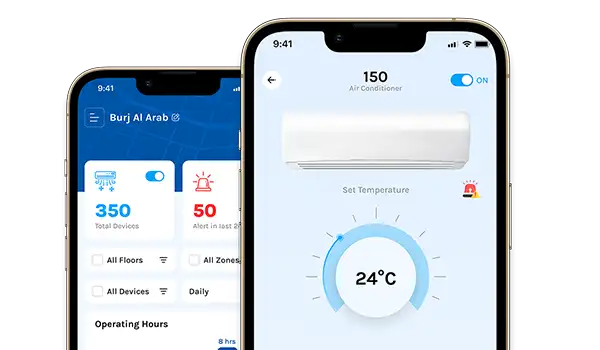
Smart AC Control and Building Energy Management System
Connected controllers, mobile and web applications, cloud infrastructure, remote control, analytics, and energy optimization are all included in our smart-building energy initiative. It is beneficial in commercial solar applications, which need the ability to balance power production and power consumption in buildings.
Read Case StudyOur IoT and AI-Powered Smart Solar Panel Monitoring Development Services
Our services are a complete package. We are a full stack development company with an in-house hardware and software team, so we provide a full solution starting with the hardware and ending with the mobile app at the user's fingertips. We understand that every solar project is unique, that's why our services are flexible enough to meet your specific requirements.
Real-time monitoring of solar energy generation and inverters
We design monitoring systems that provide data about solar propensity systems in an easy to read form. We develop dashboards that fit the purpose for every user.
We design monitoring systems that provide data about solar propensity systems in an easy to read form. The monitoring platform can provide information on:
Solar energy generation Energy production for each day/month/year/lifetime Voltages, currents, watts, and energy numbers of AC and DC Status of the inverter, alarms, and communication state Performance of the string, module, or site if available Charge of batteries and charge/discharge Grid pulling and grid feeding Temperature, irradiance, and environment sensing information Connectivity, status of the gateway, and last communication
We develop dashboards that fit the purpose for every user. For home users, this is just a reading of today's production, battery charge, and savings. For an installer/commercial company, the need could be for site comparison, inverter diagnostics, open alarms, configurable reports, and analytic reports.
Solar IoT hardware, firmware, and connectivity
A dependable monitoring system begins with dependable data collection. Our team can develop or integrate IoT gateway devices, sensors, embedded firmware, cloud communication, and remote-management workflows.
A dependable monitoring system begins with dependable data collection. Our team can develop or integrate IoT gateway devices, sensors, embedded firmware, cloud communication, and remote-management workflows.
We work with connectivity options such as Wi-Fi, Ethernet, GSM/4G, BLE, Zigbee, MQTT, Modbus, and REST APIs, selecting the right approach for the equipment, site conditions, and deployment scale.
Our services include:
IoT gateway and data-logger development Embedded firmware for custom monitoring devices Inverter, smart-meter, battery, and sensor integration Modbus, MQTT, API, and cloud connectivity Secure device provisioning and identity management Remote configuration and OTA firmware-update workflows Offline data buffering and synchronisation after connectivity returns Device health checks and support alerts
This approach is useful when a business needs to monitor multiple inverter brands or wants to create a white-label solar product rather than depend entirely on a single manufacturer's portal.
Insights on Performance and Fault Detection Utilizing AI
The use of artificial intelligence in solar monitoring systems is beneficial as it allows individuals to recognize significant issues sooner than anticipated. Rather than simply displaying massive amounts of raw data, we can create analytic systems that show users what changes to pay attention to.
The use of artificial intelligence in solar monitoring systems is beneficial as it allows individuals to recognize significant issues sooner than anticipated. Rather than simply displaying massive amounts of raw data, we can create analytic systems that show users what changes to pay attention to.
For instance, the system can compare present performance to historical patterns, predicted performance, weather conditions, and similar installations. Following that, it can identify the problems such as inverter failure, inadequate output, unforeseen battery behavior, and so on.
Some capabilities of the AI and analytics systems can comprise:
Comparison of expected and realized generation Detection of anomalies Notifications concerning inverter problems, battery issues Performance degradation analysis Predictions concerning generation and consumption Recommendations concerning energy use Prioritizing repair activities when operating multiple solar stations Reports for top management concerning energy use, savings, emissions, and uptime.
We use transparent dashboards and flexible thresholds allowing users to understand the reason for alerts.
Mobile apps and solar operations dashboards
We develop branded mobile applications for iOS and Android, alongside web dashboards for administrators, installers, and business teams. The application can provide live energy views, notifications, historical charts, system reports, customer accounts, site management, and support workflows.
We develop branded mobile applications for iOS and Android, alongside web dashboards for administrators, installers, and business teams. The application can provide live energy views, notifications, historical charts, system reports, customer accounts, site management, and support workflows.
For enterprise deployments, we can create multi-tenant platforms that let an installer, energy company, or franchise manage many customers and sites while each customer sees only their own authorised data.
We can also connect solar monitoring with smart-home controls, building-management systems, EV charging, battery storage, and energy-management platforms. This gives users a broader picture of how energy is produced, stored, consumed, and exported.
Safety, dependability, and assistance with implementing technology
Solar monitor systems are designed to endure challenging environments and unreliable networks for many years. We invest effort into secure data management, encryption, user authentication, communication encryption, activity logs and monitoring, setting backup and reliable alarm notifications.
Solar monitor systems are designed to endure challenging environments and unreliable networks for many years. We invest effort into secure data management, encryption, user authentication, communication encryption, activity logs and monitoring, setting backup and reliable alarm notifications.
Before their launch, various technical issues are analyzed as part of the testing process, including inverter communication loss, gateway reboot, meter read delay, duplication of telemetry readings, loss of sensor readings, loss of power of battery, or loss of network connection.
Smart Solar Panel Monitoring Features
Real-Time Energy Monitoring
Data from each solar panel can be viewed live.
Current power output (watts, kWh) Daily, weekly, and monthly reports Graphical views – bar, line, and comparison charts
Sunlight Intensity Tracking
Solar irradiance sensors built into the system measure sunlight intensity, indicating when the panel is performing best.
Efficiency Calculation
AI algorithms compare the panel's total capacity versus its current output and indicate the panel's efficiency.
Energy Consumption & Saving Reports
How much energy did the home or building consume? How much power was drawn from the grid, and what are the overall savings?
CO₂ Reduction Calculation
The system calculates how much CO₂ emissions your solar setup has reduced so far, and how much "green energy" it is contributing.
AI-Based Fault Detection
AI algorithms continuously analyze data patterns and send immediate alerts when a panel exhibits abnormal behavior.
Smart Alerts & Notifications
Users receive notifications via the mobile app and email in all these situations.
Panel Fault Inverter Failure Temperature Limit Exceeded Voltage Fluctuation Internet Disconnection
Predictive Maintenance
An AI model predicts when a panel may fail or experience declining performance so that timely service can be performed.
Weather Integration
The system integrates local weather data, i.e., cloud cover, temperature, wind speed, etc., and provides insight into how weather impacts production.
Historical Data Analytics
Data from past months and years can help you understand production patterns, for example, which months perform best.
Multi-Site Dashboard
If you have solar setups across multiple sites, you can view the status of all locations from a single dashboard.
Role-Based User Access
Separate rights for admins, technicians, and end users Secure login and audit logs
Mobile & Web App Support
Android/iOS mobile app Responsive web dashboard Live graphs and animated visuals
Grid Interaction Monitoring
For grid-connected systems, it monitors the power sent to and drawn from the grid in real time.
Smart Recommendations
Cleaning the dust now will increase output by 5%. Panel 3's performance is 8% lower than the rest, it needs to be checked.
Remote Configuration & Firmware Updates
IoT devices can be configured remotely, and firmware updates can be performed via the cloud.
Cloud Data Storage & Backup
All data is securely stored in the cloud, and the auto-backup feature prevents data loss during system downtime.
Panel-Level Monitoring
Not only is the entire system monitored, but the performance of each panel can be monitored individually, making it easier to understand which panel is weak.
Offline Data Sync
In the absence of network connectivity, the device stores data locally and uploads it to the cloud when it regains internet.
API Integration & Third-Party Connectivity
The system can connect to other platforms (ERP, billing, SCADA, etc.), making energy management and reporting easier.
KPI & Dashboard Customization
Users can set their own KPIs, such as Output Efficiency, ROI, and Fault Ratio, and the dashboard will display them accordingly.
Maintenance Logs & Service Scheduling
The date, technician name, and report of each maintenance procedure are tracked. The system automatically sends reminders for the next service date.
Report Exporting
All data can be exported in Excel, PDF, or CSV formats, which are useful for audits or government submissions.
ROI & Cost Analysis
The system tells you how much you've saved so far, and how long it will take for your solar project to reach break-even.
Machine Learning-Based Forecasting
AI models predict potential energy production over the next week or month.
Battery Performance Monitoring (if hybrid system)
The system displays the battery's charging, discharging, and health status, and alerts when battery capacity starts to decline.
Remote Diagnostics
Technicians can diagnose system health without even visiting the site. All installations are shown on a map, where details can be viewed by clicking on any site's location.
Multi-Language & Unit Support
Systems for different countries and languages Allows you to change the unit of measurement like kWh, MWh, €, ₹, $, etc. and language.
Smart Analytics Dashboard
AI-generated trends, causes of energy loss, and suggestions for improvement all on one screen.
Technology Stack
We offer hardware integration with trusted IoT SDKs like Nordic, ESP32, and Tuya.
Our team has designed custom IoT gateways, MPPT controllers, and sensor integration boards that send real-time data, including temperature, voltage, current, and sun intensity.
Each board is optimized for energy efficiency and low-power design, so even remote installations can run flawlessly year-round.
| IoT SDKs | Nordic nRF52840, ESP32, Tuya SDK |
|---|---|
| Communication | MQTT, HTTPS, BLE, LoRa |
| Cloud Services | AWS IoT Core, Azure IoT Hub |
| Databases | DynamoDB, PostgreSQL |
| Frontend | Flutter, React.js |
| Backend | Node.js, Python, Express |
Trusted Global Organizations, We Follow for Sustainable & Green Energy


Frequently Asked Questions
Sure. Our team develops apps for mobile devices, a web-based dashboard, a cloud-based platform, and an integration layer for Internet of Things systems using your brand name.
Yes. We first assess the device API, protocol, connectivity option, data availability, and manufacturer documentation. We then define the supported integration and testing scope.
Yes. We can create a single view of solar production, battery status, grid import/export, consumption, and energy costs when compatible data sources are available.
AI has the ability to detect anomalous trends and thereby rank checks according to the historical and real-time data available. Nevertheless, an engineer should check for actual defects before the process of maintenance.