

 Mean Stack Development
 Vue JS Development
 Javascript Development
 React JS Development
 Angular JS Development
 Next JS development
 Java Development
 Python Development
 Django Development
 Cherrypy Development
 C# Development
 ASP.NET Development
 NodeJS Development
 Laravel Development
 CodeIgniter Development
 Zend Development
 Ruby on Rails Development
 CakePHP Development
 PHP Website Development
 Symfony Development
 Drupal Development
 Joomla Development
 Wordpress Development
 .NET Nuke Development
 Kentico
 Umbraco
 .NET MAUI Development
 Xamarin Application Development
 iOS Application Development
 Android Application Development
 Android Wear App Development
 Ionic Development
 iBeacon Application Development
 Universal Windows Platform (UWP)
 Kotlin Application Development
 Swift Application Development
 Flutter Application Development
 PWA Application Development
 Flutter Health Tech & Wearable App Development Company
 React Native Health Tech Wearable App Development
 Offshore Software Development
 Custom Application Development
 Front-End Development
 Full Stack Development
 AI & Machine Learning
 Custom CRM Solutions
 Flask Software Development
 Electron JS Development
 ChatGPT Development
 Veterinary Telemedicine App Development
 Build Smart Telemedicine Platform
 Beauty & Salon App Solutions
 Hire Workato Experts
 Magento Development
 Magento 2.0 Development
 Magento Enterprise
 Shopping Cart Development
 Prestashop Development
 Shopify Development
 Open Cart Development
 WooCommerce Development
 BigCommerce Development
 NopCommerce Development
 Virto Commerce Development
 AspDotNetStorefront Development
 .NET Application Development
 Microsoft Dynamics CRM
 VB .NET Development
 Sharepoint Migration
 ASP.NET Core Development
 ASP.NET MVC Development
 AJAX Development
 Agile Development
 Microsoft Bot
 Microsoft Blazor
 Microsoft Azure Cognitive
 HTML 5
 UI/UX Design
 Graphic Design
 Adobe Photoshop
 XML Application Development
 Cloud Computing Solutions
 Azure Cloud App Development
 AWS Development
 Google Cloud Development
 Certified AWS IoT Services Developers
 DevOps Consulting & Development
 Kubernetes Consulting & Services
 SQL Programming Development
 MySQL Development
 MongoDB Development
 Big Data
 Robotic Process Automation
 Social Media Marketing
 Search Engine Optimization
 QA Testing
 Software Testing
 Software Security
 Maintenance And Support
 I.T. Consulting Services
 Business Intelligence
 YII Development
 Data Analysis
 Alexa Skills Development
 On Demand App for Mobile repairing services
 On Demand App for Car Service Booking
 On Demand App for Cleaning Services
 On Demand App for Pharmacy
 On Demand Dedicated Developers
 On Demand Lawyer App Development








 Nuki Smart Lock
 Salto Smart Lock
 TTlock Smart Lock
 NFC App Development
 Custom IOT Enabled Smart Lock
 Smart Locker Solutions
 Hospital Smart Lock Systems
 Hotel Smart Lock Systems
 Smart Home & Office Locks
 Smart Access for Schools & Colleges
 Unloc Smart Lock Integration
 Yale & August Smart Lock Integration
 Populife Smart Lock Integration
 Smart Lock Hardware Development
 Dairy IoT Solutions
 Agri IoT & AI Solutions
 Weather & Climate Solutions
 Water & Waste Management Solutions
 RaspBerry Pi
 Firmware Software Development
 ESP 32 Software Development
 Embedded Development
 Internet of Things
 Smart IoT Development
 IoT Sensor Integration & Development Solutions
 Smart IoT System Development for HVAC
 Tuya IoT App Development
 Particle IoT SDK
 IoT Development with AI
 Smart Pet GPS Tracker
 Dairy GPS Tracking Solutions
 GPS Fleet Management Software
 Car Rental & Subscription Solutions
 Car Buy & Sell Marketplace Development
 AI-Powered Car Wash App Development
 PCB Design & Fabrication
 IoT AC Automation
 AI–IoT Painting Solutions
 IoT Wearable Hardware & App Development
 HVAC Automation & AI Control Systems
 Smart Home IoT Engineering
 AI Embedded Systems
 AI Hardware Design Service
 Advanced IoT Hardware & Firmware Development
 Device Driver Development Services
 NXP i.MX RT Firmware & Hardware Services
 Microchip PIC & AVR Development
 Hire IoT Architects
 IoT Cloud & Infrastructure Solutions
 Infineon XMC / AURIX Development Services
 Matter & Thread IoT Services
 Native IoT Mobile App Development (BLE & Wi-Fi)
 Snapdragon IoT Firmware Development
 Renesas RA/RX Firmware Services
 Silicon Labs EFR32 Development Services
 Smart Wearable App Development
 Smart IoT Meters
 Smart Healthcare Wearable App Development
 Health Care Monitoring System
 Fitness Tracking App Development
 Smart Home Automation Apps
 nRF PCB Design
 ESP32 PCB Design
 Embedded Wearables Engineers
 Rental Property Management System
 Building Management System
 Smart Lighting Development
 Infineon Semiconductor Firmware Development Services
 Custom Camera Development: Hardware, Firmware & PCB Prototyping
 Smart Security Camera SDK
 Nordic Semiconductor SDK
 Infineon SDK
 Arduino SDK
 NFC Lock Integration
 Kerong Lock Integration
 IoT & AI Solutions for Manufacturing
 Smart Inventory & Logistics Solution
 Food & Beverage Industry Solutions
 Smart Hospitality Solutions
 Smart Property Management
 Custom Smart Home IOT SDK
 Smart IoT & AI in Healthcare
 AI-Powered Security Solutions
 Smart Home Safety & AI
 Veterinary Clinic Management (AI)
 Pet Care System (AI & IoT)
 Pet Training & Adoption (AI)
 Healthcare IoT Development
 Event Management Software
 Money Remittance App
 Money Lending App Development
 Utility and Bill Payment App
 IoT Mobile App Development (Flutter & React Native)
 AI & IoT Retail Solutions
 Smart EV App Development
 Smart Solar IoT & AI Solutions
 IoT-Based Energy Systems
 Smart Energy & Utilities Solutions
 6G Solutions
 IoT Security Solutions
 AI-Powered Lottery App Development
 AI-Sports Fitness Club Management
 Travel
 Real Estate
 Medical & Healthcare
 e-Learning
 Consumer Products
 Finance
 Automobile
 Media & Entertainment
 Billing Software
 Enterprise Resource Planning (ERP)
 Augumented & Virtual Reality
 Point of Sale(POS) Development
 Learning Management System
 EV Charging Solutions
 About Us
 Partners & Certifications
 Quality Assurance
 Our Clients & Testimonials
 Development Process
 Our Products
 Social Responsibility
 Work Ethics
 Vision & Mission
 Awards
 Live Project Demos
 Contact Us
 Case Studies
 Portfolio
 Blog
Custom IoT Asset Tracking Solutions and Development Services
Adequate Infosoft creates tailored asset tracking IoT solutions for businesses that require locating, monitoring, assigning, protecting and managing physical assets within indoor and outdoor spaces.
Our asset tracking development services involve creating solutions for all aspects of the technology stack from tracking devices to hardware and custom PCB design, embedded firmware, GPS/GNSS technology, BLE tags, UWB positioning, RFID technologies, cellular communications, gateways, cloud technology, web applications and mobile apps, location analysis and business system integration.
We specialize in creating solutions for equipment, tools, containers, inventory, machinery, medical equipment, construction equipment, livestock, reusable packaging, and even people as needed.
Let's Work Together!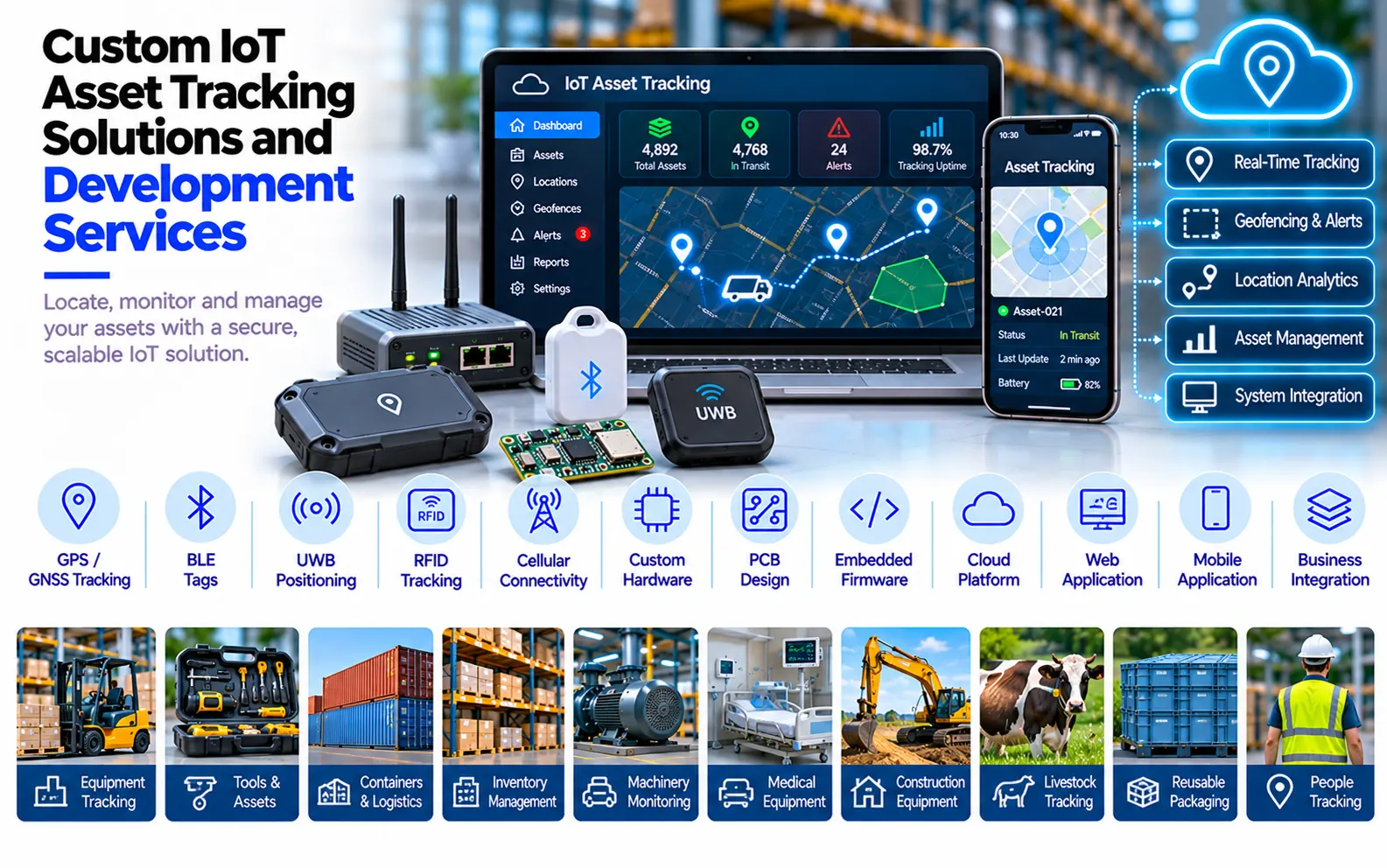
IoT Asset Tracking Development for Real Business Operations
A customized asset tracking system needs to do more than just mark locations on a map. Instead, it must also provide answers to questions such as:
Ready-made tracking systems might be good for usual tasks; however, they may limit businesses when they want to use some equipment of a specific kind, need to have an indoor positioning system, deal with special workflows, or want to ensure a unique level of security.
We create a tracking platform based on the customers' assets, environment, and needs in terms of update frequency and accuracy.
Case Study: BlueLion Tracking Ecosystem from Hardware to Cloud
BlueLion Tracking Ecosystem from Hardware to Cloud
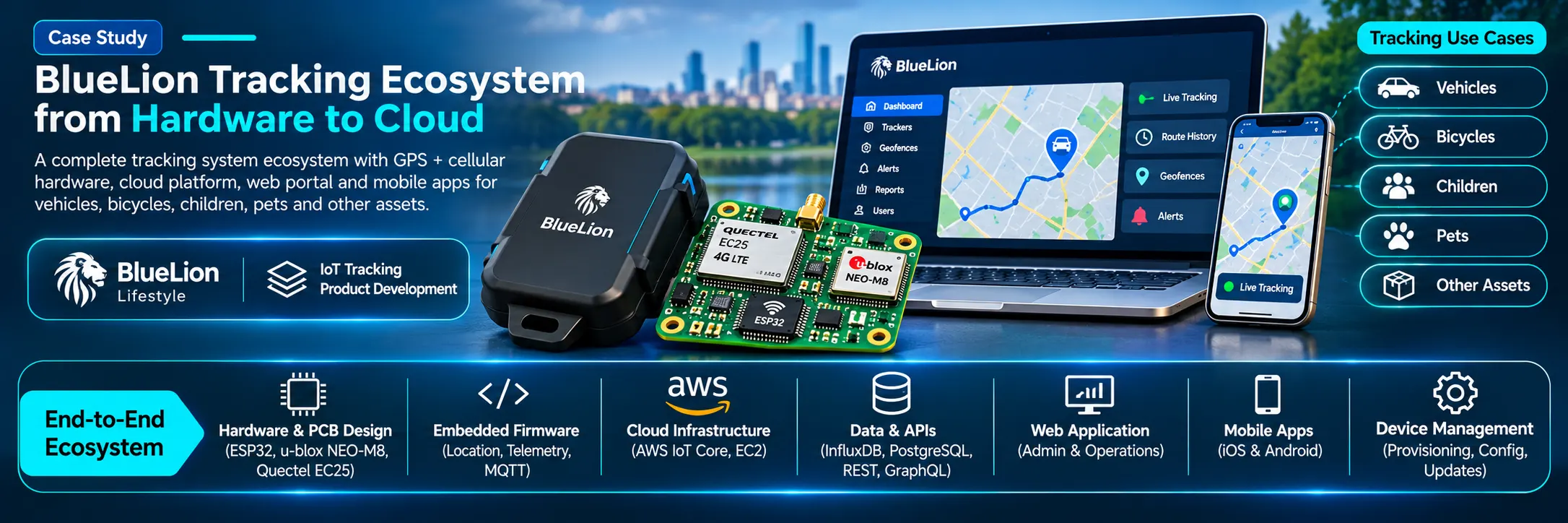
BlueLion Lifestyle needed a tracking system ecosystem that included connectivity, not just a single GPS tracker. BlueLion Lifestyle aimed to cater to several use cases involving vehicles, bicycles, children, pets, and other movable items using tracker devices, cloud, mobile apps, and management systems.
Adequate Infosoft took the assignment as an IoT product development project. The development included hardware design, PCB design, module integration for GPS and cellular connectivity, antenna design, firmware, cloud services, data storage of time series, API, web administration panel, and mobile apps.
The tracking device used a u-blox NEO-M8 GPS/GNSS receiver and a Quectel EC25 4G LTE module, with ESP32 controlling all functionalities and talking to the backend through MQTT. Hardware design also required reliable antenna integration, power management, and communication among the positioning, cellular, and processing subsystems.
As for the firmware of the tracker, it acquired location data and communicated all details about the device to the cloud. This system was designed to enable real-time tracking, store location routes in history, specify geofences, and notify users of movements of their devices.
The backend consisted of AWS IoT Core and Amazon EC2. InfluxDB was responsible for keeping time series data related to GPS coordinates, whereas PostgreSQL maintained the database for users and companies. REST and GraphQL APIs were implemented for integrations with the application, and WebSockets sent live updates to connected UIs. Monitoring tools comprised Prometheus and Grafana.
Web and mobile applications for users, administrators, and operators were built. The service provided live location tracking, route history, configurable zones, notifications, device management, and user management. Cloud-based infrastructure was designed in such a way that new trackers could be added and maintained without creating a new software instance for each tracker.
One significant challenge in engineering was integrating various layers of technology which were generally developed independently.
The proper functioning of GPS relies on the receiver and antenna designs, the reporting of correct information depends on the firmware and cellular communication and the user-friendly nature of the product depends on the way cloud data is handled and displayed.
It was hence considered necessary to treat the tracker, firmware, backend, APIs, and applications as one single product.
This complete system showcases our capability of developing an asset tracking product right from electronics and embedded software to cloud implementation and application development.
While BlueLion has some applications specific to vehicles, the basic architecture of connected tags, location data, device management, event handling, APIs, and user applications can be used in other scenarios such as equipment tracking, container tracking, outdoor assets tracking, portable machinery tracking, etc.
Related Asset Tracking Projects and Experience

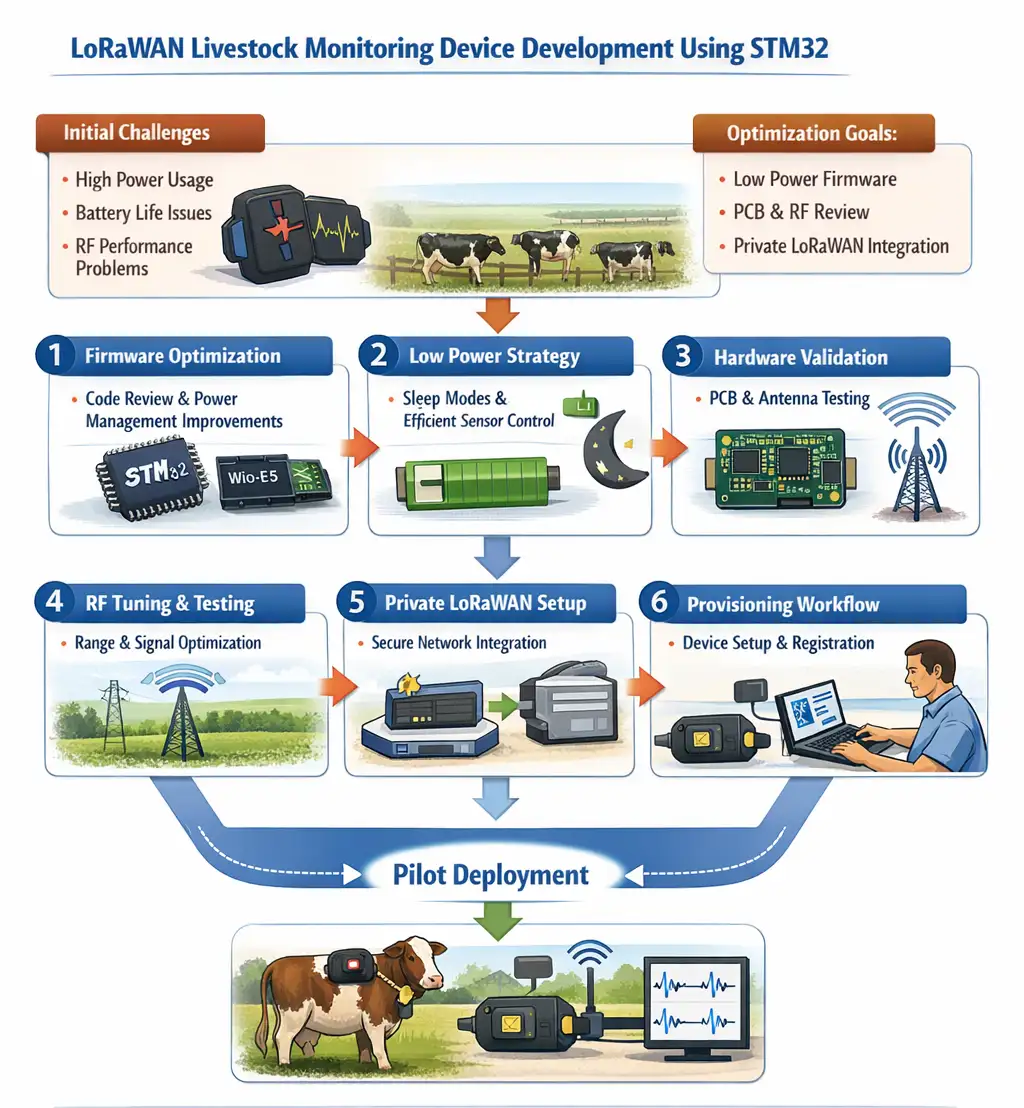
Our IoT Asset Tracking Development Services
Our engineering services can cover one part of a tracking product or its complete development lifecycle.
Asset-Tracking Hardware and PCB Development
We manufacture tracking systems, sensors, wearable devices, gateways, and corresponding electronics. Depending upon the application, the hardware may include GPS/GNSS, BLE, UWB, RFID/NFC chips, cellular communication modules, accelerometer, temperature sensor, tampering detection, external memory, or battery management systems.
Hardware engineering may include:
Embedded Firmware Development
Our firmware engineers develop the logic that controls location acquisition, sensor sampling, communication, power modes, local data storage, and secure device operation.
Firmware capabilities can include:
Cloud Platform and Tracking Software
The backend receives information from tags, trackers, readers, gateways, or mobile applications, validates it and stores it. Records of the assets, user permissions, location history, events, alerts, device configurations, and integration workflows can be kept.
We provide cloud-based platforms or hosting platforms with the following features:
Creating Applications for Mobile and the Web
Mobile apps should have the capability to scan bar/QR codes, manage assets, check transactions, show the list of items in nearby places, and send alerts to the field team in the absence of a desktop.
Web dashboards exist for centralized management, statistics, map monitoring, controlling devices, users, and operational analytics. Applications will be developed for Android, iOS, Windows, browsers, and across multiple platforms.
Choosing GPS, BLE, UWB, RFID or Cellular Asset Tracking
Different tracking technologies are used for different assets and environments. The best choice could be either a single or a combination of technologies.
GPS and GNSS technology
GPS and GNSS technologies are suitable for various outdoor assets that can be monitored via satellite communication. Common examples of its application are containers, construction machinery, mobile devices, field machinery, trailers, livestock, and other very valuable assets that move from one location to another.
The effectiveness of GPS tracking depends on how visible the satellite signal is, the design and application of a receiver, the placement of the antenna, the presence of other objects in the area such as buildings and trees, weather conditions, and signal reflexion. GPS is not the best technology for tracking assets deep inside the warehouses, hospitals, factories, etc.
Bluetooth Low Energy Asset Tracking
BLE tags deliver low-energy location-based services, proximity detection, and zone/area recognition. Its technology can be combined with mobile devices, beacons, scanners, and/or Bluetooth Direction Finding systems.
Bluetooth Angle of Arrival utilizes a system of radio antennas to determine the location of the asset's tag. BLE technology is very often used in hospital equipment, tools, reusable assets, and for warehouse inventory and personnel safety.
UWB Indoor Positioning
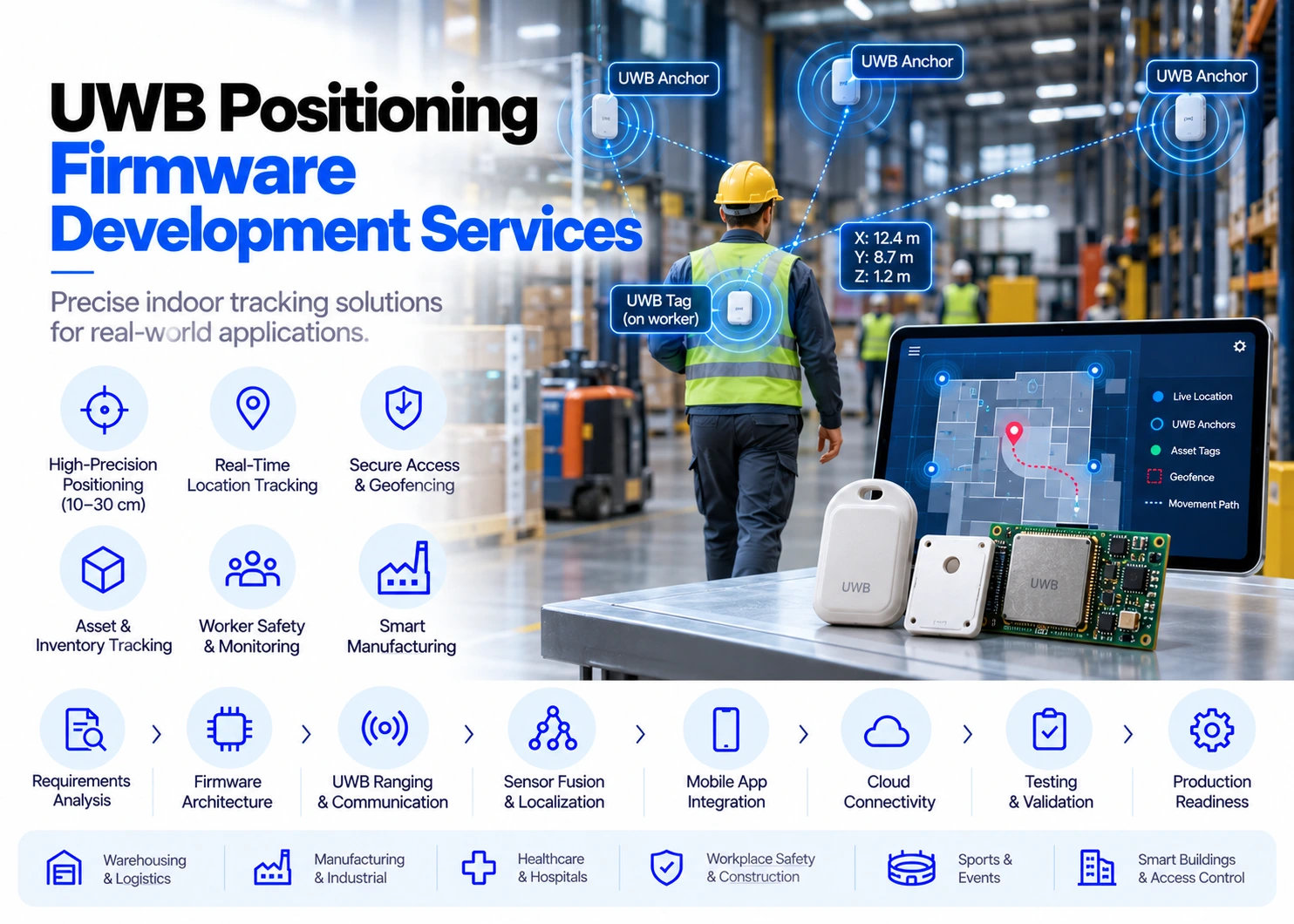
Ultra-wideband is recommended where indoor tracking with greater precision is required than the usual proximity based tracking method. The ultra-wideband system consists of moving tags, stationary anchors, calibration, positioning algorithm, and deployment strategy specific to the application.
Some possible uses of the ultra-wideband positioning technology include manufacturing tools, materials handling, medical devices, forklifts, robots, safety measures, and valuable assets. The actual performance of positioning depends on anchor placement, line-of-sight, multipath environment, tag orientation, radio settings, and the site itself.
RFID and NFC Tracking
Passive RFID technology can be applied if there is a need to identify assets at various checkpoints such as doors, storage places, work stations, and places of inventory counts. Unlike active RFID technology, passive RFID tags are not always providing information on the location, only when these items are found within the range of the reading device.
NFC technology and QR/barcode stickers may also be used for similar purposes.
Cellular Asset Tracking
LTE-M, NB-IoT, or 4G can connect assets operating farther than the limits of the local gateway or corporate network. Cellular tracking works for remotely located equipment, containers, field assets, and deployments scattered across various regions.
The design must take into consideration the coverage by the operator network, manage SIM to be used, data transmission, reporting frequencies, roaming, power consumption, and offline behavior.
Industries and Asset-Tracking Use Cases
Our custom development services can support:
Manufacturing
Track production tools, fixtures, work-in-progress materials, mobile equipment, containers, and maintenance assets across zones or workstations.
Warehousing and Logistics
Monitor reusable containers, pallets, handling equipment, packages, returnable transport items, and high-value inventory.
Healthcare
Locate mobile medical equipment, wheelchairs, diagnostic devices, maintenance tools, and other shared assets subject to security and privacy requirements.
Construction
Track portable machinery, power tools, safety equipment, generators, and material containers across changing job sites.
Energy and Utilities
Monitor field equipment, maintenance tools, remote devices, containers, and assets distributed across large or difficult-to-access locations.
Agriculture
Track livestock, portable machinery, equipment, and field assets using low-power, long-range communication.
Corporate and Institutional Assets
Manage laptops, test equipment, furniture, media devices, laboratory equipment, and items assigned to employees or departments.
Develop Your Custom IoT Asset Tracking Solution
In case you are looking for a company that would develop an IoT asset tracking system, Adequate Infosoft can assist you in taking your project from concept to tested and scalable solution.
We will develop a brand new asset tracking system, upgrade existing trackers hardware, develop indoor Real-Time Location System, integrate RFID processes, or implement cloud and application layer for your deployed trackers.
Please contact us for further discussions regarding the type of assets to be tracked, environment they will work in, accuracy needed, expected battery life, connectivity options, and more.
Our Asset-Tracking Solution Development Process
1. Asset and Workflow Assessment
We note down the types, locations, mobility patterns, applications, environmental conditions, accuracy requirements, proper functioning expectations, and operations flows of the assets.
2. Technology Selection and Site Planning
We compare GPS, BLE, UWB, RFID, cellular, Wi-Fi, and LoRaWAN with the previously mentioned deployment. Facilities in closed premises may need surveying and infrastructure planning before.
3. Proof of Concept
Specific proof of concept confirms the radios' qualities, positioning characteristics, tag properties, battery settings, backend connections, and user interaction.
4. Hardware, Firmware and Software Development
When the architecture is proved to be valid, we create the hardware, embedded firmware, cloud services, applications, dashboards, APIs, and administration tools.
5. Pilot Deployment and Calibration
A pilot runs tests to see how well the system works in a real environment. We examine the coverage, missed communications, stability, battery life, alert actions, and usability.
6. Production and Scaling Support
We offer assistance with designing improvements, preparations for production, device setup, remote updates, cloud scaling, monitoring, and providing ongoing support.
Frequently Asked Questions
Certainly. We are able to design tracking devices, PCBs, firmware, gateways, cloud architecture, web dashboards, mobile applications, APIs, analytics, and integration capabilities.
It really depends on the asset and the environment. GPS is usually appropriate outdoors, BLE enables proximity and indoor RTLS, UWB allows precise indoor ranging, RFID allows checkpoint detection and workflows, and cellular communication works well for widely dispersed assets.
Sure. A particular solution might involve GPS for outdoor location, BLE or UWB for indoor location, RFID for checkpoints, and cellular or LoRaWAN for wide-area communication.
Indeed. We can offer development of BLE Direction Finding and UWB systems for indoor RTLS solutions, involving tags, locators or anchors, firmware, position services, dashboards, APIs, and pilots.
Yes. Integration can be implemented through REST APIs, GraphQL, MQTT, webhooks, database connectors, SDKs, or platform-specific interfaces.
Yes. The firmware can retain the location and event data internally and update it when the connection is restored. How a tracking device will work offline depends on its storage space and power necessities, assumptions about reporting.
Precision is determined by technology used, electronics, design of antennas, and installation and fixing conditions. To know what precision is needed, it is necessary to perform proof-of-concept tests.
Yes. We make every effort to maximize the sleep period, frequency of measuring activity, position determining, radiation, data and number of events.
Technical References