


 Mean Stack Development
 Vue JS Development
 Javascript Development
 React JS Development
 Angular JS Development
 Next JS development
 Java Development
 Python Development
 Django Development
 Cherrypy Development
 C# Development
 ASP.NET Development
 NodeJS Development
 Laravel Development
 CodeIgniter Development
 Zend Development
 Ruby on Rails Development
 CakePHP Development
 PHP Website Development
 Symfony Development
 Drupal Development
 Joomla Development
 Wordpress Development
 .NET Nuke Development
 Kentico
 Umbraco
 .NET MAUI Development
 Xamarin Application Development
 iOS Application Development
 Android Application Development
 Android Wear App Development
 Ionic Development
 iBeacon Application Development
 Universal Windows Platform (UWP)
 Kotlin Application Development
 Swift Application Development
 Flutter Application Development
 PWA Application Development
 Flutter Health Tech & Wearable App Development Company
 React Native Health Tech Wearable App Development
 Offshore Software Development
 Custom Application Development
 Front-End Development
 Full Stack Development
 AI & Machine Learning
 Custom CRM Solutions
 Flask Software Development
 Electron JS Development
 ChatGPT Development
 Telemedicine App Development
 Build Smart Telemedicine Platform
 Beauty & Salon App Solutions
 Hire Workato Experts
 Magento Development
 Magento 2.0 Development
 Magento Enterprise
 Shopping Cart Development
 Prestashop Development
 Shopify Development
 Open Cart Development
 WooCommerce Development
 BigCommerce Development
 NopCommerce Development
 Virto Commerce Development
 AspDotNetStorefront Development
 .NET Application Development
 Microsoft Dynamics CRM
 VB .NET Development
 Sharepoint Migration
 ASP.NET Core Development
 ASP.NET MVC Development
 AJAX Development
 Agile Development
 Microsoft Bot
 Microsoft Blazor
 Microsoft Azure Cognitive
 HTML 5
 UI/UX Design
 Graphic Design
 Adobe Photoshop
 XML Application Development
 Cloud Computing Solutions
 Azure Cloud App Development
 AWS Development
 Google Cloud Development
 Certified AWS IoT Services Developers
 DevOps Consulting & Development
 Kubernetes Consulting & Services
 SQL Programming Development
 MySQL Development
 MongoDB Development
 Big Data
 Robotic Process Automation
 Social Media Marketing
 Search Engine Optimization
 QA Testing
 Software Testing
 Software Security
 Maintenance And Support
 I.T. Consulting Services
 Business Intelligence
 YII Development
 Data Analysis
 Alexa Skills Development
 On Demand App for Mobile repairing services
 On Demand App for Car Service Booking
 On Demand App for Cleaning Services
 On Demand App for Pharmacy
 On Demand Dedicated Developers
 On Demand Lawyer App Development






 Nuki Smart Lock
 Salto Smart Lock
 TTlock Smart Lock
 NFC App Development
 Custom IOT Enabled Smart Lock
 Smart Locker Solutions
 Hospital Smart Lock Systems
 Hotel Smart Lock Systems
 Smart Home & Office Locks
 Smart Access for Schools & Colleges
 Unloc Smart Lock Integration
 Yale & August Smart Lock Integration
 Populife Smart Lock Integration
 Smart Lock Hardware Development
 Dairy IoT Solutions
 Agri IoT & AI Solutions
 Weather & Climate Solutions
 Water & Waste Management Solutions
 RaspBerry Pi
 Firmware Software Development
 ESP 32 Software Development
 Embedded Development
 Internet of Things
 Smart IoT Development
 IoT Sensor Integration & Development Solutions
 Smart IoT System Development for HVAC
 Tuya IoT App Development
 Particle IoT SDK
 IoT Development with AI
 Smart Pet GPS Tracker
 Dairy GPS Tracking Solutions
 GPS Fleet Management Software
 Car Rental & Subscription Solutions
 Car Buy & Sell Marketplace Development
 AI-Powered Car Wash App Development
 PCB Design & Fabrication
 IoT AC Automation
 AI–IoT Painting Solutions
 IoT Wearable Hardware & App Development
 HVAC Automation & AI Control Systems
 Smart Home IoT Engineering
 AI Embedded Systems
 AI Hardware Design Service
 Advanced IoT Hardware & Firmware Development
 Device Driver Development Services
 NXP i.MX RT Firmware & Hardware Services
 Microchip PIC & AVR Development
 Hire IoT Architects
 IoT Cloud & Infrastructure Solutions
 Infineon XMC / AURIX Development Services
 Matter & Thread IoT Services
 Native IoT Mobile App Development (BLE & Wi-Fi)
 Snapdragon IoT Firmware Development
 Renesas RA/RX Firmware Services
 Silicon Labs EFR32 Development Services
 Smart Wearable App Development
 Smart IoT Meters
 Smart Healthcare Wearable App Development
 Health Care Monitoring System
 Fitness Tracking App Development
 Smart Home Automation Apps
 nRF PCB Design
 ESP32 PCB Design
 Embedded Wearables Engineers
 Rental Property Management System
 Building Management System
 Smart Lighting Development
 Infineon Semiconductor Firmware Development Services
 Custom Camera Development: Hardware, Firmware & PCB Prototyping
 Smart Security Camera SDK
 Nordic Semiconductor SDK
 Infineon SDK
 Arduino SDK
 NFC Lock Integration
 Kerong Lock Integration
 IoT & AI Solutions for Manufacturing
 Smart Inventory & Logistics Solution
 Food & Beverage Industry Solutions
 Smart Hospitality Solutions
 Smart Property Management
 Custom Smart Home IOT SDK
 Smart IoT & AI in Healthcare
 AI-Powered Security Solutions
 Smart Home Safety & AI
 Veterinary Clinic Management (AI)
 Pet Care System (AI & IoT)
 Pet Training & Adoption (AI)
 Healthcare IoT Development
 Event Management Software
 Money Remittance App
 Money Lending App Development
 Utility and Bill Payment App
 IoT Mobile App Development (Flutter & React Native)
 AI & IoT Retail Solutions
 Smart EV App Development
 Smart Solar IoT & AI Solutions
 IoT-Based Energy Systems
 Smart Energy & Utilities Solutions
 6G Solutions
 IoT Security Solutions
 AI-Powered Lottery App Development
 AI-Sports Fitness Club Management
 Travel
 Real Estate
 Medical & Healthcare
 e-Learning
 Consumer Products
 Finance
 Automobile
 Media & Entertainment
 Billing Software
 Enterprise Resource Planning (ERP)
 Augumented & Virtual Reality
 Point of Sale(POS) Development
 Learning Management System
 EV Charging Solutions
 About Us
 Partners & Certifications
 Quality Assurance
 Our Clients & Testimonials
 Development Process
 Our Products
 Social Responsibility
 Work Ethics
 Vision & Mission
 Awards
 Live Project Demos
 Contact Us
 Case Studies
 Portfolio
 Blog
LTE-M & NB-IoT Embedded Firmware Development Services
LTE-M and NB-IoT allow low-power devices to directly connect to cellular networks, which is well suited for applications such as asset tracking, smart meters, environmental sensors, health monitoring devices, agricultural tools, and industrial surveillance.
Adequate Infosoft is skilled in offering stem solutions to both emerging firms and renowned companies in the field of reliable IoT devices manufacturing.
Our firm has engineers who specialize in firmware developing various functions like that are used to control the modem operation, network registration, energy saving modes, secure communication, storing data locally, remote setups, and OTA firmware updates.
The systems we develop help to implement the above functions in environments with weak signals, network failures, drained batteries, and interrupted updates, which increases reliability on real-life applications.
We have expertise in integration of cellular modules, electronics development, cloud connectivity, and mobile or web applications.
Our collaboration with Nordic Semiconductor, u-blox, Quectel, SIMCom, and other cellular IoT platforms allows us to support the entire development cycle, starting from the prototype to production preparation.
Let's Work Together!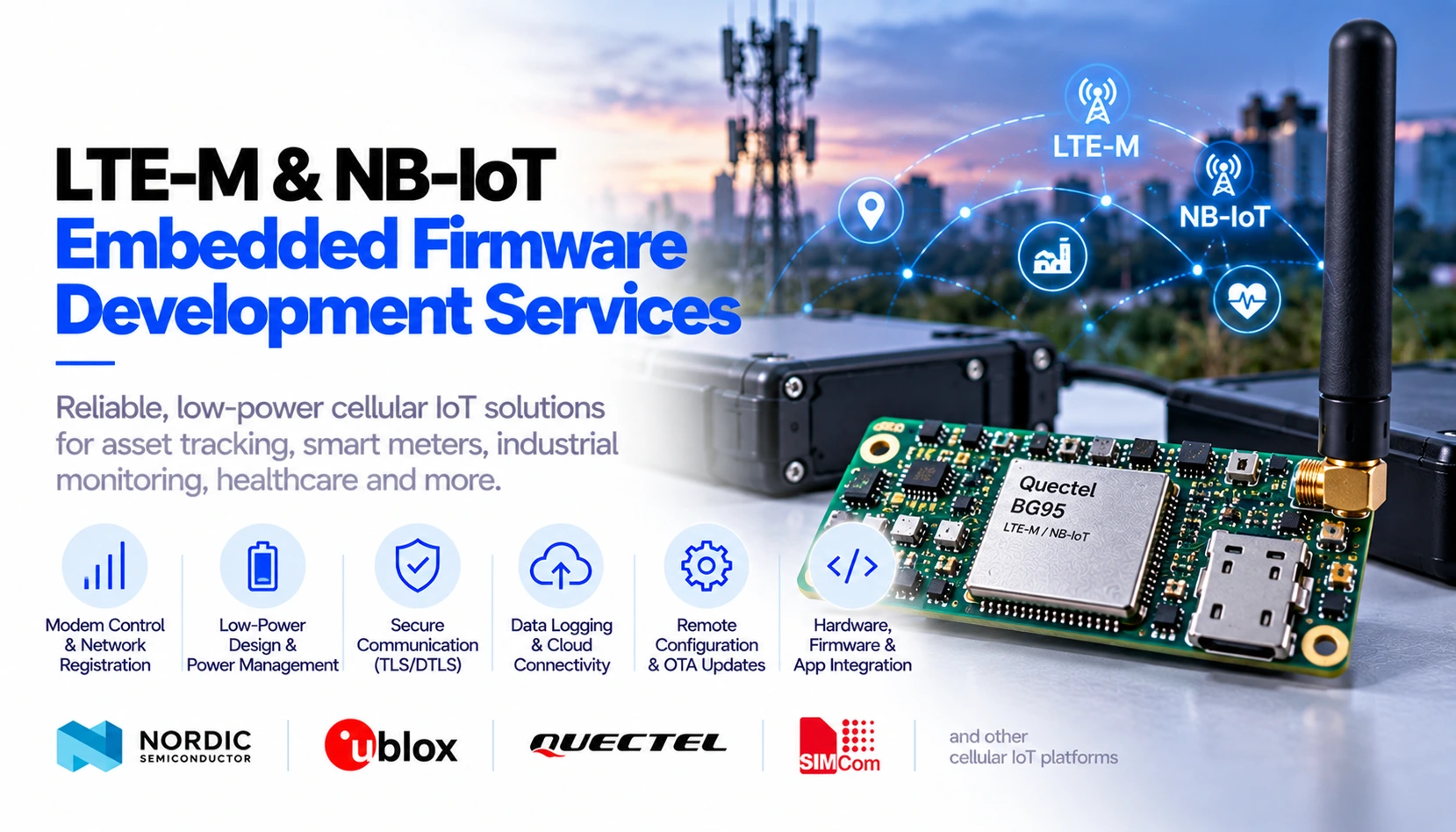
LTE-M vs NB-IoT: Choosing the Right Cellular IoT Technology
LTE-M, or Long-Term Evolution Machine, is intended for cellular devices that are low-powered but necessitate mobility, enhanced data transfer or capabilities for voice applications and GNSS.
This technology is ideal for utilization in such devices as wearables, monitoring devices and smart safety equipment.
NB-IoT stands for narrowband Internet of Things, and it is used for transmitting small data packets to devices at low speed.
This type of technology can be effectively applied in smart meters, gas and water monitoring devices and in agricultural sensors among others.
The correct choice depends on the product, not just the lowest module price. During technical discovery, we assess:
Expected message size and upload frequency Battery-life objective and available power source Stationary, mobile or roaming device behaviour Indoor, underground or rural coverage requirements Carrier availability and supported bands in the target region Need for GNSS, voice, firmware updates or higher throughput Data-security, compliance and long-term support requirements
A fleet tracker that sends route, movement and diagnostic events will generally have different requirements from a water meter that sends a small consumption report two times a day.
We assist customers in making this decision early in the planning process so that unnecessary rework due to hardware and firmware decisions can be avoided.
Unique Case Study: LTE-M Vehicle Diagnostics and Predictive Maintenance Prototype
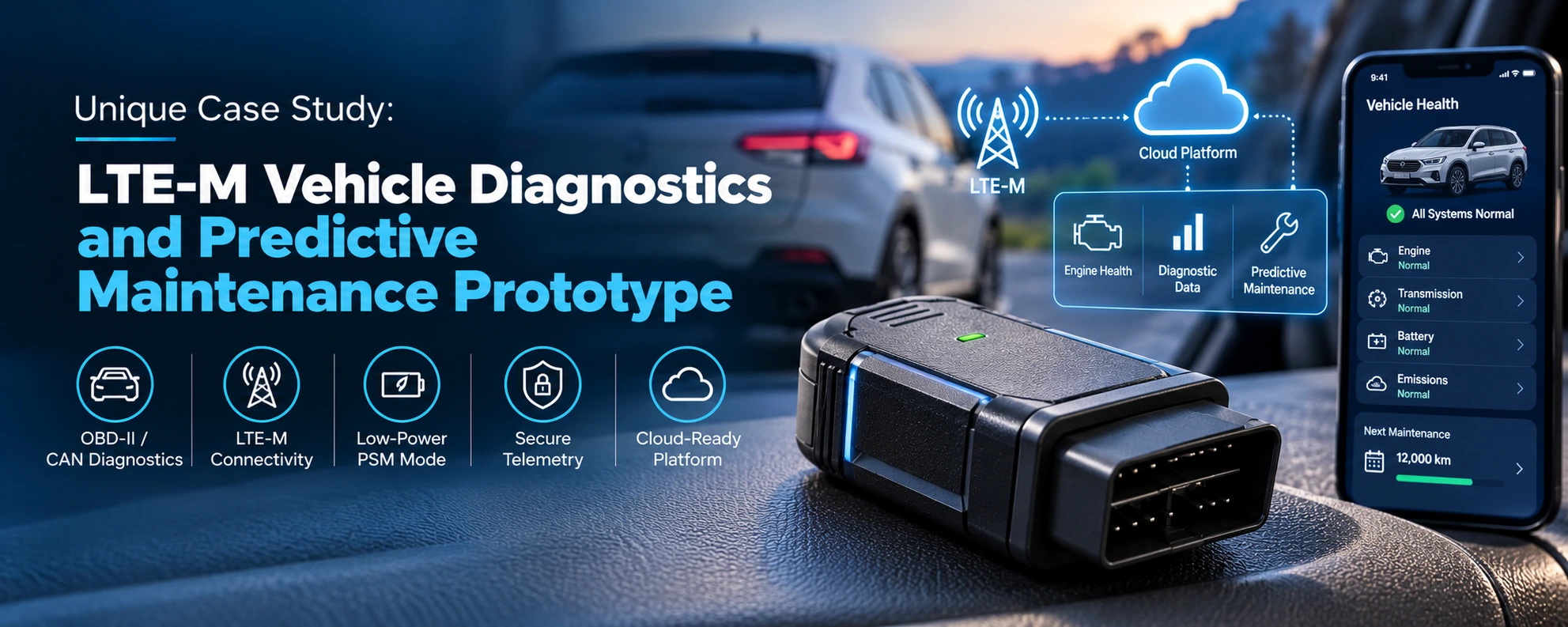
Automotive Diagnostic Equipment Client
Adequate Infosoft developed a vehicle diagnostics and predictive-maintenance IoT prototype for an automotive diagnostic equipment client. The client required a compact OBD-II device that could collect vehicle information, operate reliably while a vehicle was parked for long periods and send telemetry securely to a cloud platform.
The product needed to collect diagnostic data from a vehicle's electronic control units (ECUs), while avoiding unnecessary drain on the vehicle battery. Conventional high-bandwidth cellular connectivity was not the best fit because the device's primary requirement was periodic, efficient telemetry rather than constant high-data communication.
Why LTE-M Was Selected
The team made the decision to use LTE-M connectivity with a u-blox SARA-R4 LTE-M/NB-IoT modem.
The choice for LTE-M technology was made because the vehicle may stay inactive for a long time. The device will be expected to maintain constant network connection and transfer diagnostic data as per set schedule.
By using Power Saving Mode (PSM) in the firmware the modem was allowed to sleep between transmission periods, which allowed maximizing energy efficiency while keeping a working communication channel to transmit telemetry from the vehicle and its diagnostics.
The design focused on predictable recovery, as vehicle-based devices are prone to ignitional spikes, lack of connectivity, power failures and downtime.
Firmware and Hardware Engineering Approach
An automotive-grade microcontroller manufactured by NXP was employed in this hardware platform with the assistance of an automotive power-management architecture. The firmware was responsible for the acquisition of data from the vehicle through the CAN buses, communication via modems, managing the states of power, batching telemetry, and secure transmission to the cloud.
Key technical work included:
CAN communication for OBD-II and ECU diagnostic data LTE-M modem integration through controlled AT-command handling PSM configuration to minimise parked-vehicle battery drain Buffered telemetry to avoid loss during a cellular outage Secure payload signing using an NXP EdgeLock SE050 secure element I2C integration for protected key storage and cryptographic operations Network recovery logic for registration failure or modem unresponsiveness Cloud-ready telemetry with device identity and timestamped diagnostic records
Each data bundle was cryptographically signed before transmission, enabling server-side verification of its origin and integrity. This was especially important because diagnostic records may be used for maintenance decisions, fleet analysis or evidence-based service workflows.
Result
The prototype created provided the client with an interconnected platform for running diagnostics that allows for low-power monitoring of vehicles that are parked rather than requiring constant connectivity.
LTE-M and PSM reduced how much power was required by cellular connections while secure element and signed telemetry improved trustworthiness of the data received from the cloud.
The project demonstrates a core principle of LTE-M and NB-IoT firmware development: modem configuration, security, power strategy and recovery logic must be engineered together.
A connected product is only useful when it can continue working safely and predictably beyond the controlled conditions of a development lab.
Related case study: vehicle-diagnostics-iot-prototype-development-nxp-s32k
Relevant Adequate Infosoft Case Studies
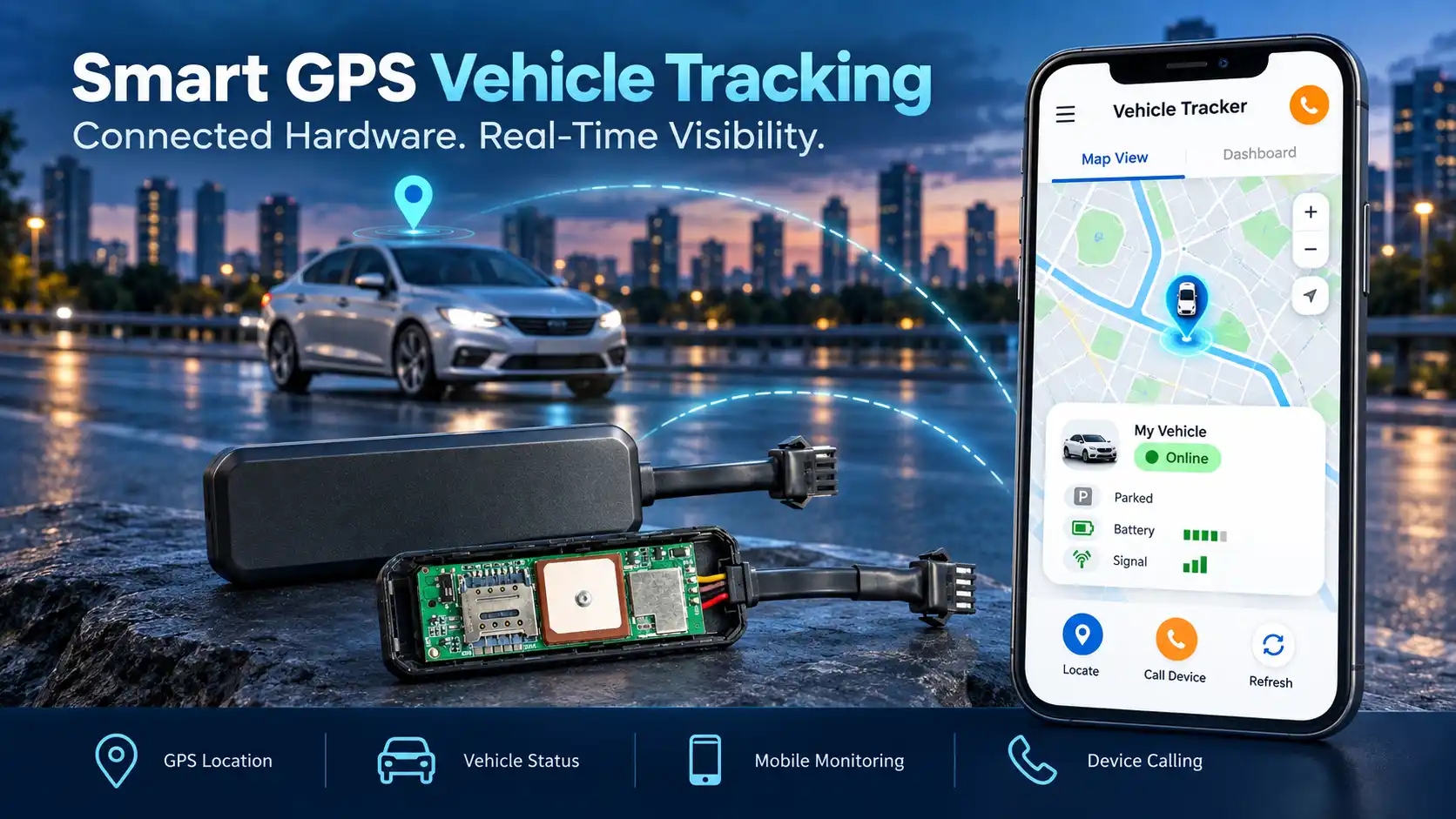
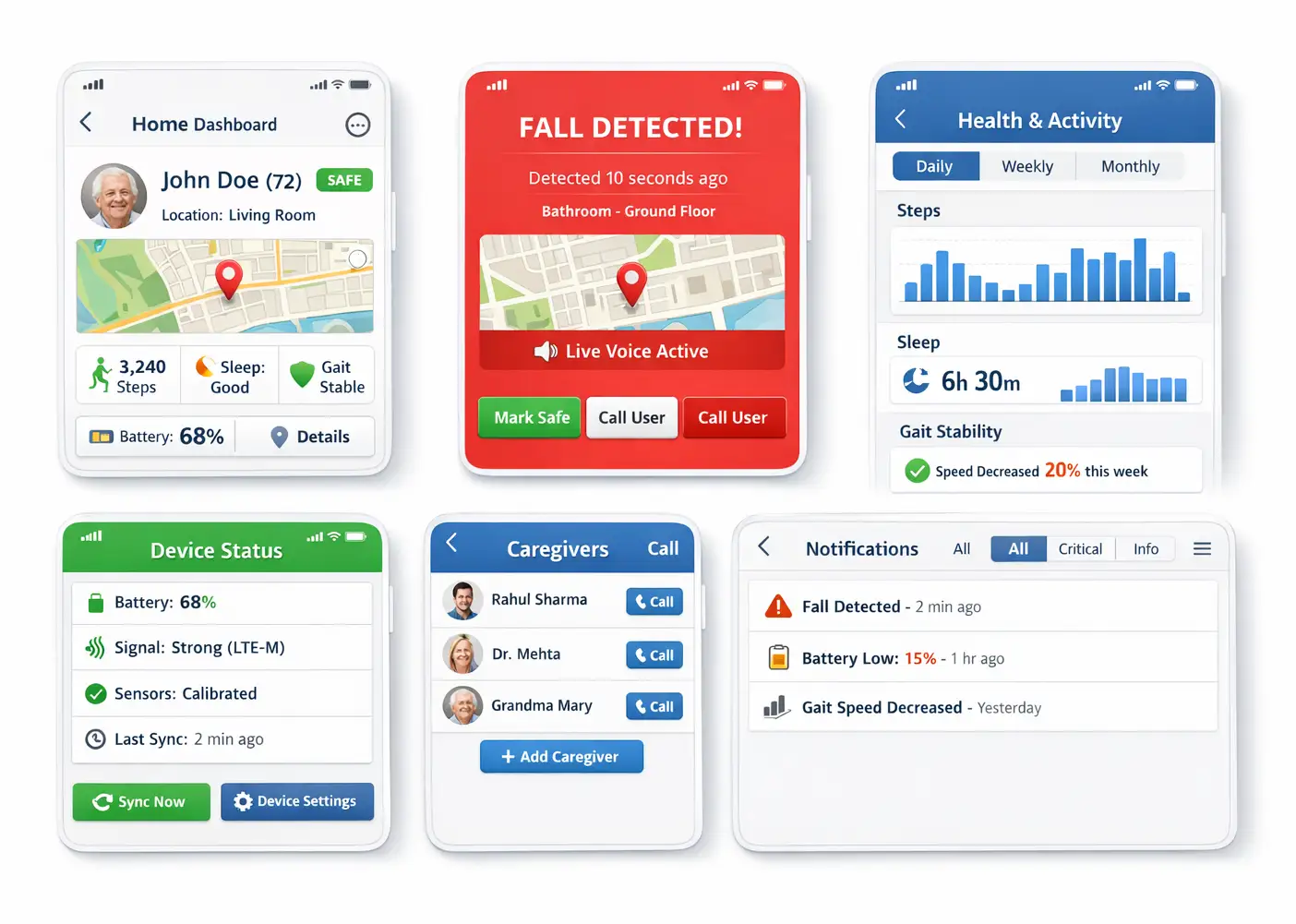
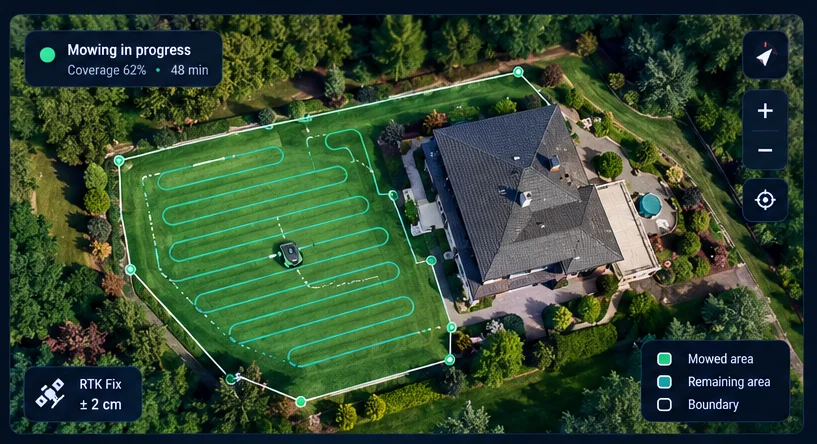
Adequate Infosoft has experience delivering complete IoT products across tracking, safety, industrial monitoring, cellular connectivity, cloud applications and embedded firmware. The following projects demonstrate the breadth of our delivery capability.
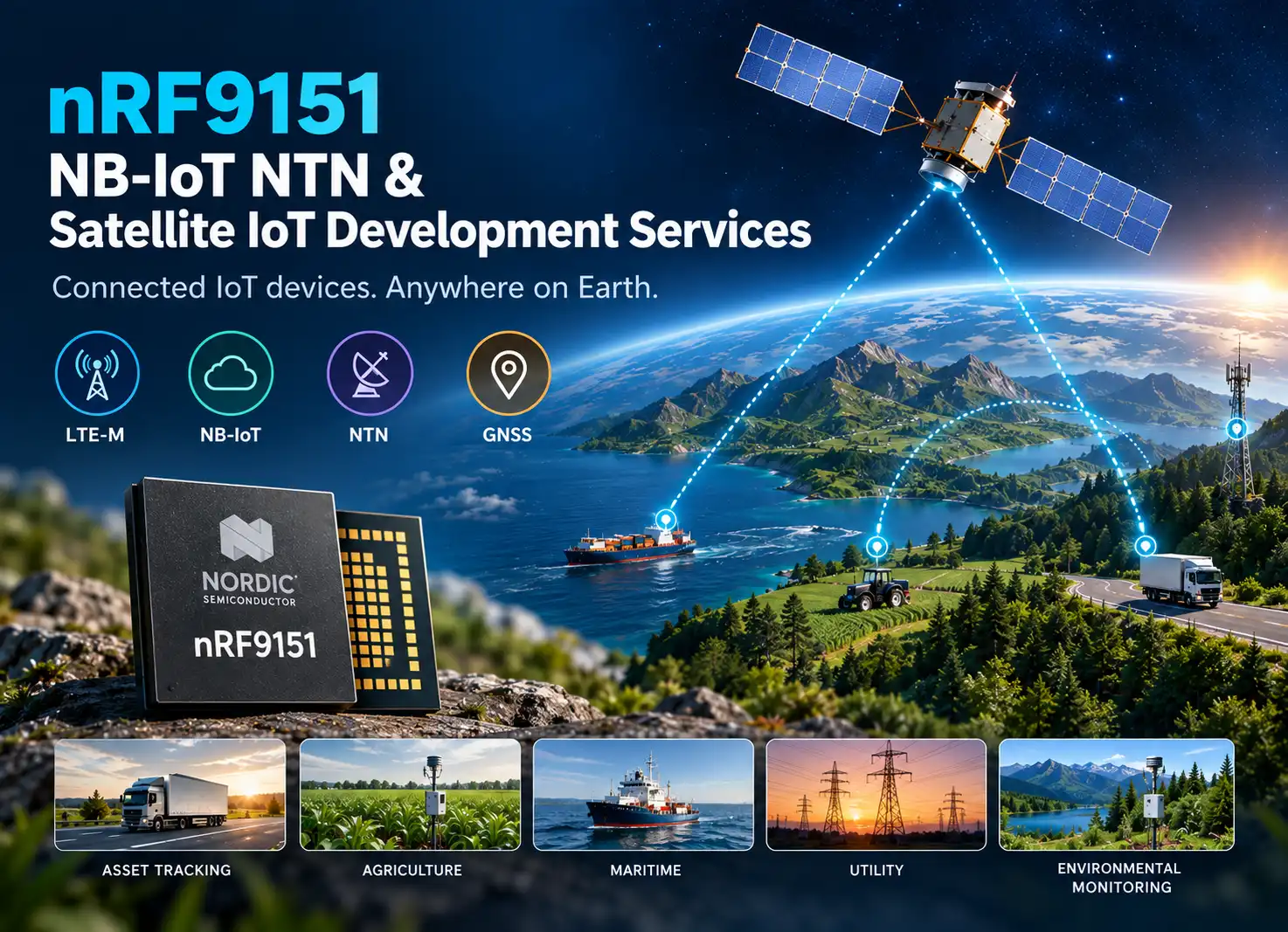
Our LTE-M and NB-IoT Firmware Development Services
Cellular Modem Integration and AT Command Firmware
Typically, wireless modules are connected through UART, USB or any serial interface using AT commands.
However, it is not merely sending and receiving commands in a commercially used device, as the system also needs to handle problems like delays between requests and responses, unexpected messages from the modem, SIM status, approval from the network, registration failure, PDP context errors, DNS problems and resets.
We develop modular modem-control firmware that manages:
SIM, eSIM or iSIM initialisation Network registration and operator selection LTE-M and NB-IoT radio configuration APN configuration and IP connectivity Signal-quality monitoring and connection recovery MQTT, HTTPS, TCP or UDP data sessions GNSS requests where supported by the modem SMS or fallback alert workflows where required Remote configuration and modem firmware support
Our firmware architecture separates critical product functions from modem communication wherever possible. This prevents a slow network operation or modem hang from blocking safety, sensing or control functions.
Low-Power Firmware and Battery-Life Optimisation
The battery is crucial for cellular IoT devices. Adequate Infosoft improves the firmware utilizing power-saving features of LTE-M and NB-IoT solutions that have the PSM (Power Saving Mode) and eDRX (extended Discontinuous Reception).
Our experts program the devices to wake up from time to time, gather information from sensors, send some data, and return to sleep mode again. We optimize power consumption while activating the modem, connecting to the network, and positioning the device via GPS.
We analyze the current consumption during different modes of operation, such as idle, sleep, sensor sampling, retry transmissions, and weak signal conditions.
This analysis helps us estimate the necessary battery size, reporting periods, solar support, and maintenance schedule.
Telemetry, Cloud Connectivity and Local Data Buffering
A mobile device must not delete valuable information just because it cannot make any connections. We create store-and-forward algorithms which save telemetry in non-volatile memory and send it later when connection is restored. The firmware manages the size of the queue, timestamps data, prevents duplication, decides when to make attempts, and prioritizes the data.
We connect devices with Amazon AWS IoT Core, Azure IoT Hub, any MQTT broker, or any REST-based cloud. Among the regular operations there are provisioning devices, uploading telemetry, issuing commands and events, remote setting, and diagnostics.
To make data manageable at scale, we use structured payloads, versioned messages and clear device identifiers. This supports accurate cloud processing and makes future firmware or backend changes easier to deploy.
Secure Firmware, Device Identity and OTA Updates
Every device that connects to the internet requires a plan for security. We take practical precautions that comply with the risk level of the product such as encrypted communication using TLS, the unique identification of devices, management of certificates and keys, secure storage of credentials, use of signed commands, and utilizing secure boot technology if the hardware allows.
For devices deployed in the field, we can implement secure over-the-air (OTA) firmware updates. A strong OTA process includes signed firmware images, integrity checks, controlled download, safe installation, status reporting and rollback support.
These features reduce the risk of bricking devices during an interrupted download or power loss.
Development Process Built for Production
1. Feasibility and Hardware Assessment
We evaluate cellular areas, the compatibility of service providers, the choice of modem, the configuration of antennas, the power unit, housing, cloud framework, and anticipated volume of information. We believe that the early investigation of RF configuration and power reliability guarantee fewer performance problems.
2. Modular Firmware Development and Testing
Our engineers develop modular firmware covering board support, sensor drivers, modem control, power management, local storage, communication protocols, security, OTA updates, and application logic. Testing covers lost coverage, SIM errors, low voltage, modem resets, invalid cloud responses, and repeated reconnection attempts.
3. Field Validation and Production Readiness
By validating devices at prototypical deployment sites, we strive to monitor network association time, payload delivery, reconnection behavior, power utilization, and performance recovery after solid periods of sleep. This guarantees reliable performance under genuine cellular conditions.
Why Work with Adequate Infosoft?
Adequate Infosoft supports the complete cellular IoT product lifecycle, including hardware design, antenna and power optimisation, embedded firmware, cloud infrastructure, web dashboards, mobile applications, and ongoing device support.
With our comprehensive methodology, we minimize risks associated with simultaneous integration across several teams and boost reliability of the developed product.
We keep records of how firmware operates, states of devices, process of construction, and scenarios for testing so as to guarantee ease of maintaining the solution.
Our engineers are highly skilled in communicating technical changes related to network coverage, time of battery life, compatibility with network carriers, process of firmware updating and functionality of hardware helping clients make wise development decisions.
Frequently Asked Questions
Generally, LTE-M is a better choice for mobile products, trackers, wearables, and devices needing higher throughput and regular over-the-air firmware updates compared to NB-IoT, which is more often a better fit for fixed, low-data devices which need extensive coverage and long battery life. It mostly depends on the carrier's presence, power goals, and data needs in the respective country.
Yes, with the correct power design and firmware implementation of PSM, eDRX, and efficient payloads and scheduled wake-ups, devices can work for months or years.
Yes. We can develop firmware around Nordic nRF91-series devices and common cellular modules from Quectel, u-blox, SIMCom and other suitable vendors, subject to the product's technical and regional requirements.
Yes. Adequate Infosoft can provide the required embedded firmware, implement device provisioning, MQTT or HTTPS connectivity, and set up a cloud backend with a dashboard and mobile app as a single IoT package.
We implement local non-volatile storage and store-and-forward logic. Data is timestamped, queued and uploaded after connectivity is restored, with controls for retries, prioritisation and duplicate prevention.
Yes, we can design secure OTA updates with signed images, integrity checks, controlled installation, update reporting, and rollback protection per the device architecture and storage mechanisms in use.