














 Mean Stack Development
 Vue JS Development
 Javascript Development
 React JS Development
 Angular JS Development
 Next JS development
 Java Development
 Python Development
 Django Development
 Cherrypy Development
 C# Development
 ASP.NET Development
 NodeJS Development
 Laravel Development
 CodeIgniter Development
 Zend Development
 Ruby on Rails Development
 CakePHP Development
 PHP Website Development
 Symfony Development
 Drupal Development
 Joomla Development
 Wordpress Development
 .NET Nuke Development
 Kentico
 Umbraco
 .NET MAUI Development
 Xamarin Application Development
 iOS Application Development
 Android Application Development
 Android Wear App Development
 Ionic Development
 iBeacon Application Development
 Universal Windows Platform (UWP)
 Kotlin Application Development
 Swift Application Development
 Flutter Application Development
 PWA Application Development
 Flutter Health Tech & Wearable App Development Company
 React Native Health Tech Wearable App Development
 Offshore Software Development
 Custom Application Development
 Front-End Development
 Full Stack Development
 AI & Machine Learning
 Custom CRM Solutions
 Flask Software Development
 Electron JS Development
 ChatGPT Development
 Telemedicine App Development
 Build Smart Telemedicine Platform
 Beauty & Salon App Solutions
 Hire Workato Experts
 Magento Development
 Magento 2.0 Development
 Magento Enterprise
 Shopping Cart Development
 Prestashop Development
 Shopify Development
 Open Cart Development
 WooCommerce Development
 BigCommerce Development
 NopCommerce Development
 Virto Commerce Development
 AspDotNetStorefront Development
 .NET Application Development
 Microsoft Dynamics CRM
 VB .NET Development
 Sharepoint Migration
 ASP.NET Core Development
 ASP.NET MVC Development
 AJAX Development
 Agile Development
 Microsoft Bot
 Microsoft Blazor
 Microsoft Azure Cognitive
 HTML 5
 UI/UX Design
 Graphic Design
 Adobe Photoshop
 XML Application Development
 Cloud Computing Solutions
 Azure Cloud App Development
 AWS Development
 Google Cloud Development
 Certified AWS IoT Services Developers
 DevOps Consulting & Development
 Kubernetes Consulting & Services
 SQL Programming Development
 MySQL Development
 MongoDB Development
 Big Data
 Robotic Process Automation
 Social Media Marketing
 Search Engine Optimization
 QA Testing
 Software Testing
 Software Security
 Maintenance And Support
 I.T. Consulting Services
 Business Intelligence
 YII Development
 Data Analysis
 Alexa Skills Development
 On Demand App for Mobile repairing services
 On Demand App for Car Service Booking
 On Demand App for Cleaning Services
 On Demand App for Pharmacy
 On Demand Dedicated Developers
 On Demand Lawyer App Development









 Nuki Smart Lock
 Salto Smart Lock
 TTlock Smart Lock
 NFC App Development
 Custom IOT Enabled Smart Lock
 Smart Locker Solutions
 Hospital Smart Lock Systems
 Hotel Smart Lock Systems
 Smart Home & Office Locks
 Smart Access for Schools & Colleges
 Unloc Smart Lock Integration
 Yale & August Smart Lock Integration
 Populife Smart Lock Integration
 Smart Lock Hardware Development
 Dairy IoT Solutions
 Agri IoT & AI Solutions
 Weather & Climate Solutions
 Water & Waste Management Solutions
 RaspBerry Pi
 Firmware Software Development
 ESP 32 Software Development
 Embedded Development
 Internet of Things
 Smart IoT Development
 IoT Sensor Integration & Development Solutions
 Smart IoT System Development for HVAC
 Tuya IoT App Development
 Particle IoT SDK
 IoT Development with AI
 Smart Pet GPS Tracker
 Dairy GPS Tracking Solutions
 GPS Fleet Management Software
 Car Rental & Subscription Solutions
 Car Buy & Sell Marketplace Development
 AI-Powered Car Wash App Development
 PCB Design & Fabrication
 IoT AC Automation
 AI–IoT Painting Solutions
 IoT Wearable Hardware & App Development
 HVAC Automation & AI Control Systems
 Smart Home IoT Engineering
 AI Embedded Systems
 AI Hardware Design Service
 Advanced IoT Hardware & Firmware Development
 Device Driver Development Services
 NXP i.MX RT Firmware & Hardware Services
 Microchip PIC & AVR Development
 Hire IoT Architects
 IoT Cloud & Infrastructure Solutions
 Infineon XMC / AURIX Development Services
 Matter & Thread IoT Services
 Native IoT Mobile App Development (BLE & Wi-Fi)
 Snapdragon IoT Firmware Development
 Renesas RA/RX Firmware Services
 Silicon Labs EFR32 Development Services
 Smart Wearable App Development
 Smart IoT Meters
 Smart Healthcare Wearable App Development
 Health Care Monitoring System
 Fitness Tracking App Development
 Smart Home Automation Apps
 nRF PCB Design
 ESP32 PCB Design
 Embedded Wearables Engineers
 Rental Property Management System
 Building Management System
 Smart Lighting Development
 Infineon Semiconductor Firmware Development Services
 Custom Camera Development: Hardware, Firmware & PCB Prototyping
 Smart Security Camera SDK
 Nordic Semiconductor SDK
 Infineon SDK
 Arduino SDK
 NFC Lock Integration
 Kerong Lock Integration
 IoT & AI Solutions for Manufacturing
 Smart Inventory & Logistics Solution
 Food & Beverage Industry Solutions
 Smart Hospitality Solutions
 Smart Property Management
 Custom Smart Home IOT SDK
 Smart IoT & AI in Healthcare
 AI-Powered Security Solutions
 Smart Home Safety & AI
 Veterinary Clinic Management (AI)
 Pet Care System (AI & IoT)
 Pet Training & Adoption (AI)
 Healthcare IoT Development
 Event Management Software
 Money Remittance App
 Money Lending App Development
 Utility and Bill Payment App
 IoT Mobile App Development (Flutter & React Native)
 AI & IoT Retail Solutions
 Smart EV App Development
 Smart Solar IoT & AI Solutions
 IoT-Based Energy Systems
 Smart Energy & Utilities Solutions
 6G Solutions
 IoT Security Solutions
 AI-Powered Lottery App Development
 AI-Sports Fitness Club Management
 Travel
 Real Estate
 Medical & Healthcare
 e-Learning
 Consumer Products
 Finance
 Automobile
 Media & Entertainment
 Billing Software
 Enterprise Resource Planning (ERP)
 Augumented & Virtual Reality
 Point of Sale(POS) Development
 Learning Management System
 EV Charging Solutions
 About Us
 Partners & Certifications
 Quality Assurance
 Our Clients & Testimonials
 Development Process
 Our Products
 Social Responsibility
 Work Ethics
 Vision & Mission
 Awards
 Live Project Demos
 Contact Us
 Case Studies
 Portfolio
 Blog
Blog
Low-Power Wearable Device Development Services
Low-power wearable development creates battery-operated devices that sense, process and communicate reliably while spending most of their time in an efficient state.
Battery life depends on the complete system: sensors, PCB leakage, regulators, radio settings, firmware, mobile synchronization and actual usage.
Adequate Infosoft provides low-power wearable development across hardware, embedded firmware, Bluetooth Low Energy (BLE), mobile apps, cloud connectivity, prototyping and production preparation.
We help healthtech, consumer, industrial and startup teams turn concepts into testable, production-oriented wearables.
Our engineers utilize Nordic nRF52/nRF54, STM32, Silicon Labs EFR32, Ambiq Apollo, and specific ESP32 devices. The selection is made according to the load, connectivity, memory, security, form factor, price and battery specifications of the product.
Let's Work Together!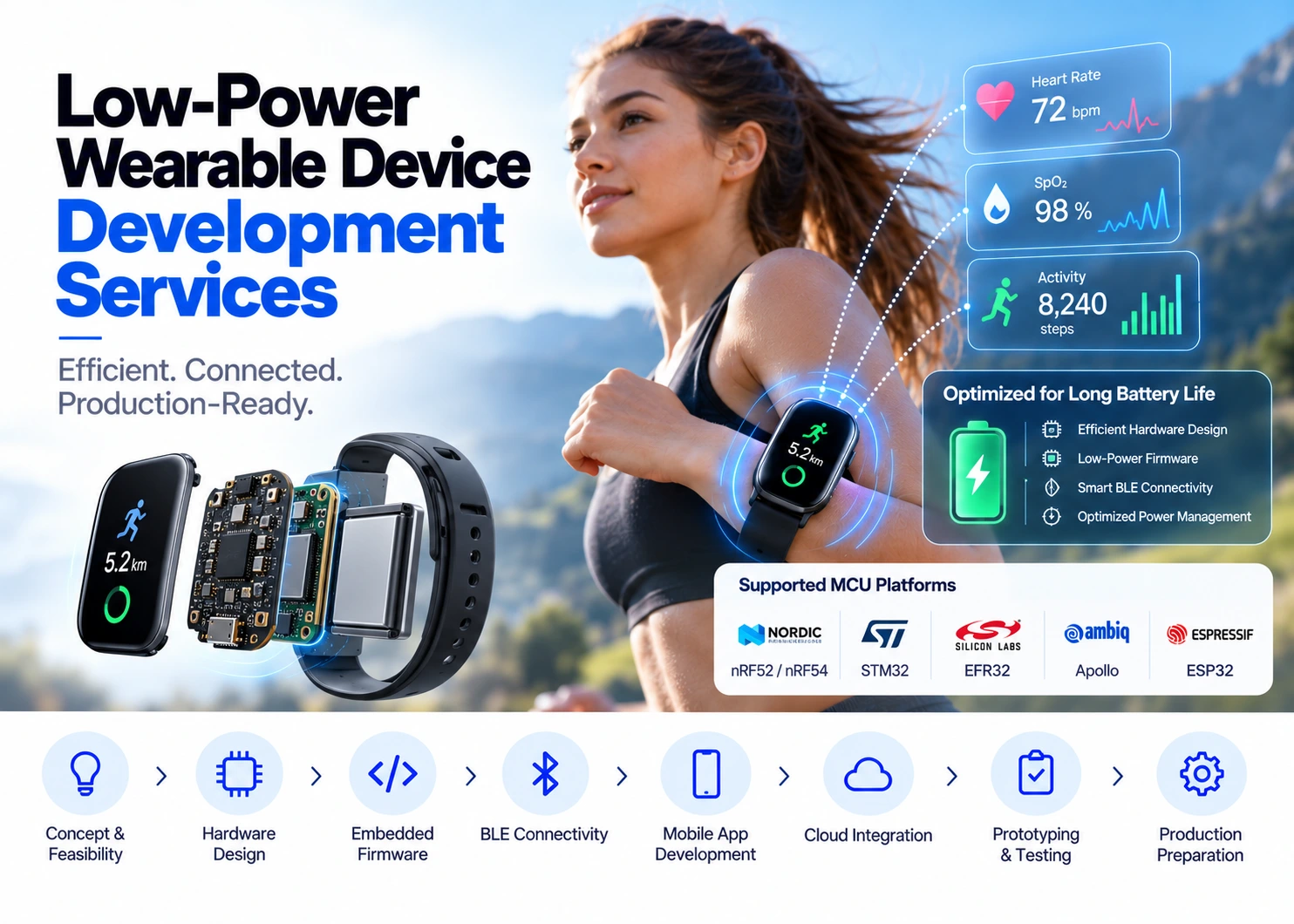
What Does Low-Power Wearable Development Include?
A project starts with an energy budget covering how often the device samples, processes, advertises, connects, transfers, writes to flash and wakes its interface. Estimated current and duration guide architecture decisions before PCB freeze.
Low power wearable technology engineering services of ours include the following:
Creation of a power budget and choice of efficient components Development of compact PCB, battery and rigid-flex system BLE GATT and sensor communication design Implementation of a secure boot system and OTA updates Integration with iOS, Android, cloud and device management Conducting current evaluation and verification of design and testing
Case Study: ThermaSense BLE Wearable Temperature Sensor Using nRF52840
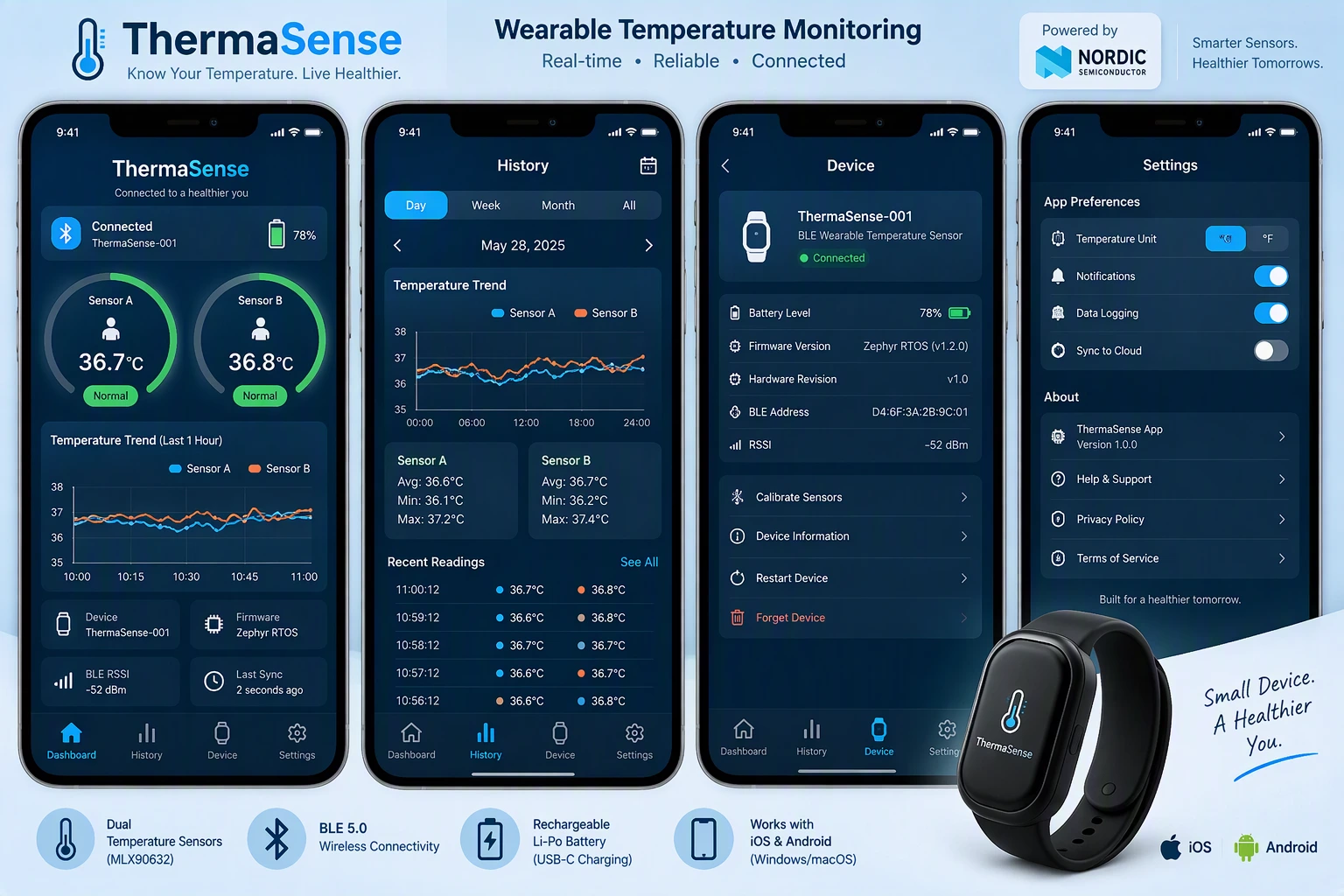
A client engaged Adequate Infosoft to develop ThermaSense, a compact BLE wearable temperature-sensing device. The project consists of the three steps: a working prototype, an integrated prototype of hardware and firmware, and a design ready for the pilot production.
The device consists of the Nordic nRF52840 with Zephyr-based software. The two MLX90632 infrared thermopile sensors have two separate channels for temperature through TCA9548A I²C multiplexer which make it possible to timestamp the data and share it with BLE-compatible devices.
Our firmware team developed the GATT database, which consisted of the base service of device information, the battery service, and a customized 128-bit temperature service that serviced two sensors. The result was an interface that eliminated ambiguities for Bluetooth-enabled devices in Windows, macOS, iOS, and Android.
Sensor readings were checked through calibration and reference comparison during development; the project did not claim regulatory approval or a universal accuracy figure.
The hardware included a lithium-polymer battery that can be recharged, as well as a USB-C charging port. The device used a TP4056 control of the charging process and a DW01/FS8205 circuit for protection, and it had a 3.3 volt NCP114 voltage regulator. Work performed included PCB assembly, firmware development, dual-sensor data acquisition, blue-tooth interface implementation, and product handover.
ThermaSense demonstrates the importance of treating a wearable device as an integrated system: sensor scheduling, I²C, BLE services, battery electronics and host compatibility need to be implemented together. It also shows how to advance from functional prototype to mass production without claiming certified performance metrics.
Relevant Low-Power Wearable Device Development Experience
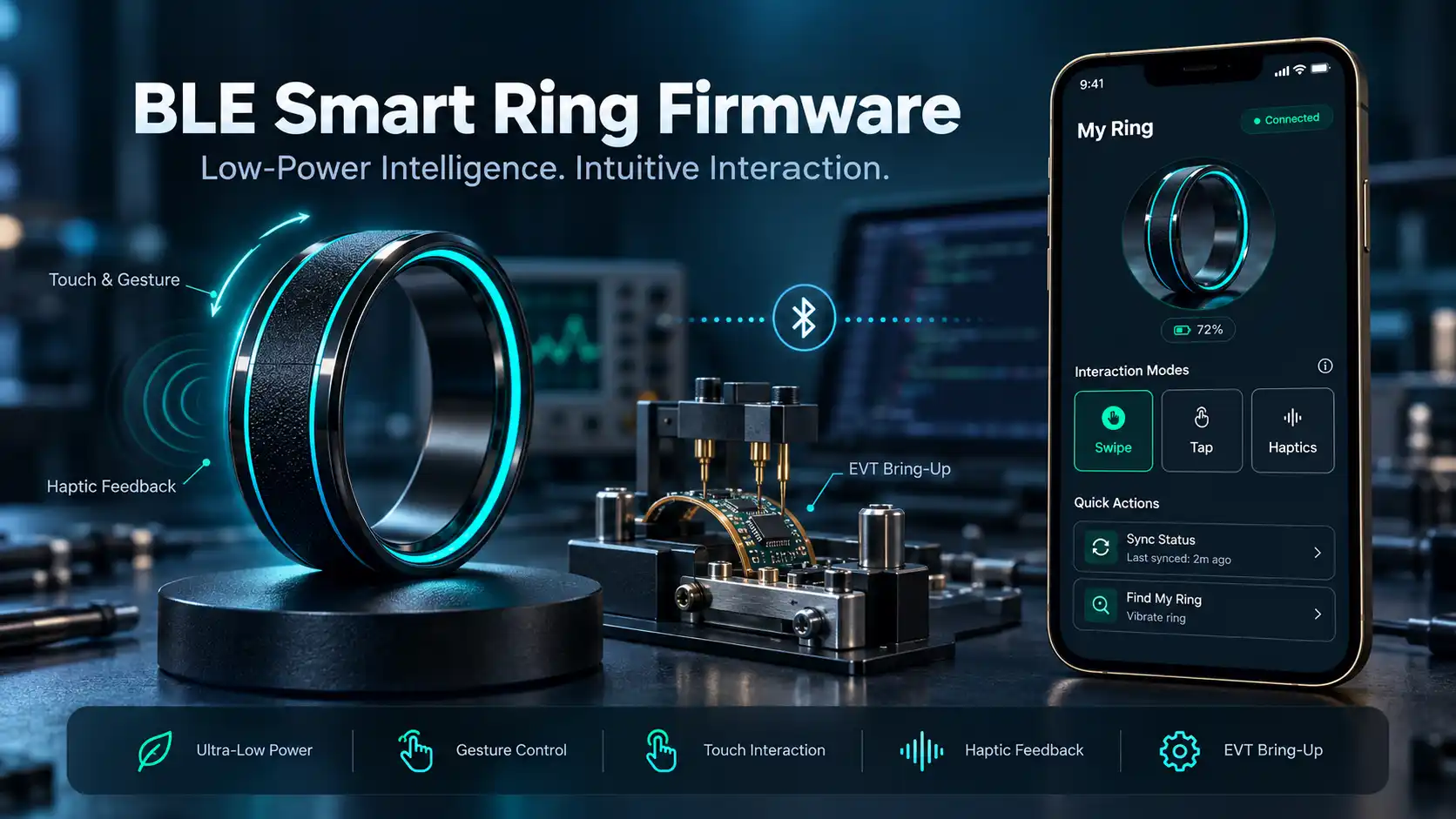
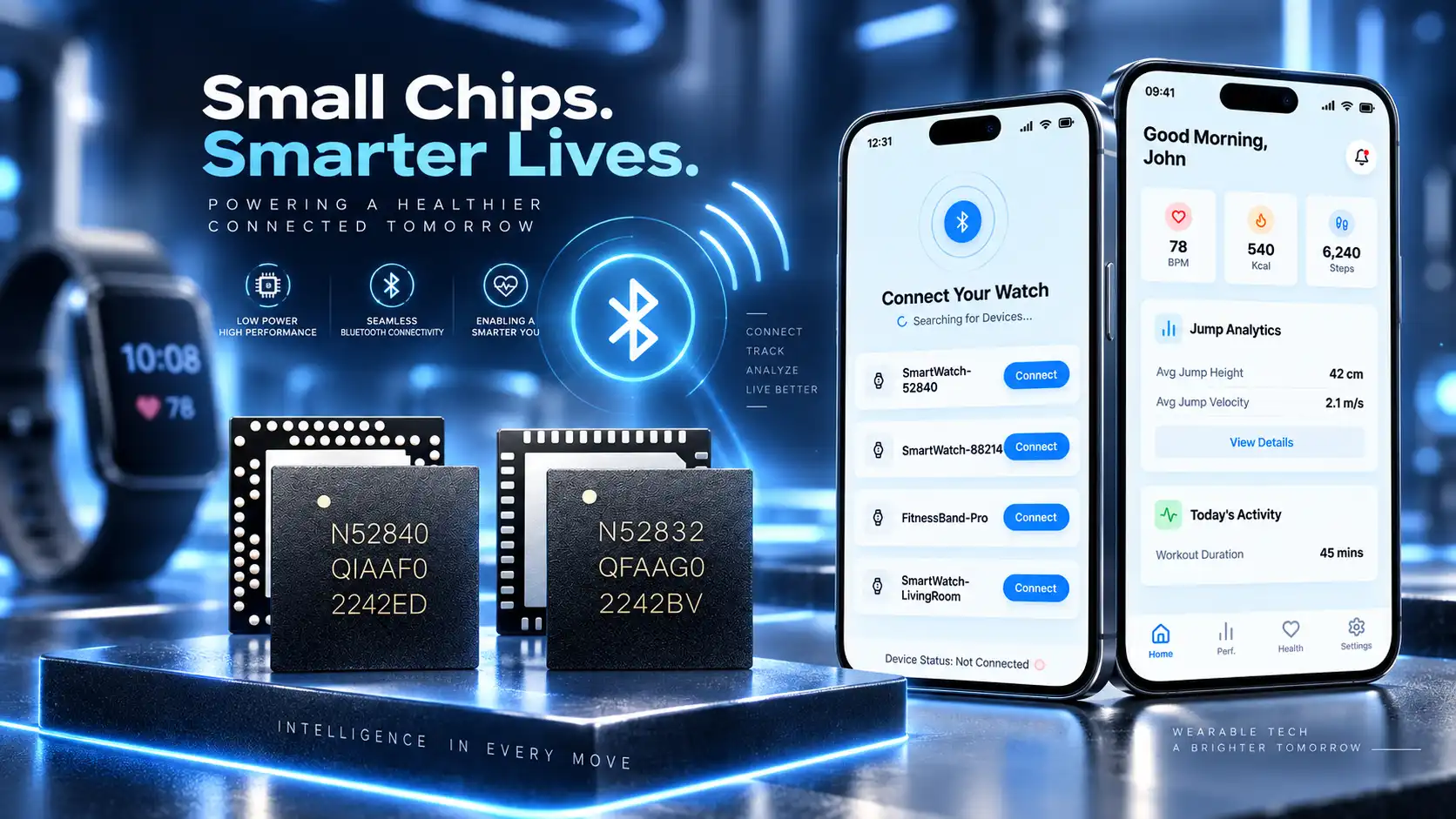
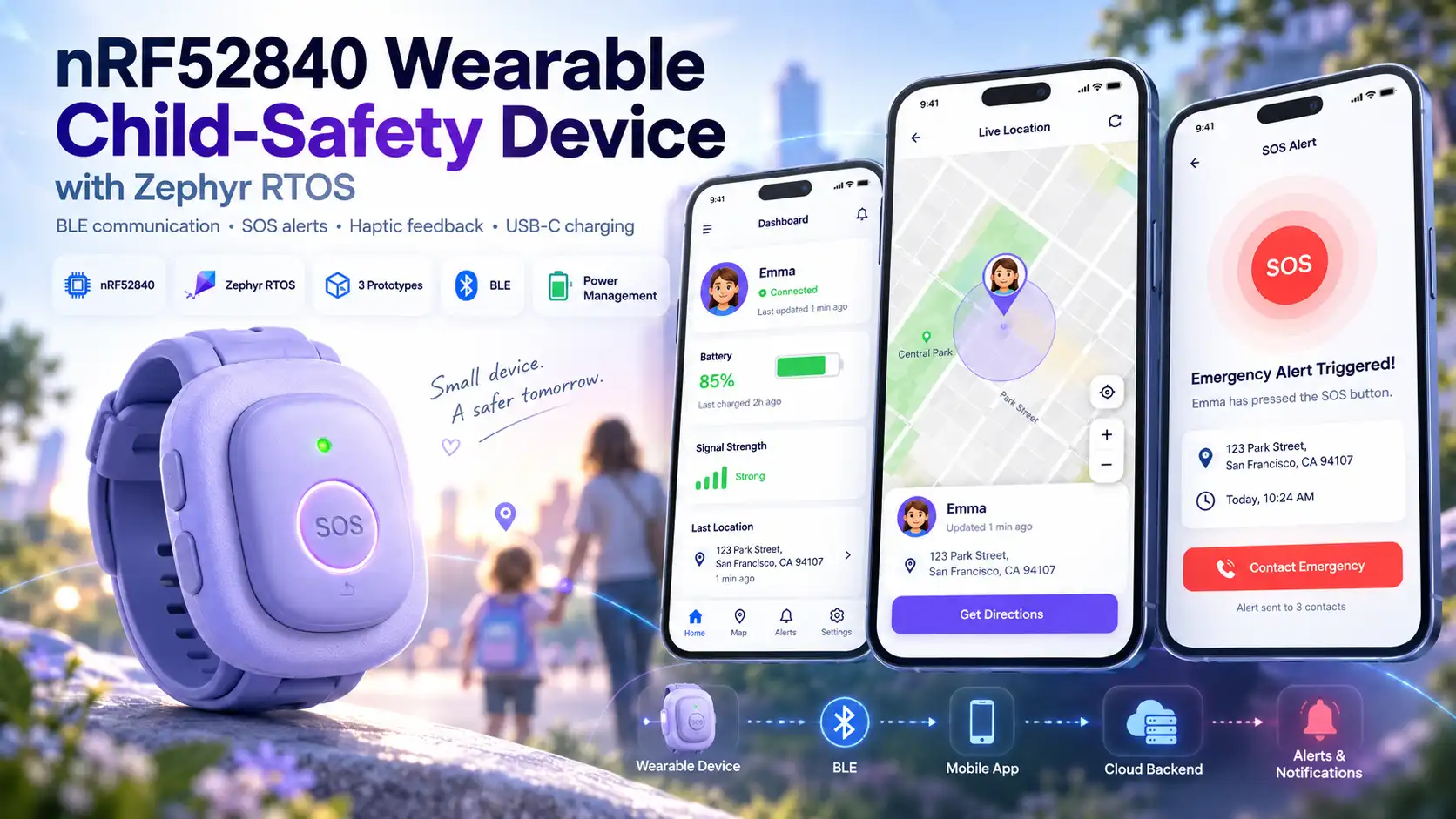
With the help of low-power microcontrollers, our company Adequate Infosoft is working on designing devices that consume less energy. The following sections include some of the projects we implemented in the field of wearables equipped with small form factors, trustworthy connectivity, and long battery life.
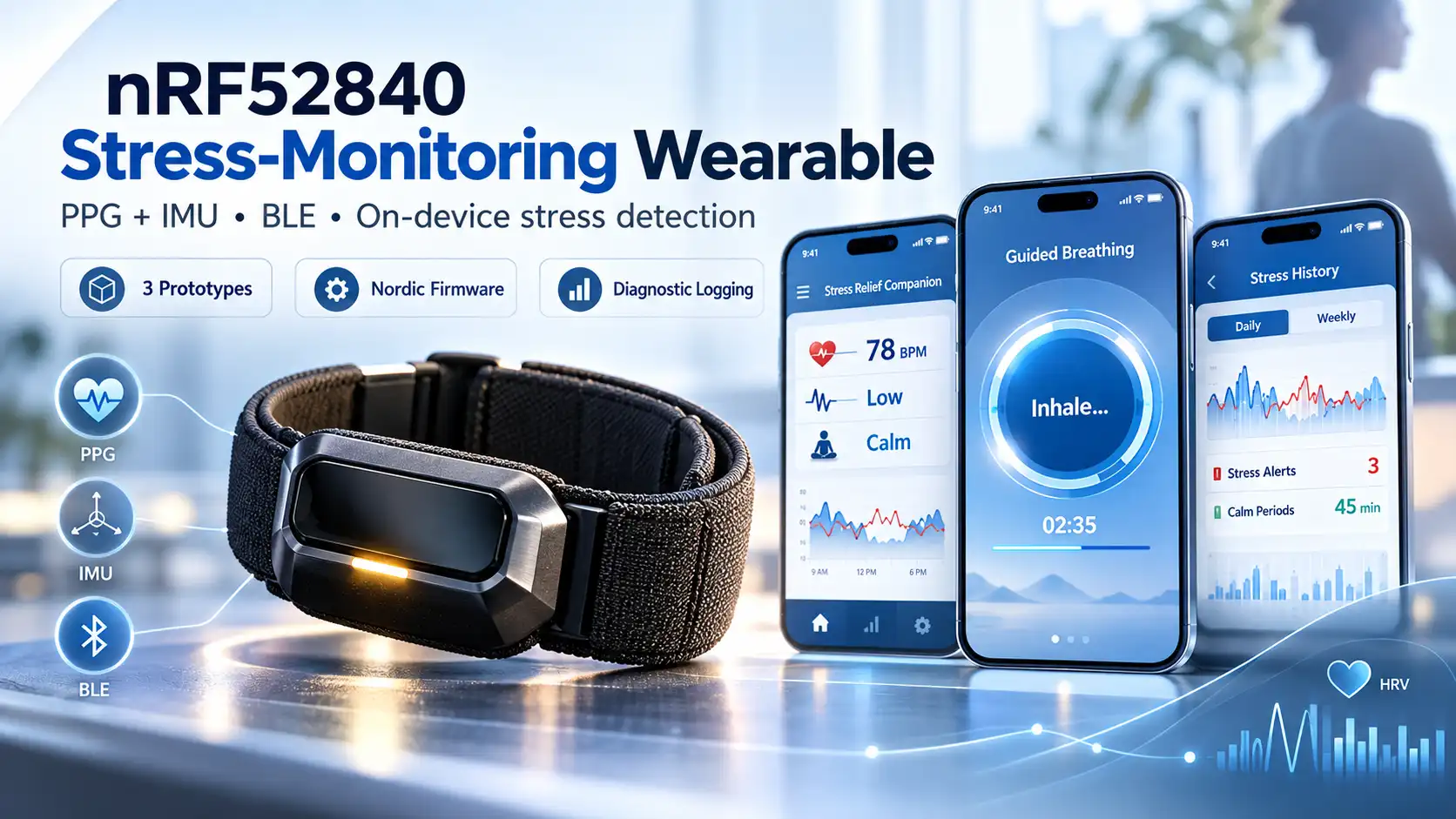
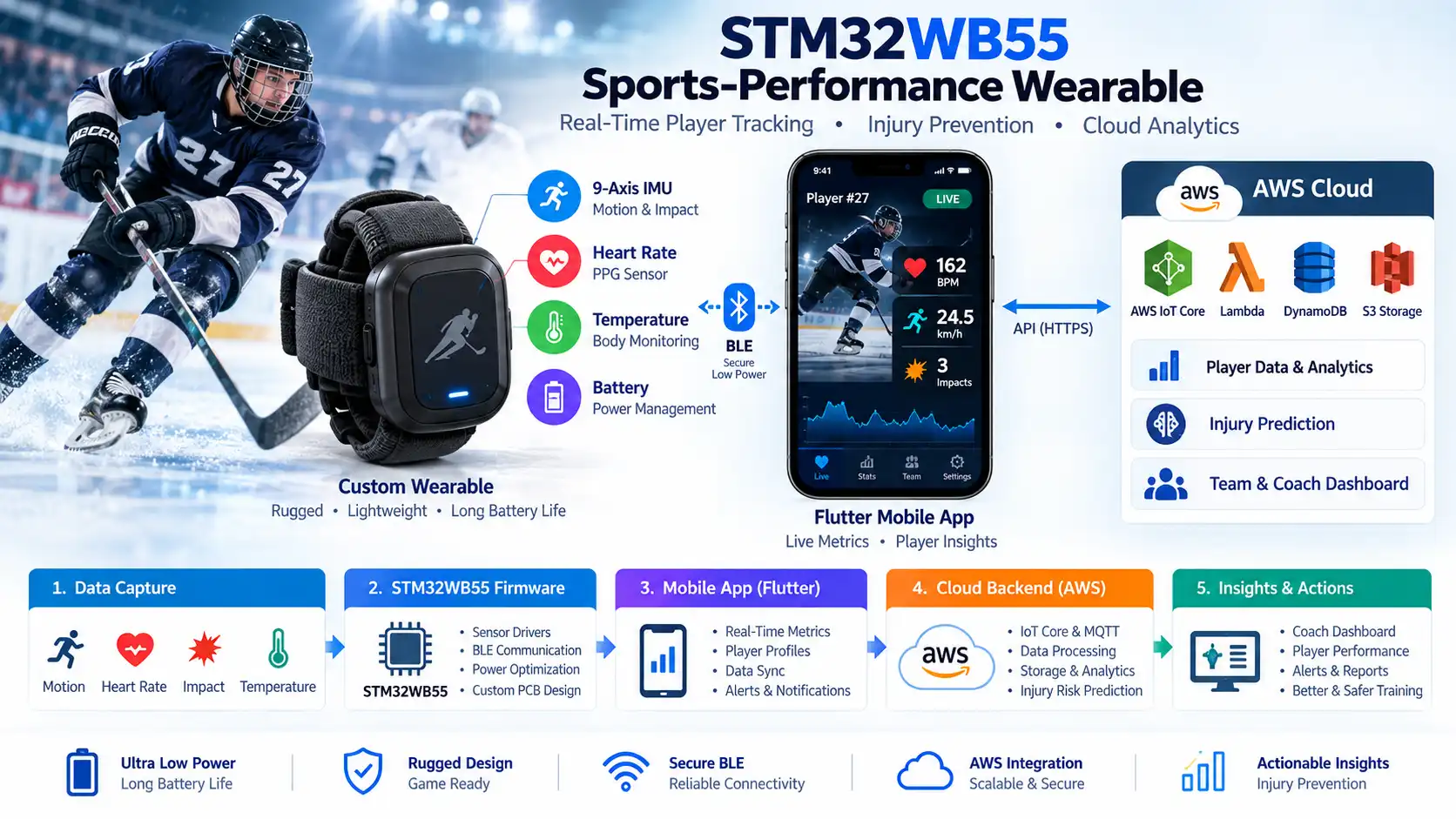
Proven Low-Power Wearable Engineering Experience
These projects demonstrate our ability to optimize complete wearable systems not only firmware.
Our projects involve choosing components, making custom PCBs, obtaining sensor readings, using BLE communication protocols, understanding power management, acquiring data locally, ensuring device is working correctly, IOS and Android platforms.
Battery Life Is a System Requirement, Not a Firmware Patch
Battery-life targets need operating scenarios, not one marketing number. "Seven days" means little without sampling rate, BLE synchronization, display and vibration use, temperature range and battery capacity.
We model realistic modes such as shipping, idle, sensing, processing, advertising, data transfer and firmware update. Hardware measurements then expose radio peaks and unexpected baseline drain.
There are numerous battery-lasting issues such as a sensor that fails to shut down, floating GPIOs, a working debug interface, rapid flash write-ins, an inefficient regulator, over-the-top BLE advertisement as well as an action that hinders the MCU to go into deep sleep.
An example of a runtime power management technology is Zephyr's power management framework which enables devices on standby to be suspended and resumed as required.
However, even though the features available in the Zephyr framework are promising, they must be correctly incorporated in device drivers and application logic as just turning on the configuration setting does not guarantee that power consumption will be low.
Low-Power Firmware and BLE Optimization
We have designed our firmware in an event-based manner. This means that the usage of timers, interrupts and DMA interface permits the processor to operate at standby mode between different events. Respective sensors go into standby based on the schedule of the measurements, while the expensive operations are being batched in order not to generate excessive wakeup signals.
BLE configuration is tuned around the product's latency and data-volume requirements. Advertising interval, connection interval, slave latency, transmit power, payload size and notification strategy all affect energy use.
Silicon Labs' published BLE measurements illustrate the scale of this trade-off: on its referenced configuration, increasing the advertising interval from 100 milliseconds to one second reduced average current by 93%. That is not a universal product result, but it shows why default radio settings should not be carried into production without measurement.
Firmware can timestamp and buffer measurements, recover interrupted transfers, prevent duplicates and reconnect without leaving the radio active indefinitely. Data may be batched rather than transmitted sample by sample.
Wearable PCB, Sensors and Power Electronics
While firmware can certainly improve hardware decisions, wearable PCBs are subject to geometric constraints like area, antenna height, position of measurement scanners, as well as restrictions enforced by manufacturability and usability and the physical laws regarding energy flow.
We work with rigid PCBs, flexible PCs, and rigid-flex circuits; position of antenna; IMU, PPG, ECG, SpO₂ and temperature sensors; low quiescent current regulators; battery charging and battery health measuring solutions, and foundry testing methods.
Our checks include leakage, start-up, voltage drop, peak load, and sensor warm-up checks. The performance of antennas is checked within their mechanical framing, since the body, the battery, and the casing can alter RF aspects of performance.
Choosing a Low-Power Wearable Platform
You cannot define only one qualified wearable MCU. Nordic's nRF52 and nRF54 are strong candidates with good BLE capabilities. STM32U5 and STM32WB can do the job with the low power consumption.
Whereas, Silicon Labs EFR32 is an option for connected projects, and Ambiq Apollo can be used in local graphics applications or edge AI processes. Finally, ESP32 is an option for projects that need Wi-Fi, ecosystem, or cheap solution.
As a case in point, Nordic has designated the nRF52840 with a 64 MHz Arm Cortex-M4F, 1 MB flash, 256 MB RAM, BLE, USB 2.0, and built-in encryption abilities. These characteristics prove beneficial for sophisticated BLE wearables; but ultimately, it is determined by practical battery limitations, size and processing capabilities, pricing among other factors.
We look at the energy used per task, sleep time, radio performance, memory, size, peripherals.
Our Development Process: Concept to Pilot Production
1. Requirements and Power Budget
We transform the concept into quantifiable use cases, sampling templates, synchronization processes and power estimates. Any uncertainties are documented explicitly.
2. Structural Arrangement and Choice of Components
We make the decision concerning the microcontroller unit, sensing instruments, electric supply systems, communication technology, data storage and method of battery charging. The calculations enable identification of the largest load concerning laboratory testing.
3. Validation of the Concept and Creation of the Prototype
Testing of the sensing effectiveness, radiofrequency features, algorithms' workload and charging method starts immediately. The installation of firmware and testing offer the opportunity of finding defects in the energy supply system.
4. Engineering Integration and Optimization
Hardware, firmware, and software undergo tests together. All operating states are thoroughly analyzed, Bluetooth protocol is tuned, storage and power restoration are investigated, and models are rerun with the input data.
5. Validation and Preparing the Manufacturing
We assist in reviewing the product, conducting testing and audits of its functions and manufacturing processes.
Security, OTA and Regulatory Readiness
Wearable devices that are connected must undergo field maintenance. Depending on their risk level, the appropriate measures like authenticated pairing, encrypted storage, signed firmware, secure boot, anti-rollback technique, provisioning, and recoverable OTA need to be applied. The update design includes failure handling and memory budgeting.
Certification requirements depend on the product and sales region. In the United States, RF devices must follow the applicable FCC equipment-authorization procedure before marketing or import. Products using Bluetooth technology may also require Bluetooth qualification.
Medical-device projects need a classification- and market-specific regulatory plan; IEC 62304 defines software lifecycle processes for medical-device software, but following a development process does not by itself certify the finished device.
We support engineering evidence and design controls while working with the client and qualified regulatory specialists on formal approval.
Frequently Asked Questions
We calculate the current draw of each operation mode, its duration and frequency. After the device is operational for the first time, these estimations are substituted with the measurements obtained from a power meter, and tested against realistic use scenarios.
Yes. We profile sleep current and active events, then isolate hardware leakage, sensor behavior, firmware wakeups, radio settings and power-supply losses. Recommendations are prioritized by expected impact and redesign cost.
Absolutely. We can provide a complete wearable system that incorporates all the required elements such as electronics engineering, embedded firmware, Bluetooth Low Energy technology, mobile application development (iOS/Android), and back end APIs and device management functions.
Bluetooth Low Energy is often suitable for short-range devices connecting to a smartphone. Depending on the use case, NFC, Wi-Fi, LTE-M, NB-IoT or GNSS connectivity may be required.
Yes. We can design signed-image verification, secure boot integration, update transfer, rollback or recovery behavior, version control and fleet rollout logic according to the selected platform.
The time depends on the complexity of the product, availability of the enclosure, risk associated with the sensors, regulatory issues and manufacturing considerations. Development of a simple concept might take weeks, while a fully functional wearable passing through EVT, DVT and PVT phases would require several stages of development. We provide the estimate after the discovery phase.