


 Mean Stack Development
 Vue JS Development
 Javascript Development
 React JS Development
 Angular JS Development
 Next JS development
 Java Development
 Python Development
 Django Development
 Cherrypy Development
 C# Development
 ASP.NET Development
 NodeJS Development
 Laravel Development
 CodeIgniter Development
 Zend Development
 Ruby on Rails Development
 CakePHP Development
 PHP Website Development
 Symfony Development
 Drupal Development
 Joomla Development
 Wordpress Development
 .NET Nuke Development
 Kentico
 Umbraco
 .NET MAUI Development
 Xamarin Application Development
 iOS Application Development
 Android Application Development
 Android Wear App Development
 Ionic Development
 iBeacon Application Development
 Universal Windows Platform (UWP)
 Kotlin Application Development
 Swift Application Development
 Flutter Application Development
 PWA Application Development
 Flutter Health Tech & Wearable App Development Company
 React Native Health Tech Wearable App Development
 Offshore Software Development
 Custom Application Development
 Front-End Development
 Full Stack Development
 AI & Machine Learning
 Custom CRM Solutions
 Flask Software Development
 Electron JS Development
 ChatGPT Development
 Telemedicine App Development
 Build Smart Telemedicine Platform
 Beauty & Salon App Solutions
 Hire Workato Experts
 Magento Development
 Magento 2.0 Development
 Magento Enterprise
 Shopping Cart Development
 Prestashop Development
 Shopify Development
 Open Cart Development
 WooCommerce Development
 BigCommerce Development
 NopCommerce Development
 Virto Commerce Development
 AspDotNetStorefront Development
 .NET Application Development
 Microsoft Dynamics CRM
 VB .NET Development
 Sharepoint Migration
 ASP.NET Core Development
 ASP.NET MVC Development
 AJAX Development
 Agile Development
 Microsoft Bot
 Microsoft Blazor
 Microsoft Azure Cognitive
 HTML 5
 UI/UX Design
 Graphic Design
 Adobe Photoshop
 XML Application Development
 Cloud Computing Solutions
 Azure Cloud App Development
 AWS Development
 Google Cloud Development
 Certified AWS IoT Services Developers
 DevOps Consulting & Development
 Kubernetes Consulting & Services
 SQL Programming Development
 MySQL Development
 MongoDB Development
 Big Data
 Robotic Process Automation
 Social Media Marketing
 Search Engine Optimization
 QA Testing
 Software Testing
 Software Security
 Maintenance And Support
 I.T. Consulting Services
 Business Intelligence
 YII Development
 Data Analysis
 Alexa Skills Development
 On Demand App for Mobile repairing services
 On Demand App for Car Service Booking
 On Demand App for Cleaning Services
 On Demand App for Pharmacy
 On Demand Dedicated Developers
 On Demand Lawyer App Development











 Nuki Smart Lock
 Salto Smart Lock
 TTlock Smart Lock
 NFC App Development
 Custom IOT Enabled Smart Lock
 Smart Locker Solutions
 Hospital Smart Lock Systems
 Hotel Smart Lock Systems
 Smart Home & Office Locks
 Smart Access for Schools & Colleges
 Unloc Smart Lock Integration
 Yale & August Smart Lock Integration
 Populife Smart Lock Integration
 Smart Lock Hardware Development
 Dairy IoT Solutions
 Agri IoT & AI Solutions
 Weather & Climate Solutions
 Water & Waste Management Solutions
 RaspBerry Pi
 Firmware Software Development
 ESP 32 Software Development
 Embedded Development
 Internet of Things
 Smart IoT Development
 IoT Sensor Integration & Development Solutions
 Smart IoT System Development for HVAC
 Tuya IoT App Development
 Particle IoT SDK
 IoT Development with AI
 Smart Pet GPS Tracker
 Dairy GPS Tracking Solutions
 GPS Fleet Management Software
 Car Rental & Subscription Solutions
 Car Buy & Sell Marketplace Development
 AI-Powered Car Wash App Development
 PCB Design & Fabrication
 IoT AC Automation
 AI–IoT Painting Solutions
 IoT Wearable Hardware & App Development
 HVAC Automation & AI Control Systems
 Smart Home IoT Engineering
 AI Embedded Systems
 AI Hardware Design Service
 Advanced IoT Hardware & Firmware Development
 Device Driver Development Services
 NXP i.MX RT Firmware & Hardware Services
 Microchip PIC & AVR Development
 Hire IoT Architects
 IoT Cloud & Infrastructure Solutions
 Infineon XMC / AURIX Development Services
 Matter & Thread IoT Services
 Native IoT Mobile App Development (BLE & Wi-Fi)
 Snapdragon IoT Firmware Development
 Renesas RA/RX Firmware Services
 Silicon Labs EFR32 Development Services
 Smart Wearable App Development
 Smart IoT Meters
 Smart Healthcare Wearable App Development
 Health Care Monitoring System
 Fitness Tracking App Development
 Smart Home Automation Apps
 nRF PCB Design
 ESP32 PCB Design
 Embedded Wearables Engineers
 Rental Property Management System
 Building Management System
 Smart Lighting Development
 Infineon Semiconductor Firmware Development Services
 Custom Camera Development: Hardware, Firmware & PCB Prototyping
 Smart Security Camera SDK
 Nordic Semiconductor SDK
 Infineon SDK
 Arduino SDK
 NFC Lock Integration
 Kerong Lock Integration
 IoT & AI Solutions for Manufacturing
 Smart Inventory & Logistics Solution
 Food & Beverage Industry Solutions
 Smart Hospitality Solutions
 Smart Property Management
 Custom Smart Home IOT SDK
 Smart IoT & AI in Healthcare
 AI-Powered Security Solutions
 Smart Home Safety & AI
 Veterinary Clinic Management (AI)
 Pet Care System (AI & IoT)
 Pet Training & Adoption (AI)
 Healthcare IoT Development
 Event Management Software
 Money Remittance App
 Money Lending App Development
 Utility and Bill Payment App
 IoT Mobile App Development (Flutter & React Native)
 AI & IoT Retail Solutions
 Smart EV App Development
 Smart Solar IoT & AI Solutions
 IoT-Based Energy Systems
 Smart Energy & Utilities Solutions
 6G Solutions
 IoT Security Solutions
 AI-Powered Lottery App Development
 AI-Sports Fitness Club Management
 Travel
 Real Estate
 Medical & Healthcare
 e-Learning
 Consumer Products
 Finance
 Automobile
 Media & Entertainment
 Billing Software
 Enterprise Resource Planning (ERP)
 Augumented & Virtual Reality
 Point of Sale(POS) Development
 Learning Management System
 EV Charging Solutions
 About Us
 Partners & Certifications
 Quality Assurance
 Our Clients & Testimonials
 Development Process
 Our Products
 Social Responsibility
 Work Ethics
 Vision & Mission
 Awards
 Live Project Demos
 Contact Us
 Case Studies
 Portfolio
 Blog
UWB Positioning Firmware Development Services | Precise Indoor Tracking Solutions
Ultra-wideband (UWB) technology is transforming the way connected devices detect their position. UWB is different from traditional positioning systems such as Bluetooth or Wi-Fi because it uses the time of flight of radio signals to determine the distance between devices with high accuracy.
The technology is a great candidate for various applications that include real-time location tracking, secure access to spaces, indoor navigation, safety of workers, tracking of items, smart manufacturing facilities, hospitals, storages, sports and wearables.
At Adequate Infosoft, we develop UWB positioning firmware for companies building reliable location-aware products. Our embedded engineering team works across firmware architecture, UWB ranging, anchor and tag communication, sensor fusion, mobile integration, cloud connectivity, testing and production readiness.
Whether you are validating a proof of concept or building a scalable commercial RTLS platform, we help turn UWB hardware into a dependable product.
Let's Work Together!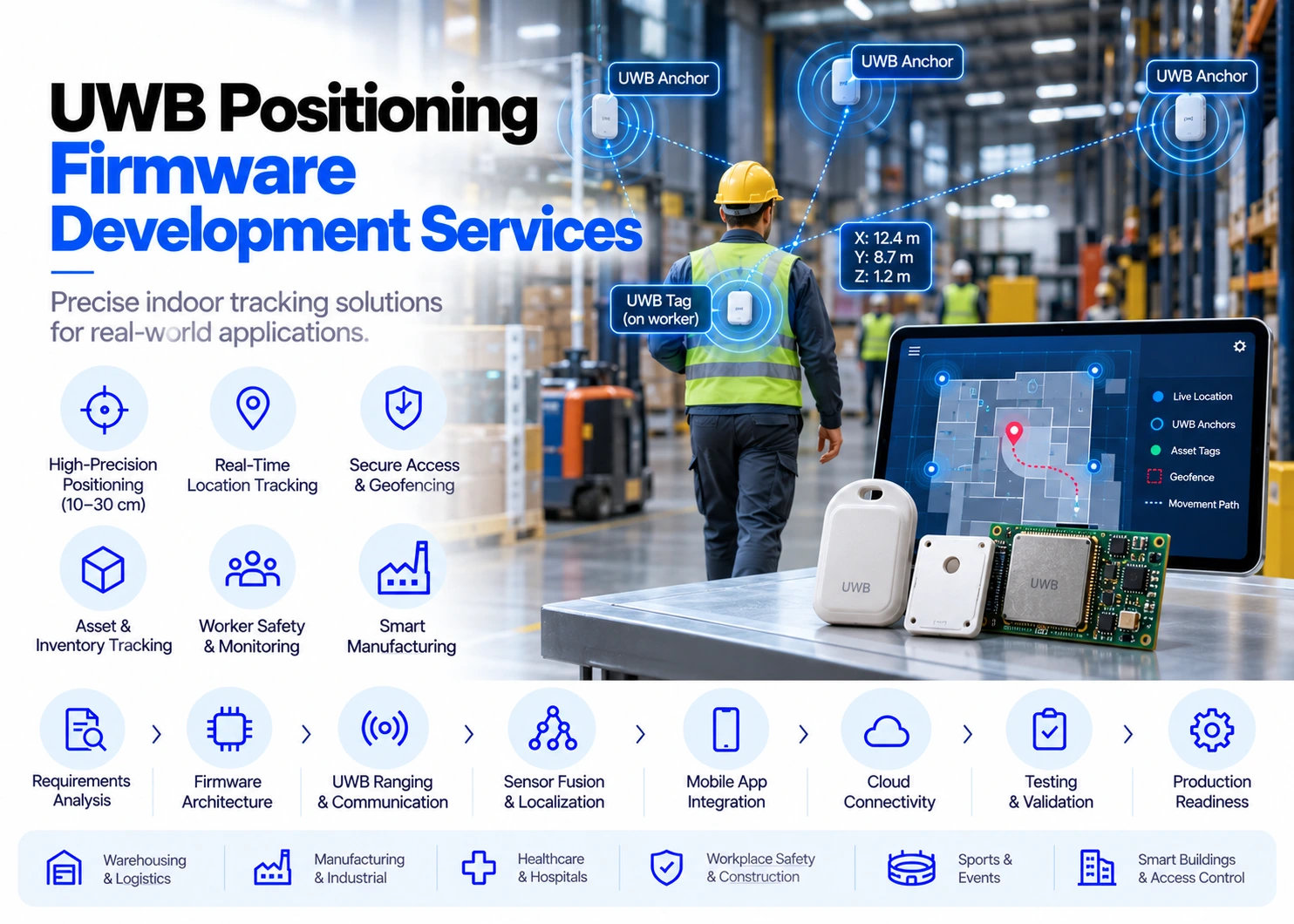
What Is UWB Positioning Firmware?
UWB positioning firmware is a piece of software that helps in the radio communication and determines the distance between the devices and the location by providing the information to the third systems through various means.
UWB Positioning Firmware is used in UWB technology-enabled microcontrollers and communication devices and handles the timely exchange of messages between the devices, tuning of the antenna, filtering of the measurements, and providing location data to users.
Reliable firmware must deal with real-world conditions such as mobility of the users, metal obstacles, low battery levels, and interference from other devices in the vicinity.
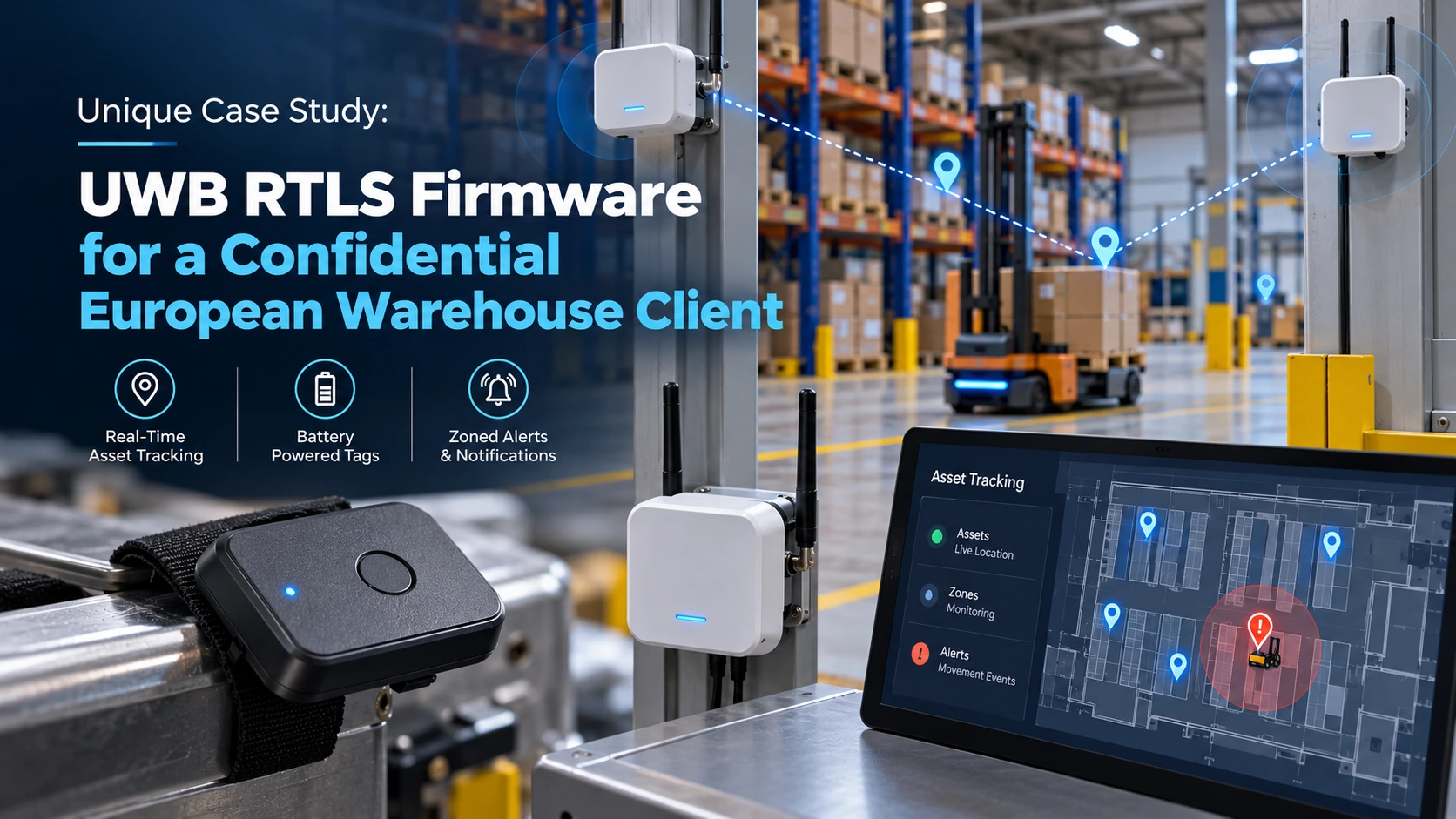
Unique Case Study: UWB RTLS Firmware for a Confidential European Warehouse Client
The Client Requirement
A client from Europe in logistics and manufacturing sought an indoor positioning system for enhanced visibility of high-value equipment, mobile tools, and safety-sensitive work areas.
According to scans via barcodes, the item's location is only visible to the operational team, but they desire that information to be available almost in real-time without requiring operators to scan the items every now and then.
The customer wanted a UWB tag to be powered by a battery that can be attached to reusable devices, fixed anchors that can be set up in different operational areas, as well as a control panel that can show the current position, down status, and notifications about unauthorized movements.
The set up also had to work in a metal-oriented environment with storage shelves, moving carts, and a broken line of sight.
Firmware and System Architecture
The embedded firmware created by our team is based on the use of ultra-wideband (UWB) tags, stationary anchors, and an edge gateway.
The tags used to function have a power-efficient microcontroller containing a UWB module, an accelerometer, and a battery monitoring circuit in their structure. Motion detection enables operation of the tags in the power-saving mode in case of no motion; when the movement is identified, the tag starts the ranging operation.
As for location determination, the anchors perform the timing measurements; then they send the data to the gateway through the reliable local network.
The gateway was a method of filtering measurements to eliminate incorrect readings by checking the quality of the distance and calculating the estimated position of tags based on information from different anchors.
We implemented flexible zone limits that let the system execute an action when the equipment moves to a designated area or exits a given location.
The firmware consisted of encryption for checked settings, identification of unique devices, recovery through the watchdog process, support in diagnosis, and many logs for further assistance.
The calibration program helped connection points to be assigned coordinates, antenna-delay settings adjusted, and coverage checked.
Engineering Challenges and Outcome
Reflections from metal shelving created occasional range outliers. Instead of presenting every raw measurement to the dashboard, we implemented confidence thresholds, rolling median filtering and position smoothing.
Measurements with weak quality indicators were ignored when stronger anchor readings were available.
The other key consideration was battery life. With the use of adaptive reporting, the tags transmitted less information when stationary and more frequently on the move using a combination of timely tracking and sensible maintenance intervals.
The completed solution provided the customer with a ready-to-use firmware foundation for indoor asset tracking, zoned alerts and future possibilities of moving into automated worker safety and workflow analytics systems.
This venture illustrates necessary engineering particulars for the UWB solution which includes radio timings, RF and power optimisation processes, different kinds of diagnostics, and business events.
Relevant Adequate Infosoft Experience
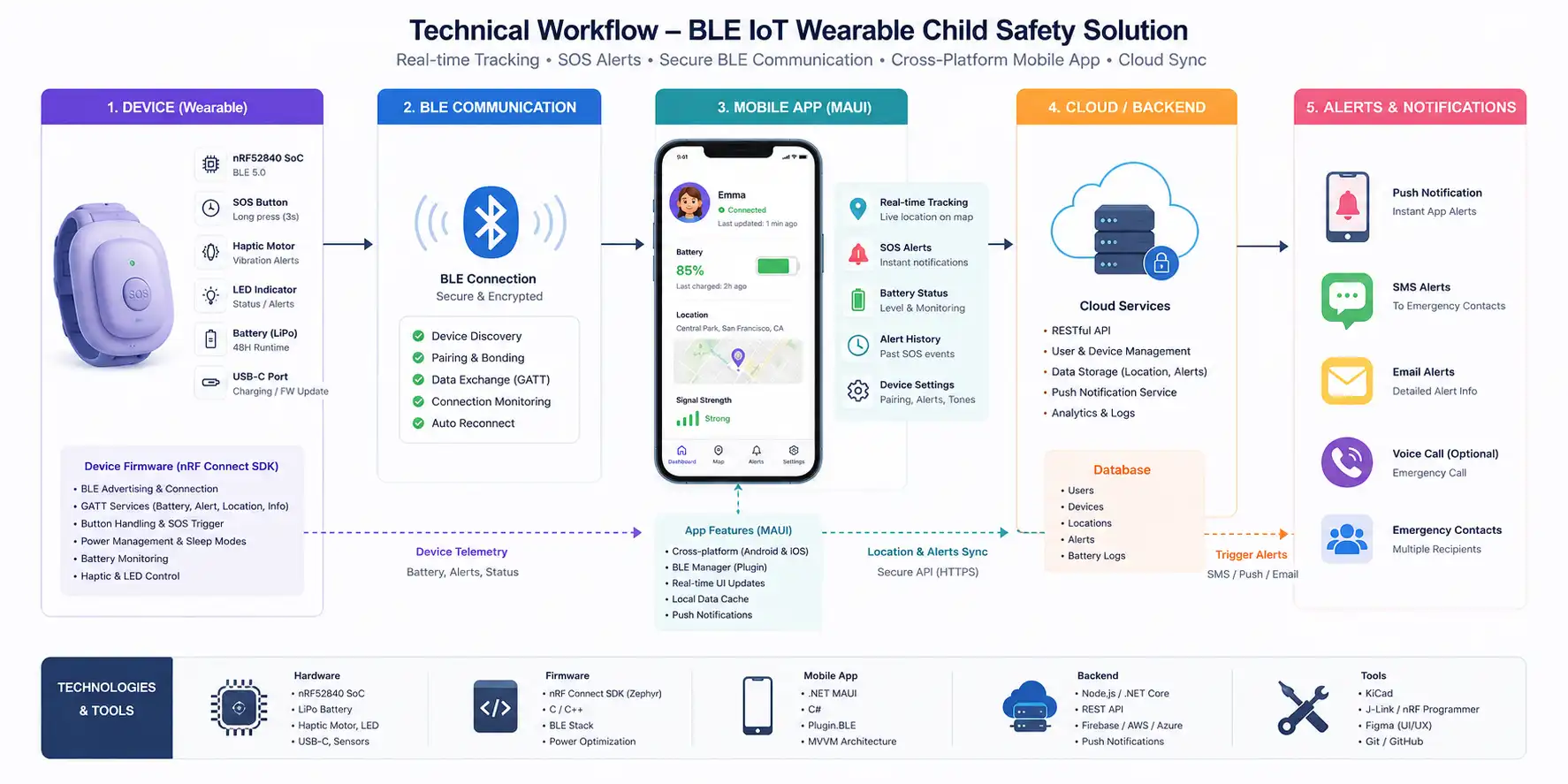
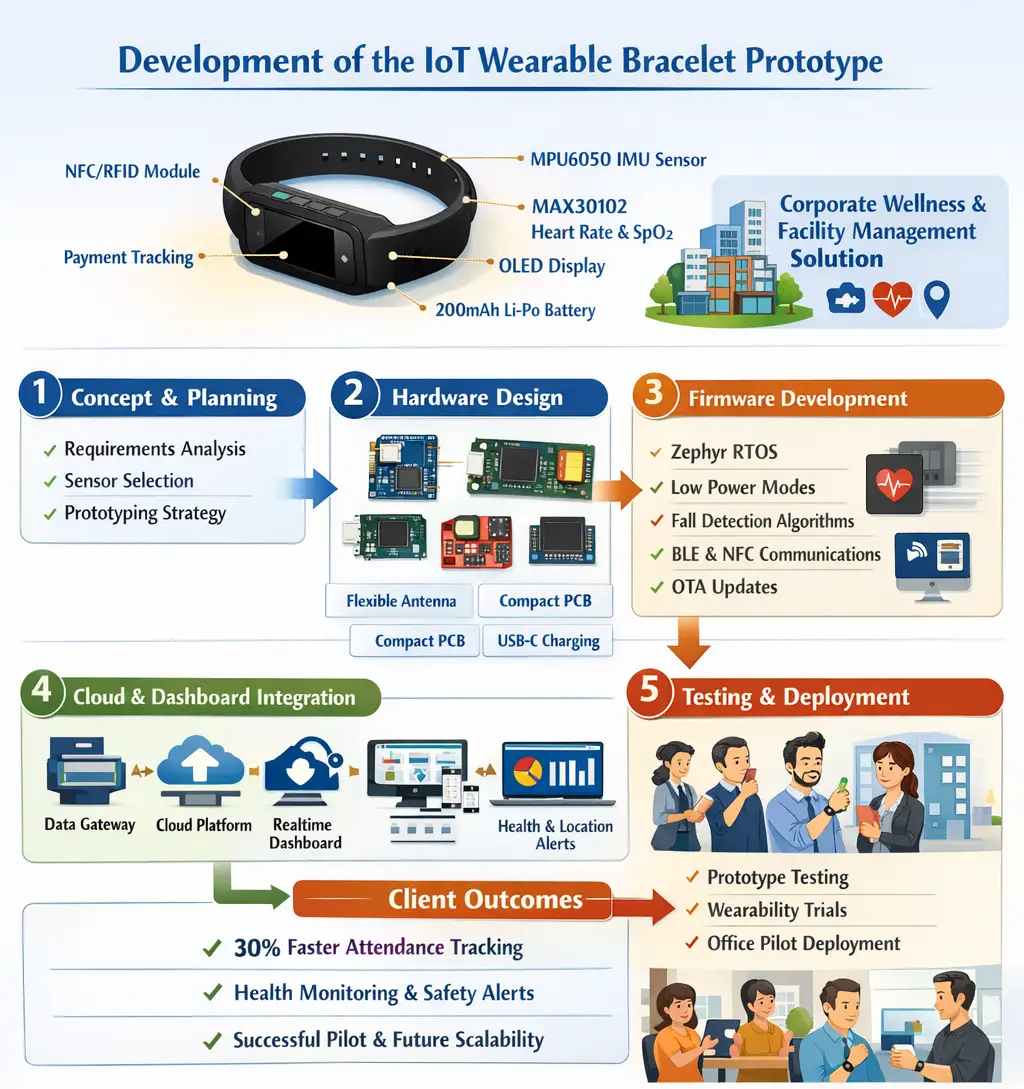
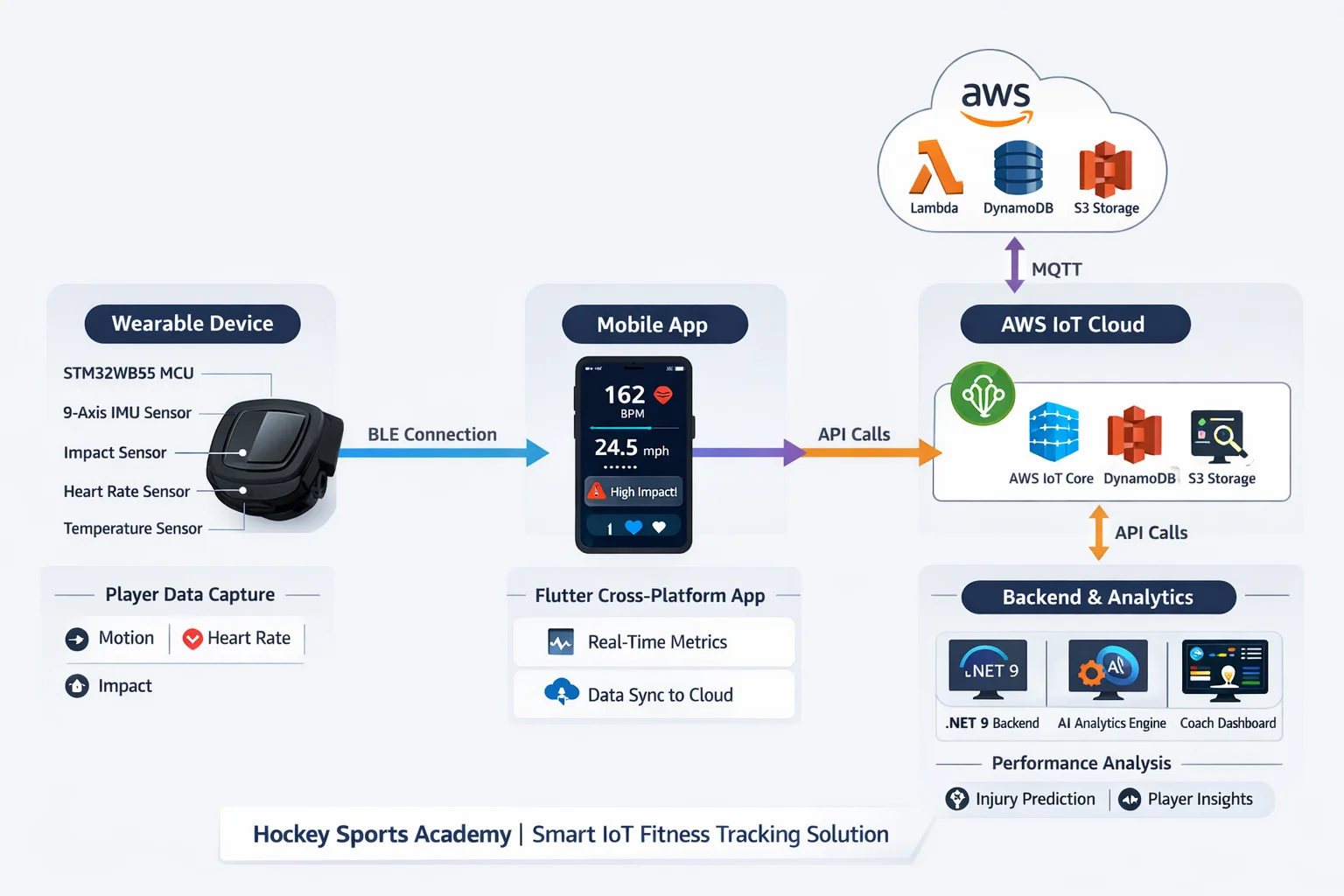
Our UWB work is supported by broader experience in embedded firmware, connected wearables, IoT tracking, Bluetooth Low Energy, secure access and mobile/cloud integration.
Our UWB Firmware Development Capabilities
UWB Ranging and Positioning Algorithms
We create Ultra-wideband firmware using both single-ended and double-ended two-way ranging (TWR) and time-difference-of-arrival (TDoA) topologies, which are chosen based on the time of flight metrics, battery duration, signal frequency and density of the tags.
We're capable of estimating distances, scheduling messages, using the multi-anchor trilateration method, synchronising clocks in anchors, calibrating antenna time delays, correcting for non-line-of-sight effects, scoring a communication channel, smoothing locations, dropping outliers, geo-fencing, and detecting closeness.
We tailor positioning logic to real-world applications, from warehouse zone monitoring to precise medical equipment tracking, balancing positioning accuracy, system complexity, and power consumption for reliable performance and scalable deployment.
Firmware for UWB Tags, Anchors and Gateways
Our team is engaged in creating firmware for all segments of the UWB device family, not just a wearable tag. This implies creating firmware for fixed anchors, battery-powered tags, moving beacons and bridges for communication between them.
Regarding tags, our firmware is focused on minimal energy consumption, motion-based wake-up, adjustable distance measurement, battery report, and safe firmware updates over the air.
For anchors, firmware implements continuous listening, network synchronization, system health monitoring, and communication between layers with the help of Ethernet, Wi-Fi, BLE, LTE-M, NB-IoT, and LoRaWAN.
We also build gateway firmware that collects measurements locally and forwards structured messages to cloud APIs or on-premise systems using MQTT, HTTPS, WebSockets or custom protocols.
Hardware and RF-Aware Embedded Development
UWB accuracy depends on antenna placement, PCB ground planes, enclosure materials, power noise, and calibration. Our firmware engineers collaborate with hardware and PCB specialists to identify issues early and improve ranging performance.
We provide support for appropriate UWB platforms for Qorvo, NXP, and Nordic Semiconductor. Some of the services we offer include board bring-up, SPI and interrupt driver development, sleep-mode optimisation, RF configuration, as well as production calibration tools and manufacturing-testing firmware necessary for producing reliable, accurate, and factory-ready UWB devices.
Secure UWB Access and Proximity Features
Various applications such as creating digital keys, opening smart locks, gaining access to vehicles, and handing over devices safely are using UWB technology. This technology will help to differentiate genuine proximity from the one conveyed through a signal.
We create firmware designed for the measuring distance process, for session control, for generating cryptographic keys, for performing authenticated commands, and for defining time-constrained access rules.
For connected access products, we can combine UWB with BLE, NFC, RFID, biometrics or cloud authorisation. The result is a practical user journey: discover the device through BLE, verify close physical proximity through UWB and then perform the approved action.
How We Build a Reliable UWB Product
The very first thing you need to pay attention to in order to start UWB-based projects is to determine environment type, accuracy, repeated update requirements, and the number of tags, obstacles, battery requirements, and integration scope.
Our engineers create firmware designs that are able to manage wireless channel allocation and state control, data transmission, energy consumption, storage of information, and restore function in case of malfunction.
We conduct tests under harsh conditions such as packet losses, tag movements, dead batteries, anchor on/off processes, and analyze link competence.
For the successful scaling of deployments, we deploy device provisioning, version management, remote diagnostics, and OTA updates.
Why Choose Adequate Infosoft for UWB Development?
Success of UWB projects depends upon the integration of embedded firmware, radio function patterns, hardware limitations, and product workflows.
Our team is fully capable of assisting you on every step of the way, from analyzing the feasibility of the project and developing prototype firmware to developing mobile applications, cloud dashboards, and maintaining equipment in the field.
We work transparently, define measurable acceptance criteria and test in conditions close to the final deployment environment. Clients receive maintainable source code, technical documentation, deployment guidance and engineering support appropriate to the product stage.
Frequently Asked Questions
The accuracy of the technology depends on the characteristics of the hardware used, the environment, and the installed hardware configuration. In theory, UWB systems can offer an accuracy level of up to a few centimeters, yet the implementation still needs to be tested in a specific building in order to verify the performance and efficiency of the setup due to external factors that may impact the efficiency of the application.
Yes. BLE and UWB work well together. BLE can provide discovery, pairing, basic connectivity and low-power control, while UWB provides precise distance or positioning when required.
The answer is yes. We make custom-designed UWB firmware, Android and iOS mobile applications, web dashboards, cloud APIs, gateway services, and conduct integration with the ERP system, access-control systems, and inventory-control systems if needed.
Yes, battery life will rely on factors such as the frequency of reporting, architecture of ranging, patterns of movement, size of batteries, and firmware optimization. We adapt our design for scheduling processes and sleeping modes according to the expected maintenance cycle.
Yes. UWB can support secure proximity verification for smart locks, vehicle access, lockers, equipment handover and restricted-area access when combined with suitable authentication and authorisation controls.
Provide us with your use case, layout of building, accuracy required, number of devices needed, battery life target, environment, integration needs, and security requirements. We will then advise you on the best hardware and firmware architecture.