


 Mean Stack Development
 Vue JS Development
 Javascript Development
 React JS Development
 Angular JS Development
 Next JS development
 Java Development
 Python Development
 Django Development
 Cherrypy Development
 C# Development
 ASP.NET Development
 NodeJS Development
 Laravel Development
 CodeIgniter Development
 Zend Development
 Ruby on Rails Development
 CakePHP Development
 PHP Website Development
 Symfony Development
 Drupal Development
 Joomla Development
 Wordpress Development
 .NET Nuke Development
 Kentico
 Umbraco
 .NET MAUI Development
 Xamarin Application Development
 iOS Application Development
 Android Application Development
 Android Wear App Development
 Ionic Development
 iBeacon Application Development
 Universal Windows Platform (UWP)
 Kotlin Application Development
 Swift Application Development
 Flutter Application Development
 PWA Application Development
 Flutter Health Tech & Wearable App Development Company
 React Native Health Tech Wearable App Development
 Offshore Software Development
 Custom Application Development
 Front-End Development
 Full Stack Development
 AI & Machine Learning
 Custom CRM Solutions
 Flask Software Development
 Electron JS Development
 ChatGPT Development
 Veterinary Telemedicine App Development
 Build Smart Telemedicine Platform
 Beauty & Salon App Solutions
 Hire Workato Experts
 Magento Development
 Magento 2.0 Development
 Magento Enterprise
 Shopping Cart Development
 Prestashop Development
 Shopify Development
 Open Cart Development
 WooCommerce Development
 BigCommerce Development
 NopCommerce Development
 Virto Commerce Development
 AspDotNetStorefront Development
 .NET Application Development
 Microsoft Dynamics CRM
 VB .NET Development
 Sharepoint Migration
 ASP.NET Core Development
 ASP.NET MVC Development
 AJAX Development
 Agile Development
 Microsoft Bot
 Microsoft Blazor
 Microsoft Azure Cognitive
 HTML 5
 UI/UX Design
 Graphic Design
 Adobe Photoshop
 XML Application Development
 Cloud Computing Solutions
 Azure Cloud App Development
 AWS Development
 Google Cloud Development
 Certified AWS IoT Services Developers
 DevOps Consulting & Development
 Kubernetes Consulting & Services
 SQL Programming Development
 MySQL Development
 MongoDB Development
 Big Data
 Robotic Process Automation
 Social Media Marketing
 Search Engine Optimization
 QA Testing
 Software Testing
 Software Security
 Maintenance And Support
 I.T. Consulting Services
 Business Intelligence
 YII Development
 Data Analysis
 Alexa Skills Development
 On Demand App for Mobile repairing services
 On Demand App for Car Service Booking
 On Demand App for Cleaning Services
 On Demand App for Pharmacy
 On Demand Dedicated Developers
 On Demand Lawyer App Development









 Nuki Smart Lock
 Salto Smart Lock
 TTlock Smart Lock
 NFC App Development
 Custom IOT Enabled Smart Lock
 Smart Locker Solutions
 Hospital Smart Lock Systems
 Hotel Smart Lock Systems
 Smart Home & Office Locks
 Smart Access for Schools & Colleges
 Unloc Smart Lock Integration
 Yale & August Smart Lock Integration
 Populife Smart Lock Integration
 Smart Lock Hardware Development
 Dairy IoT Solutions
 Agri IoT & AI Solutions
 Weather & Climate Solutions
 Water & Waste Management Solutions
 RaspBerry Pi
 Firmware Software Development
 ESP 32 Software Development
 Embedded Development
 Internet of Things
 Smart IoT Development
 IoT Sensor Integration & Development Solutions
 Smart IoT System Development for HVAC
 Tuya IoT App Development
 Particle IoT SDK
 IoT Development with AI
 Smart Pet GPS Tracker
 Dairy GPS Tracking Solutions
 GPS Fleet Management Software
 Car Rental & Subscription Solutions
 Car Buy & Sell Marketplace Development
 AI-Powered Car Wash App Development
 PCB Design & Fabrication
 IoT AC Automation
 AI–IoT Painting Solutions
 IoT Wearable Hardware & App Development
 HVAC Automation & AI Control Systems
 Smart Home IoT Engineering
 AI Embedded Systems
 AI Hardware Design Service
 Advanced IoT Hardware & Firmware Development
 Device Driver Development Services
 NXP i.MX RT Firmware & Hardware Services
 Microchip PIC & AVR Development
 Hire IoT Architects
 IoT Cloud & Infrastructure Solutions
 Infineon XMC / AURIX Development Services
 Matter & Thread IoT Services
 Native IoT Mobile App Development (BLE & Wi-Fi)
 Snapdragon IoT Firmware Development
 Renesas RA/RX Firmware Services
 Silicon Labs EFR32 Development Services
 Smart Wearable App Development
 Smart IoT Meters
 Smart Healthcare Wearable App Development
 Health Care Monitoring System
 Fitness Tracking App Development
 Smart Home Automation Apps
 nRF PCB Design
 ESP32 PCB Design
 Embedded Wearables Engineers
 Rental Property Management System
 Building Management System
 Smart Lighting Development
 Infineon Semiconductor Firmware Development Services
 Custom Camera Development: Hardware, Firmware & PCB Prototyping
 Smart Security Camera SDK
 Nordic Semiconductor SDK
 Infineon SDK
 Arduino SDK
 NFC Lock Integration
 Kerong Lock Integration
 IoT & AI Solutions for Manufacturing
 Smart Inventory & Logistics Solution
 Food & Beverage Industry Solutions
 Smart Hospitality Solutions
 Smart Property Management
 Custom Smart Home IOT SDK
 Smart IoT & AI in Healthcare
 AI-Powered Security Solutions
 Smart Home Safety & AI
 Veterinary Clinic Management (AI)
 Pet Care System (AI & IoT)
 Pet Training & Adoption (AI)
 Healthcare IoT Development
 Event Management Software
 Money Remittance App
 Money Lending App Development
 Utility and Bill Payment App
 IoT Mobile App Development (Flutter & React Native)
 AI & IoT Retail Solutions
 Smart EV App Development
 Smart Solar IoT & AI Solutions
 IoT-Based Energy Systems
 Smart Energy & Utilities Solutions
 6G Solutions
 IoT Security Solutions
 AI-Powered Lottery App Development
 AI-Sports Fitness Club Management
 Travel
 Real Estate
 Medical & Healthcare
 e-Learning
 Consumer Products
 Finance
 Automobile
 Media & Entertainment
 Billing Software
 Enterprise Resource Planning (ERP)
 Augumented & Virtual Reality
 Point of Sale(POS) Development
 Learning Management System
 EV Charging Solutions
 About Us
 Partners & Certifications
 Quality Assurance
 Our Clients & Testimonials
 Development Process
 Our Products
 Social Responsibility
 Work Ethics
 Vision & Mission
 Awards
 Live Project Demos
 Contact Us
 Case Studies
 Portfolio
 Blog
Firmware Debugging & Performance Optimization Services
The Adequate Infosoft offers firmware debugging and optimization services for embedded systems, IoT devices, industrial machines, wearables, smart home appliances, connected appliances, automotive electronics, and any kind of custom hardware.
We get to know the real underlying cause for any faulty firmware and improve on the components of the system pertaining to stability, speed, energy consumption, memory, wireless, and durability of your product.
We work with STM32, ESP32, Nordic nRF52/nRF53/nRF54, NXP i.MX RT, Silicon Labs EFR32, TI, Microchip, Renesas, Infineon, ARM Cortex-M series, FreeRTOS, Zephyr RTOS, bare metal firmware, Linux-based embedded systems, and legacy firmware.
Whatever problem you have with a prototype, a field case, a manufacturing issue, or slow device performance, we will provide you with a structured debugging process that translates observations into tangible fixes.
Let's Work Together!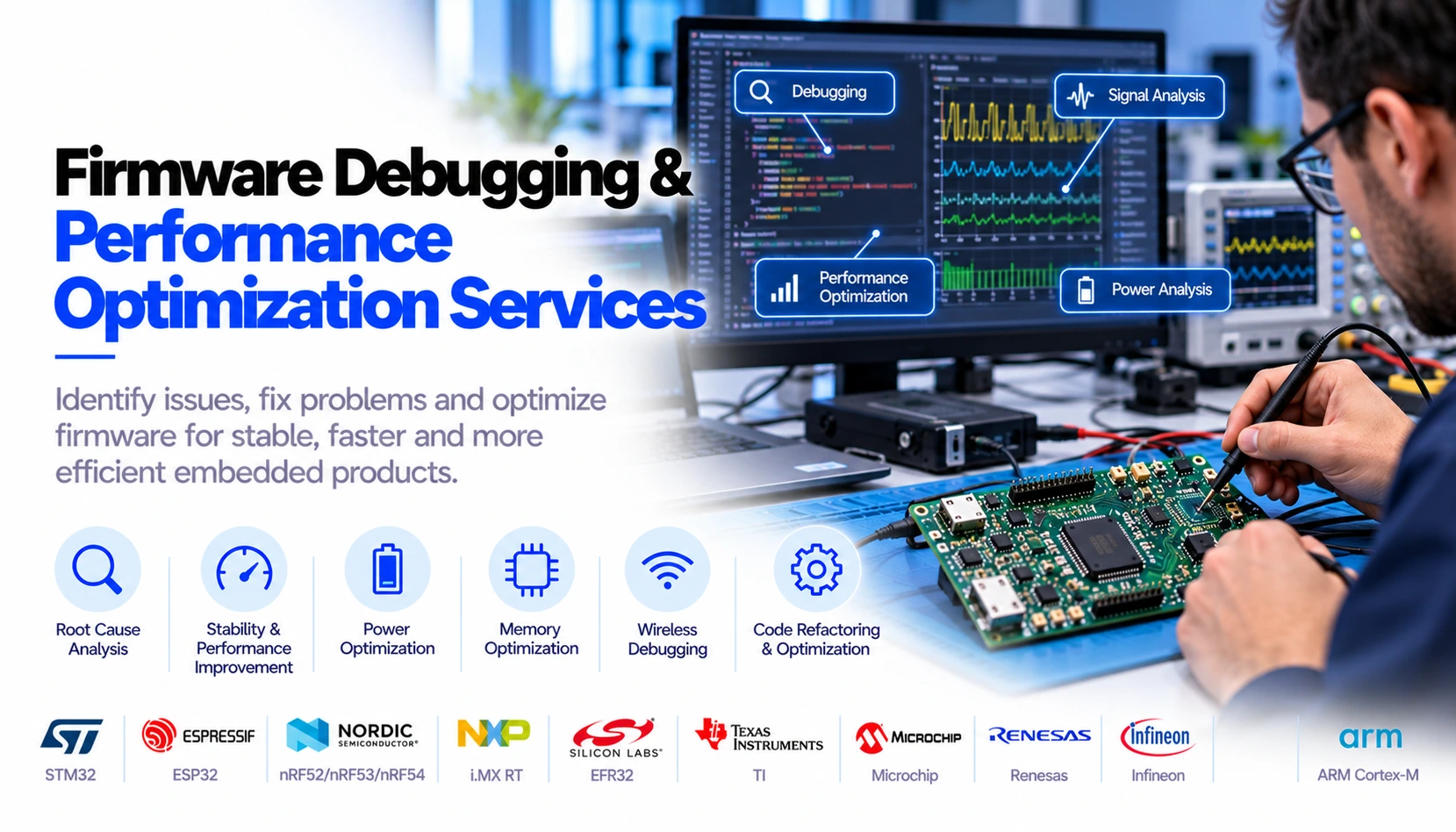
When Do You Need Firmware Debugging Services?
The problems that are embedded can come into light very late in the cycle. Prototype may run on development board but not on the final PCB. The system may be working in a laboratory but does not perform well when faced with weaker signals, electrical noise, temperature variations, lower battery voltage, etc.
Common reasons clients contact us include:
Random device resets, watchdog triggers, or startup failures Memory leaks, stack overflow, heap fragmentation, or hard faults Slow sensor processing, delayed control loops, or missed interrupts Battery life much lower than the design target BLE, Wi-Fi, Zigbee, Thread, cellular, or MQTT disconnections Firmware freezes after hours or days of operation Incorrect peripheral configuration for I2C, SPI, UART, CAN, ADC, PWM, USB, or Ethernet Problems after MCU migration, SDK updates, RTOS adoption, or PCB redesign OTA update failures, bootloader issues, or devices stuck in recovery mode Poor real-time behaviour in motor control, industrial automation, or safety-related functions
The problem is not always what is evident. What appears to be a reset due to a firmware issue might actually be a result of voltage drops, noisy power supplies, race conditions, DMA issues, wrong clock settings, stack issues, and more.
We examine the entire pathway from the firmware through board design, peripherals, connections, and into the cloud if needed.
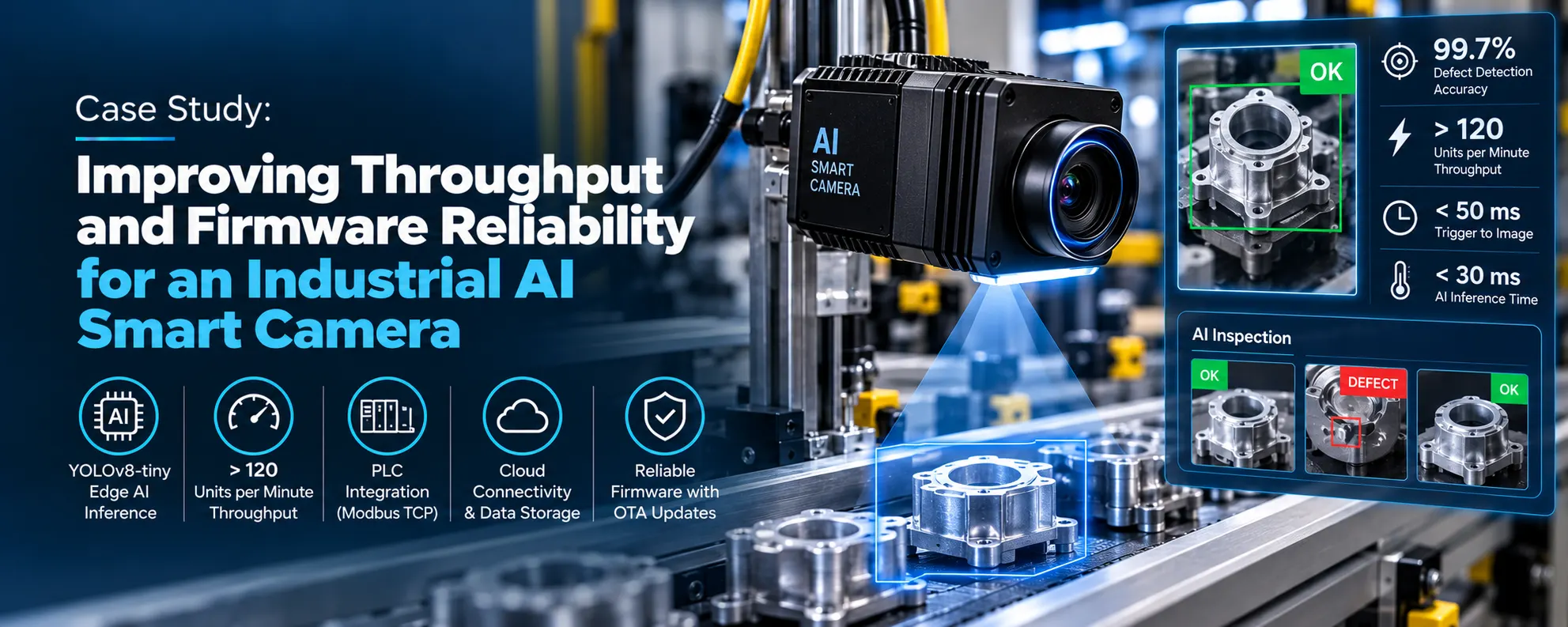
Case Study: Improving Throughput and Firmware Reliability for an Industrial AI Smart Camera
Client and Product
Client: Industrial Manufacturing and Quality-Control Client
Product: AI-Powered Smart Camera for Production-Line Inspection
Adequate Infosoft created a bespoke smart camera system using AI to solve the problem of automated quality inspection for its client working in an industrial manufacturing environment.
This involved accurately detecting product defects, responding to real-time events sent from a PLC, storing the results of the analysis, and functioning in an industrial environment.
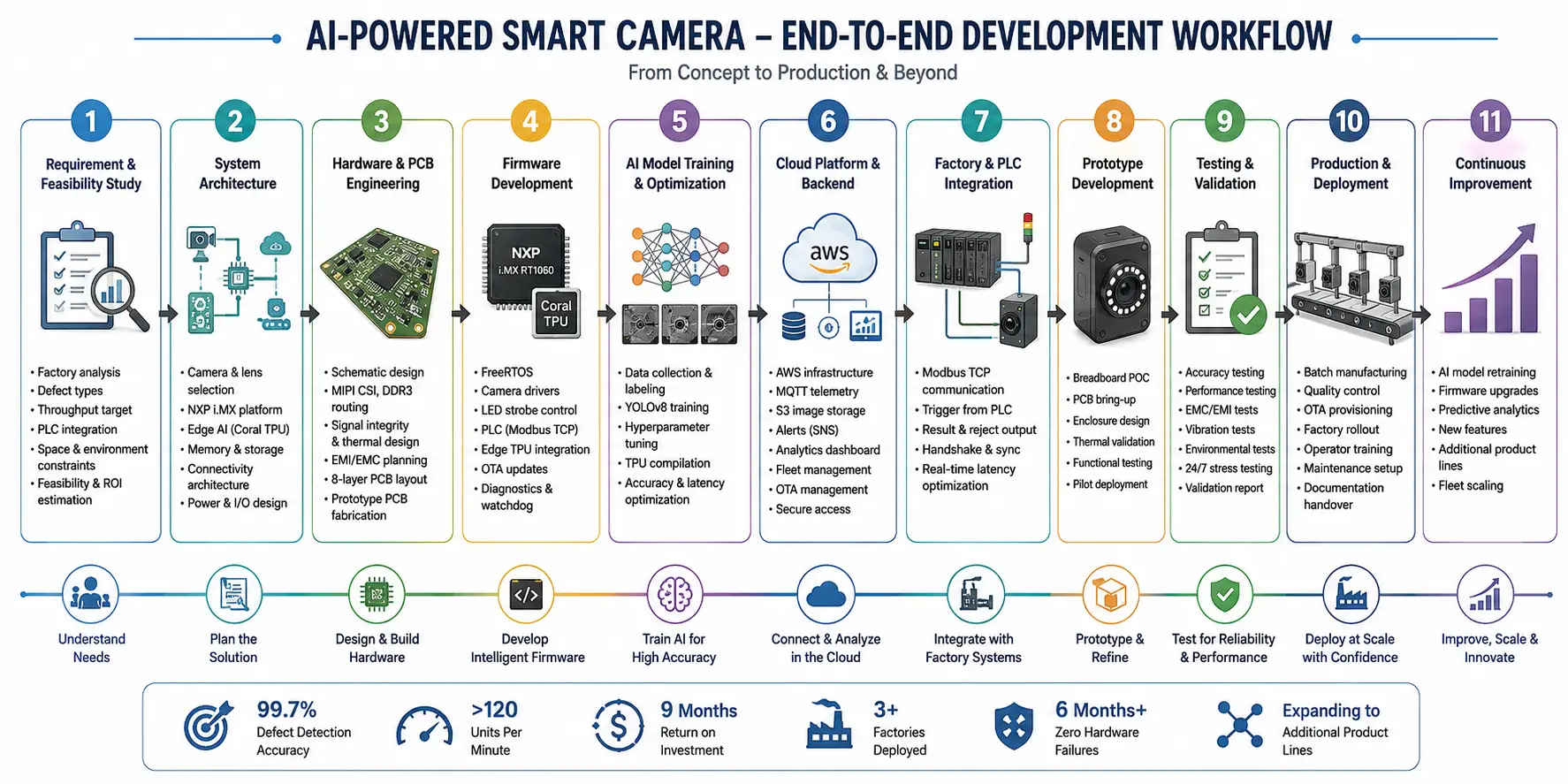
The development included creating custom hardware, writing NXP i.MX RT1060 embedded firmware, implementing the Coral Edge TPU for performing AI inference, using industrial cameras, establishing communication with the cloud, and Modbus TCP communication with factory PLCs.
Firmware Performance and Deterministic Processing
Firmware performance has been essential from day one of the development. Even minor delays caused by image acquisition, inference, networking, or PLC communication could make it impossible to detect passing-by products.
Our engineers analysed the capture-to-decision path and optimized the firmware architecture around deterministic processing. A double-buffered image-capture approach allowed the system to prepare the next frame while the current frame was being processed. This reduced blocking between image acquisition and AI inference, helping the solution maintain a production throughput of more than 120 units per minute without frame drops.
Firmware tuning was done to ensure that the trigger-to-image delay was kept below 50 milliseconds. AI inference with the YOLOv8-tiny on the Coral TPU was done in less than 30 milliseconds per image. This provided enough time for the production line to perform communication and decision making during each inspection.
Thermal and False-Positive Debugging
Debugging was not only done on the source code. During the environmental test phase, it was discovered that the Coral TPU had a thermal throttling problem at an ambient temperature of about 50 degrees centigrade.
To mitigate this problem, the team introduced enclosure level thermal tuning such as thermal pad and forced air cooling.
False positives due to reflective or shiny product surfaces were also addressed by using a combination of firmware tuning, polarized optics, and different light angles.
The solution included firmware-health features such as a hardware watchdog with a five-second timeout, device temperature monitoring, network-health checks, frame-drop detection, and diagnostic reporting.
We also designed the OTA process with dual-bank flash, digital signature verification, and rollback timing to protect devices from a corrupted or unsuccessful update.
Result
The installed system has defect detection accuracy of 99.7%, throughput greater than 120 units per minute, and it has been implemented in three different manufacturing plants.
This project shows that we can debug and optimize firmware code in the environment that counts, hardware, thermal constraints, AI computation, industrial networking, and manufacturing line performance.
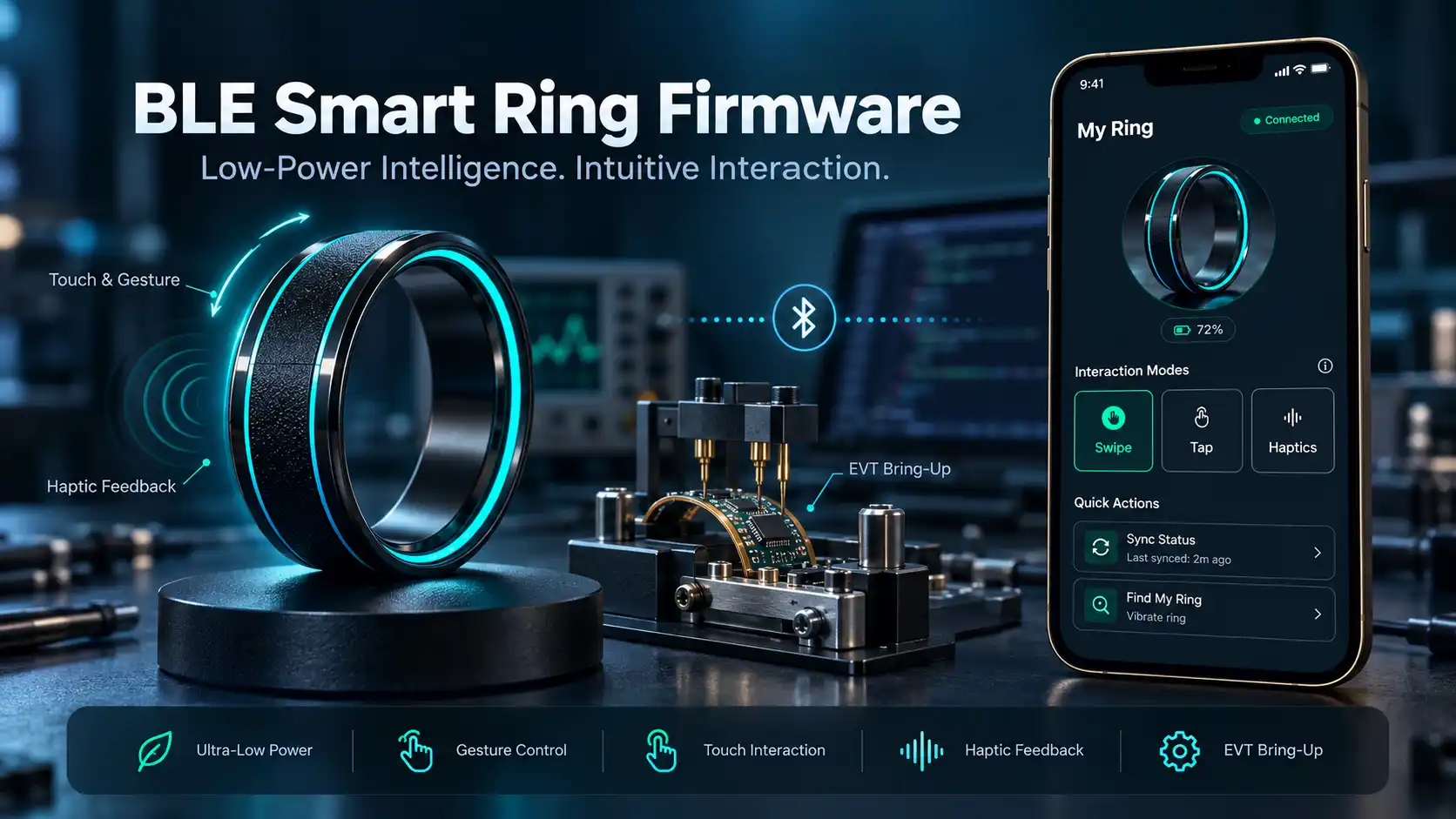
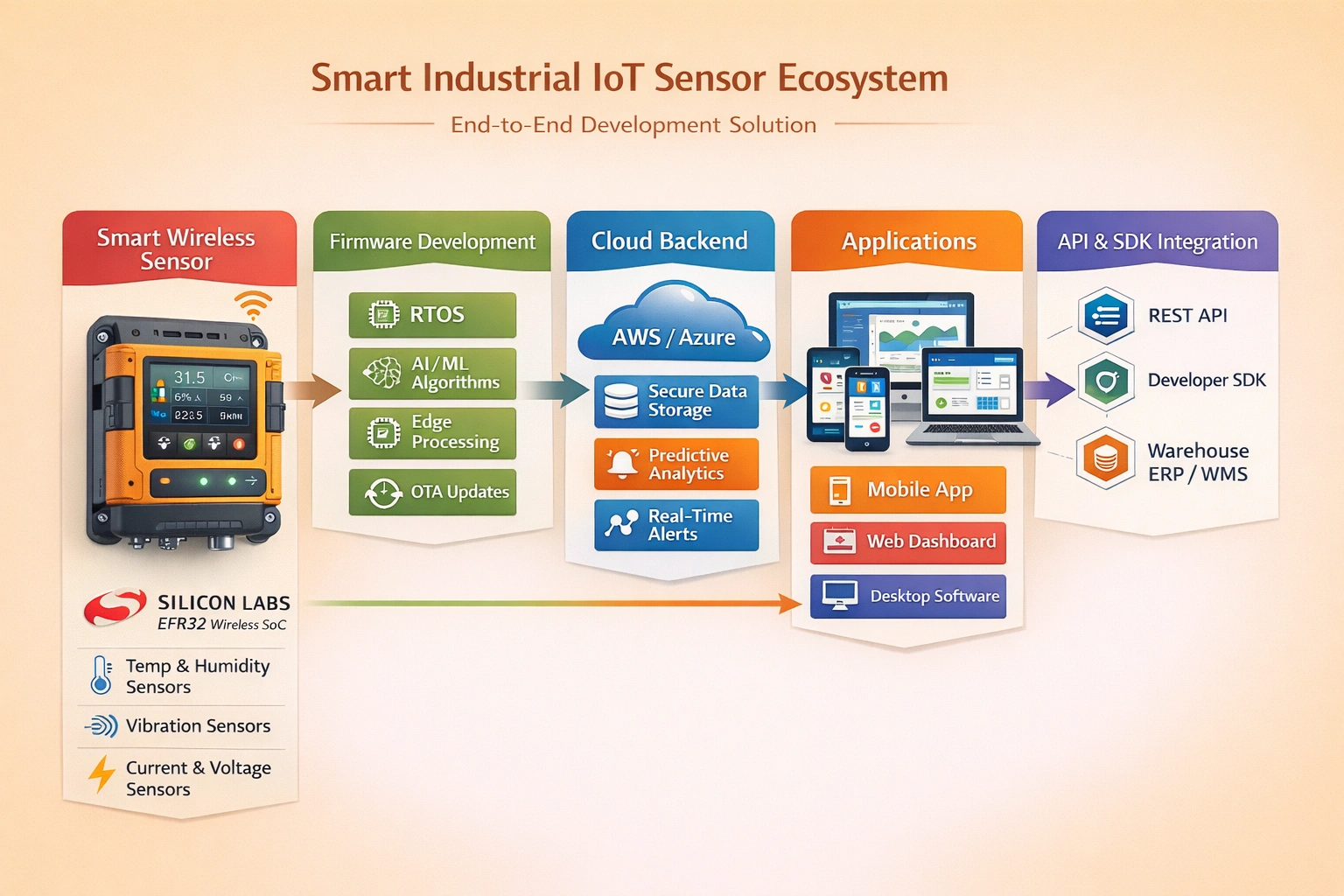
Relevant Delivered Projects That Demonstrate Our Firmware Optimization Experience
Our Firmware Debugging Approach
We start off with knowing where and when things are broken and how easily they are repeatable. This involves analyzing source code, compiler flags, linking information, log files, board design, schematics, board revisions, test results, crash dump analysis, and field data.
Afterwards, we come up with a controlled diagnostic plan. Rather than trying to guess solutions, we collect data through proper use of instruments.
This would depend on platform and problem, but might involve JTAG/SWD, GDB, logs, logic analyzers, scopes, protocol sniffers, power analyzers, tracing, fault handlers, event logs, and Hardware-in-the-loop testing.
Root Cause Analysis and Firmware Fix-Up
If it is due to an inherited or broken firmware, we begin with a good baseline analysis first. We identify build warning messages, undefined behavior, race conditions, pointer manipulations, blocking calls, time dependency, memory leaks and poor error handling.
We add useful logging messages wherever possible, without filling limited memory and interfering with the real-time process. In case of a hard fault, we analyze CPU registers, stack trace, fault status register, PC and other events that led to the exact sequence of the fault.
Such root cause analysis methodology is extremely helpful for the problem which is identified only after a lot of operation of the device or high network traffic or when operating under low battery voltage or multiple peripheral operations.
Real-Time Performance and Latency Optimization
Optimizing performance is not just about optimizing clock speed. An MCU with fast clock speed might underperform if tasks are not scheduled properly, if interrupt services take too much time, if there is too much data copying, and if communication gets in the way of control.
We increase real-time performance by:
Reviewing and optimizing RTOS task priorities and stack size Optimal interrupt services routine development Direct memory access-based transfers of data for sensors, UART, SPI, ADC and display pipeline Event-driven design rather than useless polling Circular buffer and effective queues management Memory alignment and buffer reuse, and minimizing data copying Profiling CPU usage, execution time and jitter Simplifying firmware start up and reducing boot time initialization Proper use of compiler optimizations without reducing reliability
In the case of connected devices, we also optimize the interaction of firmware and network. The device may be slow due to re-transmissions, bad packet sizes, blocked requests to the cloud, ineffective Bluetooth Low Energy connection settings and unneeded telemetry messages. We identify the exact bottleneck before any changes to architecture.
Battery and Power Consumption Optimization
Energy consumption is an important criterion for wearables, sensors, trackers, smart locks, and battery-operated IoT devices. Even though there may be good functionalities of a product, it may not be a success in the market if it requires charging or battery replacement frequently.
This involves optimizing a number of factors that include sleep state design, waking up source considerations, shutting off peripherals, clock management, radio duty cycling, sensor sampling, BLE advertising/connections parameters, and minimizing cloud communication.
We measure the real current profile rather than relying only on firmware assumptions. Short high-current peaks can be as important as average power consumption, particularly for coin-cell devices and products with cellular, motor, or wireless transmission bursts.
Firmware Code Review and Architecture Improvement
Usually, performance issues arise from the architecture of the software, which was successful during the prototyping but is difficult to maintain as more features become available. Firmware architecture improvement is carried out without changing the business functionality of the product.
They include modular firmware architecture, hardware abstraction, improvements in state machines, error recovery, protocol layers clean-up, configuration, versioning, test plans, and documentation.
In the case of legacy firmware, it can be improved in a gradual way. It could mean the migration from a blocking super-loop architecture to an event-driven one, including possibly the introduction of FreeRTOS/Zephyr, outdated library updates, better build scripts, and a repeatable testing process.
The goal is not to rewrite working code unnecessarily. The goal is to make the system understandable, testable, stable, and ready for future product development.
Enhance the Reliability of Your Embedded Product
Bugs in firmware should not impede timely delivery or be perpetual bugs for your customers.
Adequate Infosoft will help your product design team understand erratic behavior, improve embedded software performance, reduce power usage, increase real-time functionality, and get ready for the mass production of the firmware.
If you have a prototype that has not been working, a sluggish connected device, legacy embedded firmware, or even a product that is already out there, we will help you turn uncertainty into certainty.
Frequently Asked Questions
Firmware debugging is a procedure where we identify and fix errors in embedded software that operates on a microcontroller, processor, or device. This can range from reset debugging, memory corruption, peripheral debugging, communication issues, timing problems, power consumption, and instability.
Yes. We can inspect the source code, firmware binary, schematics, logs, crash dumps, PCB designs, and symptoms from the field. We start by analyzing the information we have available and formulate a recovery strategy.
First, we test device current consumption and pinpoint excessive active times, inefficient sleep modes, radio usage, sensors sampling, peripherals power consumption, and cloud connectivity. Then we optimize these areas without reducing product's performance requirements.
Definitely. We can optimize FreeRTOS/Zephyr firmware by optimizing tasks' priorities, threads' stack, scheduling, interrupts, queues, memory, drivers, device tree, and power management.
Yes. Firmware and hardware behaviour are closely connected. We use tools such as debuggers, logic analyzers, oscilloscopes, power analyzers, and protocol sniffers to identify whether the root cause is in code, power supply, timing, signal integrity, sensor behaviour, or PCB design.
Our services can be applied to STM32, ESP32, Nordic Semiconductor, NXP, Silicon Labs, Texas Instruments, Microchip, Renesas, Infineon, ARM Cortex-M, embedded Linux, and custom hardware.