


 Mean Stack Development
 Vue JS Development
 Javascript Development
 React JS Development
 Angular JS Development
 Next JS development
 Java Development
 Python Development
 Django Development
 Cherrypy Development
 C# Development
 ASP.NET Development
 NodeJS Development
 Laravel Development
 CodeIgniter Development
 Zend Development
 Ruby on Rails Development
 CakePHP Development
 PHP Website Development
 Symfony Development
 Drupal Development
 Joomla Development
 Wordpress Development
 .NET Nuke Development
 Kentico
 Umbraco
 .NET MAUI Development
 Xamarin Application Development
 iOS Application Development
 Android Application Development
 Android Wear App Development
 Ionic Development
 iBeacon Application Development
 Universal Windows Platform (UWP)
 Kotlin Application Development
 Swift Application Development
 Flutter Application Development
 PWA Application Development
 Flutter Health Tech & Wearable App Development Company
 React Native Health Tech Wearable App Development
 Offshore Software Development
 Custom Application Development
 Front-End Development
 Full Stack Development
 AI & Machine Learning
 Custom CRM Solutions
 Flask Software Development
 Electron JS Development
 ChatGPT Development
 Telemedicine App Development
 Build Smart Telemedicine Platform
 Beauty & Salon App Solutions
 Hire Workato Experts
 Magento Development
 Magento 2.0 Development
 Magento Enterprise
 Shopping Cart Development
 Prestashop Development
 Shopify Development
 Open Cart Development
 WooCommerce Development
 BigCommerce Development
 NopCommerce Development
 Virto Commerce Development
 AspDotNetStorefront Development
 .NET Application Development
 Microsoft Dynamics CRM
 VB .NET Development
 Sharepoint Migration
 ASP.NET Core Development
 ASP.NET MVC Development
 AJAX Development
 Agile Development
 Microsoft Bot
 Microsoft Blazor
 Microsoft Azure Cognitive
 HTML 5
 UI/UX Design
 Graphic Design
 Adobe Photoshop
 XML Application Development
 Cloud Computing Solutions
 Azure Cloud App Development
 AWS Development
 Google Cloud Development
 Certified AWS IoT Services Developers
 DevOps Consulting & Development
 Kubernetes Consulting & Services
 SQL Programming Development
 MySQL Development
 MongoDB Development
 Big Data
 Robotic Process Automation
 Social Media Marketing
 Search Engine Optimization
 QA Testing
 Software Testing
 Software Security
 Maintenance And Support
 I.T. Consulting Services
 Business Intelligence
 YII Development
 Data Analysis
 Alexa Skills Development
 On Demand App for Mobile repairing services
 On Demand App for Car Service Booking
 On Demand App for Cleaning Services
 On Demand App for Pharmacy
 On Demand Dedicated Developers
 On Demand Lawyer App Development







 Nuki Smart Lock
 Salto Smart Lock
 TTlock Smart Lock
 NFC App Development
 Custom IOT Enabled Smart Lock
 Smart Locker Solutions
 Hospital Smart Lock Systems
 Hotel Smart Lock Systems
 Smart Home & Office Locks
 Smart Access for Schools & Colleges
 Unloc Smart Lock Integration
 Yale & August Smart Lock Integration
 Populife Smart Lock Integration
 Smart Lock Hardware Development
 Dairy IoT Solutions
 Agri IoT & AI Solutions
 Weather & Climate Solutions
 Water & Waste Management Solutions
 RaspBerry Pi
 Firmware Software Development
 ESP 32 Software Development
 Embedded Development
 Internet of Things
 Smart IoT Development
 IoT Sensor Integration & Development Solutions
 Smart IoT System Development for HVAC
 Tuya IoT App Development
 Particle IoT SDK
 IoT Development with AI
 Smart Pet GPS Tracker
 Dairy GPS Tracking Solutions
 GPS Fleet Management Software
 Car Rental & Subscription Solutions
 Car Buy & Sell Marketplace Development
 AI-Powered Car Wash App Development
 PCB Design & Fabrication
 IoT AC Automation
 AI–IoT Painting Solutions
 IoT Wearable Hardware & App Development
 HVAC Automation & AI Control Systems
 Smart Home IoT Engineering
 AI Embedded Systems
 AI Hardware Design Service
 Advanced IoT Hardware & Firmware Development
 Device Driver Development Services
 NXP i.MX RT Firmware & Hardware Services
 Microchip PIC & AVR Development
 Hire IoT Architects
 IoT Cloud & Infrastructure Solutions
 Infineon XMC / AURIX Development Services
 Matter & Thread IoT Services
 Native IoT Mobile App Development (BLE & Wi-Fi)
 Snapdragon IoT Firmware Development
 Renesas RA/RX Firmware Services
 Silicon Labs EFR32 Development Services
 Smart Wearable App Development
 Smart IoT Meters
 Smart Healthcare Wearable App Development
 Health Care Monitoring System
 Fitness Tracking App Development
 Smart Home Automation Apps
 nRF PCB Design
 ESP32 PCB Design
 Embedded Wearables Engineers
 Rental Property Management System
 Building Management System
 Smart Lighting Development
 Infineon Semiconductor Firmware Development Services
 Custom Camera Development: Hardware, Firmware & PCB Prototyping
 Smart Security Camera SDK
 Nordic Semiconductor SDK
 Infineon SDK
 Arduino SDK
 NFC Lock Integration
 Kerong Lock Integration
 IoT & AI Solutions for Manufacturing
 Smart Inventory & Logistics Solution
 Food & Beverage Industry Solutions
 Smart Hospitality Solutions
 Smart Property Management
 Custom Smart Home IOT SDK
 Smart IoT & AI in Healthcare
 AI-Powered Security Solutions
 Smart Home Safety & AI
 Veterinary Clinic Management (AI)
 Pet Care System (AI & IoT)
 Pet Training & Adoption (AI)
 Healthcare IoT Development
 Event Management Software
 Money Remittance App
 Money Lending App Development
 Utility and Bill Payment App
 IoT Mobile App Development (Flutter & React Native)
 AI & IoT Retail Solutions
 Smart EV App Development
 Smart Solar IoT & AI Solutions
 IoT-Based Energy Systems
 Smart Energy & Utilities Solutions
 6G Solutions
 IoT Security Solutions
 AI-Powered Lottery App Development
 AI-Sports Fitness Club Management
 Travel
 Real Estate
 Medical & Healthcare
 e-Learning
 Consumer Products
 Finance
 Automobile
 Media & Entertainment
 Billing Software
 Enterprise Resource Planning (ERP)
 Augumented & Virtual Reality
 Point of Sale(POS) Development
 Learning Management System
 EV Charging Solutions
 About Us
 Partners & Certifications
 Quality Assurance
 Our Clients & Testimonials
 Development Process
 Our Products
 Social Responsibility
 Work Ethics
 Vision & Mission
 Awards
 Live Project Demos
 Contact Us
 Case Studies
 Portfolio
 Blog
Zigbee & Bluetooth Mesh Firmware Development Services | Smart Lighting, Building & IoT Networks
Zigbee and Bluetooth Mesh provide connected devices with the ability to communicate far beyond the range of individual wireless devices by transmitting signals across interconnected devices.
Both technologies are used in applications such as intelligent lighting, building management, industrial monitoring, access control, and health care and hospitality.
Reliable mesh applications require onboard firmware to manage testing, message routing, and security. Without proper implementation, commissioning will fail and communication may not be successful.
Adequate Infosoft develops Zigbee and Bluetooth Mesh firmware for connected device manufacturers, startups, and enterprises.
We support hardware bring-up, proof-of-concept development, and production-ready solutions integrating mobile applications, gateways, cloud APIs, and maintainable firmware architectures for long-term product reliability.
Let's Work Together!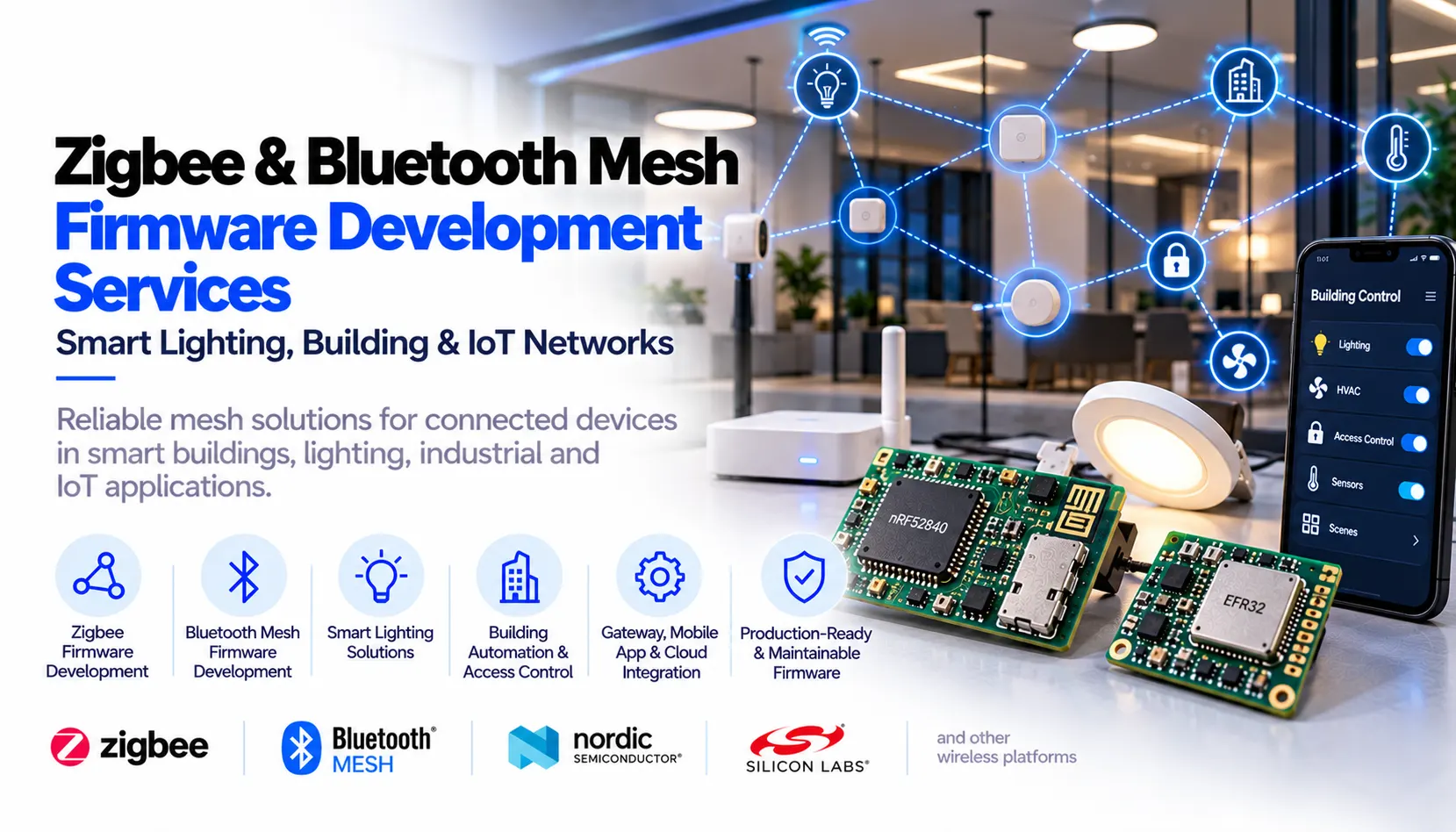
Zigbee and Bluetooth Mesh: Choosing the Right Technology
When comparing Zigbee with Bluetooth mesh, both options can be used in IoT applications that require low-power solutions. The choice of one over the other depends on how widely networked they are, and other factors such as size of deployment, ability to communicate with smartphones, and power requirements.
Zigbee is based on IEEE 802.15.4 technology, and is commonly employed in applications such as smart lights, sensors, and switches. Zigbee employs different types of devices, such as coordinators, routers and end devices, to ensure that appropriate coverage and power requirements are met.
Bluetooth mesh uses Bluetooth Low Energy technology and works using managed flooding to relay in message transfer through the nodes. Bluetooth mesh is best for lighting network deployments, retrofits, and applications that use Bluetooth for commissioning.
Adequate Infosoft evaluates these technologies against product requirements, helping businesses select suitable architectures for smart locks, industrial devices, battery-powered sensors, and connected building systems.
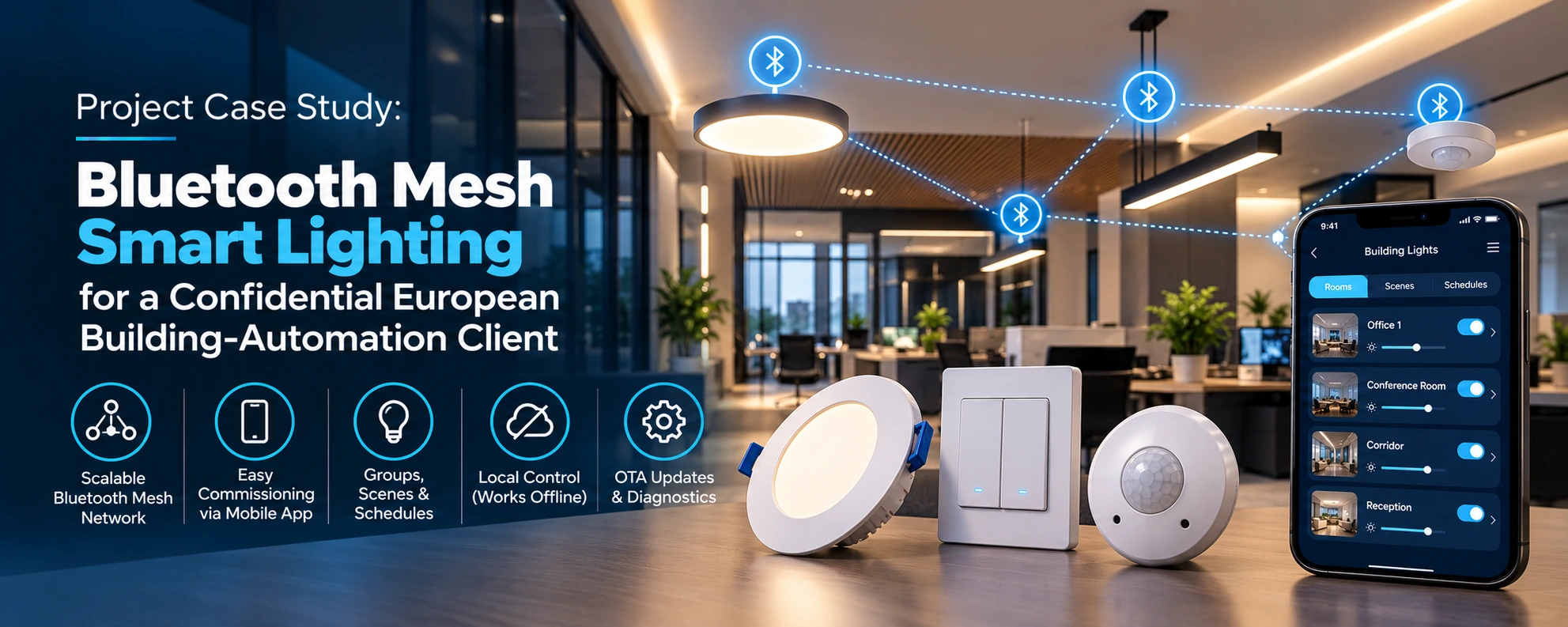
Project Case Study: Bluetooth Mesh Smart Lighting for a Confidential European Building-Automation Client
Client Requirement and Project Scope
A European technology client dealing with smart building solutions and services required a platform to control wireless lighting in office environments, hotel locations, and in multi-room residential spaces.
The client's existing solution was based on point-to-point Bluetooth control, which works in small installations but fails as soon as the installations become complicated and spread through multiple rooms and corridors.
The client required a scalable system, which can allow the customer to commission the light fixtures, switches, and the occupancy sensors using a mobile application.
Building managers also needed room-based groups, lighting scenes, schedule support and the ability to update firmware after installation. Because the product would be used in occupied buildings, the client required local lighting control to remain available even if cloud connectivity was unavailable.
Firmware Architecture and Engineering Approach
We developed Bluetooth Mesh firmware for LED drivers, wall switches, and occupancy sensors using a low-power Bluetooth SoC. The firmware supported lighting control, brightness adjustment, scenes, and group-based switching without cloud dependency.
By employing secure provisioning, we provided installers with the capability to configure network credentials, application keys, device groups, and settings through a mobile commissioning tool.
We improved message intervals and relay operations to limit excess traffic on the network.
Persistent configuration storage made it possible to recover after power failures, while watchdog monitoring, health checks, and standardized fault codes helped support teams deal with power, driver, sensor, or connection problems quickly.
Result and Production Readiness
A new firmware was delivered to allow the very first smart-lighting product to be built on a reusable foundation, not as a one-off device build. This would allow the client to add new fixture variants while maintaining a consistent commissioning experience and common cloud integration pattern.
Separation of local automation from cloud services was perhaps the most remarkable outcome. Lighting scenes, switch control and occupancy response occurred within the mesh network, while the gateway synchronised events, usage data and device status to the management dashboard.
This alleviated perceived delay on the user side and formed the basis for further building control resilient foundations.
The project reflects our approach to mesh development: practical device firmware, secure onboarding, field diagnostics, installer usability and clear consideration of what happens after thousands of devices are deployed.
Relevant Adequate Infosoft Delivery Experience
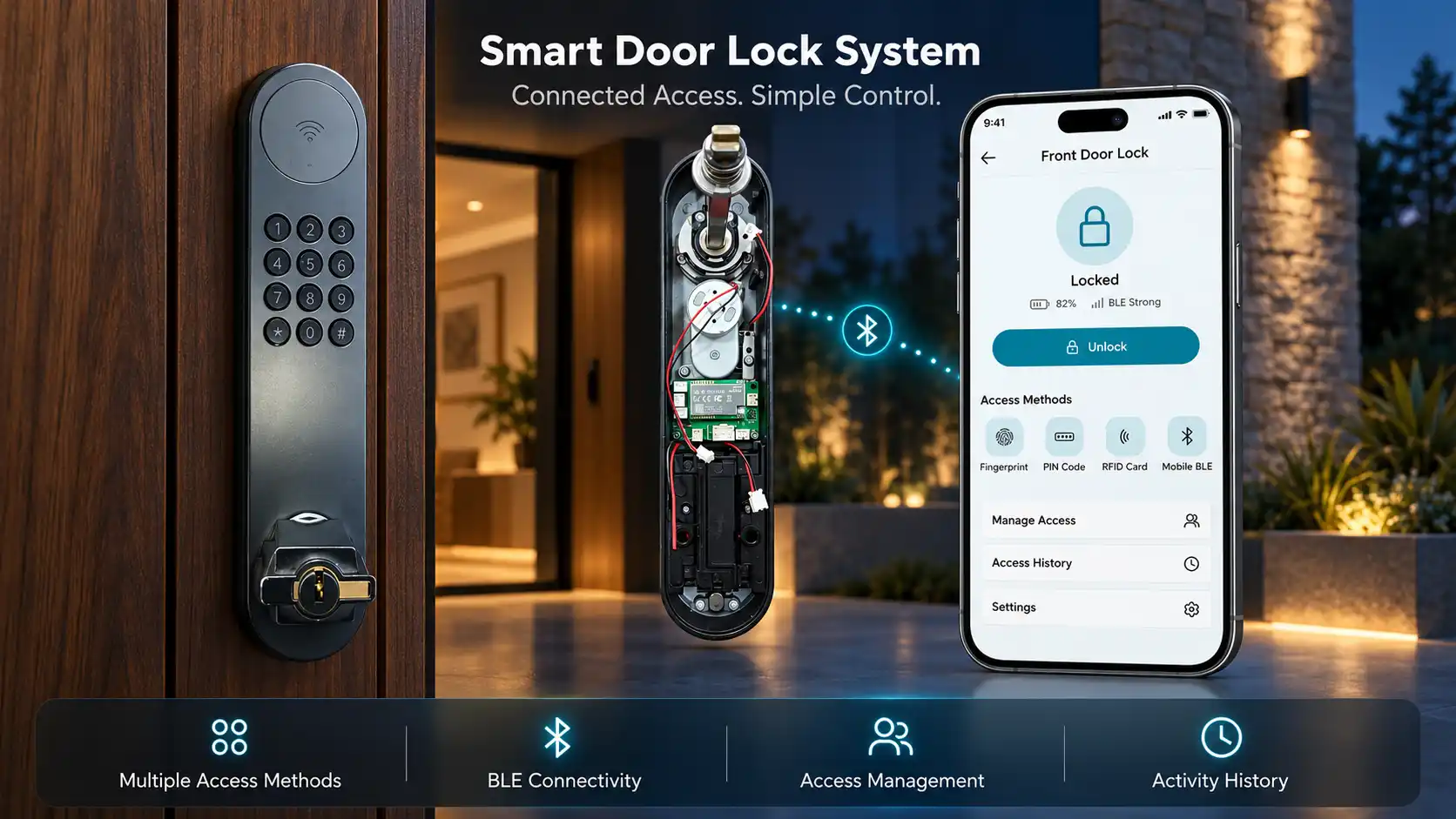
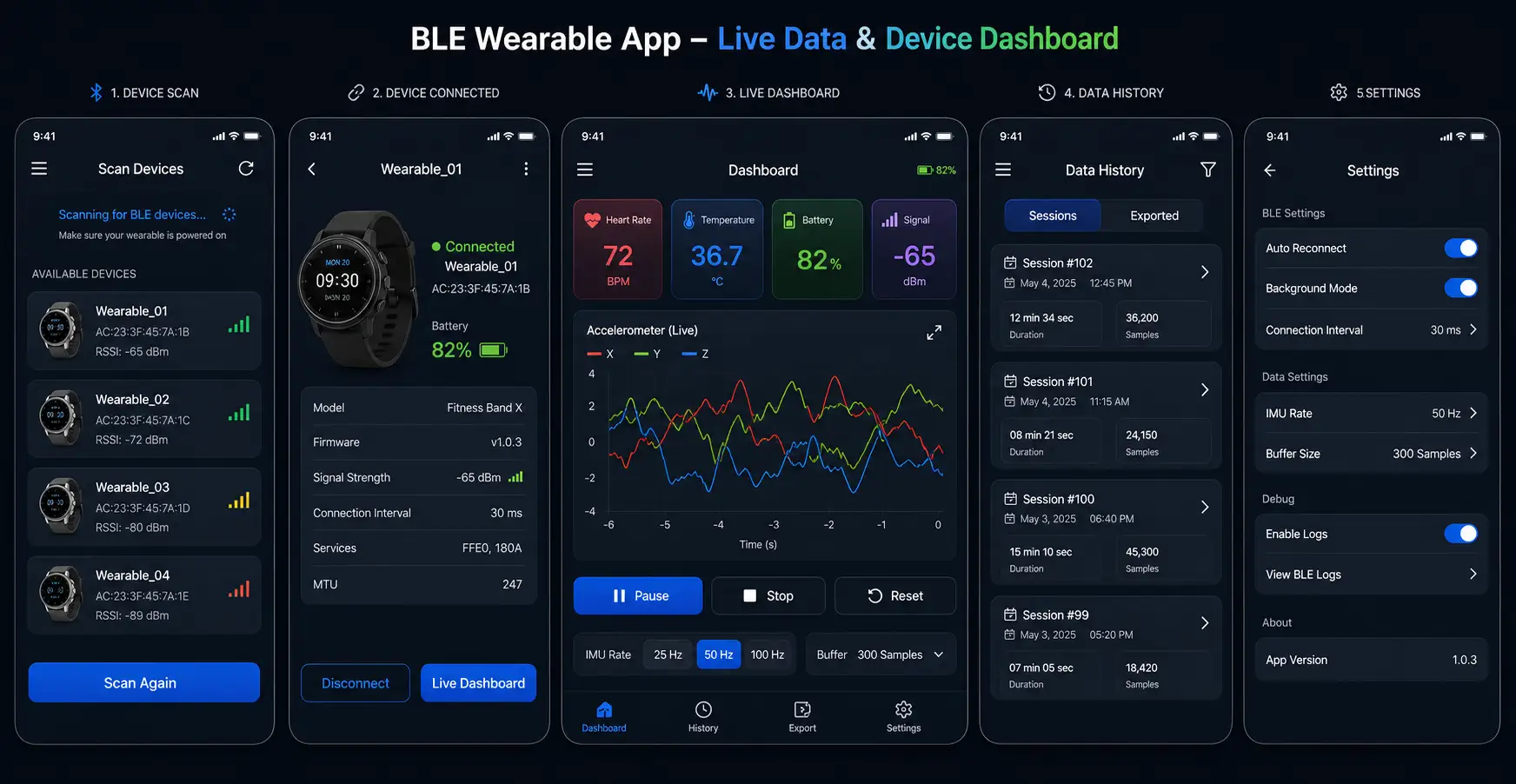
Adequate Infosoft's work across embedded firmware, connected devices, secure access and mobile applications supports the engineering needed for Zigbee and Bluetooth Mesh products.

Our Zigbee and Bluetooth Mesh Firmware Capabilities
Embedded Firmware for Mesh Devices
We build firmware for the full range of mesh devices:
Smart lights, drivers and dimmers Wall switches and scene controllers Occupancy, temperature, humidity and door sensors Smart plugs and energy-monitoring devices Smart locks and access-control peripherals Wearables and safety devices Gateways, bridges and protocol converters Industrial indicators and equipment-monitoring nodes
Undertaking engineering tasks can involve work on board support packages, peripherals, wireless stacks, GPIOs, sensors, PWMs, relays, ADCs, batteries and manufacturing test firmware.
Provisioning, Commissioning and Device Management
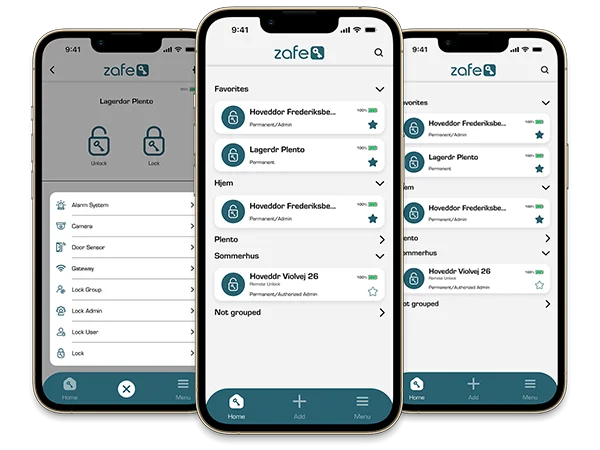
A mesh system must be easy to install repeatedly. We implement secure onboarding and commissioning flows that allow installers or end users to add devices, assign rooms or zones, create groups and apply configuration without exposing sensitive network keys.
In the case of Zigbee, the installation process also covers the joining rules, instalment codes, the trust centre configuration, binding, reporting, and group membership. As far as Bluetooth devices are concerned, the installation workflow includes secure provisioning, key allocation, an installation model, relaying and publishing addresses, as well as proxy behavior.
Moreover, we create supporting mobile applications or gateways, which makes the implementation in the field smoother.
Smart Lighting and Building Automation Firmware
Lighting is regarded as one of the most prominent examples of mesh network applications since wired installations allow to connect wireless systems in different parts of the building.
We integrate into our firmware such properties as switch functionality, dimming, selectable temperature of white light, RGB/RGBW control, decision-making based on the level of daylight, as well as functions of occupancy information systems, scene recall, timers, and simple mode of operation in case of an emergency.
For business applications, we are able to support zoned control, scheduling of the operation of entire buildings, local manual control, and integration with gateways.
The system functions at a basic level, even when there is no Internet access, and the dashboard and cloud services provide remote availability.
Security, Resilience and OTA Updates
Devices may be connected for many years. Thus, it is crucial to ensure security and maintenance from the very first firmware release.
We are building secure device identification, secure management of network keys, safe communication processes, secure firmware update flows, and access control to commissioning characteristics.
Reliability features can include watchdog recovery, connection-state monitoring, retry strategies, persistent configuration, event logging, battery alerts and remote diagnostics.
For larger deployments, OTA firmware updates are essential for rolling out feature improvements, bug fixes and security patches without physically collecting devices.
Our Development Process
Initially, we begin by gaining an understanding of product specifications, hardware design, operating conditions, number of nodes, power source, elapsed time, interoperability, and set-up processes.
Next, we develop firmware architecture which encompasses wireless stack integration, device states, sensor and actuator logic, data processing, energy management, safety, error recovery, and monitoring while both bench and scenario testing is used to evaluate network extension, node failures, interference, congestion of messages, configuration process, and gateways recovery.
Prior to launching the product, we make sure that it is production-ready through factory configuration, tracking of serial numbers, ensuring enrollment by use of QR-code or NFC, calibration, and manufacturing testing.
Why Choose Adequate Infosoft?
In mesh products, embedded engineering professionals participate in the entire process from hardware initiation to wireless platform operation, the installation software process, the integration of cloud services, the conducting of tests, troubleshooting, and maintenance.
Adequate Infosoft provides full support for all programs from first architecture workshops to the development and testing of firmware and the user interface elements, to the final transfer of products to the production.
We record the design of firmware, identify possible technical issues, and create systems for the successful functioning of the firmware while expanding the product line and customer base.
Frequently Asked Questions
Zigbee is founded on IEEE 802.15.4 and operates through coordinator/routers and end devices, while Bluetooth Mesh is based on Bluetooth Low Energy and utilizes managed flooding to carry messages. The right choice will be informed by current ecosystem compatibility, involved technologies, and deployment requirements.
Yes. A mobile app can provision, configure and control Bluetooth Mesh devices using an appropriate Bluetooth connection and proxy-node strategy. We develop mobile apps for installer commissioning and end-user control.
Yes. Zigbee end devices have sleeping capacity and are able to go inactive for a long time period until data needs to be reported or scheduled communication occurs. However, actual battery life is determined by the specific device type, reporting frequency, electromagnetic field circuit condition, and other related hardware.
Yes. We can implement secure OTA update workflows for suitable hardware and wireless stacks. This allows product teams to deliver fixes, security updates and improvements after devices are installed.
Certainly. In terms of the most important local-based functions, such as the light switch that is used to control the group of lights in a room, this is still possible to operate within the local area network mesh.
Yes. We can support the full product journey, including hardware review, PCB design, firmware, mobile apps, cloud APIs, dashboards, testing and manufacturing support.