


 Mean Stack Development
 Vue JS Development
 Javascript Development
 React JS Development
 Angular JS Development
 Next JS development
 Java Development
 Python Development
 Django Development
 Cherrypy Development
 C# Development
 ASP.NET Development
 NodeJS Development
 Laravel Development
 CodeIgniter Development
 Zend Development
 Ruby on Rails Development
 CakePHP Development
 PHP Website Development
 Symfony Development
 Drupal Development
 Joomla Development
 Wordpress Development
 .NET Nuke Development
 Kentico
 Umbraco
 .NET MAUI Development
 Xamarin Application Development
 iOS Application Development
 Android Application Development
 Android Wear App Development
 Ionic Development
 iBeacon Application Development
 Universal Windows Platform (UWP)
 Kotlin Application Development
 Swift Application Development
 Flutter Application Development
 PWA Application Development
 Flutter Health Tech & Wearable App Development Company
 React Native Health Tech Wearable App Development
 Offshore Software Development
 Custom Application Development
 Front-End Development
 Full Stack Development
 AI & Machine Learning
 Custom CRM Solutions
 Flask Software Development
 Electron JS Development
 ChatGPT Development
 Veterinary Telemedicine App Development
 Build Smart Telemedicine Platform
 Beauty & Salon App Solutions
 Hire Workato Experts
 Magento Development
 Magento 2.0 Development
 Magento Enterprise
 Shopping Cart Development
 Prestashop Development
 Shopify Development
 Open Cart Development
 WooCommerce Development
 BigCommerce Development
 NopCommerce Development
 Virto Commerce Development
 AspDotNetStorefront Development
 .NET Application Development
 Microsoft Dynamics CRM
 VB .NET Development
 Sharepoint Migration
 ASP.NET Core Development
 ASP.NET MVC Development
 AJAX Development
 Agile Development
 Microsoft Bot
 Microsoft Blazor
 Microsoft Azure Cognitive
 HTML 5
 UI/UX Design
 Graphic Design
 Adobe Photoshop
 XML Application Development
 Cloud Computing Solutions
 Azure Cloud App Development
 AWS Development
 Google Cloud Development
 Certified AWS IoT Services Developers
 DevOps Consulting & Development
 Kubernetes Consulting & Services
 SQL Programming Development
 MySQL Development
 MongoDB Development
 Big Data
 Robotic Process Automation
 Social Media Marketing
 Search Engine Optimization
 QA Testing
 Software Testing
 Software Security
 Maintenance And Support
 I.T. Consulting Services
 Business Intelligence
 YII Development
 Data Analysis
 Alexa Skills Development
 On Demand App for Mobile repairing services
 On Demand App for Car Service Booking
 On Demand App for Cleaning Services
 On Demand App for Pharmacy
 On Demand Dedicated Developers
 On Demand Lawyer App Development








 Nuki Smart Lock
 Salto Smart Lock
 TTlock Smart Lock
 NFC App Development
 Custom IOT Enabled Smart Lock
 Smart Locker Solutions
 Hospital Smart Lock Systems
 Hotel Smart Lock Systems
 Smart Home & Office Locks
 Smart Access for Schools & Colleges
 Unloc Smart Lock Integration
 Yale & August Smart Lock Integration
 Populife Smart Lock Integration
 Smart Lock Hardware Development
 Dairy IoT Solutions
 Agri IoT & AI Solutions
 Weather & Climate Solutions
 Water & Waste Management Solutions
 RaspBerry Pi
 Firmware Software Development
 ESP 32 Software Development
 Embedded Development
 Internet of Things
 Smart IoT Development
 IoT Sensor Integration & Development Solutions
 Smart IoT System Development for HVAC
 Tuya IoT App Development
 Particle IoT SDK
 IoT Development with AI
 Smart Pet GPS Tracker
 Dairy GPS Tracking Solutions
 GPS Fleet Management Software
 Car Rental & Subscription Solutions
 Car Buy & Sell Marketplace Development
 AI-Powered Car Wash App Development
 PCB Design & Fabrication
 IoT AC Automation
 AI–IoT Painting Solutions
 IoT Wearable Hardware & App Development
 HVAC Automation & AI Control Systems
 Smart Home IoT Engineering
 AI Embedded Systems
 AI Hardware Design Service
 Advanced IoT Hardware & Firmware Development
 Device Driver Development Services
 NXP i.MX RT Firmware & Hardware Services
 Microchip PIC & AVR Development
 Hire IoT Architects
 IoT Cloud & Infrastructure Solutions
 Infineon XMC / AURIX Development Services
 Matter & Thread IoT Services
 Native IoT Mobile App Development (BLE & Wi-Fi)
 Snapdragon IoT Firmware Development
 Renesas RA/RX Firmware Services
 Silicon Labs EFR32 Development Services
 Smart Wearable App Development
 Smart IoT Meters
 Smart Healthcare Wearable App Development
 Health Care Monitoring System
 Fitness Tracking App Development
 Smart Home Automation Apps
 nRF PCB Design
 ESP32 PCB Design
 Embedded Wearables Engineers
 Rental Property Management System
 Building Management System
 Smart Lighting Development
 Infineon Semiconductor Firmware Development Services
 Custom Camera Development: Hardware, Firmware & PCB Prototyping
 Smart Security Camera SDK
 Nordic Semiconductor SDK
 Infineon SDK
 Arduino SDK
 NFC Lock Integration
 Kerong Lock Integration
 IoT & AI Solutions for Manufacturing
 Smart Inventory & Logistics Solution
 Food & Beverage Industry Solutions
 Smart Hospitality Solutions
 Smart Property Management
 Custom Smart Home IOT SDK
 Smart IoT & AI in Healthcare
 AI-Powered Security Solutions
 Smart Home Safety & AI
 Veterinary Clinic Management (AI)
 Pet Care System (AI & IoT)
 Pet Training & Adoption (AI)
 Healthcare IoT Development
 Event Management Software
 Money Remittance App
 Money Lending App Development
 Utility and Bill Payment App
 IoT Mobile App Development (Flutter & React Native)
 AI & IoT Retail Solutions
 Smart EV App Development
 Smart Solar IoT & AI Solutions
 IoT-Based Energy Systems
 Smart Energy & Utilities Solutions
 6G Solutions
 IoT Security Solutions
 AI-Powered Lottery App Development
 AI-Sports Fitness Club Management
 Travel
 Real Estate
 Medical & Healthcare
 e-Learning
 Consumer Products
 Finance
 Automobile
 Media & Entertainment
 Billing Software
 Enterprise Resource Planning (ERP)
 Augumented & Virtual Reality
 Point of Sale(POS) Development
 Learning Management System
 EV Charging Solutions
 About Us
 Partners & Certifications
 Quality Assurance
 Our Clients & Testimonials
 Development Process
 Our Products
 Social Responsibility
 Work Ethics
 Vision & Mission
 Awards
 Live Project Demos
 Contact Us
 Case Studies
 Portfolio
 Blog
IoT Predictive Maintenance Solutions for Industrial Equipment
Adequate Infosoft develops custom IoT predictive maintenance solutions that help manufacturers monitor machine health, detect abnormal operating conditions, and make better maintenance decisions using real-time equipment data.
We develop the entire solution, not just the monitoring dashboard. Our services include industrial sensors, custom PCBs, firmware development, edge computing, IoT integration, cloud infrastructure, predictive analysis, web-based dashboards, desktop applications, mobile applications, and interfacing to existing SCADA, ERP, MES, and maintenance systems.
Every predictive maintenance system starts with the asset, failure modes, working conditions, and available data. A motor, pump, conveyor, compressor, CNC machine, or fan does not need the same sensors and predictive models.
We customize every system to fit the specific assets we are monitoring rather than providing off-the-shelf software packages with predetermined assumptions.
Let's Work Together!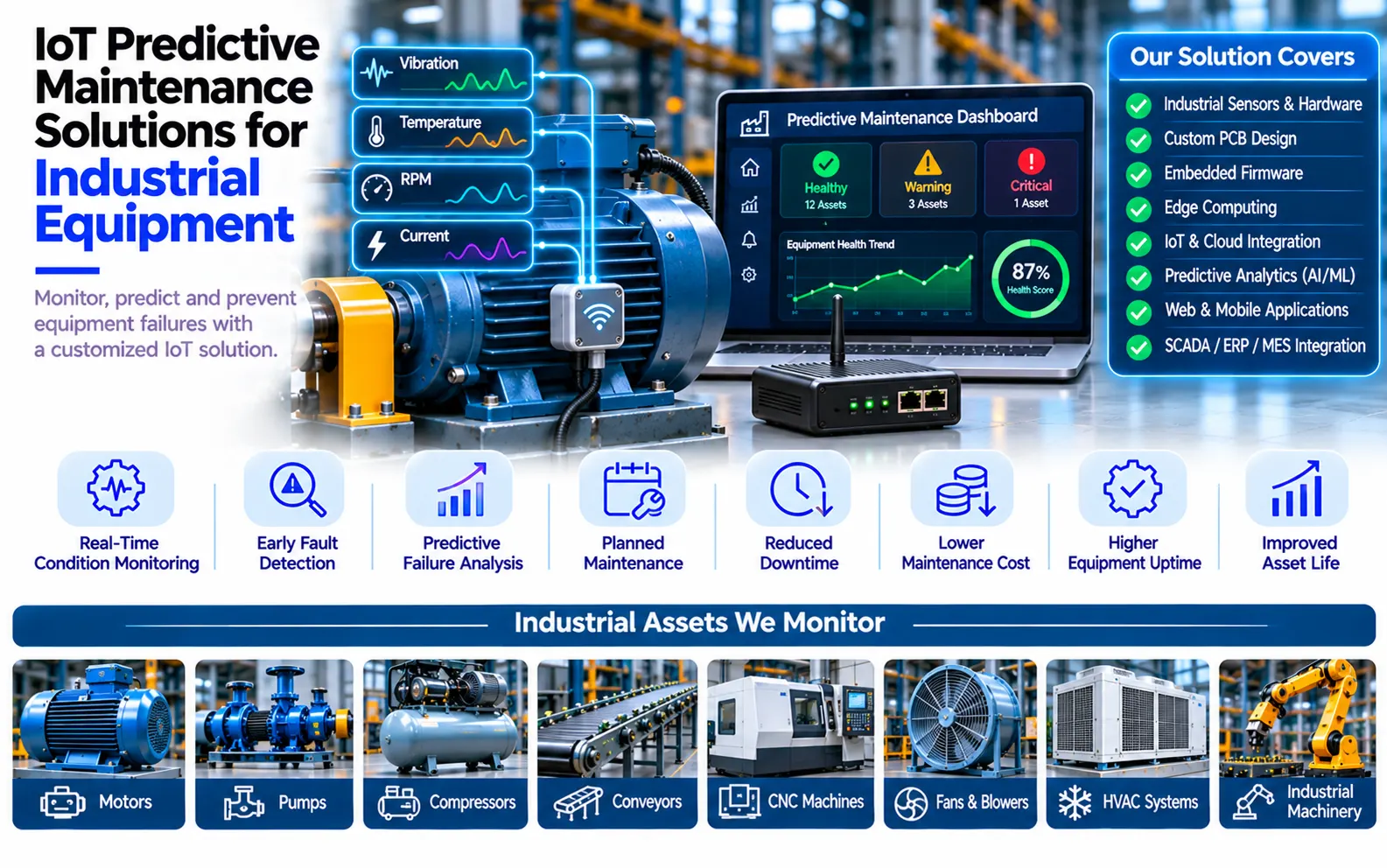
Custom Predictive Maintenance Software and IoT Development Services
It should be able to link equipment with the people responsible for its maintenance in an effective manner. This system should be capable of capturing valid inputs, processing them correctly, maintaining their context of operation, and delivering useful information without being overly burdensome on the user.
Our development services can include:
We can support a new industrial IoT product, modernize an existing monitoring device, build software around deployed equipment, or develop a proof of concept before proceeding toward production.
Case Study: STM32 Predictive Maintenance System for Titan Industrial Solution
STM32 Predictive Maintenance System for Titan Industrial Solution
Titan Industrial Solution is an international company dealing in manufacturing of heavy machinery. The company had a need for increased monitoring of its equipment at various plants. The environment at Titan comprised of conveyors, pumping stations, CNC machines and other automation equipment. Breakdowns of equipment were causing unplanned maintenance activities and production downtime.
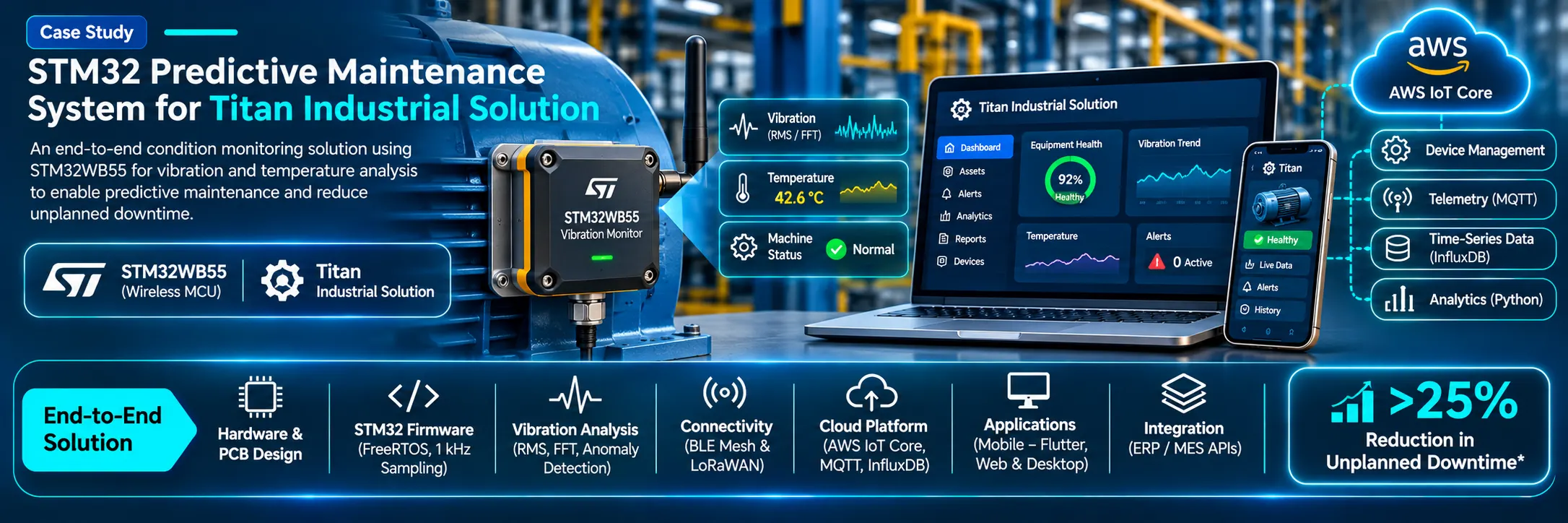
An Adequate Infosoft came up with the complete smart vibration monitoring system using the STM32WB55 wireless microcontroller. This was intended for continuous monitoring of vibration, temperature and operating status of the machinery, along with maintenance personnel having access to the alerts and data about equipment status.
The solution consisted of MEMS tri-axis vibration detection and temperature sensing. Industrial hardware was used in order to provide reliable sensing and operation in industrial environment. The STM32 software was based on the RTOS architecture and provided for vibration detection at 1 kHz sampling rate. Local processing evaluated the vibration data and abnormalities while selecting data for cloud transmission.
Edge-level processing was important because continuously sending raw, high-frequency vibration data would increase bandwidth, storage, and cloud-processing requirements. The firmware therefore performed local analysis, including RMS calculations and FFT-based processing, to reduce unnecessary traffic while preserving useful condition information.
The connectivity architecture supported BLE mesh and LoRaWAN communication. AWS IoT Core handled secure device registration and telemetry ingestion, while MQTT supported the movement of equipment data into the backend. InfluxDB was used for time-series information, and Python-based services supported analytics workflows.
The software layer included monitoring interfaces for different users. A Flutter mobile application provided machine-status visibility, alerts, and push notifications. Web and desktop applications supported deeper equipment analysis, maintenance history, device management, and plant-level monitoring. APIs also enabled the client's technical teams to integrate condition data with existing ERP and MES systems.
The project included PCB & hardware design, firmware for STM32, sensors, housing, connection with the cloud, analytics, applications, and integration services. It went through stages from development of the prototype to planning for production taking into account scalability, reliability, and cost-effectiveness.
Based on the results stated in the project documentation, it was noted that the use of predictive analytics helped decrease the time of unplanned downtime by more than 25 percent within the first three months of the testing process. It is the specific result of the project implementation and not a guarantee of success in all other implementations.
Full case study: stm32-iot-vibration-monitoring-device-development
Relevant Predictive Maintenance Projects We Have Delivered
We have had experience with different architectures, processors, sensors, communication techniques, and application environments. The following list of projects shows that we can work on all layers of the predictive maintenance stack.
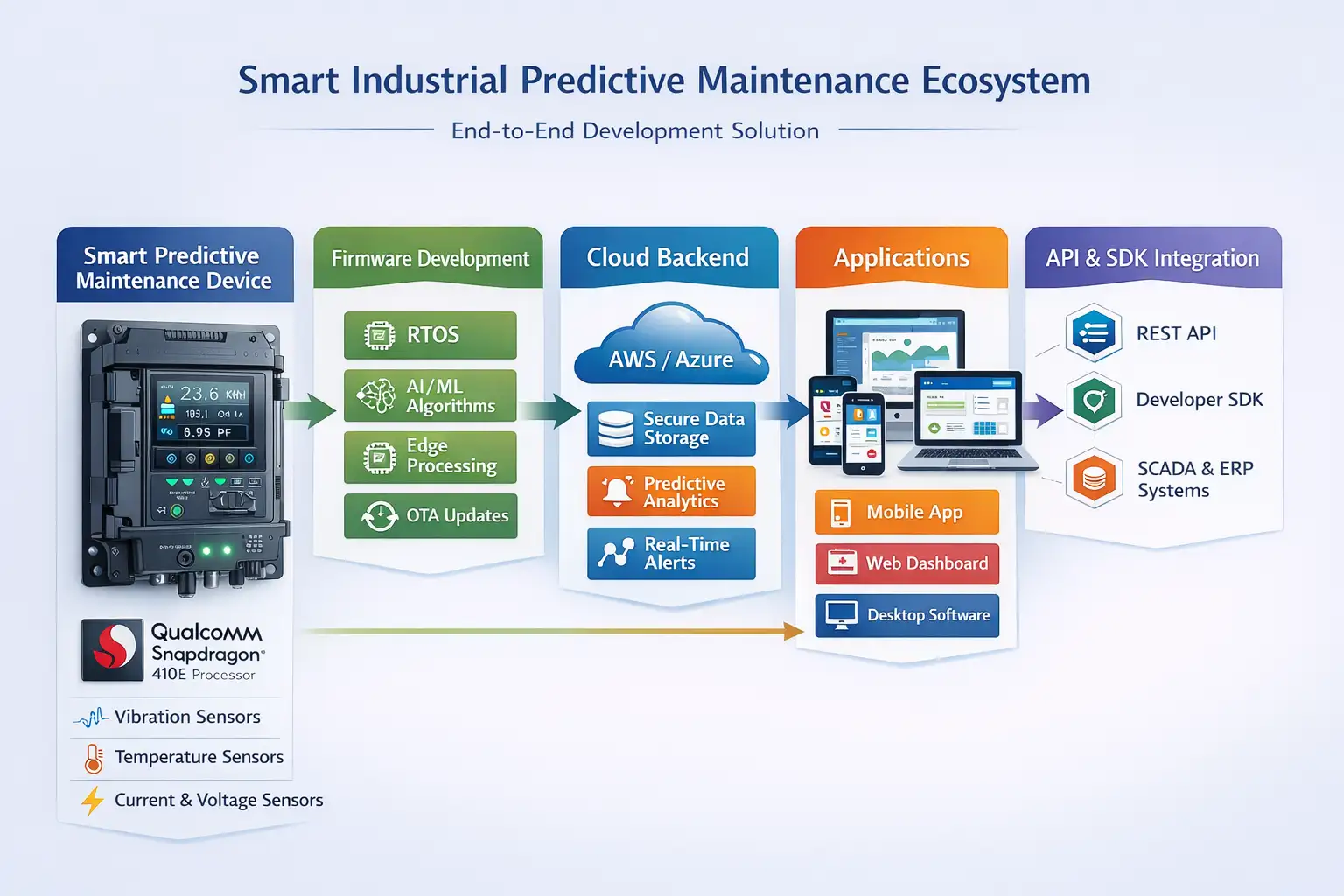
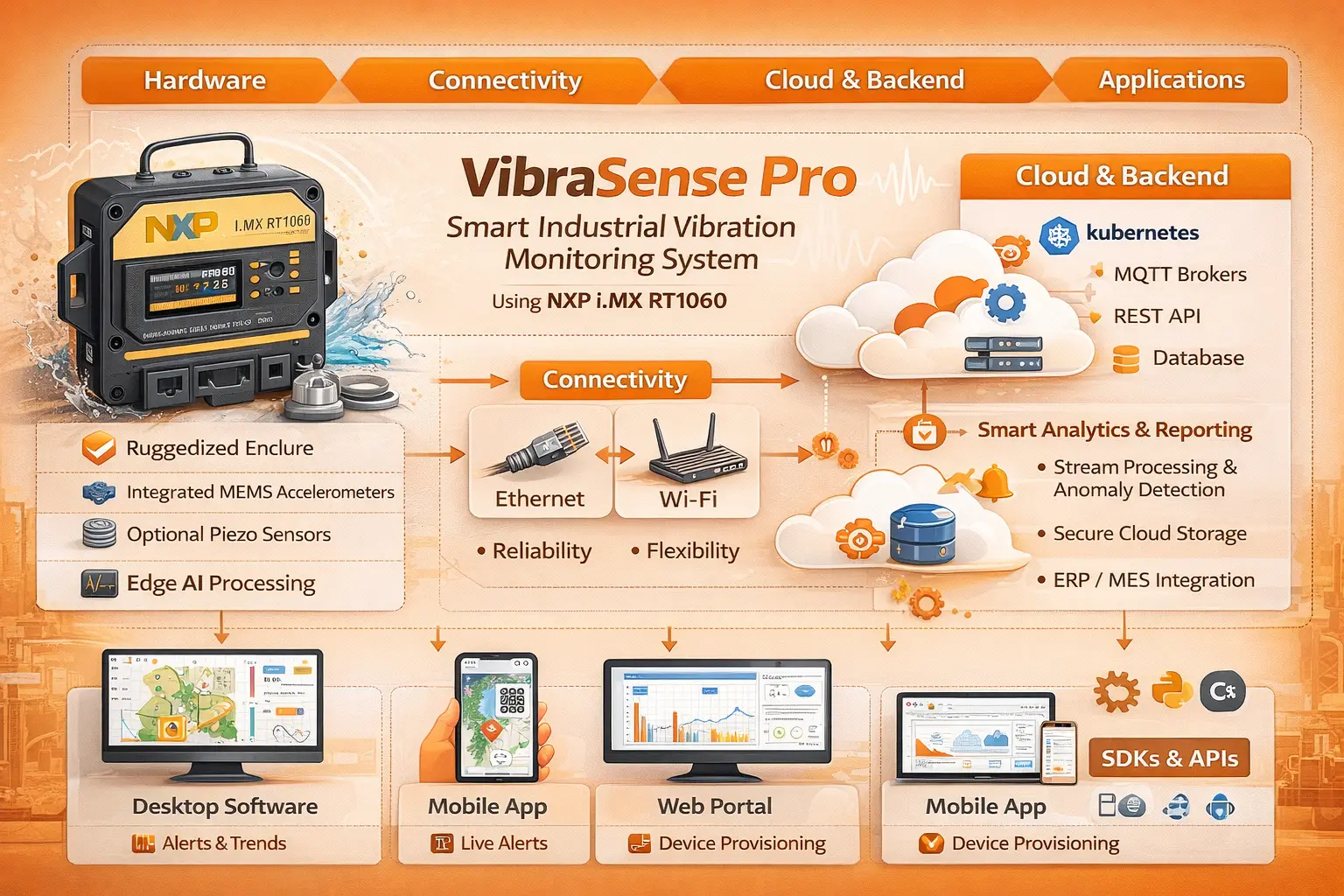
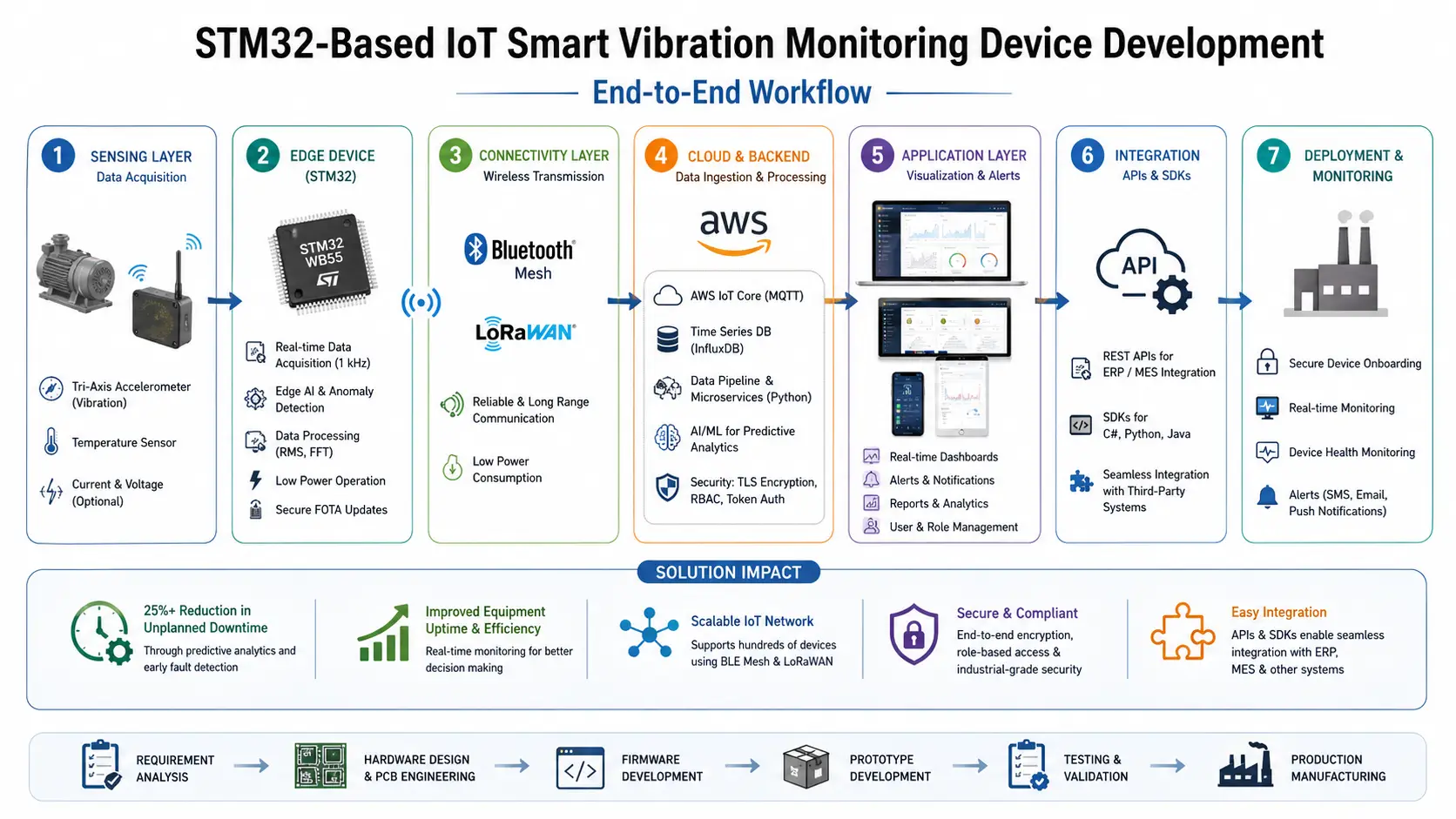
Together, these projects show experience with different hardware platforms rather than dependence on one processor or software stack. Technology selection is based on sampling requirements, processing load, power budget, connectivity, security, environmental conditions, integration needs, and target production cost.
What an IoT Predictive Maintenance System Does
Predictive maintenance involves examining information concerning the condition of equipment in order to spot problems and plan interventions that will minimize the impact of breakdown. This method of maintenance is different from the traditional "calendar maintenance" approach that prescribes carrying out the maintenance operations regardless of whether it is necessary or not.
The connected condition monitoring systems are designed to gather a wide spectrum of information related to the vibration, temperature, electrical current, voltage, pressure, acoustic data, speed, or state of operation of the equipment. The special firmware is used to process and filter the signals and send information about the necessary measurements to the edge or cloud system.
Using the software, it becomes possible to establish the equipment's operation baseline, detect abnormal patterns, compare equipment performance with other similar assets, and create maintenance alert messages.
The system can offer anomaly detection, fault classification, trend in machine condition, allocation of maintenance among the machines, and prediction of machine breakdowns depending on available data types.
Machine learning does not always entail proper commencement of all projects. For instance, a new installation may not have enough information concerning previous equipment failures to build a reliable model that will perform adequately. In that case, it is more logical to utilize engineering limits, characteristics of signal features, rules of functioning, and anomaly detection for providing initial information concerning models.
This approach results in the possibility to utilize a monitoring system in the short run and minimizes the risks associated with the development of an AI model based on incomplete or poorly understood data.
Predictive Maintenance Architecture: From Sensor to Maintenance Action
Industrial Sensors and Data Acquisition
The quality of the analysis is determined by the quality of the collected signal. We choose and interface sensors according to the asset, sensor mounting, frequency spectrum, sampling needs, environment, and anticipated modes of failure.
For rotating equipment, the measurement layers could involve the use of MEMS or piezo acceleration sensors along with temperature, current, and rotational speed measurements. The architecture may call for the use of analog filters, a low-noise power supply, isolation of signals, protection of inputs, and separation of analog and digital circuits.
Embedded Firmware and Edge Processing
Sending every data point collected from high-frequency data can cause unnecessary strain on the network and cloud. This problem can be addressed by using embedded processing to compute various vibration measures including RMS, pinnacle values, crest factor, frequency components, temperature trends, and operating mode data.
FFT process can be useful in revealing some noise parameters related to imbalance, looseness, misalignment, and bearing symptoms. Edge logic can also help identify the moments when detailed data should be saved or sent for deep analysis.
Secure IoT Connectivity
The ideal connection is determined by the type of location and its implementation type. For a cluster of sensor nodes, one can use either BLE (Bluetooth Low Energy) mesh or any local area network. In the case of long-range connectivity with low bandwidth, LoRaWAN can come into play. When the requirements differ in terms of bandwidth, network architecture and remote access, Wi-Fi, Ethernet, cellular and industrial gateways can be used.
Security must be thought out in advance in architecture design. Device identification, data encryption, controlled provisioning, secure boot, credentials protection, and signed firmware updates are critical for connected systems.
Cloud Analytics and Applications
The cloud or on-premises backend can manage device registration, telemetry ingestion, equipment hierarchies, time-series storage, alert processing, user access, and analytics workflows.
Dashboards should show information in the context maintenance teams use: plant, production line, asset, operating state, alarm severity, history, and required action. Mobile notifications can inform technicians about critical events, while desktop or web applications can provide deeper trend analysis and fleet-level visibility.
Our Predictive Maintenance Development Process
1. Asset Identification and Failure Modes
Identification of the equipment, possible failure modes, the maintenance procedure, operational states, installation constraints, and business objectives is carried out. This process dictates what should be measured and the criteria for judging success.
2. Sensor and Cloud Architecture Definition
The sensors' location, processor, signal conditioning requirements, connectivity, edge and cloud processing, data model, security, and interface requirements are defined by our team of engineers.
3. Proof of Concept
A proof of concept is carried out to validate the sensor location, quality of signals, communication, feature extraction and dashboard requirements using sample equipment.
4. Pilot Rollout
Pilot rollouts provide actual operational data and uncover environmental, network-related, user experience, and maintenance workflow concerns before general rollout.
5. Analytics and Modeling
We develop threshold settings, condition criteria, anomaly detection techniques, or machine learning models depending on the type of data that is available. Models are assessed in terms of relevant operational metrics as opposed to solely accuracy.
6. Production and Integration
The solution is fine-tuned for manufacturing, device setup, security, OTA, fleet management, application rollout, and integration into the customer's system.
Build a Custom IoT Predictive Maintenance Solution
If you are in search of a predictive maintenance IoT solutions development company, Adequate Infosoft can assist you in assessing and engineering the entire solution.
Regardless of whether you need an industrial vibration monitoring solution, machine condition monitoring software, edge computing capabilities, cloud computing capability, or anything else, we will be able to design a solution around your hardware and maintenance workflow.
Feel free to contact us to discuss your machines, failure points, sensors, infrastructure, and scope of deployment.
Who Can Use Our Predictive Maintenance Development Services?
Our services are suitable for manufacturers, industrial equipment companies, system integrators, maintenance technology providers, and startups building connected industrial products.
Typical applications include:
We can work as an end-to-end product engineering partner or support a specific layer, such as custom hardware, firmware, cloud development, signal processing, application development, or system integration.
Why Work With Adequate Infosoft?
Predictive maintenance is a multifaceted engineering issue. The dashboard is not enough to solve problems with incorrect placement of sensors, malfunctioning hardware, bad firmware, lack of context and inconsistent telemetry.
Our team spans hardware, embedded firmware, communications, cloud infrastructure, analytics and user applications. We can thus engineer the whole data path as an integrated system and detect potential technical issues earlier on, when other vendors would fail.
Moreover, we can provide published case studies where our prospective customers can look at the processors, sensors, communication protocols, cloud services and user applications involved.
Frequently Asked Questions
It is a connected system which captures machine condition data and analyzes it to identify abnormalities, machine fault diagnosis, or preventive maintenance prior to unexpected failure.
Yes. We can assist in the following tasks – sensor choice, signal conditioning, processor choice, PCB design, embedded firmware, edge processing, enclosure needs, connectivity, cloud integration, and monitoring applications.
Sensors used in machine condition monitoring include – vibration, temperature, current, voltage, pressure, acoustic, speed, and oil condition. Proper combinations depend on the machine and failure modes.
No. When historical failure data is limited, a project can begin with engineering thresholds, signal features, trend monitoring, and anomaly detection. Machine-learning models can be introduced after representative data has been collected and validated.
Yes. Edge processing can continue acquiring and analyzing signals locally. Depending on the requirements, the device can store data temporarily, generate local alarms, and synchronize with the backend when connectivity returns.
Yes, the integration can be made via REST APIs, SDKs, MQTT, Modbus TCP, gateways, databases, or platform specific connectors, depending on what kind of interfaces there are in the existing system.
It takes time depending on hardware specifications, sensor complexity, amount of analysis, data that are already available, certifications required, integrations, and other specifics of production. The proof-of-concept can be developed even before piloting and producing.
To begin with, one has to define the asset, operational issue, failure modes that are known, data available, installation environment, and required response to maintenance needs.
Technical References