

 Mean Stack Development
 Vue JS Development
 Javascript Development
 React JS Development
 Angular JS Development
 Next JS development
 Java Development
 Python Development
 Django Development
 Cherrypy Development
 C# Development
 ASP.NET Development
 NodeJS Development
 Laravel Development
 CodeIgniter Development
 Zend Development
 Ruby on Rails Development
 CakePHP Development
 PHP Website Development
 Symfony Development
 Drupal Development
 Joomla Development
 Wordpress Development
 .NET Nuke Development
 Kentico
 Umbraco
 .NET MAUI Development
 Xamarin Application Development
 iOS Application Development
 Android Application Development
 Android Wear App Development
 Ionic Development
 iBeacon Application Development
 Universal Windows Platform (UWP)
 Kotlin Application Development
 Swift Application Development
 Flutter Application Development
 PWA Application Development
 Flutter Health Tech & Wearable App Development Company
 React Native Health Tech Wearable App Development
 Offshore Software Development
 Custom Application Development
 Front-End Development
 Full Stack Development
 AI & Machine Learning
 Custom CRM Solutions
 Flask Software Development
 Electron JS Development
 ChatGPT Development
 Veterinary Telemedicine App Development
 Build Smart Telemedicine Platform
 Beauty & Salon App Solutions
 Hire Workato Experts
 Magento Development
 Magento 2.0 Development
 Magento Enterprise
 Shopping Cart Development
 Prestashop Development
 Shopify Development
 Open Cart Development
 WooCommerce Development
 BigCommerce Development
 NopCommerce Development
 Virto Commerce Development
 AspDotNetStorefront Development
 .NET Application Development
 Microsoft Dynamics CRM
 VB .NET Development
 Sharepoint Migration
 ASP.NET Core Development
 ASP.NET MVC Development
 AJAX Development
 Agile Development
 Microsoft Bot
 Microsoft Blazor
 Microsoft Azure Cognitive
 HTML 5
 UI/UX Design
 Graphic Design
 Adobe Photoshop
 XML Application Development
 Cloud Computing Solutions
 Azure Cloud App Development
 AWS Development
 Google Cloud Development
 Certified AWS IoT Services Developers
 DevOps Consulting & Development
 Kubernetes Consulting & Services
 SQL Programming Development
 MySQL Development
 MongoDB Development
 Big Data
 Robotic Process Automation
 Social Media Marketing
 Search Engine Optimization
 QA Testing
 Software Testing
 Software Security
 Maintenance And Support
 I.T. Consulting Services
 Business Intelligence
 YII Development
 Data Analysis
 Alexa Skills Development
 On Demand App for Mobile repairing services
 On Demand App for Car Service Booking
 On Demand App for Cleaning Services
 On Demand App for Pharmacy
 On Demand Dedicated Developers
 On Demand Lawyer App Development







 Nuki Smart Lock
 Salto Smart Lock
 TTlock Smart Lock
 NFC App Development
 Custom IOT Enabled Smart Lock
 Smart Locker Solutions
 Hospital Smart Lock Systems
 Hotel Smart Lock Systems
 Smart Home & Office Locks
 Smart Access for Schools & Colleges
 Unloc Smart Lock Integration
 Yale & August Smart Lock Integration
 Populife Smart Lock Integration
 Smart Lock Hardware Development
 Dairy IoT Solutions
 Agri IoT & AI Solutions
 Weather & Climate Solutions
 Water & Waste Management Solutions
 RaspBerry Pi
 Firmware Software Development
 ESP 32 Software Development
 Embedded Development
 Internet of Things
 Smart IoT Development
 IoT Sensor Integration & Development Solutions
 Smart IoT System Development for HVAC
 Tuya IoT App Development
 Particle IoT SDK
 IoT Development with AI
 Smart Pet GPS Tracker
 Dairy GPS Tracking Solutions
 GPS Fleet Management Software
 Car Rental & Subscription Solutions
 Car Buy & Sell Marketplace Development
 AI-Powered Car Wash App Development
 PCB Design & Fabrication
 IoT AC Automation
 AI–IoT Painting Solutions
 IoT Wearable Hardware & App Development
 HVAC Automation & AI Control Systems
 Smart Home IoT Engineering
 AI Embedded Systems
 AI Hardware Design Service
 Advanced IoT Hardware & Firmware Development
 Device Driver Development Services
 NXP i.MX RT Firmware & Hardware Services
 Microchip PIC & AVR Development
 Hire IoT Architects
 IoT Cloud & Infrastructure Solutions
 Infineon XMC / AURIX Development Services
 Matter & Thread IoT Services
 Native IoT Mobile App Development (BLE & Wi-Fi)
 Snapdragon IoT Firmware Development
 Renesas RA/RX Firmware Services
 Silicon Labs EFR32 Development Services
 Smart Wearable App Development
 Smart IoT Meters
 Smart Healthcare Wearable App Development
 Health Care Monitoring System
 Fitness Tracking App Development
 Smart Home Automation Apps
 nRF PCB Design
 ESP32 PCB Design
 Embedded Wearables Engineers
 Rental Property Management System
 Building Management System
 Smart Lighting Development
 Infineon Semiconductor Firmware Development Services
 Custom Camera Development: Hardware, Firmware & PCB Prototyping
 Smart Security Camera SDK
 Nordic Semiconductor SDK
 Infineon SDK
 Arduino SDK
 NFC Lock Integration
 Kerong Lock Integration
 IoT & AI Solutions for Manufacturing
 Smart Inventory & Logistics Solution
 Food & Beverage Industry Solutions
 Smart Hospitality Solutions
 Smart Property Management
 Custom Smart Home IOT SDK
 Smart IoT & AI in Healthcare
 AI-Powered Security Solutions
 Smart Home Safety & AI
 Veterinary Clinic Management (AI)
 Pet Care System (AI & IoT)
 Pet Training & Adoption (AI)
 Healthcare IoT Development
 Event Management Software
 Money Remittance App
 Money Lending App Development
 Utility and Bill Payment App
 IoT Mobile App Development (Flutter & React Native)
 AI & IoT Retail Solutions
 Smart EV App Development
 Smart Solar IoT & AI Solutions
 IoT-Based Energy Systems
 Smart Energy & Utilities Solutions
 6G Solutions
 IoT Security Solutions
 AI-Powered Lottery App Development
 AI-Sports Fitness Club Management
 Travel
 Real Estate
 Medical & Healthcare
 e-Learning
 Consumer Products
 Finance
 Automobile
 Media & Entertainment
 Billing Software
 Enterprise Resource Planning (ERP)
 Augumented & Virtual Reality
 Point of Sale(POS) Development
 Learning Management System
 EV Charging Solutions
 About Us
 Partners & Certifications
 Quality Assurance
 Our Clients & Testimonials
 Development Process
 Our Products
 Social Responsibility
 Work Ethics
 Vision & Mission
 Awards
 Live Project Demos
 Contact Us
 Case Studies
 Portfolio
 Blog
Remote IoT Monitoring Solutions and Development Services
The team at Adequate Infosoft builds customized IoT-based remote monitoring systems that enable businesses to monitor their equipment, buildings, power supply systems, storage facilities, and distributed assets from a central location.
This encompasses all of the components of the monitoring system including sensors, custom electronics, PCB design, embedded firmware, edge gateways, IoT, cloud, telemetry, dashboards, mobile apps, alerting, reports, and integration into other existing enterprise systems.
Our clients are people who are looking for something different and are dissatisfied with traditional dashboards. The monitoring system is designed with regard to the equipment to be monitored, type of connectivity, environmental conditions, measurement accuracy, alarm sounding mechanism, data retention period, and number of devices employed.
Irrespectively of whether you need to develop a new telemetry device or add remote visibility to the current device, our specialists can support your project from the stage of proving the concept to the pilot testing and production phase.
Let's Work Together!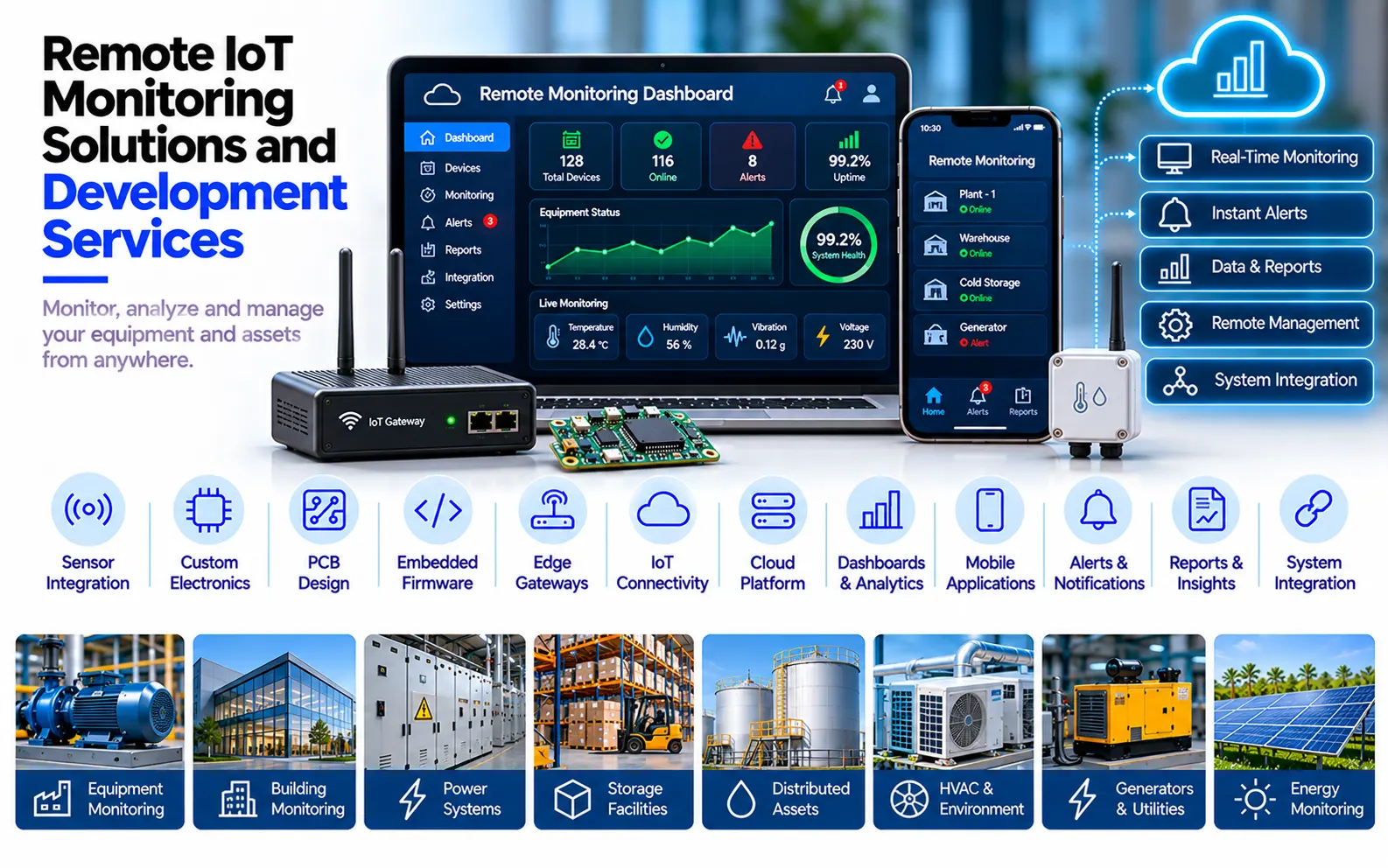
Custom Remote IoT Monitoring Development Services
Remote monitoring involves connecting physical instruments and sensors directly to the personnel responsible for creating, operating, or servicing them. This system collects data from the field, processes it either locally or in the cloud, and provides useful information through notifications, dashboards, reports, and integrations with applications.
Our remote IoT monitoring development services can include:
We can develop an end-to-end platform or work on a specific layer, such as device firmware, cloud telemetry, dashboards, mobile applications, or integration with existing equipment.
What Can a Remote IoT Monitoring Platform Track?
A custom platform may monitor various measurements based on the industry and equipment being tracked.
Equipment and Machine Condition
Industrial systems are capable of measuring vibrations, temperature, electric current, voltage, pressure, speed, and status of operation. All of this information can be used for condition monitoring, planning maintenance, equipment utilization, and detecting any anomalies.
Temperature and Environment
Cold storage chambers, storages, labs, nurseries, data storage areas, and office buildings require the observation of temperature, humidity, air quality, light, CO2 levels, water leakages, and doors status.
Energy and Electrical Performance
Smart meters and controllers allow monitoring of voltage, current, power factor, active power, energy consumption, solar manufacturing, battery condition, inverter state, and device consumption.
Storage and Cold Chain Conditions
Food production, pharmaceuticals, agriculture, and logistics companies will notice temperature deviations, blackouts, humidity variations, door openings and refrigerator problems.
Remote Devices and Deployments
With IoT telemetry, one can obtain insights regarding the devices installed in customer premises, farms, utilities sites, solar farms, cold storages, buildings, and many other remote places.
Case Study: Solar-Powered Cold-Room Monitoring for Zappy Logistics
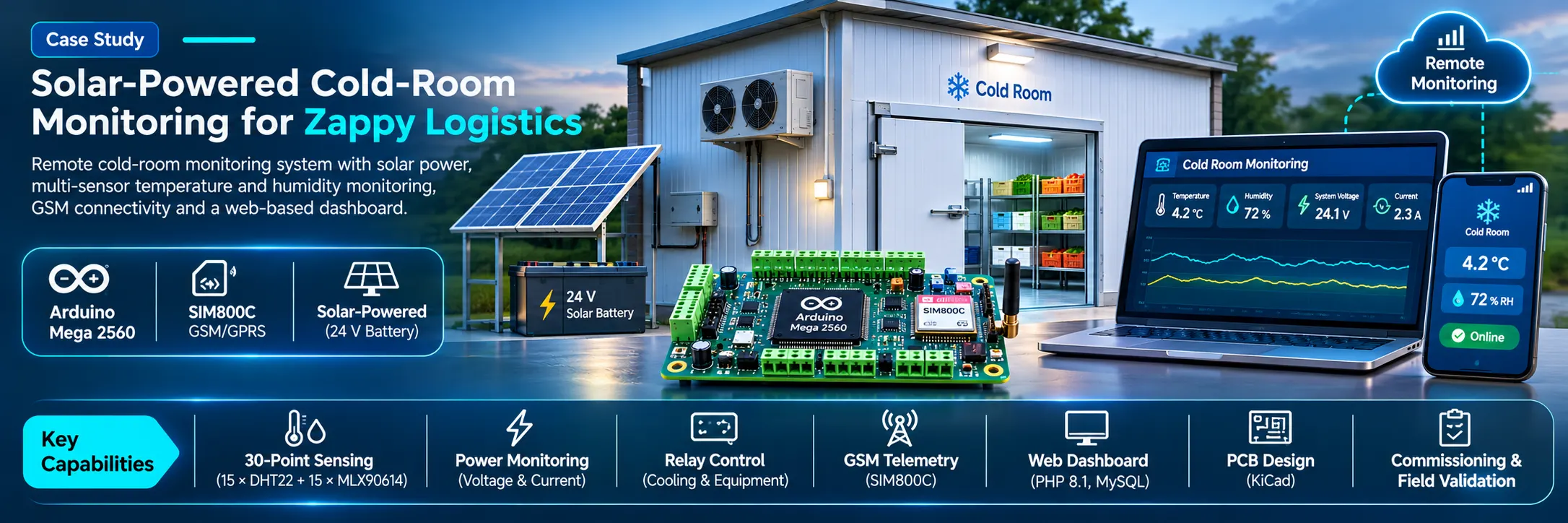
Solar-Powered Cold-Room Monitoring for Zappy Logistics
There was a need for a remote monitoring solution for cold rooms where reliance on consistent electricity from the power grid and the presence of network infrastructure was not feasible. These environments would have to hold temperature-sensitive agriculture and pharmaceutical products.
The Adequate Infosoft company developed the AdequateSolarCold monitoring system that integrates solar energy with the monitoring system of cold rooms through engineering, hardware, firmware, GSM, and web-based monitoring solutions.
The sensing design went beyond a conventional single-point temperature logger. The cold room incorporated fifteen DHT22 temperature and humidity sensors and fifteen MLX90614 infrared temperature sensors. These thirty measurement points were distributed across the chamber to observe spatial temperature differences, including potential warm areas near doors and cooling equipment.
An Arduino Mega 2560 was selected as the edge controller because the project required numerous sensor connections and separate serial communication with the GSM modem. A SIM800C GSM/GPRS module transmitted telemetry without depending on a local Wi-Fi or Ethernet network.
The controller also monitored electrical information through ACS712 current sensing and a voltage-sensing module. This allowed the platform to observe environmental conditions together with aspects of the solar-powered electrical system.
A 24-volt solar battery formed the power foundation. The power system relied on a 24-volt solar battery for its base power. The power-conversion circuits provided voltage levels for the controller, the sensors, the modem, and the relay system. This was necessary as the conditions of solar cells and batteries may change, while power is stable for devices associated with monitoring.
The PCB hardware and documentation was created with KiCad software. The engineering bundle was made up of the schematics, PCB layout, Gerber files, NC drill files, bill of materials, pick-and-place details, assembly instructions, and STEP models for the enclosure.
The firmware provided the readings from sensor arrays, measured voltage and current, controlled relay outputs, and sent telemetry to the monitoring backend. In addition, configuration for deployment included device identity, telemetry endpoint, I2C address, APN of the cellular network used, and sensor definition.
Data was received and stored by a monitoring service for PHP 8.1 and MySQL or MariaDB. In the backend, there was a dashboard, telemetry history, and an authenticated ingestion endpoint. Environmental variables were used for database credentials, timezone settings, and ingestion security, avoiding the need to include deployment credentials in the application itself.
The project also included a commissioning process that tested sensor failures, out-of-range values, relay outputs, malformed or unauthorized telemetry, calibration, and firmware versions. This helped distinguish a field-monitoring system from a demonstration that only displayed sensor readings.
The result was a reproducible remote monitoring platform for off-grid cold-chain installations. It demonstrates our ability to combine physical infrastructure, power engineering, dense sensor integration, firmware, cellular telemetry, backend development, and monitoring interfaces in one solution.
Related Remote Monitoring Projects We Have Delivered
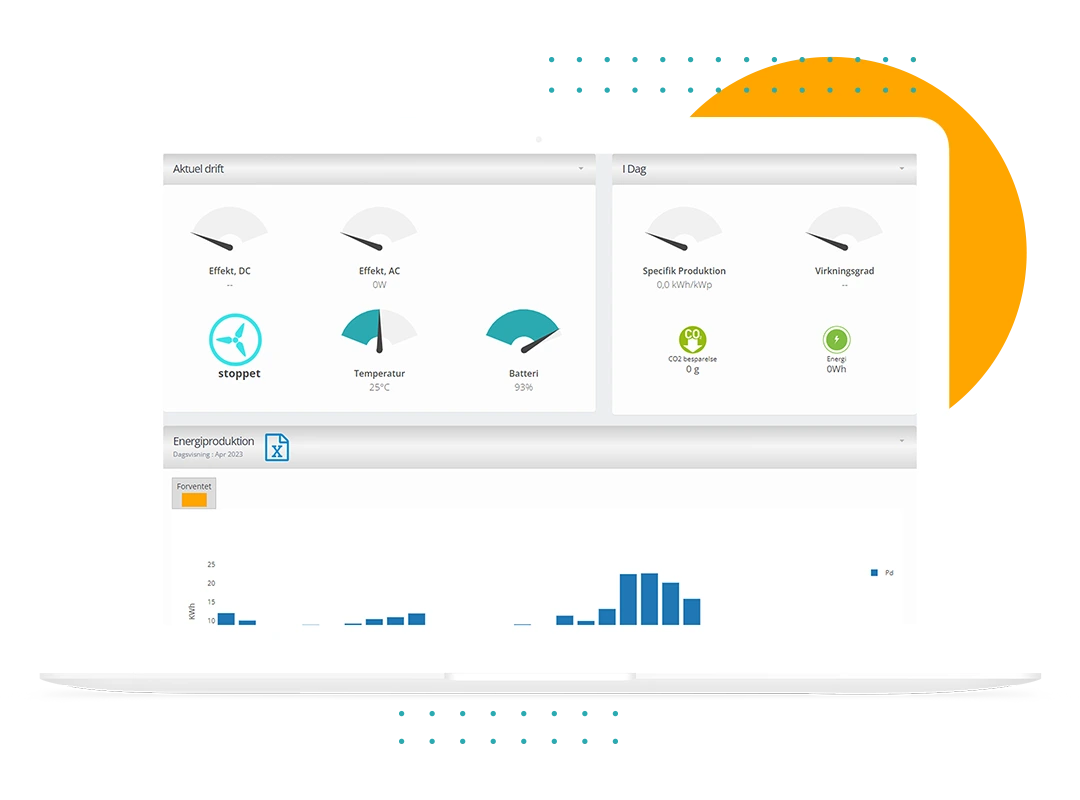
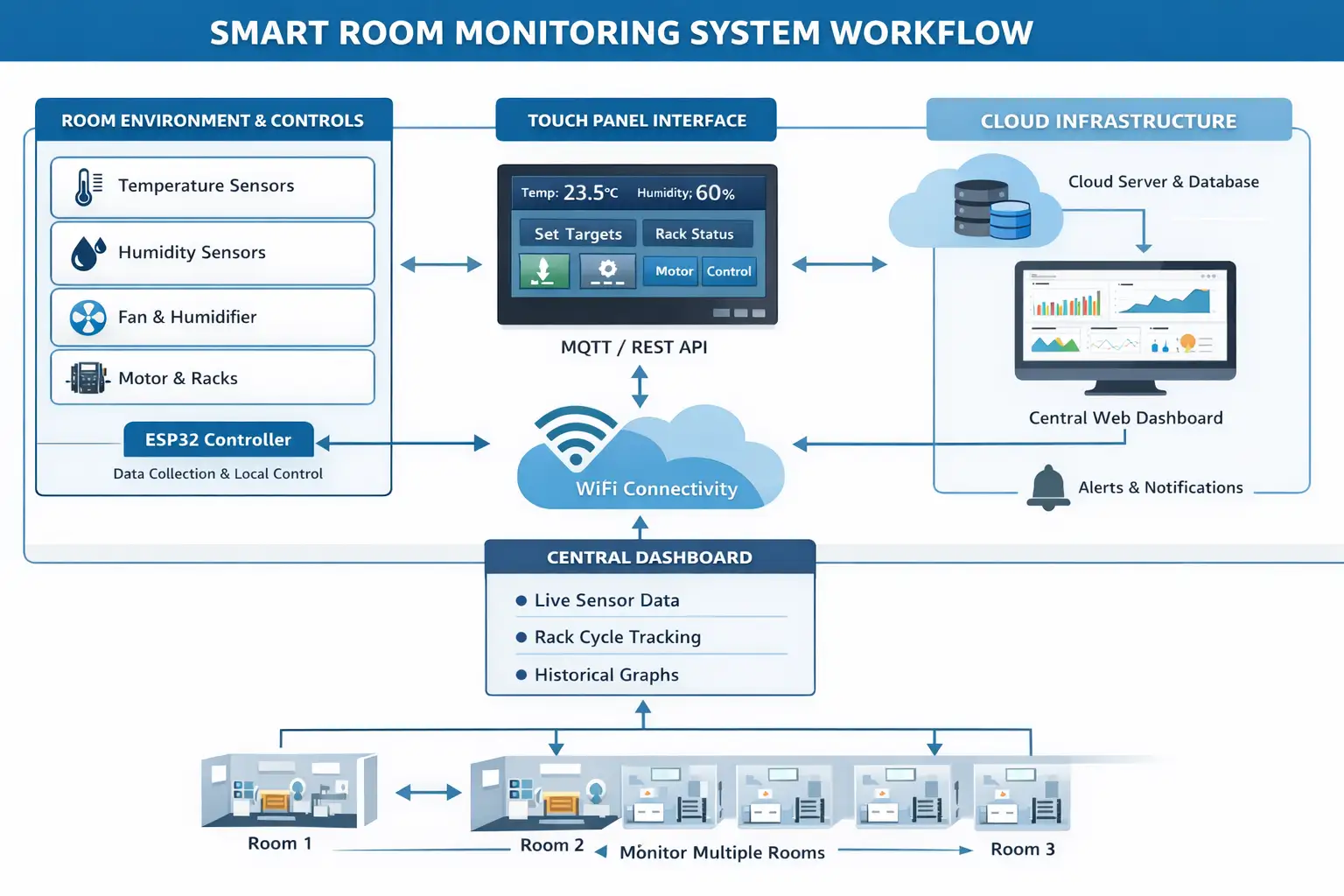
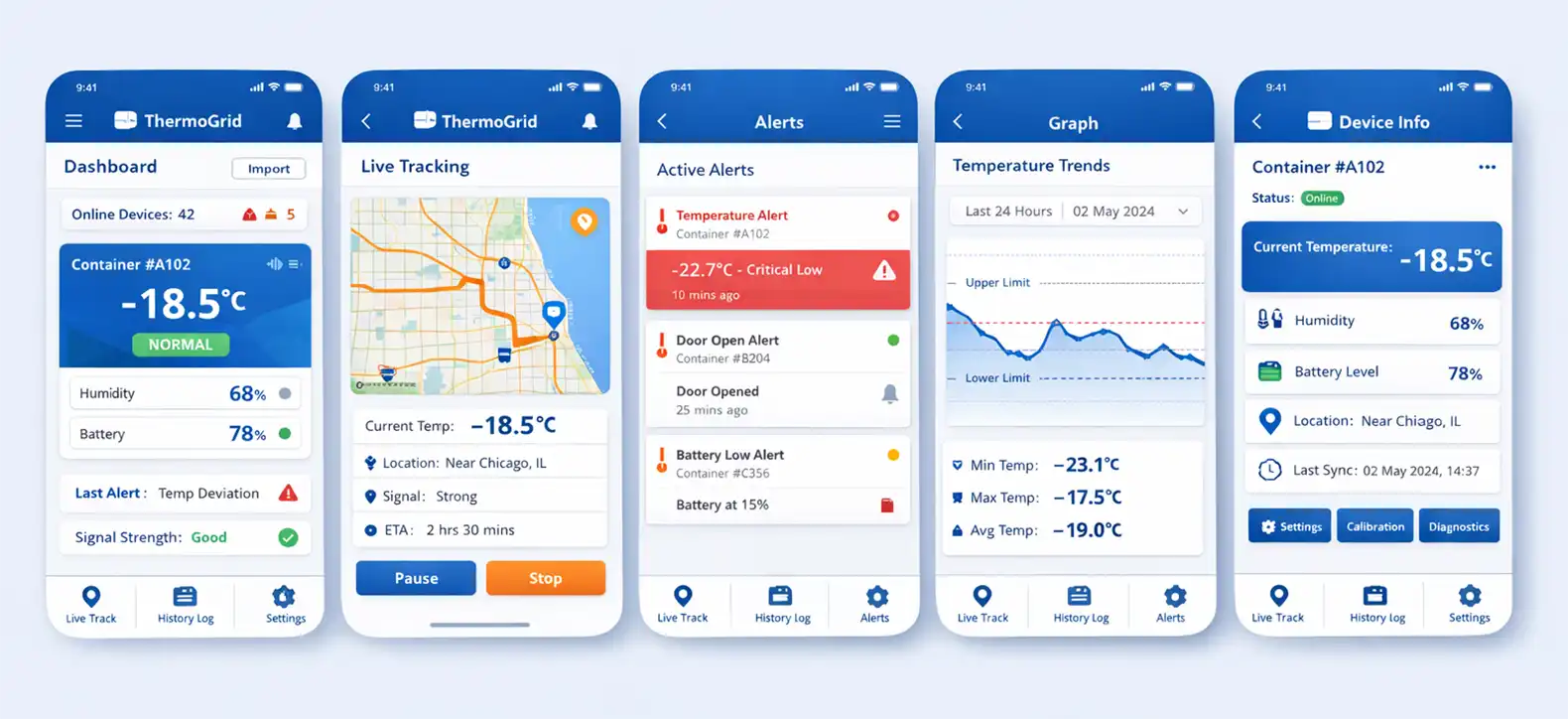
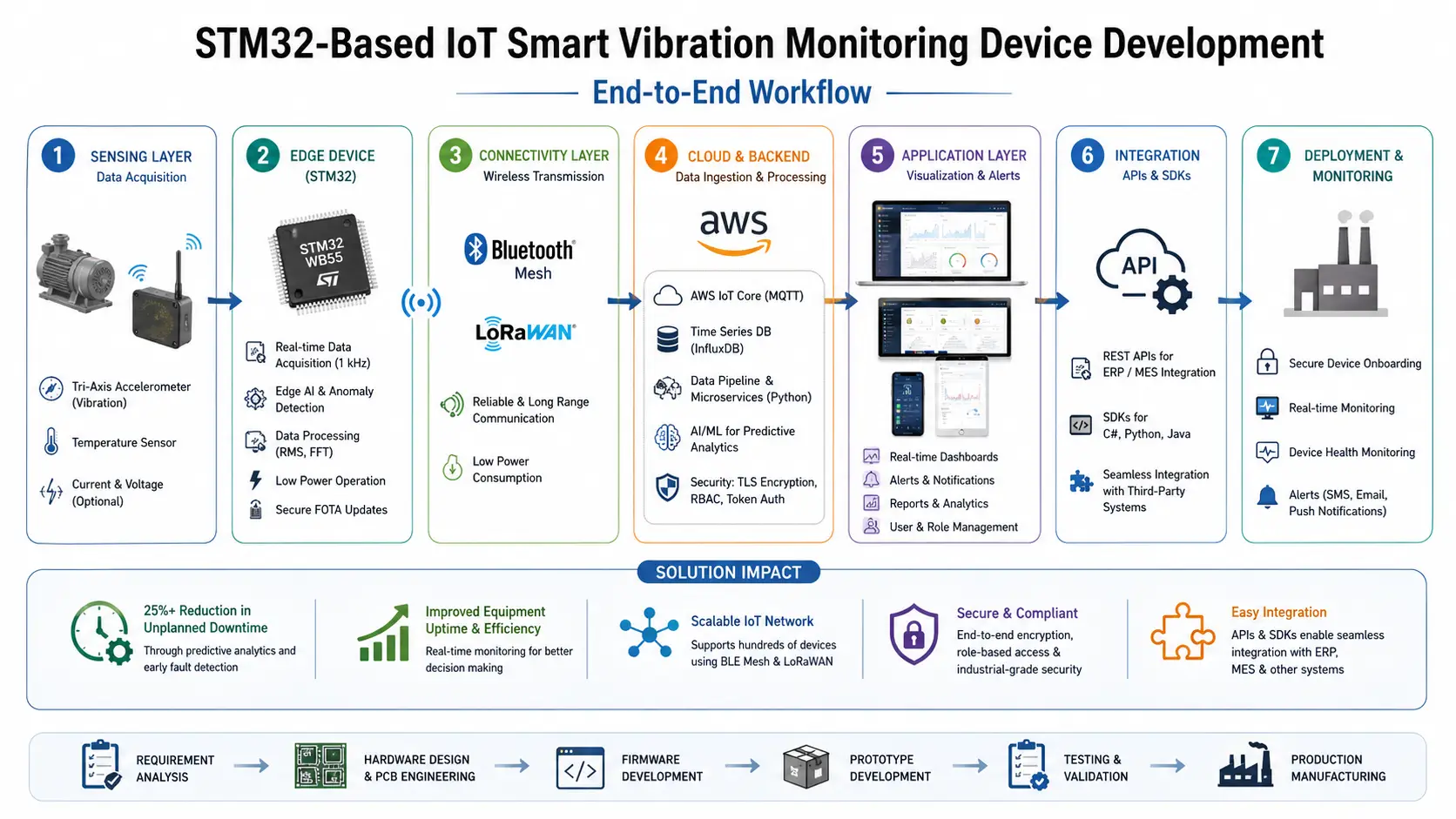
Architecture of a Remote IoT Monitoring System
Data Acquisition and Sensors
The very first stage of monitoring is reliable measurement. Sensors can connect directly to a special controller or via industrial protocols and interfaces.
Based on the purpose, it is possible to use temperature sensors, hypo-sensors, accelerometers, current transformers, voltage meters, pressure sensors, gas sensors, flow meters, GPS modules, door contacts, energy meters, equipment status indicators, and others.
The device design needs to take into consideration noise, protection from input voltage, isolation, precision of sensors, calibration, and environmental conditions among others.
Embedded Firmware and Edge Processing
The embedded firmware manages the sampling of sensors, filtering, local processing, communication, storage, alerts, and health of the devices.
Edge processing can cut down the transfer of data by processing raw data to meaningful information. The vibration device would process features of the signals locally whereas the environmental control device would verify data and thresholds and send only relevant events.
The devices can also cache telemetry information locally in case of unavailability of connectivity and later synchronize the same once the connection becomes available.
IoT Connectivity
The technology is determined by the location, bandwidth, power source, coverage range, and data reporting interval.
Wi-Fi or Ethernet could be used for communicating connected buildings and industrial infrastructure. LoRaWAN is useful for long-range and low-data-rate monitoring within farms, university campuses, and scattered facilities. Cellular, LTE-M, or NB-IoT technologies can provide connectivity for distant objects independently of the customer's network. BLE can connect the close-by sensors or help provision them via mobile device.
It may involve multiple technologies for one deployment. For instance, the local sensors can use BLE or RS-485 communication to send data to the gateway, which then communicates with the cloud using Ethernet or cellular network.
Cloud Telemetry and Data Storage
The backend receives telemetry, authenticates devices, processes measurements, stores time-series data, evaluates alert rules, and exposes information to applications.
A scalable IoT monitoring backend may include:
Sensor Monitoring Dashboards and Applications
The dashboard should be able to help the user figure out which specific things require their attention. Dashboards could display information on sensors, asset status, geographic summary, severity of incidents, historic graphs, connection status, battery life, and maintenance history of the device.
A mobile app would provide access to the field in order to send alerts, configure devices, scan QR codes, take pictures, add comments, and acknowledge alerts. Desktop software might be required in cases where the operator requires deeper visualization or interaction with the device.
Alerts in Real-Time That Enable Action
The appropriate monitoring system needs to ensure that users do not receive notifications for non-significant movements. Bad alerts logic can result in the phenomenon known as alert fatigue, which will make users miss important events.
We are establishing adjustable alert mechanisms based on:
The notifications can be delivered by means of dashboards, mobile notifications, email, SMS, messenger integration or third-party systems maintained by the clients.
Industries We Support
Our remote IoT monitoring development services can be adapted for:
Our Remote Monitoring Development Process
1. Requirements and Site Evaluation
We determine what needs to be monitored, the operating range to expect, monitoring frequency, alert needs, power supply, connectivity, user base, and environmental parameters.
2. Design of Solution Architecture
Our team determines the sensors, processor, gateway, communication protocol, security framework, cloud services, database, dashboard, and other components.
3. Prototype for Validation of Concepts
A specific prototype proves the validity of our sensors, signal acquisition capabilities, communication capability, data processing, and monitoring process.
4. Development of Hardware, Firmware and Platform Components
We design the electronics and the necessary firmware, backend, dashboards, mobile apps, and APIs.
5. Pilot Deployment
The system is tested in its intended environment. We evaluate sensor placement, connectivity, false alerts, offline behavior, power consumption, and application usability.
6. Production and Operational Support
We can assist with design refinement, manufacturing preparation, device provisioning, cloud deployment, security updates, remote diagnostics, and ongoing platform development.
Frequently Asked Questions
It is an interconnected set of hardware and software tools that gather data from devices or environmental sensors and present it remotely using dashboards, applications, alerts, reports, or integrations with external systems.
Yes. You can get help in selecting sensors, designing schematics and printed circuit boards, writing firmware, handling communication, cloud services, dashboards, mobile apps, APIs, testing, and preparing for manufacturing.
We collaborate on Wi-Fi, Ethernet, BLE, Zigbee, LoRaWAN, GSM, 4G, LTE-M, NB-IoT, MQTT, HTTP, Modbus, CAN, RS-485, and other protocols depending on your project's needs.
Yes. Monitoring devices or gateways can save telemetry locally and sync it later when connectivity becomes available again. You can still have local alerts and edge computing even without cloud connectivity.
Yes. We can evaluate available sensor outputs, communication ports, control interfaces, and protocols before designing an add-on monitoring device, gateway, or software integration.
Indeed, notifications can be sent through push messages, emails, SMS's, dashboards, text messaging applications, and third-party maintenance systems. The methods of delivery will be defined by the platform selected and the region of use.
Yes. The system enables sorting the information by its customer, organization, site, building, room, production line, equipment type, or device.
Yes. The integration can be done via REST API, MQTT, webhook, industrial gateways, database connection, and proprietary platform interfaces.
The schedule depends on hardware complexity, sensor requirements, connectivity, dashboard features, integrations, testing, certifications, and production scope. A proof of concept is normally planned before a larger deployment.
Technical References