


 Mean Stack Development
 Vue JS Development
 Javascript Development
 React JS Development
 Angular JS Development
 Next JS development
 Java Development
 Python Development
 Django Development
 Cherrypy Development
 C# Development
 ASP.NET Development
 NodeJS Development
 Laravel Development
 CodeIgniter Development
 Zend Development
 Ruby on Rails Development
 CakePHP Development
 PHP Website Development
 Symfony Development
 Drupal Development
 Joomla Development
 Wordpress Development
 .NET Nuke Development
 Kentico
 Umbraco
 .NET MAUI Development
 Xamarin Application Development
 iOS Application Development
 Android Application Development
 Android Wear App Development
 Ionic Development
 iBeacon Application Development
 Universal Windows Platform (UWP)
 Kotlin Application Development
 Swift Application Development
 Flutter Application Development
 PWA Application Development
 Flutter Health Tech & Wearable App Development Company
 React Native Health Tech Wearable App Development
 Offshore Software Development
 Custom Application Development
 Front-End Development
 Full Stack Development
 AI & Machine Learning
 Custom CRM Solutions
 Flask Software Development
 Electron JS Development
 ChatGPT Development
 Veterinary Telemedicine App Development
 Build Smart Telemedicine Platform
 Beauty & Salon App Solutions
 Hire Workato Experts
 Magento Development
 Magento 2.0 Development
 Magento Enterprise
 Shopping Cart Development
 Prestashop Development
 Shopify Development
 Open Cart Development
 WooCommerce Development
 BigCommerce Development
 NopCommerce Development
 Virto Commerce Development
 AspDotNetStorefront Development
 .NET Application Development
 Microsoft Dynamics CRM
 VB .NET Development
 Sharepoint Migration
 ASP.NET Core Development
 ASP.NET MVC Development
 AJAX Development
 Agile Development
 Microsoft Bot
 Microsoft Blazor
 Microsoft Azure Cognitive
 HTML 5
 UI/UX Design
 Graphic Design
 Adobe Photoshop
 XML Application Development
 Cloud Computing Solutions
 Azure Cloud App Development
 AWS Development
 Google Cloud Development
 Certified AWS IoT Services Developers
 DevOps Consulting & Development
 Kubernetes Consulting & Services
 SQL Programming Development
 MySQL Development
 MongoDB Development
 Big Data
 Robotic Process Automation
 Social Media Marketing
 Search Engine Optimization
 QA Testing
 Software Testing
 Software Security
 Maintenance And Support
 I.T. Consulting Services
 Business Intelligence
 YII Development
 Data Analysis
 Alexa Skills Development
 On Demand App for Mobile repairing services
 On Demand App for Car Service Booking
 On Demand App for Cleaning Services
 On Demand App for Pharmacy
 On Demand Dedicated Developers
 On Demand Lawyer App Development









 Nuki Smart Lock
 Salto Smart Lock
 TTlock Smart Lock
 NFC App Development
 Custom IOT Enabled Smart Lock
 Smart Locker Solutions
 Hospital Smart Lock Systems
 Hotel Smart Lock Systems
 Smart Home & Office Locks
 Smart Access for Schools & Colleges
 Unloc Smart Lock Integration
 Yale & August Smart Lock Integration
 Populife Smart Lock Integration
 Smart Lock Hardware Development
 Dairy IoT Solutions
 Agri IoT & AI Solutions
 Weather & Climate Solutions
 Water & Waste Management Solutions
 RaspBerry Pi
 Firmware Software Development
 ESP 32 Software Development
 Embedded Development
 Internet of Things
 Smart IoT Development
 IoT Sensor Integration & Development Solutions
 Smart IoT System Development for HVAC
 Tuya IoT App Development
 Particle IoT SDK
 IoT Development with AI
 Smart Pet GPS Tracker
 Dairy GPS Tracking Solutions
 GPS Fleet Management Software
 Car Rental & Subscription Solutions
 Car Buy & Sell Marketplace Development
 AI-Powered Car Wash App Development
 PCB Design & Fabrication
 IoT AC Automation
 AI–IoT Painting Solutions
 IoT Wearable Hardware & App Development
 HVAC Automation & AI Control Systems
 Smart Home IoT Engineering
 AI Embedded Systems
 AI Hardware Design Service
 Advanced IoT Hardware & Firmware Development
 Device Driver Development Services
 NXP i.MX RT Firmware & Hardware Services
 Microchip PIC & AVR Development
 Hire IoT Architects
 IoT Cloud & Infrastructure Solutions
 Infineon XMC / AURIX Development Services
 Matter & Thread IoT Services
 Native IoT Mobile App Development (BLE & Wi-Fi)
 Snapdragon IoT Firmware Development
 Renesas RA/RX Firmware Services
 Silicon Labs EFR32 Development Services
 Smart Wearable App Development
 Smart IoT Meters
 Smart Healthcare Wearable App Development
 Health Care Monitoring System
 Fitness Tracking App Development
 Smart Home Automation Apps
 nRF PCB Design
 ESP32 PCB Design
 Embedded Wearables Engineers
 Rental Property Management System
 Building Management System
 Smart Lighting Development
 Infineon Semiconductor Firmware Development Services
 Custom Camera Development: Hardware, Firmware & PCB Prototyping
 Smart Security Camera SDK
 Nordic Semiconductor SDK
 Infineon SDK
 Arduino SDK
 NFC Lock Integration
 Kerong Lock Integration
 IoT & AI Solutions for Manufacturing
 Smart Inventory & Logistics Solution
 Food & Beverage Industry Solutions
 Smart Hospitality Solutions
 Smart Property Management
 Custom Smart Home IOT SDK
 Smart IoT & AI in Healthcare
 AI-Powered Security Solutions
 Smart Home Safety & AI
 Veterinary Clinic Management (AI)
 Pet Care System (AI & IoT)
 Pet Training & Adoption (AI)
 Healthcare IoT Development
 Event Management Software
 Money Remittance App
 Money Lending App Development
 Utility and Bill Payment App
 IoT Mobile App Development (Flutter & React Native)
 AI & IoT Retail Solutions
 Smart EV App Development
 Smart Solar IoT & AI Solutions
 IoT-Based Energy Systems
 Smart Energy & Utilities Solutions
 6G Solutions
 IoT Security Solutions
 AI-Powered Lottery App Development
 AI-Sports Fitness Club Management
 Travel
 Real Estate
 Medical & Healthcare
 e-Learning
 Consumer Products
 Finance
 Automobile
 Media & Entertainment
 Billing Software
 Enterprise Resource Planning (ERP)
 Augumented & Virtual Reality
 Point of Sale(POS) Development
 Learning Management System
 EV Charging Solutions
 About Us
 Partners & Certifications
 Quality Assurance
 Our Clients & Testimonials
 Development Process
 Our Products
 Social Responsibility
 Work Ethics
 Vision & Mission
 Awards
 Live Project Demos
 Contact Us
 Case Studies
 Portfolio
 Blog
Battery-Powered Medical Device Hardware Development Services
Medical devices like ECG patches, monitoring devices, intelligent inhalers, and diagnostics machines require proper functionality within power budget constraints.
The development cycle for such devices involves much more than simply selecting a battery and includes proper consideration of power management, recharging, sensors, firmware, wireless, and overall device safety.
Adequate Infosoft provides assistance to health care firms, medtech startups, and product development teams in creating the hardware for battery-operated medical devices from design through testing and manufacturing.
We provide capabilities in electronics design, firmware development, BLE/Wi-Fi connectivity, cloud services, and mobile applications.
We consider all real-life usage cases involving low power levels, recharging, temperature changes, sensor noise, wireless interference, and firmware updates.
Such an approach is required in order to create reliable battery-operated medical devices.
Let's Work Together!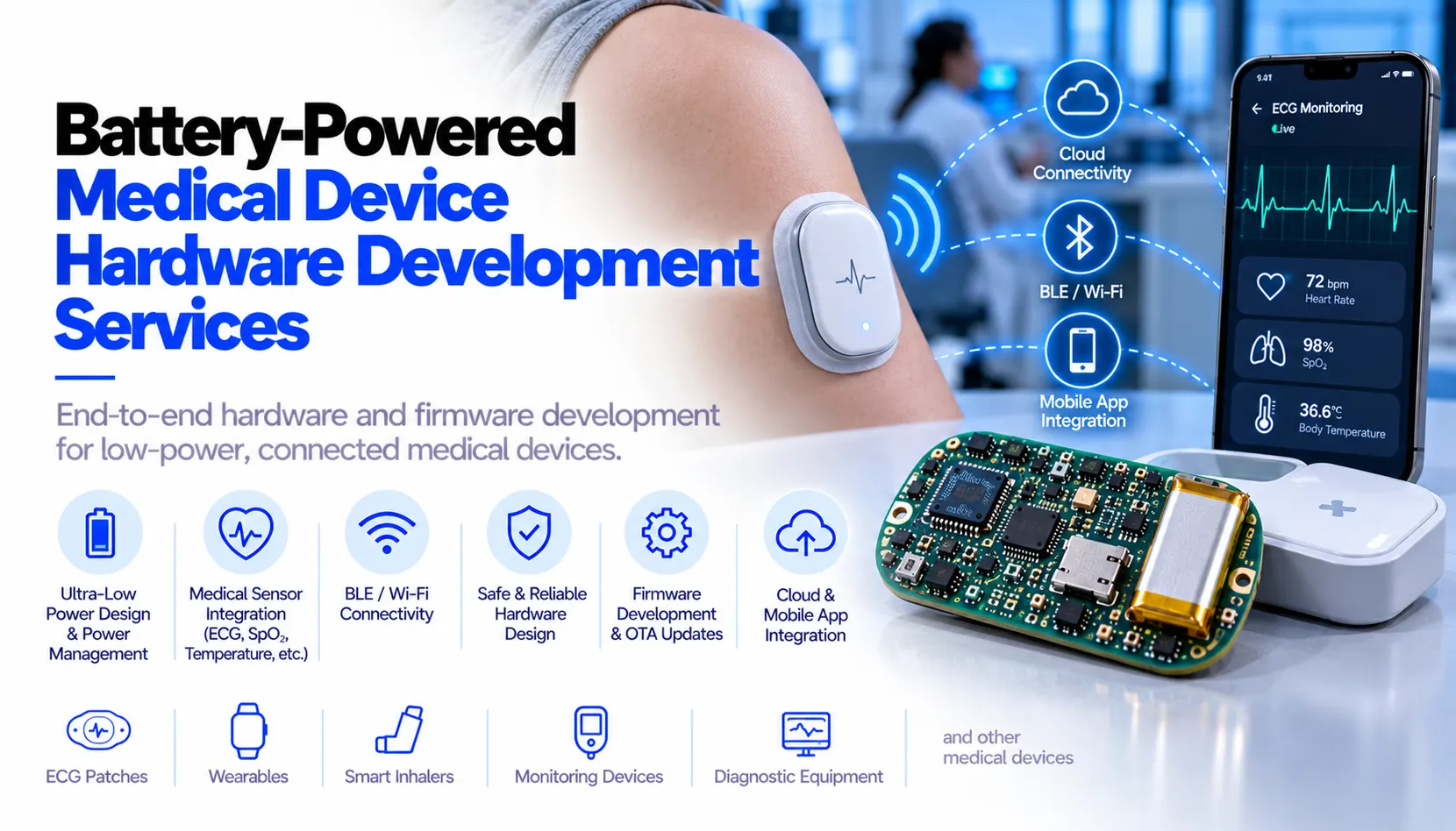
What We Develop
Our battery-powered medical hardware development services cover a wide range of portable and connected products, including:
Wearable health trackers and smart bands ECG, PPG, SpO2, temperature, respiration, and activity-monitoring devices Remote patient monitoring hardware Medication-adherence devices and smart inhaler accessories Portable diagnostic and point-of-care devices Bluetooth-enabled rehabilitation and physiotherapy equipment Connected medical accessories and home-health devices Low-power sensor modules for healthcare and wellness platforms Charging docks, cradles, and accessory electronics Companion mobile applications and cloud-connected dashboards
We can support a complete product program or join an existing engineering team for a defined phase such as PCB design, battery optimisation, embedded firmware, BLE integration, prototype debugging, or production-readiness work.
Case Study: Low-Power Remote Patient Monitoring Wearable Hardware
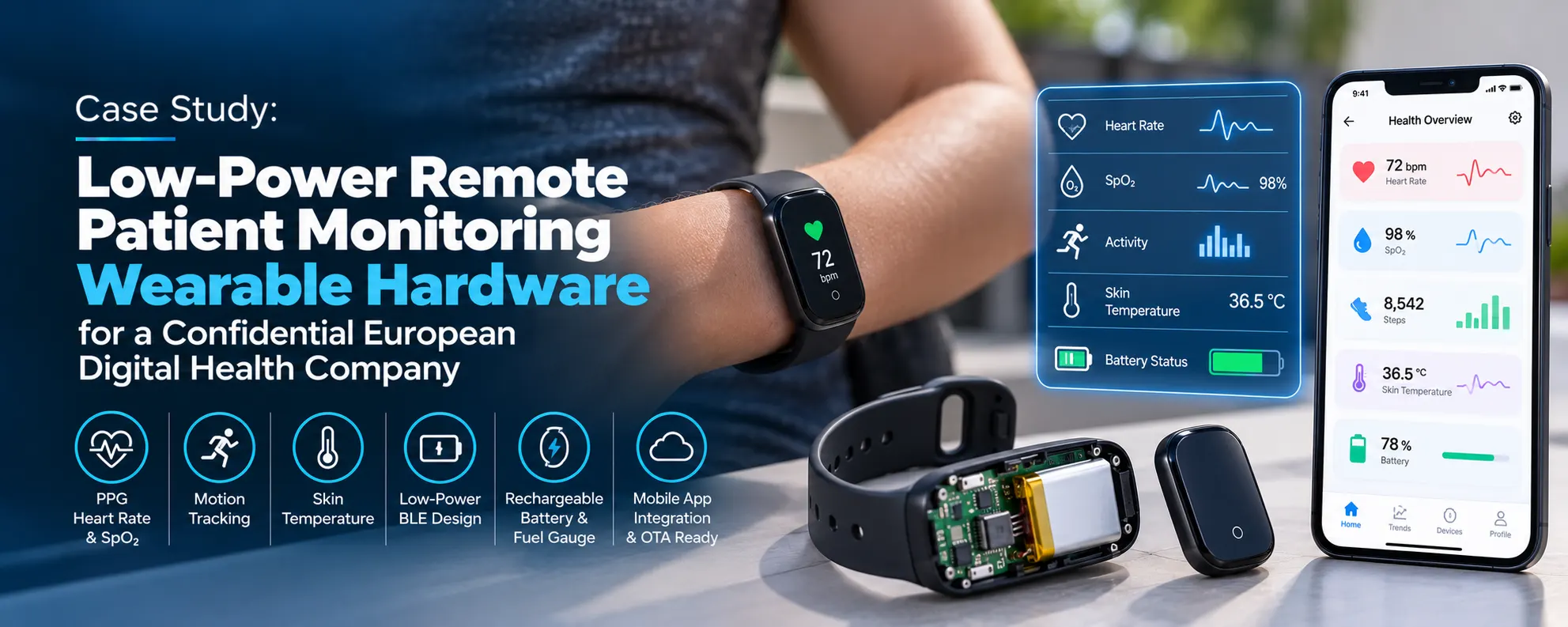
Confidential European Digital Health Company
A digital health customer from Europe asked Adequate Infosoft to assist in the development of a miniature battery-powered wearable aimed at gathering daily activity and physiological trends data and transmitting it to the corresponding mobile app.
Commercial details of the client are confidential; nevertheless, the technical problem was obvious: design a small-sized connected device capable of running several days without recharging and providing reliable sensor operation as well as good usability.
Suggested hardware platform was composed of an energy-efficient Bluetooth Low Energy MCU, optical PPG sensor, motion sensor, skin temperature interface, rechargeable lithium polymer battery, battery fuel gauge, charging circuit, haptic feedback motor, and LEDs.
Since optical sensing and BLE communication might require short-time current spikes, we started with the current consumption model of the device rather than estimating battery capacity based on its dimensions only.
Firmware, PCB and Battery Design
We defined operating states for deep sleep, periodic sensing, active measurement, BLE advertising, connected data transfer, charging, and low-battery mode. Firmware was designed to wake only the required peripherals, collect sensor data in controlled windows, buffer records locally, and send synchronised data in efficient BLE packets. This reduced unnecessary radio activity while preserving a responsive mobile-app experience.
In the PCB, the circuit design ensured separation of sensitive analog regions where sensors were located from the switching power supply section and the radio sections. It helped minimize interference that might impact low signal measurements.
The battery charger was designed with the ability of providing status reports back to the mobile application while the fuel gauge gave battery statistics which were more reliable than the voltage readings only.
The mobile application had a capability of secure BLE pairing, synchronization in background mode, battery warnings, diagnostics of the device, and flexible data upload strategy. The project team also envisaged the possibility of secure firmware updates in the future.
Prototype Testing and Outcome
Prototype tests were conducted on the battery life depending on user activity, charging and temperature behavior, Bluetooth reconnection, sensor behavior, and low battery functionality.
The consequence of this testing process was that the platform became more predictable, as the client could perform product evaluation not as separate prototypes but as an integrated hardware and software solution.
Relevant Adequate Infosoft Experience
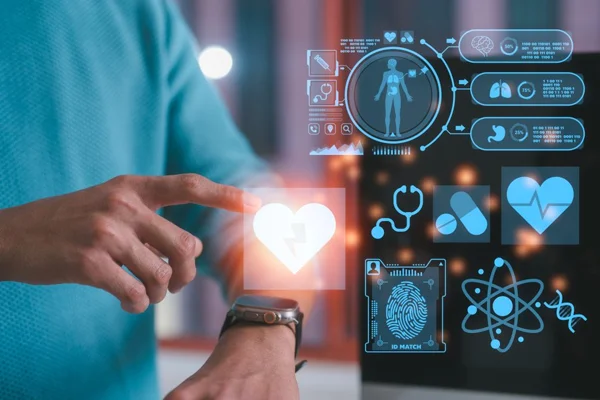
Our medical hardware capability is supported by hands-on connected-device, wearable, BLE, mobile, cloud, and health-data delivery experience.
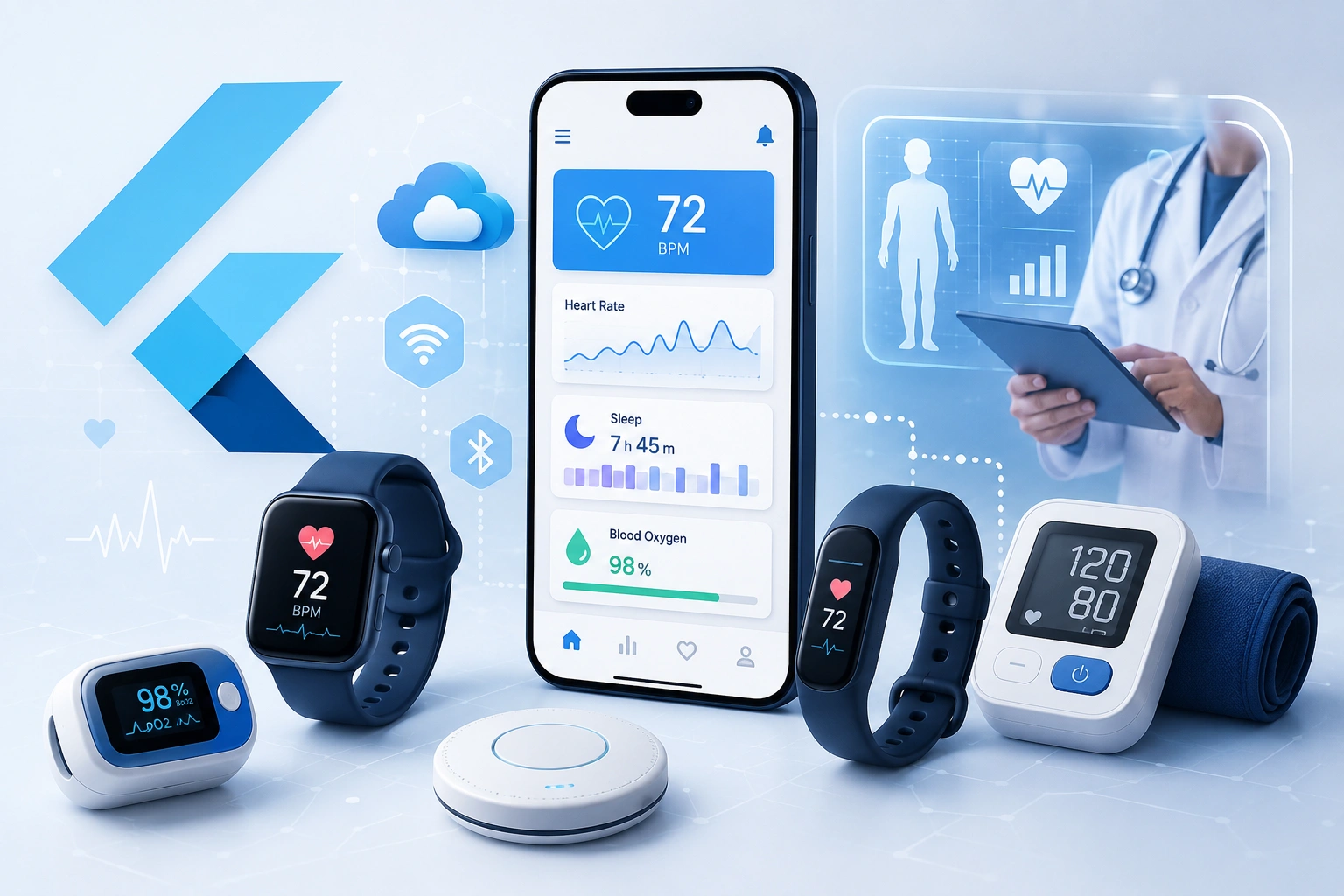
Engineering a Reliable Medical Device Starts With Power Architecture
Power Architecture and Battery Optimization
The arrangement of batteries impacts battery life, measure accuracy, heat discharge, safe charging, wireless functions, and the size of the device. Selecting suitable Infosoft establishes temperature, connectivity, battery life, charging method and size of the device before the creation of PCB is implemented.
Battery-Powered Medical Device Hardware Development
Our engineering services range from battery capacity evaluation, run time simulation, battery & charger selection, protection circuitry, integration of fuel gauges, power regulation and power saving firmware design. In addition, we integrate USB-C, magnetic, pogo pin, dock and wireless charging solutions based on our products' requirements.
Power Efficiency & Reliability
We design power sequencing, sleep modes, current peaks management, sensors, and BLE communications taking into account noise on PCB, thermal dissipation, and manufacturing. We aim for the best combination of efficiency, safety, and stability during the whole battery lifespan.
Low-Noise Electronics for Sensory Medical Measurements
In designing healthcare and medical measurements devices valid power and signal design must be implemented to protect ECG, EMG, PPG, temperature, and bioimpedance signals from noise.
The adequate design of Adequate Infosoft implies high-quality design of printed circuit boards including proper grounding, return current routing, decoupling, and isolation of sensitive analog circuits from switching power converters, displays, and radio.
Correct analysis of charging impact, Bluetooth Low Energy communication, battery level changes, and housing effect on the measurements accuracy must be performed.
For optical wearable devices, Adequate Infosoft should consider pulse currents of LED lights, photodiode processing of signal, ADC setup, illumination separation, motion artifacts and firmware filtering. It is better to catch issues with hardware at the design stage rather than later during mobile app and cloud development.
Embedded Firmware and Battery-Life Optimisation
Embedded Firmware & Power Management Techniques
Hardware and firmware have to collaborate to extend battery life and reliability. Sensor polling inefficiency, active peripherals, unnecessary data transfer, and improper sleep mode management can result in increased power utilization.
Development of Low-Power Firmware
Adequate Infosoft provides development services of embedded firmware for MCUs in medical applications such as board bring-up, peripheral driver, sensor interfacing, BLE connectivity, data security, storage, and OTA updates.
Reliable Device Operation and Data Management
We provide practical operating states through our firmware like pairing, measuring, low battery notification, charging, offline buffering, reconnecting, and update interruption recovery.
In addition, we assist in determining how the data of the device transfers from the embedded system, mobile application, or cloud platform depending on the usage, connectivity, and other factors.
Connectivity, Companion Apps, and Cloud Integration
Medical devices running on battery power require user-friendly mobile applications for easy connection, battery status, data accessibility, and charging alerts.
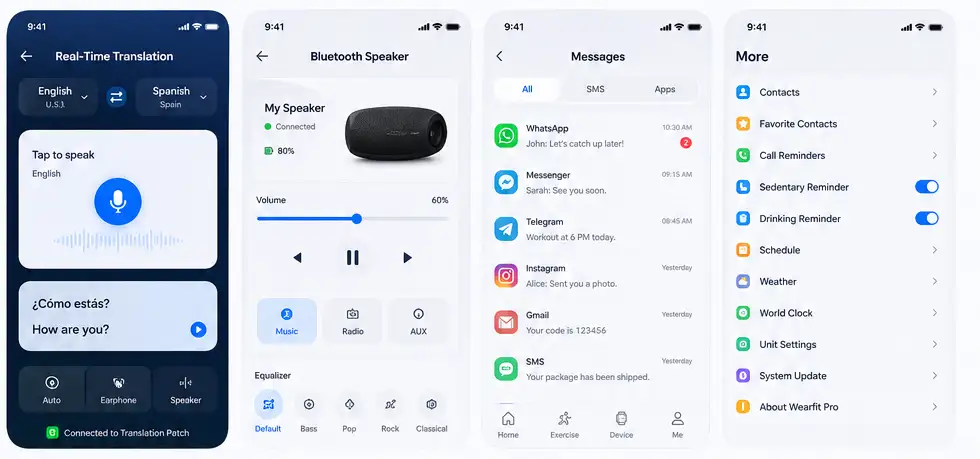
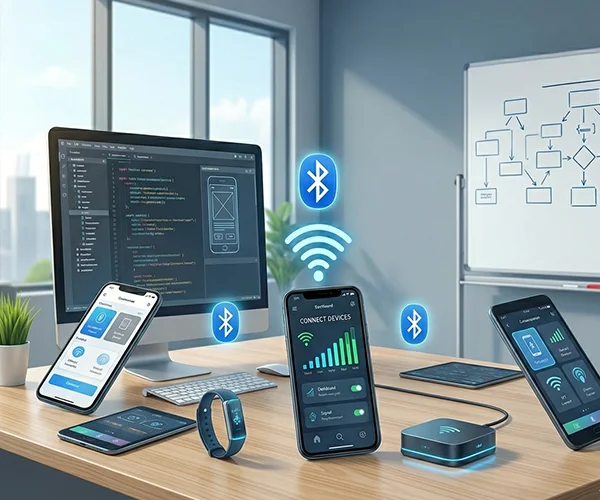
Adequate Infosoft creates iOS and Android apps integrated with medical devices via BLE technology utilizing React Native, Flutter, .NET MAUI, and native frameworks.
The range of our services includes device onboarding, Bluetooth connection, data management in offline mode, dashboards, notifications, firmware updates, and cloud API connection.
In order to provide remote monitoring software, Adequate Infosoft integrates device sensors, firmware, encrypted BLE communication, mobile apps, cloud systems, and healthcare dashboards.
Quality, Safety, and Design Controls
Product development for medical devices requires proper documentation, verification, and interaction with regulatory and quality experts. The specific requirements vary based on the intended use, classification, and market of the product.
Adequate Infosoft enables successful design work through requirements tracking, conducting design review meetings, making decisions based on available risks, product testing, prototype designing, and management of firmware versions, and keeping detailed records of the manufacturing process.
It is possible to apply standards such as ISO 13485 for quality management system, ISO 14971 for product safety, IEC 60601 for safety of medical devices, IEC 62304 for software life cycle, and IEC 62366 for usability engineering in the relevant projects.
Our solution is aimed at proper risk reduction by considering such risks as battery overheating, insufficient charging, interruption of measurements, insecure data transfer, and inability to update firmware.
Launch Your Battery-Operated Medical Device Creation Process
Whatever you need, from a clinical prototype, a connected wellbeing solution, an additional health monitor, to the scalable platform for medical devices, we can assist in the shaping of your device's electronics, firmware, connectivity, application, and cloud architecture.
The moment when issues of battery performance, sensor performance, manufacturing and security can be tackled is not after the PCB is developed – it is way earlier. And we can take care of that.
Frequently Asked Questions
Development of a proof-of-concept takes a few months while creation of a production-ready product will require much more time depending on complexity of sensors, enclosure design, mobile application development, etc. First of all, we will conduct feasibility and architectural analysis to have realistic expectations.
Yes. Adequate Infosoft can work on the development of the electronics, embedded firmware, Bluetooth low energy or Wi-Fi connectivity, iOS and Android applications, cloud API and dashboard, and OTA update process.
There is no single best battery. The appropriate option depends on energy demand, physical dimensions, charging method, runtime target, certification needs, operating temperature, and cost. Lithium-polymer batteries are common for rechargeable compact wearables, but each design requires its own power-budget analysis.
Battery life can be increased by a number of means including: selection of low-power components, usage of correct regulators, control of sensor duty cycle, ability to enter deep sleep, reduction of wireless transfer overheads, local data buffering, and verification against realistic user cases as early as possible.
Yes. We can plan and design secure bootloader and OTA update functionality so that any future improvements and bug fixes could be released to the device once it is deployed. Specific solution would be chosen based on the capabilities of MCU and the method of device connectivity.
No, but we are happy to provide our engineering expertise and input into the documents that may help you go through the required certification process. Official certification process should be carried out with your quality, regulatory, notified body and accredited lab partners.