


 Mean Stack Development
 Vue JS Development
 Javascript Development
 React JS Development
 Angular JS Development
 Next JS development
 Java Development
 Python Development
 Django Development
 Cherrypy Development
 C# Development
 ASP.NET Development
 NodeJS Development
 Laravel Development
 CodeIgniter Development
 Zend Development
 Ruby on Rails Development
 CakePHP Development
 PHP Website Development
 Symfony Development
 Drupal Development
 Joomla Development
 Wordpress Development
 .NET Nuke Development
 Kentico
 Umbraco
 .NET MAUI Development
 Xamarin Application Development
 iOS Application Development
 Android Application Development
 Android Wear App Development
 Ionic Development
 iBeacon Application Development
 Universal Windows Platform (UWP)
 Kotlin Application Development
 Swift Application Development
 Flutter Application Development
 PWA Application Development
 Flutter Health Tech & Wearable App Development Company
 React Native Health Tech Wearable App Development
 Offshore Software Development
 Custom Application Development
 Front-End Development
 Full Stack Development
 AI & Machine Learning
 Custom CRM Solutions
 Flask Software Development
 Electron JS Development
 ChatGPT Development
 Veterinary Telemedicine App Development
 Build Smart Telemedicine Platform
 Beauty & Salon App Solutions
 Hire Workato Experts
 Magento Development
 Magento 2.0 Development
 Magento Enterprise
 Shopping Cart Development
 Prestashop Development
 Shopify Development
 Open Cart Development
 WooCommerce Development
 BigCommerce Development
 NopCommerce Development
 Virto Commerce Development
 AspDotNetStorefront Development
 .NET Application Development
 Microsoft Dynamics CRM
 VB .NET Development
 Sharepoint Migration
 ASP.NET Core Development
 ASP.NET MVC Development
 AJAX Development
 Agile Development
 Microsoft Bot
 Microsoft Blazor
 Microsoft Azure Cognitive
 HTML 5
 UI/UX Design
 Graphic Design
 Adobe Photoshop
 XML Application Development
 Cloud Computing Solutions
 Azure Cloud App Development
 AWS Development
 Google Cloud Development
 Certified AWS IoT Services Developers
 DevOps Consulting & Development
 Kubernetes Consulting & Services
 SQL Programming Development
 MySQL Development
 MongoDB Development
 Big Data
 Robotic Process Automation
 Social Media Marketing
 Search Engine Optimization
 QA Testing
 Software Testing
 Software Security
 Maintenance And Support
 I.T. Consulting Services
 Business Intelligence
 YII Development
 Data Analysis
 Alexa Skills Development
 On Demand App for Mobile repairing services
 On Demand App for Car Service Booking
 On Demand App for Cleaning Services
 On Demand App for Pharmacy
 On Demand Dedicated Developers
 On Demand Lawyer App Development


 Nuki Smart Lock
 Salto Smart Lock
 TTlock Smart Lock
 NFC App Development
 Custom IOT Enabled Smart Lock
 Smart Locker Solutions
 Hospital Smart Lock Systems
 Hotel Smart Lock Systems
 Smart Home & Office Locks
 Smart Access for Schools & Colleges
 Unloc Smart Lock Integration
 Yale & August Smart Lock Integration
 Populife Smart Lock Integration
 Smart Lock Hardware Development
 Dairy IoT Solutions
 Agri IoT & AI Solutions
 Weather & Climate Solutions
 Water & Waste Management Solutions
 RaspBerry Pi
 Firmware Software Development
 ESP 32 Software Development
 Embedded Development
 Internet of Things
 Smart IoT Development
 IoT Sensor Integration & Development Solutions
 Smart IoT System Development for HVAC
 Tuya IoT App Development
 Particle IoT SDK
 IoT Development with AI
 Smart Pet GPS Tracker
 Dairy GPS Tracking Solutions
 GPS Fleet Management Software
 Car Rental & Subscription Solutions
 Car Buy & Sell Marketplace Development
 AI-Powered Car Wash App Development
 PCB Design & Fabrication
 IoT AC Automation
 AI–IoT Painting Solutions
 IoT Wearable Hardware & App Development
 HVAC Automation & AI Control Systems
 Smart Home IoT Engineering
 AI Embedded Systems
 AI Hardware Design Service
 Advanced IoT Hardware & Firmware Development
 Device Driver Development Services
 NXP i.MX RT Firmware & Hardware Services
 Microchip PIC & AVR Development
 Hire IoT Architects
 IoT Cloud & Infrastructure Solutions
 Infineon XMC / AURIX Development Services
 Matter & Thread IoT Services
 Native IoT Mobile App Development (BLE & Wi-Fi)
 Snapdragon IoT Firmware Development
 Renesas RA/RX Firmware Services
 Silicon Labs EFR32 Development Services
 Smart Wearable App Development
 Smart IoT Meters
 Smart Healthcare Wearable App Development
 Health Care Monitoring System
 Fitness Tracking App Development
 Smart Home Automation Apps
 nRF PCB Design
 ESP32 PCB Design
 Embedded Wearables Engineers
 Rental Property Management System
 Building Management System
 Smart Lighting Development
 Infineon Semiconductor Firmware Development Services
 Custom Camera Development: Hardware, Firmware & PCB Prototyping
 Smart Security Camera SDK
 Nordic Semiconductor SDK
 Infineon SDK
 Arduino SDK
 NFC Lock Integration
 Kerong Lock Integration
 IoT & AI Solutions for Manufacturing
 Smart Inventory & Logistics Solution
 Food & Beverage Industry Solutions
 Smart Hospitality Solutions
 Smart Property Management
 Custom Smart Home IOT SDK
 Smart IoT & AI in Healthcare
 AI-Powered Security Solutions
 Smart Home Safety & AI
 Veterinary Clinic Management (AI)
 Pet Care System (AI & IoT)
 Pet Training & Adoption (AI)
 Healthcare IoT Development
 Event Management Software
 Money Remittance App
 Money Lending App Development
 Utility and Bill Payment App
 IoT Mobile App Development (Flutter & React Native)
 AI & IoT Retail Solutions
 Smart EV App Development
 Smart Solar IoT & AI Solutions
 IoT-Based Energy Systems
 Smart Energy & Utilities Solutions
 6G Solutions
 IoT Security Solutions
 AI-Powered Lottery App Development
 AI-Sports Fitness Club Management
 Travel
 Real Estate
 Medical & Healthcare
 e-Learning
 Consumer Products
 Finance
 Automobile
 Media & Entertainment
 Billing Software
 Enterprise Resource Planning (ERP)
 Augumented & Virtual Reality
 Point of Sale(POS) Development
 Learning Management System
 EV Charging Solutions
 About Us
 Partners & Certifications
 Quality Assurance
 Our Clients & Testimonials
 Development Process
 Our Products
 Social Responsibility
 Work Ethics
 Vision & Mission
 Awards
 Live Project Demos
 Contact Us
 Case Studies
 Portfolio
 Blog
Wearable IoT Security & Secure OTA Development Services
Adequate Infosoft helps wearable product companies protect devices, firmware, mobile applications, cloud services and the update path connecting them.
Our IoT wearable security development services include threat modeling, secure boot, signed firmware, BLE security, device identity, key management, authenticated APIs, secure OTA update, vulnerability fix, and security testing.
Security cannot be applied at the end in an encryption layer. Wearable devices have restricted memory and power, work with sensitive information, and are exposed physically. Additionally, access can be gained through application and cloud login of the wearable device.
We ensure security through factory provisioning and pairing up until decommissioning of the device.
Let's Work Together!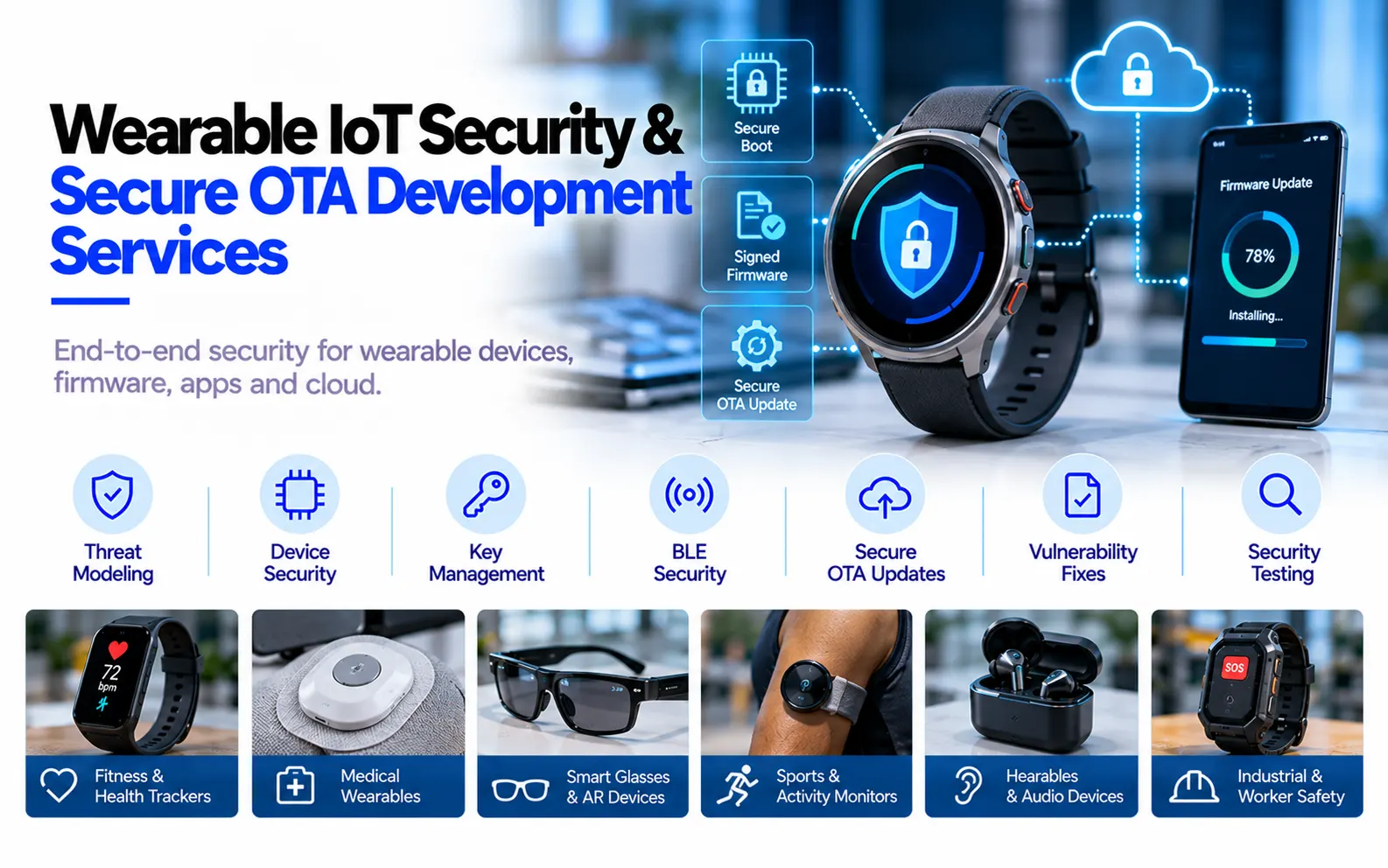
What Is Secure OTA for a Wearable Device?
OTA with security is a managed approach that ensures firmware distribution to the device maintaining the parameters of authenticity, integrity, availability and recovery.
By definition, the device needs to receive a legitimate firmware that passes all compatibility tests, survives interruptions in power supply and connectivity, and returns to operational status if the update is corrupt or incompatible.
A secure firmware cannot be defined solely by encryption – there has to be a check of authenticity performed by the device. A production OTA involves a protected boot loader, image signatures, compatibility test, secure flash map, post boot test, recovery, release test and telemetry.
Wearable Security Engineering Services
We can provide a focused security review or implement security within a wider wearable product engagement:
Secure bootloader and chain-of-trust development Signed, versioned and integrity-checked firmware images BLE device authentication, pairing and bonding Per-device identity and factory provisioning workflows Secure OTA over BLE, Wi-Fi, cellular or a companion app Rollback, recovery and power-loss-safe update behavior Firmware signing pipelines and release approval controls Debug-port lockdown and production configuration review Software bill of materials, vulnerability handling and security testing
Security requirements are traceable to threats and product behavior. This makes the result easier to test, maintain and explain during customer, partner or regulatory review.
Case Study: Wearable IoT Security and Secure OTA Development for a Smart Health Wristband
Building a Secure, Cloud-Connected Health Wearable
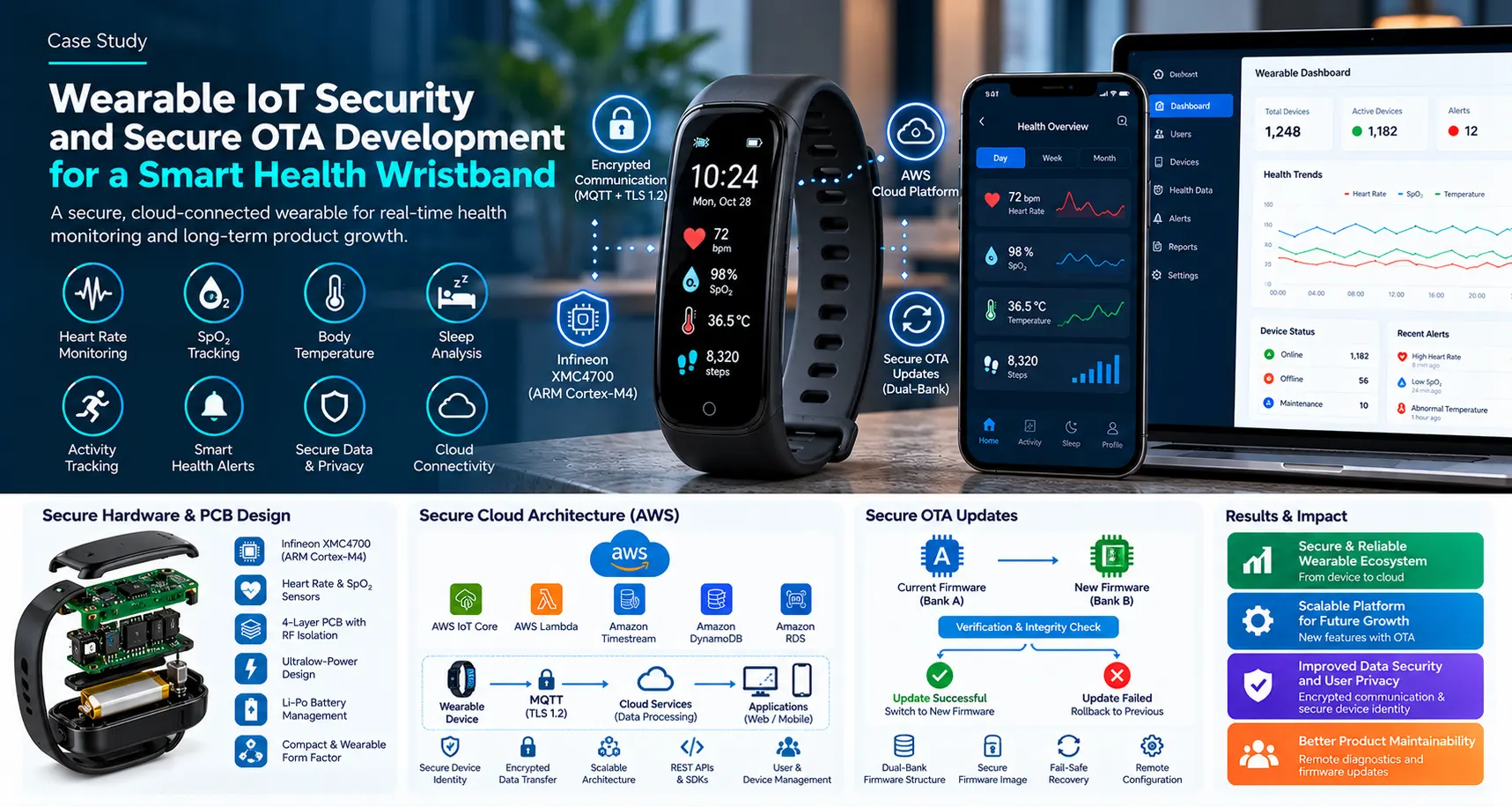
Adequate Infosoft created a Smart Health and Fitness Wristband for a health and technology client that required constant wellness tracking along with alerts and connectivity of applications on mobile, web and desktop platforms.
The product had to collect health and activity data while keeping personal information secure at all times, from the wearable device to the cloud platform.
It is a full product engineering project involving custom PCB development, embedded firmware, wearable device enclosure design, cloud infrastructure, back-end development and cross-platform applications. The device measured heart rate, SpO₂, body temperature, sleep, steps, calories and distance. It also provided alerts for abnormal heart rate, low blood-oxygen levels and poor sleep patterns.
Security Designed into the Wearable Hardware
The reason we went for the Infineon XMC4700 microcontroller – an ARM Cortex-M4 based MCU – was due to its ability to provide us with performance and security that were necessary for our connected healthcare device.
In addition, the on-board AES encryption, hardware acceleration and security keys storage would help protect our personal data when our wearable would be communicating via cloud servers.
As we had a compact wearable device which should be able to perform the signal processing but at the same time should not impact the battery performance, we created a four-layer printed circuit board with RF isolation for BLE/Wi-Fi connectivity and shielding for analog signal processing.
To support continuous use, the hardware included an ultra-low-quiescent-current power design and dedicated Li-Po battery-management circuitry. The XMC4700's processing capability also allowed the firmware to use motion-aware signal processing, helping reduce noise in health readings while maintaining dependable performance.
Secure Cloud Connectivity Using AWS
In the cloud layer, an event-driven architecture was adopted, with AWS Lambda serving as the serverless backend for data processing capabilities. The use of AWS Lambda made it possible to implement the platform in such a way that it processed wearable events without having to provision server infrastructure.
The wristband device was able to communicate with the backend through MQTT with TLS 1.2. This ensured lightweight encryption and two-way communication between the wearables eco-system and cloud-based services. MQTT is highly efficient when it comes to battery-powered IoT devices.
The user profile information was stored using relational databases while the telemetry from wearables was meant for NoSQL storage. This facilitated secure account management along with effective processing of continuous sensor information. REST APIs and SDKs were also developed to facilitate integration with the approved third-party applications.
Fail-Safe OTA Firmware Updates
Maintaining security on a wearable device is just as crucial as the initial launch itself. We incorporated an OTA update system in our firmware with a dual-bank flash structure. Whenever the firmware is upgraded, the wearable device can keep its stable current firmware until the new update is loaded on the second flash memory.
In case something goes wrong during the process and the new firmware fails to be installed, the wristband would revert back to the previous firmware. This will ensure that no unusable device results from this process and further development of features can be carried out.
The RTOS-based firmware separated critical tasks such as sensor sampling, cloud synchronization, power management and OTA handling. Priority scheduling ensured that health-data capture remained responsive, while non-critical communication tasks could run without affecting real-time measurement.
Result: A Secure and Maintainable Wearable Ecosystem
The successful implementation included a combination of secure device hardware, encrypted MQTT messaging protocol, cloud-based processing through AWS Lambda and rollback capable OTA firmware update technology. Thus, Adequate Infosoft offered the client a wearable platform that would allow updating its performance, scaling and development without interrupting the customer experience.
This project showed how Adequate Infosoft approaches wearable IoT security as a comprehensive task including encrypted data processing and cloud architecture, as well as reliable firmware updates and management of device lifetime cycle.
Case study: smart-fitness-wristband-xmc4700
Relevant Adequate Infosoft Wearable Experience
Threat Modeling the Complete Wearable Ecosystem
An effective analysis begins with consideration of the flow of data and the boundaries of trust. Possible assets range from health data to location information, credentials, firmware, signing keys, and commands. The points of entry include BLE and NFC connections, charging or debugging interfaces, the application, update files, APIs, cloud consoles, SDKs, and manufacturing interfaces.
We wonder if there is the possibility for an unauthorized phone to access data, one user to assume possession of another device, commands to be replayed, development firmware to execute on the production device, or an update process that is disrupted to prevent function of the product.
Possible outputs include risk assessments, requirements, architectural decisions, and test cases.
Secure Boot, Firmware Signing and Anti-Rollback
The secure boot process sets the first level of trust during reset. The bootloader checks the firmware by using a public key stored in secured storage space. The private signing key should never be stored in source code repositories or developer laptops, preferably in a secured signing facility with review mechanisms in place.
Release packages can contain a hash value, signature, product ID, hardware revision ID, version number, and security counter. Compatibility tests ensure cross-model installations are not possible. Anti-rollback can stop the installation of vulnerable releases, but the policy should allow for legitimate recovery.
MCUboot illustrates a useful constrained-device pattern: validate signed images, test a candidate from staged storage and revert if it does not confirm successful startup. We adapt the mechanism to the selected platform.
Designing a Failure-Safe OTA Update Flow
It is important for OTA workflow in the production stage to address every single state from "download" to "install":
The backend grants authorization to a particular release for any device cohort eligible to get it. The application, device, or gateway downloads its manifest and firmware package through secured means of transportation. All important information such as Product ID, hardware revision, minimum bootloader, version, and package size is verified. The candidate image is delivered to the staging area with the ability to stop at any point and perform integrity checks. The bootloader checks for a valid signature prior to running the image. The updated firmware performs self-checks to ensure proper functioning of the crucial parts of the device. The device only confirms the image once it fulfills the criteria required for it, otherwise it returns to its previous state. The status is being shared that makes it easier for the operator to understand which devices were downloaded, installed, confirmed, reverted, or failed.
BLE Security and Device Ownership
The Bluetooth encryption is used to secure the connection once a proper pairing and bonding has taken place, but then the product must have some form of ownership model as well. The onboarding process can make use of a QR code, a NFC tap, one-time code, physical proof, or factory injection of identity.
GATT characteristics must enforce proper authorization and cannot blindly trust every device connected to it. Different kinds of actions like reading, writing, erasing, and DFU mode can have their own separate set of policies.
Device Identity, Key Provisioning and Production Security
One system-wide secret among the fleet exposes the whole to system risk. Where hardware is amenable, we provide for unique credentials using secure storage, readout protection, and a secure element or hardware-protected key store.
Production discipline involves lock-down of debug access, key isolation, fixture control, and logging provisioning status. Key rotation and key revocation are scheduled in advance of deployment. Signing keys used in production cannot be built into scripts or file storage.
Security Testing and Vulnerability Management
Verification includes the processes of code review, dependency scanning, protocol testing and physical fault injection. Testing will include malformed BLE packets, unauthorised characteristics, replay attacks, signature validation, bad hardware images, downgrading, interrupted transfers and resets during flashing.
Following the release, developers require version control, vulnerability reporting, triage assignment, patching capabilities and end-of-life management. The IoT baseline by NIST contains identification, configuration, data protection, interface access, software update and security state awareness; product threat modelling is used to determine the specific controls.
Medical Wearables and Current Regulatory Expectations
For the case of wearables used in the healthcare sector, cybersecurity may have safety implications. The FDA final guidance of February 2026 provides information on aspects relating to the design of medical devices with cybersecurity considerations as well as the quality system issues involved and the premarket documentation required.
The European Cyber Resilience Act introduces product life cycle requirements for any device that has digital components.
The reporting requirement is effective from September 11, 2026, while the obligations take effect from December 11, 2027. Classification and conformity assessment will require a case-by-case approach. Adequate Infosoft provides engineering evidence but not regulatory/legality advice.
Frequently Asked Questions
Usually yes, though it's possible only depending on the bootloader, memory layout, microcontroller features and recovery process. Let's start with the architecture review.
No. Pairing might protect the connection itself, but there is also a need to prove ownership, control characteristics, update firmware and APIs.
Encryption protects confidentiality; signature verification establishes authenticity. Many products use both.
By using either dual slots or recovery firmware and checking the integrity pre-boot.
We will use technical controls and be able to provide evidence. It depends on the overall product, organization, and use-case.
Technical references