

 Mean Stack Development
 Vue JS Development
 Javascript Development
 React JS Development
 Angular JS Development
 Next JS development
 Java Development
 Python Development
 Django Development
 Cherrypy Development
 C# Development
 ASP.NET Development
 NodeJS Development
 Laravel Development
 CodeIgniter Development
 Zend Development
 Ruby on Rails Development
 CakePHP Development
 PHP Website Development
 Symfony Development
 Drupal Development
 Joomla Development
 Wordpress Development
 .NET Nuke Development
 Kentico
 Umbraco
 .NET MAUI Development
 Xamarin Application Development
 iOS Application Development
 Android Application Development
 Android Wear App Development
 Ionic Development
 iBeacon Application Development
 Universal Windows Platform (UWP)
 Kotlin Application Development
 Swift Application Development
 Flutter Application Development
 PWA Application Development
 Flutter Health Tech & Wearable App Development Company
 React Native Health Tech Wearable App Development
 Offshore Software Development
 Custom Application Development
 Front-End Development
 Full Stack Development
 AI & Machine Learning
 Custom CRM Solutions
 Flask Software Development
 Electron JS Development
 ChatGPT Development
 Veterinary Telemedicine App Development
 Build Smart Telemedicine Platform
 Beauty & Salon App Solutions
 Hire Workato Experts
 Magento Development
 Magento 2.0 Development
 Magento Enterprise
 Shopping Cart Development
 Prestashop Development
 Shopify Development
 Open Cart Development
 WooCommerce Development
 BigCommerce Development
 NopCommerce Development
 Virto Commerce Development
 AspDotNetStorefront Development
 .NET Application Development
 Microsoft Dynamics CRM
 VB .NET Development
 Sharepoint Migration
 ASP.NET Core Development
 ASP.NET MVC Development
 AJAX Development
 Agile Development
 Microsoft Bot
 Microsoft Blazor
 Microsoft Azure Cognitive
 HTML 5
 UI/UX Design
 Graphic Design
 Adobe Photoshop
 XML Application Development
 Cloud Computing Solutions
 Azure Cloud App Development
 AWS Development
 Google Cloud Development
 Certified AWS IoT Services Developers
 DevOps Consulting & Development
 Kubernetes Consulting & Services
 SQL Programming Development
 MySQL Development
 MongoDB Development
 Big Data
 Robotic Process Automation
 Social Media Marketing
 Search Engine Optimization
 QA Testing
 Software Testing
 Software Security
 Maintenance And Support
 I.T. Consulting Services
 Business Intelligence
 YII Development
 Data Analysis
 Alexa Skills Development
 On Demand App for Mobile repairing services
 On Demand App for Car Service Booking
 On Demand App for Cleaning Services
 On Demand App for Pharmacy
 On Demand Dedicated Developers
 On Demand Lawyer App Development


 Nuki Smart Lock
 Salto Smart Lock
 TTlock Smart Lock
 NFC App Development
 Custom IOT Enabled Smart Lock
 Smart Locker Solutions
 Hospital Smart Lock Systems
 Hotel Smart Lock Systems
 Smart Home & Office Locks
 Smart Access for Schools & Colleges
 Unloc Smart Lock Integration
 Yale & August Smart Lock Integration
 Populife Smart Lock Integration
 Smart Lock Hardware Development
 Dairy IoT Solutions
 Agri IoT & AI Solutions
 Weather & Climate Solutions
 Water & Waste Management Solutions
 RaspBerry Pi
 Firmware Software Development
 ESP 32 Software Development
 Embedded Development
 Internet of Things
 Smart IoT Development
 IoT Sensor Integration & Development Solutions
 Smart IoT System Development for HVAC
 Tuya IoT App Development
 Particle IoT SDK
 IoT Development with AI
 Smart Pet GPS Tracker
 Dairy GPS Tracking Solutions
 GPS Fleet Management Software
 Car Rental & Subscription Solutions
 Car Buy & Sell Marketplace Development
 AI-Powered Car Wash App Development
 PCB Design & Fabrication
 IoT AC Automation
 AI–IoT Painting Solutions
 IoT Wearable Hardware & App Development
 HVAC Automation & AI Control Systems
 Smart Home IoT Engineering
 AI Embedded Systems
 AI Hardware Design Service
 Advanced IoT Hardware & Firmware Development
 Device Driver Development Services
 NXP i.MX RT Firmware & Hardware Services
 Microchip PIC & AVR Development
 Hire IoT Architects
 IoT Cloud & Infrastructure Solutions
 Infineon XMC / AURIX Development Services
 Matter & Thread IoT Services
 Native IoT Mobile App Development (BLE & Wi-Fi)
 Snapdragon IoT Firmware Development
 Renesas RA/RX Firmware Services
 Silicon Labs EFR32 Development Services
 Smart Wearable App Development
 Smart IoT Meters
 Smart Healthcare Wearable App Development
 Health Care Monitoring System
 Fitness Tracking App Development
 Smart Home Automation Apps
 nRF PCB Design
 ESP32 PCB Design
 Embedded Wearables Engineers
 Rental Property Management System
 Building Management System
 Smart Lighting Development
 Infineon Semiconductor Firmware Development Services
 Custom Camera Development: Hardware, Firmware & PCB Prototyping
 Smart Security Camera SDK
 Nordic Semiconductor SDK
 Infineon SDK
 Arduino SDK
 NFC Lock Integration
 Kerong Lock Integration
 IoT & AI Solutions for Manufacturing
 Smart Inventory & Logistics Solution
 Food & Beverage Industry Solutions
 Smart Hospitality Solutions
 Smart Property Management
 Custom Smart Home IOT SDK
 Smart IoT & AI in Healthcare
 AI-Powered Security Solutions
 Smart Home Safety & AI
 Veterinary Clinic Management (AI)
 Pet Care System (AI & IoT)
 Pet Training & Adoption (AI)
 Healthcare IoT Development
 Event Management Software
 Money Remittance App
 Money Lending App Development
 Utility and Bill Payment App
 IoT Mobile App Development (Flutter & React Native)
 AI & IoT Retail Solutions
 Smart EV App Development
 Smart Solar IoT & AI Solutions
 IoT-Based Energy Systems
 Smart Energy & Utilities Solutions
 6G Solutions
 IoT Security Solutions
 AI-Powered Lottery App Development
 AI-Sports Fitness Club Management
 Travel
 Real Estate
 Medical & Healthcare
 e-Learning
 Consumer Products
 Finance
 Automobile
 Media & Entertainment
 Billing Software
 Enterprise Resource Planning (ERP)
 Augumented & Virtual Reality
 Point of Sale(POS) Development
 Learning Management System
 EV Charging Solutions
 About Us
 Partners & Certifications
 Quality Assurance
 Our Clients & Testimonials
 Development Process
 Our Products
 Social Responsibility
 Work Ethics
 Vision & Mission
 Awards
 Live Project Demos
 Contact Us
 Case Studies
 Portfolio
 Blog
Wearable Cloud & Device Management Development
Wearable cloud and device management delivers backend services for registration of devices, telemetry receipt, state synchronization, ownership management, configuration delivery, firmware release coordination and fleet management.
Adequate Infosoft provides development of wearable cloud solutions for healthcare, wellness, sports, safety, consumer and industrial applications. We provide services in API creation, device registry, telemetry, dashboards, alerting, remote configuration, OTA orchestration, mobile sync and monitoring.
We provide solutions for direct-to-cloud wearables and BLE wearables with mobile gateway. The architecture is determined by connectivity, battery, data sensitivity, offline functionality, fleet scale and remote actions.
Let's Work Together!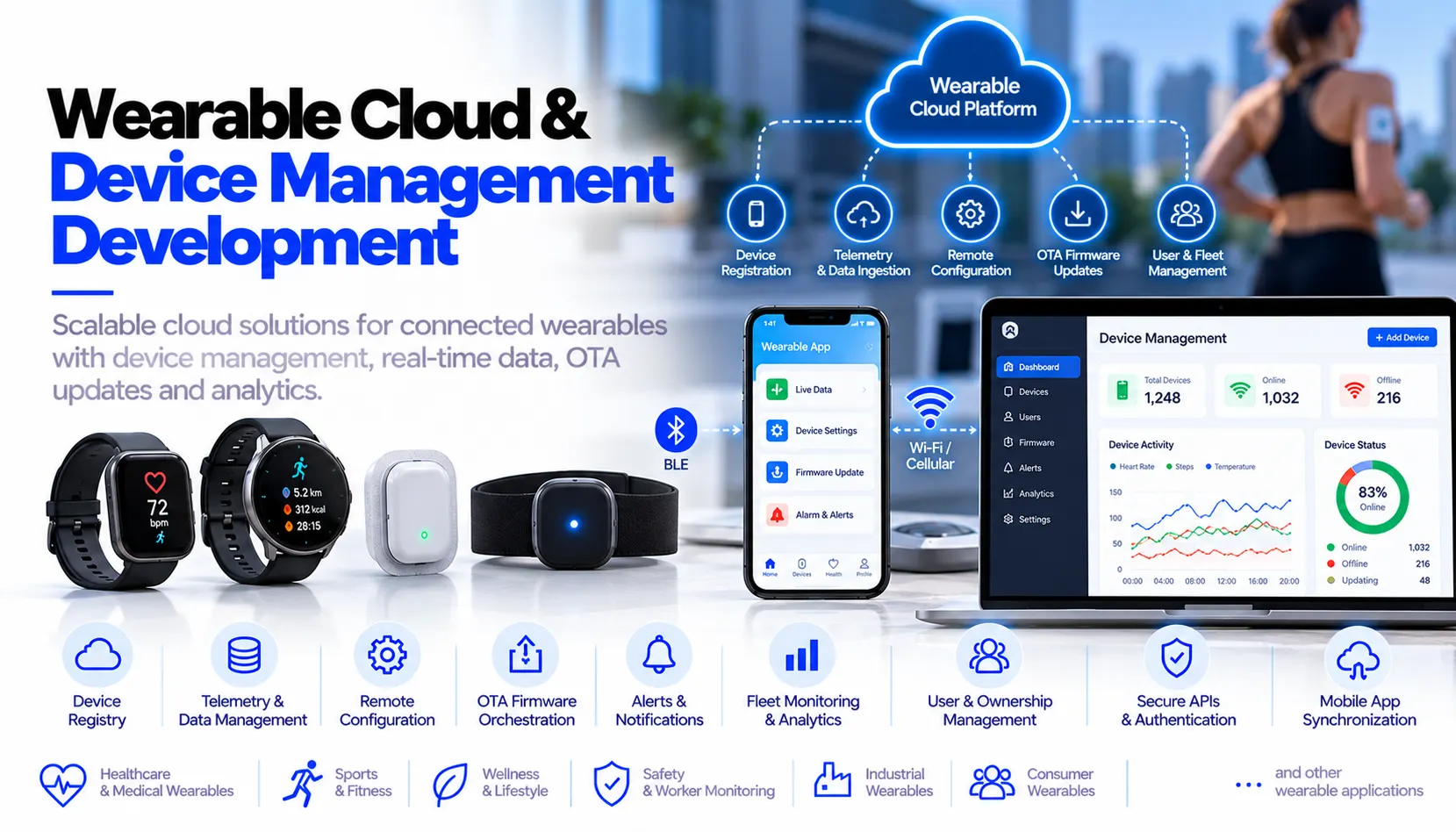
What Is Wearable Device Management?
The management of wearable device is a form of governance where each device in its physical existence is provisioned to retire. A management platform will provide information to help in answering questions such as;
What type of device am I managing and what product version or hardware revision is used? Who is the owner of this wearable? Who is wearing the device? What firmware and configuration do you have? When was it last connected and in what condition? What commands have been sent or received? What firmware or policies have been updated? What should be the data collected, exchanged or deleted?
Just because an application manages sensor data does not mean that it is a management platform.
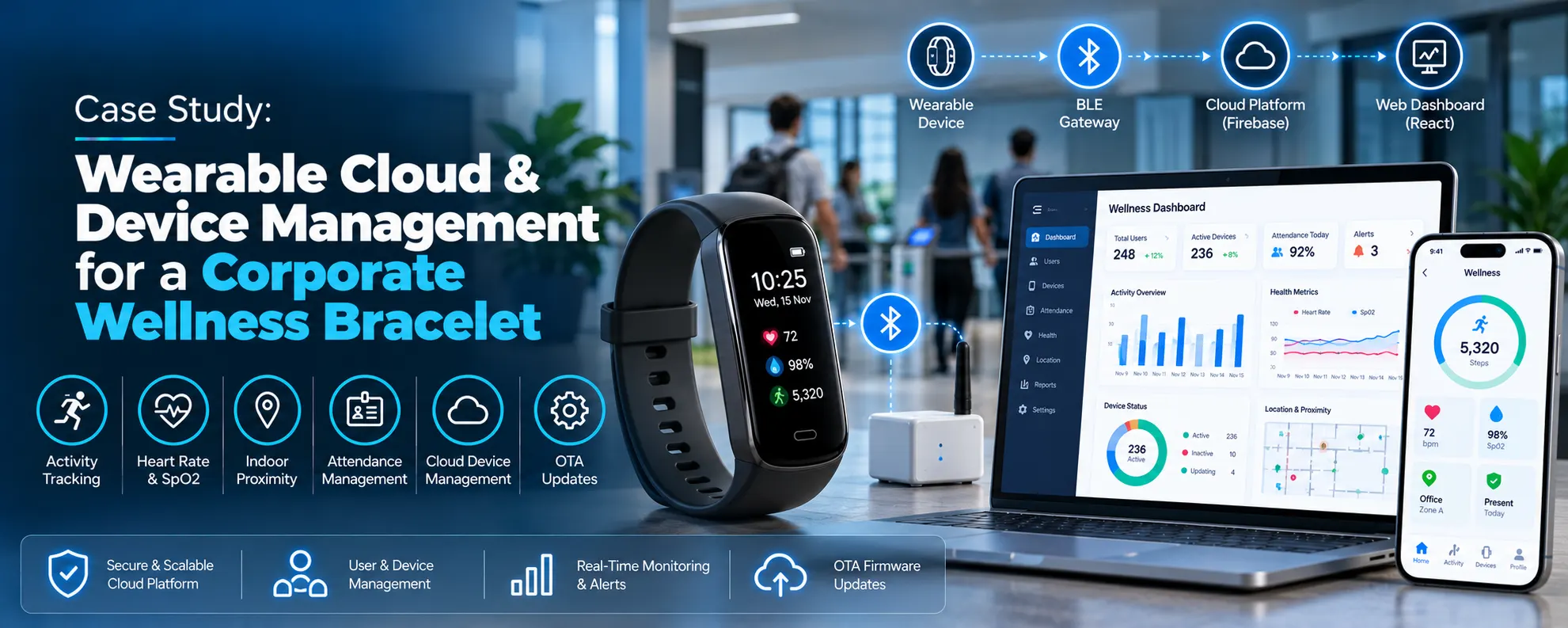
Case Study: Wearable Cloud & Device Management for a Corporate Wellness Bracelet
Client Requirement: One Connected System for Attendance, Safety and Wellness
Adequate Infosoft designed a multi-functional IoT wearable bracelet for a corporate wellness and facility management company.
The company wanted more than just a simple fitness band. What was required was an effective device management ecosystem which would enable user registration, employee attendance, indoor proximity monitoring, collection of selective health and fitness data, and provision of access to all of this data on a secured central dashboard.
The task was to connect numerous wrist wearable devices without sacrificing the compact size, low-power consumption, and usability of the bracelet during the whole working day. The solution also included the scalable monitoring of the devices' statuses, synchronization of the data and firmware update.
Our Wearable Device Management Approach
We created the wearable device to fit into a whole connected product ecosystem, as opposed to a standalone hardware component.
The device was connected to each user and capable of communicating through Bluetooth Low Energy to a gateway that is near to it. The device would capture activity, heart rate, SpO2, and proximity or attendance data.
The embedded firmware was developed to facilitate long-term device management through low-energy consumption, scheduled data transfers, device monitoring and OTA firmware updates. As a result, the customer can update capabilities, fix problems and keep devices running without recalling them for repairs.
Controlled sleep mode cycles were employed by the firmware for saving unnecessary battery power consumption. BLE beaconing technology was used for providing zone-based indoor location awareness and local processing carried out activities and falls detection process before sending events to the backend system.
Cloud Dashboard and Operational Visibility
Wearable data was sent from BLE gateways to the cloud backend, where it was structured on the real-time management dashboard.
Using Firebase and React technology, the developers created a dashboard, which made it possible to verify users' identities and to process data in real time.
The dashboard permitted administrators access to information on attendance, activity and health statistics, location reports, and alerts about conditions, for instance, prolonged inactivity.
This provided HR, wellness and operations teams with a functional insight into both employee engagement and the wearable fleet deployed.
The dashboard also set the basis for device management: detecting active devices, analyzing telemetry data, monitoring synchronization processes and preparation of the platform for its further development.
Testing, Deployment and Scalability
The implementation process transitioned from initial prototype to validation of the custom PCB in the field.
We performed tests for comfort, sensor precision, RFID performance, charging behavior, battery life, and wireless communication.
Feedback from the test users improved the design of the bracelet, OLED display, and bracelet band.
Our client got 50 functioning prototypes for distribution in two office locations.
The case shows how Adequate Infosoft can help in implementing a full range of solutions needed to develop a wearable device including hardware and firmware, cloud integration, dashboard, and OTA compatibility.
Case study: iot-wearable-bracelet-development
Relevant Adequate Infosoft Case Studies
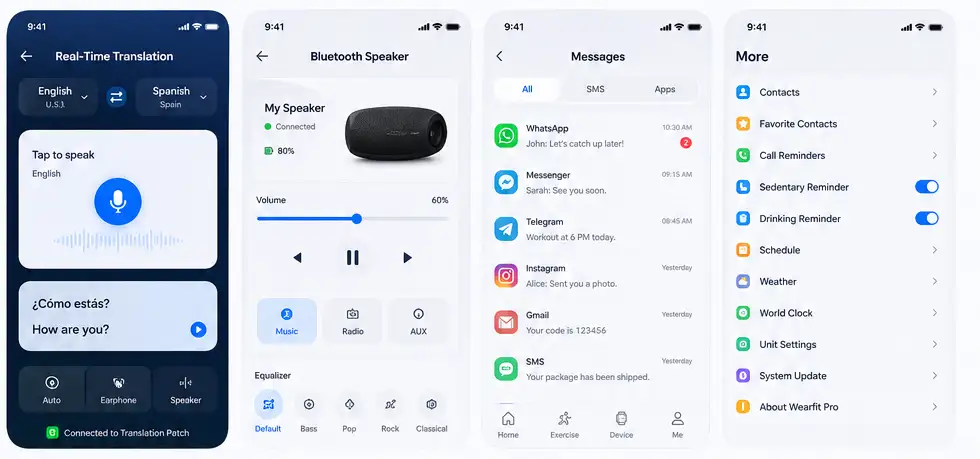
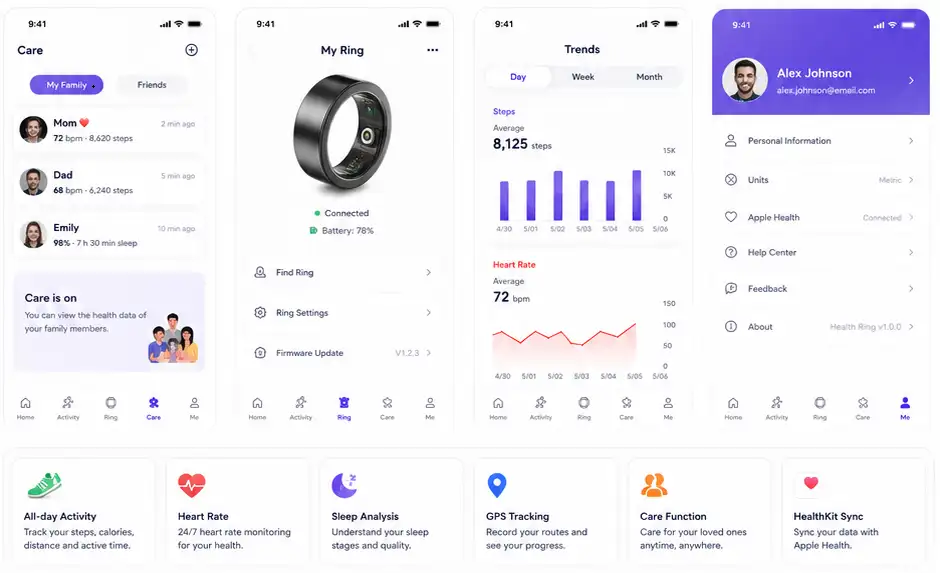
Architecture of Cloud For Connected Wearables
Wearable devices may be synchronized through a companion phone, connected directly via Wi-Fi or cellular systems, or a combination of both. Even though phone gateways help in preserving the energy of wearables, they also have to deal with background limitations, periodic disconnection of internet, and phone issues. The generalized platforms consist of:
Authenticated backend services and API gateways Stores for identities of the user, organization and device Registry of devices, along with records about assignment or ownership Functions of telemetry ingestion and managing time-series Representation of the current device-state or digital twin Command and configuration processes Firmware binary, metadata, and rollout jobs Operational dashboards, notifications and rules Metrics, audit logs, traces and support utilities
We can use managed IoT services or develop custom backend services depending on the regulation, cost, protocol, portability and existing cloud. Examples of such services may include AWS IoT or Azure IoT Hub, Node.js, .NET, Python, queues, Redis and WebSockets.
Device Identity, Provisioning and Ownership
Every device must have its unique ID, which will be entirely different from the user's phone and email.
The registry can potentially include information about the device's serial number, model, hardware, firmware version, manufacturing batch, capabilities, and state of the lifecycle. Secrets and certificates are considered distinctly from ordinary metadata.
Provisioning may be performed at the manufacturing stage, during the first pairing, or during an enterprise process. We build claim codes, QR or NFC provisioning, ownership change, upgrade path, and decommissioning. Clinical and workforce applications might need to maintain the organizational hierarchy, sites, caregivers, and wearers.
State transitions are explicit. Devices should neither transition from a dormant state to active nor stay authorized post-decommissioning. Tools for support purposes would need to look into pairing, revoke permissions, and change ownership without unnecessarily accessing any health information.
Telemetry Ingestion and Offline Synchronization
Telemetry from wearables is mostly a set of recorded values with time stamps and events. In the cloud, the data model should keep time at which the device recorded, at which it arrived at the phone, and when it was ingested by the server due to clock drift.
On phone gateways, the records of the wearable device are buffered, and the application requests the data after its last point. Idempotent keying, sequencing, and acknowledgment avoid duplicates and gaps.
Direct devices may use HTTPS or MQTT. MQTT 5.0 is an OASIS lightweight publish/subscribe standard for IoT communication. Reliability still depends on topics, quality of service, sessions, retries and deduplication.
Storage is separated by purpose: current state for operations, time series for trends, object storage for files and audit records for administrative actions.
Device State, Digital Twins and Remote Configuration
Operators need a reliable view of what the cloud wants and what the wearable has actually applied. A twin or shadow pattern separates desired state from reported state.
Microsoft states that "Azure IoT Hub device twins are JSON documents that include metadata, desired properties, and reported properties" to synchronize configurations and long-running processes like firmware upgrades.
The desired state could be for example "sampling period, alert level, or feature being enabled." The device would report back the actual value, version, and errors. The commands require identifiers, expiration, authorization, status, and acknowledgment.
The fleet groups could be based on product type, hardware revision, specific customer, or testing group. The conflict resolution rules combine the organizational policies, user preferences, and device limitations.
OTA Rollouts and Firmware Lifecycle
The Cloud Device Management system orchestrates OTA processes while secure booting and image validation continue to be handled on-device.
The platform manages the release signature information, checks for eligibility, forms cohorts for rollouts, monitors download status and install status, and aborts or rolls back the campaign once failure limits have been exceeded.
We plan rollouts via internal, canary, and larger cohorts. The criteria for eligibility include hardware version, bootloader, battery, storage, and existing firmware version.
Managed platforms provide useful primitives. For instance, AWS IoT Jobs defines remote actions on one or a number of devices that include updating firmware, renewing certificates and resolving issues. Nevertheless, any productive workflow will still require relevant policies applicable to the product, signed artifacts, the ability to provide feedback and restore operability.
Fleet Monitoring, Alerts and Support Operations
The dashboard will be designed to provide relevant information about the health of the fleet. The dashboard will contain information such as the last connection, what version of the firmware is used, any updates performed, battery status, synchronization status, what caused the last reset, possible sensor issues and anomaly detection.
The alert system requires additional context regarding the alerts and their criteria to avoid alert fatigue. One synchronization failure is fine but mass failures in hardware batches might indicate some issue ahead.
We should establish the criteria for the threshold, the severity, the ownership and the escalation process without disclosing any confidential information.
Searching the fleet can help support and engineering teams look into certain models, firmwares, statuses and capabilities.
AWS IoT fleet indexing can index registries, groups, shadows, connectivity and violations for queries. Equivalent functions can be built with Azure services or a custom operational store.
Security, Privacy and Data Governance
The security is grounded on unique device identification, the least privilege principle, encryption, key rotation, and signing of updates.
The process of user's authentication does not depend on the authentication of the device in use, i.e. a properly authenticated device does not automatically get access to the records belonging to the user. Role-based access control as well as audit requirements, authorized processes, data retention, and data deletion are founded on the requirements arising in the real world.
NIST's IoT cybersecurity core baseline covers device identification, configuration, data protection, interface access, software update and security-state awareness.
Compliance depends on intended use, organizations involved and sales regions. Encryption or a cloud-provider certification does not automatically make the complete application HIPAA, GDPR or medical-device compliant.
Our Development Process
1. Fleet and workflow discovery
We define devices, users, connectivity, telemetry, commands, updates, retention and service objectives.
2. Architecture and contracts
We design identities, APIs, schemas, state, storage, permissions and failures. Firmware, mobile and backend contracts are versioned together.
3. Implementation and integration
We build services, admin tools and app synchronization, then integrate real hardware or simulators. Infrastructure is automated.
4. Reliability and security testing
Tests cover duplicates, ordering, expired commands, offline periods, reconnect storms, partial updates, unauthorized access and dependency failures. Load tests model realistic traffic.
5. Launch and operations
Dashboards, alerts, backups, runbooks and releases are prepared before production. Operational evidence guides capacity and product improvements.
Build an Operable Wearable Fleet
Please detail your types of wearables, methods of connectivity, anticipated lifespan of device, telemetry particulars, type of remote actions you want performed and compliance requirements you have.
Adequate Infosoft is able to provide the solution on cloud and device management for your product post the first successful connection.
Frequently Asked Questions
No, because the phone acts as a secure gateway in many BLE wearables. Direct cloud connectivity makes sense when either Wi-Fi or cellular connectivity, independent notification, or enterprise use justifies it.
Yes. We use versioned capabilities, schemas and policies so models can share core services without assuming identical commands or data.
Yes, when the bootloader, memory, firmware, and the application support OTA securely. The cloud handles the release management and status of the rollout, while the device validates and deploys the image.
Yes. We can assess identity, APIs, databases, telemetry, deployment and monitoring, then migrate incrementally while preserving device compatibility.