


 Mean Stack Development
 Vue JS Development
 Javascript Development
 React JS Development
 Angular JS Development
 Next JS development
 Java Development
 Python Development
 Django Development
 Cherrypy Development
 C# Development
 ASP.NET Development
 NodeJS Development
 Laravel Development
 CodeIgniter Development
 Zend Development
 Ruby on Rails Development
 CakePHP Development
 PHP Website Development
 Symfony Development
 Drupal Development
 Joomla Development
 Wordpress Development
 .NET Nuke Development
 Kentico
 Umbraco
 .NET MAUI Development
 Xamarin Application Development
 iOS Application Development
 Android Application Development
 Android Wear App Development
 Ionic Development
 iBeacon Application Development
 Universal Windows Platform (UWP)
 Kotlin Application Development
 Swift Application Development
 Flutter Application Development
 PWA Application Development
 Flutter Health Tech & Wearable App Development Company
 React Native Health Tech Wearable App Development
 Offshore Software Development
 Custom Application Development
 Front-End Development
 Full Stack Development
 AI & Machine Learning
 Custom CRM Solutions
 Flask Software Development
 Electron JS Development
 ChatGPT Development
 Veterinary Telemedicine App Development
 Build Smart Telemedicine Platform
 Beauty & Salon App Solutions
 Hire Workato Experts
 Magento Development
 Magento 2.0 Development
 Magento Enterprise
 Shopping Cart Development
 Prestashop Development
 Shopify Development
 Open Cart Development
 WooCommerce Development
 BigCommerce Development
 NopCommerce Development
 Virto Commerce Development
 AspDotNetStorefront Development
 .NET Application Development
 Microsoft Dynamics CRM
 VB .NET Development
 Sharepoint Migration
 ASP.NET Core Development
 ASP.NET MVC Development
 AJAX Development
 Agile Development
 Microsoft Bot
 Microsoft Blazor
 Microsoft Azure Cognitive
 HTML 5
 UI/UX Design
 Graphic Design
 Adobe Photoshop
 XML Application Development
 Cloud Computing Solutions
 Azure Cloud App Development
 AWS Development
 Google Cloud Development
 Certified AWS IoT Services Developers
 DevOps Consulting & Development
 Kubernetes Consulting & Services
 SQL Programming Development
 MySQL Development
 MongoDB Development
 Big Data
 Robotic Process Automation
 Social Media Marketing
 Search Engine Optimization
 QA Testing
 Software Testing
 Software Security
 Maintenance And Support
 I.T. Consulting Services
 Business Intelligence
 YII Development
 Data Analysis
 Alexa Skills Development
 On Demand App for Mobile repairing services
 On Demand App for Car Service Booking
 On Demand App for Cleaning Services
 On Demand App for Pharmacy
 On Demand Dedicated Developers
 On Demand Lawyer App Development









 Nuki Smart Lock
 Salto Smart Lock
 TTlock Smart Lock
 NFC App Development
 Custom IOT Enabled Smart Lock
 Smart Locker Solutions
 Hospital Smart Lock Systems
 Hotel Smart Lock Systems
 Smart Home & Office Locks
 Smart Access for Schools & Colleges
 Unloc Smart Lock Integration
 Yale & August Smart Lock Integration
 Populife Smart Lock Integration
 Smart Lock Hardware Development
 Dairy IoT Solutions
 Agri IoT & AI Solutions
 Weather & Climate Solutions
 Water & Waste Management Solutions
 RaspBerry Pi
 Firmware Software Development
 ESP 32 Software Development
 Embedded Development
 Internet of Things
 Smart IoT Development
 IoT Sensor Integration & Development Solutions
 Smart IoT System Development for HVAC
 Tuya IoT App Development
 Particle IoT SDK
 IoT Development with AI
 Smart Pet GPS Tracker
 Dairy GPS Tracking Solutions
 GPS Fleet Management Software
 Car Rental & Subscription Solutions
 Car Buy & Sell Marketplace Development
 AI-Powered Car Wash App Development
 PCB Design & Fabrication
 IoT AC Automation
 AI–IoT Painting Solutions
 IoT Wearable Hardware & App Development
 HVAC Automation & AI Control Systems
 Smart Home IoT Engineering
 AI Embedded Systems
 AI Hardware Design Service
 Advanced IoT Hardware & Firmware Development
 Device Driver Development Services
 NXP i.MX RT Firmware & Hardware Services
 Microchip PIC & AVR Development
 Hire IoT Architects
 IoT Cloud & Infrastructure Solutions
 Infineon XMC / AURIX Development Services
 Matter & Thread IoT Services
 Native IoT Mobile App Development (BLE & Wi-Fi)
 Snapdragon IoT Firmware Development
 Renesas RA/RX Firmware Services
 Silicon Labs EFR32 Development Services
 Smart Wearable App Development
 Smart IoT Meters
 Smart Healthcare Wearable App Development
 Health Care Monitoring System
 Fitness Tracking App Development
 Smart Home Automation Apps
 nRF PCB Design
 ESP32 PCB Design
 Embedded Wearables Engineers
 Rental Property Management System
 Building Management System
 Smart Lighting Development
 Infineon Semiconductor Firmware Development Services
 Custom Camera Development: Hardware, Firmware & PCB Prototyping
 Smart Security Camera SDK
 Nordic Semiconductor SDK
 Infineon SDK
 Arduino SDK
 NFC Lock Integration
 Kerong Lock Integration
 IoT & AI Solutions for Manufacturing
 Smart Inventory & Logistics Solution
 Food & Beverage Industry Solutions
 Smart Hospitality Solutions
 Smart Property Management
 Custom Smart Home IOT SDK
 Smart IoT & AI in Healthcare
 AI-Powered Security Solutions
 Smart Home Safety & AI
 Veterinary Clinic Management (AI)
 Pet Care System (AI & IoT)
 Pet Training & Adoption (AI)
 Healthcare IoT Development
 Event Management Software
 Money Remittance App
 Money Lending App Development
 Utility and Bill Payment App
 IoT Mobile App Development (Flutter & React Native)
 AI & IoT Retail Solutions
 Smart EV App Development
 Smart Solar IoT & AI Solutions
 IoT-Based Energy Systems
 Smart Energy & Utilities Solutions
 6G Solutions
 IoT Security Solutions
 AI-Powered Lottery App Development
 AI-Sports Fitness Club Management
 Travel
 Real Estate
 Medical & Healthcare
 e-Learning
 Consumer Products
 Finance
 Automobile
 Media & Entertainment
 Billing Software
 Enterprise Resource Planning (ERP)
 Augumented & Virtual Reality
 Point of Sale(POS) Development
 Learning Management System
 EV Charging Solutions
 About Us
 Partners & Certifications
 Quality Assurance
 Our Clients & Testimonials
 Development Process
 Our Products
 Social Responsibility
 Work Ethics
 Vision & Mission
 Awards
 Live Project Demos
 Contact Us
 Case Studies
 Portfolio
 Blog
nRF9151 Cellular Wearable Development | LTE-M, NB-IoT & GNSS
Adequate Infosoft provides nRF9151 development covering architecture, compact PCB design, LTE-M/NB-IoT firmware, GNSS, power optimization, secure cloud communication, applications, testing and production preparation.
The nRF9151 chip was invented by Nordic Semiconductor and is intended for compact, low-consumption cellular IoT gadgets. The chip is produced with the assistance of the application processor, modem, GNSS, and security and forms a module measuring 11 × 12 mm.
It has the potential to improve the development of safety wearable devices, tracking systems, and remote monitoring gadgets, which, however, depends upon the antenna, battery, network, housing, firmware, and cloud connectivity.
Let's Work Together!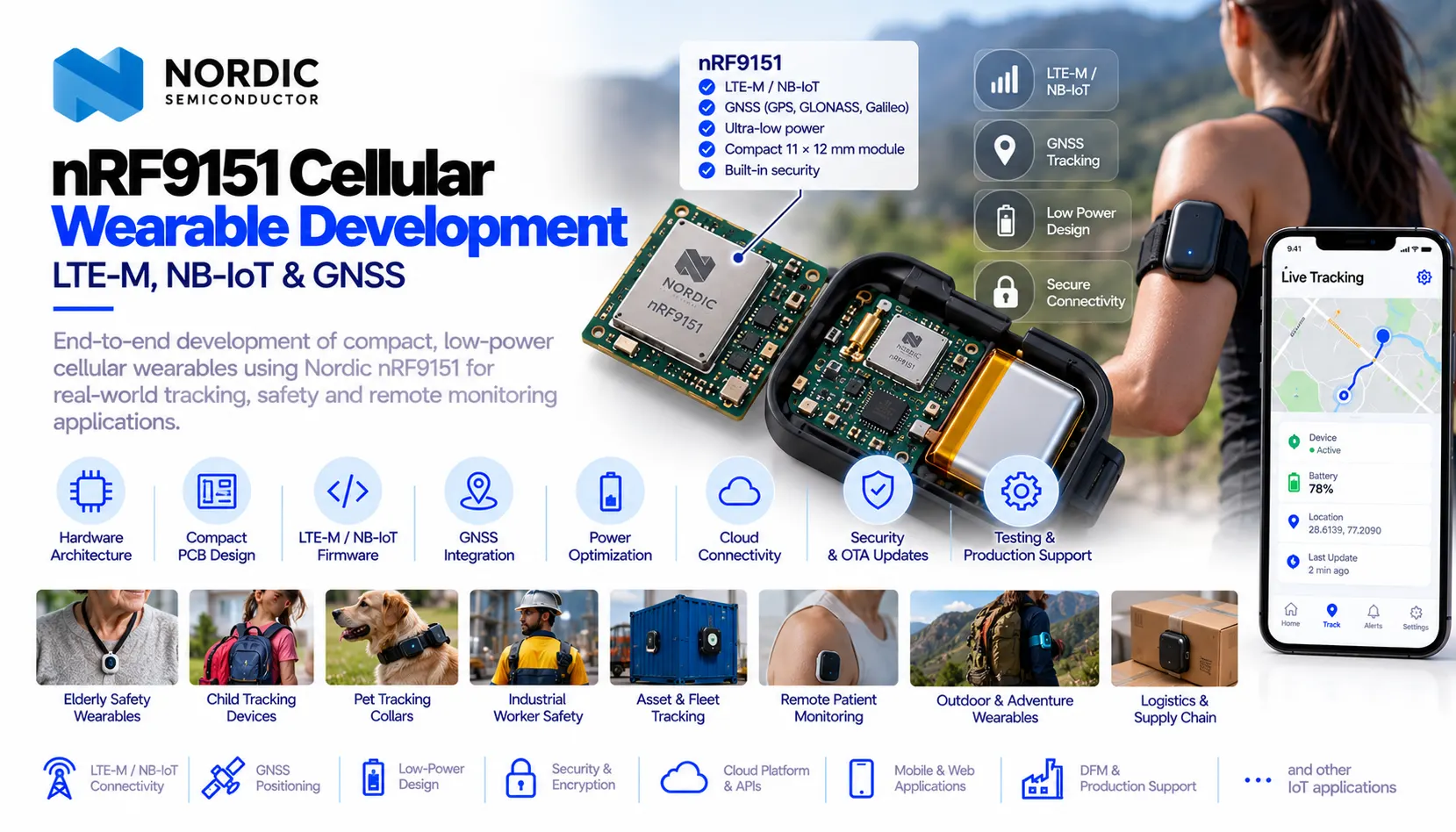
Why Use the nRF9151 for a Cellular Wearable?
The nRF9151 includes a 64 MHz Arm Cortex-M33 processor, 1 MB flash memory, 256 KB RAM, a LTE-M/NB-IoT modem and GNSS.
According to Nordic's specification, 3GPP Release 14 cellular capabilities are included, along with additional platform possibilities such as NB-IoT Non-Terrestrial Networks and DECT NR+.
It has the capability of 23 dBm Power Class 3 and 20 dBm Power Class 5, configuration needs to account for network compatibility and performance.
Cellular hardware can operate by itself when there is a need for SOS alert or geofencing or measurement.
LTE-M may be used for responsive, two-way communication on mobile products; NB-IoT may be useful for small, periodic messages on battery-powered devices that focus on coverage rather than other requirements.
The nRF9151 does not include any built-in Bluetooth Low Energy capability. For devices that require BLE for onboarding or accessory connection, we could determine the best complementary Nordic wireless SoC or cellular-only implementation with SIM and cloud configuration capabilities.
Cellular Wearable Products We Develop
Our engineering team can use the platform for lone worker badges, fall detection pendants, outdoor and workforce trackers, remote wellness devices, animal or livestock trackers, logistics wearables and products that need future NTN pathway.
However, sensor integration and safe data transmission does not by itself constitute clinical accuracy or compliance in health products. Intended use and risk classification should be considered separately.
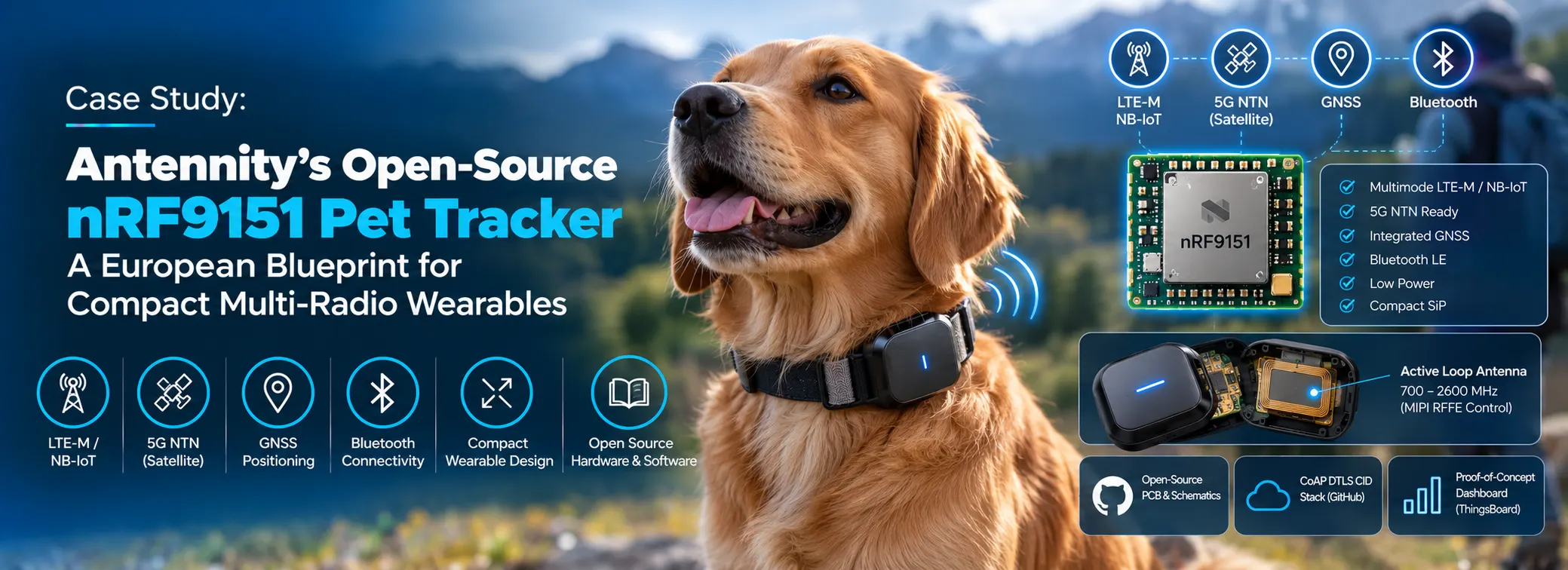
Case Study: Antennity's Open-Source nRF9151 Pet Tracker, A European Blueprint for Compact Multi-Radio Wearables
The Design Challenge: Antenna Physics in a 60–80 mm Enclosure
A pet tracker must be small and light enough for an animal to wear comfortably, yet it must maintain reliable cellular links, satellite positioning, and Bluetooth connectivity. This creates a fundamental conflict: the 60–80 mm enclosures typical of such wearables offer far too little ground plane for the low-frequency bands used in Europe.
Ground Plane should match the lowest operational frequency (about 790MHz for European NB-IoT/LTE-M) and failure to do so results in decreased Bandwidth and Antenna Gain. The most common approach to overcoming this challenge is reducing performance and increasing the size of the device.
Antennity, a European antenna specialist, took a different route: it built an open, fully documented reference design around Nordic's nRF9151 SiP that solves the antenna problem through active reconfiguration rather than physical compromise.
The nRF9151 as the Integration Hub
The nRF9151 integrates the entire radio stack in one certified SiP including multimode LTE-M/NB-IoT modem, GNSS receiver, and a 64 MHz Arm Cortex-M33 application processor with 1 MB Flash memory and 256 KB RAM. What sets apart the device for use in a pet tracker is not its compact size but the capability to control several radios from low power budgets.
It complies with 3GPP Release 14 LTE-M and NB-IoT, operates under Power Class 5 at 20 dBm for lowering the peak current consumption and most importantly in our application scenario offers connectivity to the 5G Non-Terrestrial Network (NTN) enabling the tracker to connect via the satellite when there are no terrestrial networks.
Active Loop Antenna with MIPI RFFE Control
The unique aspect of Antennity is its antenna design. This system has the chip loop antenna which covers the frequency range from 700 to 2600 MHz and can be managed via MIPI RFFE bus, just like the ones used in contemporary mobile phones.
The nRF9151 in the pet tracker performs continuous antenna switching, matching optimization, and center frequency movements, and produces a small radiation loss in terms of total radiated power (TRP) and total isotropic sensitivity (TIS).
This kind of tuning process permits having only one physical loop antenna used to perform the communication in the technologies such as NB-IoT, LTE-M, and 5G NTN in addition to GNSS and Bluetooth, where most of the efficiency of traditional passive broadband antennas is lost due to the compact size of the ground plane.
Bluetooth is coupled to the same antenna through a precision diplexer that passes the Bluetooth signal bidirectionally with only 0.5 dB passband attenuation, enabling simultaneous cellular and Bluetooth operation without a second antenna.
Technical Implementation and Openness
The design is engineered to be reproducible. Antennity and its collaborators supply an open-source Feather PCB evaluation board, which reveals MIPI RFFE control interface and loop antenna pinout along with the open schematics.
Open-source CoAP DTLS CID stack is provided on GitHub, and a proof-of-concept dashboard is implemented in ThingsBoard community edition. Such a degree of openness is not common for cellular wearable design, since antenna tuning usually is a secret. The design is specifically optimized for European regulatory and operator environment with mandatory 790 MHz band limitation.
Significance for European Wearable Development
Antennity's pet tracker is not a commercial product but a working reference architecture. Its value for European developers lies in demonstrating that active antenna tuning on a wearable-scale ground plane can make a single nRF9151 design viable across terrestrial cellular, satellite NTN, GNSS, and Bluetooth—without enlarging the enclosure or adding a second antenna.
When using this system for non-pet use cases such as personal safety wearables, smart badges, and miniaturized asset trackers, having the open-source nature of the radio-frequency front end, controller stack, and dashboard reduces the gap between conception and European prototype implementation. This is an example of why RF smartness, not just silicon, makes a difference when designing connected wearables.
End-to-End nRF9151 Development Services
Product architecture and feasibility
We translate the use case into measurable requirements: reporting frequency, alert latency, location accuracy, regions, environmental protection, temperature, runtime and charging. Feasibility work compares network strategies, estimates energy by operating state and identifies certification risks before PCB layout.
Small size PCB, RF & antenna design
Wearable antennas are placed next to tissues, batteries, ground planes, and enclosures, which influence impedance and effectiveness. The PCB design takes into account RF parameters, return path, power supply reliability, SIM/eSIM, GNSS, charging, sensors, and test points.
Antenna positioning is tested in the proposed enclosure after which matching and proper RF or field testing is done. Pre-certified development board doesn't mean automatic certification of final product.
nRF Connect SDK and Zephyr firmware
We develop firmware with Nordic's nRF Connect SDK and Zephyr RTOS. Modules may include sensor drivers, location control, registration, retry policies, encrypted transport, flash buffering, watchdogs, diagnostics and update handling. State machines keep emergency events responsive while nonessential subsystems sleep.
LTE-M and NB-IoT connectivity
Cellular software should deal with registration delays, coverage interruptions, weak signals, internet restrictions, cell transitions, absence of service, and issues with weak service. Data can use the MQTT, CoAP or HTTPS protocols. Store and forward logic is needed for the protection of data offline with the help of special identifiers.
GNSS and location engineering
The modem supports single-shot, periodic and continuous GNSS. We select fix schedules and accuracy thresholds according to safety and energy needs.
Assisted GNSS or predicted GPS through nRF Cloud can reduce fix time and radio energy when assistance is available. Cellular positioning offers a coarser fallback, Wi-Fi positioning requires a companion device.
GNSS degrades indoors, underground or near dense structures. A robust design may combine last-known position, cellular estimates, BLE beacons or Wi-Fi observations. The cloud should preserve each location's accuracy, freshness and confidence.
Designing Battery Lifetime from Measurements
The battery lifetime of an nRF9151 device cannot be generalized in any way, as the runtime will vary according to coverage, transmit power, attach attempts, GNSS sky visibility, payload, sensors duty cycles, temperature, battery chemistry and user activity.
We generate an energy budget for sensing, processing, searching, transmitting, acquiring GNSS, idle and sleep modes, then we verify this budget on actual hardware.
Software can implement power saving mode, eDRX, release assistance indication, modem sleep indications and event-based sampling.
The hardware must support peak currents of the cellular module without excessive voltage drops. We measure typical low coverage, retry and cold start cases, since averaging on a desk does not show worst case scenarios.
Security, Device Identity and Secure FOTA
The nRF9151 is equipped with Arm TrustZone and CryptoCell technology, and Nordic offers signed and encrypted modem firmware with image authentication.
In addition, we will implement application secure boot, protected credentials, unique identities, encrypted connections, least privilege cloud access, and auditable provisioning.
The FOTA process must authenticate and validate integrity, be resilient to interruptions, provide status reports, and facilitate deployment. The modem firmware in the Nordic device can perform differential FOTA updates that are compatible with each other.
Cloud, Dashboard and Mobile Application Integration
We connect our products with AWS, Azure, nRF Cloud, or tailor-made back-end solutions. Each platform can hold a device register, provide telemetry information, provide alerts, record location history, maintain fleet health, make remote configurations, deploy firmware, and keep audit logs. We employ applications showing statuses, maps, battery charge levels, and alerts.
When building the architecture, one should account for retention, consent, hosting, and access roles.
Relevant Adequate Infosoft Experience
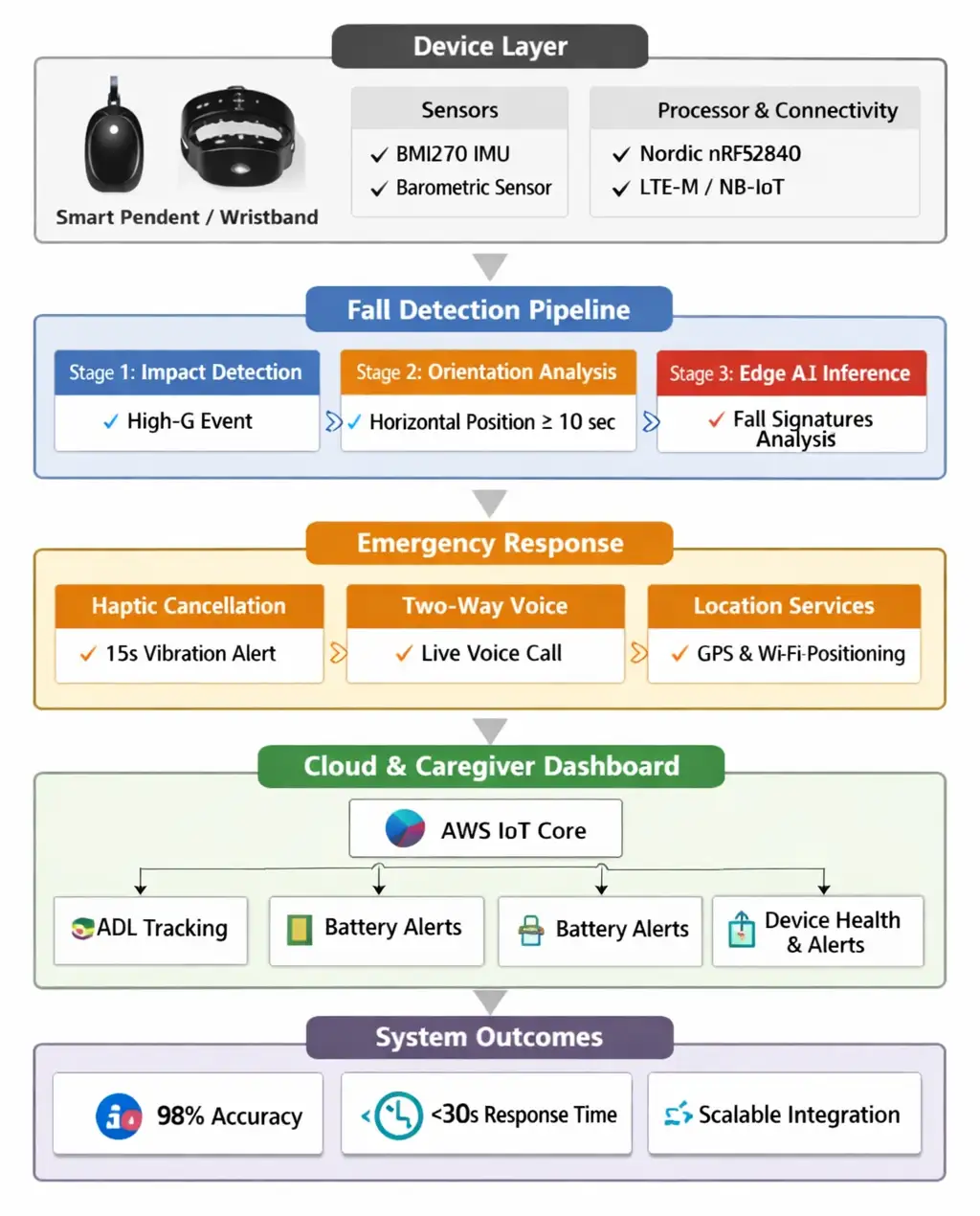
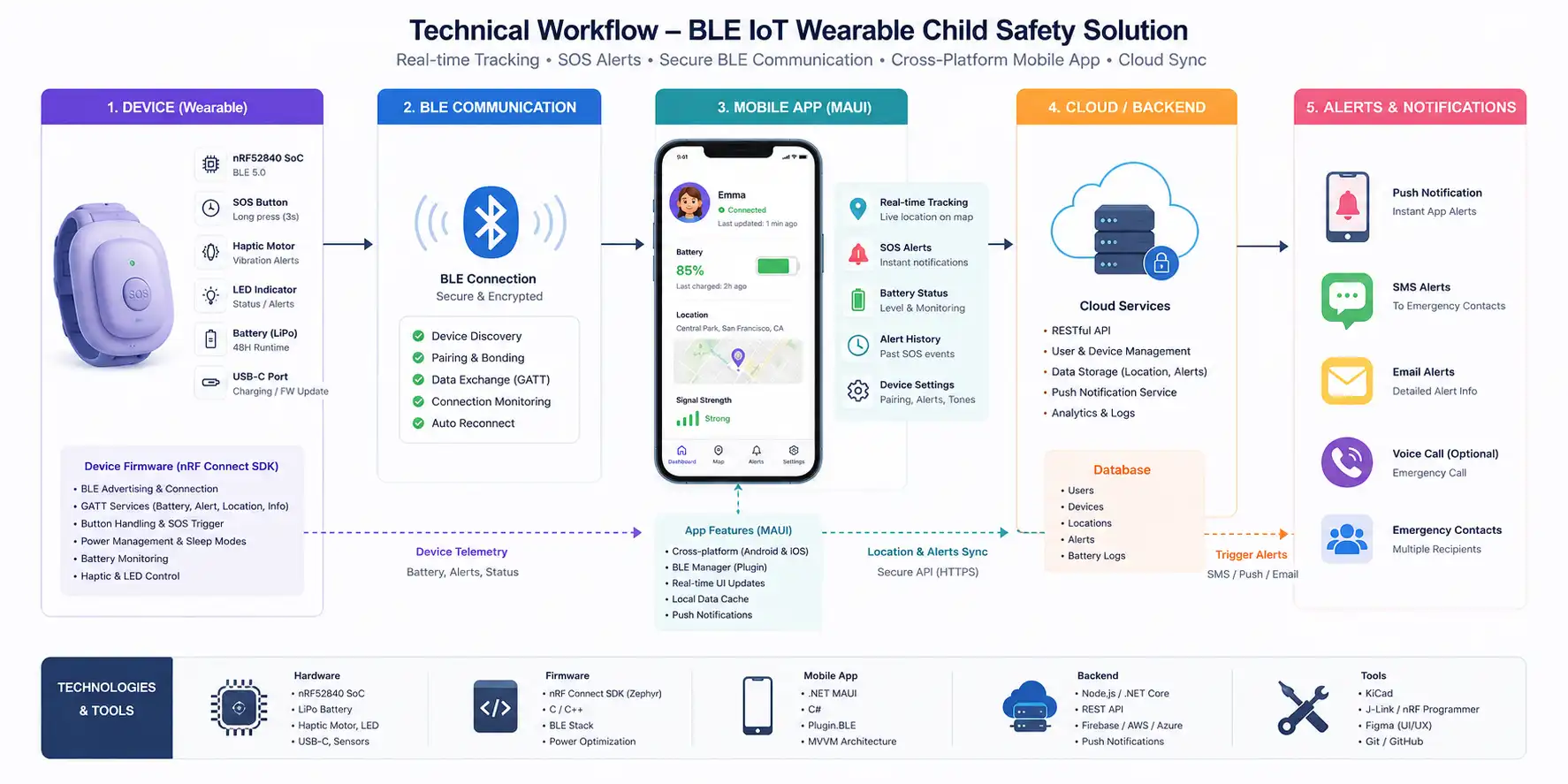
Wearable Development Process of nRF9151
Discovery
Identify users, risks, and marketplaces, routes of data, networks, and access conditions.
Architecture
Select antennas, sensors, power supply system, SIM type, cloud services, and optional communications system.
Proof of concept
Confirm connection to the network, message transfer capabilities, GPS working, sensor operation, and preliminary energy budgeting through hardware.
Custom prototype
Create PCB with a case, produce firmware and applications, and assemble the designed device.
EVT and DVT
Test radio communication, power consumption, and reliability of the device.
Preparing for Production
Support DFM/DFT, inventory and testing equipment, production documents, control tests, and apps.
Check compatibility with coverage, frequency bands, roaming, and required operators in any region where the device is to be introduced.
Discuss Your Cellular Wearable
For those who need independent alarms, remote telemetry, and tracking without relying on the smartphone's cellular connection, Adequate Infosoft may be of assistance when it comes to assessing and creating the entire nRF9151 solution, be it its feasibility or a custom-designed circuit board, firmware, cloud, applications, and preparation for production.
Let us know what countries you are targeting and we will start from there.
Frequently Asked Questions
LTE-M is a technology often used for devices that require frequent communication and timely alarms. NB-IoT may work well for devices transmitting small packets of data not very frequently and where the coverage is key. Network provider's involvement and roaming options depend on individual regions and need to be investigated.
Yes, it is possible as the device could connect to the required network and get GNSS fixes without the smartphone. The device still requires network connectivity, a SIM card provisioned for network, antenna design, and a backend. To implement BLE connectivity, the device will require a secondary radio.
Battery life cannot be determined from the chipset alone. We model and measure it using the final reporting schedule, sensor workload, GNSS strategy, network conditions, antenna performance, battery and temperature range. The result should be expressed with defined test conditions.
Nordic provides NB-IoT NTN on the relevant nRF9151 chipsets and modems. Availability commercially is determined by silicon version, firmware, satellite partner, geographical location, antenna compatibility, and service plan. We view NTN as a distinct route to validate rather than as a backup option.
This could include radio, carrier, electrical safety, EMC, battery transport, and product certification based on the target market. Medical device statements would also require a regulatory route for the device. We provide the information to prove this in engineering documentation and manage testing.