


 Mean Stack Development
 Vue JS Development
 Javascript Development
 React JS Development
 Angular JS Development
 Next JS development
 Java Development
 Python Development
 Django Development
 Cherrypy Development
 C# Development
 ASP.NET Development
 NodeJS Development
 Laravel Development
 CodeIgniter Development
 Zend Development
 Ruby on Rails Development
 CakePHP Development
 PHP Website Development
 Symfony Development
 Drupal Development
 Joomla Development
 Wordpress Development
 .NET Nuke Development
 Kentico
 Umbraco
 .NET MAUI Development
 Xamarin Application Development
 iOS Application Development
 Android Application Development
 Android Wear App Development
 Ionic Development
 iBeacon Application Development
 Universal Windows Platform (UWP)
 Kotlin Application Development
 Swift Application Development
 Flutter Application Development
 PWA Application Development
 Flutter Health Tech & Wearable App Development Company
 React Native Health Tech Wearable App Development
 Offshore Software Development
 Custom Application Development
 Front-End Development
 Full Stack Development
 AI & Machine Learning
 Custom CRM Solutions
 Flask Software Development
 Electron JS Development
 ChatGPT Development
 Veterinary Telemedicine App Development
 Build Smart Telemedicine Platform
 Beauty & Salon App Solutions
 Hire Workato Experts
 Magento Development
 Magento 2.0 Development
 Magento Enterprise
 Shopping Cart Development
 Prestashop Development
 Shopify Development
 Open Cart Development
 WooCommerce Development
 BigCommerce Development
 NopCommerce Development
 Virto Commerce Development
 AspDotNetStorefront Development
 .NET Application Development
 Microsoft Dynamics CRM
 VB .NET Development
 Sharepoint Migration
 ASP.NET Core Development
 ASP.NET MVC Development
 AJAX Development
 Agile Development
 Microsoft Bot
 Microsoft Blazor
 Microsoft Azure Cognitive
 HTML 5
 UI/UX Design
 Graphic Design
 Adobe Photoshop
 XML Application Development
 Cloud Computing Solutions
 Azure Cloud App Development
 AWS Development
 Google Cloud Development
 Certified AWS IoT Services Developers
 DevOps Consulting & Development
 Kubernetes Consulting & Services
 SQL Programming Development
 MySQL Development
 MongoDB Development
 Big Data
 Robotic Process Automation
 Social Media Marketing
 Search Engine Optimization
 QA Testing
 Software Testing
 Software Security
 Maintenance And Support
 I.T. Consulting Services
 Business Intelligence
 YII Development
 Data Analysis
 Alexa Skills Development
 On Demand App for Mobile repairing services
 On Demand App for Car Service Booking
 On Demand App for Cleaning Services
 On Demand App for Pharmacy
 On Demand Dedicated Developers
 On Demand Lawyer App Development






 Nuki Smart Lock
 Salto Smart Lock
 TTlock Smart Lock
 NFC App Development
 Custom IOT Enabled Smart Lock
 Smart Locker Solutions
 Hospital Smart Lock Systems
 Hotel Smart Lock Systems
 Smart Home & Office Locks
 Smart Access for Schools & Colleges
 Unloc Smart Lock Integration
 Yale & August Smart Lock Integration
 Populife Smart Lock Integration
 Smart Lock Hardware Development
 Dairy IoT Solutions
 Agri IoT & AI Solutions
 Weather & Climate Solutions
 Water & Waste Management Solutions
 RaspBerry Pi
 Firmware Software Development
 ESP 32 Software Development
 Embedded Development
 Internet of Things
 Smart IoT Development
 IoT Sensor Integration & Development Solutions
 Smart IoT System Development for HVAC
 Tuya IoT App Development
 Particle IoT SDK
 IoT Development with AI
 Smart Pet GPS Tracker
 Dairy GPS Tracking Solutions
 GPS Fleet Management Software
 Car Rental & Subscription Solutions
 Car Buy & Sell Marketplace Development
 AI-Powered Car Wash App Development
 PCB Design & Fabrication
 IoT AC Automation
 AI–IoT Painting Solutions
 IoT Wearable Hardware & App Development
 HVAC Automation & AI Control Systems
 Smart Home IoT Engineering
 AI Embedded Systems
 AI Hardware Design Service
 Advanced IoT Hardware & Firmware Development
 Device Driver Development Services
 NXP i.MX RT Firmware & Hardware Services
 Microchip PIC & AVR Development
 Hire IoT Architects
 IoT Cloud & Infrastructure Solutions
 Infineon XMC / AURIX Development Services
 Matter & Thread IoT Services
 Native IoT Mobile App Development (BLE & Wi-Fi)
 Snapdragon IoT Firmware Development
 Renesas RA/RX Firmware Services
 Silicon Labs EFR32 Development Services
 Smart Wearable App Development
 Smart IoT Meters
 Smart Healthcare Wearable App Development
 Health Care Monitoring System
 Fitness Tracking App Development
 Smart Home Automation Apps
 nRF PCB Design
 ESP32 PCB Design
 Embedded Wearables Engineers
 Rental Property Management System
 Building Management System
 Smart Lighting Development
 Infineon Semiconductor Firmware Development Services
 Custom Camera Development: Hardware, Firmware & PCB Prototyping
 Smart Security Camera SDK
 Nordic Semiconductor SDK
 Infineon SDK
 Arduino SDK
 NFC Lock Integration
 Kerong Lock Integration
 IoT & AI Solutions for Manufacturing
 Smart Inventory & Logistics Solution
 Food & Beverage Industry Solutions
 Smart Hospitality Solutions
 Smart Property Management
 Custom Smart Home IOT SDK
 Smart IoT & AI in Healthcare
 AI-Powered Security Solutions
 Smart Home Safety & AI
 Veterinary Clinic Management (AI)
 Pet Care System (AI & IoT)
 Pet Training & Adoption (AI)
 Healthcare IoT Development
 Event Management Software
 Money Remittance App
 Money Lending App Development
 Utility and Bill Payment App
 IoT Mobile App Development (Flutter & React Native)
 AI & IoT Retail Solutions
 Smart EV App Development
 Smart Solar IoT & AI Solutions
 IoT-Based Energy Systems
 Smart Energy & Utilities Solutions
 6G Solutions
 IoT Security Solutions
 AI-Powered Lottery App Development
 AI-Sports Fitness Club Management
 Travel
 Real Estate
 Medical & Healthcare
 e-Learning
 Consumer Products
 Finance
 Automobile
 Media & Entertainment
 Billing Software
 Enterprise Resource Planning (ERP)
 Augumented & Virtual Reality
 Point of Sale(POS) Development
 Learning Management System
 EV Charging Solutions
 About Us
 Partners & Certifications
 Quality Assurance
 Our Clients & Testimonials
 Development Process
 Our Products
 Social Responsibility
 Work Ethics
 Vision & Mission
 Awards
 Live Project Demos
 Contact Us
 Case Studies
 Portfolio
 Blog
Board Bring-Up, HAL & Device Driver Development Services
The arrival of a new PCB from fabrication is certainly an important milestone; however, the product is still far from becoming functional. In order for an embedded product to communicate, sense, control, store information or execute an application, the hardware should first be brought alive in a systematic manner.
And here comes professional board bring-up, HAL development and device driver engineering to the rescue.
Adequate Infosoft assists companies and startups in enabling their own custom embedded hardware by providing services all along the low level software stack: power up initialization, clocks, memory, pin multiplexing, boot time configurations, BSPs, peripherals drivers, RTOS integration and production tests support.
The design engineers in our team are familiar with STM32, Nordic nRF52/nRF53/nRF54, ESP32, Silicon Labs EFR32, NXP, TI, Microchip, Renesas, and ARM-based boards.
If you need to make a firmware for your first board revision that does not want to boot up, add drivers to your existing board, or develop firmware for a complicated product in EVT to DVT transition, we can provide a roadmap to firmware.
Start Your Board Bring-Up Project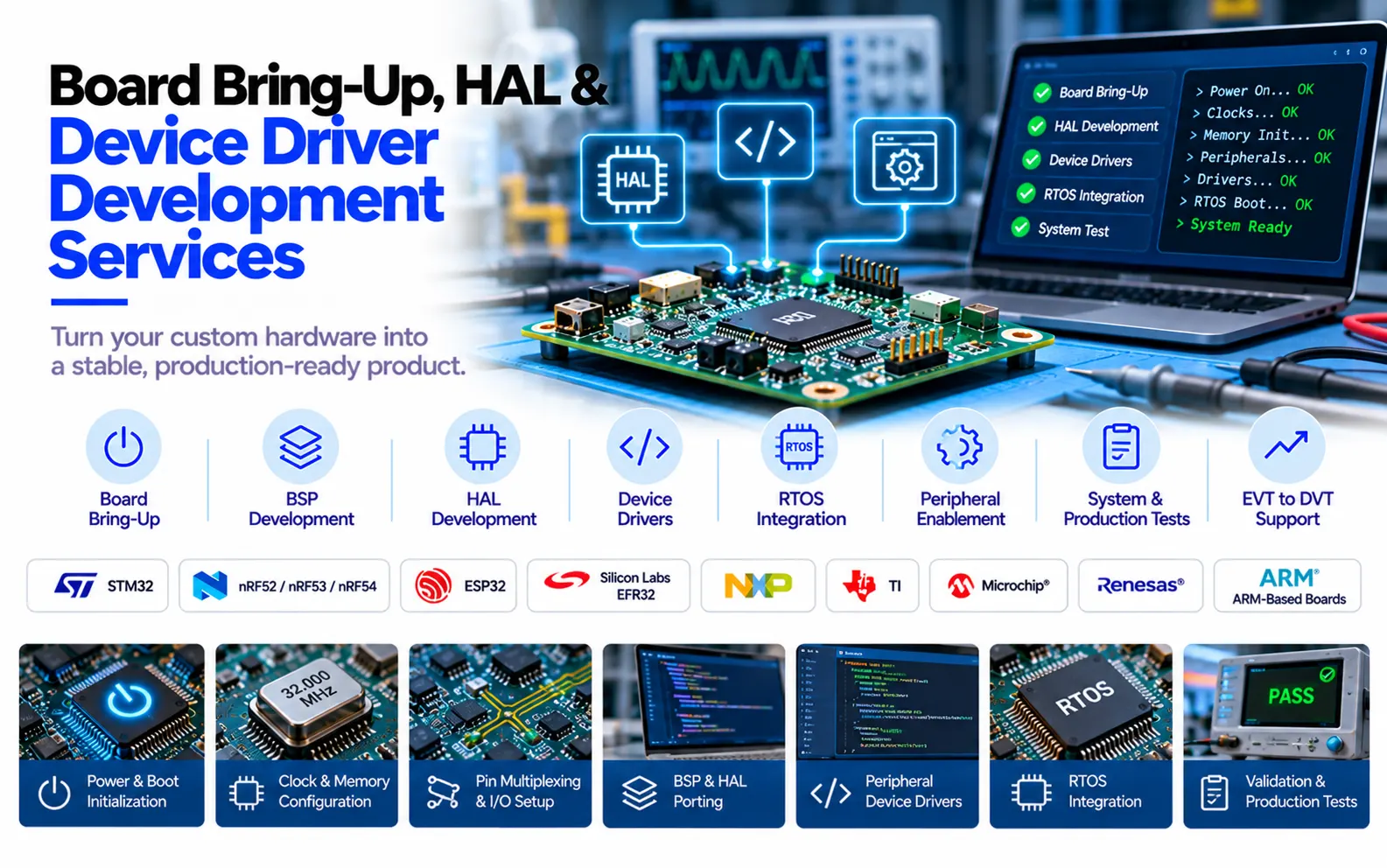
What Is Board Bring-Up?
The board bring up process involves testing and making sure that the manufactured PCB works correctly, and then bringing up its hardware functionalities via firmware in a systematic manner. It begins with basic functionalities like power rails, current consumption, resets, clocks, programmability and booting mode.
And only after verifying these functions can the board bring up progress to functionalities like memory, interfaces, sensors, radios, displays, storage devices, actuators, and applications.
This order is important because the firmware engineers should not waste time debugging the application software when the problem is just a wrong polarity for the reset line, missing pull up resistor, instable power rail, wrong load capacitor, or wrong pin functionality configuration.
A disciplined bring-up process normally includes:
Schematic, PCB layout and BOM review before power is applied Power-rail, current-consumption and thermal checks SWD, JTAG, UART or USB debug access validation Reset, bootloader and clock-tree verification GPIO, ADC, PWM, timers and interrupt testing External flash, EEPROM, RAM and SD-card integration I2C, SPI, UART, CAN/CAN FD, USB, Ethernet and RS-485 testing Sensor, display, motor, battery-management and radio driver enablement Fault handling, watchdogs, low-power modes and production diagnostics
The outcome is more than "the board turns on." It is a documented and repeatable firmware foundation that enables the next engineering stage with less risk.
HAL, BSP and Device Driver Development
Hardware Abstraction Layer is the separation of product logic from board specifics. Without proper HAL, the application code will be tightly coupled to specific MCU, pinout and library of specific vendor. In this case, even minor change of the hardware, MCU or new version of the product will cost additional money.
The services provided by our HAL Development include interface definition for GPIO, timers, non-volatile storage, communication protocols, sensors, states and identification of the device. Application calls stable interface, but the board-specific code below is changed.
The Board Support Package is a set of all configurations for one specific board of the product. The board support package can include clock configuration, pinout map, startup code, link scripts, device tree, boot configuration and others.
For RTOS-based systems, we can integrate FreeRTOS, Zephyr, ThreadX or an appropriate vendor framework while keeping drivers modular and testable.
Our device driver development covers both standard peripherals and custom components, including:
I2C, SPI and UART sensor drivers BLE, Wi-Fi, LoRaWAN, Thread, Zigbee and cellular modules Touch controllers, LCD/OLED/e-paper displays and LEDs GNSS/GPS, accelerometer, gyroscope and environmental sensors Motor-control, relay, valve and actuator interfaces BMS, fuel-gauge, charging and power-management ICs CAN/CAN FD, Modbus, RS-485, Ethernet and USB devices Secure elements, NFC, RFID, fingerprint readers and access-control modules External NOR/NAND flash, FRAM, EEPROM and file systems
We do not treat drivers as isolated code snippets. Each driver is designed around real hardware timing, interrupt behaviour, error recovery, bus contention, power consumption and system safety.
Our Board Bring-Up Methodology
1. Review Before Debugging
We start off with looking at the schematic, PCB layout, bill of materials, MCU data sheet, reference design, and any other manufacturing related material that may be available. This allows us to know what potential hazards we might encounter prior to wasting our lab time, such as wrong voltage domains, unconnected pins, etc.
2. Establish a Reliable Debug Foundation
We validate the programming and debug path first. Depending on the platform, this may include SWD, JTAG, UART bootloader, USB DFU or a vendor programmer. We confirm that the MCU can be identified consistently, flash can be erased and programmed, and reset behaviour is predictable.
3. Enable Hardware in the Correct Order
Our engineers employ firmware steps that are easy to test, rather than turning on all subsystems simultaneously. An initial GPIO test might be followed by checking the clock, followed by logging over serial, testing memory, probing buses, identifying sensors, and testing communications. At each step, uncertainty is reduced and evidence accumulated for the bring-up report.
4. Build Production-Ready Software Foundations
Once the board is stable, we structure drivers, HAL modules, diagnostic hooks, fault codes, watchdog behavior, and power states for maintenance purposes. Secure booting, signed firmware images, OTA updates, test firmware, and serial number programming are some other aspects that we could also incorporate into our platform.
Case Study: EVT Board Bring-Up and Firmware Foundation for a BLE Smart Ring
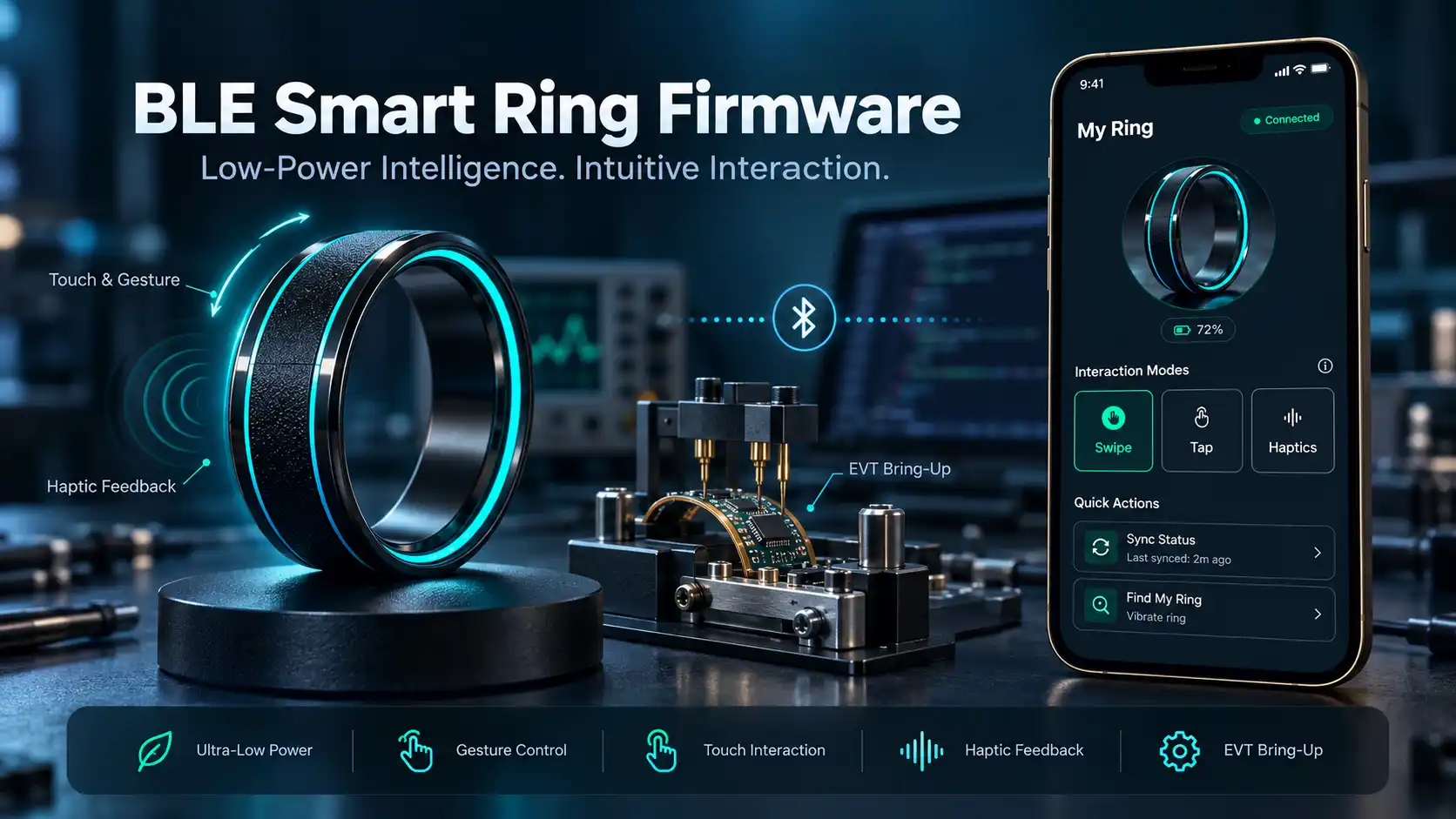
Client: North American Wearable Technology Start-up
Adequate Infosoft assisted a North American technology start-up company that was designing a small Bluetooth Low Energy smart ring for use in lifestyle and wearables industry.
The client was already in the EVT phase with the early hardware design and needed an embedded development partner that would help build a reliable firmware base, validate the board and get ready for further DVT and manufacturing phases.
The device had strict physical and electronic specifications as it had to be small in size, consume less power and still be able to communicate through touch, gestures, LEDs, haptics and BLE.
In an early wearable prototype, even a small issue in wake-up timing, peripheral configuration or current leakage can significantly affect usability and battery life.
Bring-Up and Low-Level Engineering Approach
The process started with the validation of the firmware environment, debugging capabilities, and MCU board configuration for a Nordic nRF52 family platform.
We created repeatable development workflows and validated GPIO, interrupts, peripherals timing, and low power mode transition behavior. This way, our team could quickly separate board-level problems from firmware integration problems at an early stage of the EVT.
We designed the firmware using low-level modules that can be reused instead of hardware calls inside the product functionalities. A HAL layer was used to control GPIOs, timers, LED channels, haptic output, and power modes of the board.
This helped us modify the pinout and hardware behavior in future PCB designs without modifying gesture and BLE code.
For the user-interaction layer, we developed driver-level control for touch input, haptic feedback and LED indicators. Gesture input was translated into defined operating modes, while the firmware controlled feedback timing so the ring remained responsive without wasting power. We also implemented event-driven handling so the MCU could spend more time in low-power states rather than continuously polling peripherals.
The BLE functionality was implemented separately, as a module that has well-defined interfaces with the rest of the application code.
The system provided robust pairing and connection flows while maintaining synchronization between the radio operations, user interaction and the power states. That was necessary due to the possibility of unstable behavior of wearable products when a radio event conflicts with the sensors.
The project also included firmware architecture work to support future expansion. The client required a design that could evolve as final hardware decisions, product features and manufacturing requirements became clearer. By separating board support, device drivers, HAL services and higher-level application logic, the firmware was positioned for safer updates through the subsequent DVT and PVT stages.
This resulted in an EVT-capable embedded platform that provided the customer with an obvious path from prototype testing to a more advanced wearable device.
This showed that, in addition to booting the device, the success of the board bring-up is determined by the creation of robust testable low-level software for the evolving hardware product.
Full project reference: ble-smart-ring-firmware-development-using-nordic-nrf52
Relevant Adequate Infosoft Delivery Experience
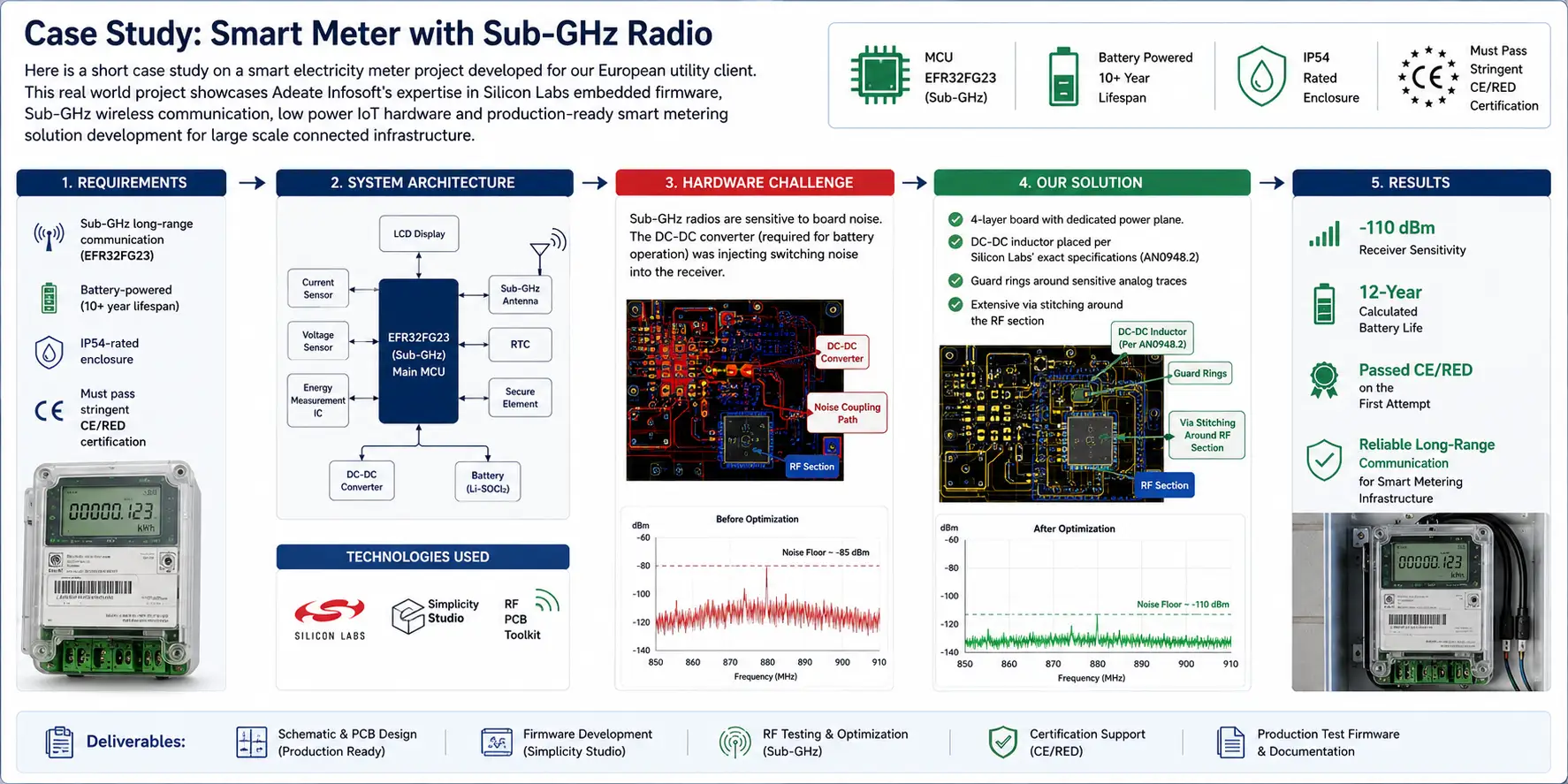
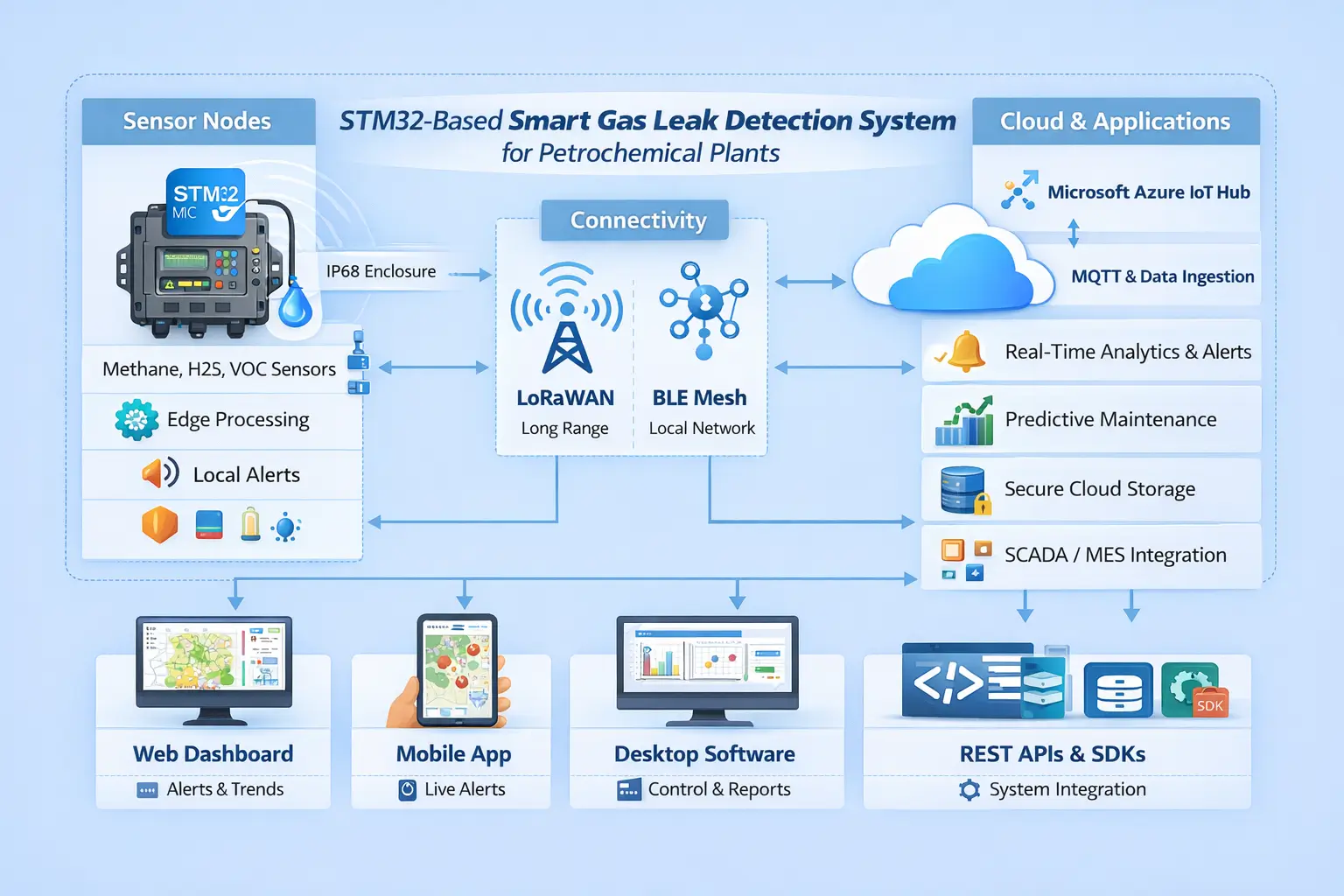
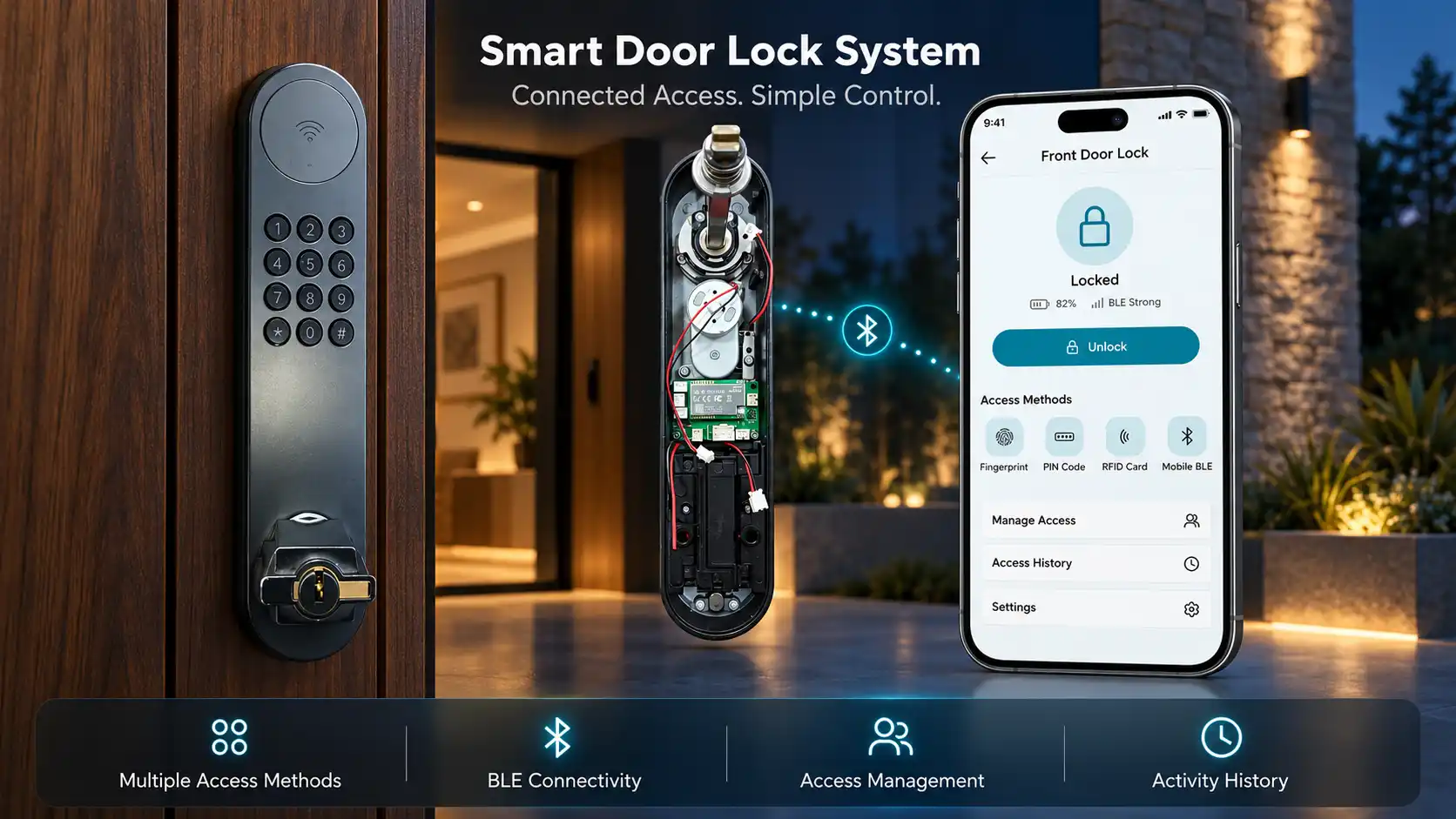
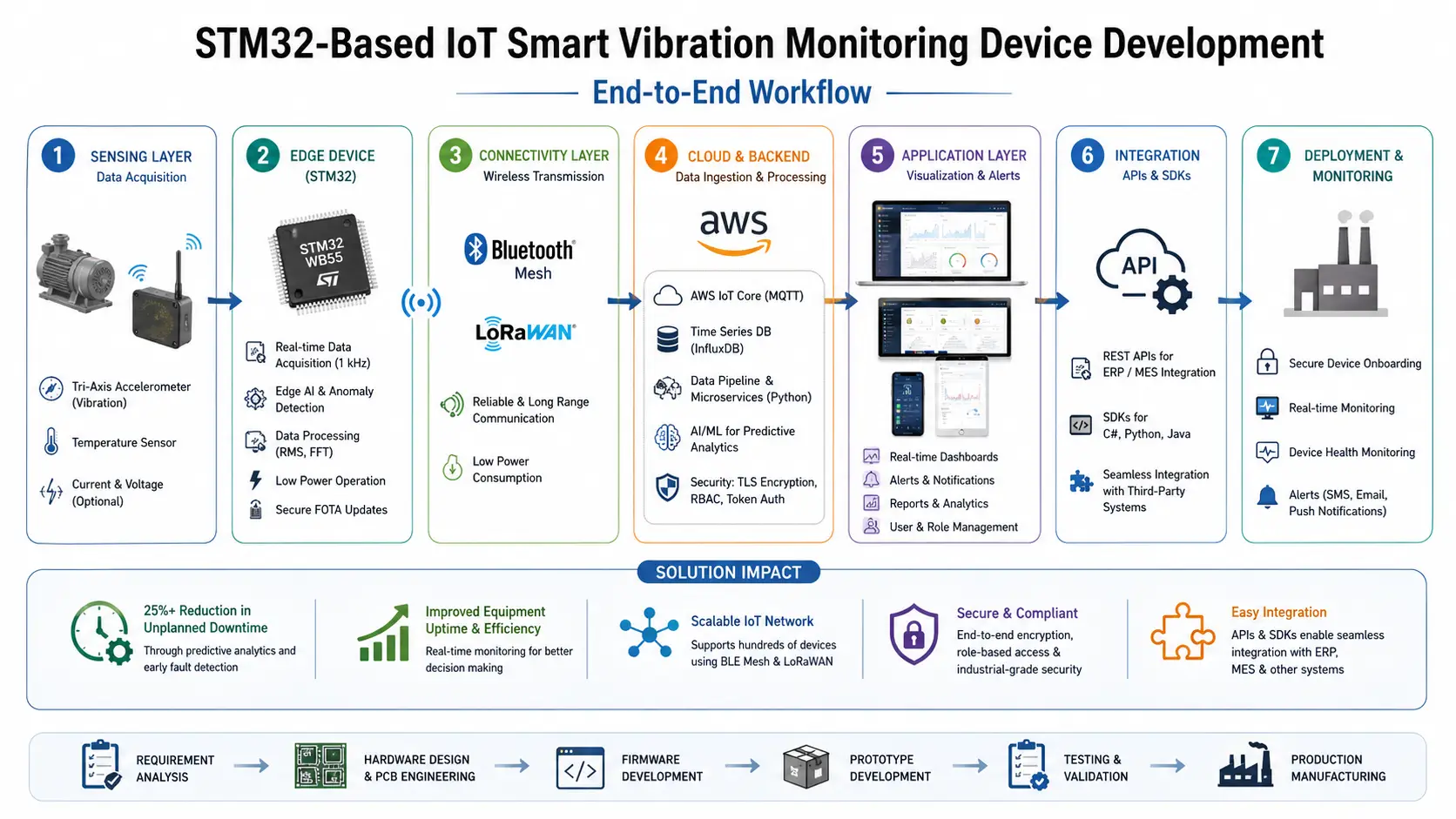
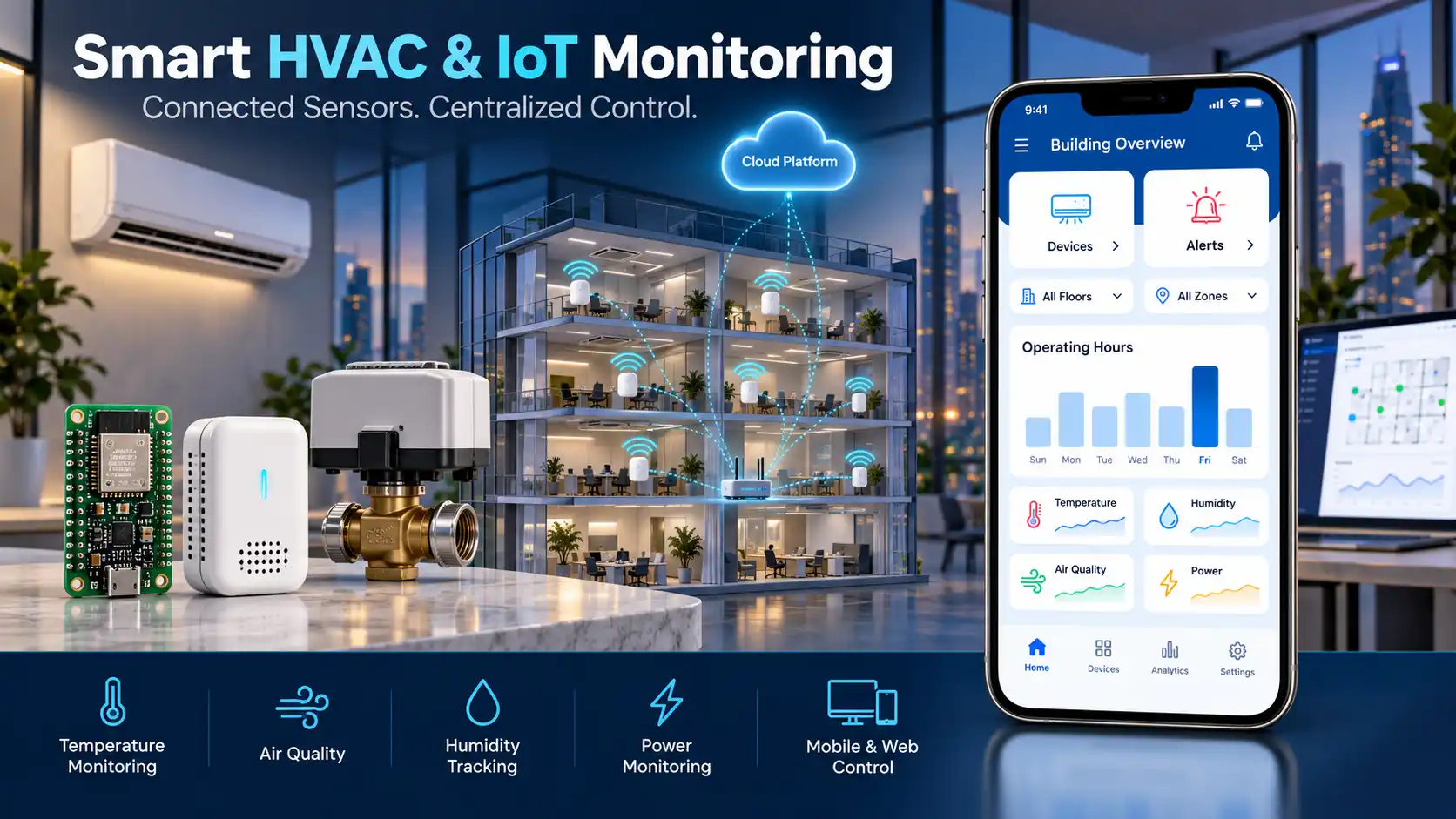
Our related case studies show hands-on experience across custom hardware, embedded firmware, sensors, wireless connectivity and production-focused validation.
Why Low-Level Firmware Quality Matters
Low quality low-level firmware is usually encountered as an occasional problem of the product: sensor disappearing, loss of connection upon wake from sleep, board malfunctioning only at low temperatures, and reset of the device during motor activity.
These problems can cost quite a lot since they are not a simple application error but may relate to such things as electrical behavior, timing, interrupt priorities, race conditions, or power sequences.
An experienced board bring-up engineer decreases that cycle. We use serial traces, logic analyzers, oscilloscopes, protocol analyzers, current measurement, and debugger watchpoints for identification of the root cause of the problem.
We are also straightforward in our documentation of the limits. If there is a need for hardware changes, we specify those clearly and make sensible suggestions.
Testing, Documentation and Handover
A successful engagement at the firmware level will provide your team with useful engineering artifacts beyond just the binary artifact. Depending upon the scope of the project, we could be delivering source code, BSP/HAL architecture, driver APIs, board configurations, test utilities, bring up instructions, list of known issues along with recommendations for the next PCB version.
We coordinate with your internal engineering team, hardware designer or even manufacturing partner to make sure that the decision making process is documented. It is very helpful during the transition into certification phase and pilot production.
Start Your Board Bring-Up Project
If you own a brand-new PCB or prototype, or if you possess an unstable device and need low-level firmware, Adequate Infosoft will assist in making the transition from hardware validation to a full-fledged embedded software system. You just need to provide us with the schematic, board description, and required product functionality.
Frequently Asked Questions
In general, we require the schematic, the PCB layout or Gerber file, the BOM, the MCU and component part numbers, the programming interface information, the existing firmware if any, and the list of the expected functionality. The sample board and hardware problems are also helpful.
Yes. We can investigate the power, reset, boot configuration, clock source, programming interface and startup firmware. We use a staged method to identify whether the problem is hardware, configuration or software.
Yes. We can use and structure vendor HALs such as STM32Cube HAL, Nordic SDK/Zephyr drivers, ESP-IDF, Silicon Labs SDKs or TI SDKs. Where required, we create custom abstractions to reduce vendor lock-in and improve code maintainability.
Yes, it is possible. The driver is developed using the data sheet and reference design of the component. It involves initializations, register configurations, interrupt handling, calibration, error handling, and interface through I2C, SPI, UART, or other supported interfaces.
Yes, we can offer firmware for manufacturing tests, serial number provisioning, debug commands, factory programming, bootloading, and OTA update firmware architecture.
We offer board bring-up and driver development for IoT, industrial automation, smart homes, access control, wearable devices, healthcare devices, energy, EV charging, GPS tracking, security devices, and consumer devices.