


 Mean Stack Development
 Vue JS Development
 Javascript Development
 React JS Development
 Angular JS Development
 Next JS development
 Java Development
 Python Development
 Django Development
 Cherrypy Development
 C# Development
 ASP.NET Development
 NodeJS Development
 Laravel Development
 CodeIgniter Development
 Zend Development
 Ruby on Rails Development
 CakePHP Development
 PHP Website Development
 Symfony Development
 Drupal Development
 Joomla Development
 Wordpress Development
 .NET Nuke Development
 Kentico
 Umbraco
 .NET MAUI Development
 Xamarin Application Development
 iOS Application Development
 Android Application Development
 Android Wear App Development
 Ionic Development
 iBeacon Application Development
 Universal Windows Platform (UWP)
 Kotlin Application Development
 Swift Application Development
 Flutter Application Development
 PWA Application Development
 Flutter Health Tech & Wearable App Development Company
 React Native Health Tech Wearable App Development
 Offshore Software Development
 Custom Application Development
 Front-End Development
 Full Stack Development
 AI & Machine Learning
 Custom CRM Solutions
 Flask Software Development
 Electron JS Development
 ChatGPT Development
 Veterinary Telemedicine App Development
 Build Smart Telemedicine Platform
 Beauty & Salon App Solutions
 Hire Workato Experts
 Magento Development
 Magento 2.0 Development
 Magento Enterprise
 Shopping Cart Development
 Prestashop Development
 Shopify Development
 Open Cart Development
 WooCommerce Development
 BigCommerce Development
 NopCommerce Development
 Virto Commerce Development
 AspDotNetStorefront Development
 .NET Application Development
 Microsoft Dynamics CRM
 VB .NET Development
 Sharepoint Migration
 ASP.NET Core Development
 ASP.NET MVC Development
 AJAX Development
 Agile Development
 Microsoft Bot
 Microsoft Blazor
 Microsoft Azure Cognitive
 HTML 5
 UI/UX Design
 Graphic Design
 Adobe Photoshop
 XML Application Development
 Cloud Computing Solutions
 Azure Cloud App Development
 AWS Development
 Google Cloud Development
 Certified AWS IoT Services Developers
 DevOps Consulting & Development
 Kubernetes Consulting & Services
 SQL Programming Development
 MySQL Development
 MongoDB Development
 Big Data
 Robotic Process Automation
 Social Media Marketing
 Search Engine Optimization
 QA Testing
 Software Testing
 Software Security
 Maintenance And Support
 I.T. Consulting Services
 Business Intelligence
 YII Development
 Data Analysis
 Alexa Skills Development
 On Demand App for Mobile repairing services
 On Demand App for Car Service Booking
 On Demand App for Cleaning Services
 On Demand App for Pharmacy
 On Demand Dedicated Developers
 On Demand Lawyer App Development


 Nuki Smart Lock
 Salto Smart Lock
 TTlock Smart Lock
 NFC App Development
 Custom IOT Enabled Smart Lock
 Smart Locker Solutions
 Hospital Smart Lock Systems
 Hotel Smart Lock Systems
 Smart Home & Office Locks
 Smart Access for Schools & Colleges
 Unloc Smart Lock Integration
 Yale & August Smart Lock Integration
 Populife Smart Lock Integration
 Smart Lock Hardware Development
 Dairy IoT Solutions
 Agri IoT & AI Solutions
 Weather & Climate Solutions
 Water & Waste Management Solutions
 RaspBerry Pi
 Firmware Software Development
 ESP 32 Software Development
 Embedded Development
 Internet of Things
 Smart IoT Development
 IoT Sensor Integration & Development Solutions
 Smart IoT System Development for HVAC
 Tuya IoT App Development
 Particle IoT SDK
 IoT Development with AI
 Smart Pet GPS Tracker
 Dairy GPS Tracking Solutions
 GPS Fleet Management Software
 Car Rental & Subscription Solutions
 Car Buy & Sell Marketplace Development
 AI-Powered Car Wash App Development
 PCB Design & Fabrication
 IoT AC Automation
 AI–IoT Painting Solutions
 IoT Wearable Hardware & App Development
 HVAC Automation & AI Control Systems
 Smart Home IoT Engineering
 AI Embedded Systems
 AI Hardware Design Service
 Advanced IoT Hardware & Firmware Development
 Device Driver Development Services
 NXP i.MX RT Firmware & Hardware Services
 Microchip PIC & AVR Development
 Hire IoT Architects
 IoT Cloud & Infrastructure Solutions
 Infineon XMC / AURIX Development Services
 Matter & Thread IoT Services
 Native IoT Mobile App Development (BLE & Wi-Fi)
 Snapdragon IoT Firmware Development
 Renesas RA/RX Firmware Services
 Silicon Labs EFR32 Development Services
 Smart Wearable App Development
 Smart IoT Meters
 Smart Healthcare Wearable App Development
 Health Care Monitoring System
 Fitness Tracking App Development
 Smart Home Automation Apps
 nRF PCB Design
 ESP32 PCB Design
 Embedded Wearables Engineers
 Rental Property Management System
 Building Management System
 Smart Lighting Development
 Infineon Semiconductor Firmware Development Services
 Custom Camera Development: Hardware, Firmware & PCB Prototyping
 Smart Security Camera SDK
 Nordic Semiconductor SDK
 Infineon SDK
 Arduino SDK
 NFC Lock Integration
 Kerong Lock Integration
 IoT & AI Solutions for Manufacturing
 Smart Inventory & Logistics Solution
 Food & Beverage Industry Solutions
 Smart Hospitality Solutions
 Smart Property Management
 Custom Smart Home IOT SDK
 Smart IoT & AI in Healthcare
 AI-Powered Security Solutions
 Smart Home Safety & AI
 Veterinary Clinic Management (AI)
 Pet Care System (AI & IoT)
 Pet Training & Adoption (AI)
 Healthcare IoT Development
 Event Management Software
 Money Remittance App
 Money Lending App Development
 Utility and Bill Payment App
 IoT Mobile App Development (Flutter & React Native)
 AI & IoT Retail Solutions
 Smart EV App Development
 Smart Solar IoT & AI Solutions
 IoT-Based Energy Systems
 Smart Energy & Utilities Solutions
 6G Solutions
 IoT Security Solutions
 AI-Powered Lottery App Development
 AI-Sports Fitness Club Management
 Travel
 Real Estate
 Medical & Healthcare
 e-Learning
 Consumer Products
 Finance
 Automobile
 Media & Entertainment
 Billing Software
 Enterprise Resource Planning (ERP)
 Augumented & Virtual Reality
 Point of Sale(POS) Development
 Learning Management System
 EV Charging Solutions
 About Us
 Partners & Certifications
 Quality Assurance
 Our Clients & Testimonials
 Development Process
 Our Products
 Social Responsibility
 Work Ethics
 Vision & Mission
 Awards
 Live Project Demos
 Contact Us
 Case Studies
 Portfolio
 Blog
BLDC Motor Controller PCB Design & Firmware Development Services
Adequate Infosoft provides end-to-end BLDC motor controller development services covering PCB design, motor-control firmware, electronics engineering, embedded software, sensor integration, communication, testing, and complete system integration.
Our qualified engineers design tailored solutions with the help of BLDC controllers in robotics, medical equipment, industrial automation, electrical drive systems, heating and cooling systems, electronic devices, pumps, UAVs, power tools, etc.
Whether you are looking for a new BLDC motor controller solution from scratch or for revamping your existing controller or updating your firmware and looking for extra resources, Adequate Infosoft has the expertise.
Let's Work Together!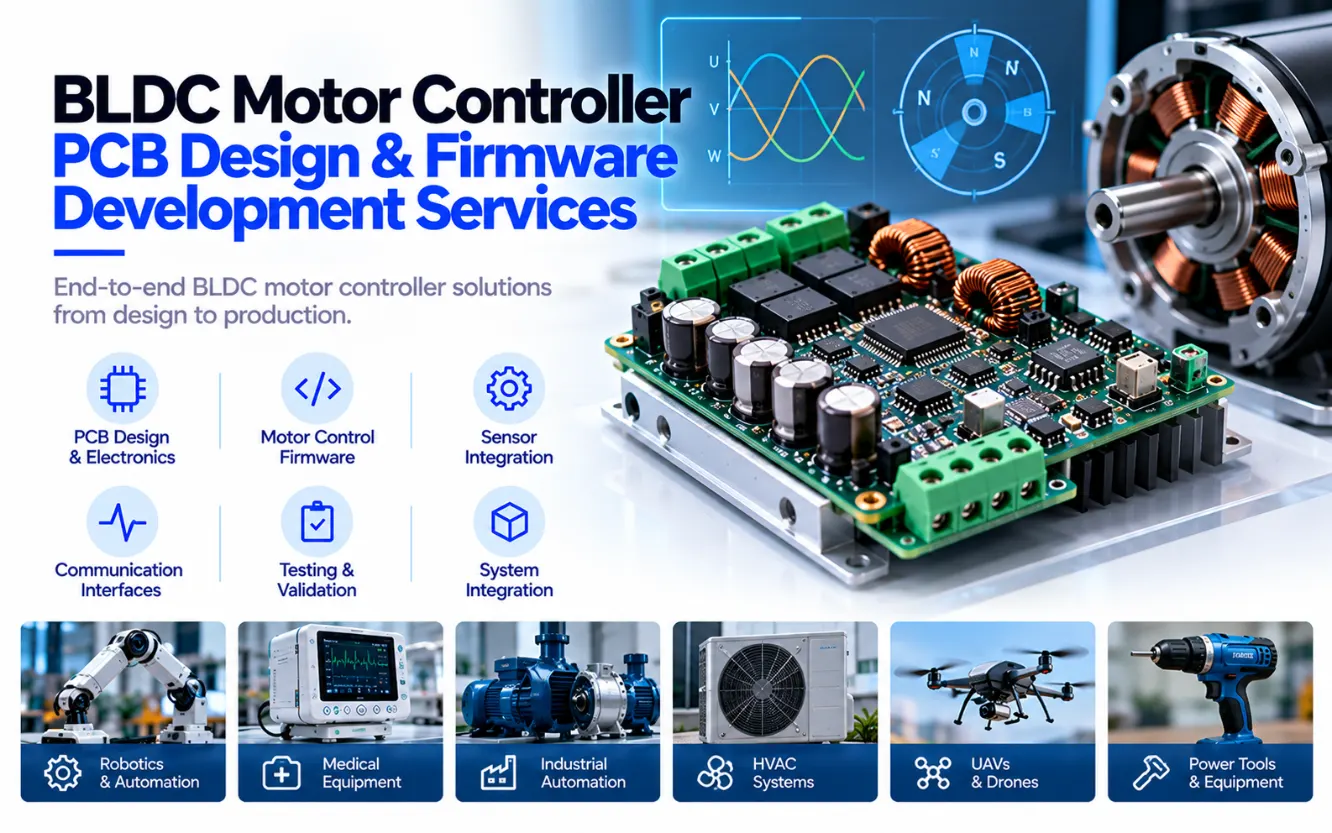
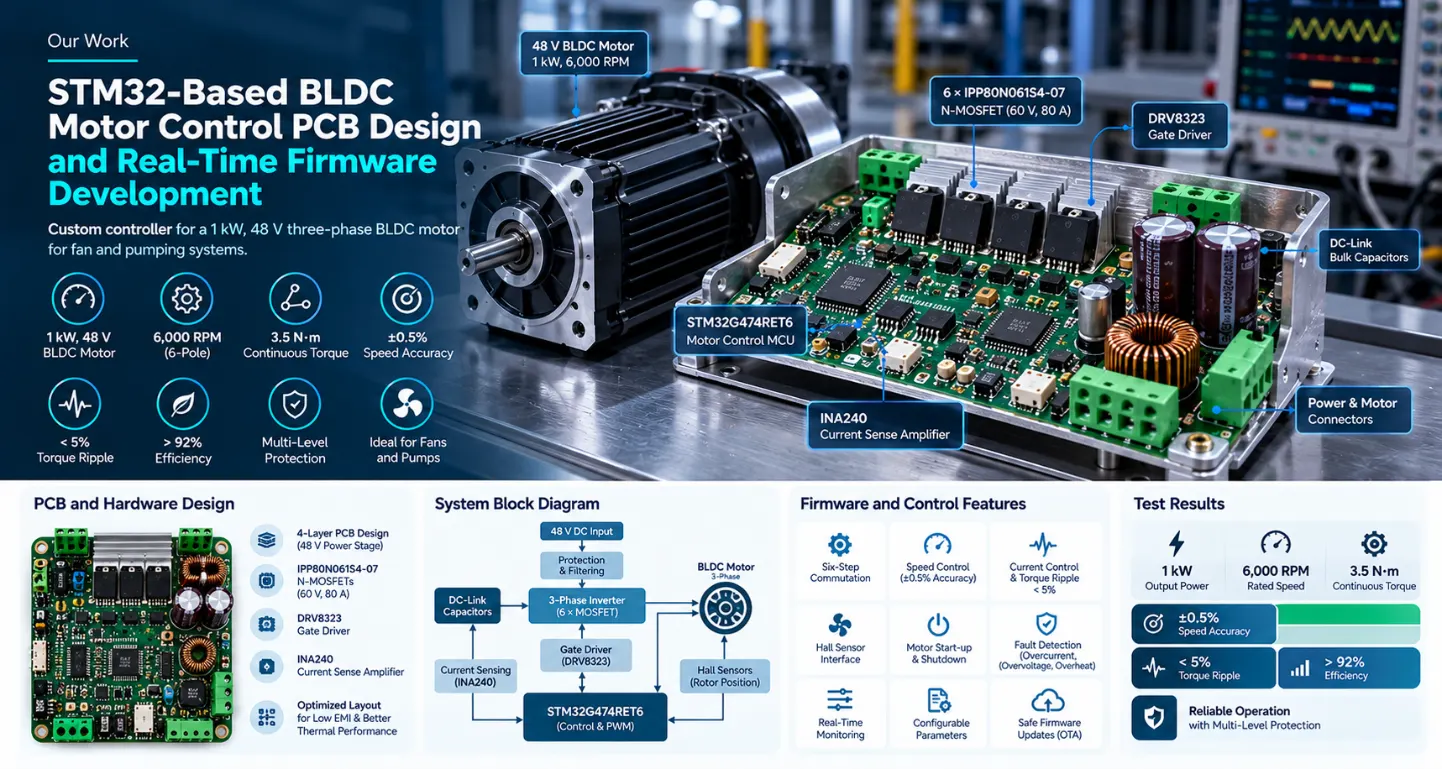
Our Work: STM32-Based BLDC Motor Control PCB Design and Real-Time Firmware Development
Understanding the Motor-Control Requirements
Adequate Infosoft provided a customized controller for a 1 kW, 48 V three-phase BLDC motor that is to be used in fan and pumping systems. The controller had to be reliable and able to operate a six-pole BLDC motor at 6,000 RPM, producing up to 3.5 N•m of continuous torque.
We began the project by identifying the electrical, mechanical, and control requirements for the motor system. The design for the controller was to ensure that the system would be capable of operating with an accuracy of ±0.5% in speed, a ripple of less than 5% in the torque, and an efficiency of over 92%.
The solution was built around the STM32G474RET6, an ARM Cortex-M4F microcontroller operating at 170 MHz. This MCU was selected for its high-resolution timer, three independent 12-bit ADCs, integrated operational amplifiers, and motor-control features that support precise PWM generation, fast current measurement, and real-time closed-loop control.
High-Power PCB and Electronics Design
A four-layer PCB design was fabricated for the 48 V power stage and the control circuitry. The three-phase inverter consisted of six IPP80N061S4-07 N-channel MOSFETs, which have a breakdown voltage of 60 V and can handle currents up to 80 A in a three-phase bridge connection. For safe switching of the MOSFETs, a DRV8323 gate driver was used along with VDS and shoot-through protections.
For precise current feedback, we integrated INA240 current-sense amplifiers. The PCB layout was engineered to minimise switching-loop inductance, reduce EMI, improve thermal performance, and ensure equal gate-drive trace lengths. DC-link bulk and film capacitors were placed close to the power stage to control voltage transients during switching.
Real-Time Firmware and Closed-Loop Control
Our embedded engineers designed firmware that generated real-time pulses, performed six-step commutation, processed Hall-sensors, calculated speed, controlled current, motor start-up, controlled shutdown, and fault management. Hall-effect sensors feedback helped in determining the rotor position and selecting the right sequence of commutation.
STM32 always monitored current, voltage, temperature, speed of the motor, and fault status. In case of any abnormal operating condition, such as overcurrent, overvoltage, overheating, or motor stall, our controller would react quickly.
Testing, Validation and Delivery
The controller was tested for functionality, loading, and temperature. The final system provided reliable closed-loop performance, power efficiency, proper speed control, and reliable protection in industrial environment conditions.
We successfully completed this project showcasing our end-to-end capabilities in BLDC controller circuit board design, firmware, motor control software, hardware testing, and engineering.
Case study: arm-based-bldc-motor-controller-development
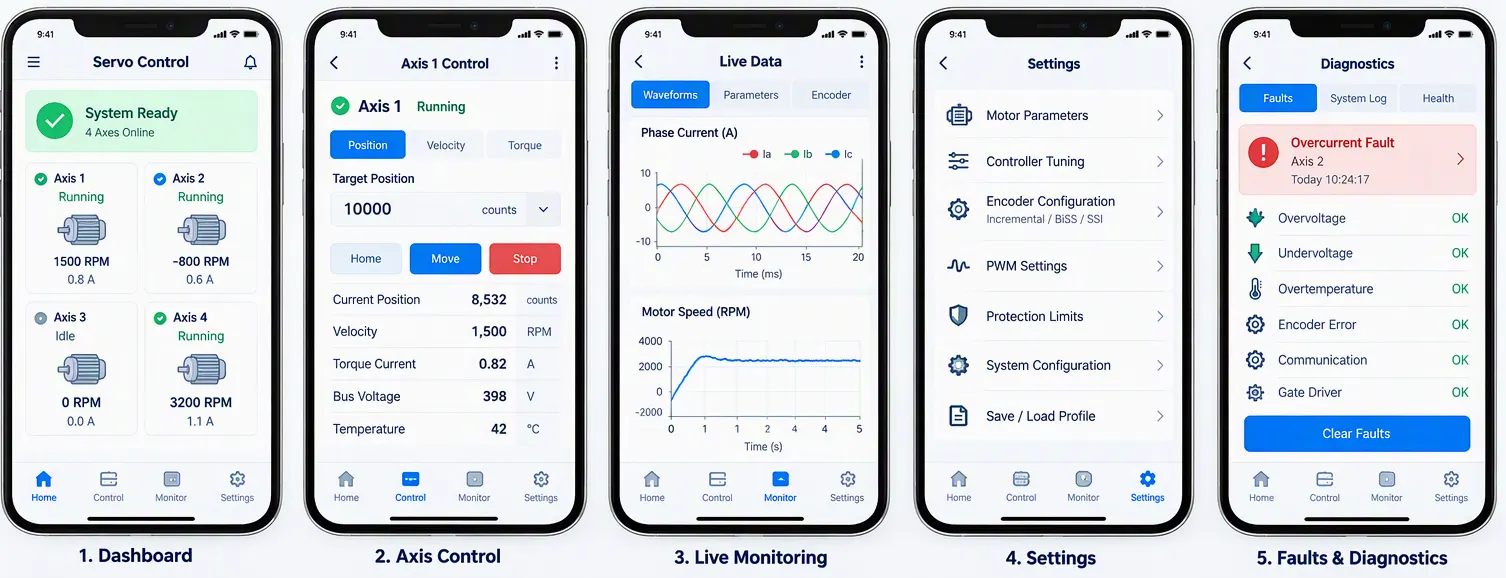
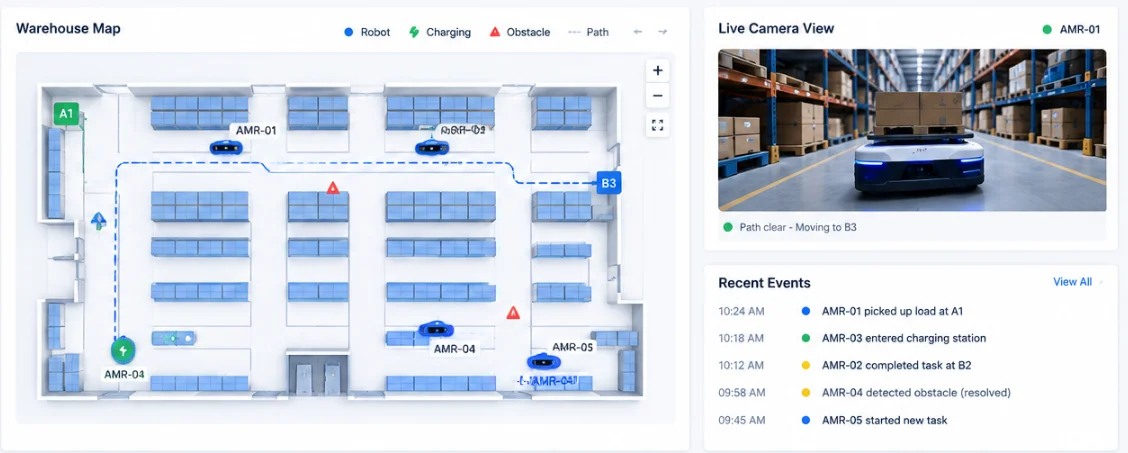
Explore Our Advanced BLDC Motor Control and Robotics Engineering Projects
Our BLDC motor controller know-how goes beyond designing individual motor PCBs and firmware.
Adequate Infosoft has extensive experience with motion control, robotics, encoder processing, and other embedded systems requiring precision, hardware safety, and deterministic behavior.
Below is a selection of projects that show our capability to implement motor control systems at any scale.
Our BLDC Motor Controller Development Services
The services provided by our company for engineering BLDC motor controllers embrace the entire process of product creation from specifications and architecture and PCB production through firmware system implementation, prototype testing, modifications, and production phase.
PCB Design for a BLDC Motor Controller
Adequate Infosoft has offered professional PCB design services for companies developing BLDC motor control systems.
A PCB of BLDC controller includes high power electronics and relevant but more sensitive circuitry for control and communication. Our engineers create the project in such a way that all functional blocks are properly placed on the board.
PCB development can include:
System architecture Circuit design Schematic capture Component selection MOSFET power stages Gate-driver circuits Current-sensing circuits Voltage-sensing circuits DC-link protection Microcontroller circuits Hall-sensor interfaces Encoder interfaces Communication interfaces Power supplies DC-DC converters Protection circuitry Thermal considerations Multilayer PCB layout Design-rule checking Manufacturing files Prototype support
Our engineers consider current capacity, switching behavior, thermal performance, EMI/EMC considerations, signal integrity, component availability, and manufacturability during PCB development.
BLDC Motor Control Firmware Development
We have a team of embedded engineer who specializes in creating time-sensitive firmware for BLDC motor controllers.
The firmware is capable of conducting motor control, performing electrical and mechanical monitoring, processing sensor feedback, communicating with outer systems, and dealing with problems during the operations.
Firmware capabilities include:
PWM generation Motor commutation Speed regulation Current regulation Torque control Position feedback Hall sensor processing Encoder processing Sensorless control ADC acquisition Current measurement Voltage measurement Temperature monitoring Fault detection Motor startup Controlled shutdown Communication Parameter configuration Diagnostics Firmware updates
Firmware architecture can be optimized for the selected microcontroller and required real-time performance.
Six-Step BLDC Commutation
For applications using conventional trapezoidal BLDC control, Adequate Infosoft can develop six-step commutation firmware.
The controller can process Hall-sensor feedback or other appropriate position information to determine the required switching sequence.
Development can include:
Commutation logic Hall-state detection PWM generation Direction control Startup sequencing Speed measurement Current limiting Fault handling Braking strategies
The control strategy is selected based on the motor characteristics, load requirements, speed range, efficiency targets, and product architecture.
Field-Oriented Control (FOC)
For applications requiring more sophisticated motor control, we can develop Field-Oriented Control solutions for appropriate BLDC/PMSM motor architectures.
FOC development can include:
Clarke transformation Park transformation Inverse transformations Current sensing Rotor-position estimation Current-loop control Speed-loop control PWM generation Space Vector PWM Sensor-based control Sensorless control Parameter configuration
FOC can be considered where the application requires improved control characteristics, efficiency, smooth operation, or precise torque and speed management.
The appropriate control strategy depends on the motor, inverter architecture, feedback mechanism, and application requirements.
Sensorless BLDC Controller Development
Adequate Infosoft can develop sensorless BLDC control solutions for applications where physical Hall sensors or encoders are undesirable or unavailable.
Depending on the motor and application, sensorless control can use electrical feedback and algorithmic estimation to determine rotor position.
Our engineers can develop:
Back-EMF detection Zero-crossing detection Startup algorithms Rotor-position estimation Speed estimation Commutation logic Low-speed handling Transition strategies Fault detection
Sensorless control performance depends heavily on motor characteristics, load conditions, speed range, electrical design, and the selected algorithm.
Integration of Encoder And Hall Sensor
Applications that require rotor positioning can make use of Hall sensor or magnetic encoder or any other feedback instruments.
The firmware reads data signals to ascertain the rotor position and gauge the speed.
Our engineering team designs the necessary PCB interfaces to bring about signal conditioning, interrupt and filtering.
Motor Speed & Torque Control
Adequate Infosoft develops configurable motor-control systems for applications requiring controlled speed and torque.
Depending on the application, the controller can support:
Fixed-speed operation Variable-speed operation Closed-loop speed control Current-based torque control Acceleration profiles Deceleration profiles Soft start Soft stop Direction control Braking Preset operating modes
Control parameters can be configured through firmware, a local interface, or an external application.
High-Current BLDC Controller Development
For high-power applications, the controller architecture must manage substantial electrical and thermal loads.
Our hardware engineers can develop high-current power stages using appropriate switching devices, gate drivers, current sensing, protection circuits, thermal management, and PCB design practices.
Potential applications include:
Industrial motors Pumps Compressors Robotics Electric mobility HVAC Automation equipment Power tools Agricultural equipment
Final voltage, current, power, thermal, and protection requirements are determined according to the motor and application specifications.
Development of Low-Power BLDC Controller
Our team also creates small-sized BLDC controllers designed for applications with low power capacity.
Systems can be tailored to the following specifications:
Low energy consumption Compact dimensions of the PCB Battery functionality Efficient control of the motors Low idle power use Wireless communication Portable devices
The applications of such controllers are vast and include but are not limited to medical devices, consumer products, small robotics, portable instrumentation, fans, pumps, battery-operated devices, etc.
BLDC Controller Communication
Currently, modern motor controllers have an increasing need for communicating with other devices.
Adequate Infosoft may integrate various channel protocols, including:
UART SPI I2C CAN RS-485 USB Ethernet Bluetooth Wi-Fi
These channels can be used for motor configuration or telemetry, diagnostics, adjusting parameters of the motor, updating firmware, and other tasks.
IoT-Connected BLDC Motor Controllers
For connected motor-control applications, we can combine BLDC firmware with IoT connectivity.
A connected controller can transmit selected motor parameters such as:
Speed Current Voltage Temperature Operating state Fault information Runtime Energy-related data
This information can be transmitted to mobile applications, gateways, backend APIs, or cloud platforms.
Remote monitoring and configuration can be implemented according to the application's security and operational requirements.
PCB Prototype & Hardware Bring-Up
Adequate Infosoft supports prototype PCB bring-up and debugging after fabrication.
Our engineers can systematically validate:
Power rails Gate-driver operation MCU operation ADC measurements PWM outputs Communication interfaces Current sensing Voltage sensing Hall sensors Encoders Motor operation Thermal behavior
Oscilloscopes, logic analyzers, power supplies, electronic loads, JTAG/SWD debuggers, and other engineering equipment can be used as appropriate during development.
Upgrading the Current BLDC Controller
In case you have an existing BLDC controller but need improvements, Adequate Infosoft can assist in upgrading the controller.
We can cooperate with the existing schematics and the PCB layouts, firmware, communication protocols, motor specification, and technical documentation.
Upgrade projects can include:
MCU migration PCB redesign Firmware rewriting Control-algorithm improvement Communication upgrades Sensor replacement Wireless connectivity Protection improvements Performance optimization Legacy-code modernization
This approach can help extend the product lifecycle while introducing modern embedded technologies.
Hire BLDC Motor Controller Engineers
Adequate Infosoft provides experienced engineers who can join your project as an extended engineering team.
You can hire engineers for specific requirements such as:
BLDC firmware development FOC development Motor-control algorithm development PCB design Embedded C/C++ development Microcontroller programming Hardware bring-up Motor testing Communication development IoT integration Application development System integration
You can engage individual specialists or a complete multidisciplinary team depending on the project's scope.
Complete BLDC Motor Controller Development Partner
If you require a new BLDC engine controller, powerful controller, compact embedded controller, FOC-based system, sensorless controller, PCB for motor-controlling, embedded software or complete motor-controlling product, Adequate Infosoft can assist throughout the development process.
From specification and electronics architecture, PCB design, firmware, motor control algorithms, prototype development, testing, connectivity, applications and production assistance, our engineers provide necessary technical skills for the implementation of dependable and scalable BLDC motor control system.