














 Mean Stack Development
 Vue JS Development
 Javascript Development
 React JS Development
 Angular JS Development
 Next JS development
 Java Development
 Python Development
 Django Development
 Cherrypy Development
 C# Development
 ASP.NET Development
 NodeJS Development
 Laravel Development
 CodeIgniter Development
 Zend Development
 Ruby on Rails Development
 CakePHP Development
 PHP Website Development
 Symfony Development
 Drupal Development
 Joomla Development
 Wordpress Development
 .NET Nuke Development
 Kentico
 Umbraco
 .NET MAUI Development
 Xamarin Application Development
 iOS Application Development
 Android Application Development
 Android Wear App Development
 Ionic Development
 iBeacon Application Development
 Universal Windows Platform (UWP)
 Kotlin Application Development
 Swift Application Development
 Flutter Application Development
 PWA Application Development
 Flutter Health Tech & Wearable App Development Company
 React Native Health Tech Wearable App Development
 Offshore Software Development
 Custom Application Development
 Front-End Development
 Full Stack Development
 AI & Machine Learning
 Custom CRM Solutions
 Flask Software Development
 Electron JS Development
 ChatGPT Development
 Telemedicine App Development
 Build Smart Telemedicine Platform
 Beauty & Salon App Solutions
 Hire Workato Experts
 Magento Development
 Magento 2.0 Development
 Magento Enterprise
 Shopping Cart Development
 Prestashop Development
 Shopify Development
 Open Cart Development
 WooCommerce Development
 BigCommerce Development
 NopCommerce Development
 Virto Commerce Development
 AspDotNetStorefront Development
 .NET Application Development
 Microsoft Dynamics CRM
 VB .NET Development
 Sharepoint Migration
 ASP.NET Core Development
 ASP.NET MVC Development
 AJAX Development
 Agile Development
 Microsoft Bot
 Microsoft Blazor
 Microsoft Azure Cognitive
 HTML 5
 UI/UX Design
 Graphic Design
 Adobe Photoshop
 XML Application Development
 Cloud Computing Solutions
 Azure Cloud App Development
 AWS Development
 Google Cloud Development
 Certified AWS IoT Services Developers
 DevOps Consulting & Development
 Kubernetes Consulting & Services
 SQL Programming Development
 MySQL Development
 MongoDB Development
 Big Data
 Robotic Process Automation
 Social Media Marketing
 Search Engine Optimization
 QA Testing
 Software Testing
 Software Security
 Maintenance And Support
 I.T. Consulting Services
 Business Intelligence
 YII Development
 Data Analysis
 Alexa Skills Development
 On Demand App for Mobile repairing services
 On Demand App for Car Service Booking
 On Demand App for Cleaning Services
 On Demand App for Pharmacy
 On Demand Dedicated Developers
 On Demand Lawyer App Development









 Nuki Smart Lock
 Salto Smart Lock
 TTlock Smart Lock
 NFC App Development
 Custom IOT Enabled Smart Lock
 Smart Locker Solutions
 Hospital Smart Lock Systems
 Hotel Smart Lock Systems
 Smart Home & Office Locks
 Smart Access for Schools & Colleges
 Unloc Smart Lock Integration
 Yale & August Smart Lock Integration
 Populife Smart Lock Integration
 Smart Lock Hardware Development
 Dairy IoT Solutions
 Agri IoT & AI Solutions
 Weather & Climate Solutions
 Water & Waste Management Solutions
 RaspBerry Pi
 Firmware Software Development
 ESP 32 Software Development
 Embedded Development
 Internet of Things
 Smart IoT Development
 IoT Sensor Integration & Development Solutions
 Smart IoT System Development for HVAC
 Tuya IoT App Development
 Particle IoT SDK
 IoT Development with AI
 Smart Pet GPS Tracker
 Dairy GPS Tracking Solutions
 GPS Fleet Management Software
 Car Rental & Subscription Solutions
 Car Buy & Sell Marketplace Development
 AI-Powered Car Wash App Development
 PCB Design & Fabrication
 IoT AC Automation
 AI–IoT Painting Solutions
 IoT Wearable Hardware & App Development
 HVAC Automation & AI Control Systems
 Smart Home IoT Engineering
 AI Embedded Systems
 AI Hardware Design Service
 Advanced IoT Hardware & Firmware Development
 Device Driver Development Services
 NXP i.MX RT Firmware & Hardware Services
 Microchip PIC & AVR Development
 Hire IoT Architects
 IoT Cloud & Infrastructure Solutions
 Infineon XMC / AURIX Development Services
 Matter & Thread IoT Services
 Native IoT Mobile App Development (BLE & Wi-Fi)
 Snapdragon IoT Firmware Development
 Renesas RA/RX Firmware Services
 Silicon Labs EFR32 Development Services
 Smart Wearable App Development
 Smart IoT Meters
 Smart Healthcare Wearable App Development
 Health Care Monitoring System
 Fitness Tracking App Development
 Smart Home Automation Apps
 nRF PCB Design
 ESP32 PCB Design
 Embedded Wearables Engineers
 Rental Property Management System
 Building Management System
 Smart Lighting Development
 Infineon Semiconductor Firmware Development Services
 Custom Camera Development: Hardware, Firmware & PCB Prototyping
 Smart Security Camera SDK
 Nordic Semiconductor SDK
 Infineon SDK
 Arduino SDK
 NFC Lock Integration
 Kerong Lock Integration
 IoT & AI Solutions for Manufacturing
 Smart Inventory & Logistics Solution
 Food & Beverage Industry Solutions
 Smart Hospitality Solutions
 Smart Property Management
 Custom Smart Home IOT SDK
 Smart IoT & AI in Healthcare
 AI-Powered Security Solutions
 Smart Home Safety & AI
 Veterinary Clinic Management (AI)
 Pet Care System (AI & IoT)
 Pet Training & Adoption (AI)
 Healthcare IoT Development
 Event Management Software
 Money Remittance App
 Money Lending App Development
 Utility and Bill Payment App
 IoT Mobile App Development (Flutter & React Native)
 AI & IoT Retail Solutions
 Smart EV App Development
 Smart Solar IoT & AI Solutions
 IoT-Based Energy Systems
 Smart Energy & Utilities Solutions
 6G Solutions
 IoT Security Solutions
 AI-Powered Lottery App Development
 AI-Sports Fitness Club Management
 Travel
 Real Estate
 Medical & Healthcare
 e-Learning
 Consumer Products
 Finance
 Automobile
 Media & Entertainment
 Billing Software
 Enterprise Resource Planning (ERP)
 Augumented & Virtual Reality
 Point of Sale(POS) Development
 Learning Management System
 EV Charging Solutions
 About Us
 Partners & Certifications
 Quality Assurance
 Our Clients & Testimonials
 Development Process
 Our Products
 Social Responsibility
 Work Ethics
 Vision & Mission
 Awards
 Live Project Demos
 Contact Us
 Case Studies
 Portfolio
 Blog
Blog
Pet Wearable & Smart Collar Development Services
Adequate Infosoft develops pet wearables and smart collars for pet-tech, veterinary, tracking and livestock companies.
Services cover architecture, PCB and antennas, GNSS, LTE-M/NB-IoT, BLE, LoRaWAN, sensors, firmware, apps, cloud geofences, prototypes and production preparation.
A pet tracker should be able to withstand dirt, moisture, chewing, impact, and inconsistent coverage while still providing comfort.
Wellness algorithms need to be validated in the context of both species and placement, so you cannot just translate what works for a human wrist onto dogs, cats, and horses. We make sure to build our technology considering the animal and environment.
Let's Work Together!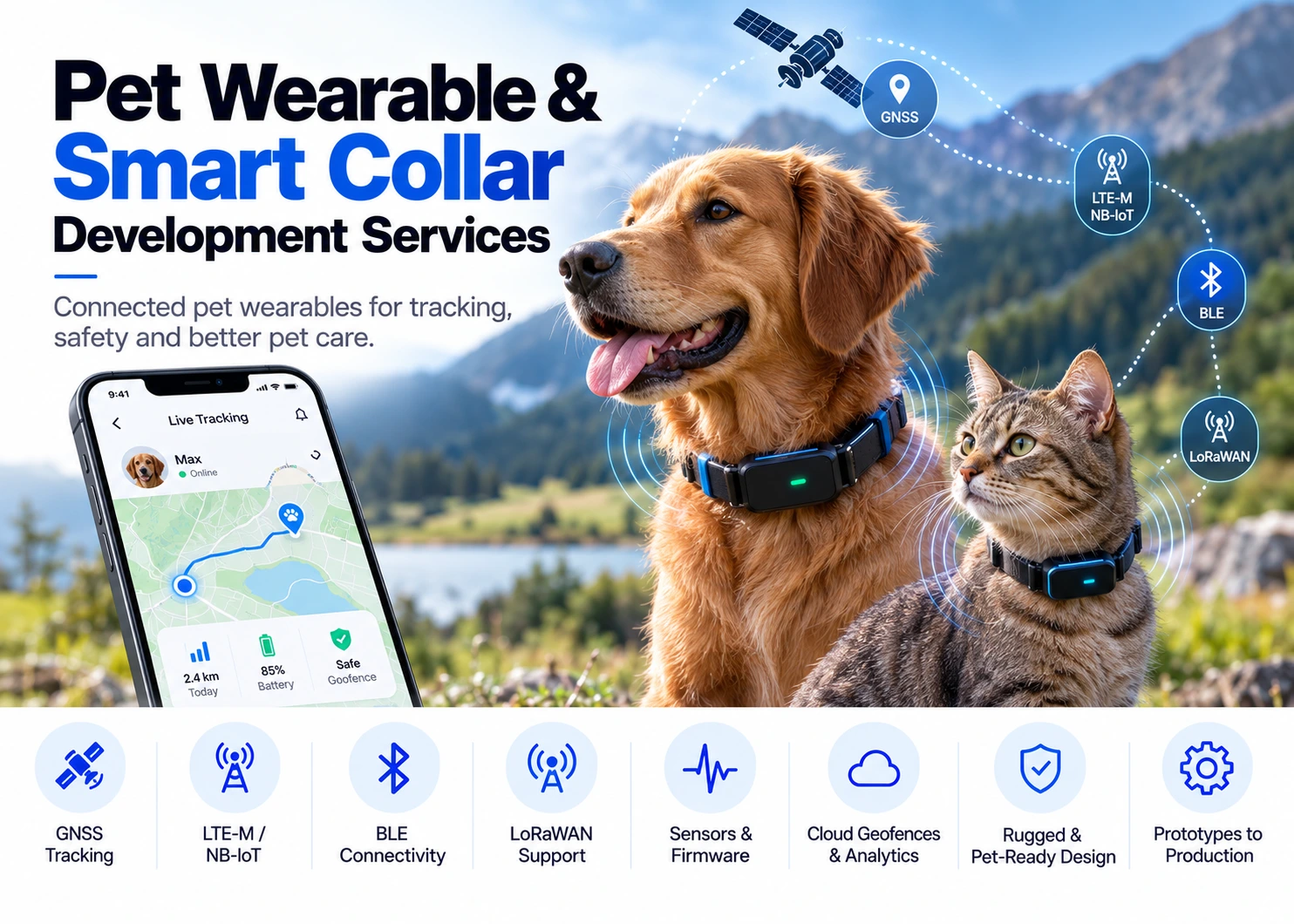
Pet and Animal Wearables We Develop
Our team of engineers can design:
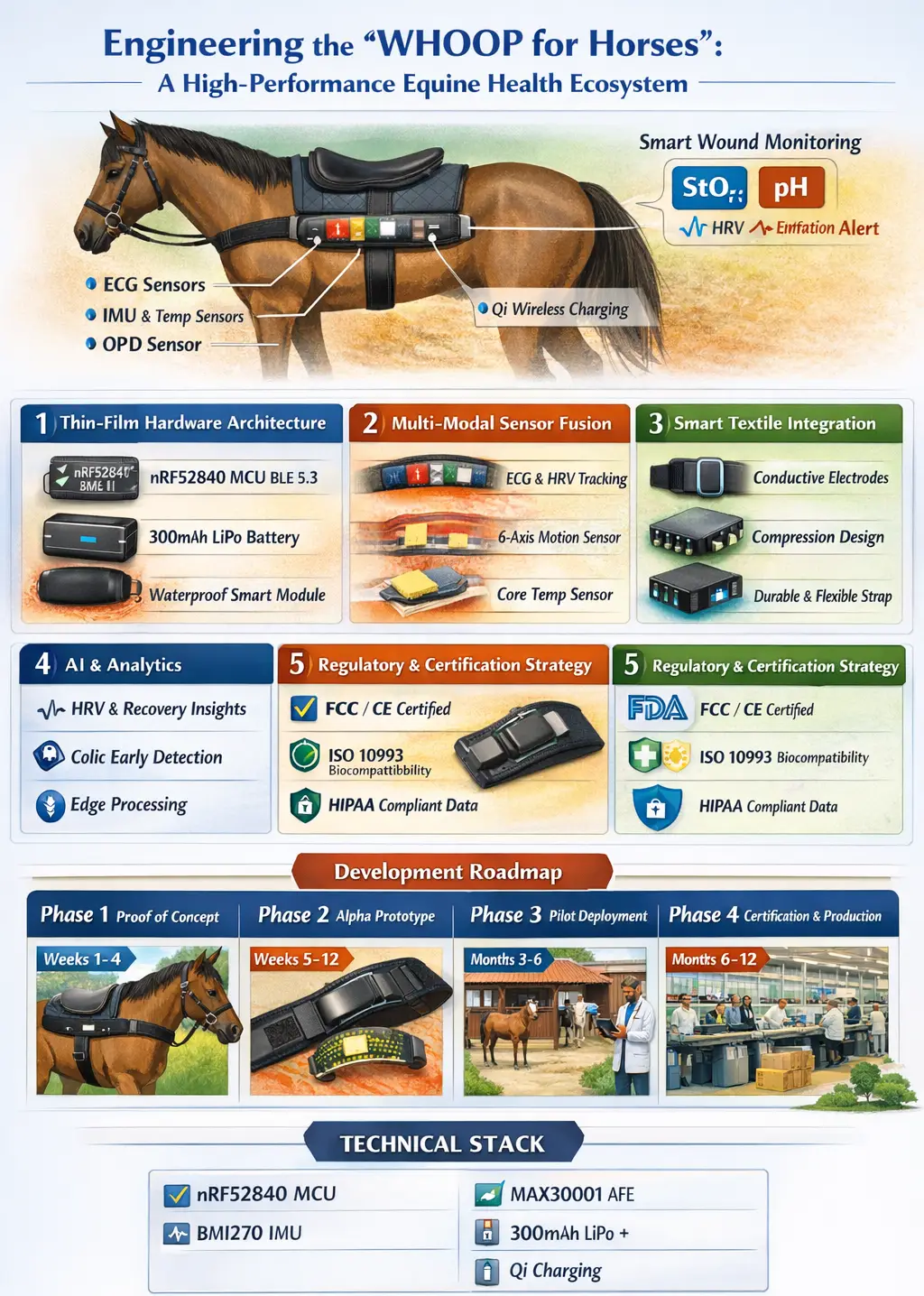
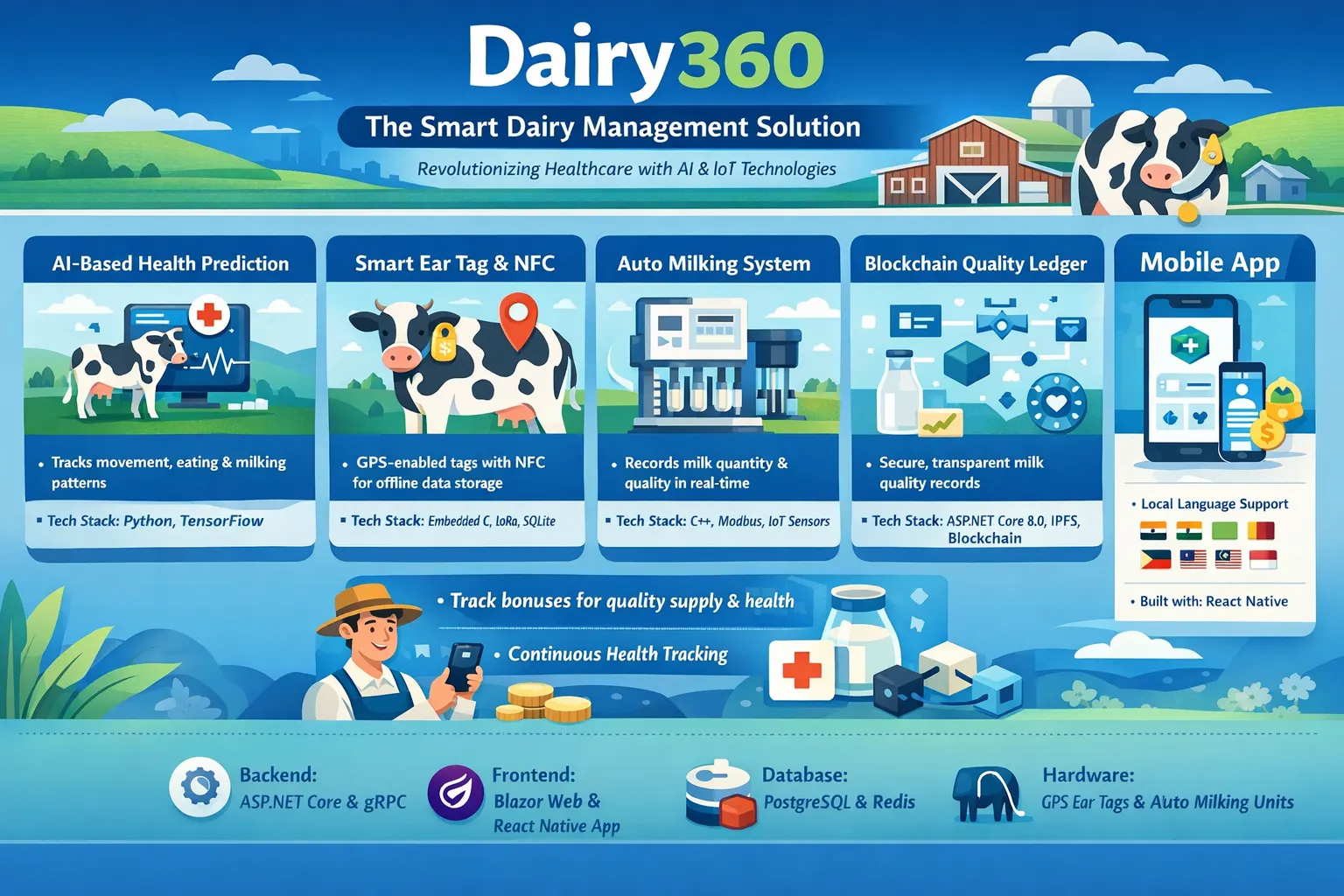
GPS-enabled collars with live location tracking, history and instant alerts about escape; lightweight trackers for cats or small dogs with built-in reporting; Bluetooth proximity tags for home, shelter, or sitting purposes; tags for livestock or dairy cows monitoring location and movements; equine wearables for tracking movements, training, or monitoring horses in a stable; activity and sleep sensors based on the IMU mounted on a collar or harness; readings of temperature, environmental parameters, or pre-defined events; white label applications and dashboards for pet products.
Taking into account possible changes in the pet activity, the owner may decide to check whether something is wrong with the pet or call a vet, but this does not mean that it is a diagnosis. Veterinary claims, safety and effectiveness must be evaluated depending on the specific market.
Case Study: Smart Collar Development for Dogs, Cats and Cattle
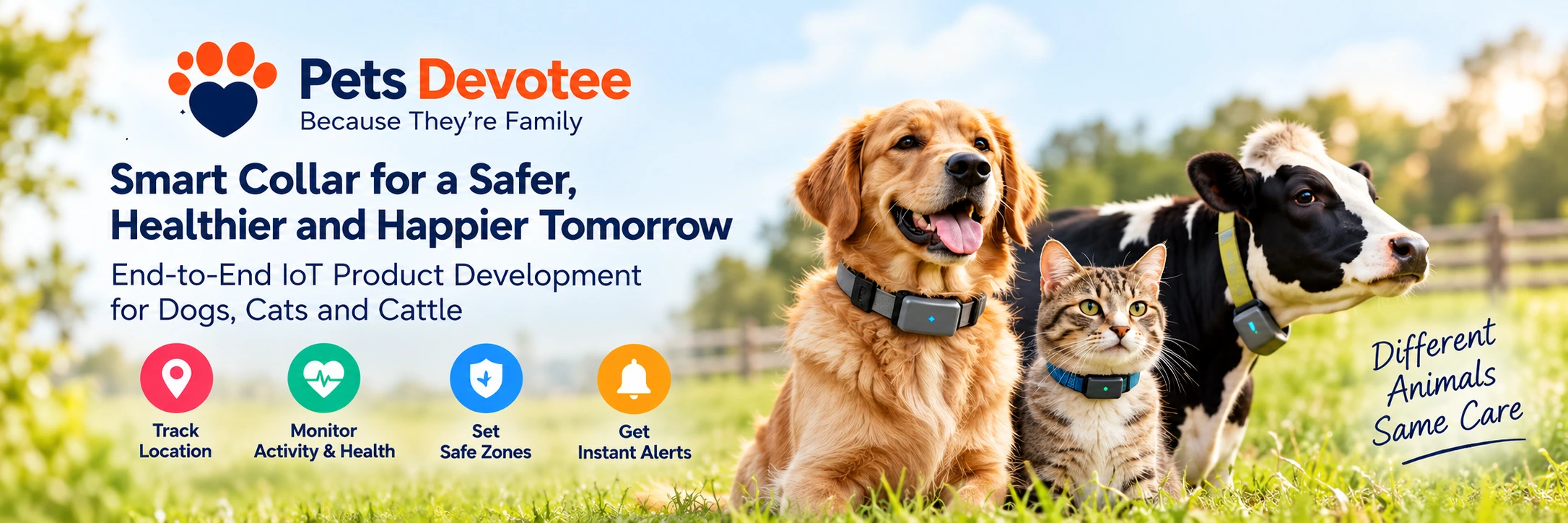
End-to-End IoT Product Engineering for Pets Devotee
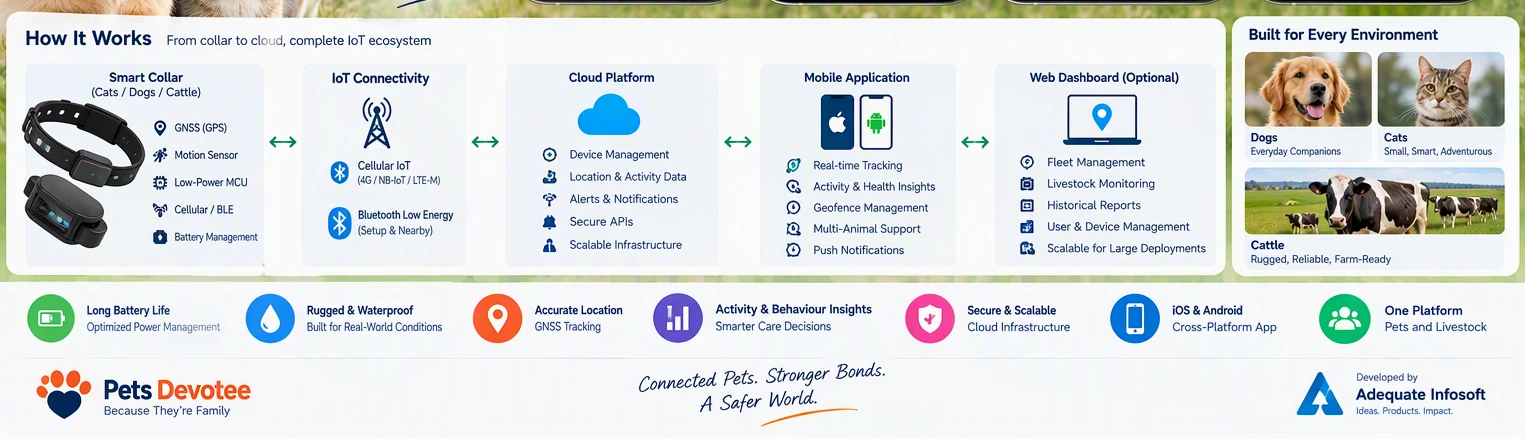
Adequate Infosoft created the smart-collar ecosystem which connects pets and their owners like never before. We managed all phases of the product development, including but not limited to hardware architecture, PCB layout and firmware.
Project Requirements
The client required an IoT platform, which could be used for various types of animals. Dog and cat collars needed to be small and lightweight whereas cattle collars were expected to be sturdy and operate in an area where capacity is not stable.
The platform needed to have features such as tracking, monitoring, geofencing, alerts about battery life, etc. It was not just necessary to implement those features but also develop an app to use the platform and control animals.
nRF52840-Based Hardware and Custom PCB
We selected the Nordic Semiconductor nRF52840 SoC as the primary controller because of its low-power ARM Cortex-M4F processor, Bluetooth 5 connectivity, hardware security capabilities and suitability for battery-powered wearable devices.
The custom multi-layer PCB incorporated:
Nordic nRF52840 Bluetooth Low Energy SoC Quectel BG95 LTE-M/NB-IoT and GNSS module BMA400 low-power three-axis accelerometer Battery charging and protection circuitry Fuel-gauge circuit for battery-level reporting External flash for offline data buffering Status LED, buzzer and vibration support USB-based charging and debugging interface RF-aware antenna layout for BLE, cellular and GNSS
Different designs of enclosures and straps have been created using the same electronic core parts. The dog and cat product was made small and light; the cattle version had a more durable and robust enclosure that could withstand long outdoor usage.
Embedded Firmware and Battery Optimization
Our embedded engineers developed firmware using the nRF Connect SDK and Zephyr RTOS. Firmware consists of a well-built system, where handling of the sensor, obtaining the location, and transmitting of the information, as well as battery-efficient operation have been separated into blocks.
In such a manner, event-driven processing instead of keeping all components working at all times is used in the firmware development. The accelerometer is designed in such a way that it is located in a low-power mode and will wake the main controller exactly when there is a certain movement.
Important firmware capabilities included:
BLE device discovery, pairing and provisioning Activity and inactivity detection Periodic or motion-triggered GNSS positioning Configurable geofence and tracking modes Local storage during network interruptions Automatic reconnection and delayed synchronization Battery and device-health reporting Secure over-the-air firmware updates Deep-sleep and peripheral power-control modes
These techniques helped balance tracking frequency, connectivity and battery consumption for different animal-monitoring scenarios.
Communication with the Mobile Application
When the user is nearby the collar, it connects to the mobile app via BLE. BLE is used for the initial link establishment, Wi-Fi or GSM configuration, device settings changes, battery status and firmware updates.
For remote tracking the devices use the Quectel BG95 module that transmits location data and device telemetry through LTE-M or NB-IoT. All data is transferred with the help of the simple MQTT protocol protected by TLS. This provides updates for users even when they are away from the animal.
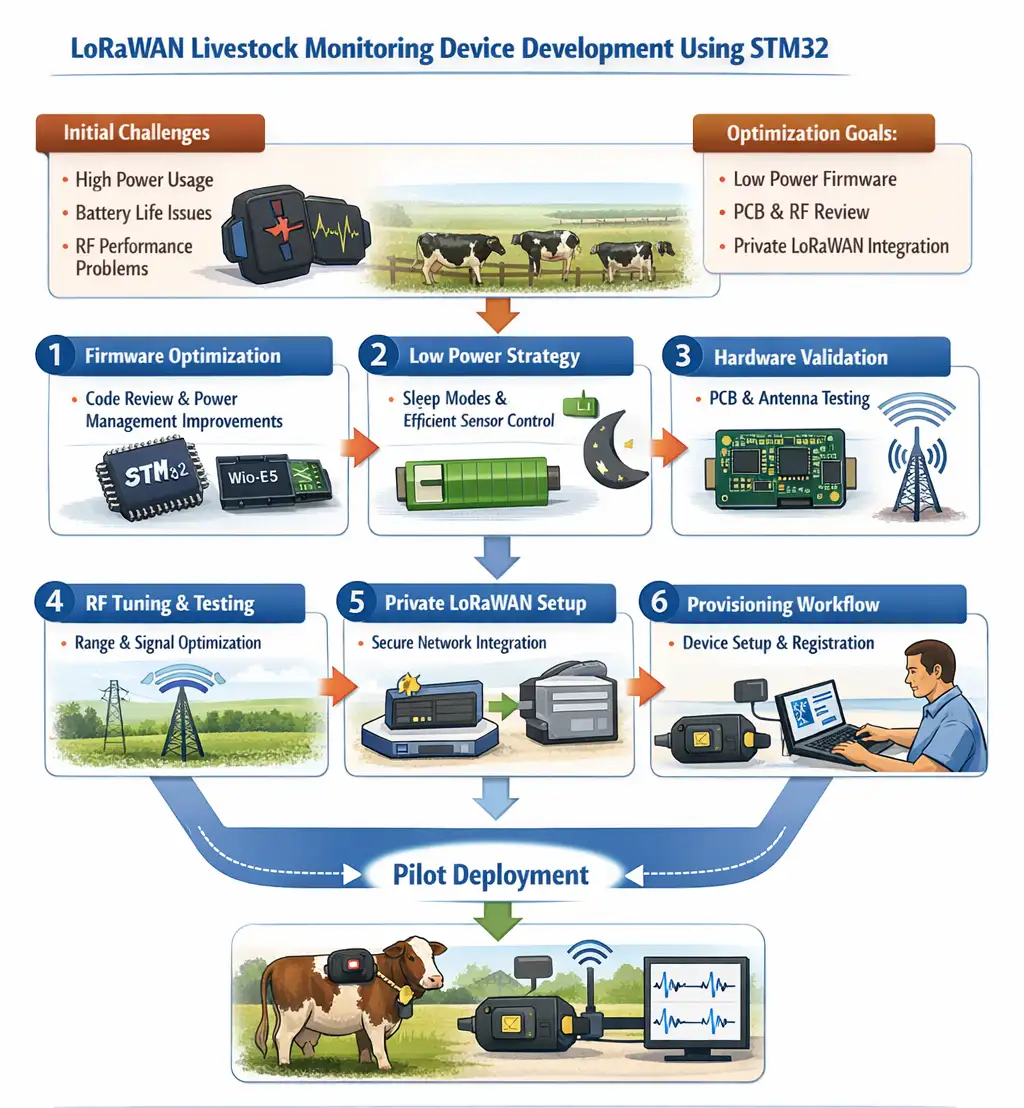
For cattle deployments where public cellular coverage is limited, the architecture can also support a long-range gateway-based communication option.
AWS IoT Cloud Architecture
We established a connected backend utilizing Amazon Web Services. AWS IoT Core is responsible for safe collar connections and acquiring MQTT telemetry.
The cloud architecture consists of the following components:
AWS IoT Core for connecting devices and issuing certificates AWS Lambda to process events and alerts Amazon DynamoDB for storing devices and animals records Amazon Timestream for monitoring time series telemetry Amazon S3 to store reports and archived content Amazon Cognito for ensuring safe user sign in Amazon SNS and Firebase Cloud Messaging for sending notifications Amazon CloudWatch for the logging and monitoring
Using the cloud rules enables location, movement, battery, and connectivity event processing. The platform is able to produce notifications in case of geofence violations, inactivity, low battery problems, and connection issues.
Cross-Platform Mobile Application
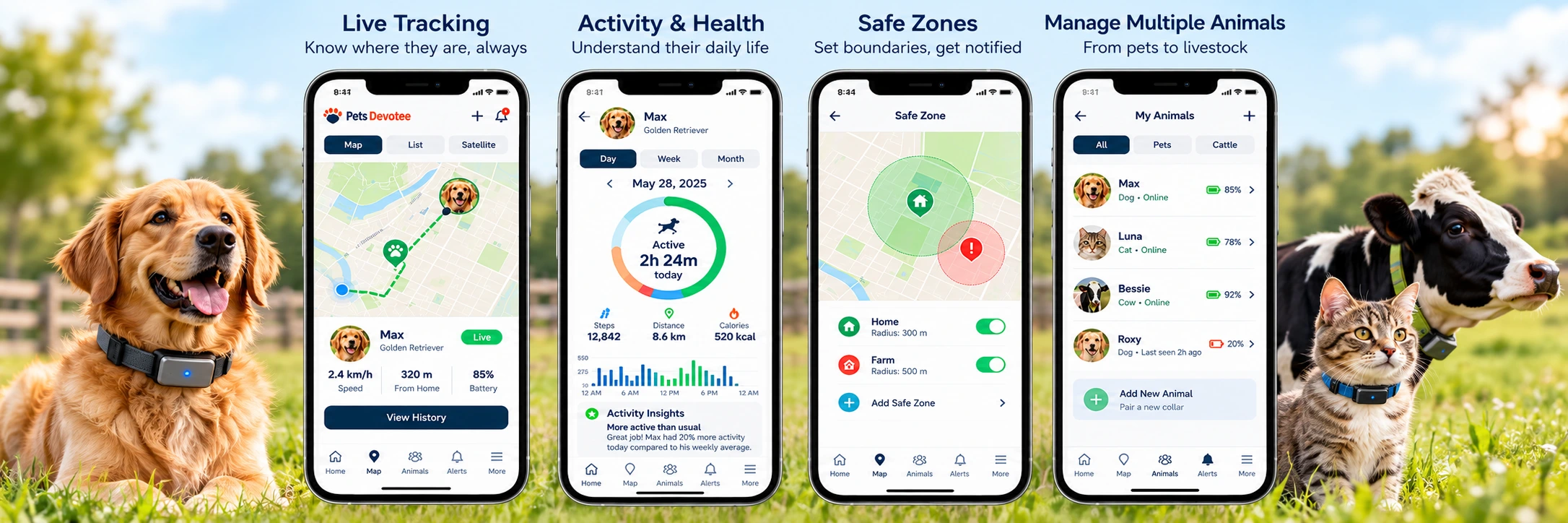
Flutter was utilized to create the mobile application, which has allowed coding for both Android and iOS platforms simultaneously. Users have the option to enroll their animals, connect the collar, track their locations from the past, mark the secure areas, find out the battery level and obtain notifications.
Dog and cat owners can keep records of their beloved pets while livestock managers can control pet animals by using the same account.
Complete Smart-Collar Ecosystem
This project demonstrates Adequate Infosoft's end-to-end IoT capabilities across PCB engineering, Zephyr firmware, BLE and cellular communication, AWS IoT infrastructure and cross-platform mobile development. We delivered an adaptable connected-animal platform rather than a standalone tracking device.
Explore Our Relevant Animal and Pet Wearable Development Case Studies
Know about our experience in developing pet wearables in an exciting case study that highlights our knowledge of connected devices, BLE communicating devices, sensor integration, and mobile applications.
Our engineers specialize in reliable data transfer, low-power technology, and successful integration that enables us to create advanced pet monitoring systems.
Choosing Connectivity and Location Technology
GNSS and cellular collars
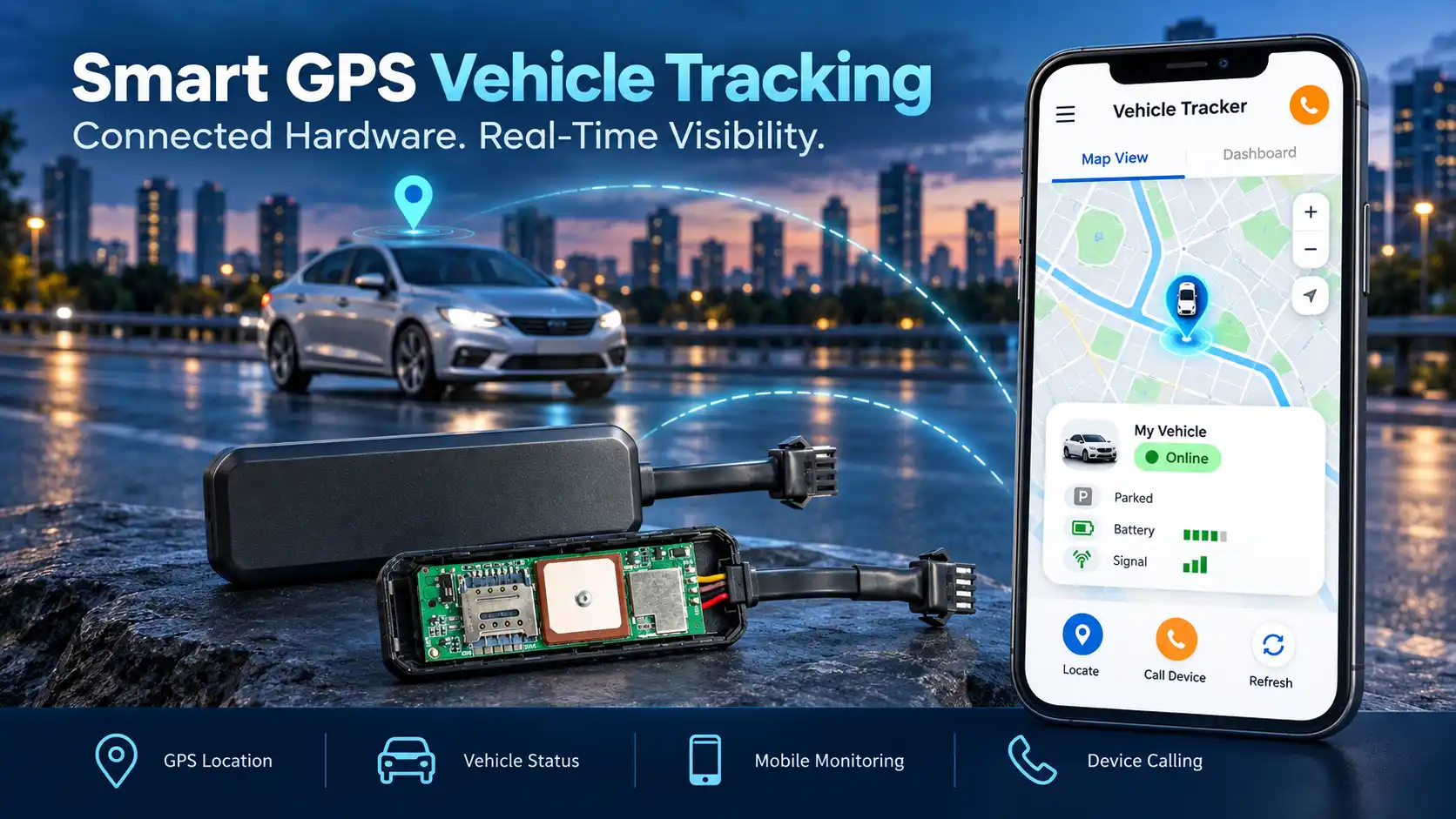
The GNSS system provides coordinates outdoors without having to rely on any local infrastructure. LTE-M or NB-IoT can transmit these coordinates even if there is no mobile phone coverage, as long as operator support and roaming is available. LTE-M suits mobile, fast-moving products; NB-IoT suits simple reports using small amounts of data.
The accuracy of GPS data depends on geometry, obstructions, atmosphere conditions and design of the receiver, and can become worse near buildings and trees. Collars introduce body shadowing and changes in orientation — that's why we design antennas, create schedules, use filtering and confidence reporting taking into account animal behavior.
BLE, Wi-Fi and home-zone awareness
Bluetooth Low Energy provides phone-based location-finding, as well as proximity and gateway zone capabilities. Wi-Fi observations can help identify known locations, or help improve estimates in the cloud. Signals are affected by walls and the orientation of the body.
A hybrid collar can remain in low-power home mode near a trusted signal, then activate GNSS and cellular after departure. Our wearable IoT device development services connect radios, firmware, apps and alerts.
LoRaWAN and private-area tracking
LoRaWAN can suit farms or managed facilities with gateway coverage and small payloads. It is not a universal replacement for GNSS or nationwide connectivity. Terrain, vegetation, duty-cycle rules and downlinks require evaluation.
Sensing of Activities and Behaviors
The collar's accelerometers are capable of measuring activity at a low energy consumption level. It may be supported by machine learning or rules to derive activity, inactivity, shaking, or scratching.
The use of gyroscopes introduces the ability to measure rotation while having to expend more resources. Any addition of the sensor would require someone to specify precisely what it serves.
Studies done on dogs suggest that validation needs to be congruent with the placement and activity. The research has shown that accelerometry gives the right results but also the lack of uniform results according to the exact mounting and the performed activity.
The breed, weight, hair length, leash state, gait, and all have an effect on results. Therefore before stating the performance of a device, we need to detail labels, reference videos, animal species, location of the device, and metrics.
The training and testing data must be kept separate. Mobile applications need to highlight the periods of missing or uncertain data instead of marking every activity as certain.
End-to-End Smart Collar Engineering
Feasibility and product architecture
The species, dimensions, wearing location, warning delay time, atmosphere, battery, areas, and information from the sensors are described in detail. Prototyping is done to examine the comfort level, antennas, motion information, and current flow, before producing smaller versions of the prototype.
Compact PCB, antenna and enclosure design
Smart collars balance weight, antennas, battery, sealing and impacts. Our wearable PCB design and prototyping team develops schematics, rigid-flex layouts, power, charging, RF, sensors and test points.
Enclosures account for snag hazards, sharp edges, chewing, attachment, charging, cleaning and ingress. Only finished-assembly testing establishes an IP rating.
Low-power embedded firmware
Firmware coordinates GNSS, network, BLE, sensors, storage and sleep. Adaptive policies report less at home, increase updates during escape and recover safely. Our wearable firmware development services cover RTOS, drivers, secure boot, OTA and SDKs.
Offline queues preserve events through gaps. Timestamps, sources and quality distinguish delayed uploads from live positions. Watchdogs and recovery tests reduce silent failures.
Battery life technology
Battery running time and performance differ depending on coverage, GNSS visibility, the update interval, temperature, sampling and movement.
We budget based on states and measure the performance of the hardware in situations including walking, the time spent at home, poor connectivity and retries. The necessary conditions for performance will be published by us. Charging options include wired connectors, docks and wireless charging.
Pet-owner apps and fleet platforms
Apps support onboarding, pet profiles, maps, safe zones, history, activity, battery warnings, sharing and lost-pet mode. Our IoT mobile app development services cover Android, iOS, APIs and device management.
Cloud platforms manage identities, geofences, alerts, subscriptions, firmware and diagnostics. Organizations may need multi-animal dashboards, roles, audits and APIs.
Geofencing and alert accuracy
It should be noted that geofencing refers to software instead of a physical fence. GPS jitter may lead to false exits while network lags can delay alerts.
Hysteresis, time spent in the area, multiple readings, and confidence levels help tell apart departing animals and measurement errors. Notifications must indicate the time and method of determination, considering that delivery depends on collar coverage, cloud connectivity, and phone settings.
Security, Privacy and Responsible Data Use
Location shows where people live, where they go and what they do. We make device IDs, pairing via authentication, encryption, role-based sharing, signed firmware, OTA control, auditing and deleting.
Tracking should not happen with identifiers. Veterinary records need to have a purpose, consent, retention and access.
Get Your Pet Wearable Solution from Adequate Infosoft
Looking for a GPS dog collar, a handheld pet tracking device, an activity monitor, or a platform for tracking multiple animals? Adequate Infosoft can assist you in every step of the way - from an idea to the final product.
Provide us with available information about types of animals, approximate dimensions, geography, frequencies of location updates, types of sensors, and batteries needed, to get started designing the system.
Frequently Asked Questions
Certainly. The combination of GNSS and cellular technology finds location by itself, provided that it has access to it. The BLE version requires a mobile phone to be present nearby. Independent navigation demands bigger computational capability of both the hardware and subscription.
Accuracy depends on satellites, antenna, terrain, trees, buildings, orientation and filtering. We define field scenarios and report measured error and fix availability instead of promising one universal number.
The time of operation depends on the frequency of updates, coverage, acquisition of GNSS data, sensors in use, climate conditions and the size of the cells. Some adaptive modes will help.
It can identify defined activity or behavior patterns after appropriate data collection and validation. A change may support owner awareness, but diagnosis and treatment decisions belong to veterinarians. Medical or veterinary claims change labeling and evidence obligations.
Yes. Coordination of radio behavior, data format, geofencing, notifications, OTA, and production testing is possible.
Editorial Sources
How FDA Regulates Animal Devices
Read sourceGPS Accuracy
Read sourceBluetooth Location Services
Read sourceMobile IoT Deployment Guide
Read sourceValidity, Practical Utility and Reliability of Actigraph Accelerometry in Dogs
Read sourceDeep Learning Classification of Canine Behavior Using a Collar-Mounted Accelerometer
Read source