














 Mean Stack Development
 Vue JS Development
 Javascript Development
 React JS Development
 Angular JS Development
 Next JS development
 Java Development
 Python Development
 Django Development
 Cherrypy Development
 C# Development
 ASP.NET Development
 NodeJS Development
 Laravel Development
 CodeIgniter Development
 Zend Development
 Ruby on Rails Development
 CakePHP Development
 PHP Website Development
 Symfony Development
 Drupal Development
 Joomla Development
 Wordpress Development
 .NET Nuke Development
 Kentico
 Umbraco
 .NET MAUI Development
 Xamarin Application Development
 iOS Application Development
 Android Application Development
 Android Wear App Development
 Ionic Development
 iBeacon Application Development
 Universal Windows Platform (UWP)
 Kotlin Application Development
 Swift Application Development
 Flutter Application Development
 PWA Application Development
 Flutter Health Tech & Wearable App Development Company
 React Native Health Tech Wearable App Development
 Offshore Software Development
 Custom Application Development
 Front-End Development
 Full Stack Development
 AI & Machine Learning
 Custom CRM Solutions
 Flask Software Development
 Electron JS Development
 ChatGPT Development
 Telemedicine App Development
 Build Smart Telemedicine Platform
 Beauty & Salon App Solutions
 Hire Workato Experts
 Magento Development
 Magento 2.0 Development
 Magento Enterprise
 Shopping Cart Development
 Prestashop Development
 Shopify Development
 Open Cart Development
 WooCommerce Development
 BigCommerce Development
 NopCommerce Development
 Virto Commerce Development
 AspDotNetStorefront Development
 .NET Application Development
 Microsoft Dynamics CRM
 VB .NET Development
 Sharepoint Migration
 ASP.NET Core Development
 ASP.NET MVC Development
 AJAX Development
 Agile Development
 Microsoft Bot
 Microsoft Blazor
 Microsoft Azure Cognitive
 HTML 5
 UI/UX Design
 Graphic Design
 Adobe Photoshop
 XML Application Development
 Cloud Computing Solutions
 Azure Cloud App Development
 AWS Development
 Google Cloud Development
 Certified AWS IoT Services Developers
 DevOps Consulting & Development
 Kubernetes Consulting & Services
 SQL Programming Development
 MySQL Development
 MongoDB Development
 Big Data
 Robotic Process Automation
 Social Media Marketing
 Search Engine Optimization
 QA Testing
 Software Testing
 Software Security
 Maintenance And Support
 I.T. Consulting Services
 Business Intelligence
 YII Development
 Data Analysis
 Alexa Skills Development
 On Demand App for Mobile repairing services
 On Demand App for Car Service Booking
 On Demand App for Cleaning Services
 On Demand App for Pharmacy
 On Demand Dedicated Developers
 On Demand Lawyer App Development







 Nuki Smart Lock
 Salto Smart Lock
 TTlock Smart Lock
 NFC App Development
 Custom IOT Enabled Smart Lock
 Smart Locker Solutions
 Hospital Smart Lock Systems
 Hotel Smart Lock Systems
 Smart Home & Office Locks
 Smart Access for Schools & Colleges
 Unloc Smart Lock Integration
 Yale & August Smart Lock Integration
 Populife Smart Lock Integration
 Smart Lock Hardware Development
 Dairy IoT Solutions
 Agri IoT & AI Solutions
 Weather & Climate Solutions
 Water & Waste Management Solutions
 RaspBerry Pi
 Firmware Software Development
 ESP 32 Software Development
 Embedded Development
 Internet of Things
 Smart IoT Development
 IoT Sensor Integration & Development Solutions
 Smart IoT System Development for HVAC
 Tuya IoT App Development
 Particle IoT SDK
 IoT Development with AI
 Smart Pet GPS Tracker
 Dairy GPS Tracking Solutions
 GPS Fleet Management Software
 Car Rental & Subscription Solutions
 Car Buy & Sell Marketplace Development
 AI-Powered Car Wash App Development
 PCB Design & Fabrication
 IoT AC Automation
 AI–IoT Painting Solutions
 IoT Wearable Hardware & App Development
 HVAC Automation & AI Control Systems
 Smart Home IoT Engineering
 AI Embedded Systems
 AI Hardware Design Service
 Advanced IoT Hardware & Firmware Development
 Device Driver Development Services
 NXP i.MX RT Firmware & Hardware Services
 Microchip PIC & AVR Development
 Hire IoT Architects
 IoT Cloud & Infrastructure Solutions
 Infineon XMC / AURIX Development Services
 Matter & Thread IoT Services
 Native IoT Mobile App Development (BLE & Wi-Fi)
 Snapdragon IoT Firmware Development
 Renesas RA/RX Firmware Services
 Silicon Labs EFR32 Development Services
 Smart Wearable App Development
 Smart IoT Meters
 Smart Healthcare Wearable App Development
 Health Care Monitoring System
 Fitness Tracking App Development
 Smart Home Automation Apps
 nRF PCB Design
 ESP32 PCB Design
 Embedded Wearables Engineers
 Rental Property Management System
 Building Management System
 Smart Lighting Development
 Infineon Semiconductor Firmware Development Services
 Custom Camera Development: Hardware, Firmware & PCB Prototyping
 Smart Security Camera SDK
 Nordic Semiconductor SDK
 Infineon SDK
 Arduino SDK
 NFC Lock Integration
 Kerong Lock Integration
 IoT & AI Solutions for Manufacturing
 Smart Inventory & Logistics Solution
 Food & Beverage Industry Solutions
 Smart Hospitality Solutions
 Smart Property Management
 Custom Smart Home IOT SDK
 Smart IoT & AI in Healthcare
 AI-Powered Security Solutions
 Smart Home Safety & AI
 Veterinary Clinic Management (AI)
 Pet Care System (AI & IoT)
 Pet Training & Adoption (AI)
 Healthcare IoT Development
 Event Management Software
 Money Remittance App
 Money Lending App Development
 Utility and Bill Payment App
 IoT Mobile App Development (Flutter & React Native)
 AI & IoT Retail Solutions
 Smart EV App Development
 Smart Solar IoT & AI Solutions
 IoT-Based Energy Systems
 Smart Energy & Utilities Solutions
 6G Solutions
 IoT Security Solutions
 AI-Powered Lottery App Development
 AI-Sports Fitness Club Management
 Travel
 Real Estate
 Medical & Healthcare
 e-Learning
 Consumer Products
 Finance
 Automobile
 Media & Entertainment
 Billing Software
 Enterprise Resource Planning (ERP)
 Augumented & Virtual Reality
 Point of Sale(POS) Development
 Learning Management System
 EV Charging Solutions
 About Us
 Partners & Certifications
 Quality Assurance
 Our Clients & Testimonials
 Development Process
 Our Products
 Social Responsibility
 Work Ethics
 Vision & Mission
 Awards
 Live Project Demos
 Contact Us
 Case Studies
 Portfolio
 Blog
Blog
Nordic nPM1300/nPM1304 Battery & Power Management Integration Services
Adequate Infosoft provides nPM1300 and nPM1304 integration services for battery-powered IoT, wearable, healthcare, industrial, tracking, and smart-device products.
We help engineering teams integrate Nordic Semiconductor PMICs into custom hardware and firmware architectures, with a focus on safe charging, regulated power rails, battery monitoring, fuel gauging, low-power operation, and reliable system behavior.
The nPM1300 is a highly integrated power management IC combining a Li-ion/Li-poly/LiFePO₄ battery charger, algorithm-based fuel gauge, two buck regulators, two LDO/load-switch channels, USB Type-C input management, power-loss warning, watchdog, reset supervision, and other system-management functions.
The nPM1304 provides a similar highly integrated architecture but is optimized for smaller batteries and supports charge currents down to 4 mA. Both devices can be controlled through an I²C-compatible TWI interface.
Our work spans PMIC hardware integration, PCB design support, embedded firmware, battery-state monitoring, power optimization, validation, and product-level system integration.
Let's Work Together!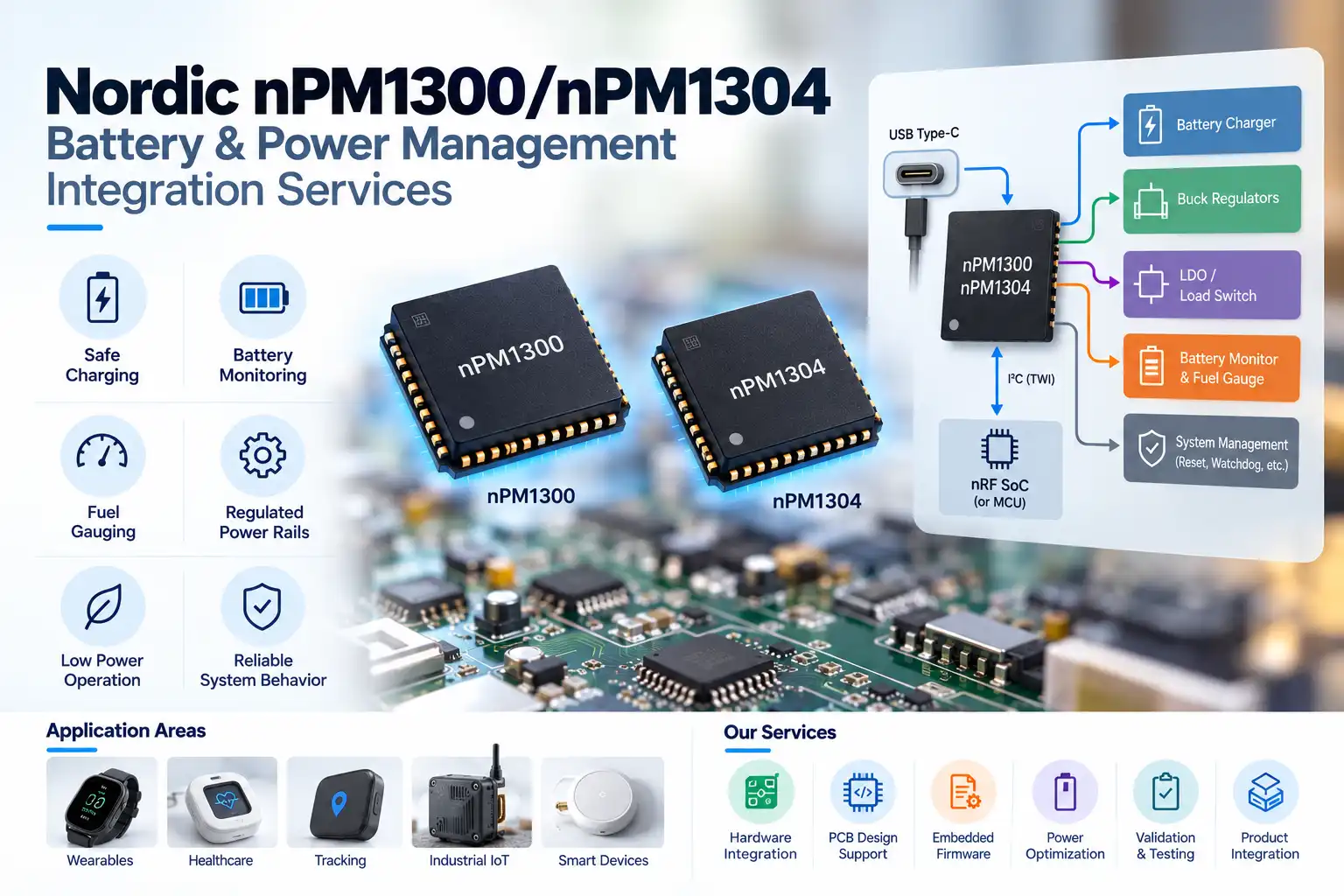
nPM1300 vs nPM1304: Choosing the Right PMIC
Selecting between nPM1300 and nPM1304 depends on the battery size, charging requirements, available PCB area, current budget, and overall product architecture.
The nPM1300 is customizable to enable charging currents ranging from 32 to 800 mA, which means it can be utilized by a variety of rechargeable IoT and wearables applications.
It consists of two 200 mA buck regulators and two channels (50 mA LDO/100 mA load-switch). Moreover, it offers monitoring of battery voltage, current, and temperature thanks to its fuel-gauge solution.
The nPM1304 is concerned with smaller rechargeable batteries and provides options to select charging currents of 4 mA to 10 mA.
As in the case of the nPM1300, it uses two 200 mA buck regulators, two LDO/load-switch channels, and battery monitoring, as well as supplies advanced features of dynamic power-path management and system management. Its concentration on smaller batteries gives it greater relevance with respect to miniature wearables and low-current designs.
It is crucial for us to assess these aspects while selecting PMIC and not to consider a single-chip solution an appropriate route.
Relevant Adequate Infosoft Experience
Adequate Infosoft has experience developing battery-powered products where power architecture, battery selection, monitoring, and low-power firmware are central engineering requirements.
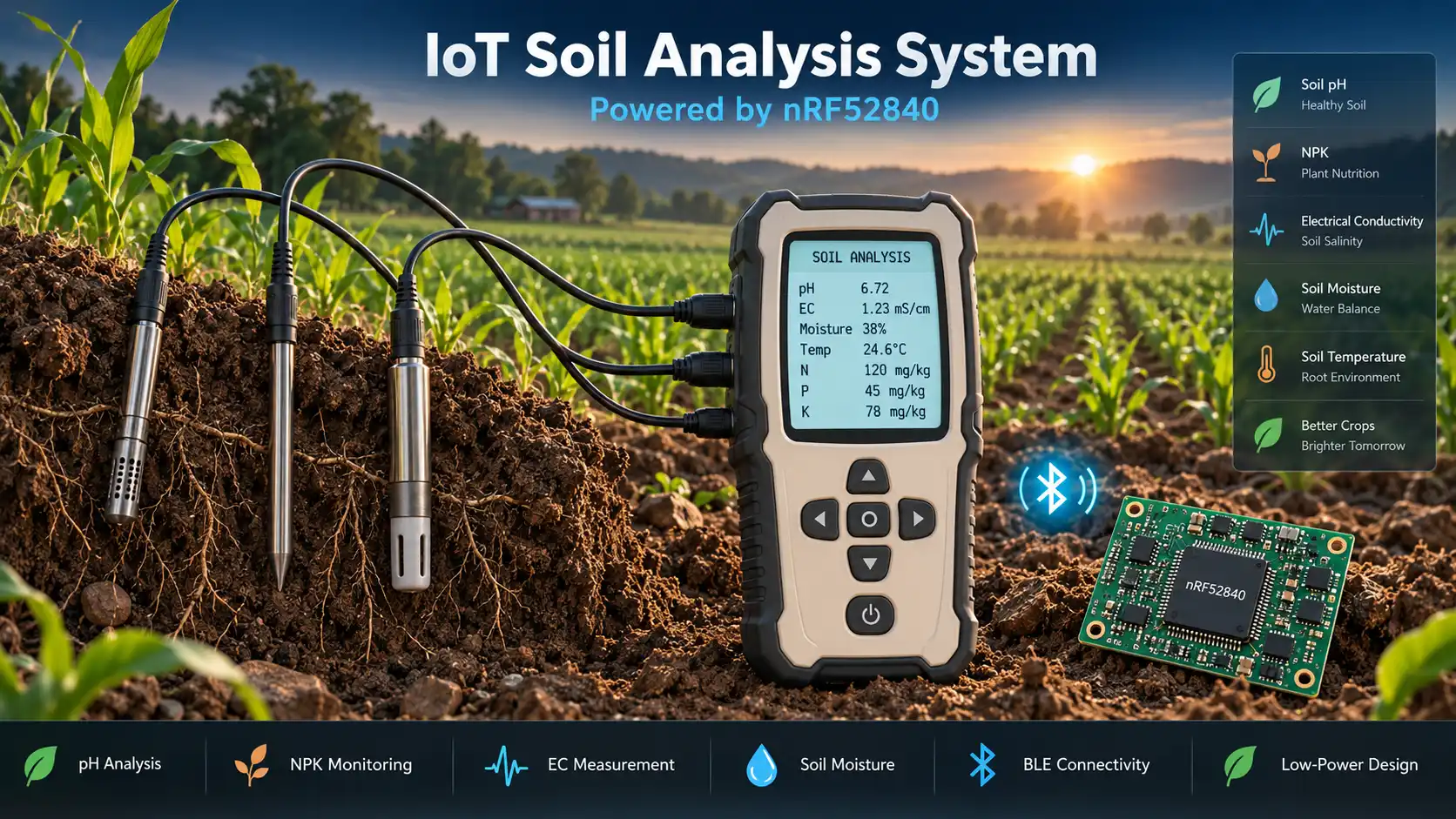
nRF52840 Handheld IoT Soil Analyzer
In our soil analysis system using the nRF52840, battery power played a key role in selecting the Nordic platform.
The design included battery charging circuitry, a MAX17048 fuel gauge, reverse polarity protection, power management circuitry, precision analog components, and hardware architecture that is suitable for manufacturing.
This project is highly relevant to the matter of PMIC integration as it showcases our approach to treating battery management in one piece with the embedded system instead of a separate circuit.
Read Case Study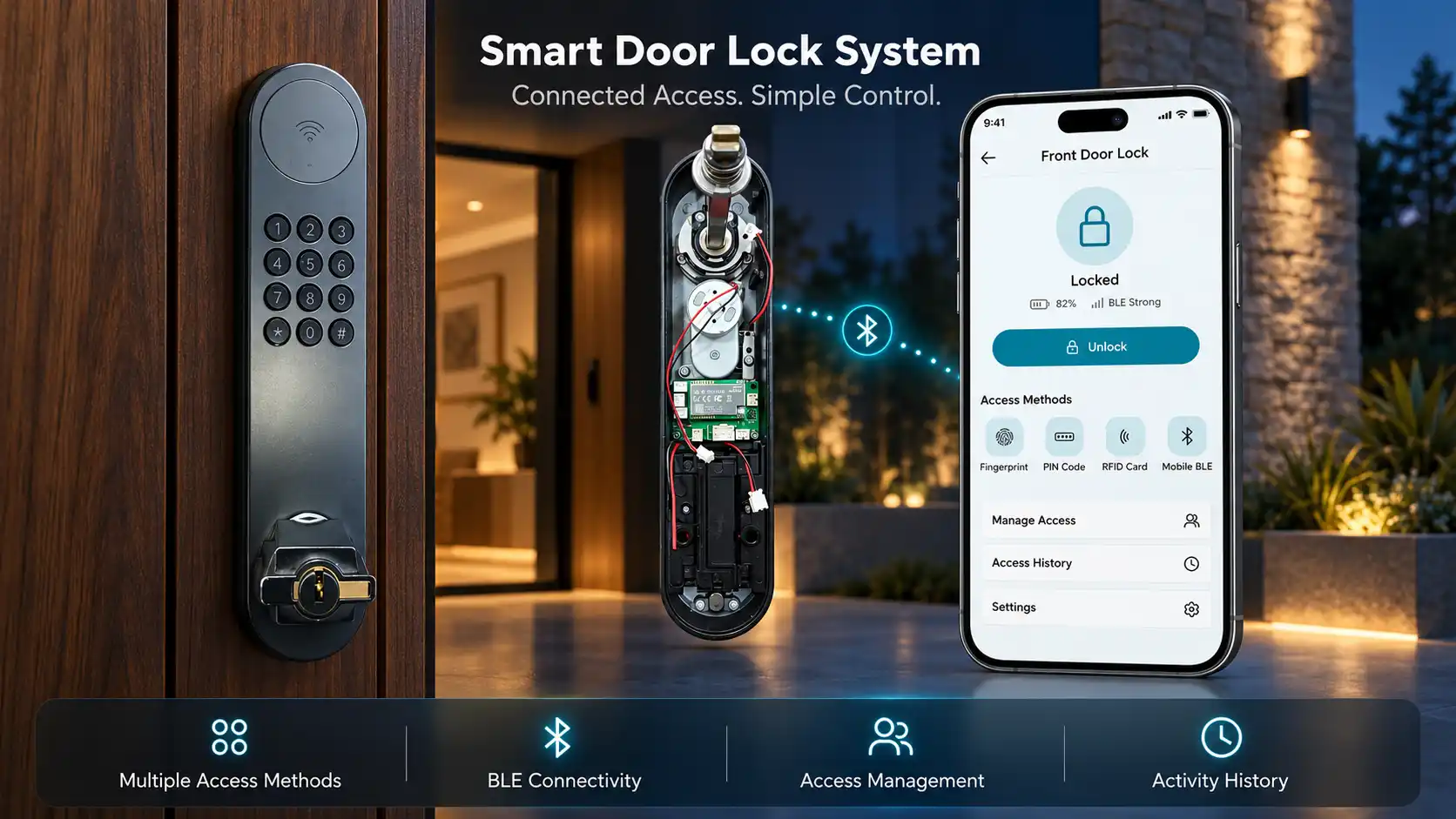
Nordic nRF52 Smart Lock
The Nordic smart lock project has a configuration based on the nRF52840 chip, featuring a PCB developed specifically for the project, low-power motor driving, battery management, secure BLE communication, and OTA functionality, as well as several ways of getting access. The firmware used is based on Nordic's technologies, namely the use of nRF5 SDK and Zephyr software for more advanced versions.
The project is of relevance to the development of the nPM1300/nPM1304 series of devices as smart locks need thorough control of standby current, motor loads, wireless operation, battery state, and reliable recovery.
Read Case Study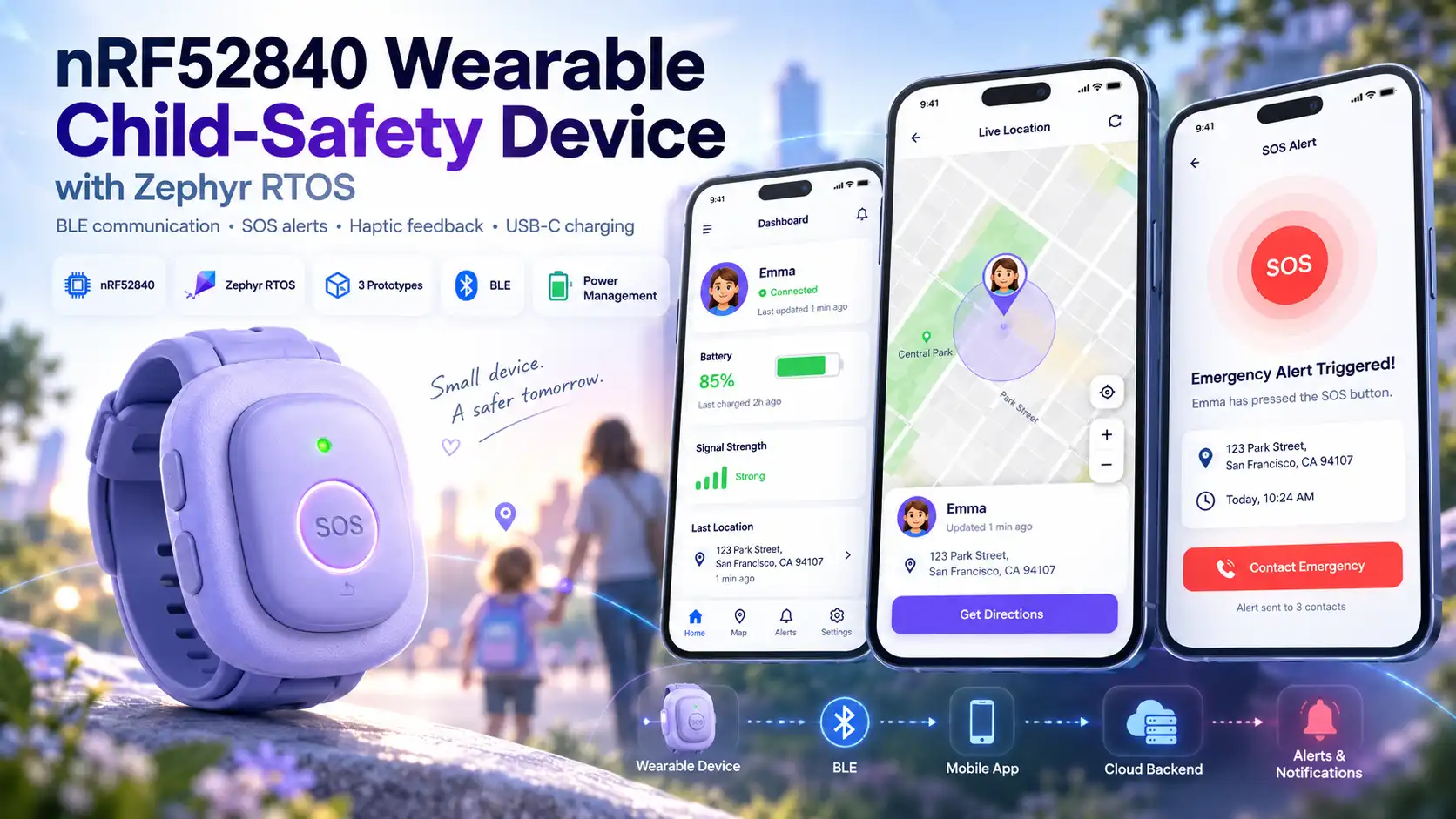
nRF52840 Wearable Child Safety Device
For a wearable child-safety device, the custom hardware included an nRF52840, rechargeable battery, BLE connectivity, haptic feedback, and USB-C charging. The project included explicit low-power behavior, with measurements and operating modes designed around the target battery life.
Read Case Study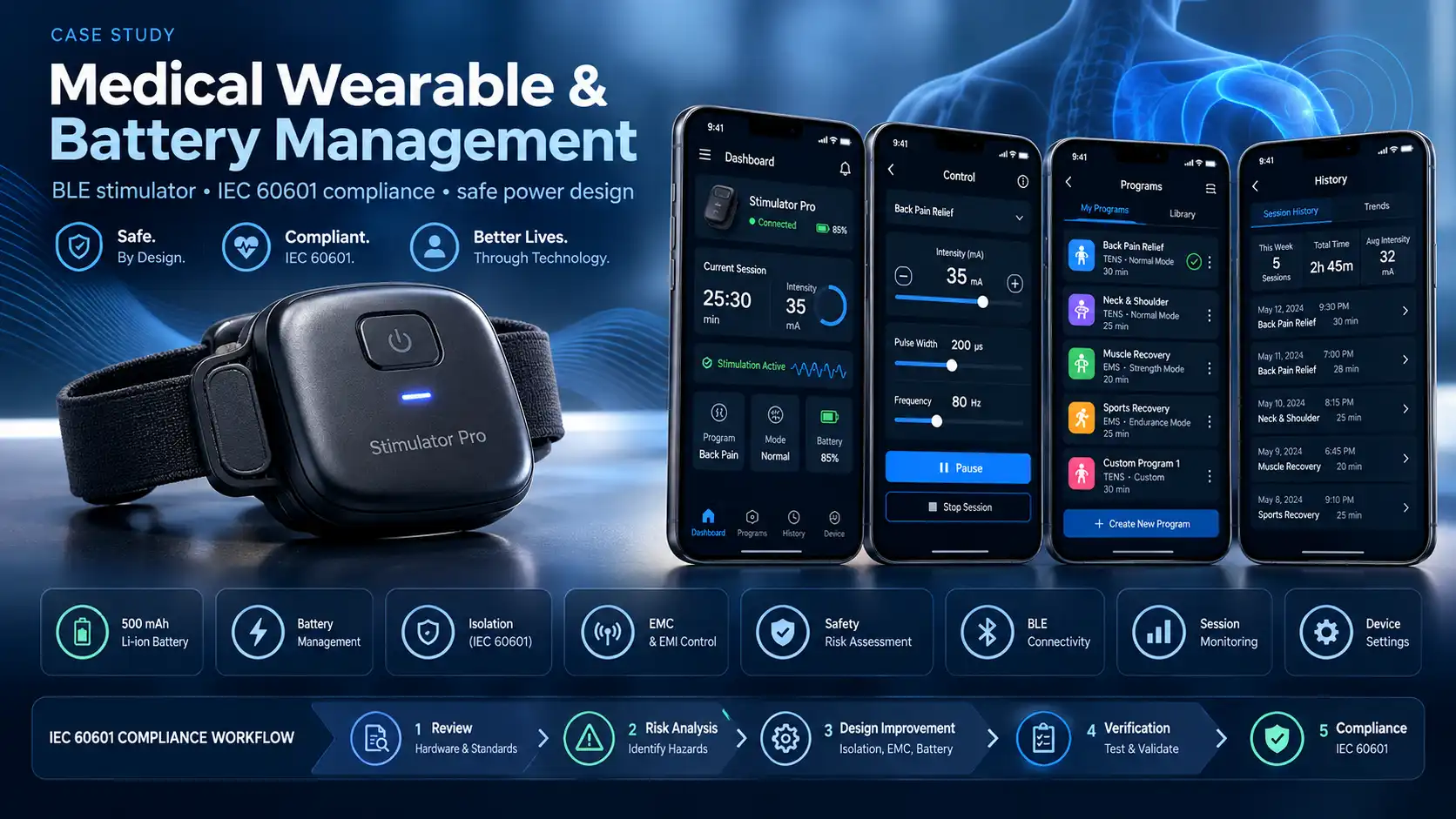
Medical Wearable and Battery Management
Adequate Infosoft has also contributed to the development of a medical wearable device that requires IEC 60601 compliance along with battery life management for such devices. The project dealt with different engineering aspects such as battery technology and management, isolation, EMC, safety assessments among others.
The power base of the wearable device consists of a 500 mAh lithium-ion battery along with dedicated power management systems.
Read Case StudyThese projects demonstrate relevant battery-powered hardware, Nordic SoC, power optimization, PCB, firmware, safety, and validation experience. They should not be interpreted as nPM1300/nPM1304-specific projects unless explicitly identified as such.
Our Affordable nPM1300/nPM1304 Integration Services
Designing Power Management Integrated circuits (PMIC) and Power Trees
A PMIC is created according to the complete product power architecture. All the involved sources and loads should be identified, allowing defining the power tree.
A PMIC is created according to the complete product power architecture. All the involved sources and loads should be identified, allowing defining the power tree.
Our engineering team can provide:
Battery and power input architecture design Buck and LDO/load switching allocation Rail voltage and current specification Power sequencing Control of peripheral power domains Integration of USB Type-C input Battery NTC and thermal measurements Resets, watch dogs, and power fail behavior Review of schematics and PCB manufacturing Prototype testing and debugging
Hardware guidelines established by Nordic state that proper PMIC integration should be performed, considering power distribution as well as additional circuits.
Battery Charging and Protection
When designing battery charging, it is important to recognize that this is a part of the overall system design rather than simply including charge management IC in the circuit.
When designing battery charging, it is important to recognize that this is a part of the overall system design rather than simply including charge management IC in the circuit.
A great example of ICs with linear charge management capability is nPM1300 and nPM1304, which can be used for charging various rechargeable lithium batteries like Li-ion, Li-polymer or LiFePO₄ with the ability to configure charge completion voltage.
Apart from linear charge management, nPM1300 and nPM1304 provide features such as thermal battery protection based on JEITA standards and NTC inputs.
In order to achieve the desired charging performance, we will select a charging device depending on the battery type, possible input power, enclosure design, expected temperature and the product usage scenarios. The operation itself will be controlled by firmware that will provide feedback on the charge level and battery state in order to make necessary error corrections.
For products with strict safety or regulatory requirements, charging behavior is reviewed together with the battery pack, protection circuit, thermal conditions, enclosure, and intended operating environment.
Fuel Gauge and Battery State-of-Charge Monitoring
A reliable battery indicator requires more than measuring battery voltage. The nPM1300 and nPM1304 support an algorithm-based fuel-gauge solution that provides state of charge (SoC), state of health (SoH), and cycle information.
A reliable battery indicator requires more than measuring battery voltage. The nPM1300 and nPM1304 support an algorithm-based fuel-gauge solution that provides state of charge (SoC), state of health (SoH), and cycle information.
Nordic's architecture uses monitoring of battery voltage, current, and temperature, with the fuel-gauge algorithm running on the host SoC or MCU.
We incorporate fuel-gauge data into embedded solutions so that battery data becomes relevant at the device level. It varies according to the application.
Percentage of the battery: Display the relevant estimate of remaining charge.
Low battery behavior: Modify how information is collected, radio usage, alerts, and modes of work in case of battery capacity consumption.
The charging status: Indicate charging, full status, input power, or fault messages.
The state of the battery: Make available the health information and cycles.
Telemetry: Transfer data about battery performance via BLE, Wi-Fi, cellular network, MQTT, HTTPS, etc.
Low-Power Firmware and Power Optimization
Hardware needs to be measured with efficiency for long battery life. Firmware influences when radios, sensors, processors, displays, memory, and peripheral components consume energy.
Hardware needs to be measured with efficiency for long battery life. Firmware influences when radios, sensors, processors, displays, memory, and peripheral components consume energy.
Our embedded engineers study operating conditions of the device and develop power behaviour around actual input load.
For instance, common states might include active measurement, wireless transmission, connected mode, idle waiting, sleep mode, charging, and recovery from a malfunction.
The PMIC can control power consumption and external load switching and firmware determines when the loads should receive power from the PMIC.
The nPM1300 provides ship mode and hibernate mode, with documented ultra-low-power system behavior, as well as watchdog and failed-boot recovery features. The nPM1304 provides the corresponding system-management capabilities for compact low-power designs.
Integration with Nordic nRF52, nRF53 and nRF54 Platforms
nPM1304 is documented as design-compatible with Nordic nRF52, nRF53, and nRF54 Series SoCs, as well as third-party host devices. The PMIC is controlled through its I²C-compatible interface.
nPM1304 is documented as design-compatible with Nordic nRF52, nRF53, and nRF54 Series SoCs, as well as third-party host devices. The PMIC is controlled through its I²C-compatible interface, allowing the host system to configure and monitor power-related functions.
The PMIC is well-suited to architectures in which application processing and communications are carried out by a Nordic wireless SoC while the PMIC is responsible for managing battery charging, regulated rails and overall monitoring of the system.
Depending on the architecture of the product, we can provide integration support with the nRF Connect SDK, Zephyr, Nordic SDK-based firmware and custom solutions.
PCB and Power Integrity Support
The effectiveness of PMIC largely relies not only on layout but also on choosing the components.
The effectiveness of PMIC largely relies not only on layout but also on choosing the components.
The hardware team analyses present electrical track routing, the placement of regulators, grounding and decoupling, as well as routing of the switching node, problems related to thermal management, battery connection, and sensitive RF and analog parts. The aim is to keep power rails stable while at the same time having as minimum amount of noise as possible in the power lines.
With the advent of miniaturized wearables and battery-operated smart devices, we consider mechanical aspects of the devices, connector positions, battery size, heat dissipation, charging conditions, and manufacturing constraints.
Where appropriate, the design progresses through schematic review, PCB layout, prototype assembly, bring-up measurements, and hardware revisions before production release.
From Prototype to Production
Planning two nPM1300/nPM1304 discussions can possibly continue from an already existing schematic or at the system architecture step.
In our usual pattern, first, we discover battery and load specifications, then, choose a correct PMIC architecture, and also build regulated lines, integrate charging and fuel gauging functions, connect to the host MCU, install monitoring software, and assess the work done via corresponding hardware.
Tests may include charging/discharging cycles, current consumption tests, the expected performance of the regulator, temperature tests, inputs about the battery state, inputs from USB, reset/restoration, etc.
Thus, we can say that the power management design process creates a design customized to the real product instead of just duplicating arbitrary references.
Reasons to Select Adequate Infosoft for nPM1300 Integration
Adequate Infosoft combines embedded hardware, firmware, PCB design, wireless communication, mobile application development, cloud integration, and IoT engineering expertise in one workflow.
It makes it possible to check energy solutions for nPM1300 and nPM1304 solutions considering the whole device, its processor, sensors, wireless communication, interface, battery, case, charging system, firmware, and manufacturing specifications.
Whether it is nPM1300 integration or nPM1304 integration, Nordic PMIC software development, battery-indicator implementation, low-power optimization, or full-cycle battery-powered IoT product development, we will provide professional assistance in the engineering process from design to prototype testing and manufacture.
Frequently Asked Questions
The nPM1300 is a multiple PMIC meant for battery-powered devices. It encompasses battery charging capability, fuel gauging, buck regulation, regulators/load switches, power management, and system management.
The main practical distinction is charging range and target battery size. nPM1300 supports charging from 32 mA up to 800 mA, while nPM1304 supports 4 mA to 100 mA and is optimized for smaller rechargeable batteries.
Yes. Both families include an algorithm-based fuel-gauge solution supporting information such as state of charge, state of health, and battery-cycle tracking.
Yes. Nordic documents the nPM1304 as compatible with nRF52, nRF53 and nRF54 Series SoCs, while the nPM1300 is also intended for embedded IoT and Nordic wireless-system architectures.
Certainly. Battery life optimization is a process that may include configuration of PMIC and behavior of firmware.