












 Mean Stack Development
 Vue JS Development
 Javascript Development
 React JS Development
 Angular JS Development
 Next JS development
 Java Development
 Python Development
 Django Development
 Cherrypy Development
 C# Development
 ASP.NET Development
 NodeJS Development
 Laravel Development
 CodeIgniter Development
 Zend Development
 Ruby on Rails Development
 CakePHP Development
 PHP Website Development
 Symfony Development
 Drupal Development
 Joomla Development
 Wordpress Development
 .NET Nuke Development
 Kentico
 Umbraco
 .NET MAUI Development
 Xamarin Application Development
 iOS Application Development
 Android Application Development
 Android Wear App Development
 Ionic Development
 iBeacon Application Development
 Universal Windows Platform (UWP)
 Kotlin Application Development
 Swift Application Development
 Flutter Application Development
 PWA Application Development
 Flutter Health Tech & Wearable App Development Company
 React Native Health Tech Wearable App Development
 Offshore Software Development
 Custom Application Development
 Front-End Development
 Full Stack Development
 AI & Machine Learning
 Custom CRM Solutions
 Flask Software Development
 Electron JS Development
 ChatGPT Development
 Telemedicine App Development
 Build Smart Telemedicine Platform
 Beauty & Salon App Solutions
 Hire Workato Experts
 Magento Development
 Magento 2.0 Development
 Magento Enterprise
 Shopping Cart Development
 Prestashop Development
 Shopify Development
 Open Cart Development
 WooCommerce Development
 BigCommerce Development
 NopCommerce Development
 Virto Commerce Development
 AspDotNetStorefront Development
 .NET Application Development
 Microsoft Dynamics CRM
 VB .NET Development
 Sharepoint Migration
 ASP.NET Core Development
 ASP.NET MVC Development
 AJAX Development
 Agile Development
 Microsoft Bot
 Microsoft Blazor
 Microsoft Azure Cognitive
 HTML 5
 UI/UX Design
 Graphic Design
 Adobe Photoshop
 XML Application Development
 Cloud Computing Solutions
 Azure Cloud App Development
 AWS Development
 Google Cloud Development
 Certified AWS IoT Services Developers
 DevOps Consulting & Development
 Kubernetes Consulting & Services
 SQL Programming Development
 MySQL Development
 MongoDB Development
 Big Data
 Robotic Process Automation
 Social Media Marketing
 Search Engine Optimization
 QA Testing
 Software Testing
 Software Security
 Maintenance And Support
 I.T. Consulting Services
 Business Intelligence
 YII Development
 Data Analysis
 Alexa Skills Development
 On Demand App for Mobile repairing services
 On Demand App for Car Service Booking
 On Demand App for Cleaning Services
 On Demand App for Pharmacy
 On Demand Dedicated Developers
 On Demand Lawyer App Development





 Nuki Smart Lock
 Salto Smart Lock
 TTlock Smart Lock
 NFC App Development
 Custom IOT Enabled Smart Lock
 Smart Locker Solutions
 Hospital Smart Lock Systems
 Hotel Smart Lock Systems
 Smart Home & Office Locks
 Smart Access for Schools & Colleges
 Unloc Smart Lock Integration
 Yale & August Smart Lock Integration
 Populife Smart Lock Integration
 Smart Lock Hardware Development
 Dairy IoT Solutions
 Agri IoT & AI Solutions
 Weather & Climate Solutions
 Water & Waste Management Solutions
 RaspBerry Pi
 Firmware Software Development
 ESP 32 Software Development
 Embedded Development
 Internet of Things
 Smart IoT Development
 IoT Sensor Integration & Development Solutions
 Smart IoT System Development for HVAC
 Tuya IoT App Development
 Particle IoT SDK
 IoT Development with AI
 Smart Pet GPS Tracker
 Dairy GPS Tracking Solutions
 GPS Fleet Management Software
 Car Rental & Subscription Solutions
 Car Buy & Sell Marketplace Development
 AI-Powered Car Wash App Development
 PCB Design & Fabrication
 IoT AC Automation
 AI–IoT Painting Solutions
 IoT Wearable Hardware & App Development
 HVAC Automation & AI Control Systems
 Smart Home IoT Engineering
 AI Embedded Systems
 AI Hardware Design Service
 Advanced IoT Hardware & Firmware Development
 Device Driver Development Services
 NXP i.MX RT Firmware & Hardware Services
 Microchip PIC & AVR Development
 Hire IoT Architects
 IoT Cloud & Infrastructure Solutions
 Infineon XMC / AURIX Development Services
 Matter & Thread IoT Services
 Native IoT Mobile App Development (BLE & Wi-Fi)
 Snapdragon IoT Firmware Development
 Renesas RA/RX Firmware Services
 Silicon Labs EFR32 Development Services
 Smart Wearable App Development
 Smart IoT Meters
 Smart Healthcare Wearable App Development
 Health Care Monitoring System
 Fitness Tracking App Development
 Smart Home Automation Apps
 nRF PCB Design
 ESP32 PCB Design
 Embedded Wearables Engineers
 Rental Property Management System
 Building Management System
 Smart Lighting Development
 Infineon Semiconductor Firmware Development Services
 Custom Camera Development: Hardware, Firmware & PCB Prototyping
 Smart Security Camera SDK
 Nordic Semiconductor SDK
 Infineon SDK
 Arduino SDK
 NFC Lock Integration
 Kerong Lock Integration
 IoT & AI Solutions for Manufacturing
 Smart Inventory & Logistics Solution
 Food & Beverage Industry Solutions
 Smart Hospitality Solutions
 Smart Property Management
 Custom Smart Home IOT SDK
 Smart IoT & AI in Healthcare
 AI-Powered Security Solutions
 Smart Home Safety & AI
 Veterinary Clinic Management (AI)
 Pet Care System (AI & IoT)
 Pet Training & Adoption (AI)
 Healthcare IoT Development
 Event Management Software
 Money Remittance App
 Money Lending App Development
 Utility and Bill Payment App
 IoT Mobile App Development (Flutter & React Native)
 AI & IoT Retail Solutions
 Smart EV App Development
 Smart Solar IoT & AI Solutions
 IoT-Based Energy Systems
 Smart Energy & Utilities Solutions
 6G Solutions
 IoT Security Solutions
 AI-Powered Lottery App Development
 AI-Sports Fitness Club Management
 Travel
 Real Estate
 Medical & Healthcare
 e-Learning
 Consumer Products
 Finance
 Automobile
 Media & Entertainment
 Billing Software
 Enterprise Resource Planning (ERP)
 Augumented & Virtual Reality
 Point of Sale(POS) Development
 Learning Management System
 EV Charging Solutions
 About Us
 Partners & Certifications
 Quality Assurance
 Our Clients & Testimonials
 Development Process
 Our Products
 Social Responsibility
 Work Ethics
 Vision & Mission
 Awards
 Live Project Demos
 Contact Us
 Case Studies
 Portfolio
 Blog
Blog
nRF52840 Wearable Device Development Services
A wearable product has very little room for engineering mistakes. Battery capacity is limited, the antenna sits close to the body, sensors move with the user, and every background task shortens operating time.
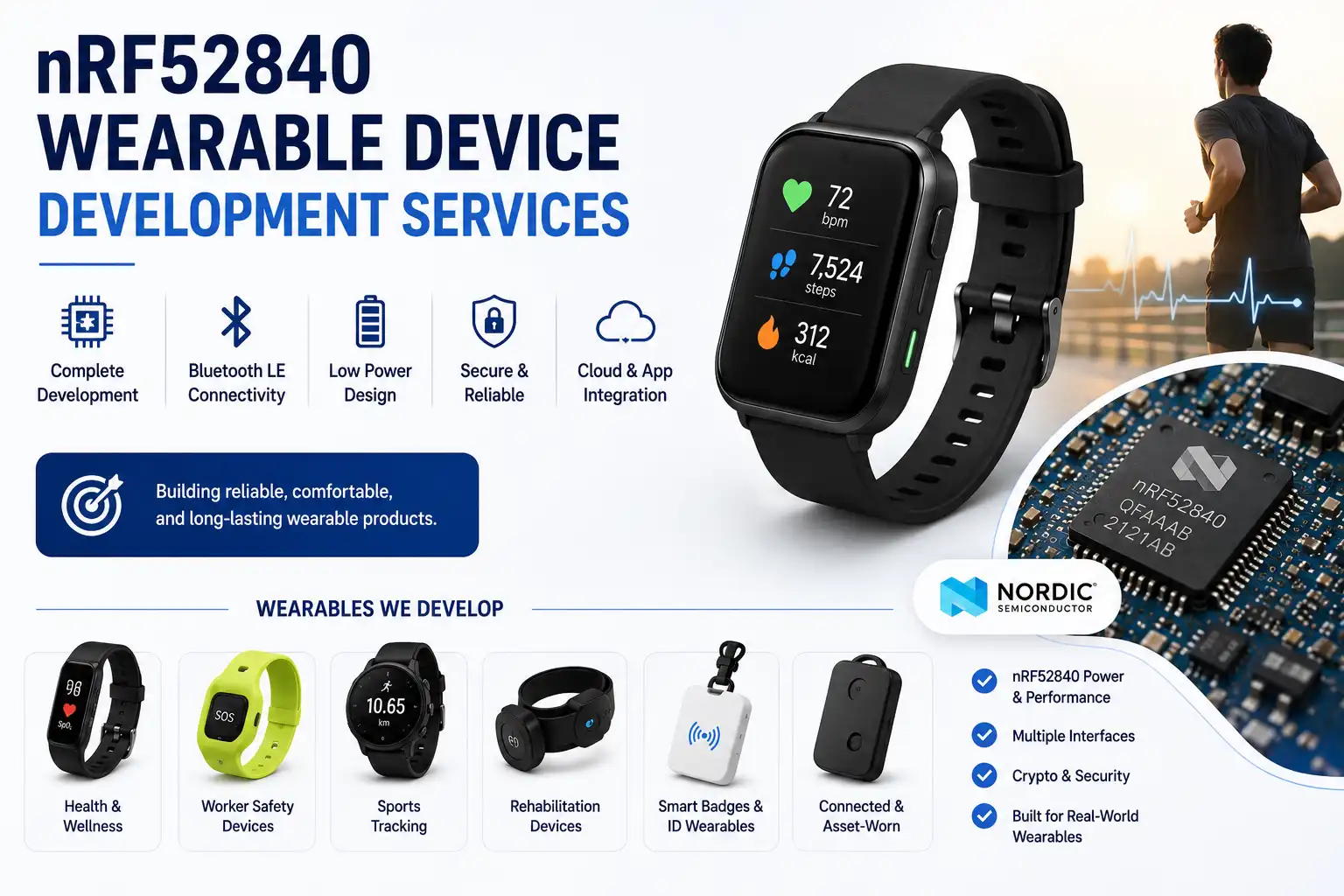
At Adequate Infosoft, we develop nRF52840 wearable devices as complete products. Our team handles requirements, proof-of-concept development, sensor selection, PCB design, embedded software, Bluetooth communication, mobile apps, cloud services, testing, and support.
Products we develop include health and wellness wearables, safety devices for workers, devices for sports tracking, rehabilitation, smart badges, connected or asset-worn products, remote controls, and accessories that can communicate wirelessly.
Our goal is not one of creating devices that work with Bluetooth advertisement but rather to develop a functional and durable device that is designed to be comfortable to wear, providing reliable data and designed to last long and work smoothly after having been shipped.
Why the nRF52840 works well for wearable products
With its 64 MHz Arm Cortex-M4 processor with a floating-point unit, 1 MB of flash memory and 256 KB of RAM, Nordic Semiconductor's nRF52840 is the right choice for wearable makers who need space for their Bluetooth stack and other things that go into the device such as application logic, sensor processing, diagnostics and updates.
The radio supports Bluetooth LE and a number of 2.4 GHz protocols, with Bluetooth LE as the means of connection in many cases, supported by NFC-A making the process easier and USB being available for charging and support.
The device also provides interfaces for wearable components, including SPI, TWI, UART, PDM, I2S, QSPI, PWM, and a 12-bit ADC. Hardware cryptography and CryptoCell support help with secure communication and firmware verification.
Nordic's power-management architecture gives firmware teams fine control over sleep states, wake sources, radio activity, and peripheral use.
Our nRF52840 wearable development services
Product discovery and technical feasibility
To start with, we present definitions about the wearable being analyzed, including the number of measures, behaviors of the decisions made locally, and how users interact with the wearables.
The battery power, case shape, recharging type, Bluetooth capabilities, storage time, accuracy of the sensor, contact with skin, area surroundings, and legal requirements are all of primary importance.
We then test the riskiest assumptions. A prototype may compare optical sensors on skin positions, measure antenna performance near the body, or determine whether the proposed algorithm can run within the available memory and power budget.
Custom wearable electronics and PCB design
Our electronics specialists create small-sized nRF52840 boards by working within mechanical limits. The design may consist of an IMU, optical heart-rate or SpO2 sensor, temperature sensor, pressure sensor, haptic motor, LEDs, buttons, external flash, NFC antenna, USB, charging circuit, fuel gauge, and protective components.
We review sensor placement, grounding, flex and rigid-flex options, battery safety, charging temperature, ESD, waterproofing boundaries, programming pads, and production test access.
RF layout and antenna clearance are enclosure decisions because the wrist, battery, display, and metal fasteners change RF behavior.
Embedded firmware and sensor processing
We build firmware with the nRF Connect SDK and Zephyr for products, while supporting established nRF5 SDK codebases during maintenance or migration. Firmware work includes device drivers, sensor scheduling, Bluetooth services, local storage, event detection, user feedback, power states, diagnostics, and device firmware updates.
We precisely utilize the peripheral devices of hardware and interrupts to ensure that CPU goes to sleep after completing the work. Instead, sensor information can be processed, merged, and summarized internally within the wearable before getting transmitted, thereby cutting back the radio time and duty of the mobile device.
Bluetooth, mobile application, and cloud integration
Our product experience is based on trustful pairing. In our process, we create customized GATT services, develop advertising strategies, define connection parameters, establish bonding, set privacy protocols, provide data framing, plan retries, and ensure synchronization.
Our mobile app will help with configuring the system, showing results, saving the history, setting alerts, and securely updating the firmware.
We develop iOS and Android apps or cross-platform applications using Flutter, React Native, or .NET MAUI.
Some wearables only need a phone, others communicate with gateways in workplaces, hospitals, gyms, or care facilities.
We design the correct topology and decide what happens when neither path is available. Local queues, timestamps, deduplication, and reconnect logic prevent missing or repeated records.
When cloud services are required, our backend team builds device registration, user accounts, telemetry storage, alert rules, dashboards, fleet health, and controlled firmware-release workflows.
Battery life is an engineering result, not a datasheet promise
The battery life of a wearable device is determined by the duty cycle. Important factors include sensor warm-up time, LED current, sampling rate, flash writes, advertising intervals, number of connections, and number of retries. We develop a power budget based on the operating conditions we measured before profiling actual firmware running on a prototype board.
This often reveals that a sensor or user-interface decision consumes more energy than the microcontroller.
Optimization may involve batching samples, adapting measurement frequency, shortening radio activity, using DMA, shutting down external components, and waking only from meaningful events.
We test poor-signal conditions, because repeated connection attempts can drain a battery. The final charging and state-of-charge experience is validated across temperatures and user behavior rather than estimated from nominal battery capacity.
Security, testing, and production readiness
Personal data, passwords, or safety details may be stored in wearable devices. We utilize secure association methods, encrypted communication, firmware signatures, key protection mechanisms, the secure updates, and monitored factory setup.
There are many decisions that need to be made about how to handle a device when it gets debug access, when it is reset, when it is transferred to a new owner, when it is lost, and when an account is deleted.
The testing phase includes functionalities of firmware. Issues related to the disconnection, power shortage, and issues stemming from the unavailability of storage are eliminated during testing. The hardware sample typically goes through RF testing, charging testing, thermal testing, ESD testing, and environmental testing as per the specifications of the product.
Prior to manufacturing, test firmware is created and all the necessary procedures of programming, calibration, serial number management, acceptance criteria, and releasing packages are established.
Case Study: nRF52840 connected-worker safety wristband
The requirement of the product
In order to maintain confidentiality, the customer and sites are not named. The maintenance crews worked in huge warehouses and remote utility locations where phones were mostly kept either in tooldes and pockets.
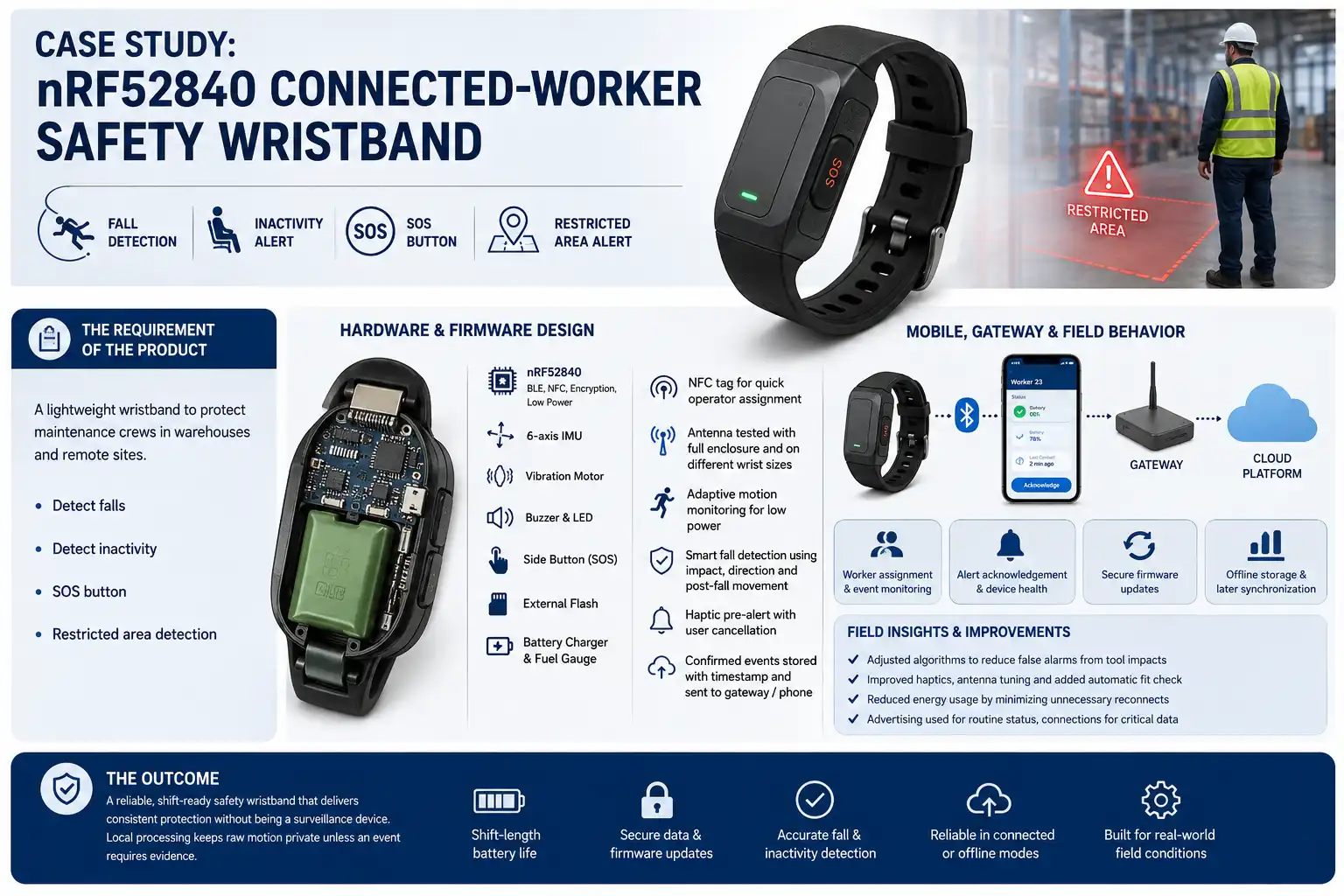
The customer was after a lightweight wristband capable of identifying if a person would fall, be inactive for a certain time, have an SOS button, and tell if the person was in a restricted area.
Hardware and firmware design
The nRF52840 was identified as the ideal model for Bluetooth Low Energy, memory capacity, near field communication functionality, encryption, and energy-efficient operation. The circuit contains a six-axis IMU, vibration motor, buzzer, LED to indicate the status, side-button, external memory storage, battery charger, and fuel gauging circuit among others in the entire build.
Using an NFC tag, a wristband could be assigned to an operator when switching shifts. Testing of the antenna was conducted with the complete enclosure and, in addition, on wrist sizes, not only on the PCB resting on the desk.
The firmware measured movement at various frequencies based on the activity being performed. In a low-energy state, the device waited for movements and only began more intensive monitoring after a sudden acceleration.
The logic of falling included the force of impact, the direction of motion, and the movements after it.
One threshold alone did not trigger an alarm. When a possible fall was detected, the band vibrated first and allowed the wearer to cancel the alert.
A confirmed event stored a timestamped motion summary and attempted delivery through the nearest gateway or paired phone.
Mobile, gateway, and field behavior
BLE advertisements carried a status record, while authenticated connections handled configuration, event transfer, and firmware updates. Gateways forwarded alerts to a cloud service, where supervisors saw worker assignment, event type, battery state, and last contact.
The mobile app supported commissioning, alert acknowledgement, device checks, and secure updates. Without a gateway or phone, events remained in flash and synchronized later without duplication.
The field tests uncovered problems that were not obvious during the tests. In some cases, the repetitive use of the tool produced some impact effects; in others, the use of winter clothing limited the sound output, allowing the workers to touch the antenna.
We made changes in the timing protocols, haptic signals, antenna tuning, and added an automated fit check. The energy data indicated that repeated reconnections under poor reception required more energy than motion processing.
The firmware therefore reduced unnecessary reconnect attempts and used advertising for routine status.
The completed wristband provided consistent safety reporting without turning it into a surveillance device.
Local processing kept raw motion on the band unless an event required evidence. The nRF52840 gave us memory and processing capacity for sensing, event logic, secure updates, and diagnostics while maintaining the low-power behavior expected from a shift-length wearable.
Our Nordic Wearable Experience Is Not Limited to a Single Project
The case study above represents only one example of our work with Nordic Semiconductor technology. We have completed multiple wearable projects using nRF52832, nRF52840, nRF52-series, and nRF54H20 platforms.
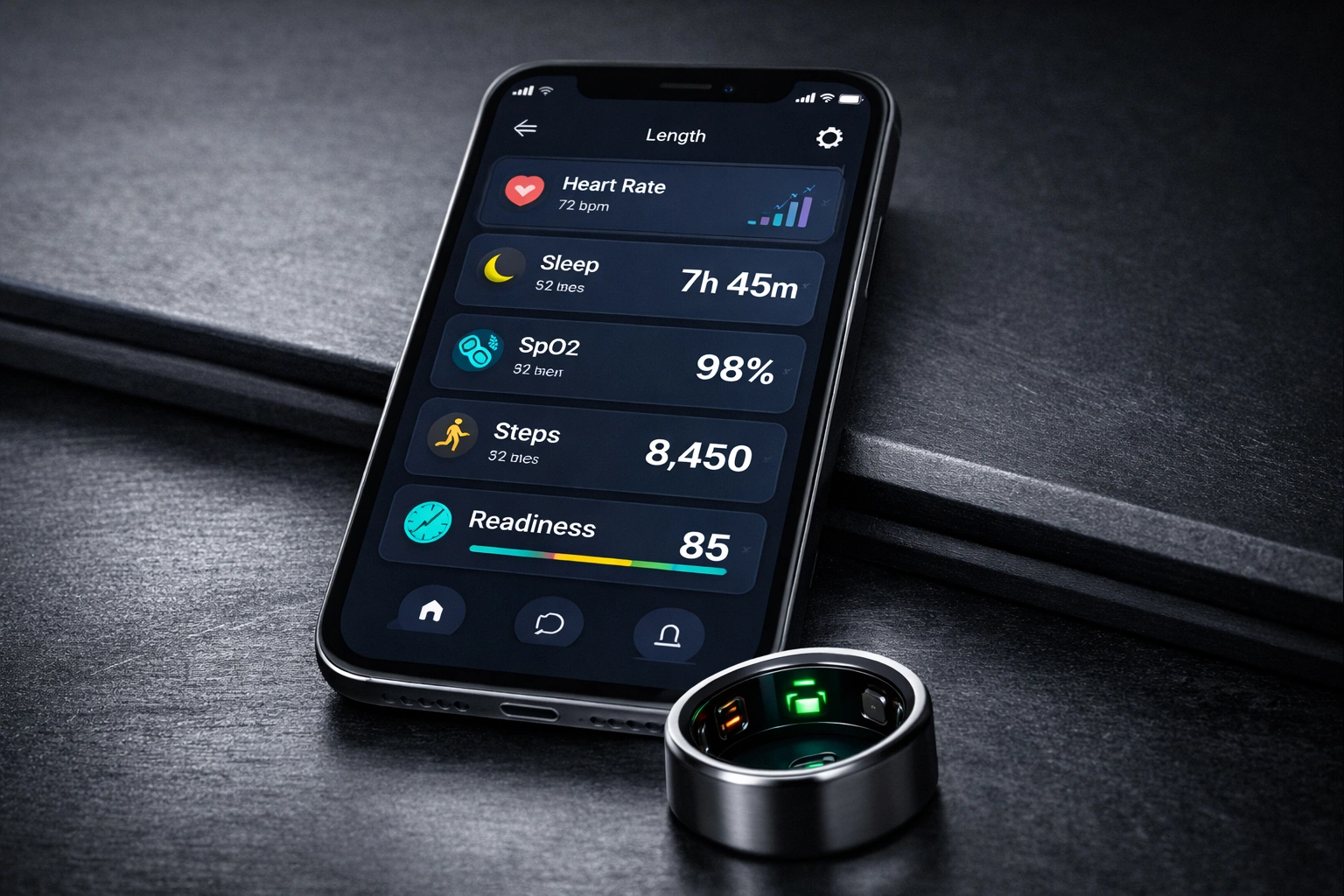
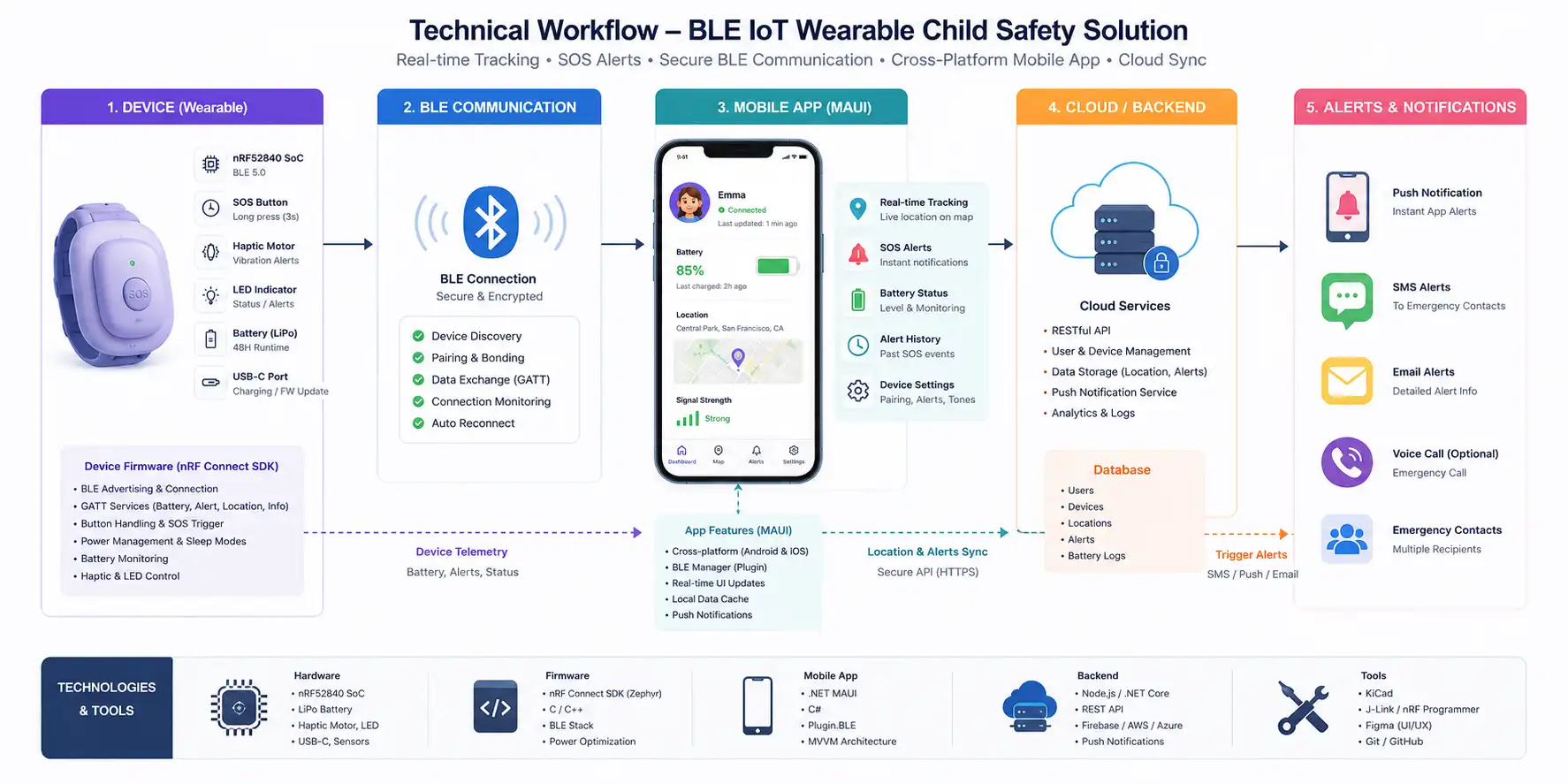
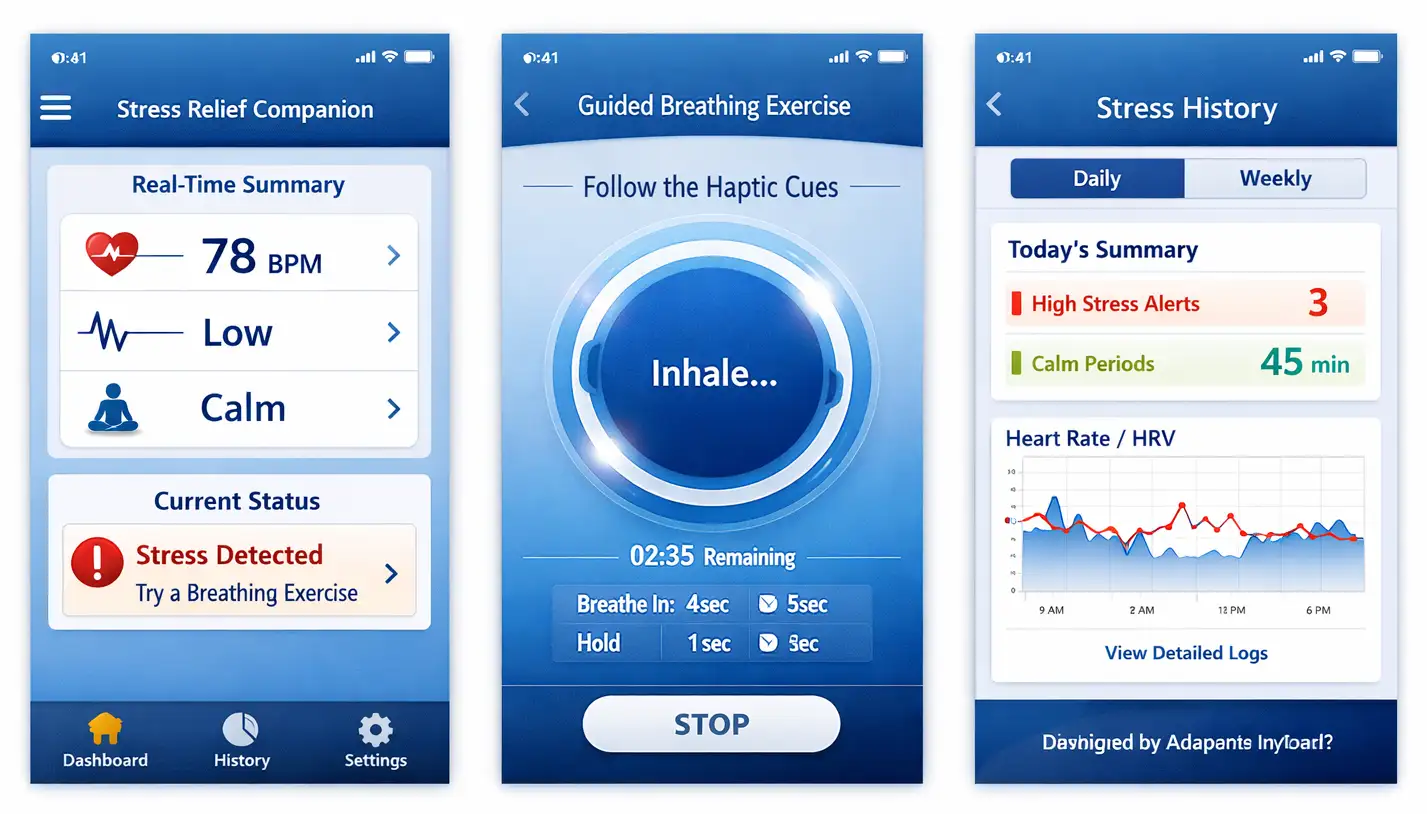
Our experience covers healthcare wearables, fitness devices, smart rings, safety products, rehabilitation systems, medical compliance, native mobile applications, and privacy-focused AI wearables. Selected projects from our website are presented below.
From engineering sample to production wearable
The development process can be divided into various stages, which include the feasibility study of sensors and radio, the electronics, development of firmware, prototyping the enclosure, mobile integration and cloud integration, tests in the fiend, preparing for certification, and production.
Every stage has its own acceptance criteria, and this gives the possibility for the developers to improve the placement of the antenna, the functioning of the sensors, charging, and user interaction before it is too late and the changes will be costly due to tooling and certifications.
Support for production may involve numerous activities from substituting materials to factory testing, managing firmware releases, troubleshooting, maintaining mobile applications, and cloud monitoring.
Continuity of these processes is of utmost importance because the performance of the wearable device hinges upon the interactions among the body, case, electronic components, radio signal, firmware, and services.
Products which we make by using nRF52840
The devices that we produce include activity trackers, safety wearables, rehabilitation devices, smart badges, medical appliances, sports gadgets, posture control devices, location tracking tags, haptic devices and remote controllers.
We are also able to upgrade a wearable device, facilitate battery operation, correct the defect in the BLE, and transfer a product based on nRF5 SDK to the technology of nRF Connect SDK.
Start your nRF52840 wearable project
The process of Adequate Infosoft involves combining various elements such as wearables technology, Nordic firmware, Bluetooth technology, cloud technology as well as testing and manufacturing engineers into a single cohesive group of experts.
We can work closely with you to gather the required parameters such as user needs, measurements, battery goals, maximum size of the enclosures, and deployment methods.
Then, we will transform this information into an efficient architecture and development plan which is rather useful and practical rather than just demonstrational with specification of endurance and fabrication milestones.