














 Mean Stack Development
 Vue JS Development
 Javascript Development
 React JS Development
 Angular JS Development
 Next JS development
 Java Development
 Python Development
 Django Development
 Cherrypy Development
 C# Development
 ASP.NET Development
 NodeJS Development
 Laravel Development
 CodeIgniter Development
 Zend Development
 Ruby on Rails Development
 CakePHP Development
 PHP Website Development
 Symfony Development
 Drupal Development
 Joomla Development
 Wordpress Development
 .NET Nuke Development
 Kentico
 Umbraco
 .NET MAUI Development
 Xamarin Application Development
 iOS Application Development
 Android Application Development
 Android Wear App Development
 Ionic Development
 iBeacon Application Development
 Universal Windows Platform (UWP)
 Kotlin Application Development
 Swift Application Development
 Flutter Application Development
 PWA Application Development
 Flutter Health Tech & Wearable App Development Company
 React Native Health Tech Wearable App Development
 Offshore Software Development
 Custom Application Development
 Front-End Development
 Full Stack Development
 AI & Machine Learning
 Custom CRM Solutions
 Flask Software Development
 Electron JS Development
 ChatGPT Development
 Telemedicine App Development
 Build Smart Telemedicine Platform
 Beauty & Salon App Solutions
 Hire Workato Experts
 Magento Development
 Magento 2.0 Development
 Magento Enterprise
 Shopping Cart Development
 Prestashop Development
 Shopify Development
 Open Cart Development
 WooCommerce Development
 BigCommerce Development
 NopCommerce Development
 Virto Commerce Development
 AspDotNetStorefront Development
 .NET Application Development
 Microsoft Dynamics CRM
 VB .NET Development
 Sharepoint Migration
 ASP.NET Core Development
 ASP.NET MVC Development
 AJAX Development
 Agile Development
 Microsoft Bot
 Microsoft Blazor
 Microsoft Azure Cognitive
 HTML 5
 UI/UX Design
 Graphic Design
 Adobe Photoshop
 XML Application Development
 Cloud Computing Solutions
 Azure Cloud App Development
 AWS Development
 Google Cloud Development
 Certified AWS IoT Services Developers
 DevOps Consulting & Development
 Kubernetes Consulting & Services
 SQL Programming Development
 MySQL Development
 MongoDB Development
 Big Data
 Robotic Process Automation
 Social Media Marketing
 Search Engine Optimization
 QA Testing
 Software Testing
 Software Security
 Maintenance And Support
 I.T. Consulting Services
 Business Intelligence
 YII Development
 Data Analysis
 Alexa Skills Development
 On Demand App for Mobile repairing services
 On Demand App for Car Service Booking
 On Demand App for Cleaning Services
 On Demand App for Pharmacy
 On Demand Dedicated Developers
 On Demand Lawyer App Development










 Nuki Smart Lock
 Salto Smart Lock
 TTlock Smart Lock
 NFC App Development
 Custom IOT Enabled Smart Lock
 Smart Locker Solutions
 Hospital Smart Lock Systems
 Hotel Smart Lock Systems
 Smart Home & Office Locks
 Smart Access for Schools & Colleges
 Unloc Smart Lock Integration
 Yale & August Smart Lock Integration
 Populife Smart Lock Integration
 Smart Lock Hardware Development
 Dairy IoT Solutions
 Agri IoT & AI Solutions
 Weather & Climate Solutions
 Water & Waste Management Solutions
 RaspBerry Pi
 Firmware Software Development
 ESP 32 Software Development
 Embedded Development
 Internet of Things
 Smart IoT Development
 IoT Sensor Integration & Development Solutions
 Smart IoT System Development for HVAC
 Tuya IoT App Development
 Particle IoT SDK
 IoT Development with AI
 Smart Pet GPS Tracker
 Dairy GPS Tracking Solutions
 GPS Fleet Management Software
 Car Rental & Subscription Solutions
 Car Buy & Sell Marketplace Development
 AI-Powered Car Wash App Development
 PCB Design & Fabrication
 IoT AC Automation
 AI–IoT Painting Solutions
 IoT Wearable Hardware & App Development
 HVAC Automation & AI Control Systems
 Smart Home IoT Engineering
 AI Embedded Systems
 AI Hardware Design Service
 Advanced IoT Hardware & Firmware Development
 Device Driver Development Services
 NXP i.MX RT Firmware & Hardware Services
 Microchip PIC & AVR Development
 Hire IoT Architects
 IoT Cloud & Infrastructure Solutions
 Infineon XMC / AURIX Development Services
 Matter & Thread IoT Services
 Native IoT Mobile App Development (BLE & Wi-Fi)
 Snapdragon IoT Firmware Development
 Renesas RA/RX Firmware Services
 Silicon Labs EFR32 Development Services
 Smart Wearable App Development
 Smart IoT Meters
 Smart Healthcare Wearable App Development
 Health Care Monitoring System
 Fitness Tracking App Development
 Smart Home Automation Apps
 nRF PCB Design
 ESP32 PCB Design
 Embedded Wearables Engineers
 Rental Property Management System
 Building Management System
 Smart Lighting Development
 Infineon Semiconductor Firmware Development Services
 Custom Camera Development: Hardware, Firmware & PCB Prototyping
 Smart Security Camera SDK
 Nordic Semiconductor SDK
 Infineon SDK
 Arduino SDK
 NFC Lock Integration
 Kerong Lock Integration
 IoT & AI Solutions for Manufacturing
 Smart Inventory & Logistics Solution
 Food & Beverage Industry Solutions
 Smart Hospitality Solutions
 Smart Property Management
 Custom Smart Home IOT SDK
 Smart IoT & AI in Healthcare
 AI-Powered Security Solutions
 Smart Home Safety & AI
 Veterinary Clinic Management (AI)
 Pet Care System (AI & IoT)
 Pet Training & Adoption (AI)
 Healthcare IoT Development
 Event Management Software
 Money Remittance App
 Money Lending App Development
 Utility and Bill Payment App
 IoT Mobile App Development (Flutter & React Native)
 AI & IoT Retail Solutions
 Smart EV App Development
 Smart Solar IoT & AI Solutions
 IoT-Based Energy Systems
 Smart Energy & Utilities Solutions
 6G Solutions
 IoT Security Solutions
 AI-Powered Lottery App Development
 AI-Sports Fitness Club Management
 Travel
 Real Estate
 Medical & Healthcare
 e-Learning
 Consumer Products
 Finance
 Automobile
 Media & Entertainment
 Billing Software
 Enterprise Resource Planning (ERP)
 Augumented & Virtual Reality
 Point of Sale(POS) Development
 Learning Management System
 EV Charging Solutions
 About Us
 Partners & Certifications
 Quality Assurance
 Our Clients & Testimonials
 Development Process
 Our Products
 Social Responsibility
 Work Ethics
 Vision & Mission
 Awards
 Live Project Demos
 Contact Us
 Case Studies
 Portfolio
 Blog
Blog
Wearable Prototype Development Company | PoC, EVT & DVT
Wearable prototype development turns an idea into testable hardware, firmware and connected software while reducing technical and manufacturing risk.
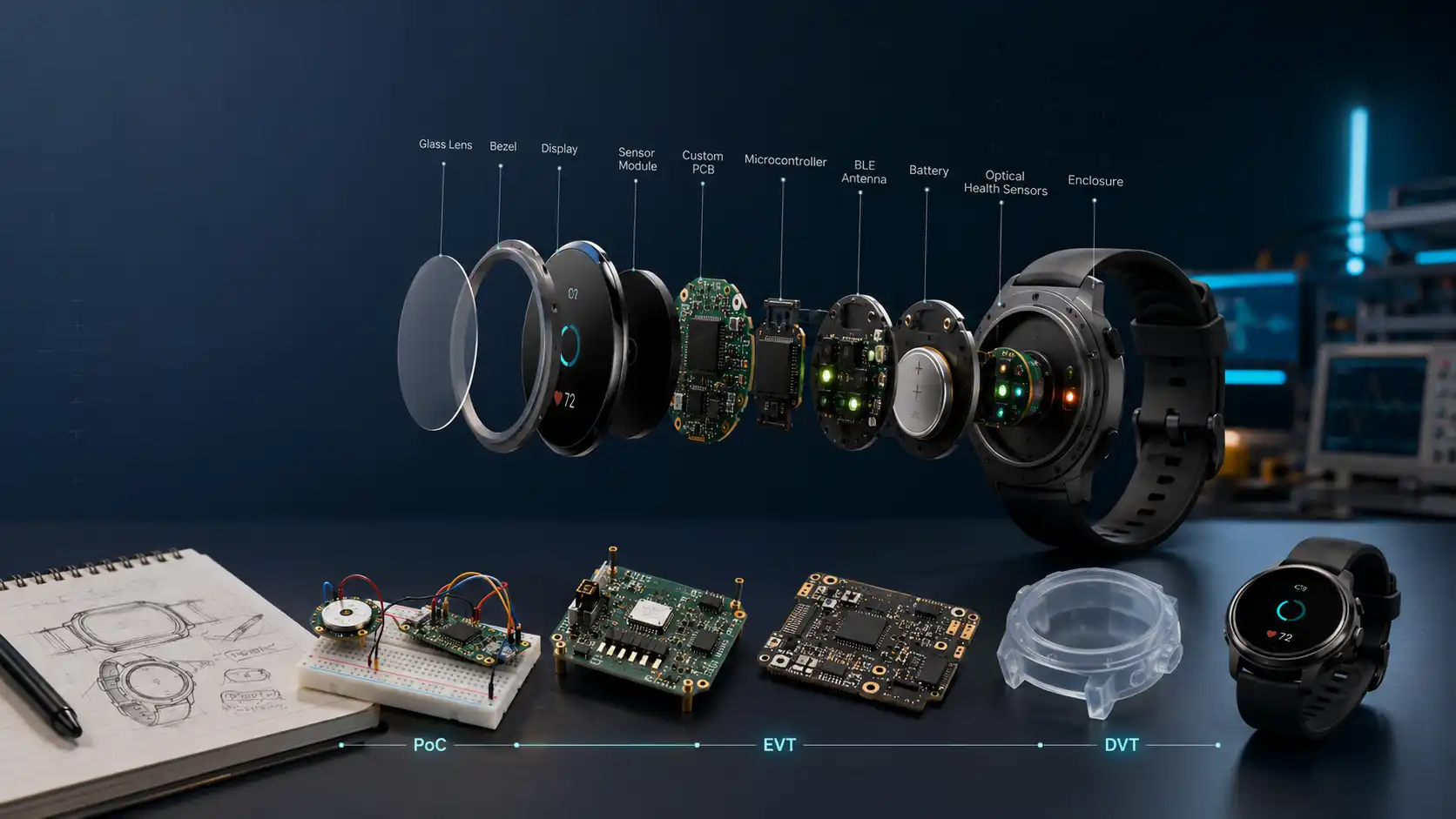
A useful program moves from proof of concept (PoC) to engineering design, Engineering Validation Test (EVT), Design Validation Test (DVT) and, when required, Production Validation Test (PVT).
Adequate Infosoft develops wearable prototypes for health, wellness, sports, safety, consumer and industrial products. Our team covers architecture, custom PCBs, firmware, sensors, Bluetooth Low Energy (BLE), mobile apps, cloud integration, testing and manufacturing handover.
Engagements can begin with an untested concept, evaluation board, existing prototype or a design failing its next validation gate.
What Is Wearable Prototype Development?
Wearable device prototyping is a staged engineering process used to answer different questions with increasing design fidelity:
PoC: Can the critical sensing, radio, algorithm or user interaction work?
Engineering prototype: Can the selected subsystems operate together?
EVT: Does the engineered hardware and firmware meet its design requirements?
DVT: Does the near-final design meet product, environmental and user requirements?
PVT: Can the intended manufacturing process build the design consistently?
These definitions pertain to industry practice, not general labels. The criteria for saying that something has entered a stage in the process, the amount of samples taken and tests that must be conducted depend on the risks associated with the product, intended market, regulatory path and supply chain. We provide definitions for stage gates in the project plan.
Proof of Concept: Test the Hardest Assumption First
The PoC must address the risk that has the highest potential to undermine the product. For a wearable device, it could be either optical signal quality at the selected location on the body, antenna performance in proximity, algorithm it uses, battery power, haptic information, warm-up time for sensors, signal overlap with a mobile phone etc.
PoCs often use development boards, breakout sensors, 3D-printed fixtures and diagnostic firmware.
We develop a testing plan and collect raw data and record the setup to enable repeatability. The result of a PoC will demonstrate the technical feasibility of the concept, but it is no indicator of actual proportions, battery life, compliance or manufacturability.
Typical PoC outputs include:
- Architecture and feasibility findings
- Demonstration hardware and source code
- Raw measurements and test results
- Initial power, memory and data-rate estimates
- Key risks, constraints and next-stage recommendation
The outcome may be to proceed, change architecture or stop before investing in a custom PCB. Finding an unsuitable method during PoC is useful risk reduction.
Engineering Prototype and Custom Wearable PCB
Following the feasibility stage, we incorporate the entire parts. The PCB, power components, antenna systems, sensors, charging modules, memory structures and testing points are designed simultaneously. The firmware changes from demo coding to structured drivers and state machines.
Mechanical limitations apply at the initial stage. Skin contact, optical devices, electrodes, battery configuration, strap force, sealing qualities, haptics, thermal pathways, and antenna clearance are factors that define if the wearable device functions in the non-lab environment. Flexible circuits are used if the rigid board is not suitable.
The application is a component of the prototype of the system. BLE services, units, timestamps, buffering features, reconnection process, pairing attributes, and OTA behaviors were discussed before the app team and firmware team start working separately.
EVT: Verify the Engineering Design
The EVT determines if a product's design adheres to its specifications. Specifically, we convert these specifications into discernible tests for electrical features, sensing capabilities, power settings, charging processes, BLE functionality, data storage, user interaction, firmware restoration, and interface options.
EVT activities can include:
- PCB bring-up and rail, clock and interface checks
- Current profiling across operating states
- Sensor calibration and reference comparison
- RF range, packet-loss and coexistence testing
- BLE GATT and mobile interoperability tests
- Battery charging, protection and fault checks
- Firmware update, interruption and recovery tests
- Early thermal, drop, sweat or ingress experiments
Failures are classified by hardware, firmware, mechanical or requirements cause. Changes are tracked, and regression tests protect working functions. Early pre-compliance scans reduce radio, EMC or safety risk before final tooling.
DVT: Validate the Near-Final Wearable
DVT employs a design similar to that of the final product, including representative PCBs, enclosures, materials, firmware and assembly techniques. The key question shifts from "have we constructed this according to plan?" to "does the gadget perform the job it was designed for?"
DVT may cover battery life, reliability, environmental constraints, cycle life, sensors, usability, behavior of the application, safety and pre-qualification of the product. The conditions and equipment, firmware, sample numbers and acceptance criteria are documented.
For medical or safety-related wearables, design controls and risk management should begin well before DVT. The FDA explains that verification can occur at every design level, while validation assesses the device against user needs and intended use. Clinical evaluation, biocompatibility, electrical safety or specialist laboratory work must be planned with qualified partners where applicable.
DVT is not simply a larger EVT batch. Late design changes or substitute components can invalidate evidence. Configuration control connects results to the exact design tested.
Preparing for PVT and Pilot Production
PVT assesses the ability of the documentation, tools, software, hardware and assembly methods to manufacture conforming parts consistently.
Prior to this, we conduct DFM/DFA analysis, lifecycle review, alternative evaluation, keep an eye on panelization, programming and final tests.
The material transfer involves such parameters as source files, binaries, schematics, print files, product structure, drawings, firmware and fixture specifications and calibration parameters. Feedback from the supplier may reveal such issues as tolerances, assembly, procurement and testing problems which need to be addressed by design modifications.
Firmware, BLE and OTA Across Prototype Stages
Prototype firmware must evolve. We establish reproducible builds, source control, logs and hardware-version handling, separating drivers from board-specific configuration.
BLE testing covers discovery, connection, bonding, data transfer, reconnection and behaviour across representative iOS and Android devices.
For products entering the market, the Bluetooth SIG requires Bluetooth products to complete its Qualification Process by the time they are sold or distributed. Qualification strategy should therefore be considered while selecting modules, controllers and profiles—not after DVT.
OTA design includes authentication, memory layout, versions, interruption and recovery. Tests cover low battery, connection loss, wrong images and rollback.
Compliance and Test Planning
Certification is market-specific. A wireless wearable for the United States may require FCC equipment authorization before marketing or import.
Bluetooth and CE/UKCA standards, as well as battery, environmental, EMC and safety requirements, may apply. Medical-device projects could require compliance with standards on electrical safety, risk management, usability and biological evaluation.
IEC 62304 defines lifecycle processes for medical-device software, but it does not by itself validate or release the final device. We help build traceable engineering evidence while the client and accredited specialists own formal regulatory strategy and approvals.
Our Portfolio of Wearable Prototype Case Studies
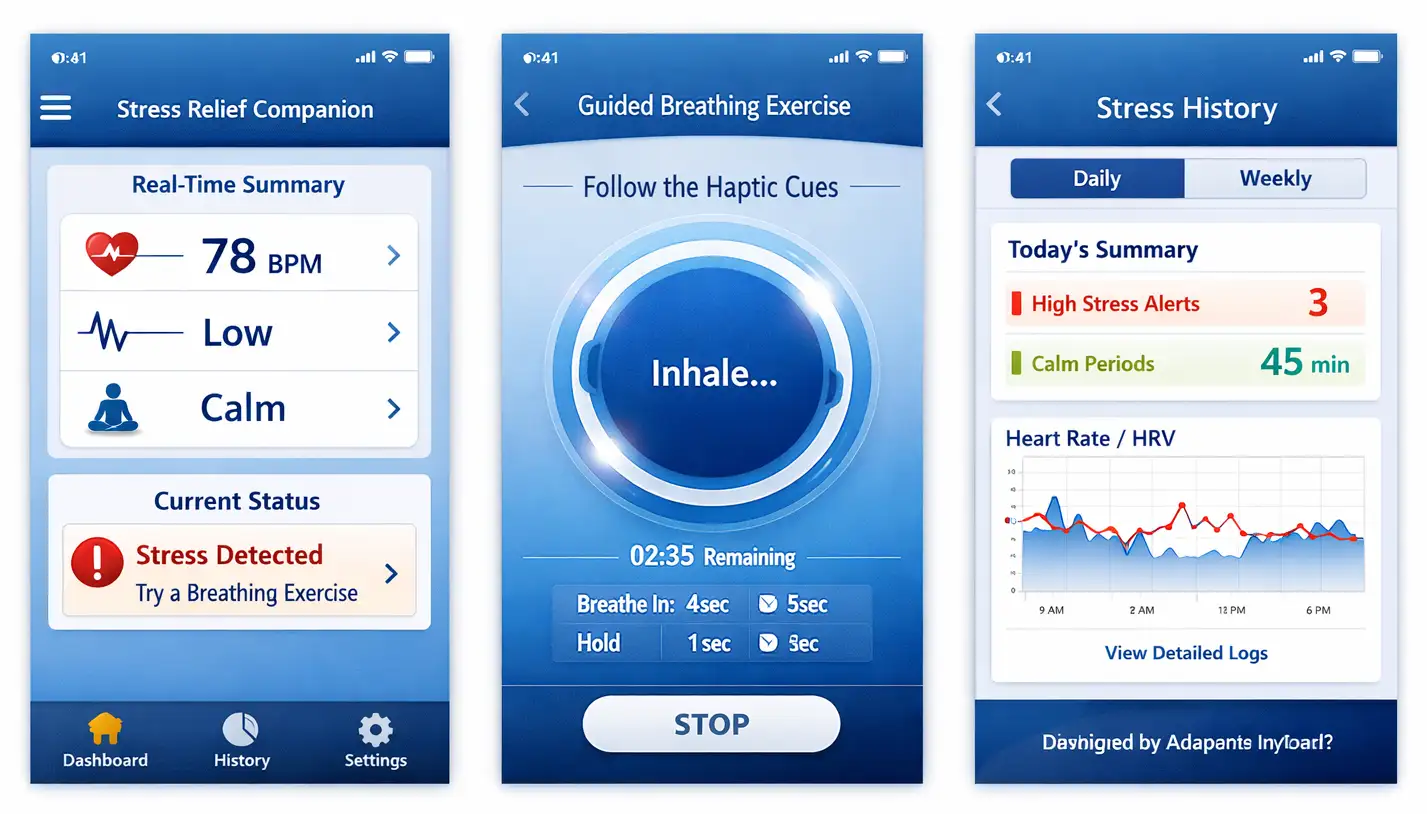
nRF52840 Stress-Management Wrist Cuff Prototype
A wearable cuff design by Adequate Infosoft included the MAX30102 heart rate sensor, the IMU from the XIAO nRF52840 Sense module, the DRV2605-controlled haptic device and the rechargeable power. The firmware uses a rules-based system taking heart rates, heart rate variability, and low activity into account.
The engagement delivered three working cuff prototypes, firmware, component documentation and the companion app. It proved integrated sensing, motion context, haptic guidance and data logging at prototype scale; it was not clinical validation of stress diagnosis.
View Case Study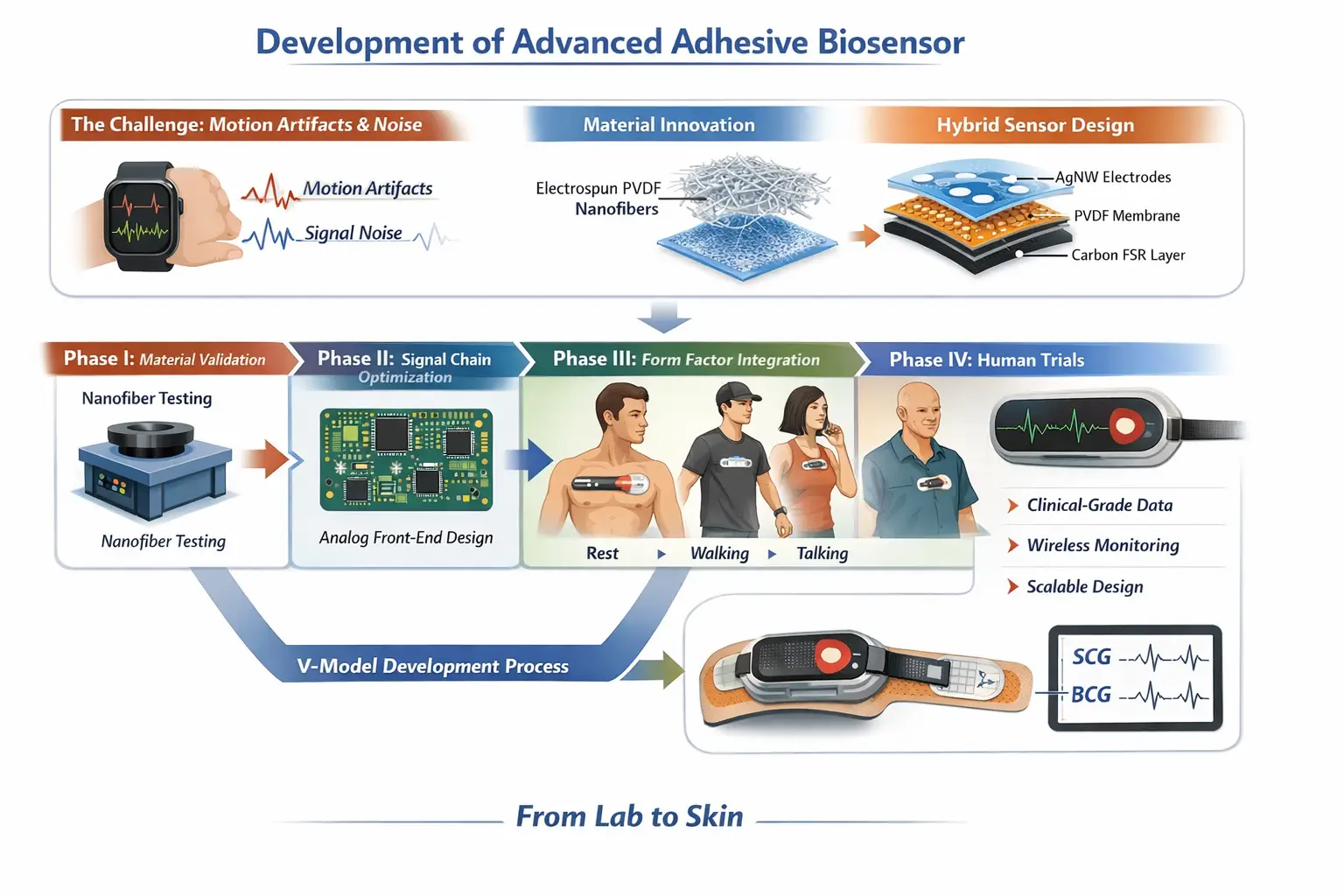
ESP32-S3 Adhesive PVDF Biosensor Prototype
The adhesive sensing prototype combines a PVDF layer made with electrospinning, flexible electrodes, a contact pressure sensor, an INA128 amplifier, an ADS1256 24-bit ADC and ESP32-S3 for BLE processing.
As a result of this work, a reusable electronics pod was created, along with a disposable sensor interface, appropriate firmware and manufacturing files.
This project is an example of using a prototype to investigate a high-risk signal chain, mechanical coupling and motion-noise reduction before making clinical or commercial-performance claims.
View Case Study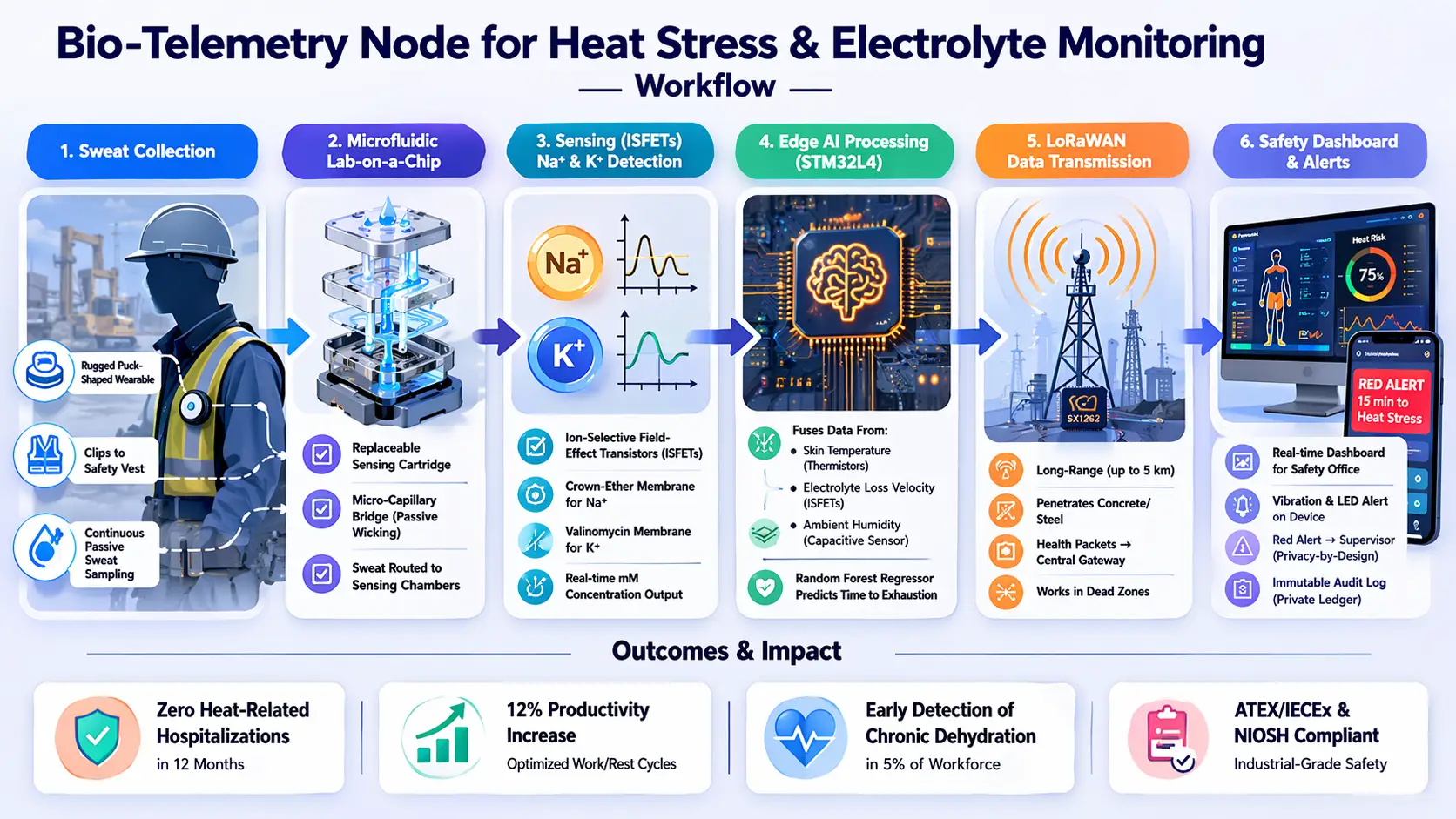
STM32L4 Heat Stress & Electrolyte Monitoring Wearable
An industrial wearable combined STM32L4 processing, a replaceable microfluidic sweat-sensing cartridge, ISFET electrolyte sensors, skin-temperature sensing, and ambient-humidity measurement.
A Semtech SX1262 transceiver provided LoRaWAN connectivity, while the electronics were housed in a rugged enclosure designed to attach to workers' safety vests.
The project illustrates the engineering issues faced by wearable prototypes, such as stability of sensing interfaces, environmental exposure, cartridge replacement, as well as secure wireless communication. These factors aid in determining relevant prototype testing and subsequent design verification standards.
View Case Study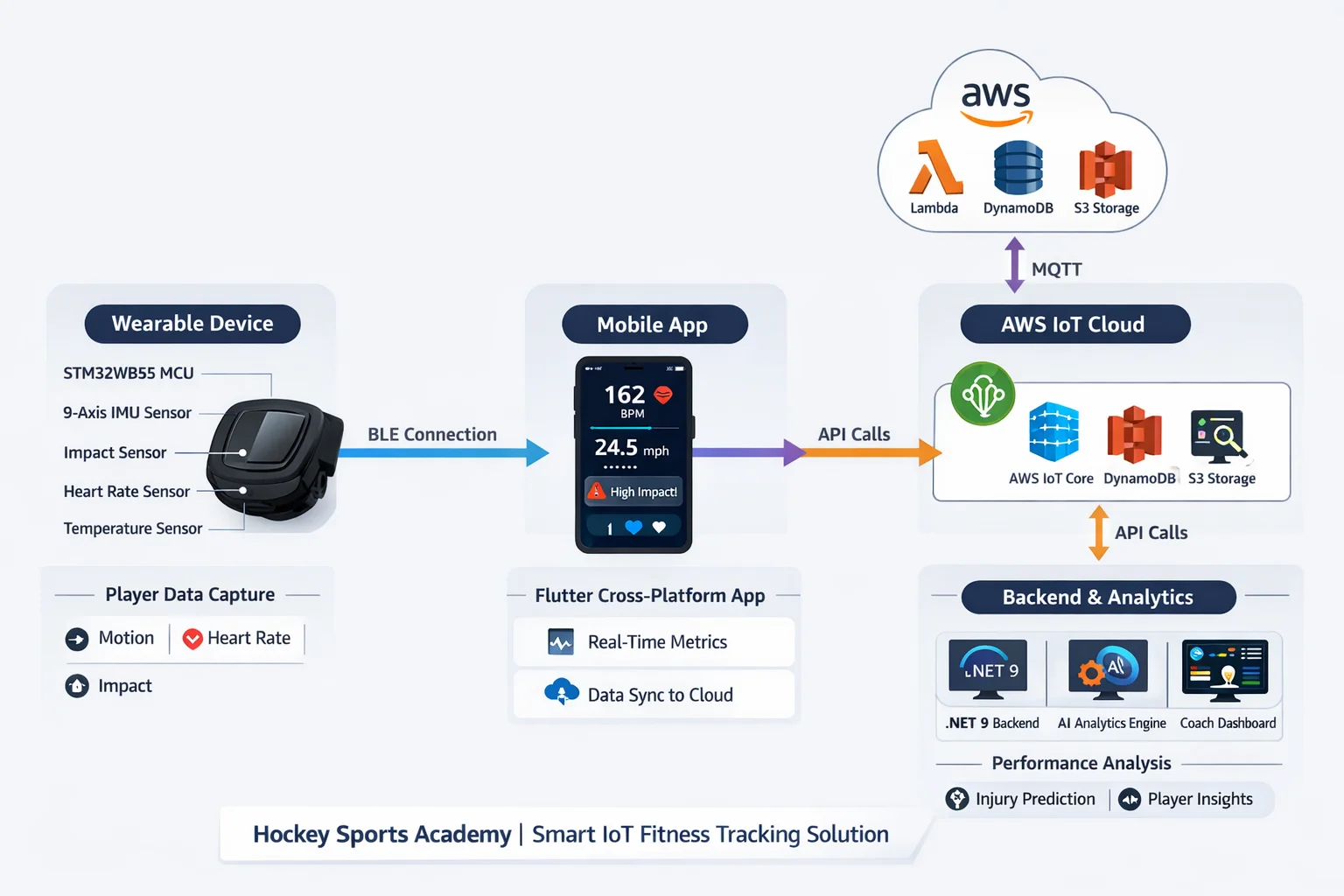
STM32WB55 Sports Performance Wearable
A wearable developed for hockey players combined STM32WB55 processing, Bluetooth Low Energy, embedded sensor fusion, and a compact four-layer PCB.
The system connected the wearable to a Flutter mobile application, AWS IoT infrastructure, a .NET backend, and a coaching dashboard for viewing performance data.
This project illustrates why sports wearable prototyping must consider the complete operating environment. Body placement, impact exposure, cold conditions, wireless data transfer, and enclosure protection provide practical priorities for an EVT and DVT test plan before committing to a production design.
View Case StudyWhy Choose Adequate Infosoft?
Our value results from the combination of hardware, firmware, sensing, BLE, mobile and cloud engineering into a single technical solution.
All the phases have clear objectives, proof of feasibility and criteria for exit. Clients are being given design files and source deliverables specified in the agreement and transparent documentation on what has been validated or not.
Frequently Asked Questions
What is the difference between PoC, EVT and DVT?
PoC tests fundamental feasibility. EVT verifies the engineered design against technical requirements. DVT validates a near-final product against intended use, user needs and applicable environmental conditions.
How many wearable prototypes are needed?
There is no universal quantity. It depends on parallel tests, destructive testing, design risk, supplier variation, certification samples and budget. We propose quantities after defining the test matrix.
Can you improve an existing wearable prototype?
Yes. We can review schematics, PCB layout, firmware, BLE behaviour, power measurements, sensor data and mechanical constraints, then prioritize corrective work.
Do you support manufacturing handover?
Yes. Support can include DFM/DFT review, controlled releases, BOM and alternates, programming, test procedures, fixtures and communication with the selected manufacturer.