


 Mean Stack Development
 Vue JS Development
 Javascript Development
 React JS Development
 Angular JS Development
 Next JS development
 Java Development
 Python Development
 Django Development
 Cherrypy Development
 C# Development
 ASP.NET Development
 NodeJS Development
 Laravel Development
 CodeIgniter Development
 Zend Development
 Ruby on Rails Development
 CakePHP Development
 PHP Website Development
 Symfony Development
 Drupal Development
 Joomla Development
 Wordpress Development
 .NET Nuke Development
 Kentico
 Umbraco
 .NET MAUI Development
 Xamarin Application Development
 iOS Application Development
 Android Application Development
 Android Wear App Development
 Ionic Development
 iBeacon Application Development
 Universal Windows Platform (UWP)
 Kotlin Application Development
 Swift Application Development
 Flutter Application Development
 PWA Application Development
 Flutter Health Tech & Wearable App Development Company
 React Native Health Tech Wearable App Development
 Offshore Software Development
 Custom Application Development
 Front-End Development
 Full Stack Development
 AI & Machine Learning
 Custom CRM Solutions
 Flask Software Development
 Electron JS Development
 ChatGPT Development
 Veterinary Telemedicine App Development
 Build Smart Telemedicine Platform
 Beauty & Salon App Solutions
 Hire Workato Experts
 Magento Development
 Magento 2.0 Development
 Magento Enterprise
 Shopping Cart Development
 Prestashop Development
 Shopify Development
 Open Cart Development
 WooCommerce Development
 BigCommerce Development
 NopCommerce Development
 Virto Commerce Development
 AspDotNetStorefront Development
 .NET Application Development
 Microsoft Dynamics CRM
 VB .NET Development
 Sharepoint Migration
 ASP.NET Core Development
 ASP.NET MVC Development
 AJAX Development
 Agile Development
 Microsoft Bot
 Microsoft Blazor
 Microsoft Azure Cognitive
 HTML 5
 UI/UX Design
 Graphic Design
 Adobe Photoshop
 XML Application Development
 Cloud Computing Solutions
 Azure Cloud App Development
 AWS Development
 Google Cloud Development
 Certified AWS IoT Services Developers
 DevOps Consulting & Development
 Kubernetes Consulting & Services
 SQL Programming Development
 MySQL Development
 MongoDB Development
 Big Data
 Robotic Process Automation
 Social Media Marketing
 Search Engine Optimization
 QA Testing
 Software Testing
 Software Security
 Maintenance And Support
 I.T. Consulting Services
 Business Intelligence
 YII Development
 Data Analysis
 Alexa Skills Development
 On Demand App for Mobile repairing services
 On Demand App for Car Service Booking
 On Demand App for Cleaning Services
 On Demand App for Pharmacy
 On Demand Dedicated Developers
 On Demand Lawyer App Development








 Nuki Smart Lock
 Salto Smart Lock
 TTlock Smart Lock
 NFC App Development
 Custom IOT Enabled Smart Lock
 Smart Locker Solutions
 Hospital Smart Lock Systems
 Hotel Smart Lock Systems
 Smart Home & Office Locks
 Smart Access for Schools & Colleges
 Unloc Smart Lock Integration
 Yale & August Smart Lock Integration
 Populife Smart Lock Integration
 Smart Lock Hardware Development
 Dairy IoT Solutions
 Agri IoT & AI Solutions
 Weather & Climate Solutions
 Water & Waste Management Solutions
 RaspBerry Pi
 Firmware Software Development
 ESP 32 Software Development
 Embedded Development
 Internet of Things
 Smart IoT Development
 IoT Sensor Integration & Development Solutions
 Smart IoT System Development for HVAC
 Tuya IoT App Development
 Particle IoT SDK
 IoT Development with AI
 Smart Pet GPS Tracker
 Dairy GPS Tracking Solutions
 GPS Fleet Management Software
 Car Rental & Subscription Solutions
 Car Buy & Sell Marketplace Development
 AI-Powered Car Wash App Development
 PCB Design & Fabrication
 IoT AC Automation
 AI–IoT Painting Solutions
 IoT Wearable Hardware & App Development
 HVAC Automation & AI Control Systems
 Smart Home IoT Engineering
 AI Embedded Systems
 AI Hardware Design Service
 Advanced IoT Hardware & Firmware Development
 Device Driver Development Services
 NXP i.MX RT Firmware & Hardware Services
 Microchip PIC & AVR Development
 Hire IoT Architects
 IoT Cloud & Infrastructure Solutions
 Infineon XMC / AURIX Development Services
 Matter & Thread IoT Services
 Native IoT Mobile App Development (BLE & Wi-Fi)
 Snapdragon IoT Firmware Development
 Renesas RA/RX Firmware Services
 Silicon Labs EFR32 Development Services
 Smart Wearable App Development
 Smart IoT Meters
 Smart Healthcare Wearable App Development
 Health Care Monitoring System
 Fitness Tracking App Development
 Smart Home Automation Apps
 nRF PCB Design
 ESP32 PCB Design
 Embedded Wearables Engineers
 Rental Property Management System
 Building Management System
 Smart Lighting Development
 Infineon Semiconductor Firmware Development Services
 Custom Camera Development: Hardware, Firmware & PCB Prototyping
 Smart Security Camera SDK
 Nordic Semiconductor SDK
 Infineon SDK
 Arduino SDK
 NFC Lock Integration
 Kerong Lock Integration
 IoT & AI Solutions for Manufacturing
 Smart Inventory & Logistics Solution
 Food & Beverage Industry Solutions
 Smart Hospitality Solutions
 Smart Property Management
 Custom Smart Home IOT SDK
 Smart IoT & AI in Healthcare
 AI-Powered Security Solutions
 Smart Home Safety & AI
 Veterinary Clinic Management (AI)
 Pet Care System (AI & IoT)
 Pet Training & Adoption (AI)
 Healthcare IoT Development
 Event Management Software
 Money Remittance App
 Money Lending App Development
 Utility and Bill Payment App
 IoT Mobile App Development (Flutter & React Native)
 AI & IoT Retail Solutions
 Smart EV App Development
 Smart Solar IoT & AI Solutions
 IoT-Based Energy Systems
 Smart Energy & Utilities Solutions
 6G Solutions
 IoT Security Solutions
 AI-Powered Lottery App Development
 AI-Sports Fitness Club Management
 Travel
 Real Estate
 Medical & Healthcare
 e-Learning
 Consumer Products
 Finance
 Automobile
 Media & Entertainment
 Billing Software
 Enterprise Resource Planning (ERP)
 Augumented & Virtual Reality
 Point of Sale(POS) Development
 Learning Management System
 EV Charging Solutions
 About Us
 Partners & Certifications
 Quality Assurance
 Our Clients & Testimonials
 Development Process
 Our Products
 Social Responsibility
 Work Ethics
 Vision & Mission
 Awards
 Live Project Demos
 Contact Us
 Case Studies
 Portfolio
 Blog
LoRaWAN IoT Development Services for Connected Devices
Adequate Infosoft offers dedicated LoRaWAN IoT development services for businesses that need to create long-range, low-power IoT devices or deploy remote monitoring systems.
The offered services include LoRaWAN device development, PCB design, embedded firmware, RF and antenna design, gateways integration, LoRaWAN network installation, device provisioning, cloud connectivity, dashboard implementation, mobile application development, testing, and preparations for manufacturing.
LoRaWAN solutions are created by us for the following industries: agriculture, livestock monitoring, industry sensors, environment monitoring, smart buildings, energy and utilities, asset management, worker safety, cold chain monitoring, and equipment condition monitoring.
All LoRaWAN projects are designed taking into account their target location, transmission range, data sending frequency, sensor payload, expected lifetime, terrain, gateways coverage, housing, and other operational needs.
Let's Work Together!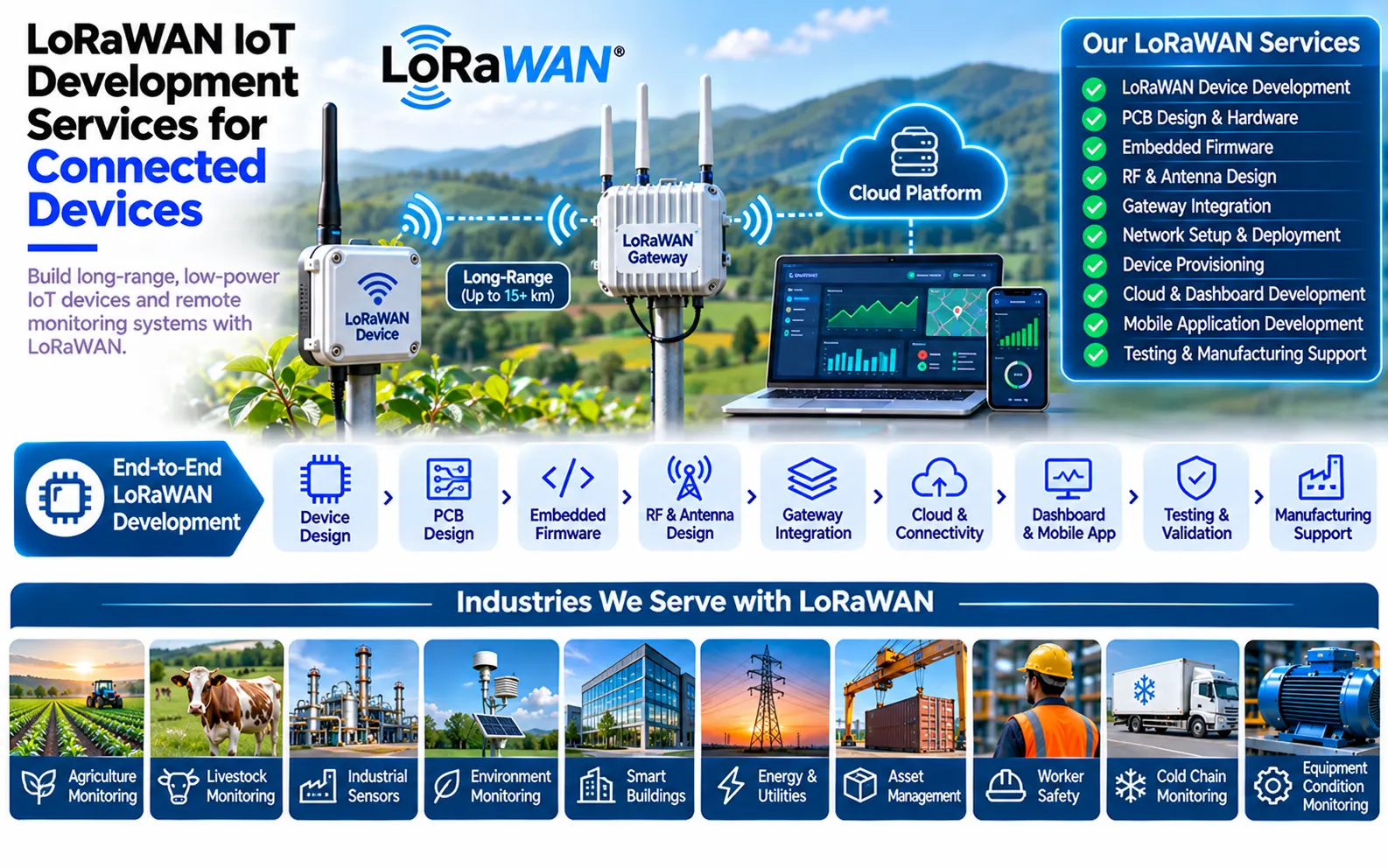
Custom LoRaWAN Device Development Services
A LoRaWAN product requires coordination between electronics, firmware, radio performance, gateways, network servers, cloud applications, and field deployment.
Our LoRaWAN development services can include:
We can develop a new LoRaWAN product, improve an inherited prototype, diagnose firmware or RF problems, integrate an existing device with a private network, or build the cloud and application layer around deployed hardware.
LoRa and LoRaWAN Are Not the Same
LoRa is a radio modulation scheme that enables long range, low power communications. LoRaWAN is a standardized networking protocol and network architecture designed to enable connectivity of LoRa-based devices via gateways and network servers.
While a proprietary LoRa point-to-point or mesh networking system is not necessarily a LoRaWAN system, the LoRaWAN specification describes classes of devices, device activation schemes, security keys, frames management, network operation, data rate adaptation, and communication between end devices, gateways, and network servers.
This differentiation is kept in mind while reviewing projects. For instance, a smart camera running on a custom LoRa mesh network can showcase sub-GHz communication experience but should not be considered a LoRaWAN system unless it employs the LoRaWAN protocol, compliant gateways, and a LoRaWAN Network Server.
Case Study: Private LoRaWAN Livestock Monitoring Device for a European Client
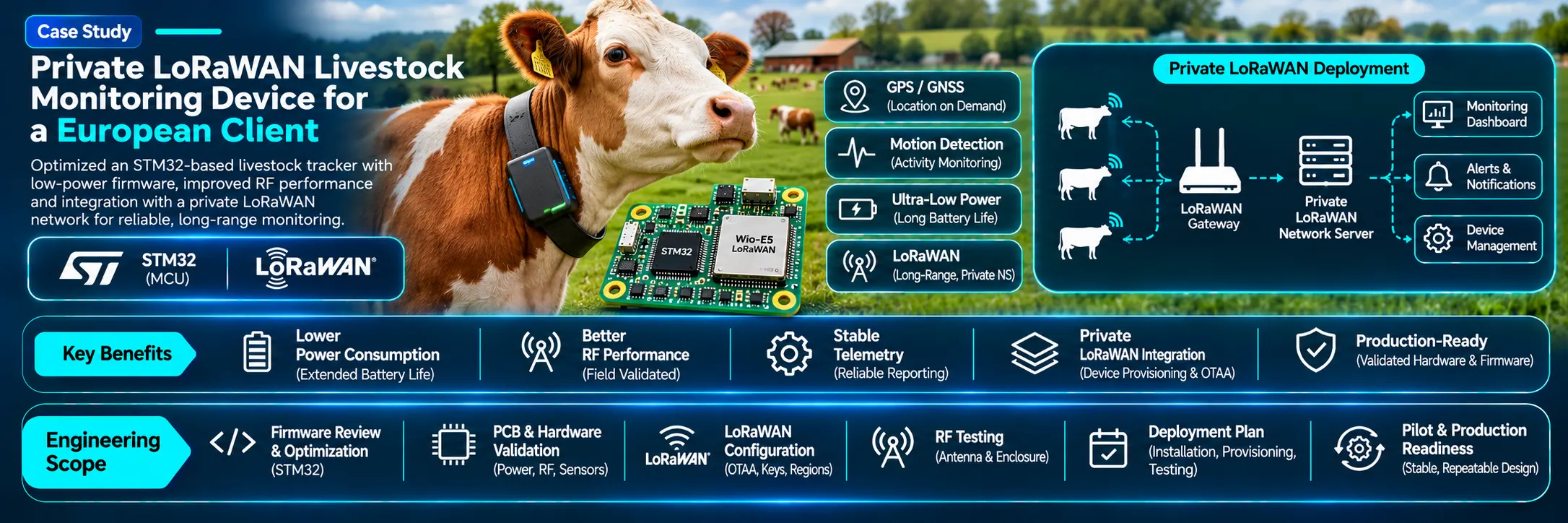
Private LoRaWAN Livestock Monitoring Device for a European Client
An existing livestock management prototype based on the STM32 microcontroller and LoRaWAN communication was presented to Adequate Infosoft by a client from Europe. The project was focused on the monitoring of cattle movement and reporting telemetry data across the wide agricultural areas.
Although the prototype was operational, the client required assistance with engineering before moving on to the pilot project and further mass production. The currently installed firmware had high power consumption, some telemetry processes were not stable, RF performance was not tested with the final enclosure, and connection with client's LoRaWAN network was not established.
Because the tracker would be mounted on livestock, regular charging or battery replacement was not practical. The firmware therefore needed to keep the device asleep for most of its operating cycle and wake only when required for sensor acquisition, scheduled reporting, or important events.
We carried out a formal review of the firmware of STM32 as well as its communication processes through LoRaWAN communication hardware that featured a Wio-E5 module being an STM32 based technology for LoRa communication.
Through the review, we found out firmware paths that made the device active worrying it would get connected more often than needed. Hence the systems were reviewed for making sure there was improvement in scheduling of tasks, sleep activating among other steps.
The monitoring system made use of LoRaWAN and GPS or GNSS location detection features through motion detection features. GPS is a feature that consumes significant amount of battery hence location acquiring could not happen on a continuous basis. Therefore, firmware was made to ensure that sensing, location acquisition and communication was conducted in accordance with the system's work requirements.
The engineering scope also included PCB and hardware validation. We reviewed power paths, radio connections, sensor interfaces, debug access, battery considerations, and hardware test points.
RF performance was tested with attention to antenna placement and enclosure effects. This was important because the device needed dependable communication across farmland where livestock could move through different terrain and vegetation conditions.
The client wanted a private LoRaWAN Network Server instead of relying on a public provider. We changed the approach to configure and provision devices to fit the private infrastructure, including calculating device identities, OTAA parameters, regional settings, security keys, and device-to-gateway and gateway-to-network server communication.
Additionally, we created a repeatable project plan that presents the device installation process, provisioning, device testings, network registration, RF validation, and telemetry confirmation.
As a result, the client received a stable, energy-efficient LoRaWAN device with customized RF performance and a private network and understanding of how the project will be realized.
Full case studyRelated LoRaWAN Projects We Have Delivered
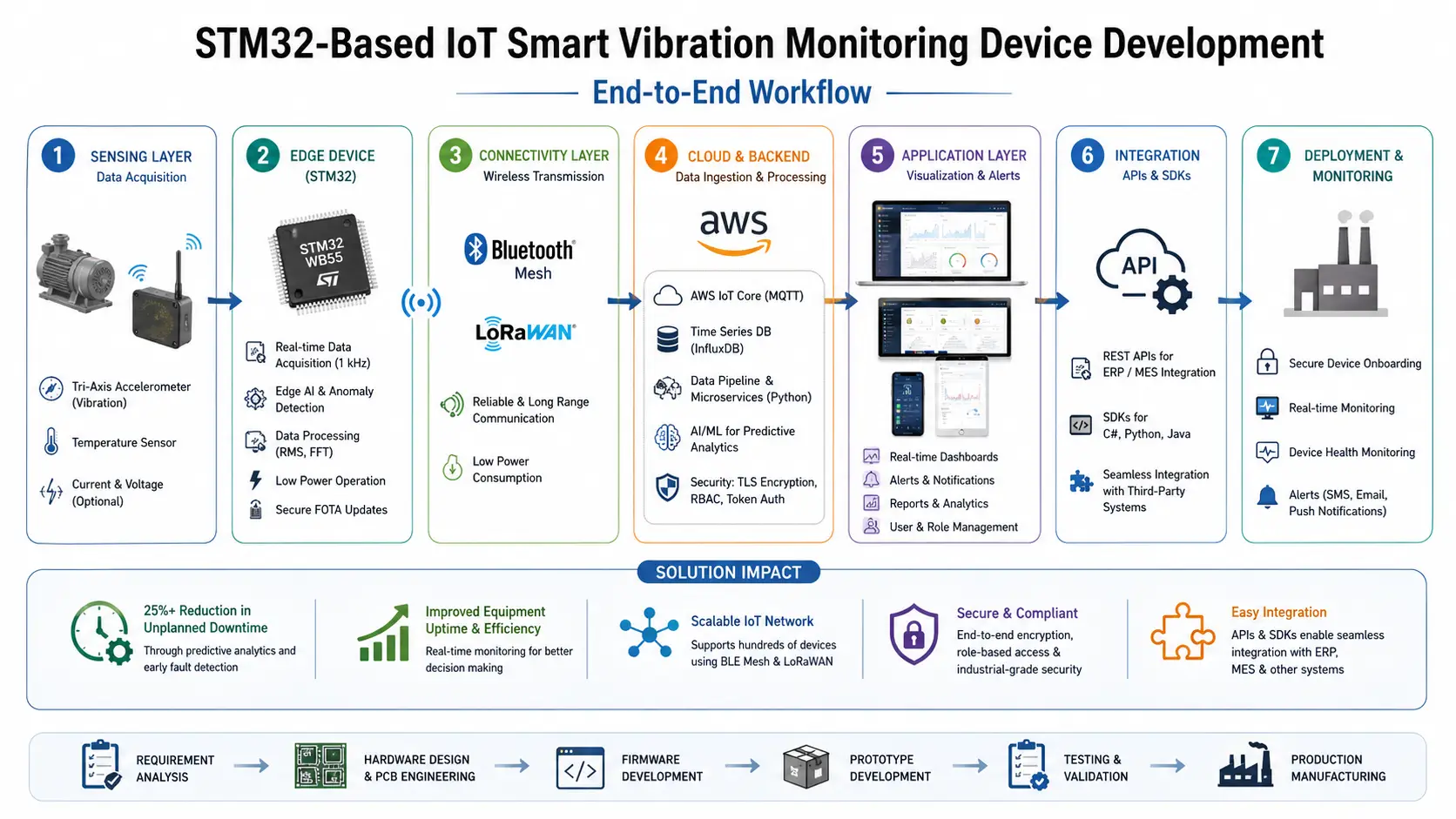
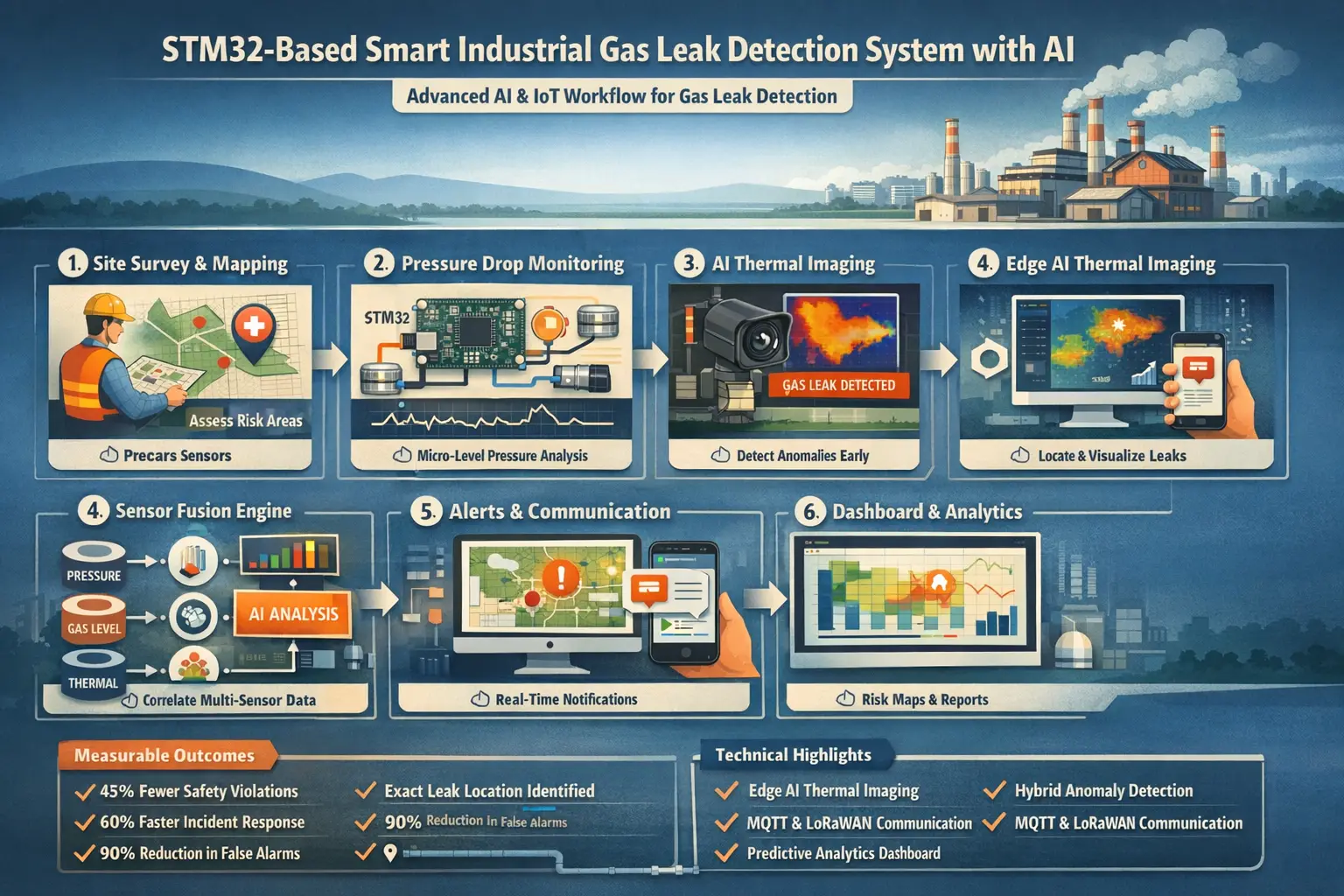
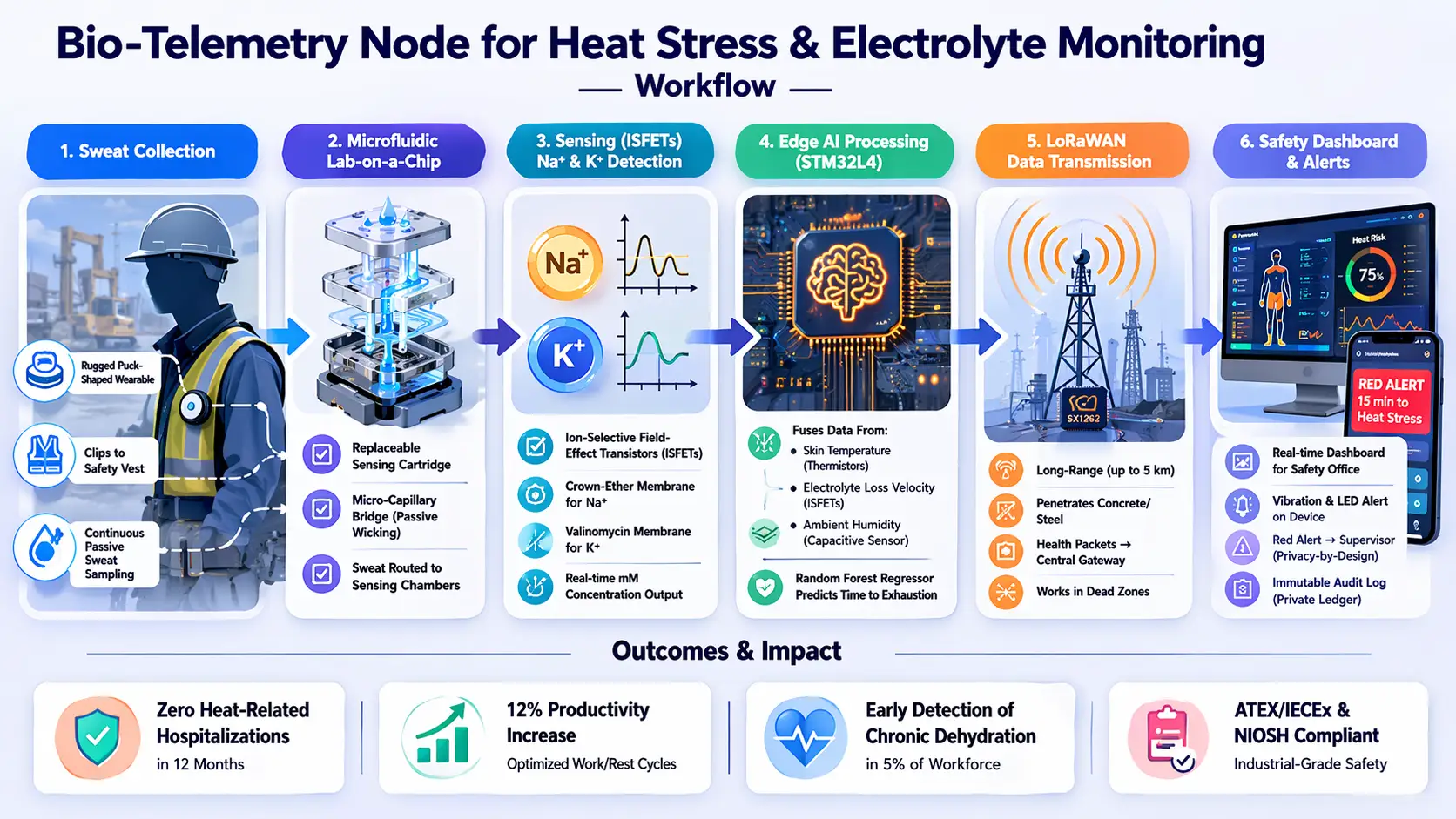
LoRaWAN Network Architecture
LoRaWAN End Devices
End node devices gather data from sensors that allow them to send small amounts of data through the LoRaWAN system. Some notable examples of these devices include temperature sensors, vibration monitors, cattle ear tags, electric meters, leak detection devices, environmental sensors, and machinery monitoring devices.
A battery powered device may spend a considerable amount of time in a low energy sleep mode. When required, it initiates its operations at a particular point of time or when a specific event occurs to gather the data from the sensors, process the information into a small message, wait for any information downlink, and again switch over to sleep mode.
LoRaWAN Gateways
LoRa radio packets coming from proximate devices are picked up by a gateway and sent to a network server using Ethernet, Wi-Fi, cellular network, or any other IP connectivity method.
Gateways usually are not responsible for business logic functions. Their main purpose is to connect LoRa radio communication with the IP network. Multiple gateways can receive the same message, with network server performing packet deduplication and making the right networking decision.
Gateway engineering may include:
LoRaWAN Network Server
The LoRaWAN Network Server is the management point for network communication. It authenticates devices, processes uplinks, removes duplicate packets, organizes downlinks, manages data rates, and sends application payloads further.
We can implement either commercial or open network server platforms, depending on the project needs. In private deployments, the infrastructure can be ChirpStack, while other networks can adopt managed LoRaWAN or operator networks.
Application Server and Cloud Platform
The application layer decodes device payloads and turns them into useful business information.
A custom cloud platform may provide:
Private LoRaWAN Network Development
A private LoRaWAN network gives an organization control over gateways, devices, the network server, security keys, data routing, and application integration.
It can be appropriate for farms, industrial plants, campuses, warehouses, mines, utility installations, commercial properties, and other managed sites where an organization can deploy its own gateway coverage.
Our private LoRaWAN network services can include:
A private network does not necessarily provide the optimal choice in all projects. There can be situations where a managed or public network is more suitable due to the fact that devices are moving across regions beyond the gateway coverage of the organization.
LoRaWAN Firmware Development
LoRaWAN firmware must manage radio communication without compromising sensor acquisition, battery life, security, or device reliability.
Our firmware engineering can include:
The appropriate message format should be determined by the data rather than sending large, repetitive JSON documents over the radio. Compact binary payloads can reduce airtime and energy use. The cloud payload decoder can convert those values into named fields for applications and dashboards.
Engineering Products with Low-Power LoRaWAN
Merely using a low power radio does not result in long life of batteries. The whole device has to be analyzed.
Some of the important factors to be considered are:
We use power profiling to determine the current drawn during sleeping, acquiring the sensor, processing, communication and recovery.
RF, Antennas, and Coverage Engineering
Communication range is much more than just the chosen LoRa transceiver.
Factors like landforms, structures, plants, the antenna height, housing materials, transmission losses, gateway site, area transmission limitations, communication frequency, spreading factor, bandwidth, and interference, and budget of the system must also be accounted for.
Our RF services can be:
LoRaWAN Applications We Develop
Our development services can support:
Our LoRaWAN Development Process
1. Requirements and Feasibility
We analyze the sensor data, period of reporting, range, geographical area, power supply, battery life target, mobility, environmental conditions, and availability of the gateway.
2. Network and Device Architecture
We establish the end device, LoRa transceiver/module, stack, device class, device activation, gateway architecture, network server, security architecture, payload architecture, and cloud service integration.
3. Proof of Concept
Proof of concept proves the connectivity, sensor data capture, network registration, decoding of payload, and initial power behavior.
4. Hardware and Firmware Development
We design or evolve the PCB design, RF design, antenna design, firmware, sensor driver, power management, provisioning, and debugging capabilities.
5. Private Network and Cloud Service Integration
The gateways and network server are configured while payload codecs, MQTT protocol, APIs, databases, dashboards, and alerts are built.
6. Field Testing
Devices are tested in the intended environment to evaluate signal strength, SNR, packet delivery, gateway coverage, power consumption, reconnect behavior, and telemetry reliability.
7. Pilot and Production Support
We assist with device provisioning, manufacturing files, firmware builds, test procedures, deployment documentation, and pilot troubleshooting.
Develop Your Custom LoRaWAN IoT Solution
For anyone looking to work with a LoRaWAN Development company, Adequate Infosoft can assist you in designing, enhancing, testing, and deploying the entire solution.
We offer LoRaWAN Device Development, embedded Firmware, Radio Frequency, antennas engineering, deployment of a private network, gateways, cloud connection, dashboards and application and manufacturing support.
Let's talk about your devices, sensors, operating region, required range, reporting frequency, battery-life requirement, gateways and scale of deployment.
Frequently Asked Questions
It is used for long-range, low-power communication where devices send relatively small amounts of sensor or status data. Typical use cases are agriculture, utilities, monitoring, metering, industrial sensing, and asset tracking.
Yes. We can help with component selection, schematic & PCB layout design, antennas, firmware, sensor drivers, power optimization, gateways, private network infrastructure, cloud integration, dashboards, applications, and production preparations.
Yes. We can set up gateways, private network-server infrastructure, device profiles, OTAA joining procedure, payload codecs, MQTT/webhook integration, dashboards, and monitoring.
Yes. ChirpStack is used for private LoRaWAN networks when it meets the needs of your project regarding hosting, integration, and operations.
In OTAA, a device can join the network and get session keys in a special join process. In ABP, a device already knows its session parameters. The best choice depends on the particular product and implementation, but in most cases, OTAA is preferable for new projects because it provides a managed joining procedure.
Battery life depends on hardware sleep current, sensors, transmission frequency, payload size, data rate, retransmissions, downlinks, GPS usage, battery chemistry, temperature, and firmware design. It should be estimated and measured for the specific device.
LoRaWAN was not intended for continuous transmission of images or videos; however, applications requiring high-bandwidth media transmission should use some other communication channel or do preprocessing and then transmit processed data using LoRaWAN.
Remote firmware updates are technically possible, but they need thorough planning related to flash memory management, boot loader protection, multicast/fragmentation capabilities, airtime, power consumption, regional limitations, recovery mechanism, and size of update packets.
LoRaWAN can operate indoors, although its effectiveness will depend on many factors including construction materials, equipment used, interference, positioning of gateways, installation of antennas, and desired coverage.
Technical References