














 Mean Stack Development
 Vue JS Development
 Javascript Development
 React JS Development
 Angular JS Development
 Next JS development
 Java Development
 Python Development
 Django Development
 Cherrypy Development
 C# Development
 ASP.NET Development
 NodeJS Development
 Laravel Development
 CodeIgniter Development
 Zend Development
 Ruby on Rails Development
 CakePHP Development
 PHP Website Development
 Symfony Development
 Drupal Development
 Joomla Development
 Wordpress Development
 .NET Nuke Development
 Kentico
 Umbraco
 .NET MAUI Development
 Xamarin Application Development
 iOS Application Development
 Android Application Development
 Android Wear App Development
 Ionic Development
 iBeacon Application Development
 Universal Windows Platform (UWP)
 Kotlin Application Development
 Swift Application Development
 Flutter Application Development
 PWA Application Development
 Flutter Health Tech & Wearable App Development Company
 React Native Health Tech Wearable App Development
 Offshore Software Development
 Custom Application Development
 Front-End Development
 Full Stack Development
 AI & Machine Learning
 Custom CRM Solutions
 Flask Software Development
 Electron JS Development
 ChatGPT Development
 Telemedicine App Development
 Build Smart Telemedicine Platform
 Beauty & Salon App Solutions
 Hire Workato Experts
 Magento Development
 Magento 2.0 Development
 Magento Enterprise
 Shopping Cart Development
 Prestashop Development
 Shopify Development
 Open Cart Development
 WooCommerce Development
 BigCommerce Development
 NopCommerce Development
 Virto Commerce Development
 AspDotNetStorefront Development
 .NET Application Development
 Microsoft Dynamics CRM
 VB .NET Development
 Sharepoint Migration
 ASP.NET Core Development
 ASP.NET MVC Development
 AJAX Development
 Agile Development
 Microsoft Bot
 Microsoft Blazor
 Microsoft Azure Cognitive
 HTML 5
 UI/UX Design
 Graphic Design
 Adobe Photoshop
 XML Application Development
 Cloud Computing Solutions
 Azure Cloud App Development
 AWS Development
 Google Cloud Development
 Certified AWS IoT Services Developers
 DevOps Consulting & Development
 Kubernetes Consulting & Services
 SQL Programming Development
 MySQL Development
 MongoDB Development
 Big Data
 Robotic Process Automation
 Social Media Marketing
 Search Engine Optimization
 QA Testing
 Software Testing
 Software Security
 Maintenance And Support
 I.T. Consulting Services
 Business Intelligence
 YII Development
 Data Analysis
 Alexa Skills Development
 On Demand App for Mobile repairing services
 On Demand App for Car Service Booking
 On Demand App for Cleaning Services
 On Demand App for Pharmacy
 On Demand Dedicated Developers
 On Demand Lawyer App Development








 Nuki Smart Lock
 Salto Smart Lock
 TTlock Smart Lock
 NFC App Development
 Custom IOT Enabled Smart Lock
 Smart Locker Solutions
 Hospital Smart Lock Systems
 Hotel Smart Lock Systems
 Smart Home & Office Locks
 Smart Access for Schools & Colleges
 Unloc Smart Lock Integration
 Yale & August Smart Lock Integration
 Populife Smart Lock Integration
 Smart Lock Hardware Development
 Dairy IoT Solutions
 Agri IoT & AI Solutions
 Weather & Climate Solutions
 Water & Waste Management Solutions
 RaspBerry Pi
 Firmware Software Development
 ESP 32 Software Development
 Embedded Development
 Internet of Things
 Smart IoT Development
 IoT Sensor Integration & Development Solutions
 Smart IoT System Development for HVAC
 Tuya IoT App Development
 Particle IoT SDK
 IoT Development with AI
 Smart Pet GPS Tracker
 Dairy GPS Tracking Solutions
 GPS Fleet Management Software
 Car Rental & Subscription Solutions
 Car Buy & Sell Marketplace Development
 AI-Powered Car Wash App Development
 PCB Design & Fabrication
 IoT AC Automation
 AI–IoT Painting Solutions
 IoT Wearable Hardware & App Development
 HVAC Automation & AI Control Systems
 Smart Home IoT Engineering
 AI Embedded Systems
 AI Hardware Design Service
 Advanced IoT Hardware & Firmware Development
 Device Driver Development Services
 NXP i.MX RT Firmware & Hardware Services
 Microchip PIC & AVR Development
 Hire IoT Architects
 IoT Cloud & Infrastructure Solutions
 Infineon XMC / AURIX Development Services
 Matter & Thread IoT Services
 Native IoT Mobile App Development (BLE & Wi-Fi)
 Snapdragon IoT Firmware Development
 Renesas RA/RX Firmware Services
 Silicon Labs EFR32 Development Services
 Smart Wearable App Development
 Smart IoT Meters
 Smart Healthcare Wearable App Development
 Health Care Monitoring System
 Fitness Tracking App Development
 Smart Home Automation Apps
 nRF PCB Design
 ESP32 PCB Design
 Embedded Wearables Engineers
 Rental Property Management System
 Building Management System
 Smart Lighting Development
 Infineon Semiconductor Firmware Development Services
 Custom Camera Development: Hardware, Firmware & PCB Prototyping
 Smart Security Camera SDK
 Nordic Semiconductor SDK
 Infineon SDK
 Arduino SDK
 NFC Lock Integration
 Kerong Lock Integration
 IoT & AI Solutions for Manufacturing
 Smart Inventory & Logistics Solution
 Food & Beverage Industry Solutions
 Smart Hospitality Solutions
 Smart Property Management
 Custom Smart Home IOT SDK
 Smart IoT & AI in Healthcare
 AI-Powered Security Solutions
 Smart Home Safety & AI
 Veterinary Clinic Management (AI)
 Pet Care System (AI & IoT)
 Pet Training & Adoption (AI)
 Healthcare IoT Development
 Event Management Software
 Money Remittance App
 Money Lending App Development
 Utility and Bill Payment App
 IoT Mobile App Development (Flutter & React Native)
 AI & IoT Retail Solutions
 Smart EV App Development
 Smart Solar IoT & AI Solutions
 IoT-Based Energy Systems
 Smart Energy & Utilities Solutions
 6G Solutions
 IoT Security Solutions
 AI-Powered Lottery App Development
 AI-Sports Fitness Club Management
 Travel
 Real Estate
 Medical & Healthcare
 e-Learning
 Consumer Products
 Finance
 Automobile
 Media & Entertainment
 Billing Software
 Enterprise Resource Planning (ERP)
 Augumented & Virtual Reality
 Point of Sale(POS) Development
 Learning Management System
 EV Charging Solutions
 About Us
 Partners & Certifications
 Quality Assurance
 Our Clients & Testimonials
 Development Process
 Our Products
 Social Responsibility
 Work Ethics
 Vision & Mission
 Awards
 Live Project Demos
 Contact Us
 Case Studies
 Portfolio
 Blog
Blog
STM32 USB Type-C & USB Power Delivery Development
Even if the connector is USB-C it does not necessarily mean that the specific device is USB Power Delivery capable. Due to the reversible connection, power negotiation in this case has to be done as well: the device has to sense the correct orientation, advertise/ request the respective profiles, manage VBUS, handle role switching, withstand faults, etc.
Adequate Infosoft provides STM32 USB PD development services for chargers, industrial equipment, battery devices, docks, gateways, medical electronics, and embedded controllers.
We combine firmware, power-path design, protection, PCB development, protocol debugging, and interoperability testing.
Let's Work Together!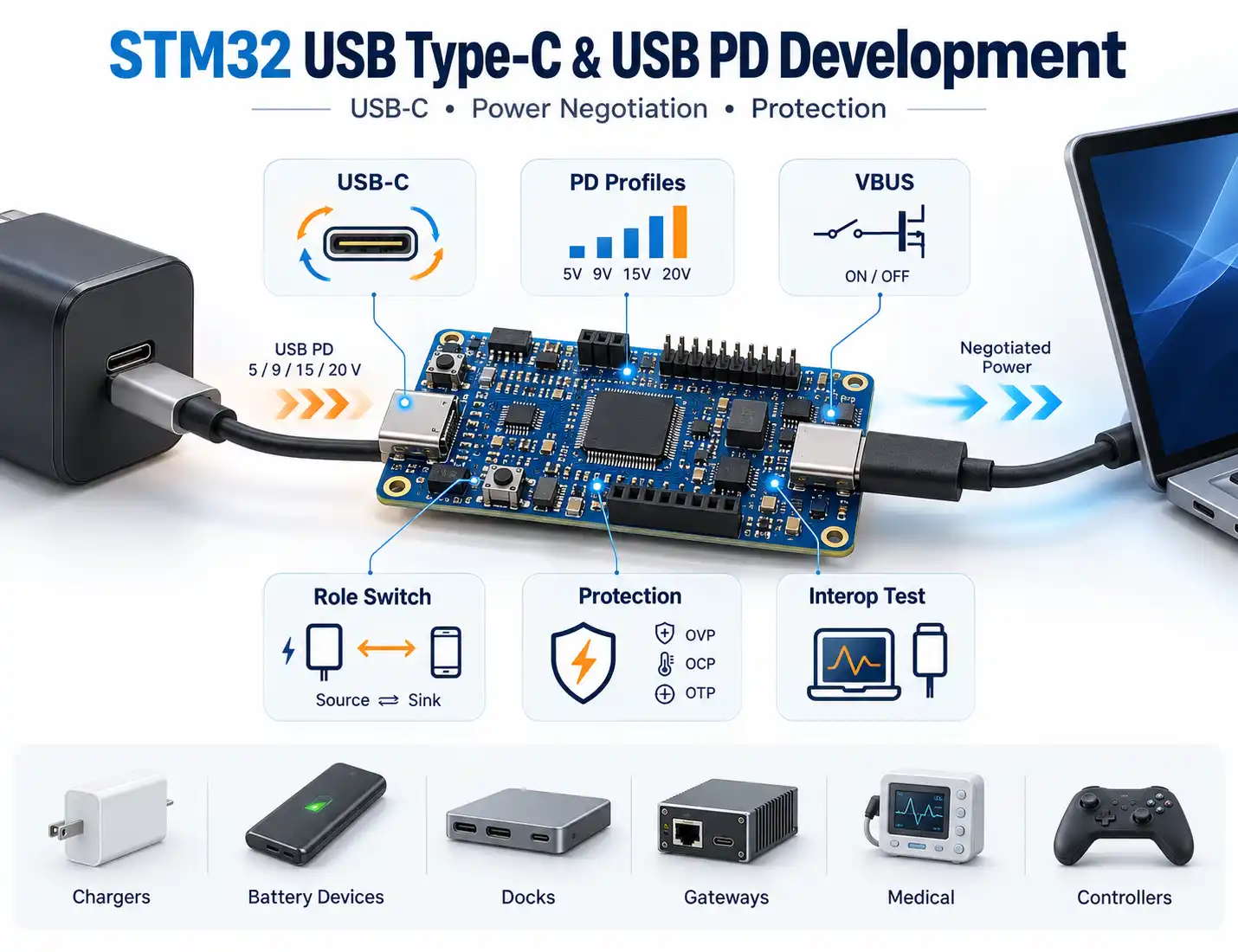
Begin with the Port's Job, Not the MCU
The first decision to make about architecture is what each USB-C port will do. There are three types of ports in terms of power: a power sink accepts energy; a power source provides energy; and a dual-role power port does both.
The data side is completely different: an item may be classified as either a USB host, a USB device, or a dual-role data item. The power swap is different from the data swap.
This ensures that there is no confusion about terms such as "USB-C," "USB data," or "USB PD" because they should not be used interchangeably.
| Port requirement | Firmware responsibility | Typical product |
|---|---|---|
| Sink | Evaluate source capabilities, request a safe PDO or PPS level, monitor contract and detach | Battery product, instrument, embedded computer |
| Source | Advertise supported PDOs, enforce current limits, enable and discharge VBUS | Charger, hub, powered accessory |
| Dual-role power | Toggle roles, establish policy, perform swaps, prevent unsafe transitions | Dock, power bank, portable terminal |
| Alternate Mode | Discover identity and SVIDs, exchange VDMs, control mux and orientation | Display, dock, specialized interface |
Why STM32 Is a Strong USB-C PD Platform
According to ST, over 500 STM32 devices utilize its USB Type-C Power Delivery intellectual property (UCPD). This technology takes care of the CC interface and USB PD communication so designers do not need an external PD controller.
Currently, ST's ecosystem supports USB PD 3.1, Standard Power Range messages (up to 100 W), Extended Power Range messages (up to 240 W), Programmable Power Supply, and Alternate Mode.
These are ecosystem capabilities; not every STM32 or reference circuit supports every feature. EPR requires a power path, protection, connector, cable, spacing, thermal design, and policy suitable for higher voltage. We verify the MCU, package, peripherals, memory, temperature grade, and middleware against the product.
Starting points include UCPD-equipped STM32G0, STM32G4, STM32L5, and STM32U5 devices. Selection depends on whether the MCU manages only the port or also the converter and application.
Relevant Adequate Infosoft Project Evidence
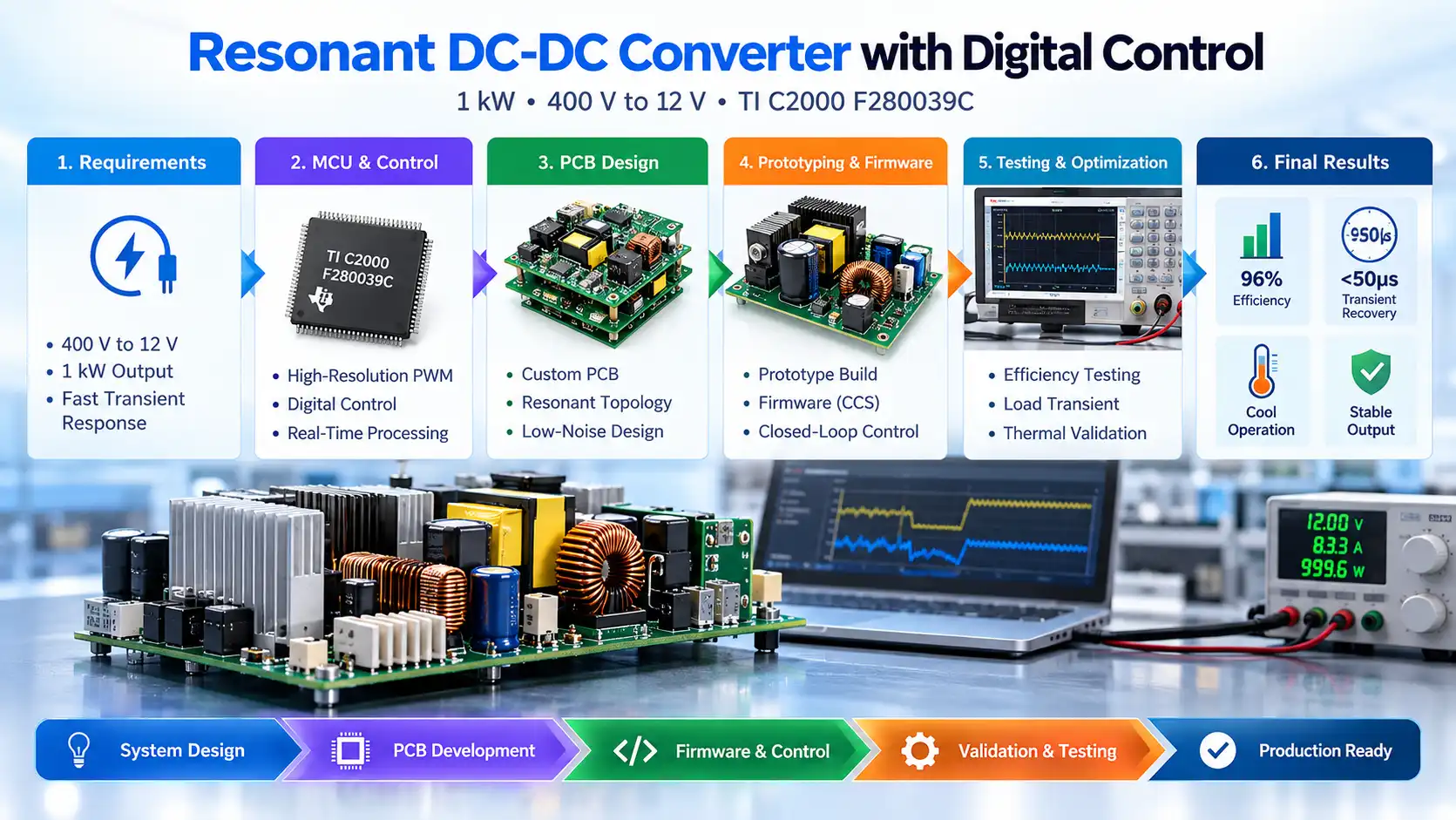
Resonant DC-DC converter with high-resolution digital control
Adequate Infosoft has created a prototype of a resonant converter with an output of 1 kW and a voltage range of 400 V to 12 V using the TI C2000 F280039C. The published case describes the custom PCB design, PWM implementation, synchronized measurements, closed-loop control, noise suppression, transient tuning, and thermal validation methods used.
These fields can also be directly applied in the case where the USB PD source or sink must negotiate with a custom conversion stage.
Read Case Study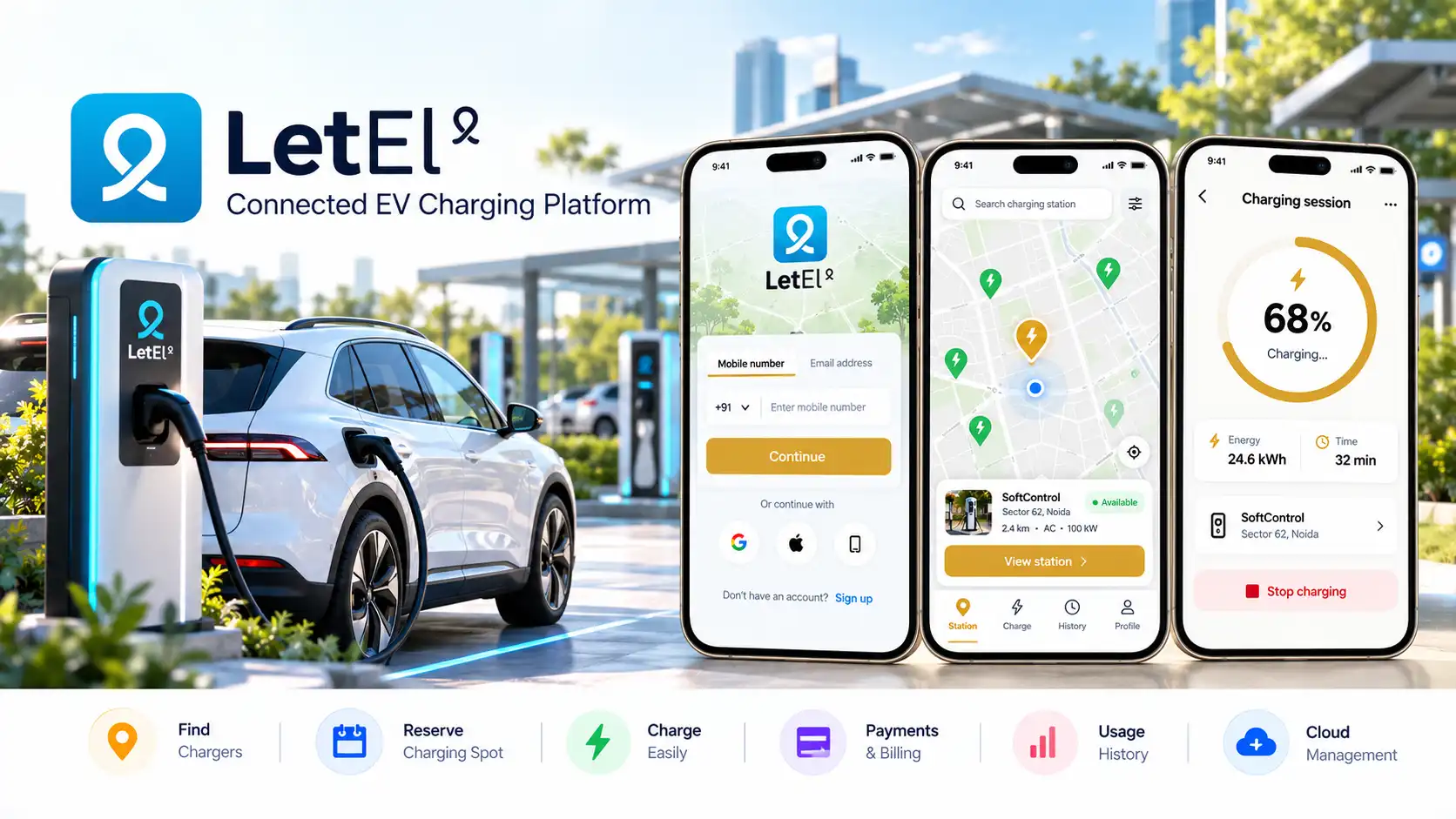
LetEl connected EV charging platform and custom charger
The LetEl project involved integration of custom charging hardware with software, mobile apps, ASP.NET Core-based backend, PostgreSQL, Microsoft Azure, payments, and multiple vendor operations.
While EV charging is not about USB PD, this case shows how Adequate Infosoft brings together power electronics, device control, cloud services and operational records, and user workflows. This will represent invaluable experience for managed charging devices and connected power products.
Read Case Study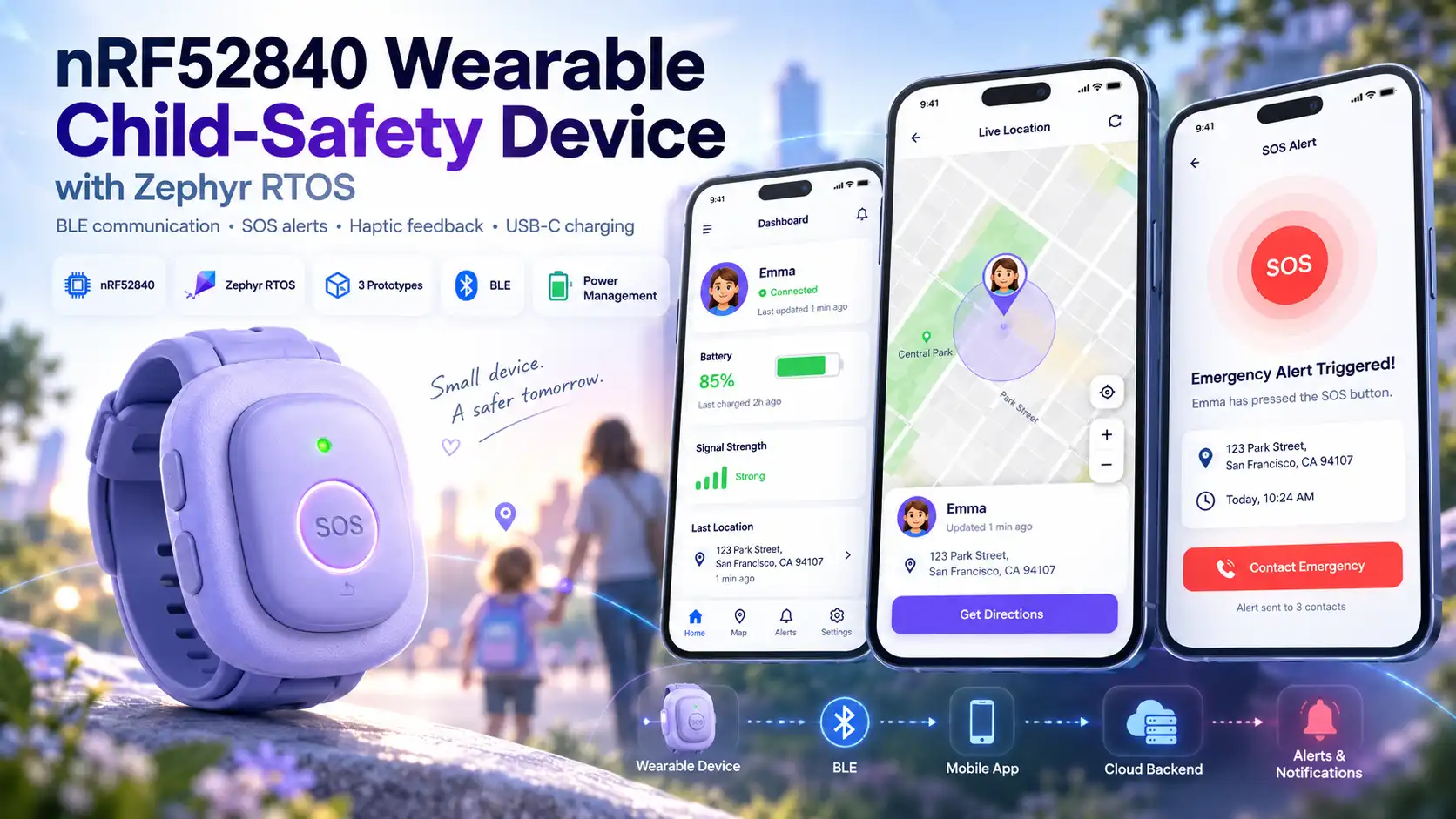
USB-C rechargeable nRF52840 child-safety wearable
For a compact child-tracking device, the team delivered PCB and firmware engineering, BLE connectivity, positioning, a .NET MAUI companion application, and USB-C recharging.
This was not presented as a negotiated USB PD design; its relevance is honest and specific: battery-product integration, compact USB-C charging hardware, power budgeting, mobile connectivity, and movement from prototype toward a production-ready product.
Read Case StudyFirmware That Owns the Entire Power Contract
We cover everything from driving the cables to shutting down devices when they are done. We set the STM32Cube USB PD middleware, UCPD low-level interface, device policy manager, board support package and application for the product. The firmware implements:
both source and sink Power Data Objects including fixed supplies and alternative extra PDOs; connecting, disconnecting, orientation, also cable and capabilities realization; selecting agreements related to battery charged state, temperature, load, and converter limits; supporting Power Role Swap, Data Role Swap, and Fast Role Swap on hardware; implementing the requests for PPS to speed up the charging or to have variable voltage loads; User Defined Messages and using Alternate Mode sequences; working on dead battery, low power mode, waking up, resetting and restoring devices; managing data from multiple connected devices sharing powers and prioritizing their use; monitoring and analyzing telemetry and diagnostics data and creating event logs and firmware updates.
The policy engine must never request or advertise what the hardware cannot sustain. We connect negotiated limits to converter control, battery state, system load, connector temperature, and fault logic. The application can shed load if available power falls.
For broader embedded delivery, visit our custom firmware development services page.
USB-C Power Hardware and PCB Engineering
There is no way to use firmware to overcome the challenges facing poor power delivery design. Sink designs can require input switches or regulators, VBUS and current sensing, reverse current blocking, discharge characteristics, and dead battery support.
For sources, the requirement is controlled VBUS generation, current limiting, discharge, back feeding prevention, and stable supply over all specified profiles. Dual role ports handle both signalling without compromising performance.
ST's TCPP portfolio separates protection by role: TCPP01-M12 for sink, TCPP02-M18 for source, and TCPP03-M20 for dual-role power. X-CUBE-TCPP provides STM32Cube-compatible examples and expansion-board support. We use reference designs as evidence, then adapt them to the product's actual voltage, current, transient, thermal, EMC, mechanical, and supply constraints.
Hardware engineering services include connector selection, ESD and overstress protection, VBUS switching, CC protection, sensing, converter integration, schematics, layout, BOM review, prototypes, and test points.
Layout review checks things like return path, high current copper, hot-plug transients, switching, heat dissipation, creepages, and isolation.
Finding Faulty Conduct While Debugging USB PD
A failure can happen randomly such as a working charger being connected to one device and a non-working one being connected to another, or one cable working fine, and the other cable that has suddenly changed. To understand the error, we must have a proper sequence.
We can do this by monitoring the oscilloscope CC signal and comparing it with protocol messages. Another excellent tool to show the port characteristics, PD packets, VBUS, and IBUS data, as well as contracts negotiations in case of ST-based chips is STM32CubeMonitor-UCPD.
The protocol analyzer can supply us with information about the cable, while also providing the timestamp that is linked with the current protocol messages.
Testing included tests with the attachment released while working, switching, wire changes, and other complex situations that have been adhered to during development.
Interoperability, Safety, and Compliance Preparation
Completing a bench test with one laptop charger is just the first step. We will generate an interoperability matrix based on power supply, devices, cables, current/voltage profiles, operating systems, and kinds of equipment.
The preparation for compliance may consist of USB-IF requirements for electricity and protocol, USB Type-C/PD specifications, test safety, EMC, ESD, environmental and regional regulations.
Adequate Infosoft can prepare configuration records, tracing logs, test procedures, problems reports, hardware changes, and reproducible firmware versions for the laboratory work and pre-compliance. The procedures for certification and patent approval are a responsibility of the owner and certified certification bodies.
Build a USB-C Product That Works Beyond the Lab
Share the required input and output profiles, port roles, data modes, battery or converter architecture, target STM32, mechanical constraints, and compliance markets. Adequate Infosoft will convert them into a practical STM32 USB Type-C and Power Delivery development plan with measurable acceptance criteria.
Frequently Asked Questions
Yes, multiple STM32 microcontrollers have UCPD, which will sufficiently handle CC-line and PD communication. However, protective measures in accordance with the role assigned to the device must be taken, along with ensuring a secure VBUS power path in the design.
Yes. We audit spare pins and peripherals, power architecture, connector design, flash/RAM, boot flow, and current firmware. Depending on those findings, the solution may use integrated UCPD, another STM32 as a port manager, or an external controller.
Yes, we distinguished both data roles and power roles separately before combining it with USB device or host classes.
Editorial Sources
- STMicroelectronics — STM32 solutions for USB Type-C and Power Delivery
- STMicroelectronics — X-CUBE-TCPP software package
- STMicroelectronics — AN5225, Introduction to USB Type-C Power Delivery for STM32 MCUs and MPUs
- STMicroelectronics — STM32CubeMonitor-UCPD
- USB Implementers Forum — USB specifications and compliance resources