












 Mean Stack Development
 Vue JS Development
 Javascript Development
 React JS Development
 Angular JS Development
 Next JS development
 Java Development
 Python Development
 Django Development
 Cherrypy Development
 C# Development
 ASP.NET Development
 NodeJS Development
 Laravel Development
 CodeIgniter Development
 Zend Development
 Ruby on Rails Development
 CakePHP Development
 PHP Website Development
 Symfony Development
 Drupal Development
 Joomla Development
 Wordpress Development
 .NET Nuke Development
 Kentico
 Umbraco
 .NET MAUI Development
 Xamarin Application Development
 iOS Application Development
 Android Application Development
 Android Wear App Development
 Ionic Development
 iBeacon Application Development
 Universal Windows Platform (UWP)
 Kotlin Application Development
 Swift Application Development
 Flutter Application Development
 PWA Application Development
 Flutter Health Tech & Wearable App Development Company
 React Native Health Tech Wearable App Development
 Offshore Software Development
 Custom Application Development
 Front-End Development
 Full Stack Development
 AI & Machine Learning
 Custom CRM Solutions
 Flask Software Development
 Electron JS Development
 ChatGPT Development
 Telemedicine App Development
 Build Smart Telemedicine Platform
 Beauty & Salon App Solutions
 Hire Workato Experts
 Magento Development
 Magento 2.0 Development
 Magento Enterprise
 Shopping Cart Development
 Prestashop Development
 Shopify Development
 Open Cart Development
 WooCommerce Development
 BigCommerce Development
 NopCommerce Development
 Virto Commerce Development
 AspDotNetStorefront Development
 .NET Application Development
 Microsoft Dynamics CRM
 VB .NET Development
 Sharepoint Migration
 ASP.NET Core Development
 ASP.NET MVC Development
 AJAX Development
 Agile Development
 Microsoft Bot
 Microsoft Blazor
 Microsoft Azure Cognitive
 HTML 5
 UI/UX Design
 Graphic Design
 Adobe Photoshop
 XML Application Development
 Cloud Computing Solutions
 Azure Cloud App Development
 AWS Development
 Google Cloud Development
 Certified AWS IoT Services Developers
 DevOps Consulting & Development
 Kubernetes Consulting & Services
 SQL Programming Development
 MySQL Development
 MongoDB Development
 Big Data
 Robotic Process Automation
 Social Media Marketing
 Search Engine Optimization
 QA Testing
 Software Testing
 Software Security
 Maintenance And Support
 I.T. Consulting Services
 Business Intelligence
 YII Development
 Data Analysis
 Alexa Skills Development
 On Demand App for Mobile repairing services
 On Demand App for Car Service Booking
 On Demand App for Cleaning Services
 On Demand App for Pharmacy
 On Demand Dedicated Developers
 On Demand Lawyer App Development









 Nuki Smart Lock
 Salto Smart Lock
 TTlock Smart Lock
 NFC App Development
 Custom IOT Enabled Smart Lock
 Smart Locker Solutions
 Hospital Smart Lock Systems
 Hotel Smart Lock Systems
 Smart Home & Office Locks
 Smart Access for Schools & Colleges
 Unloc Smart Lock Integration
 Yale & August Smart Lock Integration
 Populife Smart Lock Integration
 Smart Lock Hardware Development
 Dairy IoT Solutions
 Agri IoT & AI Solutions
 Weather & Climate Solutions
 Water & Waste Management Solutions
 RaspBerry Pi
 Firmware Software Development
 ESP 32 Software Development
 Embedded Development
 Internet of Things
 Smart IoT Development
 IoT Sensor Integration & Development Solutions
 Smart IoT System Development for HVAC
 Tuya IoT App Development
 Particle IoT SDK
 IoT Development with AI
 Smart Pet GPS Tracker
 Dairy GPS Tracking Solutions
 GPS Fleet Management Software
 Car Rental & Subscription Solutions
 Car Buy & Sell Marketplace Development
 AI-Powered Car Wash App Development
 PCB Design & Fabrication
 IoT AC Automation
 AI–IoT Painting Solutions
 IoT Wearable Hardware & App Development
 HVAC Automation & AI Control Systems
 Smart Home IoT Engineering
 AI Embedded Systems
 AI Hardware Design Service
 Advanced IoT Hardware & Firmware Development
 Device Driver Development Services
 NXP i.MX RT Firmware & Hardware Services
 Microchip PIC & AVR Development
 Hire IoT Architects
 IoT Cloud & Infrastructure Solutions
 Infineon XMC / AURIX Development Services
 Matter & Thread IoT Services
 Native IoT Mobile App Development (BLE & Wi-Fi)
 Snapdragon IoT Firmware Development
 Renesas RA/RX Firmware Services
 Silicon Labs EFR32 Development Services
 Smart Wearable App Development
 Smart IoT Meters
 Smart Healthcare Wearable App Development
 Health Care Monitoring System
 Fitness Tracking App Development
 Smart Home Automation Apps
 nRF PCB Design
 ESP32 PCB Design
 Embedded Wearables Engineers
 Rental Property Management System
 Building Management System
 Smart Lighting Development
 Infineon Semiconductor Firmware Development Services
 Custom Camera Development: Hardware, Firmware & PCB Prototyping
 Smart Security Camera SDK
 Nordic Semiconductor SDK
 Infineon SDK
 Arduino SDK
 NFC Lock Integration
 Kerong Lock Integration
 IoT & AI Solutions for Manufacturing
 Smart Inventory & Logistics Solution
 Food & Beverage Industry Solutions
 Smart Hospitality Solutions
 Smart Property Management
 Custom Smart Home IOT SDK
 Smart IoT & AI in Healthcare
 AI-Powered Security Solutions
 Smart Home Safety & AI
 Veterinary Clinic Management (AI)
 Pet Care System (AI & IoT)
 Pet Training & Adoption (AI)
 Healthcare IoT Development
 Event Management Software
 Money Remittance App
 Money Lending App Development
 Utility and Bill Payment App
 IoT Mobile App Development (Flutter & React Native)
 AI & IoT Retail Solutions
 Smart EV App Development
 Smart Solar IoT & AI Solutions
 IoT-Based Energy Systems
 Smart Energy & Utilities Solutions
 6G Solutions
 IoT Security Solutions
 AI-Powered Lottery App Development
 AI-Sports Fitness Club Management
 Travel
 Real Estate
 Medical & Healthcare
 e-Learning
 Consumer Products
 Finance
 Automobile
 Media & Entertainment
 Billing Software
 Enterprise Resource Planning (ERP)
 Augumented & Virtual Reality
 Point of Sale(POS) Development
 Learning Management System
 EV Charging Solutions
 About Us
 Partners & Certifications
 Quality Assurance
 Our Clients & Testimonials
 Development Process
 Our Products
 Social Responsibility
 Work Ethics
 Vision & Mission
 Awards
 Live Project Demos
 Contact Us
 Case Studies
 Portfolio
 Blog
Blog
STM32 Firmware Migration & Legacy Code Modernization Services
Legacy firmware often contains years of product knowledge: workarounds, calibration procedures, fixes and manufacturing processes which are not really documented anywhere else. Starting from scratch means throwing all that knowledge away.
Leaving it untouched can make component replacement, security maintenance and feature delivery increasingly difficult.
Adequate Infosoft provides STM32 firmware migration services for organizations that need to move an established product to a newer STM32 MCU, update an old STM32Cube or RTOS baseline, replace obsolete middleware, rescue an inherited codebase or create a maintainable architecture around working legacy logic.
Our approach preserves verified behavior first, then improves the code through measured, reviewable changes.
We work across bare-metal and RTOS-based sensors. It also includes devices that work in industries. The tasks can also include the revision of PCB, Bootloader, connectivity, cloud interface and testing in production.
Let's Work Together!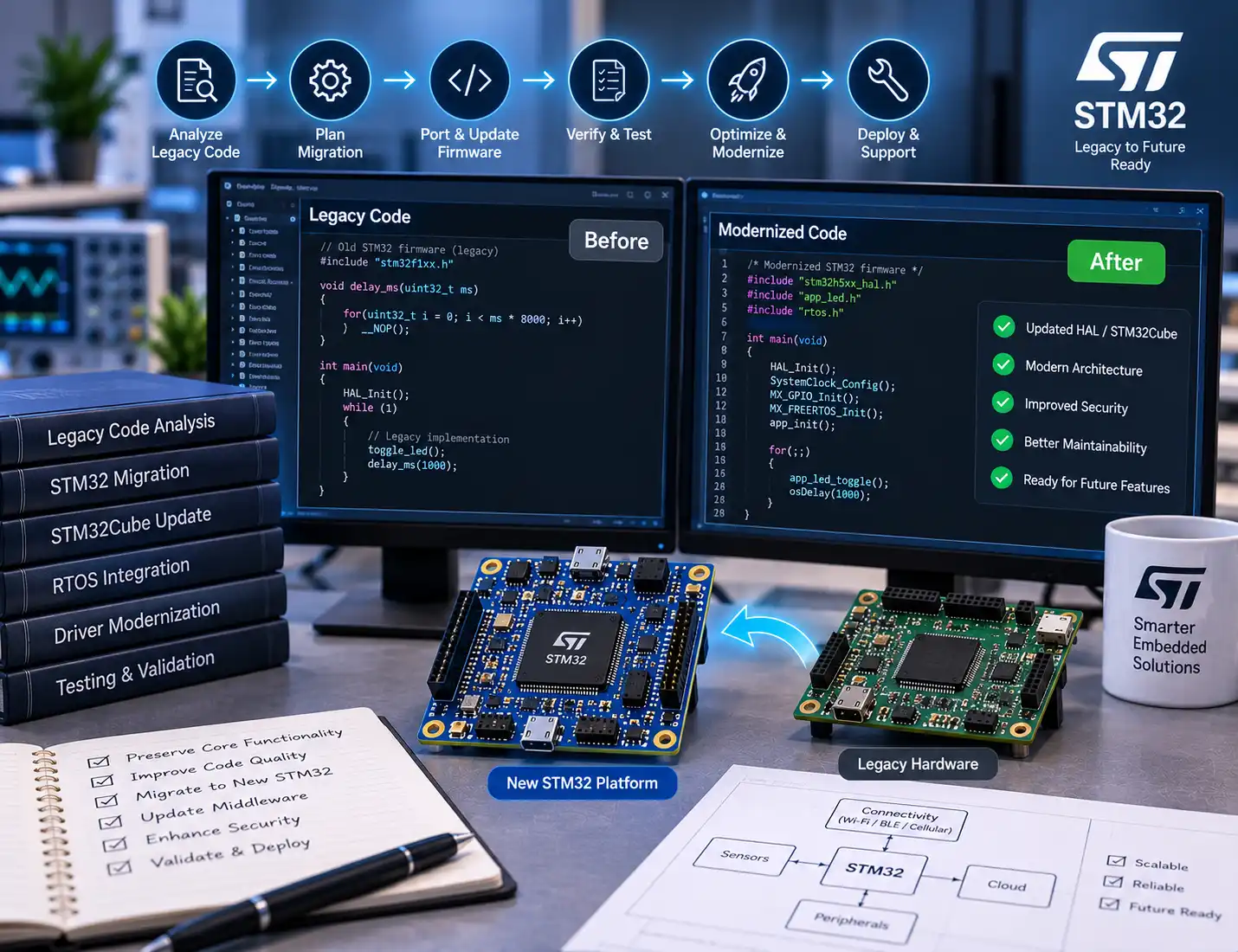
What Is STM32 Firmware Migration?
STM32 firmware migration is transferring the embedded software while keeping the behavior of the product intact. It might need new MCU families, clock tree, pinout, peripheral instance, compiler, IDE, STM32Cube package, HAL/LL version, RTOS, protocol stack, and PCB revision
Refactoring may keep the hardware unchanged while tightly coupled code, blocking routines, global state or duplicated drivers become testable modules. Modernization can combine both activities while retaining sound existing decisions.
| Modernization need | Typical trigger | Primary evidence of success |
|---|---|---|
| MCU-to-MCU port | Obsolescence, shortage, cost or performance | Peripheral equivalence and hardware regression tests |
| Cube/HAL/LL update | Old vendor package or compiler | Clean build plus functional and timing parity |
| RTOS migration | Unsupported kernel or scaling limits | Task, queue, ISR and worst-case timing validation |
| Architecture refactor | Slow changes and fragile coupling | Module tests, clearer interfaces and stable behavior |
| Security modernization | New threat or customer requirement | Verified boot/update chain, key handling and recovery |
| Board-revision adaptation | New sensors, memory or pinout | Bring-up report and interface-level acceptance tests |
Why Legacy STM32 Projects Become Difficult to Change
When the MCU is not available, you may need to track dependencies more widely. The generated code may include changes done manually, the application may call the HAL directly, business logic may be embedded in interrupts, and the timing of the DMA and peripherals may depend on some undocumented sequencing as well.
Moreover, protocols may rely on compiler packing, and the production tools may expect fixed addresses in flash memory.
A clean build does not guarantee a successful porting process. ADC gain, PWM dead time, watchdog window, wakeup, bootloader handover and communication timings may change without being noticed. Hence, we first define the expected behavior of the process under different circumstances.
Relevant Adequate Infosoft Case Studies
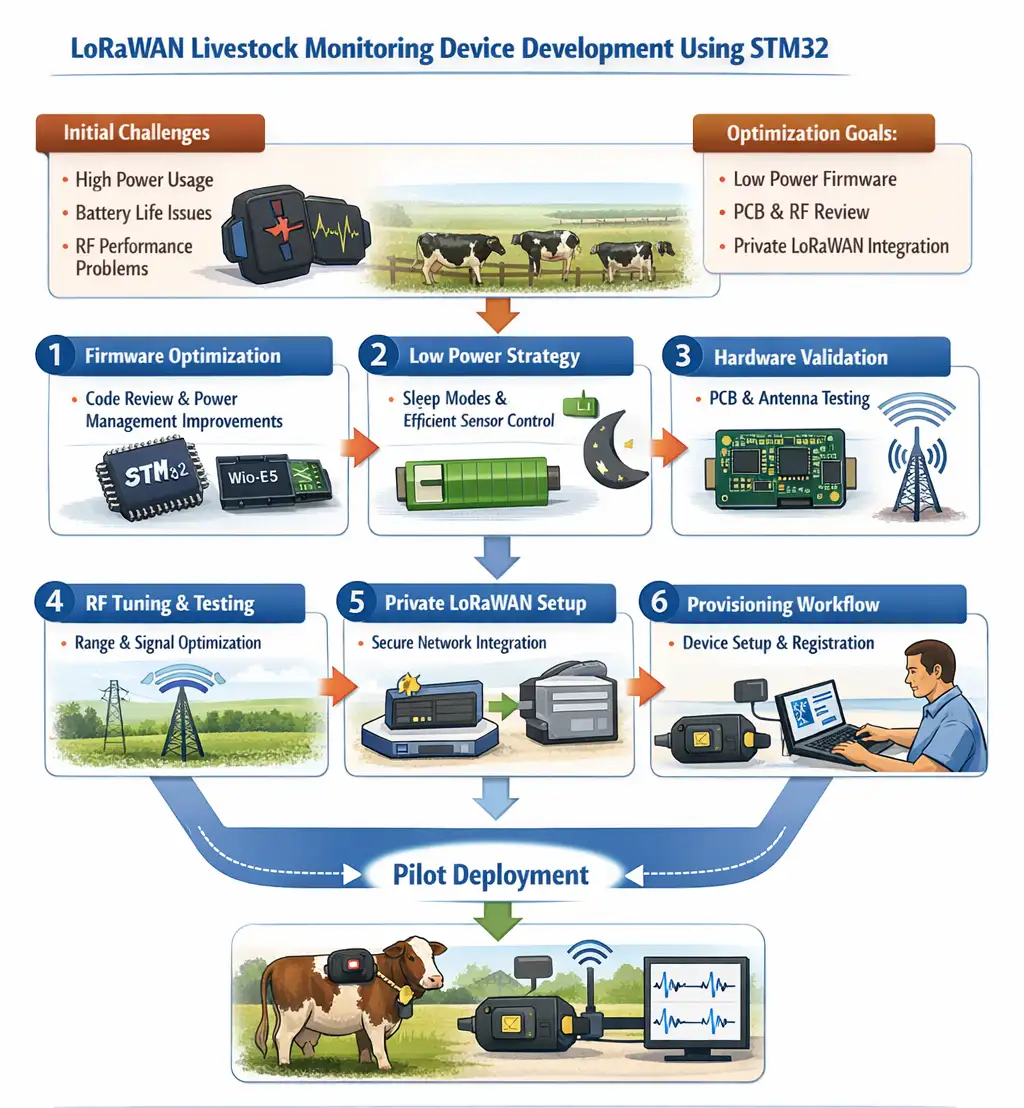
Existing STM32 LoRaWAN device refactoring and optimization
In our LoRaWAN livestock monitoring device case study, the client already had STM32 hardware and firmware.
We found unnecessary wake-ups and inefficient scheduling, optimized sensing and transmission, refactored modules and added diagnostics.
Private-network integration, RF validation, manufacturing review and pilot preparation followed. This directly demonstrates improvement of an inherited embedded product.
Read Case Study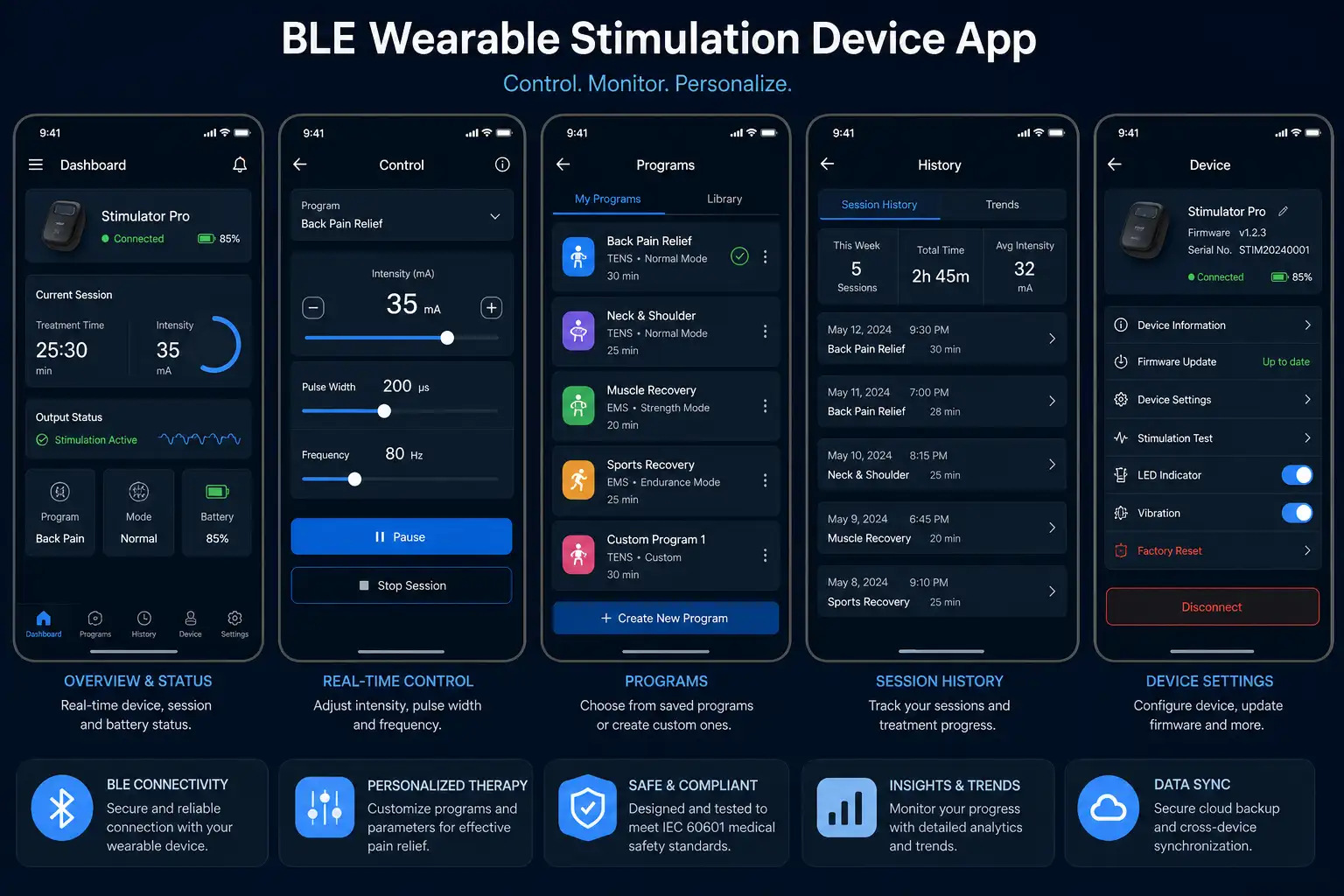
STM32L496 medical wearable remediation
The IEC 60601 wearable remediation case study covered an existing STM32L496VG/nRF52840 design.
The coverage of this project covers aspects such as the design assessment, the realization of isolation, EMC, battery security, BLE co-existence, and testing process but not MCU shifting.
Its applicability lies in the technique: base-line the present design, isolate its causes, redesign concerned subsystems and verify them.
Read Case StudyThese examples can be indicative of two modernization realities: enhancing maintenance as well as energy efficiency of existing firmware, and fixing system-level hazards in an established STM32 design.
Our STM32 Migration and Refactoring Services
Codebase and dependency assessment
We inventory sources, generated files, build settings, libraries, licenses, bootloader, memory map, boards and production utilities. Review identifies race conditions, stack risks, coupling, blocking paths and hardware assumptions.
We inventory sources, generated files, build settings, libraries, licenses, bootloader, memory map, boards and production utilities. Review identifies race conditions, stack risks, coupling, blocking paths and hardware assumptions. The migration map separates reusable logic from code requiring adaptation.
If artifacts are incomplete, we distinguish known facts, inferences and measurements so assumptions do not become silent requirements.
STM32 series and board transfer
Choose between various STM32F, G, H, L, U, WB and WL series with regard to peripherals, memory, capabilities, power consumption, package, temperature, security features, and product lifecycle.
Choose between various STM32F, G, H, L, U, WB and WL series with regard to peripherals, memory, capabilities, power consumption, package, temperature, security features, and product lifecycle.
Our work involves working with clocks, GPIOs, ADCs/DACs, timers, PWM, DMA, serial buses, USB, CAN/FDCAN, Ethernet, external memory, caches, MPUs, and low-power modes. We check altered interrupts, DMA routing, and peripheral operation against specifications and errata.
Upgrades of STM32Cube, HAL, LL and toolchain
While initialization code is generated through STM32CubeMX, Cube packages provide HAL, low-layer drivers, and middleware. Through regeneration, the impact of modification of the files can be traced in the output.
While initialization code is generated through STM32CubeMX, Cube packages provide HAL, low-layer drivers, and middleware. Through regeneration, the impact of modification of the files can be traced in the output.
We compare the regenerated output by isolating user code and pinning versions. Compiler warnings, optimization, linker scripts, startup assembly, and library performance are all analyzed.
Modernization of bare-metal and RTOS solutions
Changing an RTOS impacts scheduling, interrupt, timeout, memory, and program concurrency, not just APIs. We map out tasks, queues, synchronization, and ISR interactions before making the switch to a different OS.
Changing an RTOS impacts scheduling, interrupt, timeout, memory, and program concurrency, not just APIs. We map out tasks, queues, synchronization, and ISR interactions before making the switch to a different OS.
For bare-metal systems, we stick to a deterministic superloop, implement state machines and begin to use an RTOS only if necessary.
Modular refactoring and testability
We separate board support, drivers, services, protocols and application logic. Narrow hardware interfaces, state machines and consistent errors replace scattered access and flags. Small commits distinguish structural from behavioral changes.
We separate board support, drivers, services, protocols and application logic. Narrow hardware interfaces, state machines and consistent errors replace scattered access and flags. Small commits distinguish structural from behavioral changes.
Host tests cover calculations, parsers and state transitions; hardware-in-the-loop tests cover peripherals, timing and electrical behavior. Both are needed for credible regression evidence.
Bootloader, update and security improvement
Modernization might incorporate signing for images, secure boot support, secure keys, rollback control, control of debug policy and robust update patterns.
Modernization might incorporate signing for images, secure boot support, secure keys, rollback control, control of debug policy and robust update patterns. Image structure, relocation of vector, versioning and power loss recovery will be checked for all valid and old images.
A Migration Process Built Around Evidence
We adopt an explicit approach in our delivery model:
-
1
Baseline
Get a running build and gather all information regarding the functional, timing, memory, power, and interface characteristics.
-
2
Risk map
Identify dependencies and make decisions on what has to be kept, wrapped, substituted, or discarded.
-
3
Minimal port
Start the system, verify clock and memory operation, and then start the peripheral devices one by one.
-
4
Behavioral equivalent
Perform the test with the use of the same inputs, same protocol, timing, and hardware.
-
5
Refactoring stage
Enhance the architecture with ensured bounded change.
-
6
Hardening stage
Add the necessary diagnostic features and controls in accordance with a particular system.
-
7
Release stage
Deliver repeatable builds and traceable testing outcomes with instructions on manufacturing or upgrading processes.
This prevents an uncontrolled rewrite. Suspected legacy defects are characterized first; each approved correction receives a separate test.
Regression Testing for Actual Embedded Dangers
Testing may involve boot timing, reset issues, memory, stack margins, active throughput, interrupt latency, control timing issues, change in protocols, accuracy of the sensors, change in several power modes, and process of the update recovery.
Test equipment in the form of logic analyzer, oscilloscopes, current traces and protocol traces help in the work.
Negative tests feature configuration corruption, issue with brownout, bus timeout problem, sensor disconnection, storage overflow, problem with networking, and interruption of update process. Soak tests establish rollover, leak, queue growth, and drift.
Deliverables That Equip Your Team to Own the Outcome
Deliverables encompass assessments, dependencies maps, moved sources, cube configurations, hardware board support packages, bootloaders, build manufacturing pipelines, interpretation notes, tests results, performance comparison results, release reports, and limitations registry.
We document the history, the reasons for decisions made, and third-party licenses as well as differentiate generated code from code maintained. Your engineers get build and debugging guidelines they can reproduce.
Frequently Asked Questions
As a rule, staged refactoring is a safer option when there is some undocumented functionality in the working system. A complete rewrite may be warranted if there are some issues connected with licensing, changes in the architecture or safety problems. In this paper, we will consider both options and assess them against testing coverage and risk of regression.
Yes, if usable source and hardware exist. We reproduce the build and recover behavior from code, traces, protocols and tests. Missing information is recorded as risk.
Yes, when the target fits. Such ports may involve caches, DMA, clocks, memory, analog behavior, security and power. Effort follows from a peripheral and behavioral gap analysis.
Not unless this is due to some requirements. BLE characteristics, CAN frames, Modbus registers, USB specifications, payloads, etc. can all be verified against "golden vectors." Necessary changes are versioned.
Editorial Resources