















 Mean Stack Development
 Vue JS Development
 Javascript Development
 React JS Development
 Angular JS Development
 Next JS development
 Java Development
 Python Development
 Django Development
 Cherrypy Development
 C# Development
 ASP.NET Development
 NodeJS Development
 Laravel Development
 CodeIgniter Development
 Zend Development
 Ruby on Rails Development
 CakePHP Development
 PHP Website Development
 Symfony Development
 Drupal Development
 Joomla Development
 Wordpress Development
 .NET Nuke Development
 Kentico
 Umbraco
 .NET MAUI Development
 Xamarin Application Development
 iOS Application Development
 Android Application Development
 Android Wear App Development
 Ionic Development
 iBeacon Application Development
 Universal Windows Platform (UWP)
 Kotlin Application Development
 Swift Application Development
 Flutter Application Development
 PWA Application Development
 Flutter Health Tech & Wearable App Development Company
 React Native Health Tech Wearable App Development
 Offshore Software Development
 Custom Application Development
 Front-End Development
 Full Stack Development
 AI & Machine Learning
 Custom CRM Solutions
 Flask Software Development
 Electron JS Development
 ChatGPT Development
 Telemedicine App Development
 Build Smart Telemedicine Platform
 Beauty & Salon App Solutions
 Hire Workato Experts
 Magento Development
 Magento 2.0 Development
 Magento Enterprise
 Shopping Cart Development
 Prestashop Development
 Shopify Development
 Open Cart Development
 WooCommerce Development
 BigCommerce Development
 NopCommerce Development
 Virto Commerce Development
 AspDotNetStorefront Development
 .NET Application Development
 Microsoft Dynamics CRM
 VB .NET Development
 Sharepoint Migration
 ASP.NET Core Development
 ASP.NET MVC Development
 AJAX Development
 Agile Development
 Microsoft Bot
 Microsoft Blazor
 Microsoft Azure Cognitive
 HTML 5
 UI/UX Design
 Graphic Design
 Adobe Photoshop
 XML Application Development
 Cloud Computing Solutions
 Azure Cloud App Development
 AWS Development
 Google Cloud Development
 Certified AWS IoT Services Developers
 DevOps Consulting & Development
 Kubernetes Consulting & Services
 SQL Programming Development
 MySQL Development
 MongoDB Development
 Big Data
 Robotic Process Automation
 Social Media Marketing
 Search Engine Optimization
 QA Testing
 Software Testing
 Software Security
 Maintenance And Support
 I.T. Consulting Services
 Business Intelligence
 YII Development
 Data Analysis
 Alexa Skills Development
 On Demand App for Mobile repairing services
 On Demand App for Car Service Booking
 On Demand App for Cleaning Services
 On Demand App for Pharmacy
 On Demand Dedicated Developers
 On Demand Lawyer App Development











 Nuki Smart Lock
 Salto Smart Lock
 TTlock Smart Lock
 NFC App Development
 Custom IOT Enabled Smart Lock
 Smart Locker Solutions
 Hospital Smart Lock Systems
 Hotel Smart Lock Systems
 Smart Home & Office Locks
 Smart Access for Schools & Colleges
 Unloc Smart Lock Integration
 Yale & August Smart Lock Integration
 Populife Smart Lock Integration
 Smart Lock Hardware Development
 Dairy IoT Solutions
 Agri IoT & AI Solutions
 Weather & Climate Solutions
 Water & Waste Management Solutions
 RaspBerry Pi
 Firmware Software Development
 ESP 32 Software Development
 Embedded Development
 Internet of Things
 Smart IoT Development
 IoT Sensor Integration & Development Solutions
 Smart IoT System Development for HVAC
 Tuya IoT App Development
 Particle IoT SDK
 IoT Development with AI
 Smart Pet GPS Tracker
 Dairy GPS Tracking Solutions
 GPS Fleet Management Software
 Car Rental & Subscription Solutions
 Car Buy & Sell Marketplace Development
 AI-Powered Car Wash App Development
 PCB Design & Fabrication
 IoT AC Automation
 AI–IoT Painting Solutions
 IoT Wearable Hardware & App Development
 HVAC Automation & AI Control Systems
 Smart Home IoT Engineering
 AI Embedded Systems
 AI Hardware Design Service
 Advanced IoT Hardware & Firmware Development
 Device Driver Development Services
 NXP i.MX RT Firmware & Hardware Services
 Microchip PIC & AVR Development
 Hire IoT Architects
 IoT Cloud & Infrastructure Solutions
 Infineon XMC / AURIX Development Services
 Matter & Thread IoT Services
 Native IoT Mobile App Development (BLE & Wi-Fi)
 Snapdragon IoT Firmware Development
 Renesas RA/RX Firmware Services
 Silicon Labs EFR32 Development Services
 Smart Wearable App Development
 Smart IoT Meters
 Smart Healthcare Wearable App Development
 Health Care Monitoring System
 Fitness Tracking App Development
 Smart Home Automation Apps
 nRF PCB Design
 ESP32 PCB Design
 Embedded Wearables Engineers
 Rental Property Management System
 Building Management System
 Smart Lighting Development
 Infineon Semiconductor Firmware Development Services
 Custom Camera Development: Hardware, Firmware & PCB Prototyping
 Smart Security Camera SDK
 Nordic Semiconductor SDK
 Infineon SDK
 Arduino SDK
 NFC Lock Integration
 Kerong Lock Integration
 IoT & AI Solutions for Manufacturing
 Smart Inventory & Logistics Solution
 Food & Beverage Industry Solutions
 Smart Hospitality Solutions
 Smart Property Management
 Custom Smart Home IOT SDK
 Smart IoT & AI in Healthcare
 AI-Powered Security Solutions
 Smart Home Safety & AI
 Veterinary Clinic Management (AI)
 Pet Care System (AI & IoT)
 Pet Training & Adoption (AI)
 Healthcare IoT Development
 Event Management Software
 Money Remittance App
 Money Lending App Development
 Utility and Bill Payment App
 IoT Mobile App Development (Flutter & React Native)
 AI & IoT Retail Solutions
 Smart EV App Development
 Smart Solar IoT & AI Solutions
 IoT-Based Energy Systems
 Smart Energy & Utilities Solutions
 6G Solutions
 IoT Security Solutions
 AI-Powered Lottery App Development
 AI-Sports Fitness Club Management
 Travel
 Real Estate
 Medical & Healthcare
 e-Learning
 Consumer Products
 Finance
 Automobile
 Media & Entertainment
 Billing Software
 Enterprise Resource Planning (ERP)
 Augumented & Virtual Reality
 Point of Sale(POS) Development
 Learning Management System
 EV Charging Solutions
 About Us
 Partners & Certifications
 Quality Assurance
 Our Clients & Testimonials
 Development Process
 Our Products
 Social Responsibility
 Work Ethics
 Vision & Mission
 Awards
 Live Project Demos
 Contact Us
 Case Studies
 Portfolio
 Blog
Blog
NXP EV Battery Management System Firmware Development
Adequate Infosoft provides NXP EV battery management system firmware development for electric vehicles, low-voltage lithium packs, high-voltage battery systems and connected energy products.
Our engineers convert raw voltage, current and temperature measurements into dependable protection decisions, state estimates, diagnostics and vehicle-network data.
For projects based on the NXP S32K344 and MC33772C, we support requirements, board bring-up, monitoring drivers, SOC and SOH algorithms, balancing, contactor control, CAN FD, UDS, bootloaders, cybersecurity and validation.
The result is a maintainable BMS platform designed around the pack architecture, chemistry, safety goals and production test strategy.
Why Use the S32K344 and MC33772C for BMS Development?
The S32K344 is included in the automotive MCU family called S32K3, developed by NXP. Its Arm Cortex-M7 architecture, lockstep function, automotive connectivity option, Hardware Security Engine and functional-safety ecosystem makes it suitable for real-time, safety-related control tasks.
NXP applies this component in its RD-K344BMU reference design of the high-voltage battery management unit, as well as in the RD33772C14VEVM reference design of the fourteen-Volt battery management unit.
The MC33772C is a six-channel lithium-ion battery cell controller for automotive and industrial applications.
According to NXP, it performs differential cell-voltage, current and temperature measurements, supports coulomb counting, provides embedded balancing transistors and diagnostics, and communicates through standard SPI or an isolated daisy chain.
The device can therefore serve as a local monitor in a compact low-voltage pack or as part of a distributed measurement architecture.
The choice of a component still depends on a product. The MC33772C component monitors from three to six cells in NXP’s fourteen-Volt reference design, whereas large EV battery packs can apply several monitoring components or a mixed architecture of CMU and BJB.
Before choosing the architecture, we analyze the number of cells, isolation areas, accuracy of measurement, voltage of the battery pack, current of balancing, number of thermal sensors, communication schemes and safety objectives.
Relevant Adequate Infosoft Case Studies
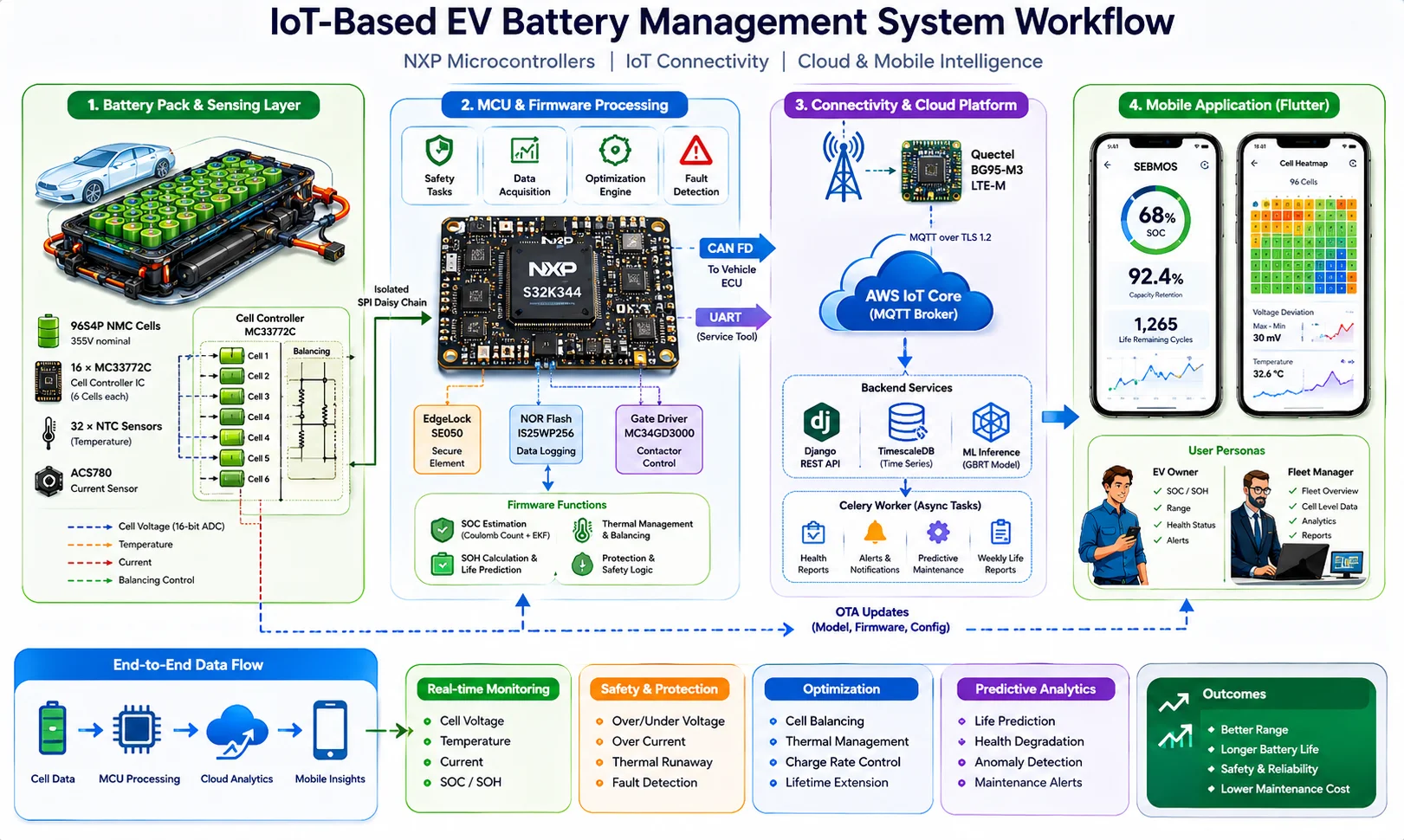
IoT-Based EV Battery Management System Using NXP Microcontrollers and Flutter
In our recent work, we utilized NXP S32K344 and MC33772C for the architecture of EV battery monitoring and optimization system.
The project involved cell voltage and temperature acquisition, current measurements, passive balancing, SOC/SOH processing and thermal supervision with CAN FD interface where cellular telemetry provided the information to a cloud platform and a Flutter application was used to provide views for the owner or fleet.
Read the EV BMS case study.
Lithium Battery IoT App with CAN-Bus and BLE
For a lithium-battery manufacturer, we developed a branded Flutter application that receives BMS data through a BLE module connected to a CAN-based battery system.
The solution included device discovery, reconnection, MTU handling, notification subscriptions, checksum validation and binary-packet parsing.
It shows the integration work required after core BMS firmware is complete: making live battery metrics reliable and understandable on iOS and Android.
View the lithium battery app project.
Solar and Home Battery Monitoring Platform
We created a .NET MAUI production platform for solar energy generation monitoring, power consumption, and battery monitoring.
Despite the fact the software was created for stationary energy and not the control of transport vehicles, it still showcases our expertise in the field of real-time monitoring of battery and power information transfer through various connected systems.
Read the solar and home battery case study.Our NXP BMS Firmware Development Services
MC33772C Driver and Measurement Acquisition
In the area of driver development and integration, we specialize in the development of low-level drivers that help in device startup, register access, synchronized sampling, cell voltage acquisition, extra temperature inputs, measurement of pack current, coulomb counting, and monitoring diagnostic status.
The acquisition layer manages communication timeout, CRC or protocol errors, out-of-range data, and device chain errors instead of forwarding unverified data to the application.
Our work can include offset and gain calibration, shunt scaling, NTC conversion tables, plausibility limits, filtering and timestamp alignment. Startup sequencing prevents incomplete initialization from being mistaken for a valid battery state.
State of Charge, State of Health and Power Limits
Charge state is not merely a matter of voltage measurement as we use various SOC estimators based on methods such as coulomb counting, open-circuit-voltage correction and application-specific parameters including capacity, temperature, charge efficiency and sensor drift.
State of health employs techniques for determining usable capacity, cycle history and changes in resistance. Charge and discharge limitations are determined by voltage, temperature, current and safety.
Algorithms are chemistry-specific and calibrated against representative pack data; a generic estimator is not production-ready without such validation.
Cell Balancing and Thermal Management
The firmware detects an unequal active status, identifies suitable cells and completes passive balancing within values of voltage, current and temperature.
Scheduling helps prevent balancing in inappropriate conditions and registers the reasons for either enabling, postponing or stopping balancing for each channel. Timer monitoring and feedback checking make it possible to avoid turning balancing into a source of excessive heat.
Thermal-management logic evaluates individual sensors, pack gradients and rate of change.
It can coordinate pumps, fans, heaters or charge-rate requests and apply derating before a hard shutdown is required. Sensor open-circuit, short-circuit and implausibility handling are included in the diagnostic design.
Contactor, Precharge and Protection State Machines
In implementing deterministic states, we utilize precharge, sleep, wake-up, drive, charge, service, and fault shutdown states.
Before the closing of the main contactors, the precharge state supervises the battery pack and DC-link voltage. The protection state provides covers for voltage, current, and temperature limits, short circuits, isolation faults, and welded contactors.
Each fault receives a threshold, debounce time, severity, recovery rule and diagnostic record. Critical protection may combine MC33772C diagnostics, MCU supervision, external comparators and a safety system basis chip such as the FS26.
CAN FD, UDS Diagnostics and Vehicle Integration
You can use either CAN or CAN FD for connecting the BMS with various vehicle controllers, chargers and diagnostic tools.
We make use of various techniques including signal packing, network management and DBC based integration.
The application payloads contain information about many things like State of Charge (SOC), State of Health (SOH), pack voltage, current, temperature, maximum allowed power, operating mode and errors.
For serviceability, we develop UDS diagnostic functions such as diagnostic trouble codes, data identifiers, routines, session control, security access and firmware programming, based on the OEM specification. End-of-line and service routines can expose measurement checks, contactor tests, calibration data, software versions and traceable fault snapshots.
Functional Safety, Cybersecurity and Secure Updates
Although the S32K3 series and NXP reference ecosystem can accommodate systems targeted to achieve high automotive safety integrity levels, simply selecting an ASIL-capable MCU does not automatically qualify the completed BMS for ASIL D compliance.
The ultimate claim is based on the definitions of hardware characteristics, hazard analyses, safety concepts, the hardware technology applied, processes for software design and verification, and system integration.
We support safety-oriented firmware practices including requirement traceability, freedom-from-interference considerations, watchdog supervision, clock and memory checks, redundant or diverse plausibility monitoring, safe-state handling, controlled fault injection and documented verification.
Depending on the engagement, software may use NXP Real-Time Drivers in AUTOSAR or non-AUTOSAR architectures.
Tasks in cybersecurity can encompass secure boot, signed firmware, key management via the S32K344 Hardware Security Engine, authenticated testing, anti-rollback functionality as well as secure storage of the calibration.
In the case of connected BMS, we create fail-safe update procedures to prevent an interrupted programming from leading to a vehicle with a malfunctioning controller.
Development and Validation Process
Chemistry, packing arguments, voltages, and current intervals as well as thermal design, interfaces, diagnostic procedures, and security criteria are involved at the start. Then the team identifies software components, time budgets, malfunction behavior, and acceptance criteria.
Development proceeds with the setup of evaluation boards, assembly of target PCBs, and performing hardware-in-the-loop tests. Tests take place in case of the noisy measurements, loss of communication, sensor malfunctions, resets, brownout, extreme temperatures, and interruptions of updates.
CAN traces and automated reports make failures reproducible. Calibration can be versioned separately so thresholds and cell parameters remain under change control.
Deliverables may include C/C++ source, RTD integration, bootloader, diagnostic specification, DBC files, calibration definitions, tests, build instructions and release documentation.
Why Work with Adequate Infosoft?
Battery solutions involve several technical areas, including analog measurement technology, embedded control, automotive networking technology, cloud solutions, and mobile applications.
Our experts possess sufficient knowledge and expertise to deal with specific firmware modules or cover complex tasks across the mentioned interfaces which eliminates the gaps often resulting from the independent BMS, telematics backend, and operator application development.
We provide architecture reviews, development milestones, test evidence and source-controlled deliverables. Where a safety or certification claim is required, we align engineering outputs with the customer’s appointed safety, validation and homologation partners instead of overstating what firmware alone can prove.
Frequently Asked Questions
Of course. The configuration is made to fit the battery pack. A compact SPI-connected design could be used for a 12-48 V system, while a traction pack could be set up with isolated cell monitoring units, reliable daisy-chain communication, battery junction box, and HV contactor control.
Yes. Our scope can include schematic and PCB review, component selection, prototype bring-up, interface testing, calibration support and design-for-test input alongside firmware development.
Absolutely. We first identify the reusable algorithms, separating them from microcontroller dependent drivers and outdated assumptions. Afterward, we transfer parts related to peripherals, timing, memory, diagnostics, boot and communication layers, verifying correct functions by means of regression testing on the target devices.
Share the cell chemistry, pack configuration, voltage/current limits, existing hardware, communication specification, safety goals and required production phase. Adequate Infosoft can then propose an architecture, work breakdown, validation plan and realistic deliverables for your S32K344 and MC33772C BMS.
Read Editorial Sources