










 Mean Stack Development
 Vue JS Development
 Javascript Development
 React JS Development
 Angular JS Development
 Next JS development
 Java Development
 Python Development
 Django Development
 Cherrypy Development
 C# Development
 ASP.NET Development
 NodeJS Development
 Laravel Development
 CodeIgniter Development
 Zend Development
 Ruby on Rails Development
 CakePHP Development
 PHP Website Development
 Symfony Development
 Drupal Development
 Joomla Development
 Wordpress Development
 .NET Nuke Development
 Kentico
 Umbraco
 .NET MAUI Development
 Xamarin Application Development
 iOS Application Development
 Android Application Development
 Android Wear App Development
 Ionic Development
 iBeacon Application Development
 Universal Windows Platform (UWP)
 Kotlin Application Development
 Swift Application Development
 Flutter Application Development
 PWA Application Development
 Flutter Health Tech & Wearable App Development Company
 React Native Health Tech Wearable App Development
 Offshore Software Development
 Custom Application Development
 Front-End Development
 Full Stack Development
 AI & Machine Learning
 Custom CRM Solutions
 Flask Software Development
 Electron JS Development
 ChatGPT Development
 Telemedicine App Development
 Build Smart Telemedicine Platform
 Beauty & Salon App Solutions
 Hire Workato Experts
 Magento Development
 Magento 2.0 Development
 Magento Enterprise
 Shopping Cart Development
 Prestashop Development
 Shopify Development
 Open Cart Development
 WooCommerce Development
 BigCommerce Development
 NopCommerce Development
 Virto Commerce Development
 AspDotNetStorefront Development
 .NET Application Development
 Microsoft Dynamics CRM
 VB .NET Development
 Sharepoint Migration
 ASP.NET Core Development
 ASP.NET MVC Development
 AJAX Development
 Agile Development
 Microsoft Bot
 Microsoft Blazor
 Microsoft Azure Cognitive
 HTML 5
 UI/UX Design
 Graphic Design
 Adobe Photoshop
 XML Application Development
 Cloud Computing Solutions
 Azure Cloud App Development
 AWS Development
 Google Cloud Development
 Certified AWS IoT Services Developers
 DevOps Consulting & Development
 Kubernetes Consulting & Services
 SQL Programming Development
 MySQL Development
 MongoDB Development
 Big Data
 Robotic Process Automation
 Social Media Marketing
 Search Engine Optimization
 QA Testing
 Software Testing
 Software Security
 Maintenance And Support
 I.T. Consulting Services
 Business Intelligence
 YII Development
 Data Analysis
 Alexa Skills Development
 On Demand App for Mobile repairing services
 On Demand App for Car Service Booking
 On Demand App for Cleaning Services
 On Demand App for Pharmacy
 On Demand Dedicated Developers
 On Demand Lawyer App Development







 Nuki Smart Lock
 Salto Smart Lock
 TTlock Smart Lock
 NFC App Development
 Custom IOT Enabled Smart Lock
 Smart Locker Solutions
 Hospital Smart Lock Systems
 Hotel Smart Lock Systems
 Smart Home & Office Locks
 Smart Access for Schools & Colleges
 Unloc Smart Lock Integration
 Yale & August Smart Lock Integration
 Populife Smart Lock Integration
 Smart Lock Hardware Development
 Dairy IoT Solutions
 Agri IoT & AI Solutions
 Weather & Climate Solutions
 Water & Waste Management Solutions
 RaspBerry Pi
 Firmware Software Development
 ESP 32 Software Development
 Embedded Development
 Internet of Things
 Smart IoT Development
 IoT Sensor Integration & Development Solutions
 Smart IoT System Development for HVAC
 Tuya IoT App Development
 Particle IoT SDK
 IoT Development with AI
 Smart Pet GPS Tracker
 Dairy GPS Tracking Solutions
 GPS Fleet Management Software
 Car Rental & Subscription Solutions
 Car Buy & Sell Marketplace Development
 AI-Powered Car Wash App Development
 PCB Design & Fabrication
 IoT AC Automation
 AI–IoT Painting Solutions
 IoT Wearable Hardware & App Development
 HVAC Automation & AI Control Systems
 Smart Home IoT Engineering
 AI Embedded Systems
 AI Hardware Design Service
 Advanced IoT Hardware & Firmware Development
 Device Driver Development Services
 NXP i.MX RT Firmware & Hardware Services
 Microchip PIC & AVR Development
 Hire IoT Architects
 IoT Cloud & Infrastructure Solutions
 Infineon XMC / AURIX Development Services
 Matter & Thread IoT Services
 Native IoT Mobile App Development (BLE & Wi-Fi)
 Snapdragon IoT Firmware Development
 Renesas RA/RX Firmware Services
 Silicon Labs EFR32 Development Services
 Smart Wearable App Development
 Smart IoT Meters
 Smart Healthcare Wearable App Development
 Health Care Monitoring System
 Fitness Tracking App Development
 Smart Home Automation Apps
 nRF PCB Design
 ESP32 PCB Design
 Embedded Wearables Engineers
 Rental Property Management System
 Building Management System
 Smart Lighting Development
 Infineon Semiconductor Firmware Development Services
 Custom Camera Development: Hardware, Firmware & PCB Prototyping
 Smart Security Camera SDK
 Nordic Semiconductor SDK
 Infineon SDK
 Arduino SDK
 NFC Lock Integration
 Kerong Lock Integration
 IoT & AI Solutions for Manufacturing
 Smart Inventory & Logistics Solution
 Food & Beverage Industry Solutions
 Smart Hospitality Solutions
 Smart Property Management
 Custom Smart Home IOT SDK
 Smart IoT & AI in Healthcare
 AI-Powered Security Solutions
 Smart Home Safety & AI
 Veterinary Clinic Management (AI)
 Pet Care System (AI & IoT)
 Pet Training & Adoption (AI)
 Healthcare IoT Development
 Event Management Software
 Money Remittance App
 Money Lending App Development
 Utility and Bill Payment App
 IoT Mobile App Development (Flutter & React Native)
 AI & IoT Retail Solutions
 Smart EV App Development
 Smart Solar IoT & AI Solutions
 IoT-Based Energy Systems
 Smart Energy & Utilities Solutions
 6G Solutions
 IoT Security Solutions
 AI-Powered Lottery App Development
 AI-Sports Fitness Club Management
 Travel
 Real Estate
 Medical & Healthcare
 e-Learning
 Consumer Products
 Finance
 Automobile
 Media & Entertainment
 Billing Software
 Enterprise Resource Planning (ERP)
 Augumented & Virtual Reality
 Point of Sale(POS) Development
 Learning Management System
 EV Charging Solutions
 About Us
 Partners & Certifications
 Quality Assurance
 Our Clients & Testimonials
 Development Process
 Our Products
 Social Responsibility
 Work Ethics
 Vision & Mission
 Awards
 Live Project Demos
 Contact Us
 Case Studies
 Portfolio
 Blog
Blog
NXP S32K Automotive Communication and Diagnostic Software Development
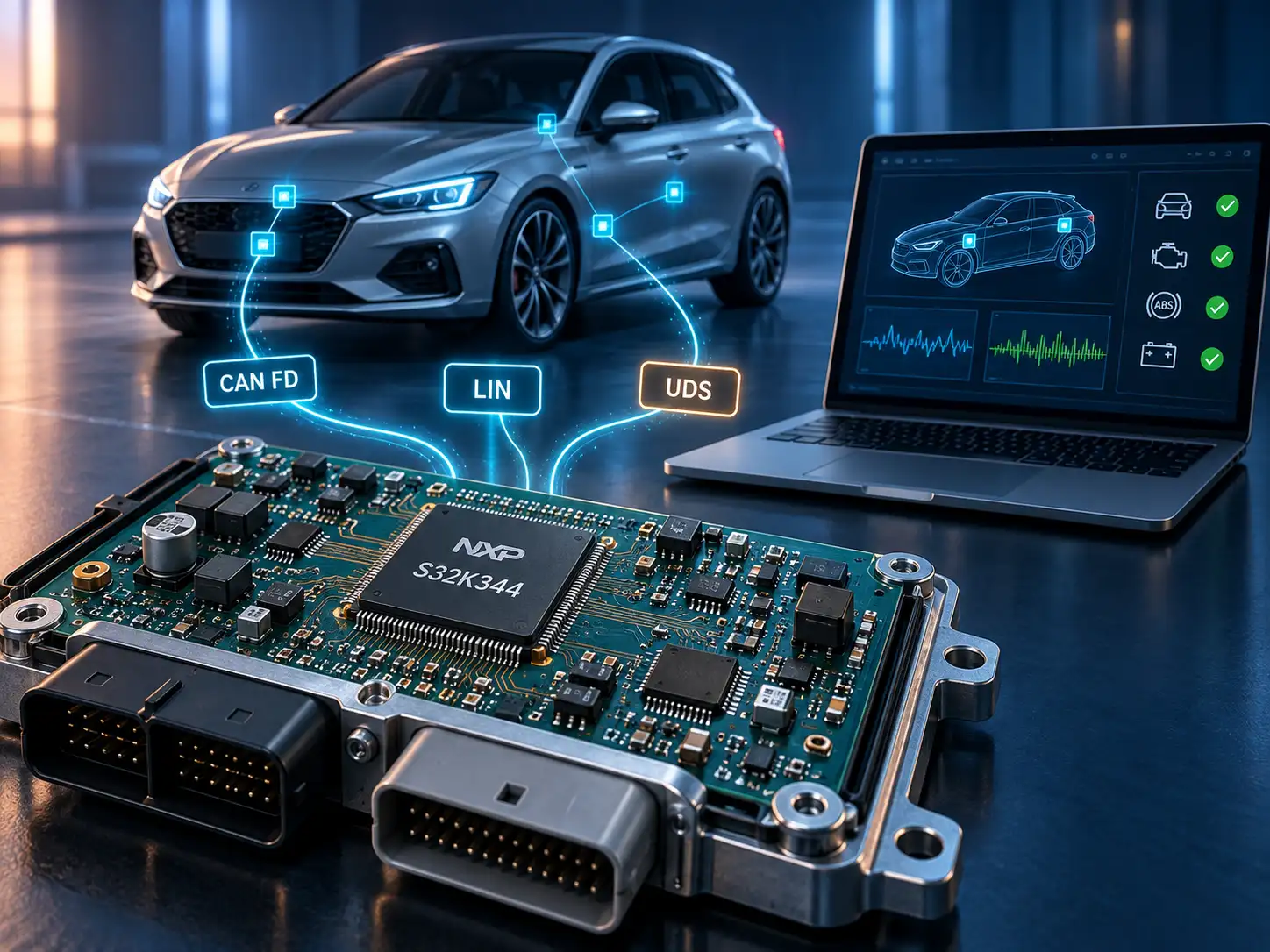
Adequate Infosoft develops automotive communication and diagnostic software for NXP S32K-based ECUs. Our services cover Classic CAN, CAN FD, LIN, ISO-TP and Unified Diagnostic Services (UDS), from network design and driver configuration through integration, validation and production support.
We work with S32K1 and S32K3 microcontrollers, including the S32K344 used in our connected-vehicle projects.
Customers contact us for new ECUs, diagnostic boot loaders, telematics equipment and tricky communication issues. In addition, our team can create the PCB, cloud back-end and mobile app.
What Do Our NXP S32K Communication Services Include?
We configure FlexCAN and LIN peripherals, map DBC or LDF definitions, implement transport and diagnostic layers, record faults, protect programming access and verify recovery under abnormal bus conditions.
A telematics device could read several CAN buses and send normalized signals. A body controller is able to utilize LIN for local actuators.
A diagnostic ECU may require ISO-TP and UDS for identification, failure detection, and maintenance management. We establish such boundaries before the implementation starts.
Relevant NXP S32K Projects from Adequate Infosoft
Vehicle Diagnostics and Predictive Maintenance Using S32K344
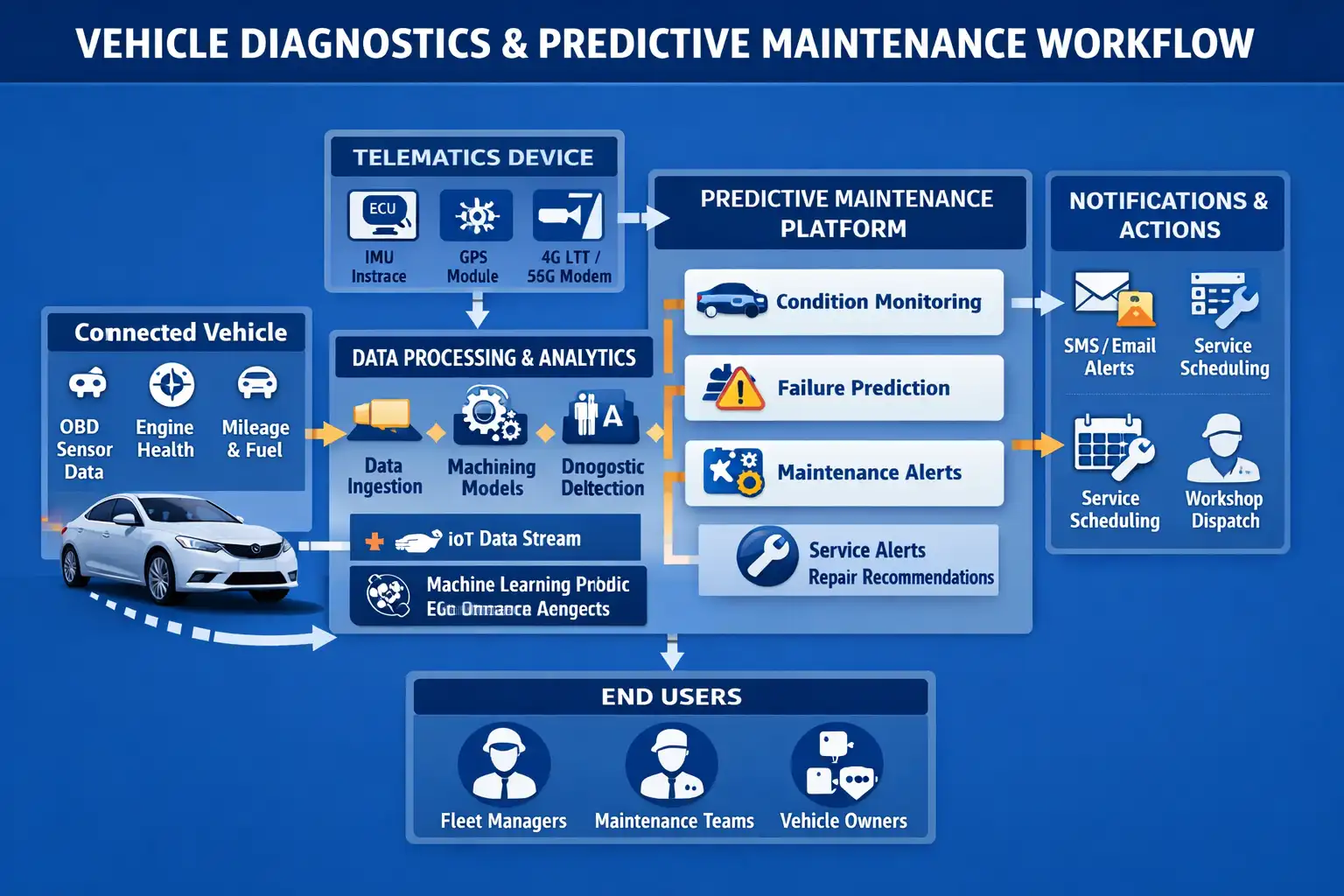
We developed a vehicle-health prototype in which an NXP S32K344 acquired OBD-II and CAN data and prepared operating information for predictive-maintenance analysis.
The firmwares responsible for communication and edge processing for vehicles, and the ASP.NET Core backend provides users, data, and analytical information.
A .NET MAUI application displays information on health-related parameters of vehicles. The project demonstrates the capability of our team to transmit different types of diagnostic data from the physical interface of vehicles to the end-user application.
Read the vehicle diagnostics and
predictive-maintenance case study
Our Development Process
We start by reviewing the ECU role, network topology, DBC/LDF files, diagnostic specification, target S32K device, electrical interface, safety assumptions and test environment.
The last requirements and ownership limits are documented before making the estimates final.
After this, the implementation passes through validation by the evaluation board, configuration of drives, integration of applications, booting of custom PCB, and testing.
The deliverables can be in the form of source code, configuration files, specifications of interfaces, records of logs, and results of tests.
We can continue through prototype manufacture, vehicle integration, fault investigation and maintenance releases.
CAN, CAN FD, LIN, ISO-TP and UDS
These technologies occupy different roles in an automotive system:
| Technology | Primary role | Typical use |
|---|---|---|
| Classic CAN | Robust, priority-based vehicle communication | Control signals, sensor values and status messages |
| CAN FD | CAN communication with larger payloads and a faster data phase | Higher-volume ECU data, gateways and diagnostics |
| LIN | Scheduled, lower-cost local subnetwork | Switches, mirrors, seats, lighting and simple actuators |
| ISO-TP | Segmentation and reassembly above CAN/CAN FD | Carrying messages larger than one CAN frame |
| UDS | Standardized diagnostic services | DTCs, identification, routines, security and programming |
UDS is data-link independent. In UDS on CAN, ISO-TP transports multi-frame diagnostic requests and responses. Keeping the layers separate makes software easier to test and reuse.
Classic CAN Development on NXP S32K
We configure bit timing, message buffers, filters, interrupts, error handling and transceiver control.
Signals are implemented or validated in accordance with the DBC file which stipulates scaling, byte order, counters, checksum and timeouts.
We verify arbitration, high bus load, missing or repeated frames, bus-off conditions, resets and power transitions. The network state and reset reasons can be logged as evidence of sporadic faults.
Services can include:
-
FlexCAN and transceiver integration -
Standard and extended identifiers -
DBC-based encoding and decoding -
Message filtering and routing -
Timeout, alive-counter and checksum handling -
Bus-off detection and controlled recovery -
CAN logging, replay and test utilities -
Gateway and multi-channel CAN applications
CAN FD Firmware and Gateway Development
CAN FD retains CAN arbitration while supporting a longer data field and faster data phase. It can improve throughput only when controllers, transceivers, the physical network and connected nodes are compatible.
We define nominal and data-phase timing, payloads, buffers and acceptance rules. Gateways also need explicit routing, signal-freshness, queue and overload policies.
NXP’s S32K3 telematics reference design demonstrates S32K344-based networking with CAN FD, LIN and Ethernet. Interface counts must be checked against the chosen device and package.
LIN Master and Slave Node Development
LIN is effective for applications where CAN’s excessive bandwidth and redundancy is not necessary. Its scheduled communication and lower-cost design of nodes makes it suitable for local networks controlling simple devices, such as switches, motors, lights, HVAC systems and seat functions.
We implement commander or responder nodes, schedule tables, diagnostic frames, sleep/wake behavior and error reporting. Work may include LDF integration, timing verification and LIN-to-CAN gateway mapping. Startup and loss-of-communication behavior receive explicit testing.
UDS and ISO-TP Development Services
We map diagnostic sessions, permissions, timing, data identifiers, routines, DTC behavior and programming flows to the product’s service and manufacturing needs.
Depending on the project, implementation may cover:
-
Diagnostic Session Control -
ECU Reset and Tester Present -
Read and Write Data by Identifier -
Read and Clear Diagnostic Trouble Codes -
Routine Control -
Security Access or stronger authenticated access designs -
Communication and DTC-setting controls -
Request Download, Transfer Data and Transfer Exit -
Negative-response handling and diagnostic timing
ISO-TP work includes single- and multi-frame messaging, flow control, separation time, addressing, timeouts and buffers. We test malformed sequences and interrupted transfers, not only positive examples.
Diagnostic Bootloader and ECU Reprogramming
We create S32K bootloaders that enable updates through CAN or CAN FD. Our designs may contain application validation, image validation, version policies, flash management, recovery after interruptions, rollback, or fail-safety.
Security follows the threat model; seed-key access alone may not protect a connected product. Supported S32K3 hardware security can assist secure boot, key protection and cryptographic operations. Provisioning and service-tool authorization are considered with firmware.
AUTOSAR and Non-AUTOSAR Integration
NXP provides Real-Time Drivers for AUTOSAR and non-AUTOSAR applications.
We back the optimized non-AUTOSAR firmware and the AUTOSAR Classic integration activities. These comprise the configuration of MCAL, complex driver development, communication interfaces, and application integration.
Prior to development, we agree upon ownership of the stack, tools, version of tools, license, inputs and proof of acceptance. This helps rule out the gaps between the application, basic software and hardware teams.
Testing and Network Validation
Verification can involve unit tests, software-in-the-loop simulation, bench setups, traffic generators, bus diagnostics, fault injecting as well as hardware testing methods.
The tests of system overload, corrupted messages, missed messages, unknown message sequences, all cycles of ignition and low-voltage resets are conducted. Diagnostic tests involve the changes of sessions, access control, timing of operations, negative responses, long transactions, and interruption of updates.
Frequently Asked Questions
Yes. The first step will be to analyze the available architecture, transport layer, memory consumption, diagnostic requirements and bootloader requirements, then develop an identification and regression test procedure.
Yes. Support depends on the selected S32K device, transceiver and physical network. We validate timing and compatibility rather than treating CAN FD as a software-only upgrade.
Yes. We are able to implement and validate signal encoding, decoding, timeouts, counters, checksums, schedules and gateway mapping based on defined networks.
Yes. We can build authorized engineering, commissioning or service applications that communicate with the ECU directly or through a connected gateway.
Discuss Your S32K Networking or Diagnostics Project
If you need CAN/CAN FD firmware, a LIN node, an ISO-TP and UDS stack, a diagnostic bootloader or help resolving an unstable vehicle network, contact Adequate Infosoft.
Share your target S32K part, network files, required diagnostic functions and present development stage so our team can prepare a focused technical assessment.
Editorial Sources and Further Reading