.NET MAUI Development
Xamarin Application Development
React Native App Development
iOS Application Development
Android Application Development
Android Wear App Development
Ionic Development
Universal Windows Platform (UWP)
Kotlin Application Development
Swift Application Development
Flutter Application Development
PWA Application Development
Hire Flutter Developers
Hire Certified React Native Developers
Flutter Health Tech & Wearable App Development Company
React Native Health Tech Wearable App Development
Offshore Software Development
Custom Application Development
Front-End Development
Full Stack Development
AI & Machine Learning
Custom CRM Solutions
Flask Software Development
Electron JS Development
ChatGPT Development
.NET Application Development
.NET Nuke Development
Microsoft Dynamics CRM
Microsoft Small Business Solution
VB .NET Development
C# Development
Sharepoint Migration
Sharepoint Development
ASP.NET Core Development
ASP.NET Development
ASP.NET MVC Development
Kentico CMS
Umbraco CMS
AJAX Development
Agile Development
Microsoft Bot
Microsoft Blazor
Microsoft Azure Cognitive
.Net Maui Healthcare Wearable App
Nuki Smart Lock
Salto Smart Lock
TTlock Smart Lock
NFC App Development
Smart Locker Solutions
Hospital Smart Lock Systems
Hotel Smart Lock Systems
Smart Home & Office Locks
Smart Access for Schools & Colleges
Unloc Smart Lock Integration
Yale & August Smart Lock Integration
Populife Smart Lock Integration
Smart Lock Hardware Development
RaspBerry Pi
Firmware Software Development
ESP 32 Software Development
Embedded Development
Internet of Things
IoT Sensor Integration & Development Solutions
Azure IOT Integration
Tuya IoT App Development
Particle IoT SDK
Hire IoT & Embedded Developers
STM32 Firmware & Hardware Development
IoT Development with AI
Dairy GPS Tracking Solutions
GPS Fleet Management Software
Car Rental & Subscription Solutions
Car Buy & Sell Marketplace Development
AI-Powered Car Wash App Development
PCB Design & Fabrication
IoT AC Automation
AI–IoT Painting Solutions
IoT Wearable Hardware & App Development
HVAC Automation & AI Control Systems
Smart Home IoT Engineering
AI Embedded Systems
AI Hardware Design Service
Advanced IoT Hardware & Firmware Development
Device Driver Development Services
Microchip PIC & AVR Development
Hire IoT Architects
IoT Cloud & Infrastructure Solutions
Infineon XMC / AURIX Development Services
Matter & Thread IoT Services
IoT Wearable Device Development
Native IoT Mobile App Development (BLE & Wi-Fi)
Snapdragon IoT Firmware Development
Renesas RA/RX Firmware Services
Smart Wearable App Development
Smart IoT Meters
Smart Healthcare Wearable App Development
Health Care Monitoring System
Fitness Tracking App Development
Smart Home Automation Apps
nRF PCB Design
ESP32 PCB Design
STM32 PCB Design
Embedded Wearables Engineers
Rental Property Management System
Smart Lighting Development
Infineon Semiconductor Firmware Development Services
Custom Camera Development: Hardware, Firmware & PCB Prototyping
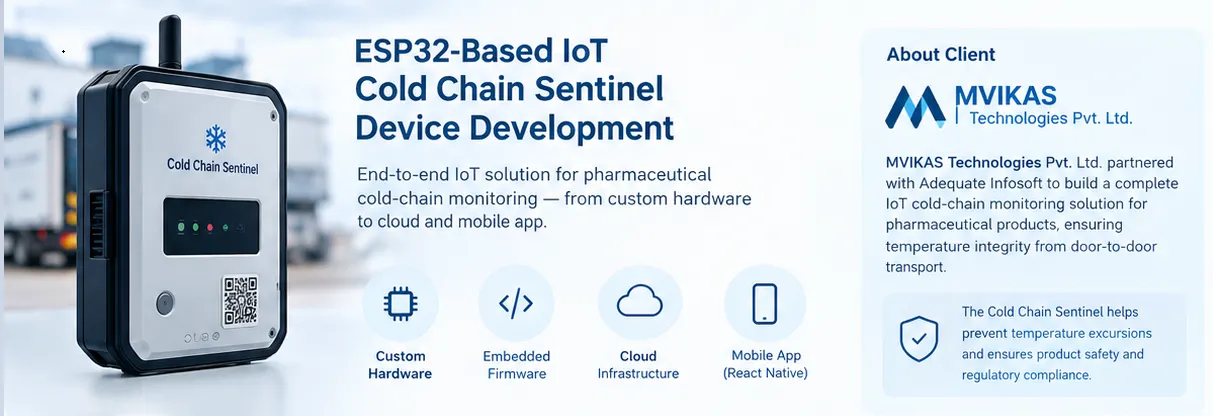
Explore our IoT cold-chain monitoring project for MVIKAS Technologies, integrating custom hardware, embedded firmware, cloud infrastructure, and cross-platform mobile app development.
MVIKAS Technologies Pvt. Ltd. partnered with our team to develop an end-to-end IoT solution for pharmaceutical cold-chain monitoring. The project focused on integrating custom hardware, embedded firmware, cloud infrastructure, and a cross-platform mobile application to support temperature monitoring and maintain the integrity of temperature-sensitive pharmaceutical products during storage and transportation.
The Cold Chain Sentinel, which is a product of Adequate Infosoft, is a complete stack solution involving hardware, firmware, cloud-based software, and a cross-platform mobile app.
The solution was envisioned for the lack of a vital feature in drug and perishables logistics – continuous and immutable tracking of temperature-sensitive products from door-to-door transport.
This innovation was born out of a need to overcome the limitations of passive trackers that only indicate an excursion after the delivery of the shipment.
At the heart of the system is the ESP32-S3 SoC, an Xtensa LX7 dual-core processor that ensures the proper power and computing capacity for sensor fusion and cryptography as well as wireless stack management.
The decision to use the ESP32-S3 was a wise one because of its built-in USB-OTG capabilities for manufacturing and debugging, sufficient SRAM memory to buffer time-series data in case of lack of connectivity, and well-developed software environment for secure boot and flash encryption.
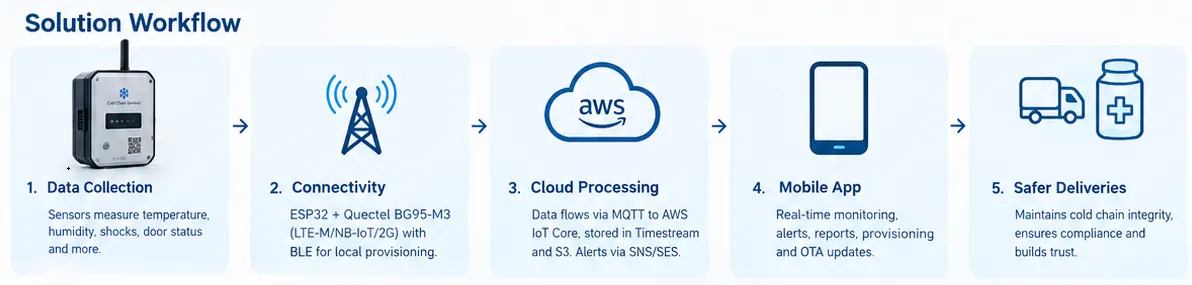
For connectivity, the board integrates a Quectel BG95-M3 LTE Cat M1/NB-IoT module with 2G fallback.
By using multiple cellular technologies, the device's ability to stay connected regardless of the maturity of the LTE-M coverage is assured, especially in emerging markets that are often cold-chain hotbeds.
The ESP32-S3 is connected to the cellular modem via a specialized UART with implemented hardware flow control; the Nordic nRF52832 BLE processor performs all the necessary provisioning and diagnostics at the short range without pulling the main SoC out of sleep mode.
The sensor set is provided to be redundant and precise. The primary temperature sensors in this project are two Maxim DS18B20 digital thermometers in a voting configuration, which have a resolution of 12 bits (0.0625 °C) and a precision of ±0.5 °C for −10 °C to +85 °C.
The secondary Sensirion SHT40 offers a relative humidity value as well as an extra temperature measurement, which is necessary in order to prevent possible errors in the reading of the main temperature sensor.
The ST LIS3DH accelerometer detects excessive vibrations and shocks, indicating that the vaccines or biological materials have potentially been damaged.
The door open signal is generated through a magnetic reed switch, while the provided information about the amount of ambient light helps confirm the door status.
All sensors share an I²C bus (for the SHT40 and LIS3DH) and a OneWire bus (for the DS18B20s), with separate power gating to allow the firmware to completely disconnect unused sensors and achieve sub-10 µA sleep currents.
The power management is managed through a linear charger Texas Instruments BQ25120A having power path management capability that uses a 3.7V 2000mAh Li-Po pouch cell as its source. The BQ25120A chip's 'ship mode' ensures the device can be kept in storage for months without draining the battery, and the I²C-programmable charge profile allows charging using both USB-C and wireless charging, thanks to an optional Qi receiver daughterboard.
The fuel gauge MAX17055 provides the firmware with the SoC/SoH information for predicting battery replacement intervals.
The PCB design was done using KiCad 7 and is implemented as a four-layer stack up to optimize signal integrity, thermal and cost aspects.
The first layer contains RF traces as well as a ground pad for the cellular module. The second layer is the ground layer, and the third layer consists of the power plane with voltage layers of 3.3V and 1.8V as well as the battery. The final layer has the front end of the sensor as well as the USB-C connector. The antenna used is known as Taoglas FXP830.07.0100C FPC operating in the frequency range of 700-960 MHz and 1710-2170 MHz.
It is mounted on a plastic holder 8 mm above the ground plane to satisfy the radiation efficiency of the modem. The Bluetooth antenna chosen is the small Johanson 2450AT18A100 chip antenna along with the pi matching network.
Thermal management was a significant challenge. Since the equipment must work within refrigerated boxes at −20 °C and occasionally go through steam-cleaning cycles at +60 °C, the PCB uses FR-4 with a high Tg of 180 °C and careful placement of components to avoid cold-start issues.
Ceramic and tantalum polymer capacitors with stable ESR down to −40 °C are used instead of electrolytic capacitors. While the bottom side of the PCB has been covered with Humiseal 1B31 conformal coating to avoid condensation problems, the upper side of it is left free for ventilation of the humidity sensor aperture.
The enclosure was designed in Fusion 360 and then fabricated using PETG material with the Delrin face plate. It has a Gore-Tex valve to equalize the pressure inside.
Manufacturing files were generated for JLCPCB's 4-layer prototype service, with a bill of materials (BOM) optimized for their in-stock parts library. The BOM cost at 100-unit volume was held under $38, with the cellular module and the ESP32-S3 accounting for 62% of the total component cost. A separate programming jig was designed with pogo pins for in-circuit flashing and RF calibration, reducing the per-unit test time to under 90 seconds.
The implemented firmware is based on the FreeRTOS operating system. It has been constructed using the ESP-IDF v5.1 framework and organized into a collection of separately running tasks that communicate with each other through queues and event groups. The sensor_task works at 1 Hz and processes data from all the sensors. Furthermore, it tries to use a Kalman filter on temperature data to filter out interference from various factors such as opening the door or freezing process.
Telemetry_task collects the data and sends it to comms_task which is responsible for establishing a connection.
The power_task has a different task - it works as a state machine that changes CPU frequency and switches peripheral devices on or off based on the existing mode (transport, storage, or shelf mode).
Dual-buffer storage is another key component of the firmware. When there is no cellular connection available, data gets stored in the ring buffer in an external W25Q128JV 16MB flash with each data point accompanied by a CRC32 and a monotonic sequence number. After reestablishing the connection, all the missed data is transmitted chronologically.
The firmware also implements OTA updates using the ESP-IDF's native esp_https_ota component with Ed25519 signature verification, ensuring that only firmware images signed by the company's private key can be installed. Rollback is automatic if the new image fails to boot within three attempts.
Low power operation is realized by employing dynamic frequency scaling and light sleep modes. When in transport mode, the device wakes up after every 30 seconds for sensing and transmission whenever an excursion in temperature is recorded; otherwise, it operates at an interval of 5 minutes.
When in storage mode, the time between each cycle rises to 15 minutes, and the cellular modem is completely switched off. The average current consumption in transport mode is 1.8 mA, providing about 45 days of use per charge.
The firmware includes a watchdog task that monitors all other tasks for hangs, and a brown-out detector that safely logs a power-fail event before shutting down.
AWS is the backend provider and utilizes a serverless, event-based architecture to deliver these cloud services. Devices communicate through MQTT secured by TLS to connect to AWS IoT Core, which verifies a device's authenticity using X.509 certificates resulting from manufacture. The IoT rules engine directs the message to Amazon Timestream database and to AWS Lambda for alerts in real-time.
Thanks to the unique query engine of Amazon Timestream, operation teams can get temperature profiles for any shipment in extremely short periods of time. Meanwhile, Amazon S3 will keep raw telemetry data.
The alerting rule has been designed as a step function which compares each incoming reading with the shipment's set temperature profile (such as 2 to 8°C for vaccines) by providing a configurable hysteresis value of 0.2°C. Upon detection of any deviation, the system sends a push notification using Simple Notification Service (SNS), an email using Simple Email Service (SES), and invokes the Webhook in the customer's ERP system.
The backend also computes Mean Kinetic Temperature (MKT) in near real-time using the Arrhenius equation, providing a stability metric that goes beyond simple min/max thresholds.
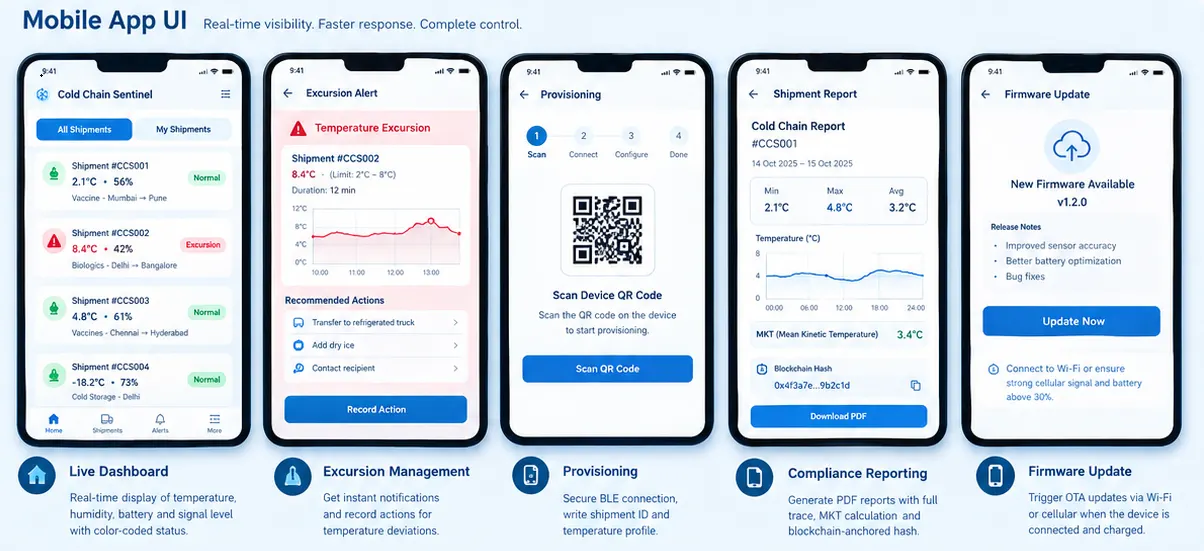
The mobile app has been created based on React Native and TypeScript technologies that offers capabilities to the field operators as well as logistics managers. The mobile app communicates with the backend through GraphQL API (AWS AppSync) and stores shipment information through offline-first caching with WatermelonDB, which allows drivers to view shipments they had in the past and receive notifications offline.
Real-time display of temperature, humidity, battery, and signal level of all currently shipping packages along with status indication using color codes.
Notification in case of temperature deviation and workflow support for recording actions (like transferring to a new refrigeration truck or adding dry ice).
Provisioning of BLE-enabled device using app that scans the QR code, makes secure BLE connection and writes shipment ID and temperature profile into device configuration partition.
One-tap generation of PDF reports that include the full temperature trace, MKT calculation, and a blockchain-anchored hash of the data for tamper evidence.
The app can trigger OTA updates when the device is connected to Wi-Fi (via a future gateway accessory) or when it has sufficient cellular signal and battery.
The design adopted the HIL development approach. Revision A was a board design where the sensors were connected to an ESP32-S3 dev kit to validate the drivers and the power profiles.
Revision B is the custom PCB, which suffered from a ground loop problem between the analog and the digital world, solved by the addition of a ferrite bead and star grounding configuration.
The hardest part of the project was the cellular qualification as BG95-M3 module had to be certified in PTCRB and GCF, for which a test cycle of 12 weeks was needed, and the antenna matching network was redesigned twice due to the SAR limits.
Another challenge was cold-start reliability. At −20 °C, the Li-Po battery's internal resistance increases dramatically, causing voltage droops during cellular transmit bursts.
The firmware addresses this by gradually ramping the modem's power amplifier and by using a supercapacitor (0.1 F) to buffer the peak current. Field trials in pharmaceutical shipments between Mumbai and Pune validated the design, with the device maintaining 99.7% telemetry completeness over a 30-day period.
The design of the Cold Chain Sentinel shows that it is possible to create an IoT solution for production with an efficient engineering effort, by carefully selecting the architecture for each level. The ESP32-S3 represents an adequate computing platform that supports secure computing operations. Connectivity via multiple modes of cellular and Bluetooth Low Energy makes sure the network is robust enough to be reachable while still being easily operable locally.
The complete development period for this solution was 4 months, from initial concept design to the launch of the pilot, and its per unit hardware cost makes large scale deployments financially feasible for medium-sized logistics organizations.
By prioritizing the integrity of data as well as efficiency in power usage, the Sentinel provides the required visibility to be compliant with today's standards.
Project Repository: github.com/IoT-App-Development-Company/cold-chain-sentinel-device
Client LinkedIn: MVIKAS Technologies Pvt. Ltd.
Client satisfaction is our ultimate goal. Here are some kind words of our precious clients they have used to express their satisfaction with our service.
I came across Adequate Infosoft while searching for an IT company to design a virtual platform for my Telemedicine business. AI helped me to make my dream project a reality.
Frederick Hess
The price and professionalism of Adequate Infosoft's project team are the most appealing aspects of working with them. The team provides weekly progress reports and responds quickly to the concerns I have.
Kim Jespersen
My team is very satisfied with the professionalism shown by the Adequate Infosoft team during the project. We are looking forward to working with them again.
Óli Freysson
I contacted AI for an Android and iOS application and I am completely satisfied with their service.
Thomas Cheah
I am very satisfied with Adequate Infosoft. very helpful, positive, and quick communication so far. I am looking forward to further cooperation.
Great experience hiring them, understood the requirements very well, and were very effective and efficient in delivering the project. I will hire them for my next project as well and also recommend them to others.
Adequate Infosoft lead development team is efficient and provides the best IT solutions. If you're looking for quick and affordable software development, Adequate Infosoft is your go-to guru!
Adequate Infosoft has stood out to be the best company for providing IT services at affordable prices. Their rapid development approach works in line with our iterative process.
David Kattah
We have worked with Adequate Infosoft for 4 years and it has been a positive experience for me and my company.
Frank Eson
Adequate Infosoft has set a benchmark with its robust product development services. Their development team is highly professional that understands the value of time.
Exceptional service! The AI team guided me through the entire procedure and made it an enjoyable experience.
Kim Jespersen
As a small business, we were most attracted to Adequate Infosoft's competitive pricing and the ability to quickly scale up or down the number of developers supporting the application.
Mr. Aaron
It was a pleasure to collaborate with Adequate Infosoft. Their development team is comprised of true experts.
Adequate Infosoft helped us get the most from Ceraphi, with smooth setup, responsive support, and practical, effective solutions.
Adequate Infosoft helped us develop our smart lock solution, including both the mobile app and web app
The Adequate Infosoft team helped us deliver a custom IoT solution for our European customers very efficiently
Smart Controls
Adequate Infosoft did a great job, helping us implement energy-efficient solutions smoothly.
Australia Health Pty Ltd
The team understood our needs and delivered quality health tech solutions on time.
Adequate Infosoft felt like a true partner, very supportive team, clear communication, on-time delivery, and quality work we genuinely trust.
With a physical presence in over 15 countries and a global footprint spanning 25+ countries, we are ready to serve you anywhere. Location, language, or culture is never a barrier, because our global team can work with you in your language. Our strong international team ensures seamless collaboration across borders We have a strong tech team, highly recognized in their domains, with extensive technical expertise.
Architect & Solution-Level Expert | Recognized Thought Leader with 8k+ LinkedIn Followers
Certified Developer | Driving AI, ML & Data Science Solutions
17+ Years in AI & IoT | 7,000+ Followers | Recognized Technology Leader
20+ Years in Tech | AI & Cloud Architect | HealthTech Innovator | 3,000+ Followers
IoT4All | IoT & Hardware Expert | Established Reputation in Europe
Technology Director at AOTC Limited, certified in CISSP, TOGAF, and SAFe. Leading technical operations across UK, Australia & New Zealand. Former Principal Integration Architect at Vodafone. Available on WhatsApp: +44 7563 407814, +61 458 765 85.
Helping SMEs Overcome Digitalization Challenges | Startup Tech Expert
AI, Life Sciences, HealthTech & Robotics Expert | 8,000+ Followers
25+ Years in Tech | Cloud Consultant | Lead Developer
SFMC Consultant & Developer
Cloud & AI Consultant
Tech Consultant • Sr. Application Developer • IoT & Hardware Expert
AI, IoT & Cloud Expert | Software Consultant
SAP Developer • Technical Consultant | ERP Solutions Specialist
Database & Network Expert • Mobile & Web Architect
Java Developer | Backend & Application Specialist
Engineer & Technology Consultant
Developer • Technical Consultant | Solutions & Strategy Expert
Technical Consultant | IT Strategy & Solutions Specialist
Technical Consultant & Developer
Cloud Solutions Expert with 17+ Years of Experience | HBIT Graduate | AI, IoT & Scalable Architecture Specialist
Lead Architect, Java Developer specializing in RESTful Services & Mobile Applications
Technical Consulting & Speaking | ANZ Region
Product Leadership & AI Architecture
Product Engineer (Python, C#, JavaScript, SQL) | Software Engineer & Speaker
Specializing in servers, virtualization, and network infrastructure
IoT Leadership | Global Operations | Digital Transformation
PMP-Certified Expert in IoT, AMI & Smart Metering
Send your message in the form below and we will get back to you as early as possible.
Your request has been sent successfully!