


 Mean Stack Development
 Vue JS Development
 Javascript Development
 React JS Development
 Angular JS Development
 Next JS development
 Java Development
 Python Development
 Django Development
 Cherrypy Development
 C# Development
 ASP.NET Development
 NodeJS Development
 Laravel Development
 CodeIgniter Development
 Zend Development
 Ruby on Rails Development
 CakePHP Development
 PHP Website Development
 Symfony Development
 Drupal Development
 Joomla Development
 Wordpress Development
 .NET Nuke Development
 Kentico
 Umbraco
 .NET MAUI Development
 Xamarin Application Development
 iOS Application Development
 Android Application Development
 Android Wear App Development
 Ionic Development
 iBeacon Application Development
 Universal Windows Platform (UWP)
 Kotlin Application Development
 Swift Application Development
 Flutter Application Development
 PWA Application Development
 Flutter Health Tech & Wearable App Development Company
 React Native Health Tech Wearable App Development
 Offshore Software Development
 Custom Application Development
 Front-End Development
 Full Stack Development
 AI & Machine Learning
 Custom CRM Solutions
 Flask Software Development
 Electron JS Development
 ChatGPT Development
 Veterinary Telemedicine App Development
 Build Smart Telemedicine Platform
 Beauty & Salon App Solutions
 Hire Workato Experts
 Magento Development
 Magento 2.0 Development
 Magento Enterprise
 Shopping Cart Development
 Prestashop Development
 Shopify Development
 Open Cart Development
 WooCommerce Development
 BigCommerce Development
 NopCommerce Development
 Virto Commerce Development
 AspDotNetStorefront Development
 .NET Application Development
 Microsoft Dynamics CRM
 VB .NET Development
 Sharepoint Migration
 ASP.NET Core Development
 ASP.NET MVC Development
 AJAX Development
 Agile Development
 Microsoft Bot
 Microsoft Blazor
 Microsoft Azure Cognitive
 HTML 5
 UI/UX Design
 Graphic Design
 Adobe Photoshop
 XML Application Development
 Cloud Computing Solutions
 Azure Cloud App Development
 AWS Development
 Google Cloud Development
 Certified AWS IoT Services Developers
 DevOps Consulting & Development
 Kubernetes Consulting & Services
 SQL Programming Development
 MySQL Development
 MongoDB Development
 Big Data
 Robotic Process Automation
 Social Media Marketing
 Search Engine Optimization
 QA Testing
 Software Testing
 Software Security
 Maintenance And Support
 I.T. Consulting Services
 Business Intelligence
 YII Development
 Data Analysis
 Alexa Skills Development
 On Demand App for Mobile repairing services
 On Demand App for Car Service Booking
 On Demand App for Cleaning Services
 On Demand App for Pharmacy
 On Demand Dedicated Developers
 On Demand Lawyer App Development






 Nuki Smart Lock
 Salto Smart Lock
 TTlock Smart Lock
 NFC App Development
 Custom IOT Enabled Smart Lock
 Smart Locker Solutions
 Hospital Smart Lock Systems
 Hotel Smart Lock Systems
 Smart Home & Office Locks
 Smart Access for Schools & Colleges
 Unloc Smart Lock Integration
 Yale & August Smart Lock Integration
 Populife Smart Lock Integration
 Smart Lock Hardware Development
 Dairy IoT Solutions
 Agri IoT & AI Solutions
 Weather & Climate Solutions
 Water & Waste Management Solutions
 RaspBerry Pi
 Firmware Software Development
 ESP 32 Software Development
 Embedded Development
 Internet of Things
 Smart IoT Development
 IoT Sensor Integration & Development Solutions
 Smart IoT System Development for HVAC
 Tuya IoT App Development
 Particle IoT SDK
 IoT Development with AI
 Smart Pet GPS Tracker
 Dairy GPS Tracking Solutions
 GPS Fleet Management Software
 Car Rental & Subscription Solutions
 Car Buy & Sell Marketplace Development
 AI-Powered Car Wash App Development
 PCB Design & Fabrication
 IoT AC Automation
 AI–IoT Painting Solutions
 IoT Wearable Hardware & App Development
 HVAC Automation & AI Control Systems
 Smart Home IoT Engineering
 AI Embedded Systems
 AI Hardware Design Service
 Advanced IoT Hardware & Firmware Development
 Device Driver Development Services
 NXP i.MX RT Firmware & Hardware Services
 Microchip PIC & AVR Development
 Hire IoT Architects
 IoT Cloud & Infrastructure Solutions
 Infineon XMC / AURIX Development Services
 Matter & Thread IoT Services
 Native IoT Mobile App Development (BLE & Wi-Fi)
 Snapdragon IoT Firmware Development
 Renesas RA/RX Firmware Services
 Silicon Labs EFR32 Development Services
 Smart Wearable App Development
 Smart IoT Meters
 Smart Healthcare Wearable App Development
 Health Care Monitoring System
 Fitness Tracking App Development
 Smart Home Automation Apps
 nRF PCB Design
 ESP32 PCB Design
 Embedded Wearables Engineers
 Rental Property Management System
 Building Management System
 Smart Lighting Development
 Infineon Semiconductor Firmware Development Services
 Custom Camera Development: Hardware, Firmware & PCB Prototyping
 Smart Security Camera SDK
 Nordic Semiconductor SDK
 Infineon SDK
 Arduino SDK
 NFC Lock Integration
 Kerong Lock Integration
 IoT & AI Solutions for Manufacturing
 Smart Inventory & Logistics Solution
 Food & Beverage Industry Solutions
 Smart Hospitality Solutions
 Smart Property Management
 Custom Smart Home IOT SDK
 Smart IoT & AI in Healthcare
 AI-Powered Security Solutions
 Smart Home Safety & AI
 Veterinary Clinic Management (AI)
 Pet Care System (AI & IoT)
 Pet Training & Adoption (AI)
 Healthcare IoT Development
 Event Management Software
 Money Remittance App
 Money Lending App Development
 Utility and Bill Payment App
 IoT Mobile App Development (Flutter & React Native)
 AI & IoT Retail Solutions
 Smart EV App Development
 Smart Solar IoT & AI Solutions
 IoT-Based Energy Systems
 Smart Energy & Utilities Solutions
 6G Solutions
 IoT Security Solutions
 AI-Powered Lottery App Development
 AI-Sports Fitness Club Management
 Travel
 Real Estate
 Medical & Healthcare
 e-Learning
 Consumer Products
 Finance
 Automobile
 Media & Entertainment
 Billing Software
 Enterprise Resource Planning (ERP)
 Augumented & Virtual Reality
 Point of Sale(POS) Development
 Learning Management System
 EV Charging Solutions
 About Us
 Partners & Certifications
 Quality Assurance
 Our Clients & Testimonials
 Development Process
 Our Products
 Social Responsibility
 Work Ethics
 Vision & Mission
 Awards
 Live Project Demos
 Contact Us
 Case Studies
 Portfolio
 Blog
Arduino BLE, Wi-Fi & Mobile App Integration Services
Adequate Infosoft provides Arduino BLE, Wi-Fi and mobile app integration services for startups, manufacturers and businesses developing IoT products.
We help turn early concepts into working prototypes and production-ready connected systems. Our team works across embedded firmware, wireless communication, iOS and Android applications, cloud APIs, dashboards and device data management.
Arduino is still a viable option in terms of fast prototyping, as it provides developers with the means to test the behavior of the hardware quickly. But creating a viable IoT product means doing more than programming an Arduino sketch; it should include all the above-mentioned factors.
Let's Work Together!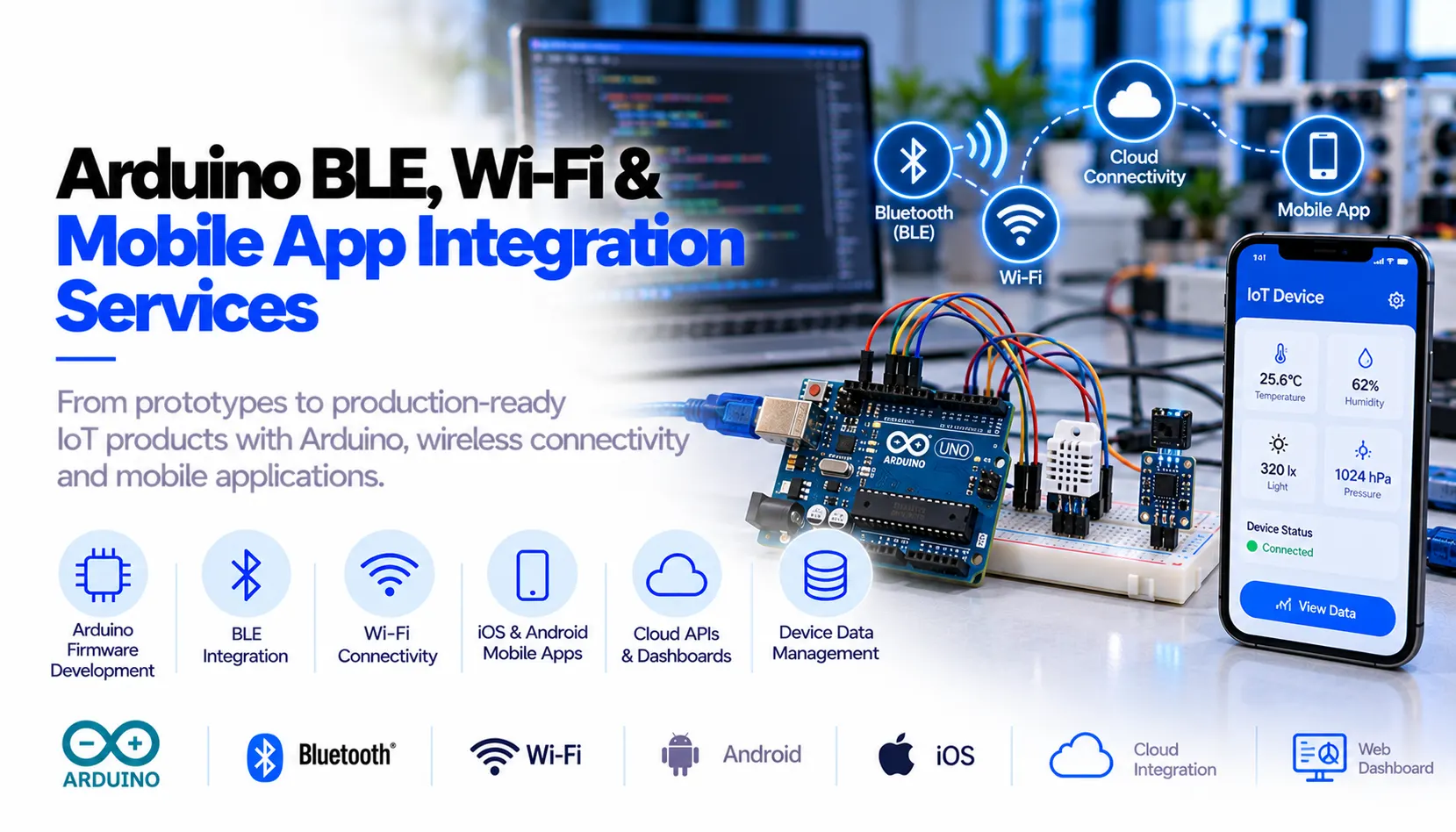
Arduino BLE, Wi-Fi and Mobile App Development Services
Our engineers create fully integrated connected solutions based on Arduino platforms, such as Arduino Uno, Nano, Mega, Portenta, ESP32, and ESP8266, depending on the processing, power consumption, connectivity, and cost needs of the product.
Our services for Arduino IoT integration encompass:
Arduino firmware development and sensor integration Pairing of devices via BLE, GATT service development Wi-Fi configuration through Bluetooth, SoftAP or QR codes Mobile application development for Android and iOS Development of Flutter, React Native, .NET MAUI, Swift, and Kotlin applications Real-time dashboards, remote control, telemetry monitoring MQTT, HTTP/HTTPS, WebSocket, and REST API integration Cloud solutions built on Microsoft Azure, AWS, or custom back-end systems Over The Air firmware update planning and implementation Device authentication, encrypted storage, role-based access Proof of concept, MVP development, HIL testing, and deployment support
Not all projects should follow the same architecture – a battery-powered BLE wearable shouldn't be created the same way a Wi-Fi-controlled device plugged into the wall is created, and an industrial sensor solution has to have a different approach from a consumer gadget.
When Should You Use BLE, Wi-Fi or Both?
BLE and Wi-Fi solve different product requirements. Choosing the right connection model at the start prevents costly redesign work later.
Bluetooth Low Energy for nearby setup and low-power products
BLE is perfectly fit for wearable technology, battery monitoring devices, electronic locks, portable medical equipment, fitness trackers, and other hand-held equipment. It enables an application running on a mobile phone to discover a device, connect to it and exchange data without expending too much energy.
An efficient use of BLE involves more steps than simply discovering and connecting. Service and characteristic models need to be defined, MTU size set and packet structure chosen, and even some command acknowledgements implemented. This becomes particularly important if the mobile application is sending any commands or getting sensor data continuously.
Wi-Fi for internet-connected monitoring and control
Wi-Fi will be ideal where direct cloud connection, remote control, and higher throughput capabilities are required by the device. Examples of such include smart irrigation controllers, devices for connecting appliances, energy monitoring, security systems and sensors.
We have station-mode connection, captive portal and SoftAP onboard, credentials storage, MQTT protocol communication, HTTPS API and handling of unstable networks through retries. Where necessary, we ensure that the device retains key functionalities locally even when the internet is not available.
Hybrid BLE and Wi-Fi architecture
Most of the connected products will take advantage of both of these technologies. The BLE technology can help in setting up the device for the first time and also give the users a way of controlling the device locally, whereas Wi-Fi helps in connecting the device to a cloud platform after the device has been provisioned.
For instance, the customer will be able to pair the device using BLE and then transfer the Wi-Fi credentials to the device and register the device to their account and later on remotely control it.
Featured Client Case Study: BlueLion Smart GPS Tracker, From Arduino-Based Device Concept to Mobile and Cloud Product
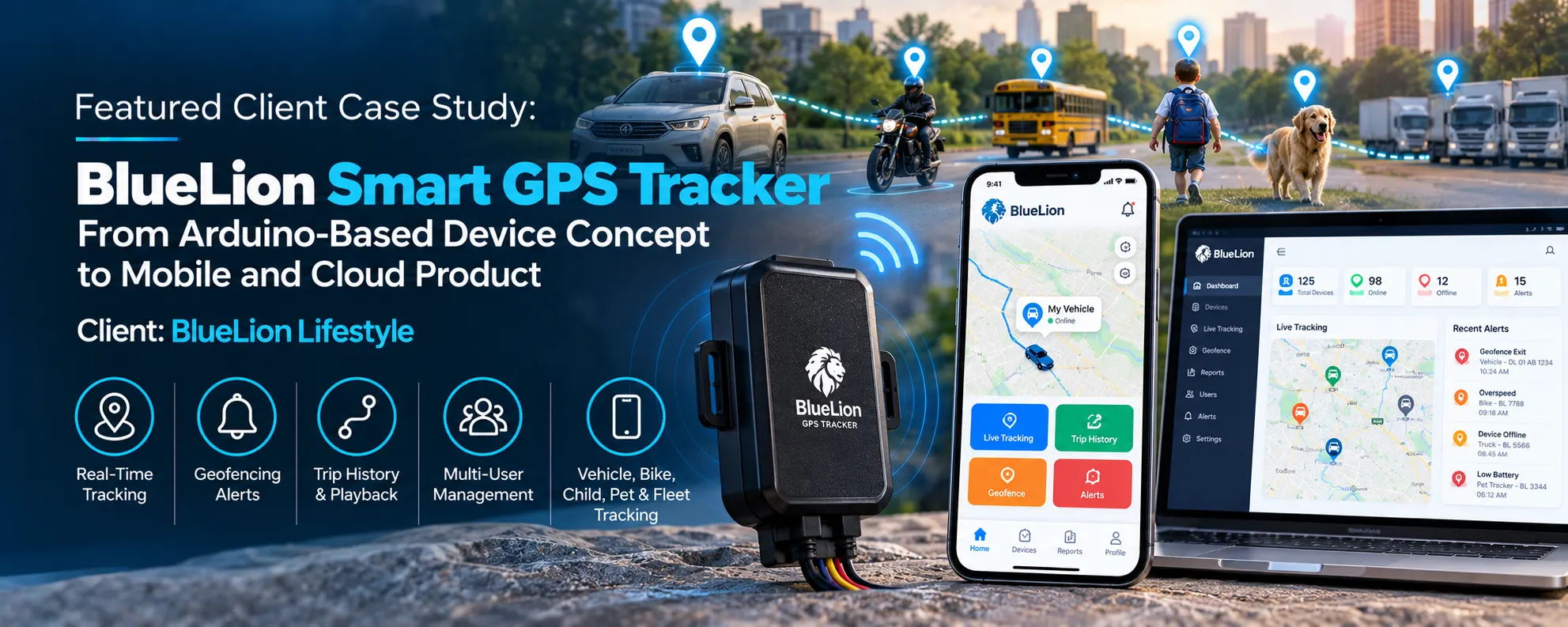
Building a connected tracker for BlueLion Lifestyle
BlueLion Lifestyle required tracking services to take care of their vehicle, bike, child, pet, and fleet tracking needs. This was something new for them as they have entered the competitive market of GPS trackers and needed to create one integrated system of products to manage tracking devices, notifications, users, alerts, etc.
Adequate Infosoft delivered the end-to-end product for BlueLion: embedded device development, hardware and PCB work, GPS and SIM integration, cloud infrastructure, web dashboard and mobile application.
The project demonstrates the type of engineering required when a connected device must work reliably outside a controlled lab environment.
The solution was designed keeping in view that it would be based on the Arduino-friendly embedded development process that would help in validation and integration of the devices in practical applications; however, the bigger framework was meant to ensure real-time tracking along with expansion of the number of connected devices.
Technology and integration approach
The project was based on the fusion of embedded hardware and firmware along with mobile applications in Flutter, ASP.NET core services, PostgreSQL, and IoT communication in Microsoft Azure. The GPS sensors supplied location details, whereas the cellular network allowed the tracker to transmit data beyond local Wi-Fi range.
Having worked with Arduino helped when starting off with the embedded system prototype.
This mobile application has been developed to ensure everyday practicality: for instance, a user can see his or her own position, check his or her journey history, get geofencing notifications, and track a device without any knowledge of the technology behind it. The back end ensured the relations between devices and users, the real-time treatment of data, and storing data in a scalable manner.
One of the most important design parameters of the solution is reliability. GPS and network signals may not work consistently in tunnels, in densely populated areas, and other locations with poor signal reception. Hence, the firmware had to use smart buffer, timestamp management and reconnecting capabilities, rather than assuming that the connection would always be available.
Outcome
BlueLion was not just a tracker but a device-to-cloud solution. The client was provided with a base for various customer and enterprise use cases like tracking of vehicles, people, assets. According to the published case study, the project encompassed the entire process, from the hardware stage to the cloud, website, and mobile applications.
Full case study: bluelion-gps-tracker-smart-gps-tracking-system
Why Businesses Choose Professional Arduino Mobile App Integration
A simple Arduino-based test may show that a sensor or relay does its job. A finished device should prove its reliability after months of use. Businesses usually choose to cooperate with an Arduino IoT development company if they have to deal with such issues as:
The connection appears to be reliable in demonstration mode but not in real use. Data is delayed or even lost between a board and an application via BLE. There are difficulties in Wi-Fi onboarding for non-technical users. The product requires local BLE control and cloud access from remote. The existing firmware cannot provide secure mobile integration layer. The app should support both Android and iOS. Data needs to be stored securely and monitored in the app. A prototype is ready for pilot launch or mass production.
Our role is to close the gaps between electronics, firmware, mobile development and cloud operations so that the customer receives one coherent solution.
Relevant Adequate Infosoft Delivery Experience
Our experience spans connected devices, mobile applications, cloud services and real-world device communication. The following published projects are relevant to Arduino BLE, Wi-Fi and mobile app integration work.
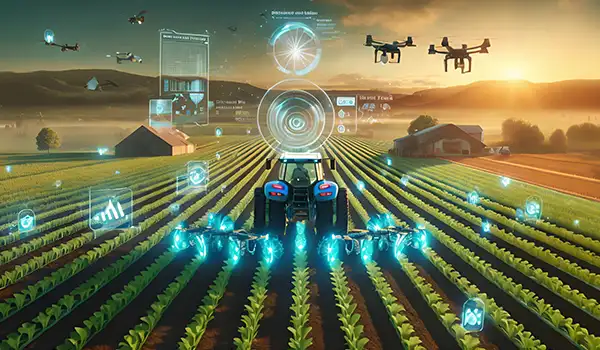
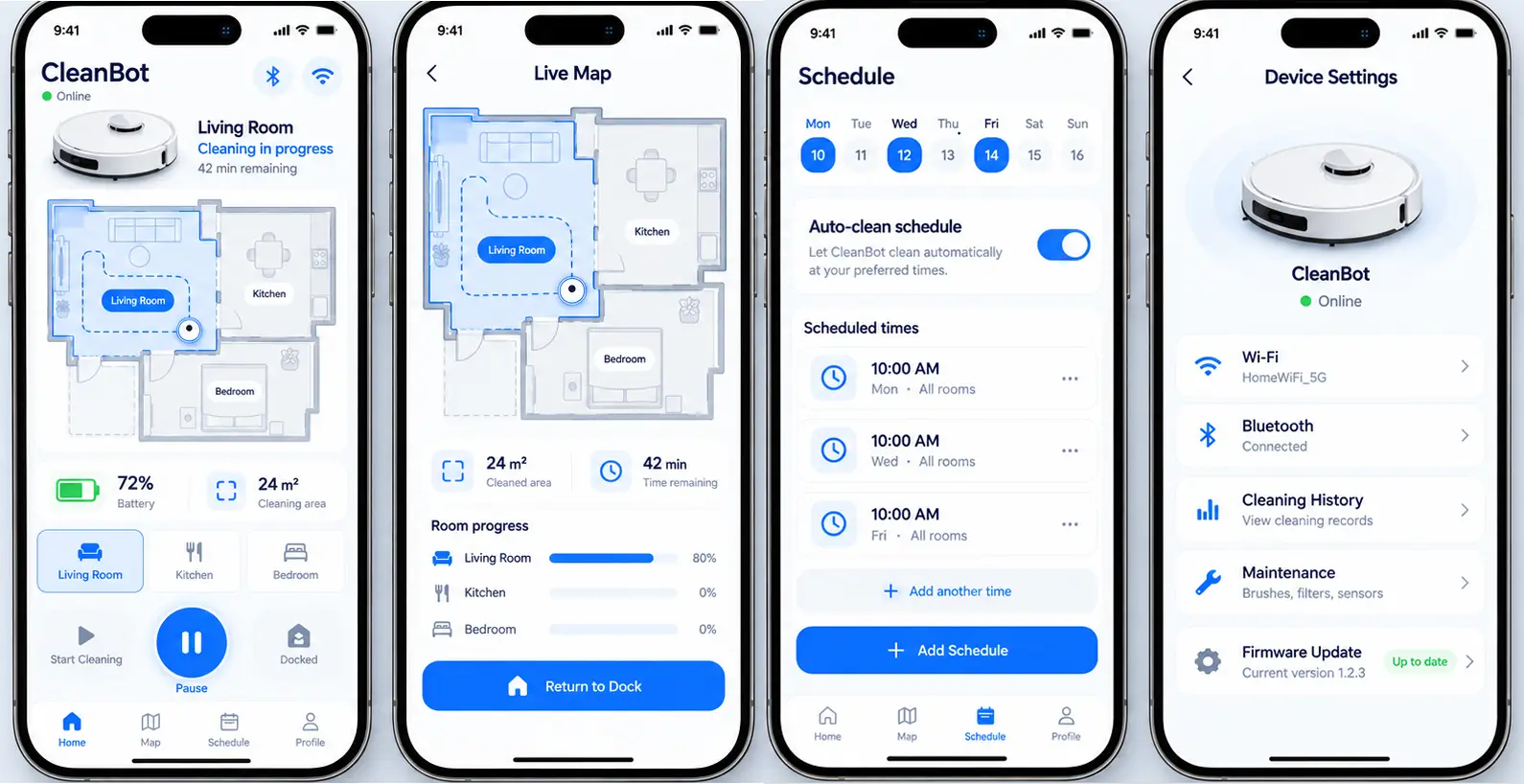
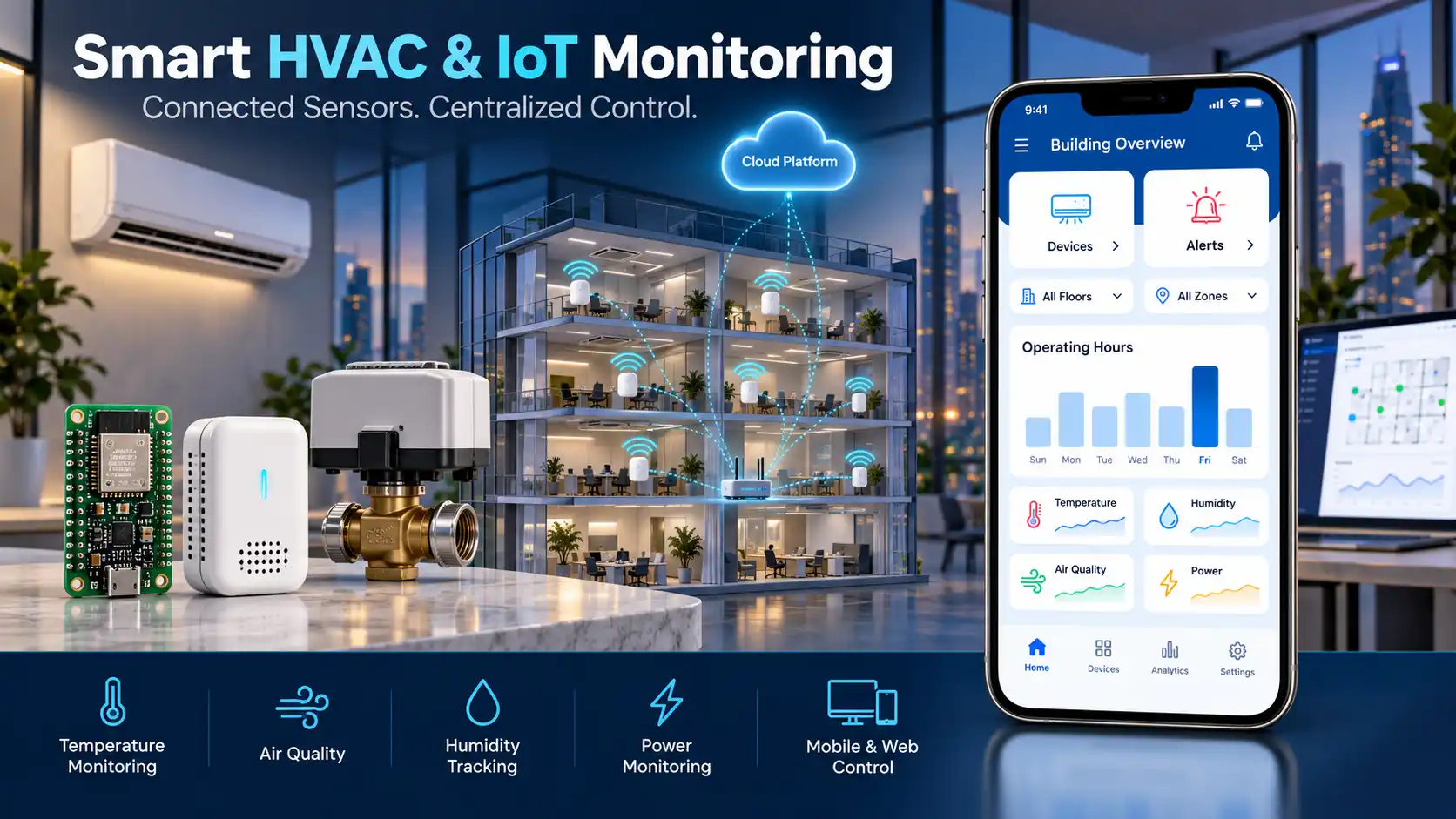
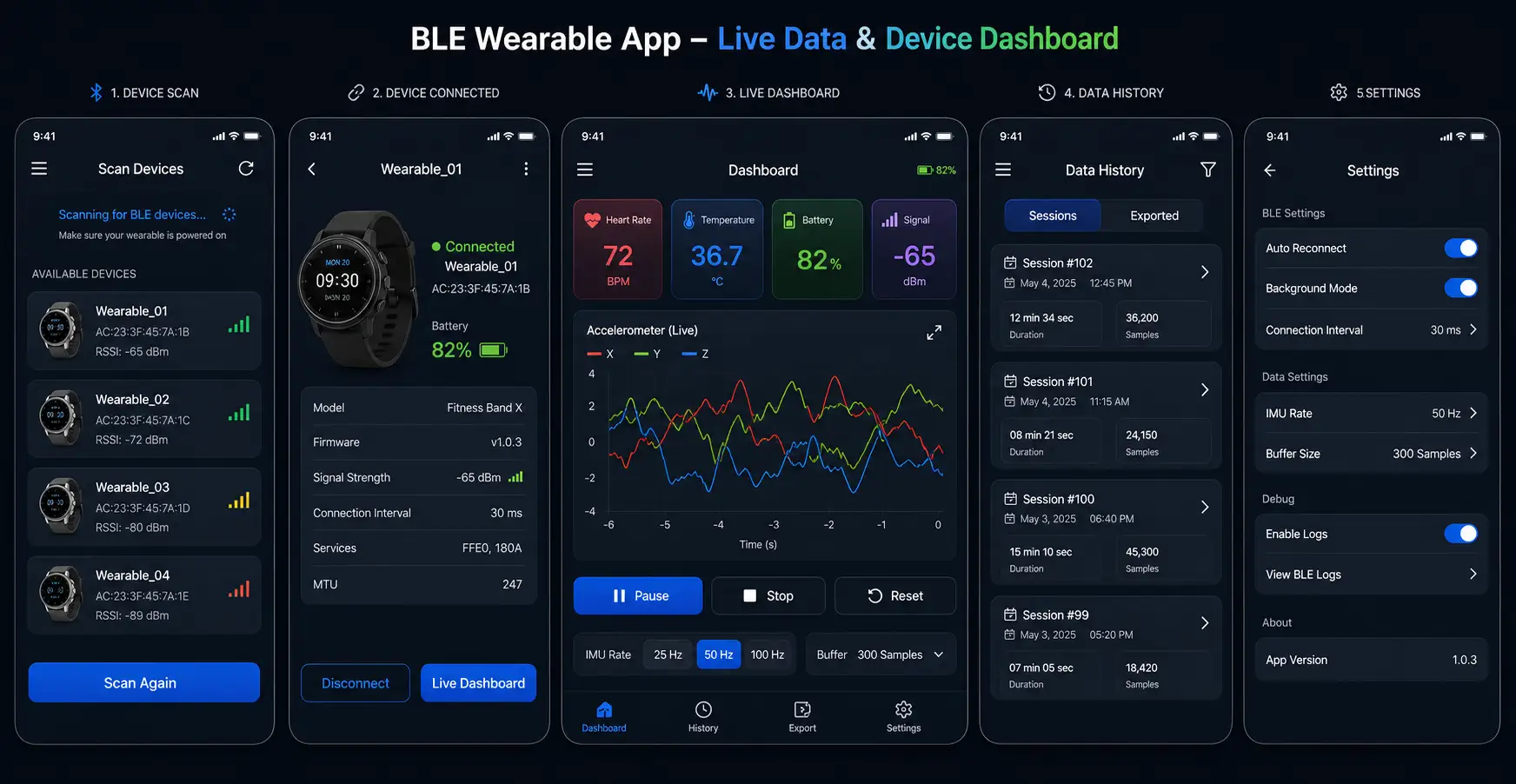
Mobile App Integration That Works Beyond the Demo
An IoT application must be created within the framework of current usage conditions, where the phone is constantly switching between Wi-Fi access and mobile networks, authorization is rejected, Bluetooth is turned off, the battery is run down, and the devices are occasionally out of reach.
Typical features in an Arduino companion app include:
Device discovery, pairing and account-based ownership Wi-Fi setup and device activation Live sensor readings and historical charts Remote control for relays, motors, lights, valves or locks Schedules, alerts and push notifications Device health, battery status and diagnostics Multi-device and multi-user management Firmware update notifications and guided maintenance Secure sign-in, permissions and audit logs
For a simple local product, the mobile app may communicate directly with the device over BLE. For a scalable commercial product, it can also connect to a cloud backend that manages user accounts, data retention, notifications and fleet operations.
Our Arduino Connectivity Engineering Approach
A dependable connected product starts with a defined communication contract. Before development, we identify the data that must be transmitted, the required response time, power constraints, security expectations and failure behaviour.
Our practical delivery process includes:
1. Finding the product and the architecture
We specify the board, the sensors, the actuators, the number of estimated devices, and the goal of the app platforms. After that, we choose whether to use BLE, Wi-Fi or hybrid architecture and what's going to be the role of the cloud in that case.
2. Creating firmware and protocols
We think through the commands and implement a structure of the commands. Each command gets an ID, validation rules, status response and timeouts instead of simply broadcasting messages.
3. Mobile app and UX design
Our designers and developers create intuitive onboarding of devices, control screens, diagnostic screens and alert flows. We ensure that it works according to the actual permissions, Bluetooth states and backstage work of the app on the supported versions of iOS and Android.
4. Cloud and remote services
In cases where the product necessitates remote access, we create secure APIs, device registration, MQTT services, platforms and dashboards. We can implement it on ASP.NET Core, Node.js, Django or different appropriate tech stack.
5. Device testing and release readiness
We test on real boards, phones, routers and network conditions. This includes dropped connections, power cycles, invalid configuration, sensor failures and app restarts. Hardware-in-the-loop testing is essential because many connectivity issues do not appear in software-only testing.
Frequently Asked Questions
Yes. We offer services such as firmware for embedded systems, BLE/Wi-Fi capabilities, Android and iOS applications and cloud backend and web interface development. Having one team responsible for all layers minimizes the risks associated with integration.
We can use the Arduino Uno, Nano, Mega and Portenta, as well as Arduino compatible boards like ESP32 and ESP8266 among others. It all depends on the requirements.
Yes. We focus on cross-platform IoT app development with Flutter, React Native, and .NET MAUI as well as on building native apps for Android and iOS using Kotlin and Swift when specific platform features are required.
Yes, when the device has internet connectivity through Wi-Fi, cellular connectivity or a gateway. We build cloud APIs and MQTT-based architectures to enable secure remote monitoring and control.
Security may require pairing with authentication, secure communications encryption, credentials being stored securely, firmware updates receiving signing, device management done on an account basis, and authorizations and audits taking place at a server.
Sure! We can analyze the current firmware, behavior of the mobile app, communication protocols and cloud architecture, and we will enhance connections and security, as well as application usability and data processing for pilot launch or production.