















 Mean Stack Development
 Vue JS Development
 Javascript Development
 React JS Development
 Angular JS Development
 Next JS development
 Java Development
 Python Development
 Django Development
 Cherrypy Development
 C# Development
 ASP.NET Development
 NodeJS Development
 Laravel Development
 CodeIgniter Development
 Zend Development
 Ruby on Rails Development
 CakePHP Development
 PHP Website Development
 Symfony Development
 Drupal Development
 Joomla Development
 Wordpress Development
 .NET Nuke Development
 Kentico
 Umbraco
 .NET MAUI Development
 Xamarin Application Development
 iOS Application Development
 Android Application Development
 Android Wear App Development
 Ionic Development
 iBeacon Application Development
 Universal Windows Platform (UWP)
 Kotlin Application Development
 Swift Application Development
 Flutter Application Development
 PWA Application Development
 Flutter Health Tech & Wearable App Development Company
 React Native Health Tech Wearable App Development
 Offshore Software Development
 Custom Application Development
 Front-End Development
 Full Stack Development
 AI & Machine Learning
 Custom CRM Solutions
 Flask Software Development
 Electron JS Development
 ChatGPT Development
 Telemedicine App Development
 Build Smart Telemedicine Platform
 Beauty & Salon App Solutions
 Hire Workato Experts
 Magento Development
 Magento 2.0 Development
 Magento Enterprise
 Shopping Cart Development
 Prestashop Development
 Shopify Development
 Open Cart Development
 WooCommerce Development
 BigCommerce Development
 NopCommerce Development
 Virto Commerce Development
 AspDotNetStorefront Development
 .NET Application Development
 Microsoft Dynamics CRM
 VB .NET Development
 Sharepoint Migration
 ASP.NET Core Development
 ASP.NET MVC Development
 AJAX Development
 Agile Development
 Microsoft Bot
 Microsoft Blazor
 Microsoft Azure Cognitive
 HTML 5
 UI/UX Design
 Graphic Design
 Adobe Photoshop
 XML Application Development
 Cloud Computing Solutions
 Azure Cloud App Development
 AWS Development
 Google Cloud Development
 Certified AWS IoT Services Developers
 DevOps Consulting & Development
 Kubernetes Consulting & Services
 SQL Programming Development
 MySQL Development
 MongoDB Development
 Big Data
 Robotic Process Automation
 Social Media Marketing
 Search Engine Optimization
 QA Testing
 Software Testing
 Software Security
 Maintenance And Support
 I.T. Consulting Services
 Business Intelligence
 YII Development
 Data Analysis
 Alexa Skills Development
 On Demand App for Mobile repairing services
 On Demand App for Car Service Booking
 On Demand App for Cleaning Services
 On Demand App for Pharmacy
 On Demand Dedicated Developers
 On Demand Lawyer App Development











 Nuki Smart Lock
 Salto Smart Lock
 TTlock Smart Lock
 NFC App Development
 Custom IOT Enabled Smart Lock
 Smart Locker Solutions
 Hospital Smart Lock Systems
 Hotel Smart Lock Systems
 Smart Home & Office Locks
 Smart Access for Schools & Colleges
 Unloc Smart Lock Integration
 Yale & August Smart Lock Integration
 Populife Smart Lock Integration
 Smart Lock Hardware Development
 Dairy IoT Solutions
 Agri IoT & AI Solutions
 Weather & Climate Solutions
 Water & Waste Management Solutions
 RaspBerry Pi
 Firmware Software Development
 ESP 32 Software Development
 Embedded Development
 Internet of Things
 Smart IoT Development
 IoT Sensor Integration & Development Solutions
 Smart IoT System Development for HVAC
 Tuya IoT App Development
 Particle IoT SDK
 IoT Development with AI
 Smart Pet GPS Tracker
 Dairy GPS Tracking Solutions
 GPS Fleet Management Software
 Car Rental & Subscription Solutions
 Car Buy & Sell Marketplace Development
 AI-Powered Car Wash App Development
 PCB Design & Fabrication
 IoT AC Automation
 AI–IoT Painting Solutions
 IoT Wearable Hardware & App Development
 HVAC Automation & AI Control Systems
 Smart Home IoT Engineering
 AI Embedded Systems
 AI Hardware Design Service
 Advanced IoT Hardware & Firmware Development
 Device Driver Development Services
 NXP i.MX RT Firmware & Hardware Services
 Microchip PIC & AVR Development
 Hire IoT Architects
 IoT Cloud & Infrastructure Solutions
 Infineon XMC / AURIX Development Services
 Matter & Thread IoT Services
 Native IoT Mobile App Development (BLE & Wi-Fi)
 Snapdragon IoT Firmware Development
 Renesas RA/RX Firmware Services
 Silicon Labs EFR32 Development Services
 Smart Wearable App Development
 Smart IoT Meters
 Smart Healthcare Wearable App Development
 Health Care Monitoring System
 Fitness Tracking App Development
 Smart Home Automation Apps
 nRF PCB Design
 ESP32 PCB Design
 Embedded Wearables Engineers
 Rental Property Management System
 Building Management System
 Smart Lighting Development
 Infineon Semiconductor Firmware Development Services
 Custom Camera Development: Hardware, Firmware & PCB Prototyping
 Smart Security Camera SDK
 Nordic Semiconductor SDK
 Infineon SDK
 Arduino SDK
 NFC Lock Integration
 Kerong Lock Integration
 IoT & AI Solutions for Manufacturing
 Smart Inventory & Logistics Solution
 Food & Beverage Industry Solutions
 Smart Hospitality Solutions
 Smart Property Management
 Custom Smart Home IOT SDK
 Smart IoT & AI in Healthcare
 AI-Powered Security Solutions
 Smart Home Safety & AI
 Veterinary Clinic Management (AI)
 Pet Care System (AI & IoT)
 Pet Training & Adoption (AI)
 Healthcare IoT Development
 Event Management Software
 Money Remittance App
 Money Lending App Development
 Utility and Bill Payment App
 IoT Mobile App Development (Flutter & React Native)
 AI & IoT Retail Solutions
 Smart EV App Development
 Smart Solar IoT & AI Solutions
 IoT-Based Energy Systems
 Smart Energy & Utilities Solutions
 6G Solutions
 IoT Security Solutions
 AI-Powered Lottery App Development
 AI-Sports Fitness Club Management
 Travel
 Real Estate
 Medical & Healthcare
 e-Learning
 Consumer Products
 Finance
 Automobile
 Media & Entertainment
 Billing Software
 Enterprise Resource Planning (ERP)
 Augumented & Virtual Reality
 Point of Sale(POS) Development
 Learning Management System
 EV Charging Solutions
 About Us
 Partners & Certifications
 Quality Assurance
 Our Clients & Testimonials
 Development Process
 Our Products
 Social Responsibility
 Work Ethics
 Vision & Mission
 Awards
 Live Project Demos
 Contact Us
 Case Studies
 Portfolio
 Blog
Blog
Apollo510B Voice-Activated Wearable with Offline Keyword Detection Development
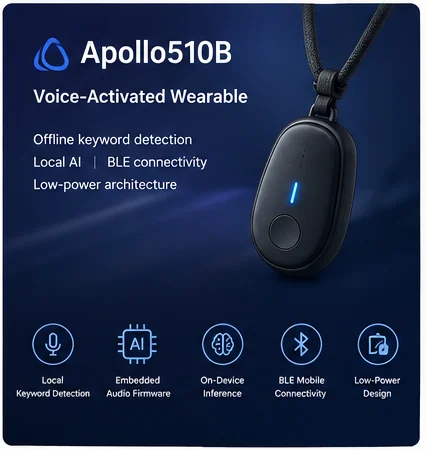
Adequate Infosoft develops Ambiq Apollo510B voice-activated wearables with offline keyword detection, embedded audio firmware, local inference, BLE mobile connectivity and low-power architecture.
We help product companies progress from concept and proof of feasibility to validated prototypes, companion applications and manufacturing-ready embedded systems.
The Apollo510B serves as a suitable foundation for products of such kind because it utilizes low-energy audio interfaces, the Arm Cortex-M55 processor and BLE 5.4.
The product executes a minor, specifically-defined audio function independently, such as a wake word recognition, and later switches to utilize more energy-expensive audio, BLE or cloud processes.
Let's Work Together!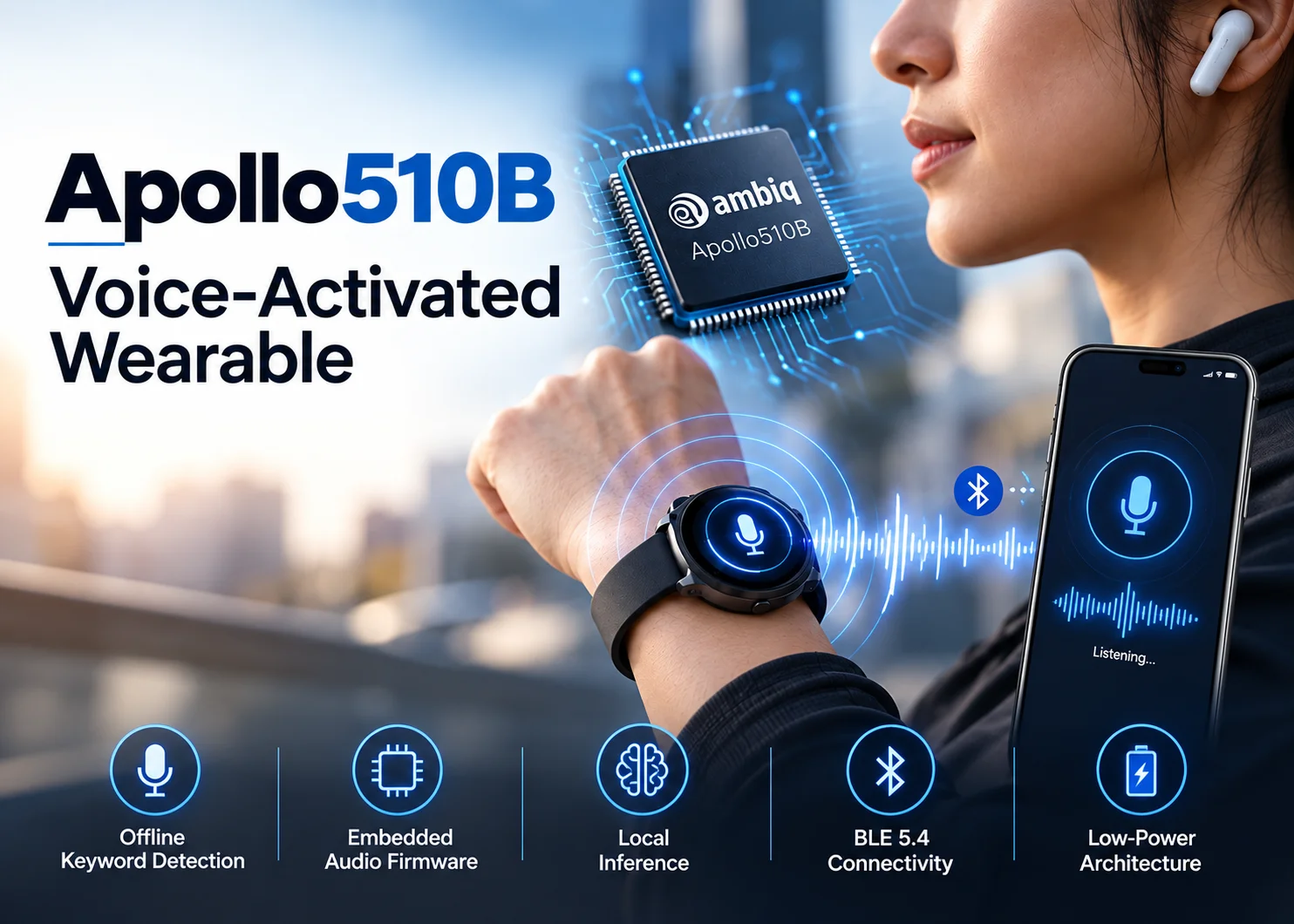
Case Study: Apollo510B Voice-Activated Wearable with Offline Keyword Detection
This delivered project demonstrates our hands-on expertise in Apollo510B wearable development, offline keyword detection, embedded AI, low-power audio processing, BLE connectivity, and production-focused wearable electronics.
Product concept and user experience
This case study illustrates the design method used for the compact pendant which is a voice-controlled AI device intended for the rapid capturing of authorized voice commands.
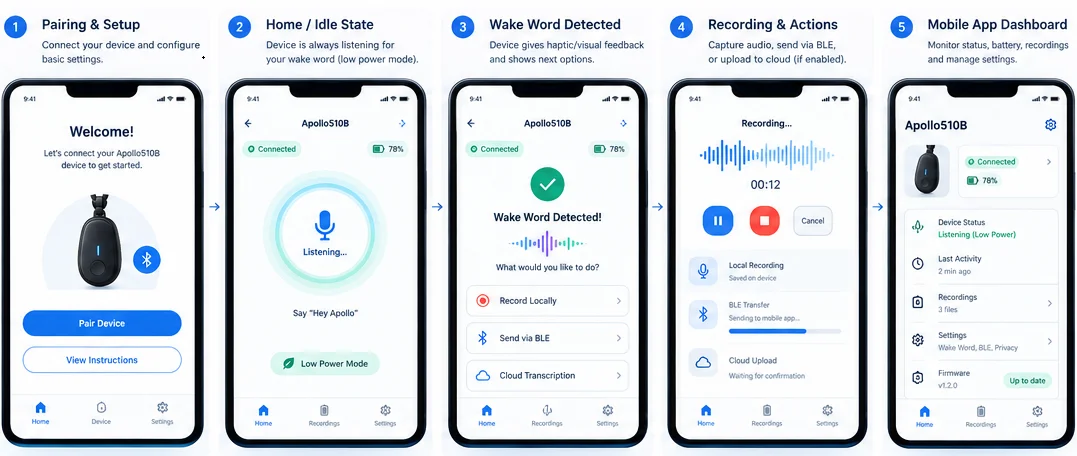
The pendant must be used by attaching it either to the user's garments or around the neck. While in the idle state, the gadget enters into a low power listening state and uses offline voice detection.
Once the pendant detects the required command and verifies it, it can give the user haptic or light feedback and starts the second step according to predetermined actions.
The product was designed so that the wake word itself could be processed locally. This reduces dependence on an internet connection and avoids continuously uploading ambient audio to a cloud service.
After activation, the user could choose between a short local recording, a BLE event sent to the mobile application or an explicitly enabled cloud-transcription workflow. The app showed clear microphone, recording and data-sharing states so that the user was not left guessing whether the device was listening or uploading audio.
Apollo510B hardware architecture
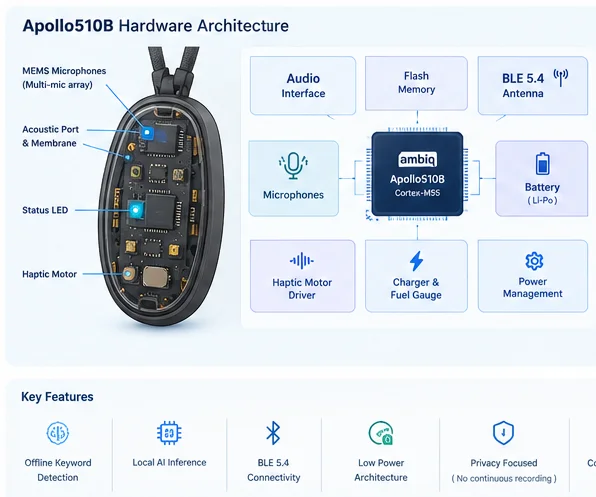
The Apollo510B became the choice for the primary processor for wearable technology due to its ideal mix of low-power embedded processing, audio connectivity, local AI capabilities, and BLE compatibility.
The reference model consisted of several microphones, a rechargeable lithium-polymer battery, a battery charger, a fuel gauge, flash memory, haptic motor driver, a status light-emitting diode/LED, and a BLE antenna network.
Multiple microphones were evaluated to improve audio capture under different wearing conditions. A pendant can be partly blocked by fabric, rotate on a lanyard or sit near a noisy jacket zip.
Hardware layout therefore considered microphone-port access, isolation from the haptic motor, vibration coupling, wind exposure and distance from the wearer's mouth. The design team also selected enclosure materials and acoustic membranes that balanced protection from dust and sweat with practical sound transmission.
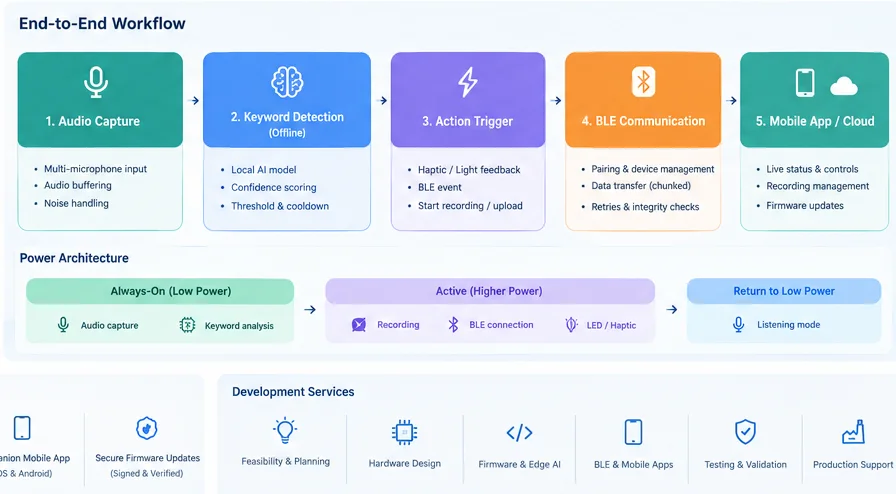
The power architecture has been designed in a way that the requirements of always-on function are clearly separated from power demanding "active" recording behaviour. In the low-power mode, the device engaged only those hardware elements that were required for audio capture and keyword analysis.
As soon as the keyword has been recognized, the processing capacity could increase temporarily and initiate user feedback mechanism as well as establish or restore the BLE connection. Such state-oriented architecture becomes a while target of creating good battery life and responsiveness at the same time.
Offline keyword-detection pipeline
The keyword-detection workflow began with a carefully defined phrase. Short phrases that are too common create false activations, while long phrases add user friction.
The team developed a keyword that was distinctive and easy to pronounce. Subsequently, they created a plan that took into consideration the nuances of pronunciation of the product keyword, the volume of sounds produced, the distance from the microphone, and other parameters such as indoor noise, outdoors noise, music, TV speech, vehicle environments, and incidental conversations.
There were digital microphone streams that were captured with the help of audio interfaces and processed further using lightweight processing line. The scheme of firmware was capable of buffering the audio that had been captured.
The detector output a confidence value rather than a simple yes-or-no response. Application logic then used thresholding, consecutive-frame checks and cooldown rules before accepting the keyword.
This matters because accuracy alone is not enough. A wearable that activates from nearby conversation loses user trust. Conversely, a device that misses normal spoken commands becomes frustrating. We evaluated false accepts, false rejects, time to detection, wake-word detection while walking and behaviour in music or traffic noise.
Where microphone quality was inadequate, we investigated gain settings, enclosure changes and model retraining rather than hiding the issue in application logic.
Local inference, tuning and privacy
The local model has been evaluated with respect to its memory consumption, processing times and power usage on the target device.
The size of the model is inherently linked to the product decision made since a larger model might improve detection performance in tough conditions, but at the expense of higher energy consumption, longer startup times and increased development complexity.
In terms of the wearable device model, the objective was to control for a very specific inference task that could operate for long times without the requirement of full speech to text processing to take place on device.
The wake word fine-tuning involved real word recordings collected in a consent based testing procedure.
Evaluation was segmented by environment, accent group and distance, allowing the engineering team to identify where changes were needed. This method provides stronger evidence than tuning only with quiet office recordings.
Privacy was built into the interaction model. In standby, the device processed short audio windows locally for keyword detection rather than storing continuous ambient recordings.
When the wake word triggered a recording event, clear LED or haptic feedback communicated the active state. The mobile app allowed the user to disable voice activation, remove recordings and control whether any audio was transferred for cloud processing.
BLE, companion application and secure updates
BLE established the connection between the wearable technology and the user's smartphone. At the time of the setup, the app paired the gadget, performed the action, displayed the battery information and looked for any firmware updates. Whenever the device was in use, the wearable transmitted small messages, e.g. "keyword found" or "ready to record" instead of keeping a pointless continuous connection.
If recording upload was enabled, audio data could be transferred in chunks after user confirmation or when the app was available.
The design included transfer retries, sequence numbers and integrity checks so that a temporary Bluetooth interruption did not silently corrupt the user experience. Device time was synchronised from the phone to provide meaningful event timestamps.
A production-ready update system included signed image verification, version compatibility checks, battery safeguards before update, resumable transfer and recovery behaviour. Firmware-update security is especially important in a device with microphones because an unauthorised image must never be allowed to alter the stated privacy behaviour.
Validation and engineering results
Validation activity took into consideration power consumption while being in standby listening, keyword detecting, BLE advertising, connected BLE, audio recording and firmware update modes. The team performed acoustic testing in quiet rooms, cafés, outdoors, in vehicles and while wearing the device under various types of garments.
Also, we measured microphone obstruction, enclosure vibration, charging, BLE range and reconnection process.
The completed reference product demonstrated a practical pathway for an Apollo510B-based voice wearable: always-available offline keyword detection, explicit privacy behaviour, low-latency feedback and secure BLE integration.
The same platform can be adapted for a voice-note pendant, field-worker safety device, branded wellness accessory, accessibility controller or smart-home interaction wearable.
Apollo510B Voice-Activated Wearable Development Services
Adequate Infosoft is engaged in creating wearable devices using Apollo510B voice-activated technology integrated with offline keyword recognition technology along with low consumption AI, Bluetooth enabling technology, and custom electronics.
Adequate Infosoft's services cover different areas including product feasibility, hardware for audio, firmware based on microcontrollers, Edge AI technology, mobile apps development, and connection of devices.
Feasibility of Technology of Voice Detection and Planning of Product
We provide description of voice expertise required including custom wake words, offline commands, languages, environment with background noise, accuracy of detection, aims in terms of battery lifetime, and confidentiality.
We consider planning feasibility including aspects like:
Efficiency of keyword detection and ratio of wrong detection of commands Work from the hour of voice detection Some technical requirements for microphone in terms of sound characteristics Life of battery and consumption of power Size of device and conditions of usage Features related to confidentiality of data and security
Wearable Electronics and Audio Hardware Design
We design the wearable electronics around the Ambiq Apollo510B, integrating digital MEMS microphones, audio interfaces, speakers or haptic feedback, battery management, flash storage, charging circuits, and optional sensors.
Our hardware development includes:
Schematic and PCB design Microphone and acoustic-port placement Power-tree design and component selection Antenna and wireless integration Prototype bring-up and hardware validation Design-for-test and manufacturing documentation
Embedded Audio Firmware and Edge AI
Our firmware incorporates interfaces for microphones, techniques for buffering audio feeds, processes for handling audio signals, techniques for detecting the presence of speech, algorithms for detecting keywords, Bluetooth Low Energy services, and power-saving modes.
We improve the audio and machine learning processes to minimize delays and the occupancy of memory and, at the same time; limit energy consumption of the device as much as possible.
Bluetooth Low Energy (BLE) and its Integration with Application Software
We develop BLE communication apps as well as companion applications that communicate over BLE for both iOS and Android platforms. The apps allow users to connect devices, set up voice recognition, monitor battery levels, update the device software, and perform device settings.
Our expertise in BLE helps us achieve:
Seamless connection Device management Activation of events Software upgrade Certification of data received Power-saving device handling
In case it is necessary, we connect the apps with backend software and the cloud for the event of using the device.
Development of a Power Efficient Voice Wearable
The efficiency of power is a key requirement for the wearables that listen all the time. In our case, we optimise the functioning of a microphone, acoustic processing, keyword detection, BLE activity, advertising rates, connection parameters, and data transmission so a device reaches practical battery life.
In this way, we realise how to obtain a compact, safe, and deviced prototype of Apollo510B.
Relevant Adequate Infosoft Case Studies
Adequate Infosoft has direct experience relevant to this development model. Our Wearable AI Audio Pendant with Secure BLE demonstrates local wake-word processing, multi-microphone audio capture, BLE connectivity, encrypted audio buffering and cloud-transcription integration.
The Native BLE Wearable Application reflects the mobile architecture needed for pairing, settings, synchronisation and user-facing device management. Our Smart Wearable Ecosystem App also demonstrates broader BLE and Bluetooth Classic workflows across connected wearable products.
Develop an Offline Voice Wearable with Adequate Infosoft
Making a reliable voice-controlled wearable does not just need sticking a microphone and ML system onto some PCB.
It takes a sophisticated approach to engineering, appropriate power budgets, effective wake-word testing, privacy-sensitive product development, resilient BLE performance, and sustainable embedded programming.
With adequate Infosoft, teams can take the Apollo510B wearable from concept to prototype, validation, and production.
Editorial Resources