















 Mean Stack Development
 Vue JS Development
 Javascript Development
 React JS Development
 Angular JS Development
 Next JS development
 Java Development
 Python Development
 Django Development
 Cherrypy Development
 C# Development
 ASP.NET Development
 NodeJS Development
 Laravel Development
 CodeIgniter Development
 Zend Development
 Ruby on Rails Development
 CakePHP Development
 PHP Website Development
 Symfony Development
 Drupal Development
 Joomla Development
 Wordpress Development
 .NET Nuke Development
 Kentico
 Umbraco
 .NET MAUI Development
 Xamarin Application Development
 iOS Application Development
 Android Application Development
 Android Wear App Development
 Ionic Development
 iBeacon Application Development
 Universal Windows Platform (UWP)
 Kotlin Application Development
 Swift Application Development
 Flutter Application Development
 PWA Application Development
 Flutter Health Tech & Wearable App Development Company
 React Native Health Tech Wearable App Development
 Offshore Software Development
 Custom Application Development
 Front-End Development
 Full Stack Development
 AI & Machine Learning
 Custom CRM Solutions
 Flask Software Development
 Electron JS Development
 ChatGPT Development
 Telemedicine App Development
 Build Smart Telemedicine Platform
 Beauty & Salon App Solutions
 Hire Workato Experts
 Magento Development
 Magento 2.0 Development
 Magento Enterprise
 Shopping Cart Development
 Prestashop Development
 Shopify Development
 Open Cart Development
 WooCommerce Development
 BigCommerce Development
 NopCommerce Development
 Virto Commerce Development
 AspDotNetStorefront Development
 .NET Application Development
 Microsoft Dynamics CRM
 VB .NET Development
 Sharepoint Migration
 ASP.NET Core Development
 ASP.NET MVC Development
 AJAX Development
 Agile Development
 Microsoft Bot
 Microsoft Blazor
 Microsoft Azure Cognitive
 HTML 5
 UI/UX Design
 Graphic Design
 Adobe Photoshop
 XML Application Development
 Cloud Computing Solutions
 Azure Cloud App Development
 AWS Development
 Google Cloud Development
 Certified AWS IoT Services Developers
 DevOps Consulting & Development
 Kubernetes Consulting & Services
 SQL Programming Development
 MySQL Development
 MongoDB Development
 Big Data
 Robotic Process Automation
 Social Media Marketing
 Search Engine Optimization
 QA Testing
 Software Testing
 Software Security
 Maintenance And Support
 I.T. Consulting Services
 Business Intelligence
 YII Development
 Data Analysis
 Alexa Skills Development
 On Demand App for Mobile repairing services
 On Demand App for Car Service Booking
 On Demand App for Cleaning Services
 On Demand App for Pharmacy
 On Demand Dedicated Developers
 On Demand Lawyer App Development










 Nuki Smart Lock
 Salto Smart Lock
 TTlock Smart Lock
 NFC App Development
 Custom IOT Enabled Smart Lock
 Smart Locker Solutions
 Hospital Smart Lock Systems
 Hotel Smart Lock Systems
 Smart Home & Office Locks
 Smart Access for Schools & Colleges
 Unloc Smart Lock Integration
 Yale & August Smart Lock Integration
 Populife Smart Lock Integration
 Smart Lock Hardware Development
 Dairy IoT Solutions
 Agri IoT & AI Solutions
 Weather & Climate Solutions
 Water & Waste Management Solutions
 RaspBerry Pi
 Firmware Software Development
 ESP 32 Software Development
 Embedded Development
 Internet of Things
 Smart IoT Development
 IoT Sensor Integration & Development Solutions
 Smart IoT System Development for HVAC
 Tuya IoT App Development
 Particle IoT SDK
 IoT Development with AI
 Smart Pet GPS Tracker
 Dairy GPS Tracking Solutions
 GPS Fleet Management Software
 Car Rental & Subscription Solutions
 Car Buy & Sell Marketplace Development
 AI-Powered Car Wash App Development
 PCB Design & Fabrication
 IoT AC Automation
 AI–IoT Painting Solutions
 IoT Wearable Hardware & App Development
 HVAC Automation & AI Control Systems
 Smart Home IoT Engineering
 AI Embedded Systems
 AI Hardware Design Service
 Advanced IoT Hardware & Firmware Development
 Device Driver Development Services
 NXP i.MX RT Firmware & Hardware Services
 Microchip PIC & AVR Development
 Hire IoT Architects
 IoT Cloud & Infrastructure Solutions
 Infineon XMC / AURIX Development Services
 Matter & Thread IoT Services
 Native IoT Mobile App Development (BLE & Wi-Fi)
 Snapdragon IoT Firmware Development
 Renesas RA/RX Firmware Services
 Silicon Labs EFR32 Development Services
 Smart Wearable App Development
 Smart IoT Meters
 Smart Healthcare Wearable App Development
 Health Care Monitoring System
 Fitness Tracking App Development
 Smart Home Automation Apps
 nRF PCB Design
 ESP32 PCB Design
 Embedded Wearables Engineers
 Rental Property Management System
 Building Management System
 Smart Lighting Development
 Infineon Semiconductor Firmware Development Services
 Custom Camera Development: Hardware, Firmware & PCB Prototyping
 Smart Security Camera SDK
 Nordic Semiconductor SDK
 Infineon SDK
 Arduino SDK
 NFC Lock Integration
 Kerong Lock Integration
 IoT & AI Solutions for Manufacturing
 Smart Inventory & Logistics Solution
 Food & Beverage Industry Solutions
 Smart Hospitality Solutions
 Smart Property Management
 Custom Smart Home IOT SDK
 Smart IoT & AI in Healthcare
 AI-Powered Security Solutions
 Smart Home Safety & AI
 Veterinary Clinic Management (AI)
 Pet Care System (AI & IoT)
 Pet Training & Adoption (AI)
 Healthcare IoT Development
 Event Management Software
 Money Remittance App
 Money Lending App Development
 Utility and Bill Payment App
 IoT Mobile App Development (Flutter & React Native)
 AI & IoT Retail Solutions
 Smart EV App Development
 Smart Solar IoT & AI Solutions
 IoT-Based Energy Systems
 Smart Energy & Utilities Solutions
 6G Solutions
 IoT Security Solutions
 AI-Powered Lottery App Development
 AI-Sports Fitness Club Management
 Travel
 Real Estate
 Medical & Healthcare
 e-Learning
 Consumer Products
 Finance
 Automobile
 Media & Entertainment
 Billing Software
 Enterprise Resource Planning (ERP)
 Augumented & Virtual Reality
 Point of Sale(POS) Development
 Learning Management System
 EV Charging Solutions
 About Us
 Partners & Certifications
 Quality Assurance
 Our Clients & Testimonials
 Development Process
 Our Products
 Social Responsibility
 Work Ethics
 Vision & Mission
 Awards
 Live Project Demos
 Contact Us
 Case Studies
 Portfolio
 Blog
Blog
Apollo MCU & SoC Development Services Company
If you're searching for Apollo MCU/SoC development services, chances are power efficiency is one of the most critical requirements for your product.
Designed to deliver superior performance with ultra-low power consumption, the Ambiq Apollo family is suitable for wearable medical devices, industrial IoT sensors, smart consumer products, asset tracking solutions or battery-powered edge devices.
At Adequate Infosoft, we are committed to developing turnkey products for startups, enterprises, and product companies by taking their concept and turning it into an efficient Apollo-based operating system compatible with today's applications.
We support all aspects of product development from hardware architecture (schematics-to-PBMs), followed by firmware development, integrating sensors, connecting wirelessly, and optimizing power usage.
We also assist with rapid prototyping, product validation, product testing, product certification, and manufacturing readiness to support bringing Apollo-based products from their conception to production successfully.
Contact Us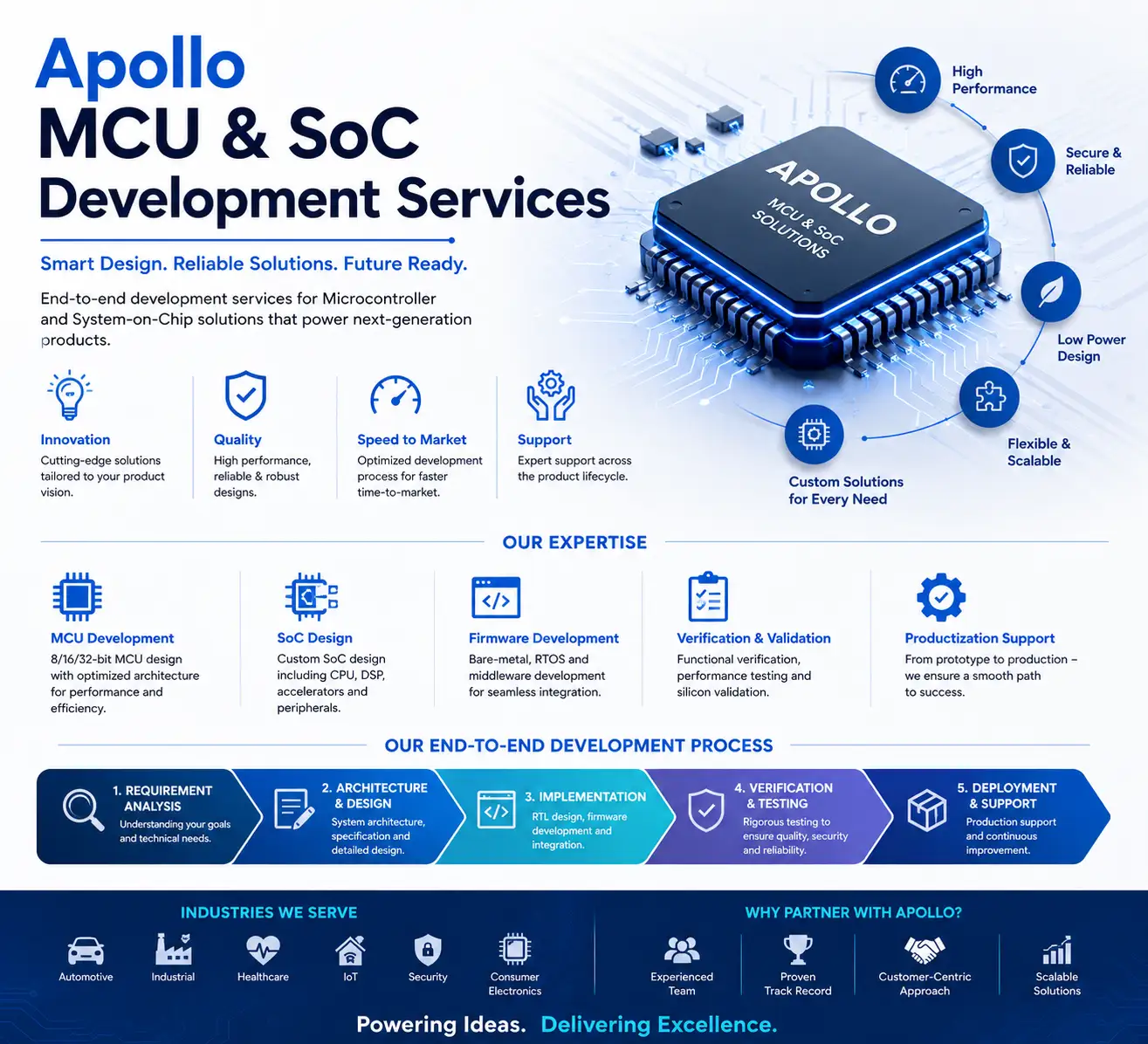
What Is the Ambiq Apollo MCU and Why Do Developers Choose It?
The Ambiq Apollo Microcontroller (MCU) Series with Apollo4 Blue, Apollo4 Plus, Apollo4 Lite, Apollo3 Blue and Apollo3 Blue+ are underpinned by Ambiq's proprietary Subthreshold Power Optimization Technology (SPOT).
In other words, the analogue and digital logic gates on these chips consume power at a lower voltage than traditional CMOS transistors would require, allowing for data processing with an active current draw as low as 5uA/MHz, meaning that their power usage is about ten times less than competing ARM Cortex-M4 microcontrollers.
In conclusion, every decision will lead you to pick a specific Apollo MCU development partner who has the knowledge of not only what chip architecture to work with.
But also what type of development team and engineering ecosystem are required for design and implementation of the product being developed, such as PCB design, sensor integration, fast real-time operating system (RTOS) porting and configuration of the Bluetooth Low Energy (BLE) Stack, cloud connectivity, and developing compliance with governmental regulations.
Our Apollo Development Experience
We have vast experience supporting the entire Ambiq family of Apollo MCU and SoC platforms like Apollo3 Blue, Apollo4 Blue, Apollo4 Plus, and Apollo510B.
These ultra-low power platforms are widely leveraged in many products today, including smartwatches, fitness trackers, smart rings, healthcare/medical monitoring devices, smart glasses, wireless sensors, and other IoT products that run on batteries.
We have extensive experience with firmware development, BLE integration, sensor interfacing, optimizing power consumption, processing real-time data, and developing production-ready embedded software to produce reliable, high-performance, energy-efficient connected devices.
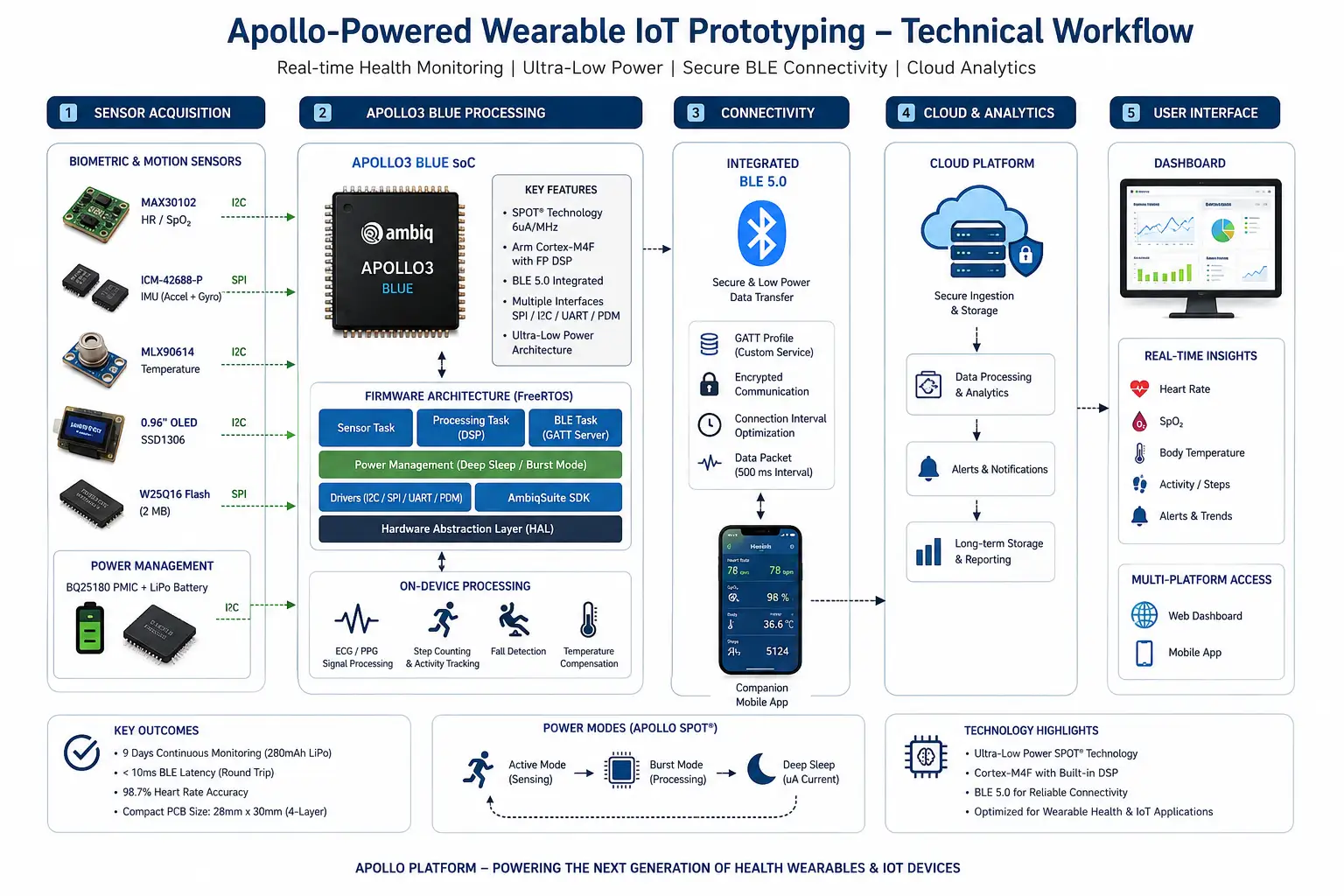
Read Our Latest Case Study: Apollo-Powered Wearable IoT Prototyping Development
This study examines a wearable Internet of Things (IoT) device developed as a health monitoring system that features a compact design with low energy consumption, utilizing the Apollo microcontroller. The device will collect real-time biometric information (heart rate, SpO2, body temperature and motion) and will transmit wirelessly to a cloud dashboard so that the data can be analyzed.
Apollo's ultra-low-power architecture made it the preferred hardware selection for performing ongoing 24/7 health monitoring without the need to recharge frequently.
1. Why Apollo?
We selected the Ambiq Micro Apollo3 Blue microcontroller for IoT solutions used in wearables because it provides several benefits:
Its SPOT technology consumes only 6uA/MHz, which is the best energy efficiency in the market. This means that wearables can last weeks on a single 200mAh cell. Bluetooth 5.0 (BLE) is integrated into the device so that it does not need a separate radio chip, which saves board space and reduces power consumption. The device has an Arm Cortex-M4F core and has a built-in floating point (FP) DSP for doing real-time signal processing of ECG and PPG data on the device. The device supports multiple interfaces, including SPI, I2C, UART, and PDM, allowing seamless connectivity with various peripherals like sensors, displays, and external flash memory.
2. Hardware Stack & Board Design
The custom PCB was designed around the Apollo3 Blue SoC. The board layout prioritized compactness (28 mm × 30 mm), EMI shielding for BLE antenna clearance, and efficient power delivery. Key hardware components included:
| Component | Part / Module | Interface |
|---|---|---|
| MCU | Apollo3 Blue (Ambiq) | SoC |
| HR / SpO2 Sensor | MAX30102 | I2C |
| IMU (Accel + Gyro) | ICM-42688-P | SPI |
| Temperature | MLX90614 | I2C |
| Display | 0.96" OLED SSD1306 | I2C |
| Storage | W25Q16 Flash (2 MB) | SPI |
| Power | BQ25180 PMIC + LiPo | I2C |
3. Firmware Architecture on Apollo
Firmware was developed using the AmbiqSuite SDK in conjunction with FreeRTOS for task scheduling. Apollo's power-mode APIs (Deep Sleep / Burst Mode) were leveraged to dynamically switch between active sensing and idle states. A dedicated BLE task streamed compressed GATT packets to the companion mobile app every 500 ms. Sensor fusion for step counting and fall detection ran entirely on the Cortex-M4F DSP, offloading the cloud backend from computationally intensive operations.
4. Results and Outcomes
Battery Life:
Device will provide 9 days of continuous monitoring with 280mAh LiPo versus the 3 days of comparable battery life for current competing designs based on STM32 microcontrollers.
BLE Latency:
Bluetooth LE latency of less than 10ms round trip for real-time push alerts to mobile devices.
Data Accuracy:
Heart-rate accuracy of 98.7%, validated against a medical grade pulse oximeter.
Board Area:
The final printed circuit board measured 28mm x 30mm in 4-layer circuit run.
5. Conclusion
Apollo has been a game changer for the wearable IoT development team. With integrated ultra-low-power SPOT technologies, Cortex-M4F DSP Development Kit and BLE 5.0, Apollo provides an all-inclusive, compact and low-power solution at a better price point than competing MCUs.
The Apollo platform continues to define the standard for next-generation health wearables or other edge IoT devices that require real-time connectivity and long battery life.
You can also read our “Wearable IoT Audio Pendant Design & Development with Apollo510B & nRF54H20” case study, showcasing advanced Apollo-based wearable innovation and low-power embedded system development.
Core Apollo MCU Development Services
We have extensive experience in designing embedded systems, IoT, wearable technology, healthcare devices, and low-power electronics.
As such, we provide reliable Apollo-based products that have been optimized for performance, battery life, and scalability, let's explore our services.
1. Custom Firmware & Embedded Software Development
The reason why Apollo Microcontrollers (MCUs) have a great reputation, is because of their firmware. Firmware is developed by a professional team of Apollo developers using C/C++ and the AmbiqSuite SDK. They use either FreeRTOS or Zephyr RTOS as the operating system for their firmware systems. Some examples of the key services provided by their firmware are:
Development of Sensor Drivers
Creating i2c, spi, uart drivers for biometric sensors such as MAX30102, MLX90632, LSM6DSO, environmental sensors SHT40 and BME280, as well as transducers for industrial use.
These drivers support functions such as:
Interupt driven sensor acquisition via DMA on Apollo's ARM Cortex-M4F CPU through their peripheral hardware.
Managing Power States
Multiple low-power modes (hibernate, sleep, and deep sleep) are implemented by Apollo MCU's, which also provide sub µA standby currents. Expert firmware engineering provide sleep/wake state machines that maximize battery life (which is essential for a product designed to survive on one charge for either one or several years).
Signal Processing and Sensor Fusion
Real-time DSP algorithms (FIR/IIR digital filter functions, FFT analysis, complementary filter-based IMU fusion (Mahony/Madgwick), and peak detection of PPG signals for heart rate and SpO₂) can be run on an Apollo4, with the use of the floating-point unit and DSP extensions to minimize power usage when performing these functions.
Firmware Over-The-Air (OTA) Updates
OTA updates can be performed via BLE using the Ambiq OTA bootloader, allowing the firmware to be updated remotely when there is no physical access to the hardware – a feature that is essential for managing IoT device fleets.
2. PCB Hardware Design for Apollo MCU Devices
Great firmware running on a poor hardware design will underperform every time. Professional Apollo MCU hardware design services cover:
Schematic capture and layout
Full PCB design in Altium Designer, KiCad, or Cadence. Apollo MCU designs typically require a 4 to 6-layer stackup to properly manage the BLE 2.4 GHz antenna keep-out zone, high-speed SPI traces, and clean power plane separation. Designers follow Ambiq's reference design guidelines for decoupling, ground plane continuity, and crystal oscillator routing.
BLE antenna design
Whether using a chip antenna (such as the Johanson 2450AT18D0100E) or a PCB trace antenna, the antenna placement, ground clearance, and matching network tuning determine real-world BLE range and power efficiency. Antenna tuning with a vector network analyser is a standard step in professional Apollo BLE hardware development.
Miniaturisation for wearables
Apollo MCU wearable PCBs routinely achieve board sizes of 30–40 mm × 20 mm using 0201 and 0402 passive components, fine-pitch BGA/QFN packages, and flexible PCB (FPC) connectors. Rigid-flex PCB designs are available for devices where the electronics must conform to a curved or folded chassis.
Bring-up and hardware validation
Post-fabrication board bring-up, power rail validation with an oscilloscope and power analyser, I²C/SPI bus verification with a logic analyser, BLE RF testing, and DRC/signal integrity review.
3. BLE 5.x Wireless Stack Integration
The Apollo4 Blue and Apollo3 Blue variants include an integrated Bluetooth Low Energy 5.1 radio, eliminating the need for an external wireless module and reducing bill-of-materials cost significantly. BLE development services include:
GATT profile design
Defining custom BLE services, characteristics, and descriptors aligned with Bluetooth SIG standard profiles (Heart Rate Profile, Health Thermometer Profile, Device Information Service) or fully proprietary data formats for industrial applications.
Configuration of BLE Host Stack
The BLE host stack needs configuring to modify the connection interval, slave latency, supervision timeout, and advertising parameters to help you find balance between device throughput, latency and current consumption. An advertising device that has an interval of 1,000 ms will consume vastly less power than a device with an interval of 100 ms; however, the correct value will depend upon your application's required level of responsiveness.
BLE Mesh and Broadcast for Multi-Device Applications
If the application requires one to many (or mesh topology) connections (for example, smart building sensor or asset tracking arrays), then the application must be able to support integration of a BLE mesh stack using Bluetooth Mesh 1.0 profiles.
4. Cloud & IoT Backend Integration
Apollo MCU devices almost never operate alone because the general trend for IoT devices today is to require a cloud connection for their data movement. Apollo's experienced development teams can provide user-friendly, end-to-end cloud integration solutions. These integrations can include:
Azure IoT Hub / AWS IoT Core connectivity
When a device acts as a BLE peripheral, the associated gateway application (non-traditional applications such as .NET MAUI, React Native, or dedicated hardware gateways) can relay telemetry from the device to an Azure IoT Hub or AWS IoT Core using MQTT with TLS encryption.
Device twins enable both devices and the cloud to synchronize data between each other for the purpose of configuration management.
Edge Processing on the Apollo
Latency-sensitive applications run on the Apollo using its integrated machine learning core (available in Apollo4 variant MCUs) or through CMSIS-DSP algorithm processing. Only the compressed data packets or the summary events are sent to the cloud, enabling massive power savings in sending telemetric data to the cloud.
Device provisioning and certificate management
Zero-touch device provisioning using Azure Device Provisioning Service (DPS) or AWS IoT Fleet Provisioning, with X.509 certificate injection during manufacturing.
Types of Devices Built on Apollo MCU
This is where the platform's versatility becomes apparent. Professional Apollo MCU development teams build across a wide range of industries and device categories:
Medical & Clinical Wearables
Continuous glucose monitoring (CGM) patches, cardiac monitoring patches, SpO₂ wristbands, smart spirometers, rehabilitation motion trackers, and clinical-grade sleep monitors.
Apollo's low power enables multi-day or multi-week continuous recording, a hard requirement in clinical trial wearables. Teams working in this space understand IEC 62304 software lifecycle requirements and ISO 14971 risk management as part of the development process.
Industrial IoT Sensors
Industrial Internet of Things (IoT) Sensors include vibration monitoring nodes for rotating machinery, wireless temperature and humidity loggers that are used for cold-chain compliance, gas leak detectors, pipeline pressure sensors, and smart utility meters. The extended operating temperature range and high levels of hardware security (TrustZone, Secure Boot) offered by Apollo MCU provide reliability in harsh industrial environments.
Consumer Health & Fitness Devices
Smart rings, fitness bands, continuous stress monitors using HRV analysis, sleep trackers, hydration monitors, and posture correction wearables. The Apollo4's combination of BLE, efficient DSP, and minimal PCB footprint makes it the go-to silicon for consumer wellness devices targeting a 7-day battery life in a sub-10 mm thick chassis.
Asset Tracking & Asset Location
Types of devices used for asset tracking include BLE beacons, cold-chain shipping monitors, livestock tracking collars, and lone worker safety devices. The devices in this category typically last 12 months or more on one CR2032 battery thanks to the Apollo's hibernate current of less than 1 µA.
Military and Field Equipment
Military and outdoor ruggedized environmental monitoring equipment, soldier capable biometric monitor, end-to-end encrypted communication endpoints, and portable diagnosis devices. Apollo's TrustZone security and support for custom secure boot chains is also relevant here.
Home and Building Automation
Home Automation products such as occupancy sensor, air quality monitor, smart door lock, and wireless light switch with the product defining value proposition being that they all have a battery life expectation of 2 to 5 years on AA cells.
What to Look for in an Apollo MCU Development Partner
While assessing Apollo MCU development services suppliers, inquire specifically about:
AmbiqSuite SDK experience
AmbiqSuite's SDK offers developers a complete SDK with HAL drivers, power management, BLE stack libraries and peripheral examples. The development teams who are more experienced with Deep AmbiqSuite SDK gain improved FW Quality and Delivery speeds when compared to teams simply porting Generic ARM code.
Total end to end ownership
The best development teams create hardware and firmware product together. A firmware development of a GPIO, with the ability to review the schematic for power rail noise issues prior to tape out, will attribute value to both development teams.
Experience with regulatory compliance
Fulfilling regulatory requirements includes various means of documentation, testing, etc., beginning on Day One with the documentation and testing of BLE (FCC / CE RF certification), the FDA (for medical devices) or CE-MDR (medical devices), as well as IEC / UL for industrial product certifications.
Testing and Validation Infrastructure
Test and validate equipment should include automated firmware test harness, power profiling (for example through the use of Nordic PPK2 or Otii Arc), BLE protocol analysis through Wireshark or Ellisys, and manufacturing test fixtures.
Frequently Asked Questions (FAQs)
We develop on Ambiq's Apollo family of microcontrollers, which includes the Apollo3 Blue, Apollo4 Blue, Apollo4 Plus, Apollo4 Lite, and Apollo510B, and we build devices for use in wearable technology, medical applications, and the Internet of Things (IoT) markets.
Apollo Microcontrollers are frequently found in smartwatches, fitness trackers, smart rings, medical devices, industrial IoT sensor solutions, smart glasses, asset-trackers, and battery operated connected products.
Yes, we provide the entire breadth of firmware development—from drivers and running real-time operating systems to integrating Bluetooth low energy (BLE) and optimizing power consumption—through to Over-The-Air (OTA) updates and production-quality embedded applications.
Yes; We are a complete solution provider that offers schematic capture, printed circuit board (PCB) layout, components sourcing, prototype development, hardware verification/testing, and direct assistance with the manufacture of Apollo-based products.
Yes, the Apollo3 Blue and Apollo4 Blue microcontroller family has builtin capabilities for Bluetooth Low Energy, making them a good choice for IoT and wearables applications that are wireless.
Yes, the Apollo microcontrollers have been designed to provide ultra-low power operation, and we provide advanced techniques to conserve battery life.
Yes, we can integrate devices with applications on mobile devices, Cloud-based platforms and Internet of Things (IoT) services, such as AWS IoT and Azure IoT, using Apollo technology.
Yes, we will provide a full range of services, from concept validation to hardware designs to firmware development to test support to certification support to producing and deploying the hardware used in the consumer electronics.
Primarily, we use C/C++, and the AmbiqSuite SDK. Furthermore, we will be using FreeRTOS or Zephyr RTOS in conjunction with standard testing/debugging tools.
Apollo microcontrollers provide the most advanced ultra-low power performance, built-in wireless connectivity, high levels of processing power, and exceptional support for long-life battery-powered solutions.