















 Mean Stack Development
 Vue JS Development
 Javascript Development
 React JS Development
 Angular JS Development
 Next JS development
 Java Development
 Python Development
 Django Development
 Cherrypy Development
 C# Development
 ASP.NET Development
 NodeJS Development
 Laravel Development
 CodeIgniter Development
 Zend Development
 Ruby on Rails Development
 CakePHP Development
 PHP Website Development
 Symfony Development
 Drupal Development
 Joomla Development
 Wordpress Development
 .NET Nuke Development
 Kentico
 Umbraco
 .NET MAUI Development
 Xamarin Application Development
 iOS Application Development
 Android Application Development
 Android Wear App Development
 Ionic Development
 iBeacon Application Development
 Universal Windows Platform (UWP)
 Kotlin Application Development
 Swift Application Development
 Flutter Application Development
 PWA Application Development
 Flutter Health Tech & Wearable App Development Company
 React Native Health Tech Wearable App Development
 Offshore Software Development
 Custom Application Development
 Front-End Development
 Full Stack Development
 AI & Machine Learning
 Custom CRM Solutions
 Flask Software Development
 Electron JS Development
 ChatGPT Development
 Telemedicine App Development
 Build Smart Telemedicine Platform
 Beauty & Salon App Solutions
 Hire Workato Experts
 Magento Development
 Magento 2.0 Development
 Magento Enterprise
 Shopping Cart Development
 Prestashop Development
 Shopify Development
 Open Cart Development
 WooCommerce Development
 BigCommerce Development
 NopCommerce Development
 Virto Commerce Development
 AspDotNetStorefront Development
 .NET Application Development
 Microsoft Dynamics CRM
 VB .NET Development
 Sharepoint Migration
 ASP.NET Core Development
 ASP.NET MVC Development
 AJAX Development
 Agile Development
 Microsoft Bot
 Microsoft Blazor
 Microsoft Azure Cognitive
 HTML 5
 UI/UX Design
 Graphic Design
 Adobe Photoshop
 XML Application Development
 Cloud Computing Solutions
 Azure Cloud App Development
 AWS Development
 Google Cloud Development
 Certified AWS IoT Services Developers
 DevOps Consulting & Development
 Kubernetes Consulting & Services
 SQL Programming Development
 MySQL Development
 MongoDB Development
 Big Data
 Robotic Process Automation
 Social Media Marketing
 Search Engine Optimization
 QA Testing
 Software Testing
 Software Security
 Maintenance And Support
 I.T. Consulting Services
 Business Intelligence
 YII Development
 Data Analysis
 Alexa Skills Development
 On Demand App for Mobile repairing services
 On Demand App for Car Service Booking
 On Demand App for Cleaning Services
 On Demand App for Pharmacy
 On Demand Dedicated Developers
 On Demand Lawyer App Development










 Nuki Smart Lock
 Salto Smart Lock
 TTlock Smart Lock
 NFC App Development
 Custom IOT Enabled Smart Lock
 Smart Locker Solutions
 Hospital Smart Lock Systems
 Hotel Smart Lock Systems
 Smart Home & Office Locks
 Smart Access for Schools & Colleges
 Unloc Smart Lock Integration
 Yale & August Smart Lock Integration
 Populife Smart Lock Integration
 Smart Lock Hardware Development
 Dairy IoT Solutions
 Agri IoT & AI Solutions
 Weather & Climate Solutions
 Water & Waste Management Solutions
 RaspBerry Pi
 Firmware Software Development
 ESP 32 Software Development
 Embedded Development
 Internet of Things
 Smart IoT Development
 IoT Sensor Integration & Development Solutions
 Smart IoT System Development for HVAC
 Tuya IoT App Development
 Particle IoT SDK
 IoT Development with AI
 Smart Pet GPS Tracker
 Dairy GPS Tracking Solutions
 GPS Fleet Management Software
 Car Rental & Subscription Solutions
 Car Buy & Sell Marketplace Development
 AI-Powered Car Wash App Development
 PCB Design & Fabrication
 IoT AC Automation
 AI–IoT Painting Solutions
 IoT Wearable Hardware & App Development
 HVAC Automation & AI Control Systems
 Smart Home IoT Engineering
 AI Embedded Systems
 AI Hardware Design Service
 Advanced IoT Hardware & Firmware Development
 Device Driver Development Services
 NXP i.MX RT Firmware & Hardware Services
 Microchip PIC & AVR Development
 Hire IoT Architects
 IoT Cloud & Infrastructure Solutions
 Infineon XMC / AURIX Development Services
 Matter & Thread IoT Services
 Native IoT Mobile App Development (BLE & Wi-Fi)
 Snapdragon IoT Firmware Development
 Renesas RA/RX Firmware Services
 Silicon Labs EFR32 Development Services
 Smart Wearable App Development
 Smart IoT Meters
 Smart Healthcare Wearable App Development
 Health Care Monitoring System
 Fitness Tracking App Development
 Smart Home Automation Apps
 nRF PCB Design
 ESP32 PCB Design
 Embedded Wearables Engineers
 Rental Property Management System
 Building Management System
 Smart Lighting Development
 Infineon Semiconductor Firmware Development Services
 Custom Camera Development: Hardware, Firmware & PCB Prototyping
 Smart Security Camera SDK
 Nordic Semiconductor SDK
 Infineon SDK
 Arduino SDK
 NFC Lock Integration
 Kerong Lock Integration
 IoT & AI Solutions for Manufacturing
 Smart Inventory & Logistics Solution
 Food & Beverage Industry Solutions
 Smart Hospitality Solutions
 Smart Property Management
 Custom Smart Home IOT SDK
 Smart IoT & AI in Healthcare
 AI-Powered Security Solutions
 Smart Home Safety & AI
 Veterinary Clinic Management (AI)
 Pet Care System (AI & IoT)
 Pet Training & Adoption (AI)
 Healthcare IoT Development
 Event Management Software
 Money Remittance App
 Money Lending App Development
 Utility and Bill Payment App
 IoT Mobile App Development (Flutter & React Native)
 AI & IoT Retail Solutions
 Smart EV App Development
 Smart Solar IoT & AI Solutions
 IoT-Based Energy Systems
 Smart Energy & Utilities Solutions
 6G Solutions
 IoT Security Solutions
 AI-Powered Lottery App Development
 AI-Sports Fitness Club Management
 Travel
 Real Estate
 Medical & Healthcare
 e-Learning
 Consumer Products
 Finance
 Automobile
 Media & Entertainment
 Billing Software
 Enterprise Resource Planning (ERP)
 Augumented & Virtual Reality
 Point of Sale(POS) Development
 Learning Management System
 EV Charging Solutions
 About Us
 Partners & Certifications
 Quality Assurance
 Our Clients & Testimonials
 Development Process
 Our Products
 Social Responsibility
 Work Ethics
 Vision & Mission
 Awards
 Live Project Demos
 Contact Us
 Case Studies
 Portfolio
 Blog
Blog
Apollo510 Health Monitoring Patch for Heart Rate & Respiration Tracking Development
The earliest task of any wearable health monitoring patch must be acquiring trustworthy information. Heart rate and respiration patterns can be influenced by many external factors, such as skin contact, position of the patch, and amount of sweat, among others.
To be successful, the patch has to offer more than just a miniaturized PCB and a Bluetooth-enabled connection. A reliable patch must be characterized by a careful design process of obtaining signals, firmware capable of assessing data quality, and a validation method that describes the expected use of the device.
Adequate Infosoft develops connected health-monitoring patches built around low-power MCU platforms such as Ambiq Apollo510. We support the complete engineering path from sensor and electronics architecture through embedded firmware development, BLE data transfer, mobile integration, power profiling, test planning and production-readiness documentation.
Apollo510 aims to cater to edge workload requirements and operates in compact devices powered by battery systems. The device consists of Arm Cortex-M55 processor paired with Helium vector modules, Bluetooth Low Energy technology as well as security features and sufficient memory that facilitates the operation of the local signal processing system.
Selection of the appropriate sensor, analogue front end, battery and mechanical stack up is still to be carried out based on specific product requirements; the presence of MCU does not guarantee clinical quality performance alone.
Let's Work Together!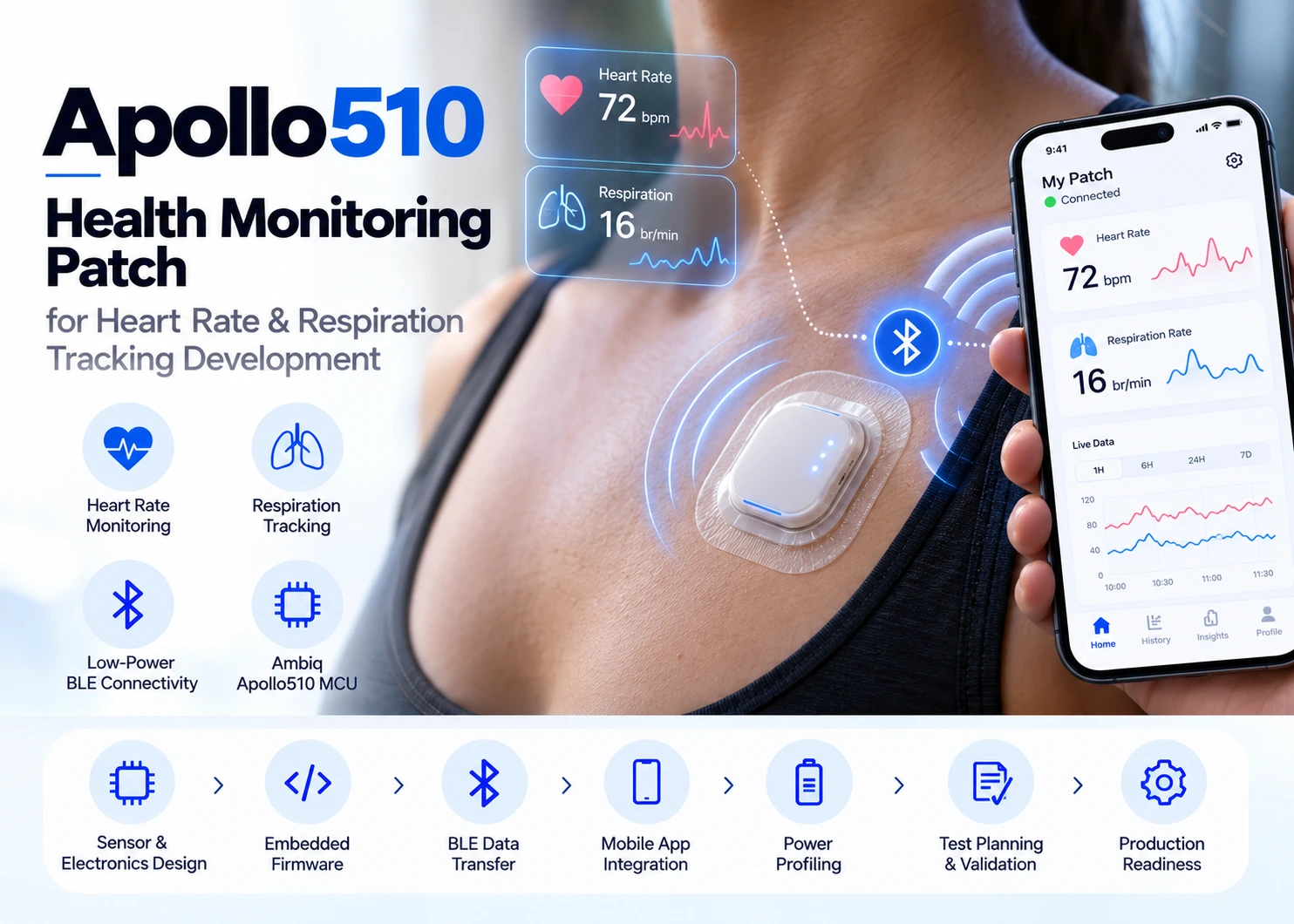
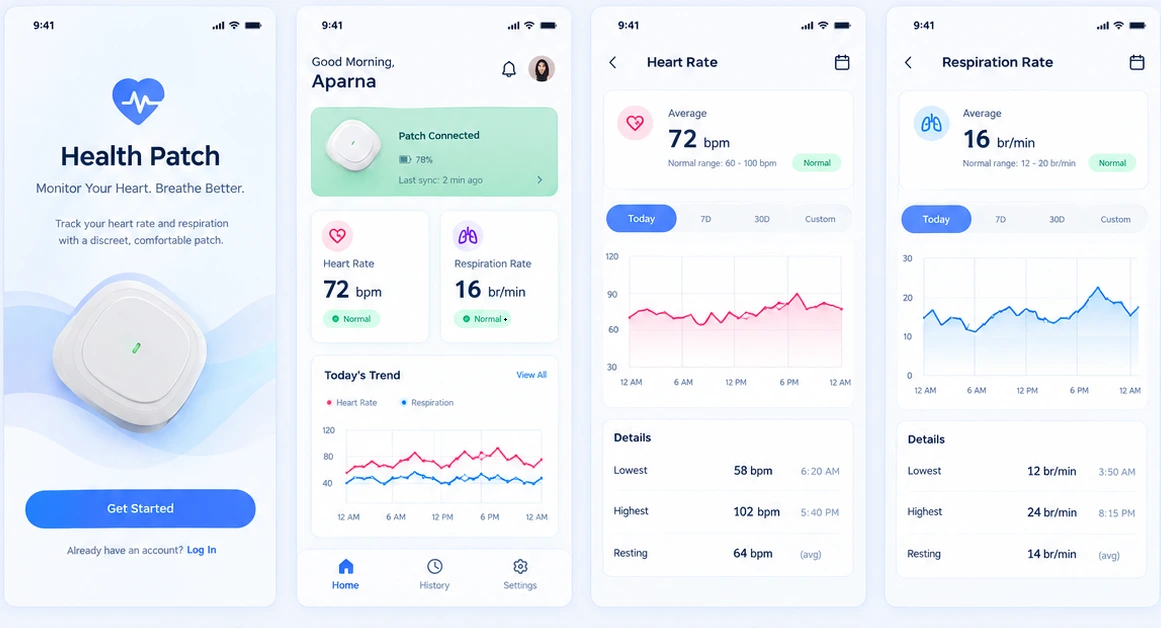
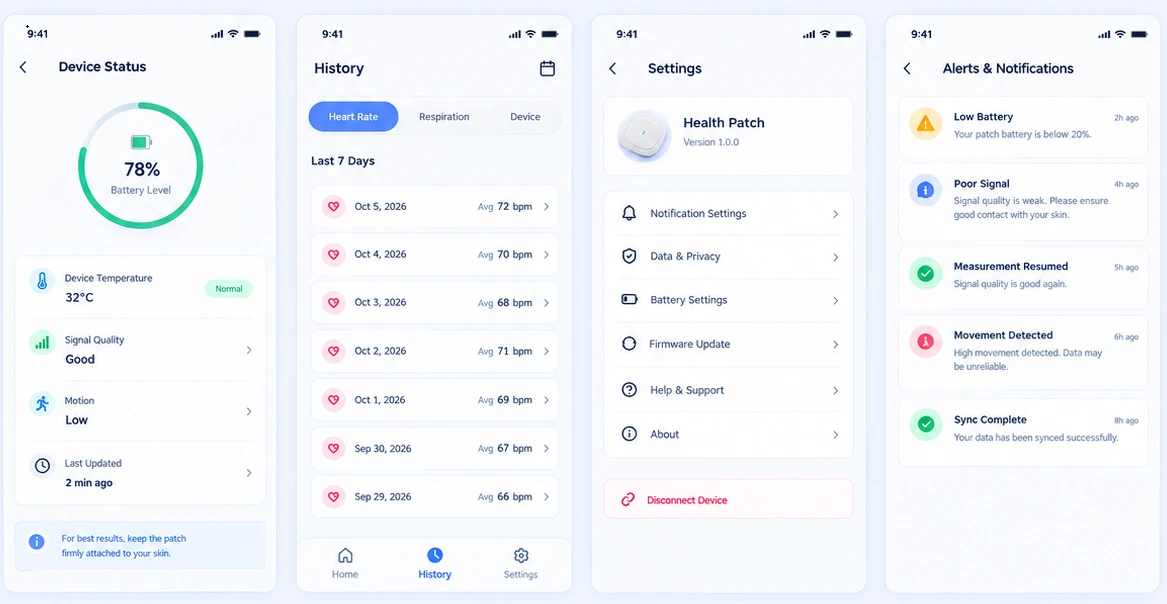
Case Study: A Discreet Patch for Heart-Rate and Respiration Trend Monitoring
Project Requirements
This idea was proposed as a new product in the domain of wearable device technology. This wearable device has several purposes, such as assisting in health monitoring processes in both commercial use and scientific research, depending on its final classification and functional uses.
According to the original product brief, the device was supposed to deliver a reliable health-monitoring patch with the following requirements:
-
Collect optical pulse signal via PPG sensor or electrical cardiovascular signal via ECG-compatible analogue front-end -
Obtain the trend for heart rate based on accepted signal windows -
Determine the trend of breathing rate using an adequate and validated signal source, such as body movement, impedance, breathing derived from ECG or modulation of PPG -
Detect moments of movements, bad contact and signal overwriting in order to detect the moments when the measurement is unreliable -
Save the measured values in a local storage if the phone is out of reach -
Send the encrypted data to the Android and iOS applications via BLE -
Work effectively using a tiny rechargeable device or with non-rechargeable battery -
Provide information on the state of the device without having a large display -
Provide the basis for proper testing, tracing and future product upgrades
The project's most important requirement was not to maximise the number of data points sent to a mobile app. It was to ensure that the system could distinguish between usable and unusable data. A patch should not turn a poor optical contact, a lifted adhesive edge or heavy motion into a falsely confident health trend.
Designing the Biosignal Acquisition Path
The interaction between the user and devices produces the biosignal response. The parameters that affect the PPG parameter include the kind of LED wavelength, optical layout, photodiode pathway, differences in skin colour, protection from external light, and touch of the sensor on the skin.
As for the ECG device, variables that need to be monitored are electrode positioning, skin-electrode resistance, cable flexing, design of the analog front end, and noise reduction. When it comes to respiration determination, the compromise must be made: the technology must be adequate for the patch site and its purpose.
The firmware architecture separated acquisition from interpretation. The sensor driver was responsible for deterministic sampling, timing, hardware interrupts and safe recovery after an I²C or SPI fault. A data-preparation layer handled filtering, baseline management, saturation flags and sensor diagnostics. The algorithm layer then worked only with time windows that passed defined quality checks.
This separation makes the product easier to validate and maintain. If an algorithm changes in a future firmware release, the original acquisition and quality metadata remain available for comparison. It also prevents application screens from presenting a number when the device has already detected that the underlying signal was unreliable.
In an optical application, the patch may check for the LED's current limitations, saturation of the photodiode, ambient illumination, clips on a sample, and contacts periodically made. In the case of an ECG-based design, firmware will check lead-off status, saturation on input, interference conditions, and amplitude of the signal.
These checks, although not providing the basis for a medical certification in themselves, may offer enough scientific proof to enable the assessment of whether a particular signal can be used for trend calculation.
From Raw Samples to Meaningful Trends
In general, raw waveform data is not suitable for any application intended for user use. The patch firmware has applied configurable digital filters to the data and divided it into small analysis windows. Each window is given a score according to certain criteria, such as amplitude range, noise level, correlation of movement, as well as periodicity and a number of missing samples.
For heart-rate trends, the system identified candidate beats or pulse peaks, evaluated interval consistency and calculated a rate only when the window met the configured quality threshold. Instead of forcing a value every few seconds, the product was designed to preserve an explicit "no reliable reading" state. This is better engineering and better user communication than displaying a precise-looking number generated from poor data.
Respiration trends may be inferred differently according to the selected sensing architecture. A chest-mounted patch could use motion-related information from an IMU, whereas an ECG or PPG signal may contain respiratory modulation that can be analysed carefully over a longer interval. The design team must document the source, applicable conditions, known limitations and validation method for the selected approach. It is not appropriate to treat all respiration algorithms as interchangeable.
The Apollo510 platform is capable of performing local processing of data, meaning it doesn't always need to send every single raw data sample over. The device has the ability to measure quality indicators and trends at the location, save raw data formats necessary for troubleshooting while still complying with privacy policies, as well as transmit any information required by the system.
This means less wireless activity, preventing battery drain as well as the leakage of sensitive personal information.
Firmware Architecture for a Connected Health Patch
The embedded firmware was organised around a robust event-driven design. Core services included:
-
Sensor acquisition service – manages timing, sensor registers, FIFO reads and fault recovery. -
Signal-quality service – evaluates contact, motion contamination, clipping, saturation and data completeness. -
Trend-analysis service – processes accepted windows for heart-rate and respiration-related outputs. -
Storage service – saves encrypted or protected records, device events and synchronization state. -
BLE service – handles advertising, pairing, transfer protocol, reconnection and acknowledgement. -
Power-management service – coordinates low-power modes, sensor duty cycles, radio activity and battery measurement. -
Diagnostics service – exposes controlled logs and device-health flags for development, QA and support.
BLE was developed as a resumable synchronization process. The companion application could order certain indexes from records, confirm that files have been sent, and continue from the last successful operation point after disconnection.
This approach allows users to refrain from considering the wireless connection as always available, which is essential for a bracelet that can be worn under clothing or moved from a smartphone.
Security was considered during the development phase, which means the functionality includes authentication pairing mechanisms, bonded devices' controls, and data encoding during the transfer process, as well as secure firmware update methods.
The security functionalities of Apollo510 family, such as secure boot, approved TrustZone inclusion, and hardware-based security capabilities, can facilitate the development of a defense-in-depth system; however, the secured product delivery process also includes the proper key management and update signing process, and access limitations for back-end systems.
Battery-Life Testing Is an Engineering Activity, Not a Marketing Estimate
Patch wearables have limited battery capacity, so every subsystem must have a defined energy budget. In this case, we measured and modelled the current consumed during sensing, local processing, BLE advertising, synchronization, flash writes and sleep.
An effective battery test plan would comprise of:
-
Idle current measurement with complete retention states enabled -
Sensor collection current with desired sampling parameters -
BLE communication current in various modes -
Data-upload current for realistic daily operation -
Current consumption during algorithm processing and flash writing activities -
Behavior under low-battery threshold -
Behavior with temperature and battery-voltage changes -
Charging and discharging behavior in regular rechargeable designs -
Worst-case scenarios that are different from best-case laboratory scenarios
This procedure results in accurate runtime estimation. Whatever battery-life claims are made must be related to the specific sensor mode, sample frequency, connection interval, uploading frequency, and environmental conditions.
Data Quality, Validation and Responsible Health Claims
Monitoring heart rate and respiration is valuable, although it needs to be done with appropriate language. Consumer wellness tracking, investigative devices, clinical decision support, and medical devices are all subject to wildly different evidence, quality system, and compliance requirements.
Adequate Infosoft supports teams in implementing a requirements-to-test traceability concept. All user requirements are linked to technical requirements, verification, testing records, and limitations known beforehand.
For example, a requirement to "show a heart-rate trend after adequate signal contact" can be traced to contact-quality conditions, window scoring logic, user-interface behaviour and test acceptance criteria.
When a customer wants to make healthcare or diagnosis claims, the development program must integrate the appropriate regulatory, quality management, clinical assessment, and cybersecurity expertise at the beginning. While firmware engineering is vital, it is still just a section of the broader medical device development process. We are not presenting a prototype algorithm or the output of a sensor as a diagnosis.
Apollo510 Health Monitoring Patch Development Services
Adequate Infosoft offers specialized embedded and connected product development solutions for wellness patches, biosensor wearables, heart-affecting concepts, exercise activity sensors, and remote health monitoring platforms.
Biosignal Firmware and Sensor Integration
We incorporate optical PPG modules, ECG/biopotential analogue front ends, IMUs, temperature readers, battery indicators and specialized sensor assemblies.
We undertake firmware development across sensor bring-up, timing, FIFO and interrupt handling, calibration procedures, fault signing and construction of testing reports. We help businesses differentiate between raw sensor availability and quality-certified or user-approved measurements.
Signal Quality and Embedded Processing
We develop firmware pipelines for filtering, windowing, quality scoring, peak or event detection and trend calculation. The implementation is designed around measurable thresholds, reproducible test data and versioned algorithm parameters.
When edge AI or compact machine-learning models are appropriate, Apollo510's Cortex-M55 and Helium capabilities can support efficient local inference; the model must still be evaluated against intended users, wear locations and environmental conditions.
BLE, Mobile Applications, and Secure Information Flow
Our team is engaged in creating BLE GATT services, mobile onboarding, working in the background, data security and mobile applications. We design ASP.NET Core services or cloud-based APIs to provide functionality such as doctor portal creation, user account creation, device management, alerts, and historical data analysis.
Availability of data, user consent and auditability can be built in from the first release.
Power Optimization and Battery Characterization
We analyze the hardware and software level of energy consumption, determine superfluous wake-up interactions, adjust radio frequency and sampling frequencies and organize software testing of battery life.
The significance of this process is especially notable with regard to software changes because changing batteries and recharging batteries may cause troubles for consumers and alter a product's marketing model.
Prototype and Production Assistance
We offer assistance in proof-of-concept, EVT and DVT programmes including firmware release management, PCB review inputs, manufacturing test specifications, bootloader and OTA update plans, documentation and defect resolution.
This outcome is more than just a proof-of-concept software; it is a set of software tools that the product team can use to test, manufacture and improve their product accordingly.
Get Your Apollo510 Health Monitoring Patch from Adequate Infosoft
An Ambiq Apollo510 health-monitoring patch can become a strong platform for long-duration trend collection when it is built around data-quality controls, efficient firmware and transparent validation boundaries.
Adequate Infosoft helps product teams turn that platform into a practical connected wearable with a roadmap for reliable future releases.
Editorial Resources