















 Mean Stack Development
 Vue JS Development
 Javascript Development
 React JS Development
 Angular JS Development
 Next JS development
 Java Development
 Python Development
 Django Development
 Cherrypy Development
 C# Development
 ASP.NET Development
 NodeJS Development
 Laravel Development
 CodeIgniter Development
 Zend Development
 Ruby on Rails Development
 CakePHP Development
 PHP Website Development
 Symfony Development
 Drupal Development
 Joomla Development
 Wordpress Development
 .NET Nuke Development
 Kentico
 Umbraco
 .NET MAUI Development
 Xamarin Application Development
 iOS Application Development
 Android Application Development
 Android Wear App Development
 Ionic Development
 iBeacon Application Development
 Universal Windows Platform (UWP)
 Kotlin Application Development
 Swift Application Development
 Flutter Application Development
 PWA Application Development
 Flutter Health Tech & Wearable App Development Company
 React Native Health Tech Wearable App Development
 Offshore Software Development
 Custom Application Development
 Front-End Development
 Full Stack Development
 AI & Machine Learning
 Custom CRM Solutions
 Flask Software Development
 Electron JS Development
 ChatGPT Development
 Telemedicine App Development
 Build Smart Telemedicine Platform
 Beauty & Salon App Solutions
 Hire Workato Experts
 Magento Development
 Magento 2.0 Development
 Magento Enterprise
 Shopping Cart Development
 Prestashop Development
 Shopify Development
 Open Cart Development
 WooCommerce Development
 BigCommerce Development
 NopCommerce Development
 Virto Commerce Development
 AspDotNetStorefront Development
 .NET Application Development
 Microsoft Dynamics CRM
 VB .NET Development
 Sharepoint Migration
 ASP.NET Core Development
 ASP.NET MVC Development
 AJAX Development
 Agile Development
 Microsoft Bot
 Microsoft Blazor
 Microsoft Azure Cognitive
 HTML 5
 UI/UX Design
 Graphic Design
 Adobe Photoshop
 XML Application Development
 Cloud Computing Solutions
 Azure Cloud App Development
 AWS Development
 Google Cloud Development
 Certified AWS IoT Services Developers
 DevOps Consulting & Development
 Kubernetes Consulting & Services
 SQL Programming Development
 MySQL Development
 MongoDB Development
 Big Data
 Robotic Process Automation
 Social Media Marketing
 Search Engine Optimization
 QA Testing
 Software Testing
 Software Security
 Maintenance And Support
 I.T. Consulting Services
 Business Intelligence
 YII Development
 Data Analysis
 Alexa Skills Development
 On Demand App for Mobile repairing services
 On Demand App for Car Service Booking
 On Demand App for Cleaning Services
 On Demand App for Pharmacy
 On Demand Dedicated Developers
 On Demand Lawyer App Development









 Nuki Smart Lock
 Salto Smart Lock
 TTlock Smart Lock
 NFC App Development
 Custom IOT Enabled Smart Lock
 Smart Locker Solutions
 Hospital Smart Lock Systems
 Hotel Smart Lock Systems
 Smart Home & Office Locks
 Smart Access for Schools & Colleges
 Unloc Smart Lock Integration
 Yale & August Smart Lock Integration
 Populife Smart Lock Integration
 Smart Lock Hardware Development
 Dairy IoT Solutions
 Agri IoT & AI Solutions
 Weather & Climate Solutions
 Water & Waste Management Solutions
 RaspBerry Pi
 Firmware Software Development
 ESP 32 Software Development
 Embedded Development
 Internet of Things
 Smart IoT Development
 IoT Sensor Integration & Development Solutions
 Smart IoT System Development for HVAC
 Tuya IoT App Development
 Particle IoT SDK
 IoT Development with AI
 Smart Pet GPS Tracker
 Dairy GPS Tracking Solutions
 GPS Fleet Management Software
 Car Rental & Subscription Solutions
 Car Buy & Sell Marketplace Development
 AI-Powered Car Wash App Development
 PCB Design & Fabrication
 IoT AC Automation
 AI–IoT Painting Solutions
 IoT Wearable Hardware & App Development
 HVAC Automation & AI Control Systems
 Smart Home IoT Engineering
 AI Embedded Systems
 AI Hardware Design Service
 Advanced IoT Hardware & Firmware Development
 Device Driver Development Services
 NXP i.MX RT Firmware & Hardware Services
 Microchip PIC & AVR Development
 Hire IoT Architects
 IoT Cloud & Infrastructure Solutions
 Infineon XMC / AURIX Development Services
 Matter & Thread IoT Services
 Native IoT Mobile App Development (BLE & Wi-Fi)
 Snapdragon IoT Firmware Development
 Renesas RA/RX Firmware Services
 Silicon Labs EFR32 Development Services
 Smart Wearable App Development
 Smart IoT Meters
 Smart Healthcare Wearable App Development
 Health Care Monitoring System
 Fitness Tracking App Development
 Smart Home Automation Apps
 nRF PCB Design
 ESP32 PCB Design
 Embedded Wearables Engineers
 Rental Property Management System
 Building Management System
 Smart Lighting Development
 Infineon Semiconductor Firmware Development Services
 Custom Camera Development: Hardware, Firmware & PCB Prototyping
 Smart Security Camera SDK
 Nordic Semiconductor SDK
 Infineon SDK
 Arduino SDK
 NFC Lock Integration
 Kerong Lock Integration
 IoT & AI Solutions for Manufacturing
 Smart Inventory & Logistics Solution
 Food & Beverage Industry Solutions
 Smart Hospitality Solutions
 Smart Property Management
 Custom Smart Home IOT SDK
 Smart IoT & AI in Healthcare
 AI-Powered Security Solutions
 Smart Home Safety & AI
 Veterinary Clinic Management (AI)
 Pet Care System (AI & IoT)
 Pet Training & Adoption (AI)
 Healthcare IoT Development
 Event Management Software
 Money Remittance App
 Money Lending App Development
 Utility and Bill Payment App
 IoT Mobile App Development (Flutter & React Native)
 AI & IoT Retail Solutions
 Smart EV App Development
 Smart Solar IoT & AI Solutions
 IoT-Based Energy Systems
 Smart Energy & Utilities Solutions
 6G Solutions
 IoT Security Solutions
 AI-Powered Lottery App Development
 AI-Sports Fitness Club Management
 Travel
 Real Estate
 Medical & Healthcare
 e-Learning
 Consumer Products
 Finance
 Automobile
 Media & Entertainment
 Billing Software
 Enterprise Resource Planning (ERP)
 Augumented & Virtual Reality
 Point of Sale(POS) Development
 Learning Management System
 EV Charging Solutions
 About Us
 Partners & Certifications
 Quality Assurance
 Our Clients & Testimonials
 Development Process
 Our Products
 Social Responsibility
 Work Ethics
 Vision & Mission
 Awards
 Live Project Demos
 Contact Us
 Case Studies
 Portfolio
 Blog
Blog
Wearable Sensor & Biosensor Integration Services Company
Wearable sensor integration turns a sensing component into a reliable body-worn system. It includes selection, electrical and mechanical integration, calibration, motion-artifact handling, embedded processing, wireless transfer and realistic validation.
A good datasheet does not guarantee useful data when the device moves, encounters ambient light or operates against skin.
Adequate Infosoft provides wearable sensor and biosensor integration for health, wellness, sports, rehabilitation, industrial safety and research products.
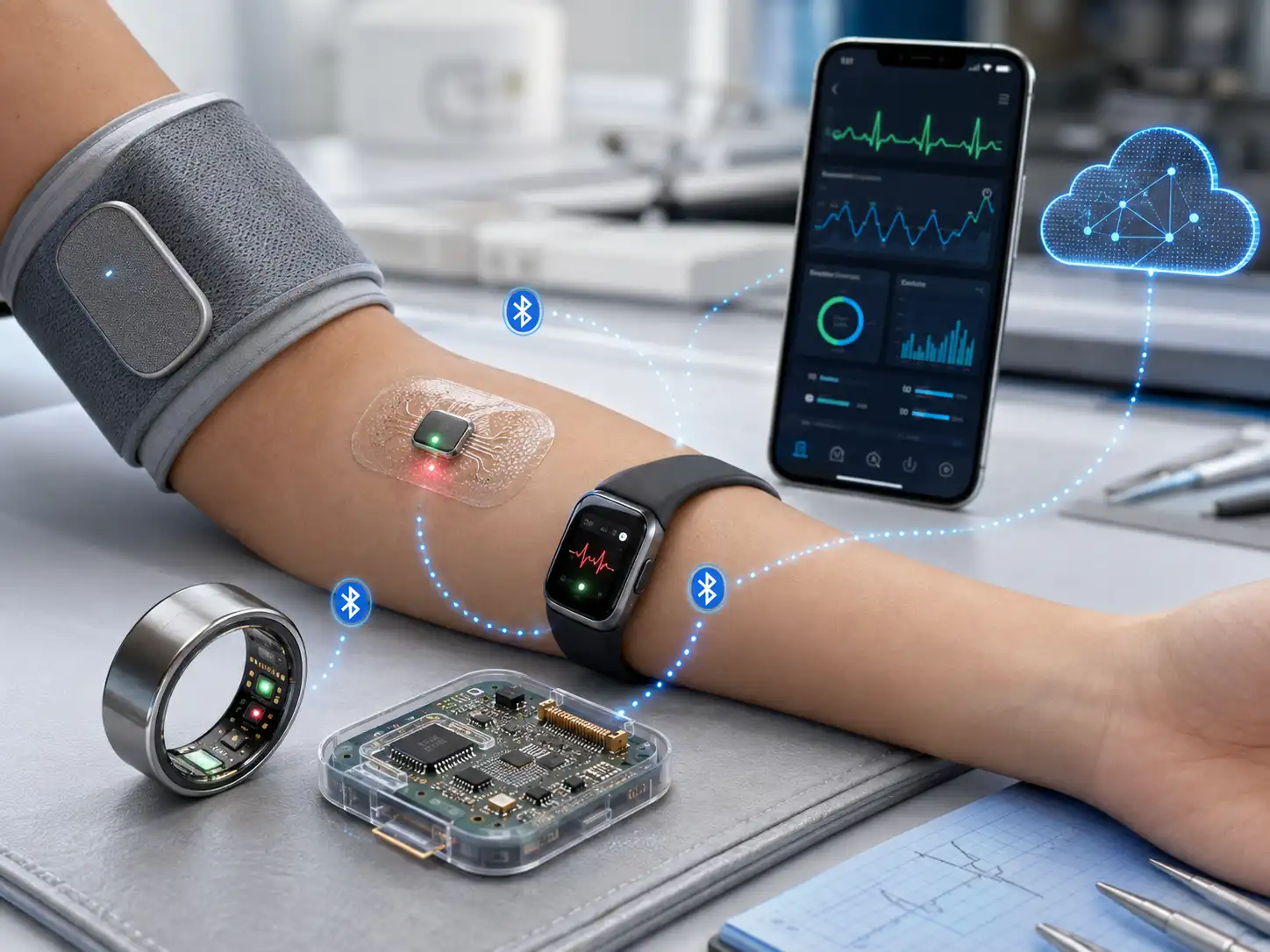
Our team covers custom PCBs, analog electronics, firmware, digital signal processing, Bluetooth Low Energy (BLE), mobile apps, cloud platforms and production preparation across patches, cuffs, rings and other wearables.
What Is Wearable Biosensor Integration?
Biosensors are devices that transform biological and medical signals into electrical data. These signals can take the form of optical pulses, electrical impulses (biopotentials), temperature, breathing (respiration), skin conductivity, and biochemical indicators (markers).
Integration is the process of creating a complete path for the signal and not simply attaching a sensor to a microcontroller unit (MCU).
Our engineering scope can include:
- PPG, heart-rate and SpO₂ sensor integration
- ECG, EMG and other biopotential acquisition
- Skin, body and non-contact temperature sensing
- IMU integration for movement, posture and artifact detection
- Respiration, pressure, force and mechanical-vibration sensing
- Electrodermal activity and skin-conductance measurement
- Sweat, hydration and electrolyte-sensing prototypes
- Sensor fusion, calibration and edge algorithms
- BLE GATT services, mobile apps and cloud data pipelines
- Flexible, rigid-flex and skin-contact electronics
The correct architecture depends on intended use. A wellness tracker, sports-training device and regulated medical product may measure similar signals but require different evidence, risk controls, software processes and claims.
Sensor Selection Starts with the Intended Measurement
We begin by defining what the product must measure, where it will be worn, how frequently it will sample and what decisions will be made from the data.
The discussion of accuracy cannot be done appropriately unless we consider the population, activity condition, nature of measuring procedure, environmental conditions and acceptable errors behavior.
The criteria of selection consist of sensor working principle, wave length or type of electrode, dynamic range of measurement, level of noise, sampling rate, value of current, package and available algorithms.
Analog Devices describes the MAX30102 as an integrated heart-rate and pulse-oximetry module with LEDs, photodetectors, optics and ambient-light rejection. Yet enclosure optics, skin contact, movement and algorithms still determine system performance.
For ECG or respiration, a dedicated analog front end may fit. Texas Instruments' ADS1292R combines two 24-bit channels with ECG and respiration-impedance functions.
Mechanical and Optical Integration Determine Signal Quality
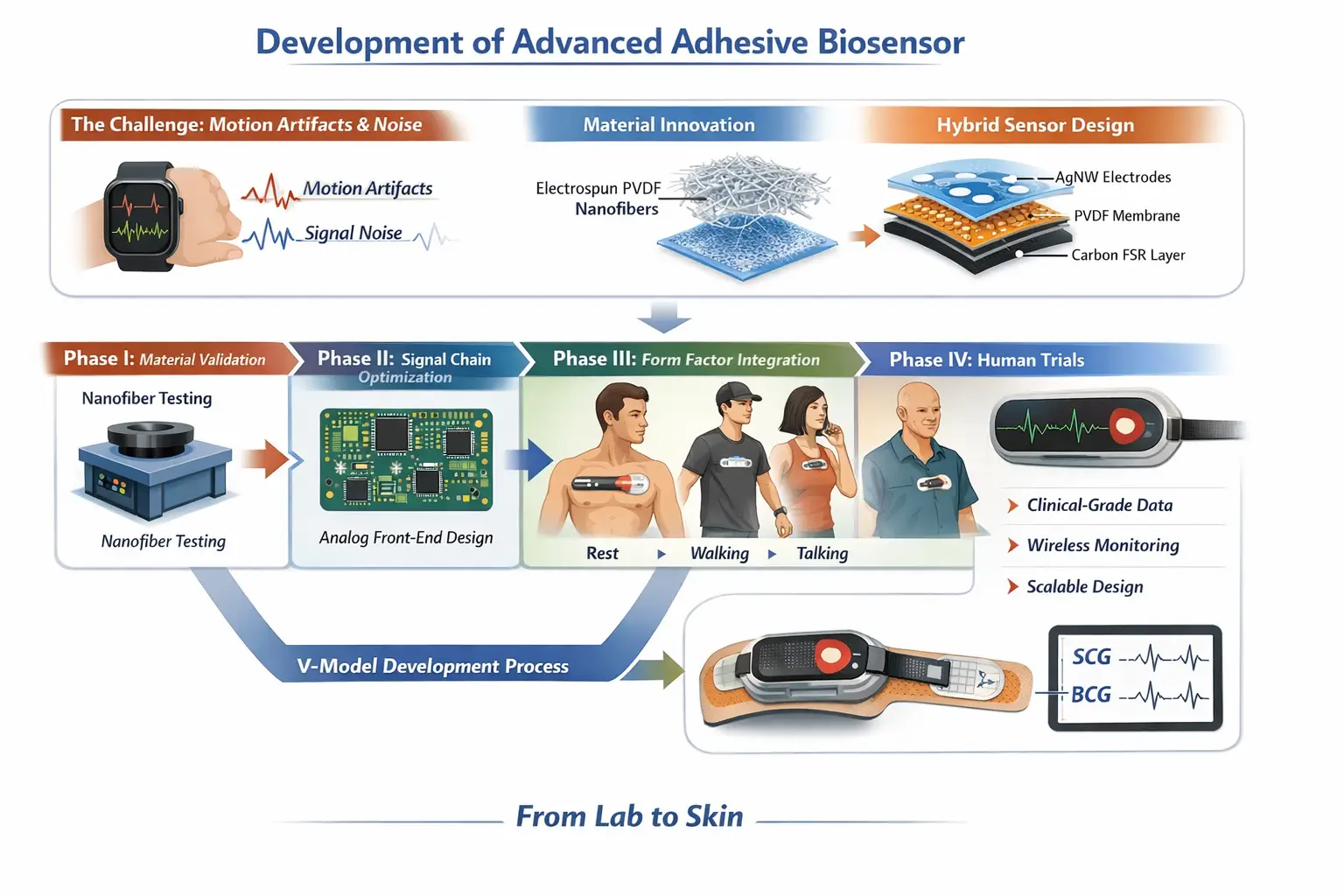
Wearable sensing is integral to mechanical and industrial design. The optical sensor must have a consistent coupling as well as controlled path of light. The electrodes must maintain stable contact with no nasty irritation.
Thermal isolation may be required in the case of temperature sensors from PCB or battery. IMUs should be mounted and oriented in such a way that their axes align with the needed algorithms.
For wrist PPG, gaps, excessive pressure, ambient light and motion can distort the waveform. Analog Devices notes that motion artifacts are especially important for PPG-derived measurements such as SpO₂, and its opto-mechanical guidance describes raised sensor geometry as one technique for improving skin coupling.
Our integration work considers optical barriers, window material, LED-to-photodiode spacing, strap force, sensor location, enclosure colour and motion-reference data.
For skin-contact devices, flexibility, adhesive behaviour, sweat, cable strain, cleaning and reusable versus disposable parts must be resolved early. Medical products may require biological evaluation; a "skin safe" component label does not evaluate the finished product or contact duration.
Analog Front Ends, PCB Layout and Power Integrity
Small biological signals can be negatively impacted through switching power supplies, digital clocks, radio waves, mains interference or poor grounding.
We design the talent power domains, references, amplifications, anti-alias filtering, ADC path and PCB layout according to the expected bandwidth of the signals.
The activities consist of creating noise budgets, controlling gain, monitoring common-mode voltage levels, protecting from noise, putting shielding in place, grounding and isolating analog circuitry from antennas and high current loads. The system test points allow for direct access to raw signals, rails and timing signals.
Power design affects signal quality. PPG LED current, AFE duty cycle, sensor warm-up and radio bursts influence battery life and stability. Firmware can sample during quiet periods, batch transfers and place unused sensors in standby.
Embedded Firmware, DSP and Sensor Fusion
Drivers, acquisition state machines, timestamping, buffering, calibrating storage, qualities and fault detection are made sufficiently by our firmware engineers. The raw data can be used for algorithm development while derived metrics are used using the device or in the connected application.
Processing may include baseline removal, notch and band-pass filtering, peak detection, resampling and artifact rejection. PPG can be synchronized with accelerometer data to identify movement-corrupted intervals; Analog Devices similarly documents combined PPG and accelerometer algorithms.
Sensor fusion must remain testable. We define units, time alignment, missing-data behaviour, quality thresholds and algorithm versions. TinyML decisions also consider training data, resources, latency, energy and updates.
BLE, Mobile Apps and Health-Data Delivery
We design BLE services around payload, sampling rate, latency, privacy and energy. Adopted profiles or custom GATT services carry documented units, timestamps, sequence numbers and quality indicators.
The Bluetooth SIG's Generic Health Sensor Profile provides a framework for health observations and device status; suitability depends on the receiving ecosystem.
Mobile applications take care of pairing, visualization, background synchronization of data, storage, firmware upgrades, and consent. Cloud frameworks make it possible for huge databases, reports, and fleet management to run. Health data is minimized, kept safe, and controlled.
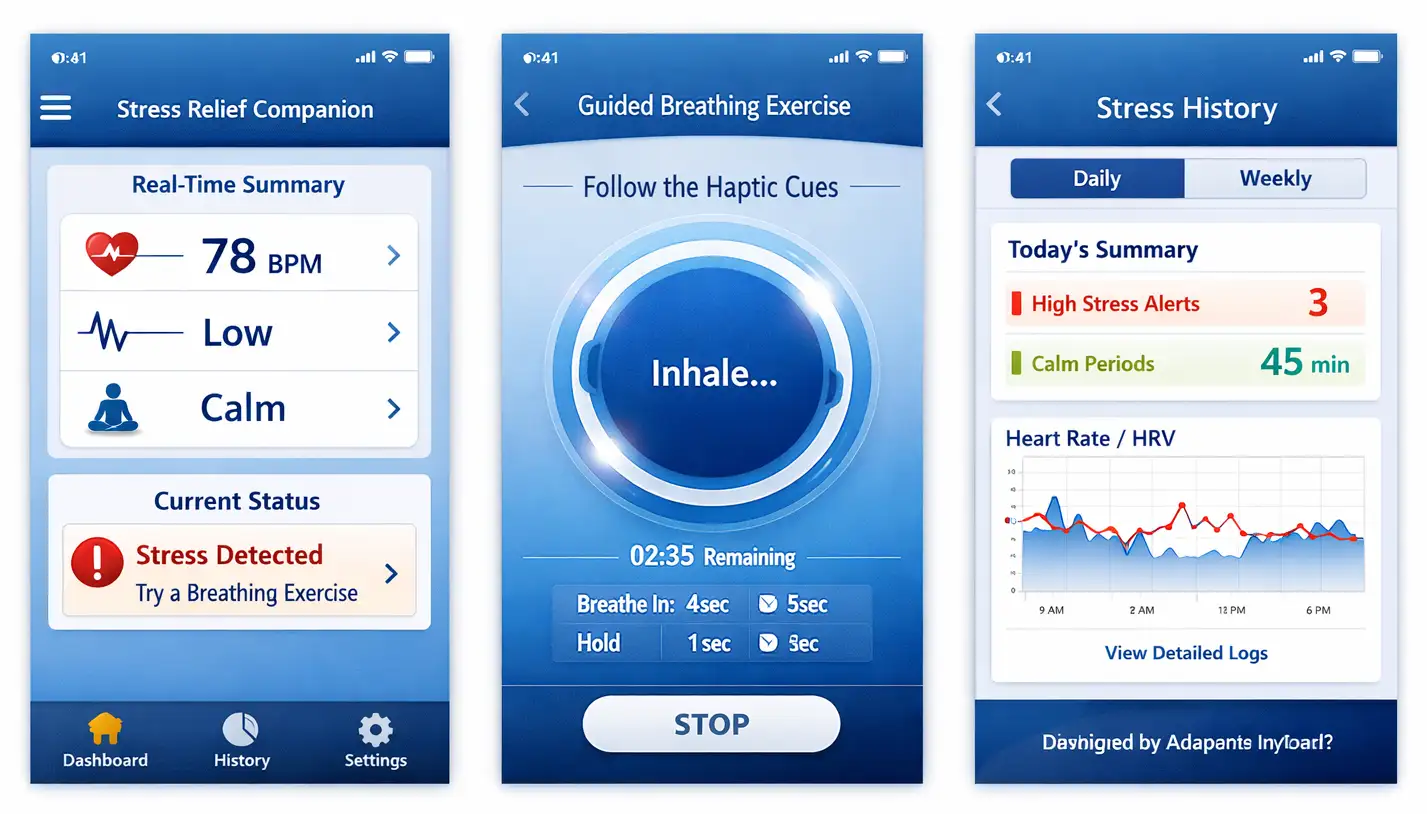
Explore Our Wearable Biosensor Case Studies

Popular Sensor & Biosensor Brands We Often Use
We incorporate sensors and biosensors by top manufacturers into our wearable and connected devices. Our work explores the area of temperature, motion, heart rate and other physiological signals too.
We choose the components based on the requirements of applications, energy consumption, size, connectivity, and measurement environment.
Our Wearable Sensor Integration Process
Measurement and Feasibility Definition
We document intended use, signal, body location, activity, reference method, data rate, battery target and acceptance criteria. Benchtop tests expose sensing risk early.
Sensor and Architecture Assessment
A comparison is made between sensors, analog front ends, microcontrollers, radio technology, electrical components, and mechanics, and then the specialist lab, the clinical partner or regulatory consultant is contacted.
Raw Data Collection
The first version of the prototype focuses on signals and replicable tests. The existence of raw datasets allows results based on the previous evidence to be compared using different filters and mechanics.
Integration of Algorithms and Products
The work is performed in such a way that firmware, DSP, BLE, the shell of the device, and application can be modified simultaneously. Tests include connection loss, buffer overflow, sensor disconnection, poor connection, and low battery.
Verification and Production Preparation
Requirements are traced to tests. We support calibration, regression fixtures, DFM/DFT, manufacturing files and pilot builds. Certification and clinical validation are scoped separately.
Regulatory and Validation Readiness
Product claims determine the regulatory path. The FDA's January 2026 general-wellness guidance distinguishes low-risk products promoting a healthy lifestyle from functions intended for diagnosis, cure, mitigation, prevention or treatment. Teams should settle intended use and claims before locking the verification plan.
For medical-device software, IEC 62304 defines lifecycle processes for development and maintenance.
Additional prerequisites involve risk assessment, electrical safety, electromagnetic compatibility, ease of use, security and biological testing.
Adequate Infosoft has the ability to create engineering evidence and verifiable designs, nevertheless, certification and clinical efficiency do not follow from the fact that the component enables a certain physiological measurement.
Frequently Asked Questions
Can you integrate PPG, ECG, SpO₂, temperature and IMU sensors in one wearable?
Yes, when the use case and form factor support them. We assess optical, analog, power, processing and mechanical interactions before defining the architecture.
How do you reduce motion artifacts in wearable sensor data?
We combine mechanical coupling, sensor placement, synchronized IMU data, signal-quality indicators and tested filtering. The correct method depends on the signal and activity.
Can you work with an existing PCB or prototype?
Yes. We can review sensor circuits, PCB layout, firmware, raw data and enclosure integration, then prioritize changes by measurement risk and redesign effort.
Do you provide medical certification?
We support design controls, documentation, verification engineering and remediation. Formal certification, clinical studies and regulatory submissions are completed with the client's accredited laboratories and regulatory specialists.