














 Mean Stack Development
 Vue JS Development
 Javascript Development
 React JS Development
 Angular JS Development
 Next JS development
 Java Development
 Python Development
 Django Development
 Cherrypy Development
 C# Development
 ASP.NET Development
 NodeJS Development
 Laravel Development
 CodeIgniter Development
 Zend Development
 Ruby on Rails Development
 CakePHP Development
 PHP Website Development
 Symfony Development
 Drupal Development
 Joomla Development
 Wordpress Development
 .NET Nuke Development
 Kentico
 Umbraco
 .NET MAUI Development
 Xamarin Application Development
 iOS Application Development
 Android Application Development
 Android Wear App Development
 Ionic Development
 iBeacon Application Development
 Universal Windows Platform (UWP)
 Kotlin Application Development
 Swift Application Development
 Flutter Application Development
 PWA Application Development
 Flutter Health Tech & Wearable App Development Company
 React Native Health Tech Wearable App Development
 Offshore Software Development
 Custom Application Development
 Front-End Development
 Full Stack Development
 AI & Machine Learning
 Custom CRM Solutions
 Flask Software Development
 Electron JS Development
 ChatGPT Development
 Telemedicine App Development
 Build Smart Telemedicine Platform
 Beauty & Salon App Solutions
 Hire Workato Experts
 Magento Development
 Magento 2.0 Development
 Magento Enterprise
 Shopping Cart Development
 Prestashop Development
 Shopify Development
 Open Cart Development
 WooCommerce Development
 BigCommerce Development
 NopCommerce Development
 Virto Commerce Development
 AspDotNetStorefront Development
 .NET Application Development
 Microsoft Dynamics CRM
 VB .NET Development
 Sharepoint Migration
 ASP.NET Core Development
 ASP.NET MVC Development
 AJAX Development
 Agile Development
 Microsoft Bot
 Microsoft Blazor
 Microsoft Azure Cognitive
 HTML 5
 UI/UX Design
 Graphic Design
 Adobe Photoshop
 XML Application Development
 Cloud Computing Solutions
 Azure Cloud App Development
 AWS Development
 Google Cloud Development
 Certified AWS IoT Services Developers
 DevOps Consulting & Development
 Kubernetes Consulting & Services
 SQL Programming Development
 MySQL Development
 MongoDB Development
 Big Data
 Robotic Process Automation
 Social Media Marketing
 Search Engine Optimization
 QA Testing
 Software Testing
 Software Security
 Maintenance And Support
 I.T. Consulting Services
 Business Intelligence
 YII Development
 Data Analysis
 Alexa Skills Development
 On Demand App for Mobile repairing services
 On Demand App for Car Service Booking
 On Demand App for Cleaning Services
 On Demand App for Pharmacy
 On Demand Dedicated Developers
 On Demand Lawyer App Development










 Nuki Smart Lock
 Salto Smart Lock
 TTlock Smart Lock
 NFC App Development
 Custom IOT Enabled Smart Lock
 Smart Locker Solutions
 Hospital Smart Lock Systems
 Hotel Smart Lock Systems
 Smart Home & Office Locks
 Smart Access for Schools & Colleges
 Unloc Smart Lock Integration
 Yale & August Smart Lock Integration
 Populife Smart Lock Integration
 Smart Lock Hardware Development
 Dairy IoT Solutions
 Agri IoT & AI Solutions
 Weather & Climate Solutions
 Water & Waste Management Solutions
 RaspBerry Pi
 Firmware Software Development
 ESP 32 Software Development
 Embedded Development
 Internet of Things
 Smart IoT Development
 IoT Sensor Integration & Development Solutions
 Smart IoT System Development for HVAC
 Tuya IoT App Development
 Particle IoT SDK
 IoT Development with AI
 Smart Pet GPS Tracker
 Dairy GPS Tracking Solutions
 GPS Fleet Management Software
 Car Rental & Subscription Solutions
 Car Buy & Sell Marketplace Development
 AI-Powered Car Wash App Development
 PCB Design & Fabrication
 IoT AC Automation
 AI–IoT Painting Solutions
 IoT Wearable Hardware & App Development
 HVAC Automation & AI Control Systems
 Smart Home IoT Engineering
 AI Embedded Systems
 AI Hardware Design Service
 Advanced IoT Hardware & Firmware Development
 Device Driver Development Services
 NXP i.MX RT Firmware & Hardware Services
 Microchip PIC & AVR Development
 Hire IoT Architects
 IoT Cloud & Infrastructure Solutions
 Infineon XMC / AURIX Development Services
 Matter & Thread IoT Services
 Native IoT Mobile App Development (BLE & Wi-Fi)
 Snapdragon IoT Firmware Development
 Renesas RA/RX Firmware Services
 Silicon Labs EFR32 Development Services
 Smart Wearable App Development
 Smart IoT Meters
 Smart Healthcare Wearable App Development
 Health Care Monitoring System
 Fitness Tracking App Development
 Smart Home Automation Apps
 nRF PCB Design
 ESP32 PCB Design
 Embedded Wearables Engineers
 Rental Property Management System
 Building Management System
 Smart Lighting Development
 Infineon Semiconductor Firmware Development Services
 Custom Camera Development: Hardware, Firmware & PCB Prototyping
 Smart Security Camera SDK
 Nordic Semiconductor SDK
 Infineon SDK
 Arduino SDK
 NFC Lock Integration
 Kerong Lock Integration
 IoT & AI Solutions for Manufacturing
 Smart Inventory & Logistics Solution
 Food & Beverage Industry Solutions
 Smart Hospitality Solutions
 Smart Property Management
 Custom Smart Home IOT SDK
 Smart IoT & AI in Healthcare
 AI-Powered Security Solutions
 Smart Home Safety & AI
 Veterinary Clinic Management (AI)
 Pet Care System (AI & IoT)
 Pet Training & Adoption (AI)
 Healthcare IoT Development
 Event Management Software
 Money Remittance App
 Money Lending App Development
 Utility and Bill Payment App
 IoT Mobile App Development (Flutter & React Native)
 AI & IoT Retail Solutions
 Smart EV App Development
 Smart Solar IoT & AI Solutions
 IoT-Based Energy Systems
 Smart Energy & Utilities Solutions
 6G Solutions
 IoT Security Solutions
 AI-Powered Lottery App Development
 AI-Sports Fitness Club Management
 Travel
 Real Estate
 Medical & Healthcare
 e-Learning
 Consumer Products
 Finance
 Automobile
 Media & Entertainment
 Billing Software
 Enterprise Resource Planning (ERP)
 Augumented & Virtual Reality
 Point of Sale(POS) Development
 Learning Management System
 EV Charging Solutions
 About Us
 Partners & Certifications
 Quality Assurance
 Our Clients & Testimonials
 Development Process
 Our Products
 Social Responsibility
 Work Ethics
 Vision & Mission
 Awards
 Live Project Demos
 Contact Us
 Case Studies
 Portfolio
 Blog
Blog
Snapdragon Wear Elite AI Wearable Development Services
Adequate Infosoft provides Snapdragon Wear Elite AI wearable development services for companies creating intelligent smartwatches, safety devices, health and fitness products, enterprise wearables, pendants and emerging personal-AI form factors.
Our engineering scope can connect embedded hardware, sensor fusion, on-device AI, wireless connectivity, companion applications, cloud services, security and production validation into one product roadmap.
Qualcomm introduced Snapdragon Wear Elite in 2026 as its first wearable platform with a dedicated NPU for personal AI.
It lists up to 12 TOPS, models up to two billion parameters, a 3 nm architecture, low-power islands and six connectivity modes. Product results still depend on workload, thermal design, sensors and measured power.
What Can You Build with Snapdragon Wear Elite?
The platform is able to be used in wearable devices that require higher processing capabilities, context information and connectivity than it is possible to get from a small BLE microcontroller. For example:
-
Smartwatches implementing AI technology that allow for providing personalized coaching and context-based assistance -
Health and wellness wearables that make use of multiple sources of information coming from sensors -
Industrial or lone-worker devices capable of local event classification -
Smart sports devices equipped with motion analysis and ability to provide feedback -
Voice-purposed pendants, pins or hands-free assistants -
Navigation, safety and enterprise wearables applying contextual AI
Effective designs delegate simple tasks to low-power processing units, use NPU if necessary and rely on a phone or a cloud, when the device has reached its energy or memory limits.
When Should You Choose Snapdragon Wear Elite?
Choose this class of platform when the product needs a rich display, advanced local AI, several high-bandwidth sensors, independent connectivity or coordinated experiences across wearable, phone and cloud. A simpler BLE MCU may remain the better choice for a screenless ring, basic tracker or tiny sensor node that prioritizes minimal size and multi-day or multi-week runtime. We compare both architectures against actual workloads before committing to the higher compute, memory, RF and thermal complexity.
Snapdragon Wear Elite Development Services
Adequate Infosoft is capable of offering dedicated engineering stream or all the services needed for the manufacture of wearable gadgets.
Implementation of Qualcomm platforms, BSPs and development kits
Choice of sensors and assembling them on the board
Development of AI models and their deployment on devices
Creating pipelines for motion, sound, health, and environmental sensors
Development of operating system for devices and connecting multiple radios
Creating apps on Android and iOS operating systems
Creating APIs for cloud services and analytics
Conducting power, memory, latency, and heating evaluations
Ensuring security and privacy of returns
The range of services that can be provided depends on the Qualcomm hardware used on the device, as well as on the BSP, license documentation, and configuration of the device.
Relevant Adequate Infosoft Wearable Experience
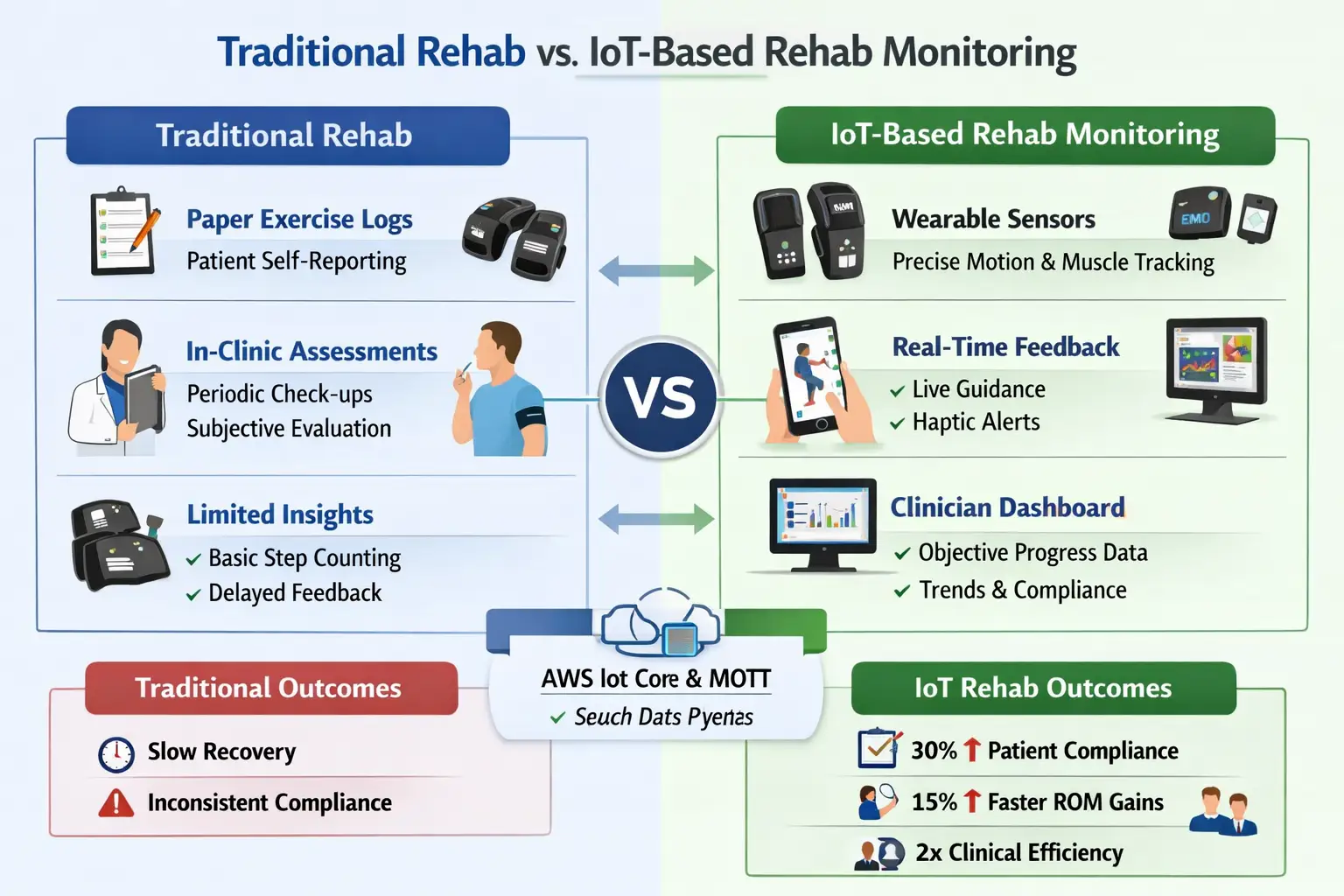
AI Rehabilitation Wearable with Motion Intelligence
Our published AI-powered rehabilitation wearable case study describes a multi-node system using wearable motion sensors, quaternion-based orientation processing, BLE and biomechanical algorithms for exercise feedback.
The project addressed the variability in sensor placement, noise due to movement, and the conversion of raw orientation information into practical motion quality metrics.
It illustrates the use of effective sensor fusion and wearable artificial intelligence technology although it opted for Nordic components over Snapdragon Wear Elite hardware and did not test its implementation using Qualcomm’s NPU.
Read Rehabilitation Wearable Case Study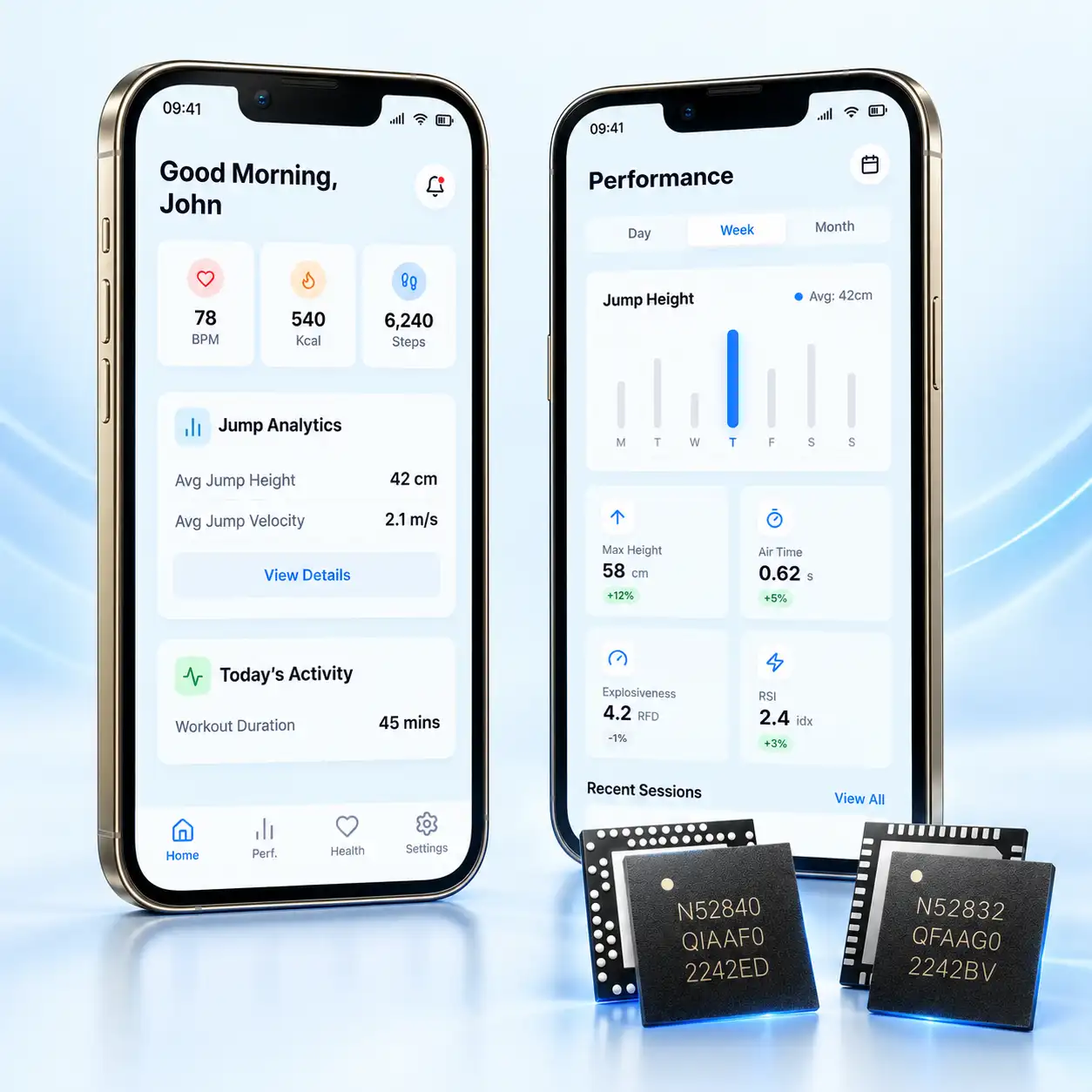
On-Device AI Engineering for Wearables
Selecting the Right Workload
Wearable AI should solve a defined user problem, not exist because an NPU is available. We begin with inputs, output, acceptable error, response time, privacy constraints and the action the product will take.
Workloads for the candidates include activity recognition, gesture classification, audio event detection, personalization of recommendations, anomaly detection, contextual ranking and compact features of voice or language.
In addition, engineers should specify sensor windows, sampling, preprocessing, thresholds of confidence, and fallback responses. Low confidence response could ask for another sample, references to the phone, or result in no action at all, which is critical for health and safety.
Model Optimization and Deployment
After platform access is confirmed, work can include model selection, representative data, quantization, operator compatibility, memory planning, conversion and on-device profiling.
“Up to” TOPS or parameter limits do not guarantee latency or battery life. Results vary with architecture, precision, memory traffic, concurrent workloads and thermals, so we measure end-to-end inference under representative use.
Sensor Fusion and Context-Aware Intelligence
According to Qualcomm, Snapdragon Wear Elite is compatible with over 50 sensors. The actual product will come with a custom selection of certain sensors, including accelerometers, gyroscopes, magnetometers, optical sensors, temperature, microphones, pressure, proximity or surroundings.
Sensor fusion requires timestamp alignment, calibration, orientation, artifact detection and missing-data behavior. Products must distinguish measurements from inferred states. Health or safety conclusions require appropriate verification, risk management and, where applicable, clinical or regulatory work.
Connectivity Architecture: From Wrist to Cloud
Qualcomm's hexa-connectivity suite has been released and includes technologies like 5G RedCap, Micro-Power Wi-Fi, UWB, Bluetooth 6.0, GNSS, and NB-NTN. This offers systems from watches connected to phones to safety equipment connected on their own.
We are in charge of such things as setting up the system, selecting links, handling queues in case of offline work, syncing and working in case of losing the connection. Bluetooth handles peripherals, Wi-Fi takes care of bulk transferring, UWB is used for proximity and GNSS works in terms of positioning; RedCap and NB-NTN perform independently if network conditions allow that.
Antennas, enclosure, the body, coexistence, carriers and certification influence results. We validate intended combinations rather than treating a platform feature list as device performance.
Power, Thermal and Always-On Design
Qualcomm claims that it can increase battery life by up to 30%, and charging times are reduced to under ten minutes to 50%, depending on the conditions given. The actual usage time varies based on the screen quality, wireless connections, sensors, workload for AI, the quality of the battery, and ways of utilizing it.
We profile idle, sensing, inference, display, audio, location, synchronization and charging on target hardware. Lightweight tasks can stay in low-power domains, waking high-performance compute for bounded work. Thermal policies may limit concurrency or duty cycle near the skin.
Wearable Software, Mobile Apps and Cloud
We develop onboarding, permissions, settings, notifications, dashboards and update flows. Companion apps can handle deeper visualization, health-data synchronization and recovery.
Backends may manage identity, configuration, model and firmware versions, consent, telemetry and phased rollouts. Work can be split across wearable, phone and cloud according to privacy, latency and availability.
Safety, Privacy and Ethical AI
Wearable devices are capable of tracking position and motion, sound and procedures together with biological parameters.
We use the principles of data minimization, least-privilege access rights, secure booting, secure updates, encrypted transmission, and role-based access controls according to our products’ risk classification.
AI control techniques comprise data provenance, auditability of output, version management, tracking of impacts and monitoring of input changes.
Frequently Asked Questions
Not at all. Qualcomm has aimed this technology towards both watches and newer form factors, including pins and pendants. Practicality will depend on size, thermal and battery requirements, screen and communication capabilities.
Qualcomm advertises support for models up to two billion parameters, but feasibility depends on model architecture, precision, memory, latency, power and concurrent functions. It must be tested on target hardware.
Some tracking and operations will work locally. Whether the unit can provide an independent connection will depend upon the hardware solution, availability of the network, approvals, and service plan.
Yes. Scope can include embedded or wearable-OS software, AI integration, Android/iOS apps, cloud APIs, device management and OTA workflows.
No. We develop and test according to specifications but the performance parameters and certifications require the real-life confirmation and evaluation from specialized third parties that know how to process the information correctly.
Build a Snapdragon Wear Elite AI Product
Share your form factor, sensors, AI use case, target markets, connectivity needs and battery constraints.
Adequate Infosoft can assess platform fit, identify access dependencies and define a phased plan from feasibility prototype through connected product development and validation.