











 Mean Stack Development
 Vue JS Development
 Javascript Development
 React JS Development
 Angular JS Development
 Next JS development
 Java Development
 Python Development
 Django Development
 Cherrypy Development
 C# Development
 ASP.NET Development
 NodeJS Development
 Laravel Development
 CodeIgniter Development
 Zend Development
 Ruby on Rails Development
 CakePHP Development
 PHP Website Development
 Symfony Development
 Drupal Development
 Joomla Development
 Wordpress Development
 .NET Nuke Development
 Kentico
 Umbraco
 .NET MAUI Development
 Xamarin Application Development
 iOS Application Development
 Android Application Development
 Android Wear App Development
 Ionic Development
 iBeacon Application Development
 Universal Windows Platform (UWP)
 Kotlin Application Development
 Swift Application Development
 Flutter Application Development
 PWA Application Development
 Flutter Health Tech & Wearable App Development Company
 React Native Health Tech Wearable App Development
 Offshore Software Development
 Custom Application Development
 Front-End Development
 Full Stack Development
 AI & Machine Learning
 Custom CRM Solutions
 Flask Software Development
 Electron JS Development
 ChatGPT Development
 Telemedicine App Development
 Build Smart Telemedicine Platform
 Beauty & Salon App Solutions
 Hire Workato Experts
 Magento Development
 Magento 2.0 Development
 Magento Enterprise
 Shopping Cart Development
 Prestashop Development
 Shopify Development
 Open Cart Development
 WooCommerce Development
 BigCommerce Development
 NopCommerce Development
 Virto Commerce Development
 AspDotNetStorefront Development
 .NET Application Development
 Microsoft Dynamics CRM
 VB .NET Development
 Sharepoint Migration
 ASP.NET Core Development
 ASP.NET MVC Development
 AJAX Development
 Agile Development
 Microsoft Bot
 Microsoft Blazor
 Microsoft Azure Cognitive
 HTML 5
 UI/UX Design
 Graphic Design
 Adobe Photoshop
 XML Application Development
 Cloud Computing Solutions
 Azure Cloud App Development
 AWS Development
 Google Cloud Development
 Certified AWS IoT Services Developers
 DevOps Consulting & Development
 Kubernetes Consulting & Services
 SQL Programming Development
 MySQL Development
 MongoDB Development
 Big Data
 Robotic Process Automation
 Social Media Marketing
 Search Engine Optimization
 QA Testing
 Software Testing
 Software Security
 Maintenance And Support
 I.T. Consulting Services
 Business Intelligence
 YII Development
 Data Analysis
 Alexa Skills Development
 On Demand App for Mobile repairing services
 On Demand App for Car Service Booking
 On Demand App for Cleaning Services
 On Demand App for Pharmacy
 On Demand Dedicated Developers
 On Demand Lawyer App Development










 Nuki Smart Lock
 Salto Smart Lock
 TTlock Smart Lock
 NFC App Development
 Custom IOT Enabled Smart Lock
 Smart Locker Solutions
 Hospital Smart Lock Systems
 Hotel Smart Lock Systems
 Smart Home & Office Locks
 Smart Access for Schools & Colleges
 Unloc Smart Lock Integration
 Yale & August Smart Lock Integration
 Populife Smart Lock Integration
 Smart Lock Hardware Development
 Dairy IoT Solutions
 Agri IoT & AI Solutions
 Weather & Climate Solutions
 Water & Waste Management Solutions
 RaspBerry Pi
 Firmware Software Development
 ESP 32 Software Development
 Embedded Development
 Internet of Things
 Smart IoT Development
 IoT Sensor Integration & Development Solutions
 Smart IoT System Development for HVAC
 Tuya IoT App Development
 Particle IoT SDK
 IoT Development with AI
 Smart Pet GPS Tracker
 Dairy GPS Tracking Solutions
 GPS Fleet Management Software
 Car Rental & Subscription Solutions
 Car Buy & Sell Marketplace Development
 AI-Powered Car Wash App Development
 PCB Design & Fabrication
 IoT AC Automation
 AI–IoT Painting Solutions
 IoT Wearable Hardware & App Development
 HVAC Automation & AI Control Systems
 Smart Home IoT Engineering
 AI Embedded Systems
 AI Hardware Design Service
 Advanced IoT Hardware & Firmware Development
 Device Driver Development Services
 NXP i.MX RT Firmware & Hardware Services
 Microchip PIC & AVR Development
 Hire IoT Architects
 IoT Cloud & Infrastructure Solutions
 Infineon XMC / AURIX Development Services
 Matter & Thread IoT Services
 Native IoT Mobile App Development (BLE & Wi-Fi)
 Snapdragon IoT Firmware Development
 Renesas RA/RX Firmware Services
 Silicon Labs EFR32 Development Services
 Smart Wearable App Development
 Smart IoT Meters
 Smart Healthcare Wearable App Development
 Health Care Monitoring System
 Fitness Tracking App Development
 Smart Home Automation Apps
 nRF PCB Design
 ESP32 PCB Design
 Embedded Wearables Engineers
 Rental Property Management System
 Building Management System
 Smart Lighting Development
 Infineon Semiconductor Firmware Development Services
 Custom Camera Development: Hardware, Firmware & PCB Prototyping
 Smart Security Camera SDK
 Nordic Semiconductor SDK
 Infineon SDK
 Arduino SDK
 NFC Lock Integration
 Kerong Lock Integration
 IoT & AI Solutions for Manufacturing
 Smart Inventory & Logistics Solution
 Food & Beverage Industry Solutions
 Smart Hospitality Solutions
 Smart Property Management
 Custom Smart Home IOT SDK
 Smart IoT & AI in Healthcare
 AI-Powered Security Solutions
 Smart Home Safety & AI
 Veterinary Clinic Management (AI)
 Pet Care System (AI & IoT)
 Pet Training & Adoption (AI)
 Healthcare IoT Development
 Event Management Software
 Money Remittance App
 Money Lending App Development
 Utility and Bill Payment App
 IoT Mobile App Development (Flutter & React Native)
 AI & IoT Retail Solutions
 Smart EV App Development
 Smart Solar IoT & AI Solutions
 IoT-Based Energy Systems
 Smart Energy & Utilities Solutions
 6G Solutions
 IoT Security Solutions
 AI-Powered Lottery App Development
 AI-Sports Fitness Club Management
 Travel
 Real Estate
 Medical & Healthcare
 e-Learning
 Consumer Products
 Finance
 Automobile
 Media & Entertainment
 Billing Software
 Enterprise Resource Planning (ERP)
 Augumented & Virtual Reality
 Point of Sale(POS) Development
 Learning Management System
 EV Charging Solutions
 About Us
 Partners & Certifications
 Quality Assurance
 Our Clients & Testimonials
 Development Process
 Our Products
 Social Responsibility
 Work Ethics
 Vision & Mission
 Awards
 Live Project Demos
 Contact Us
 Case Studies
 Portfolio
 Blog
Blog
NVIDIA Jetson Orin NX Forklift & Pedestrian Monitoring Development Services
Pedestrian routes and forklift routes can often share the same spaces in warehouses as warehouse racking creates blind spots, pallets obstruct sightlines, lighting conditions differ across loading bays, and moving forklifts can change ordinary crossings into precarious points in seconds.
A proximity detection system using video technology adds another layer of awareness by detecting the presence of pedestrians and forklifts, estimating whether they enter any pre-defined hazardous zone, and generating the appropriate alerts for the location or supervision.
This monitoring system is not to be seen as a self-sufficient safety system and a substitute of trained operators, separation schemes, designated routes for pedestrian traffic, speed restrictions, mirrors, signals, personal protective equipment and site safety instructions including procedures and regulations.
Adequate Infosoft develops NVIDIA Jetson Orin NX edge-AI systems for forklift-pedestrian awareness, industrial camera analytics, dangerous-zone monitoring and real-time alert workflows.
Our services include camera placement studies, edge video analytics, object detection, tracking, alert logic, industrial integration, dashboards and field validation.
Jetson Orin NX provides compact GPU-accelerated computing for running computer-vision models directly at the edge.
It enables the site to process video nearer to the camera and decreases its reliance on the cloud which translates into low latency reactions.
The real effect, however, heavily depends on many factors including camera viewpoint, line of sight, calibration, quality of the model, alerting scheme, and operation response method.
Let's Work Together!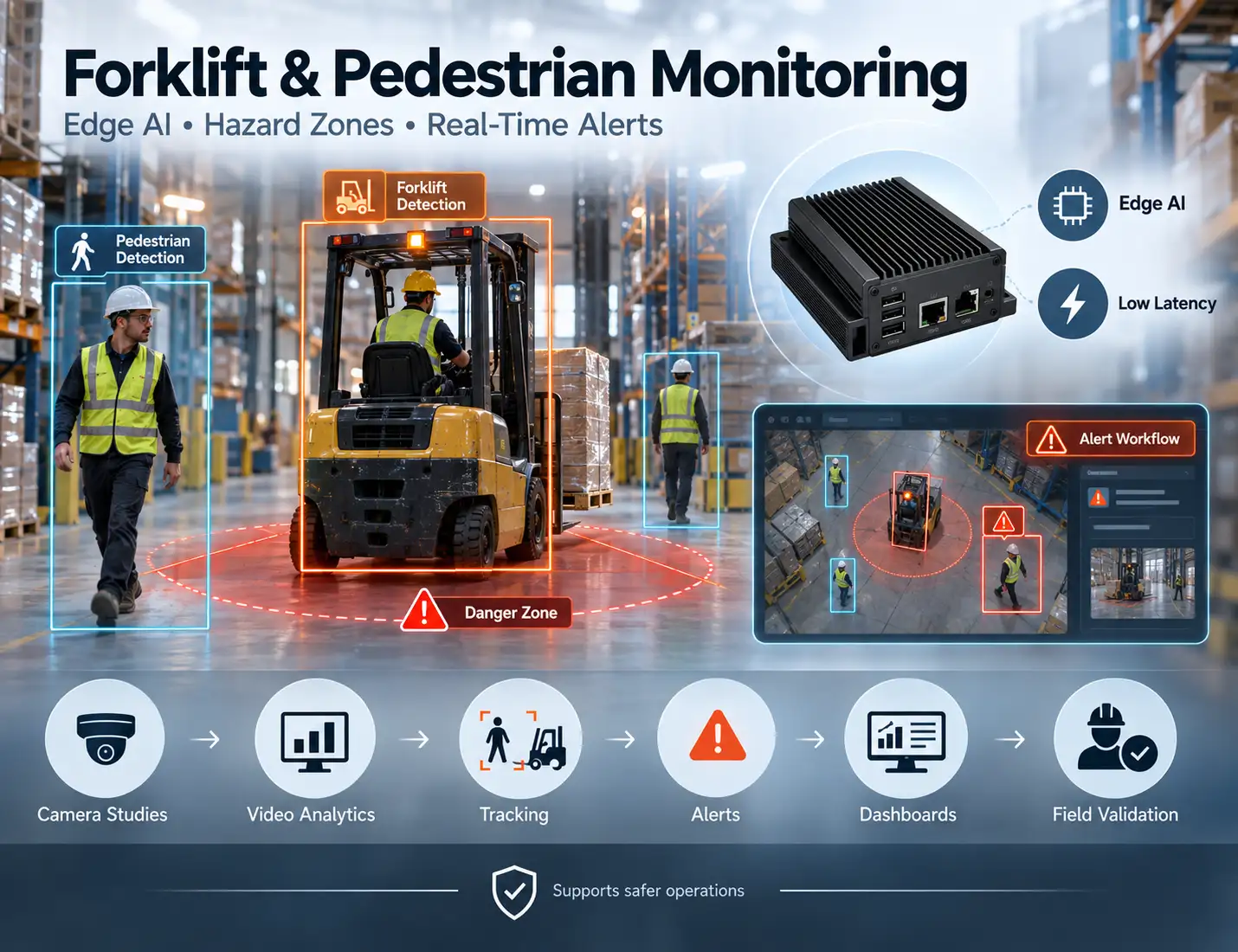
Case Study: Forklift and Pedestrian Proximity Monitoring at a Warehouse Crossing
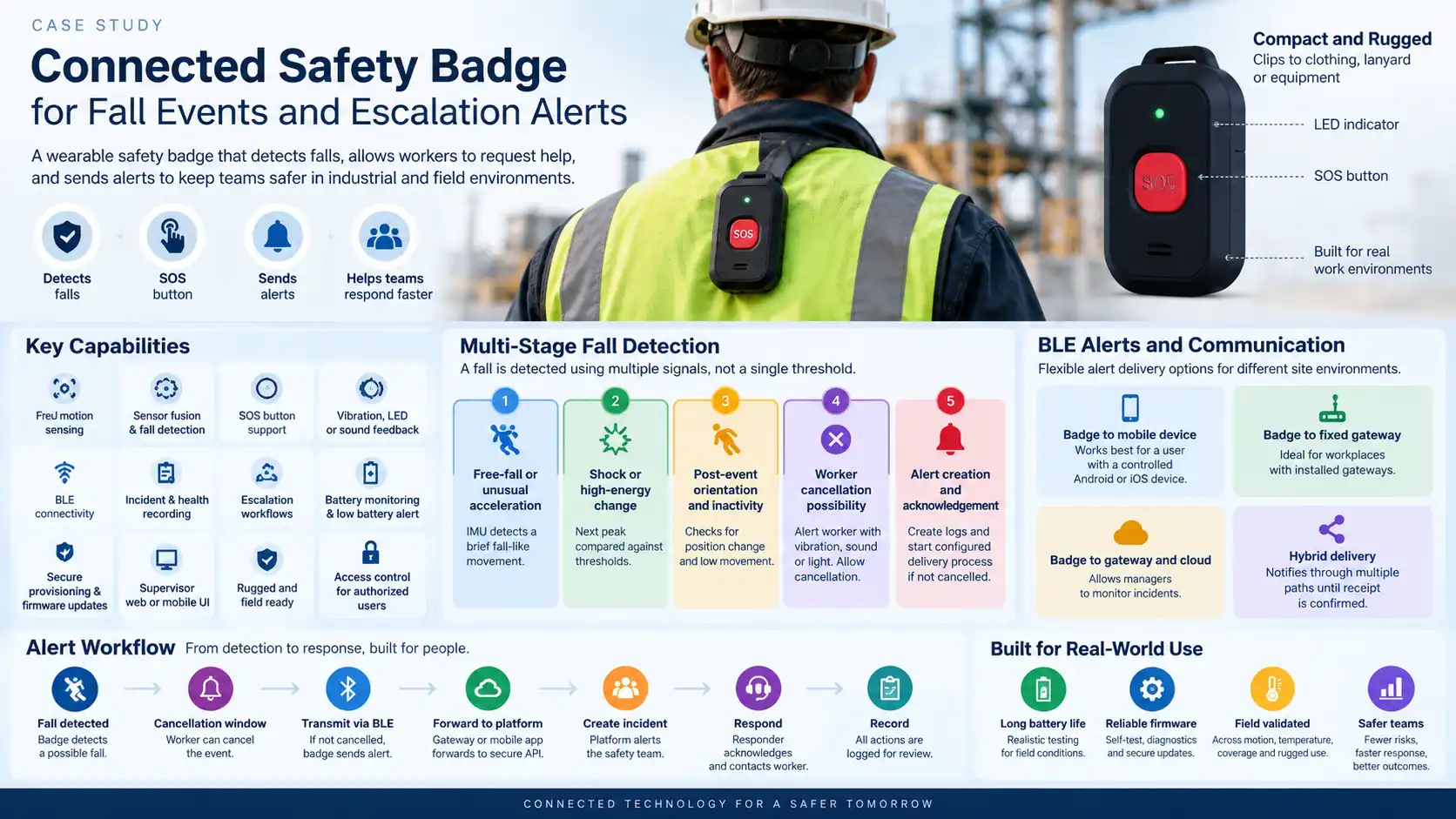
This case study is about a connected system for monitoring a warehouse that has active areas for the movement of forklift trucks, pedestrian crossings, pallet-staging areas, and blind spots.
The objective of this project was to determine the different types of interaction between moving vehicles and humans in certain danger spots and provide warning messages and event records to help users apply safer operating practices.
The connected system includes:
Fixed cameras in the areas that have blind spots and loading zones Cameras that have been attached to a forklift for viewing in either the forward or backward direction NVIDIA Jetson Orin NX local processing computer AI algorithms capable of detecting the presence of pedestrians and forklifts in predefined secured zones Technology of multi-object tracking of moving objects Predefined warning zones and risk protocols Ability to connect to alarms, alerts displays, info dashboards, etc. Reliability of surveillance video systems in the warehouse Maintained health of CCTV and logs of its operation
The project did not treat every nearby person and forklift as an emergency. The objective was to identify a meaningful interaction: a pedestrian entering a risk area, a forklift moving toward that area, visibility being limited, and a situation persisting long enough to justify an alert.
A warehouse cannot be seen as a controlled environment. Warehouse camera performance can differ because of rack shadows, reflective floor surfaces, brightly colored clothing, the change of daylight at loading doors, suspended particles in the air, product movements and obstructions in people's footage that occur while filming in a warehouse.
Before developing the AI workflow, Adequate Infosoft would conduct a site assessment with the operations and safety teams. The assessment defines where the risk is, which behaviours the system should observe and what action is realistic when a warning occurs.
Questions that must be answered are as follows:
How does the path of forklift and pedestrians cross or coincide? What intersections, corridors, or loading areas have no visibility? What are the typical speeds of the forklift and expected directions? Should there usually be pedestrians in the monitored area or it must remain empty? Can the property set up a permanent camera, lights, historical or limited access? How does the operator perceive a warning without losing attention? Who and what organizing actions is required to do after getting a record?
The camera location depends on the responses. For example, a camera mounted in the ceiling can show the general picture, but the details may not allow the identification of partly covered people.
A lower side camera may see a crossing more clearly but can be obstructed by pallets. In many sites, two complementary views are more reliable than one.
Each camera position is evaluated for field of view, mounting stability, lens selection, illumination, cable route, cleaning access and expected occlusion. For outdoor or loading-bay use, the enclosure, weather rating and low-light performance must be selected accordingly.
The Jetson Orin NX system receives one or more video streams from IP cameras, USB cameras or other supported industrial camera interfaces. The edge application performs detection locally and can operate without sending continuous video to the cloud.
The primary processing steps consist of:
Video Recording and Streaming Verification
Confirm that the specific camera is up and running, producing frames and doing so at the recommended velocity.
Object Recognition
Identify the humans, forklifts, and pallet jacks, as well as other things, such as hazard barriers, doors or other reflective outfits if so desired.
Multi-Object Identification
Associate the captured objects within their origin frames so that their direction of movement can be followed.
Zone Definition
Find out whether the object is moving to the pedestrian zone, forklift zone, or other similar areas.
Interaction Determination
Check if the moving forklift and pedestrian arrive at the same danger zone.
Alert Generation
Check how much time has passed since the previous alert was created.
Data Creation
Keep a record of the event for future reference.
The software can make use of NVIDIA TensorRT to optimize the detection model that was already approved. NVIDIA DeepStream can also be used in case of handling various streams of video, tracking and event metadata.
The final design depends on the number of cameras, required speed of processing, storage policy, and current state of the factory's IT infrastructure.
A major design risk in camera-based proximity systems is assuming that two objects that appear close together in an image are physically close. Perspective distortion makes that unreliable without proper calibration.
For a fixed camera view, the system can be calibrated against known floor-plane reference points.
This allows pixel locations near the ground contact area to be mapped approximately into real-world coordinates. In more demanding deployments, stereo cameras, depth sensors, LiDAR, UWB or vehicle telemetry can be evaluated as complementary technologies.
The proximity logic should state what it actually measures. It may determine that a pedestrian and forklift occupy the same marked zone, that their projected paths are converging, or that they are within a calibrated approximate distance threshold.
It should not claim centimetre-level distance accuracy unless the deployed sensing method has been tested and verified for that condition.
The technology should not proclaim that the distance accuracy is measured down to the centimetre level until it is tested in that manner.
Good rules may be for example when:
A person enters the active area for forklifts A forklift goes to the crossing when a person is present A person stays in restricted areas for too long Forklift reverses in the occupied area behind it Many people are present at the spot where a vehicle is moving The vision of the camera is blocked or is not fresh anymore
The system's alert design is as important as its AI model. Excessive alarms can distract operators, reduce trust and lead to alarms being ignored. Alerts should be meaningful, short, local to the risk area and tied to a response people understand.
At a fixed intersection, a stack light, directional warning lamp or audible beacon may be more useful than a remote push notification. A supervisor dashboard can provide incident records and recurring-risk analysis, but it is not a substitute for a real-time local warning.
The alert workflow has several phases:
Awareness Level
The first level has a visual alert that both the pedestrian and the forklift vehicle are near the same area.
High-Risk Level
The second level has either a stronger local beacon or a sound alert that is activated when both persons are in a risk situation.
Technical Fault Level
The third level produces a different alert if the camera or edge device is down.
Reporting Level
The last level is the dashboard that logs the occurrences to check for safety compromises and find the root cause.
In addition, if allowed by the factory conditions, the system can collaborate with PLCs, barricades, and speed regulators.
Thus, any device control action must be engineered separately and validated in terms of risks together with the equipment manufacturer and safety department of the plant.
A model which has been trained on public images or clean sample datasets is not adequate for warehouse deployment, but rather specific videos collected directly from an actual site must be used for evaluation.
Our validation technique requires using clips from different shifts, uniforms of workers, types of forklifts, positions of pallets, lighting conditions, aisle congestion, and views of cameras.
At E-E-A-T, the difficult circumstances being tested include partial obstruction, pedestrians walking in reverse, reflective surfaces, worker carrying cargo and forklift operation with light or heavy load.
The project team produces a list of quantitative parameters that must be met at the time of testing including:
Detection recall for people and lift trucks in the frame of reference of the camera Documented false-alarm rate per camera and per hour of operation Documentation of missed events Total delay in issuing alerts Percentage of recorded events Detection time for faults in camera or network Performance at fixed conditions of lighting and traffic Effectiveness of models after any modifications in layout or camera position
No machine vision system can be qualified as "collision-proof." A company practicing E-E-A-T expects its content on industrial safety to have descriptions that clearly explain system limits, hypothesis testing, and accountability of individuals.
Video analytics can involve personally identifiable information. When deploying video cameras, the system should state how it works, who can access it, how long is the information kept, what happens to the recorded event and how the data will be accessed.
Jetson devices are supposed to operate under secure credentials, have the software updated regularly and operate in a secure network environment.
The design determines how the IT department and the security guys may know everyone having access and how the solution works when connected to the Internet.
Jetson Orin NX Proximity Monitoring Development Services
Camera Positioning and Industrial Vision Engineering
We examine layout of the area, blind zones, line-of-sight constraints, mounting options and illumination conditions.
We examine layout of the area, blind zones, line-of-sight constraints, mounting options and illumination conditions.
At this stage of the workflow, our team chooses cameras, lenses, housings, PoE/network requirements and Jetson carrier-board I/O in order to provide the system with evidence that can be reliably reproduced before it is necessary to develop the AI system.
Edge AI Tracking and Detection
We build detection mechanisms for a wide range of objects which include humans, vehicles, forklifts, machines and other custom-made devices.
We build detection mechanisms for a wide range of objects which include humans, vehicles, forklifts, machines and other custom-made devices.
Our other activities include planning of datasets, labelling of data, training of machine learning models, optimising TensorRT models and assessing model performance on Jetson devices.
Real-Time Alerts and Industrial Integration
The services we provide include development of local notifications and alarms, design of dashboards and implementation of notification processes.
The services we provide include development of local notifications and alarms, design of dashboards and implementation of notification processes.
We can also connect to PLCs, Modbus TCP, OPC UA, MQTT, REST APIs and factory databases, and record all states of the alerts and faults.
Edge Software, Device Management and Analytics
Our Jetson software services cover Linux deployment, containerisation, camera-reconnection handling, local event storage, health checks, central fleet monitoring, controlled model updates and role-based web dashboards.
Our Jetson software services cover Linux deployment, containerisation, camera-reconnection handling, local event storage, health checks, central fleet monitoring, controlled model updates and role-based web dashboards.
We also build reporting views to identify high-frequency locations, recurring near-miss patterns and camera performance issues.
Verification and Lifecycle Assistance
We elaborate field verification plans, testing documents, deployment reports and stakeholder support mechanisms.
We elaborate field verification plans, testing documents, deployment reports and stakeholder support mechanisms.
After the system is operational it is supervised in order to make sure that model effectiveness, alerts and layout changes are monitored, rather than considered constant.
Our Edge and Industrial IoT Experience
Adequate Infosoft's Jetson Orin Nano Autonomous Mobile Robot with ROS 2 project showcases our expertise in edge computing, embedded Linux, sensor-driven decision-making processes and operational robotics systems.
These skills are applicable to third-party pedestrian systems because both must operate under the established operational framework and process real-time sensor readings.
Combining IoT knowledge with its custom embedded software systems, cloud APIs, mobile apps, access control equipment and industrial systems.
That combined expertise helps when a proximity-monitoring project needs cameras, edge AI, dashboards, alerts and factory-system communication to operate as one maintainable solution.
A Jetson Orin NX forklift and pedestrian monitoring system can improve awareness at identified risk zones and provide meaningful evidence for continuous safety improvement. Its value comes from careful camera engineering, calibrated detection rules, clear human response and ongoing real-world validation.
Editorial Resources