















 Mean Stack Development
 Vue JS Development
 Javascript Development
 React JS Development
 Angular JS Development
 Next JS development
 Java Development
 Python Development
 Django Development
 Cherrypy Development
 C# Development
 ASP.NET Development
 NodeJS Development
 Laravel Development
 CodeIgniter Development
 Zend Development
 Ruby on Rails Development
 CakePHP Development
 PHP Website Development
 Symfony Development
 Drupal Development
 Joomla Development
 Wordpress Development
 .NET Nuke Development
 Kentico
 Umbraco
 .NET MAUI Development
 Xamarin Application Development
 iOS Application Development
 Android Application Development
 Android Wear App Development
 Ionic Development
 iBeacon Application Development
 Universal Windows Platform (UWP)
 Kotlin Application Development
 Swift Application Development
 Flutter Application Development
 PWA Application Development
 Flutter Health Tech & Wearable App Development Company
 React Native Health Tech Wearable App Development
 Offshore Software Development
 Custom Application Development
 Front-End Development
 Full Stack Development
 AI & Machine Learning
 Custom CRM Solutions
 Flask Software Development
 Electron JS Development
 ChatGPT Development
 Telemedicine App Development
 Build Smart Telemedicine Platform
 Beauty & Salon App Solutions
 Hire Workato Experts
 Magento Development
 Magento 2.0 Development
 Magento Enterprise
 Shopping Cart Development
 Prestashop Development
 Shopify Development
 Open Cart Development
 WooCommerce Development
 BigCommerce Development
 NopCommerce Development
 Virto Commerce Development
 AspDotNetStorefront Development
 .NET Application Development
 Microsoft Dynamics CRM
 VB .NET Development
 Sharepoint Migration
 ASP.NET Core Development
 ASP.NET MVC Development
 AJAX Development
 Agile Development
 Microsoft Bot
 Microsoft Blazor
 Microsoft Azure Cognitive
 HTML 5
 UI/UX Design
 Graphic Design
 Adobe Photoshop
 XML Application Development
 Cloud Computing Solutions
 Azure Cloud App Development
 AWS Development
 Google Cloud Development
 Certified AWS IoT Services Developers
 DevOps Consulting & Development
 Kubernetes Consulting & Services
 SQL Programming Development
 MySQL Development
 MongoDB Development
 Big Data
 Robotic Process Automation
 Social Media Marketing
 Search Engine Optimization
 QA Testing
 Software Testing
 Software Security
 Maintenance And Support
 I.T. Consulting Services
 Business Intelligence
 YII Development
 Data Analysis
 Alexa Skills Development
 On Demand App for Mobile repairing services
 On Demand App for Car Service Booking
 On Demand App for Cleaning Services
 On Demand App for Pharmacy
 On Demand Dedicated Developers
 On Demand Lawyer App Development










 Nuki Smart Lock
 Salto Smart Lock
 TTlock Smart Lock
 NFC App Development
 Custom IOT Enabled Smart Lock
 Smart Locker Solutions
 Hospital Smart Lock Systems
 Hotel Smart Lock Systems
 Smart Home & Office Locks
 Smart Access for Schools & Colleges
 Unloc Smart Lock Integration
 Yale & August Smart Lock Integration
 Populife Smart Lock Integration
 Smart Lock Hardware Development
 Dairy IoT Solutions
 Agri IoT & AI Solutions
 Weather & Climate Solutions
 Water & Waste Management Solutions
 RaspBerry Pi
 Firmware Software Development
 ESP 32 Software Development
 Embedded Development
 Internet of Things
 Smart IoT Development
 IoT Sensor Integration & Development Solutions
 Smart IoT System Development for HVAC
 Tuya IoT App Development
 Particle IoT SDK
 IoT Development with AI
 Smart Pet GPS Tracker
 Dairy GPS Tracking Solutions
 GPS Fleet Management Software
 Car Rental & Subscription Solutions
 Car Buy & Sell Marketplace Development
 AI-Powered Car Wash App Development
 PCB Design & Fabrication
 IoT AC Automation
 AI–IoT Painting Solutions
 IoT Wearable Hardware & App Development
 HVAC Automation & AI Control Systems
 Smart Home IoT Engineering
 AI Embedded Systems
 AI Hardware Design Service
 Advanced IoT Hardware & Firmware Development
 Device Driver Development Services
 NXP i.MX RT Firmware & Hardware Services
 Microchip PIC & AVR Development
 Hire IoT Architects
 IoT Cloud & Infrastructure Solutions
 Infineon XMC / AURIX Development Services
 Matter & Thread IoT Services
 Native IoT Mobile App Development (BLE & Wi-Fi)
 Snapdragon IoT Firmware Development
 Renesas RA/RX Firmware Services
 Silicon Labs EFR32 Development Services
 Smart Wearable App Development
 Smart IoT Meters
 Smart Healthcare Wearable App Development
 Health Care Monitoring System
 Fitness Tracking App Development
 Smart Home Automation Apps
 nRF PCB Design
 ESP32 PCB Design
 Embedded Wearables Engineers
 Rental Property Management System
 Building Management System
 Smart Lighting Development
 Infineon Semiconductor Firmware Development Services
 Custom Camera Development: Hardware, Firmware & PCB Prototyping
 Smart Security Camera SDK
 Nordic Semiconductor SDK
 Infineon SDK
 Arduino SDK
 NFC Lock Integration
 Kerong Lock Integration
 IoT & AI Solutions for Manufacturing
 Smart Inventory & Logistics Solution
 Food & Beverage Industry Solutions
 Smart Hospitality Solutions
 Smart Property Management
 Custom Smart Home IOT SDK
 Smart IoT & AI in Healthcare
 AI-Powered Security Solutions
 Smart Home Safety & AI
 Veterinary Clinic Management (AI)
 Pet Care System (AI & IoT)
 Pet Training & Adoption (AI)
 Healthcare IoT Development
 Event Management Software
 Money Remittance App
 Money Lending App Development
 Utility and Bill Payment App
 IoT Mobile App Development (Flutter & React Native)
 AI & IoT Retail Solutions
 Smart EV App Development
 Smart Solar IoT & AI Solutions
 IoT-Based Energy Systems
 Smart Energy & Utilities Solutions
 6G Solutions
 IoT Security Solutions
 AI-Powered Lottery App Development
 AI-Sports Fitness Club Management
 Travel
 Real Estate
 Medical & Healthcare
 e-Learning
 Consumer Products
 Finance
 Automobile
 Media & Entertainment
 Billing Software
 Enterprise Resource Planning (ERP)
 Augumented & Virtual Reality
 Point of Sale(POS) Development
 Learning Management System
 EV Charging Solutions
 About Us
 Partners & Certifications
 Quality Assurance
 Our Clients & Testimonials
 Development Process
 Our Products
 Social Responsibility
 Work Ethics
 Vision & Mission
 Awards
 Live Project Demos
 Contact Us
 Case Studies
 Portfolio
 Blog
Blog
NVIDIA Jetson Orin Nano Super On-Premise PPE Detection for Industrial Sites
The process of detecting industrial PPE goes beyond just being able to draw a box around a helmet. A reliable solution must have the ability to understand a complicated working environment, match the correct PPE to the correct worker, avoid sending duplicate notifications, deal with the collected information in a sensible manner, and function even when there is any shortage of internet access.
Adequate Infosoft develops on-premise PPE detection solutions using the NVIDIA Jetson Orin Nano Super platform, combining edge AI, camera-video engineering, industrial integration, and privacy-aware reporting.
This service is suited to manufacturing plants, warehouses, logistics yards, construction projects, utilities, chemical facilities, workshops, and controlled-entry zones.
This system is able to track the use of all protective equipment, including hard hats, reflective vests, safety goggles, face masks, gloves, safety footwear and any other site-specific PPE.
It provides an important decision support and incident management function; however, compliance and incident management responsibility remains with the proper company personnel and procedures.
Let's Work Together!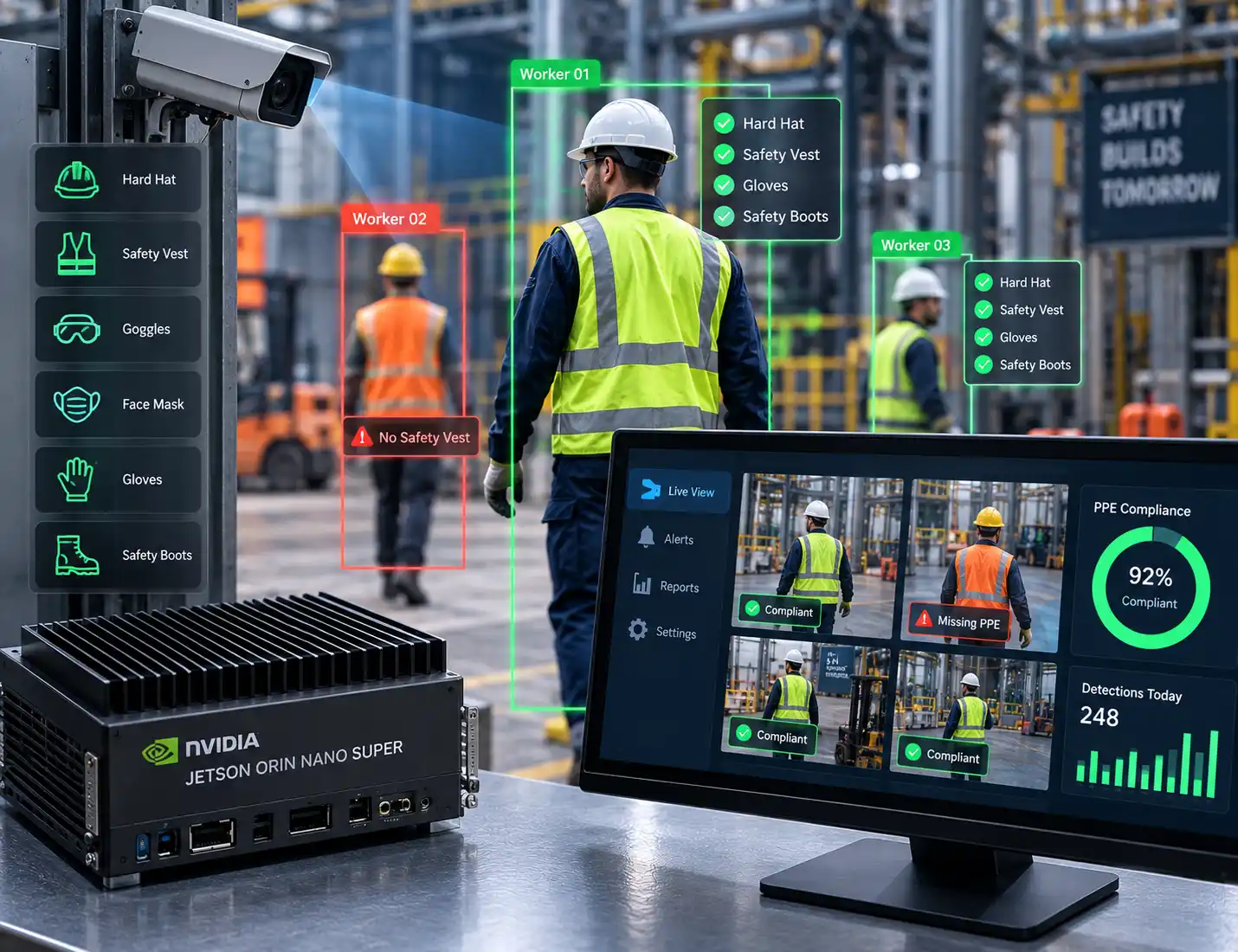
Representative Case Study: On-Premise PPE Detection for a Multi-Zone Industrial Site
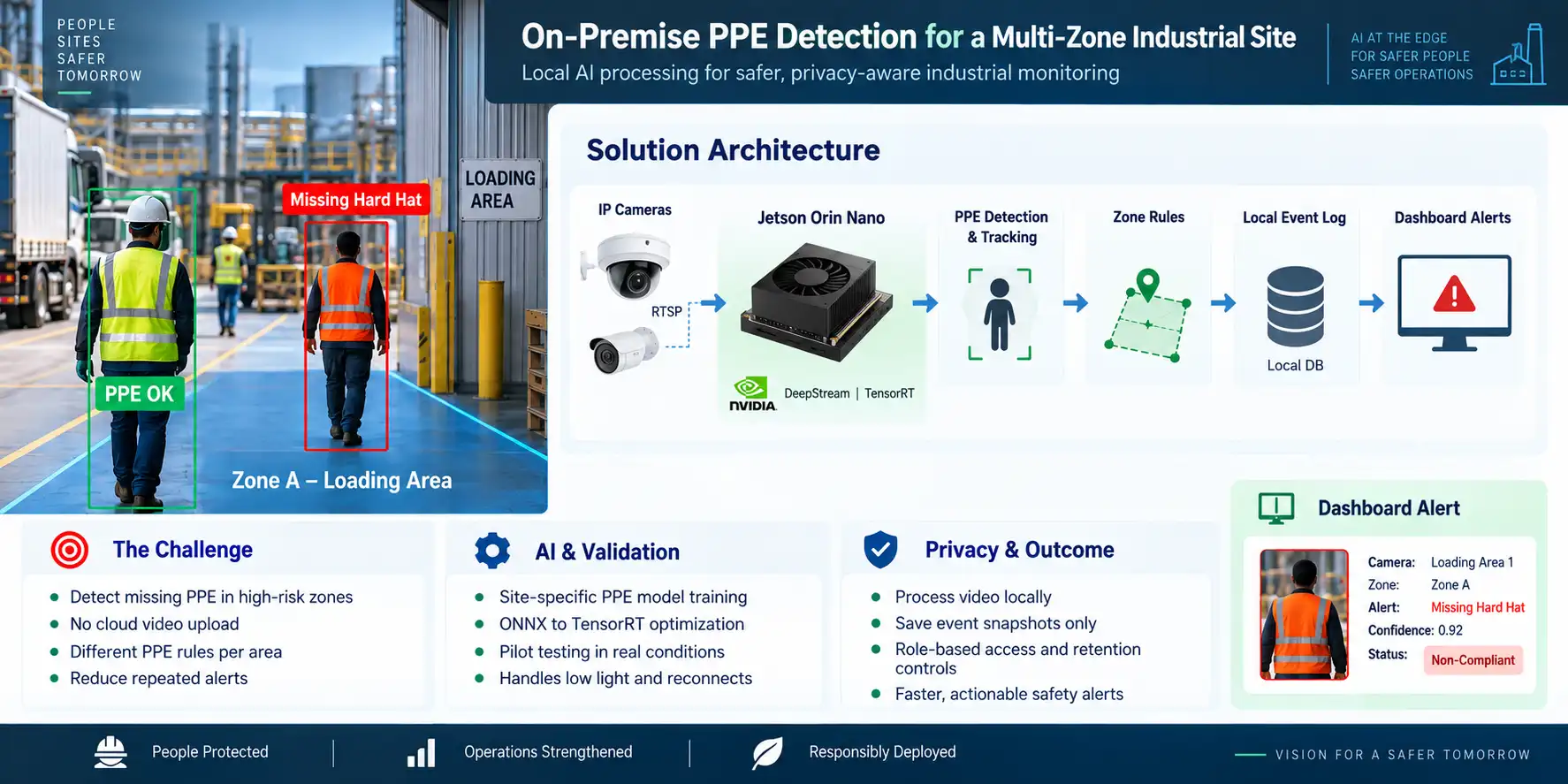
A growing industrial site wanted a proactive way to identify missing PPE in high-risk work areas without sending all camera footage to a cloud service.
CCTV available was utilized for the purpose of post-analysis but was not able to give timely and systematic safety events.
The customer needs local processing, support for a variety of IP cameras, workflow of audit events, and specific design that can be applied even under adverse conditions like lack of light, unstable network, and in situations in which people hide behind the gear.
The required PPE varied by zone. In a loading area, the focus was hard hats and hi-vis vests. In a fabrication area, protective eyewear and face protection could also be required.
The key requirement was not “detect PPE somewhere in a frame”; it was to identify a person entering a defined zone without the PPE required for that zone and notify the right safety team without creating alert fatigue.
We designed the deployment design on the NVIDIA Jetson Orin Nano Super Developer Kit, chosen for its small edge-AI design and advanced inference ability for vision applications. The Jetson was operated by Ubuntu obtained from NVIDIA JetPack, enabled by NVIDIA drivers, CUDA libraries, multimedia accelerators, TensorRT, and supported by containers.
Existing ONVIF-compatible IP cameras delivered H.264/H.265 RTSP streams over a segmented local network. GStreamer and DeepStream components were used to ingest, decode, batch, and process the streams efficiently.
The inference service performed person and PPE detection, while a tracking layer assigned a temporary identity to each visible person across successive frames. This reduced repeated alerts when the same worker remained in view.
A rule engine joined three sources of information: detected objects, configured polygon zones, and the PPE policy for each zone. The event logic checked whether a tracked person was inside a zone long enough to be considered present and whether the required PPE was visible with sufficient confidence.
A configurable grace period and persistence rule prevented an alert from being raised when a helmet was briefly hidden by a raised arm, a pallet, or another worker.
The system separated video analysis from reporting. The live video feed was processed locally. Once an event occurred, the system saved a timestamped image, camera ID, PPE rule outcome, and the respective confidence value in the internal database.
The event data was accessed from the dashboard by an internal API.
A generic PPE model is rarely enough for a production deployment. Site-issued helmets may have unusual colours, vests may be covered by jackets, face shields may look different from safety glasses, and camera angles may vary sharply. We therefore planned a data pipeline using representative footage collected under approved site procedures.
The annotation schema included person, helmet, high-visibility vest, safety glasses, face shield, glove, and other agreed classes.
Multiple samples were chosen from various shifts, weather conditions, camera perspectives, crowd population, body postures, blockages, and distance ranges. The training, evaluation, and test sets were separated, preventing exaggerated results obtained from almost identical specimens.
Once trained and validated, the model was passed to ONNX and later turned into a TensorRT engine relevant to the Jetson platform.
The end-to-end performance profiling was done instead of recording model inference performance only. The good acceptance criteria are the number of cameras used, resolution of the source, frame rate, GPU/CPU usage, thermal indicators, memory consumption, event timing, and stream recovery performance.
All these things are important as a load on the decoder, overlays for analytics, writes to database, and instability of the network can become a factor in the production process.
The organization believed that having an overly-safe workflow would not fit in with their ideals. We developed a reporting practice that focused on incidents labeled as safe.
The platform interface contained helpful information including a smaller version of the image, details regarding the date and time of the event, location, details about PPE use, event state, and information introduced by the supervisor. Whenever possible, the stored photo was subject to face-blurring.
Access to the system was supposed to be given based on users’ roles which meant that system administration, safety reviewers, and read-only managers had only the access they needed for their work.
Retention schedules could automatically delete event images after the organisation’s approved period, while preserving anonymised aggregate metrics such as events by zone, PPE category, time period, and resolution status.
By using this method, health-and-safety teams can obtain usable information without treating each movement of their employees as a record that requires reporting.
It helps to have a straightforward discussion about governance before implementing the system: which locations will be included, who will analyze notifications, how workers will receive information on new events, how long the evidence will be kept, and how disagreements regarding detecting certain actions will be solved.
Before production rollout, we validate the system in stages. First, recorded streams confirm camera connectivity, model loading, and event rules. Next, controlled site walkthroughs test expected PPE and deliberate non-compliance scenarios. Finally, a monitored pilot measures real operational performance and tunes thresholds, zone boundaries, grace periods, and notification routing.
We include negative scenarios in the test plan: camera disconnect, RTSP reconnect, Jetson restart, database unavailability, low-light periods, congested scenes, PPE partially outside the frame, and dashboard-network loss. Alerts should be queued or safely retried rather than silently lost. Device-health signals report temperature, storage, CPU/GPU utilisation, stream status, and service availability so the safety team knows when the system is not in a reliable monitoring state.
Jetson Orin Nano Super PPE Detection Development Services
Adequate Infosoft provides end-to-end NVIDIA Jetson Orin Nano Super development services for organisations that need local, responsive, and controllable PPE monitoring. We begin with a practical discovery workshop covering which zones matter, what PPE rules apply to each zone, how many cameras are needed, what constitutes a reportable event, and who may access footage or event metadata.
This approach helps prevent a common failure mode in computer-vision projects: selecting an AI model before defining the operational workflow.
Industrial Video Architecture and Camera Integration
Our engineering team designs the video architecture around the actual deployment site rather than assuming every IP camera behaves identically. We assess camera position, lens field of view, illumination, mounting height, RTSP stream stability, network segmentation, and the expected size of a person in each frame.
Industrial environments can introduce challenges such as:
Small helmets or safety equipment at long camera distances Heavy backlighting around entrances Reflective PPE Forklifts or machinery temporarily blocking workers Workers moving between indoor and outdoor environments Variable lighting throughout the day Unstable or high-latency video streams
When required, we recommend separate detection zones instead of attempting to make one camera cover an unrealistic area.
GPU-Accelerated Edge AI Pipeline
On the Jetson device, we build a GPU-accelerated computer-vision pipeline using NVIDIA JetPack, CUDA, TensorRT, GStreamer, and DeepStream, where appropriate.
The pipeline can ingest:
RTSP camera streams USB cameras CSI cameras Recorded video streams
The system decodes video efficiently, runs the PPE detection model, tracks people across frames, applies PPE and zone rules, and generates an event when configurable persistence criteria are satisfied.
For example, a missing-helmet alert can require a person to remain inside a restricted area for several consecutive frames instead of triggering on a single frame affected by momentary occlusion.
PPE Detection Model Development and Optimization
In the process of model development, we will choose and analyze suitable object detection models, create industrially relevant datasets, annotate people and PPE categories, train or fine-tune models, and export them to ONNX and TensorRT to improve inference.
The selection of PPE categories depends on the purpose of the model. The validation of accuracy occurs via a reserved test dataset as well as footage collected from practice.
We perform a collection of explanations of classes, thresholds for acceptance, erroneous detections, and particular limitations of operation instead of presenting the laboratory accuracy as a guarantee for any camera or site.
Person Tracking, Zone Rules, and Event Detection
PPE detection becomes more useful when combined with person tracking and site-specific rules. We can configure virtual zones for restricted areas, entry points, production lines, loading areas, or other locations where PPE compliance is mandatory.
The system can apply rules such as:
Person enters a restricted zone without a helmet Worker enters without a high-visibility vest Required PPE is missing for a defined period PPE compliance changes while a worker remains in a zone Repeated violations occur within a configurable time window
Persistence rules help reduce unnecessary alerts caused by brief occlusions, camera noise, or temporary detection failures.
Web Dashboard and Safety-System Integration
For operations and safety teams, we develop a browser-based dashboard or integrate PPE events with an existing platform through REST APIs, MQTT, webhooks, or message queues.
Depending on requirements, the dashboard can display:
Camera status Recent PPE events Cropped evidence images PPE category Timestamp Detection zone Acknowledgement status Escalation history
We can also implement role-based access control, audit logging, event-retention rules, CSV export, and notifications through email, Microsoft Teams, SMS gateways, or an existing site safety application.
On-Premise Privacy and Data Protection
Privacy is considered as part of the system architecture rather than as an afterthought. The Jetson-based solution can process camera streams fully on premises, reducing the need to transfer continuous video to a cloud platform.
Depending on organisational requirements, the system can:
Store event snapshots instead of continuous footage Crop evidence to the relevant incident region Apply face blurring where appropriate Use short evidence-retention periods Restrict remote access Apply role-based permissions Maintain audit logs for event access
For organisations using existing CCTV infrastructure, we work with security, legal, HR, and health-and-safety stakeholders to establish appropriate retention, access-control, signage, and review policies.
Edge AI can reduce unnecessary cloud video transfer, but it does not eliminate the need for a lawful and transparent workplace-monitoring policy.
Jetson Deployment, Monitoring, and Production Engineering
Our delivery covers the engineering work required to move a PPE detection solution from a development environment into an operational industrial deployment.
This can include:
Jetson device provisioning Docker-based deployment where suitable Secure system configuration Application health monitoring Watchdog and automatic restart behaviour Model-version control Camera and stream health checks Acceptance testing Production configuration Deployment documentation Engineering handover and support
We design the software stack with maintainability in mind so that models, application components, and configuration can be updated without unnecessarily disrupting the complete edge system.
Custom Industrial Hardware and Enclosure Integration
When the deployment requires hardware adaptation beyond a standard Jetson development kit, we can also support a custom carrier-board or enclosure strategy.
Depending on site requirements, this may include:
DIN-rail installation Industrial power input PoE networking GPIO integration UPS status monitoring Temperature monitoring Ruggedized field installation Industrial enclosure design considerations
This enables the Jetson Orin Nano Super platform to be integrated more effectively into existing industrial infrastructure and edge-computing environments.
Why Choose an On-Premise Jetson PPE Detection System?
A Jetson-enabled solution installed on the premises offers industrial teams the ability for local processing of video information, allowing for a lesser dependency on Internet connection, easy integration into existing infrastructure, and better control over data processes.
This solution is especially useful when there are limitations in bandwidth, it is undesirable to use the cloud for video transfer, or when events with security implications need processing on-site with no delay.
Adequate Infosoft can deliver the full system: camera and network assessment, Jetson provisioning, edge-AI pipeline, model optimisation, dashboard and API development, privacy controls, field testing, documentation, and ongoing model improvement.
The result is a maintainable PPE detection platform designed around the realities of an industrial site, not a generic demo converted into a safety claim.
Editorial Resources