








 Mean Stack Development
 Vue JS Development
 Javascript Development
 React JS Development
 Angular JS Development
 Next JS development
 Java Development
 Python Development
 Django Development
 Cherrypy Development
 C# Development
 ASP.NET Development
 NodeJS Development
 Laravel Development
 CodeIgniter Development
 Zend Development
 Ruby on Rails Development
 CakePHP Development
 PHP Website Development
 Symfony Development
 Drupal Development
 Joomla Development
 Wordpress Development
 .NET Nuke Development
 Kentico
 Umbraco
 .NET MAUI Development
 Xamarin Application Development
 iOS Application Development
 Android Application Development
 Android Wear App Development
 Ionic Development
 iBeacon Application Development
 Universal Windows Platform (UWP)
 Kotlin Application Development
 Swift Application Development
 Flutter Application Development
 PWA Application Development
 Flutter Health Tech & Wearable App Development Company
 React Native Health Tech Wearable App Development
 Offshore Software Development
 Custom Application Development
 Front-End Development
 Full Stack Development
 AI & Machine Learning
 Custom CRM Solutions
 Flask Software Development
 Electron JS Development
 ChatGPT Development
 Telemedicine App Development
 Build Smart Telemedicine Platform
 Beauty & Salon App Solutions
 Hire Workato Experts
 Magento Development
 Magento 2.0 Development
 Magento Enterprise
 Shopping Cart Development
 Prestashop Development
 Shopify Development
 Open Cart Development
 WooCommerce Development
 BigCommerce Development
 NopCommerce Development
 Virto Commerce Development
 AspDotNetStorefront Development
 .NET Application Development
 Microsoft Dynamics CRM
 VB .NET Development
 Sharepoint Migration
 ASP.NET Core Development
 ASP.NET MVC Development
 AJAX Development
 Agile Development
 Microsoft Bot
 Microsoft Blazor
 Microsoft Azure Cognitive
 HTML 5
 UI/UX Design
 Graphic Design
 Adobe Photoshop
 XML Application Development
 Cloud Computing Solutions
 Azure Cloud App Development
 AWS Development
 Google Cloud Development
 Certified AWS IoT Services Developers
 DevOps Consulting & Development
 Kubernetes Consulting & Services
 SQL Programming Development
 MySQL Development
 MongoDB Development
 Big Data
 Robotic Process Automation
 Social Media Marketing
 Search Engine Optimization
 QA Testing
 Software Testing
 Software Security
 Maintenance And Support
 I.T. Consulting Services
 Business Intelligence
 YII Development
 Data Analysis
 Alexa Skills Development
 On Demand App for Mobile repairing services
 On Demand App for Car Service Booking
 On Demand App for Cleaning Services
 On Demand App for Pharmacy
 On Demand Dedicated Developers
 On Demand Lawyer App Development





 Nuki Smart Lock
 Salto Smart Lock
 TTlock Smart Lock
 NFC App Development
 Custom IOT Enabled Smart Lock
 Smart Locker Solutions
 Hospital Smart Lock Systems
 Hotel Smart Lock Systems
 Smart Home & Office Locks
 Smart Access for Schools & Colleges
 Unloc Smart Lock Integration
 Yale & August Smart Lock Integration
 Populife Smart Lock Integration
 Smart Lock Hardware Development
 Dairy IoT Solutions
 Agri IoT & AI Solutions
 Weather & Climate Solutions
 Water & Waste Management Solutions
 RaspBerry Pi
 Firmware Software Development
 ESP 32 Software Development
 Embedded Development
 Internet of Things
 Smart IoT Development
 IoT Sensor Integration & Development Solutions
 Smart IoT System Development for HVAC
 Tuya IoT App Development
 Particle IoT SDK
 IoT Development with AI
 Smart Pet GPS Tracker
 Dairy GPS Tracking Solutions
 GPS Fleet Management Software
 Car Rental & Subscription Solutions
 Car Buy & Sell Marketplace Development
 AI-Powered Car Wash App Development
 PCB Design & Fabrication
 IoT AC Automation
 AI–IoT Painting Solutions
 IoT Wearable Hardware & App Development
 HVAC Automation & AI Control Systems
 Smart Home IoT Engineering
 AI Embedded Systems
 AI Hardware Design Service
 Advanced IoT Hardware & Firmware Development
 Device Driver Development Services
 NXP i.MX RT Firmware & Hardware Services
 Microchip PIC & AVR Development
 Hire IoT Architects
 IoT Cloud & Infrastructure Solutions
 Infineon XMC / AURIX Development Services
 Matter & Thread IoT Services
 Native IoT Mobile App Development (BLE & Wi-Fi)
 Snapdragon IoT Firmware Development
 Renesas RA/RX Firmware Services
 Silicon Labs EFR32 Development Services
 Smart Wearable App Development
 Smart IoT Meters
 Smart Healthcare Wearable App Development
 Health Care Monitoring System
 Fitness Tracking App Development
 Smart Home Automation Apps
 nRF PCB Design
 ESP32 PCB Design
 Embedded Wearables Engineers
 Rental Property Management System
 Building Management System
 Smart Lighting Development
 Infineon Semiconductor Firmware Development Services
 Custom Camera Development: Hardware, Firmware & PCB Prototyping
 Smart Security Camera SDK
 Nordic Semiconductor SDK
 Infineon SDK
 Arduino SDK
 NFC Lock Integration
 Kerong Lock Integration
 IoT & AI Solutions for Manufacturing
 Smart Inventory & Logistics Solution
 Food & Beverage Industry Solutions
 Smart Hospitality Solutions
 Smart Property Management
 Custom Smart Home IOT SDK
 Smart IoT & AI in Healthcare
 AI-Powered Security Solutions
 Smart Home Safety & AI
 Veterinary Clinic Management (AI)
 Pet Care System (AI & IoT)
 Pet Training & Adoption (AI)
 Healthcare IoT Development
 Event Management Software
 Money Remittance App
 Money Lending App Development
 Utility and Bill Payment App
 IoT Mobile App Development (Flutter & React Native)
 AI & IoT Retail Solutions
 Smart EV App Development
 Smart Solar IoT & AI Solutions
 IoT-Based Energy Systems
 Smart Energy & Utilities Solutions
 6G Solutions
 IoT Security Solutions
 AI-Powered Lottery App Development
 AI-Sports Fitness Club Management
 Travel
 Real Estate
 Medical & Healthcare
 e-Learning
 Consumer Products
 Finance
 Automobile
 Media & Entertainment
 Billing Software
 Enterprise Resource Planning (ERP)
 Augumented & Virtual Reality
 Point of Sale(POS) Development
 Learning Management System
 EV Charging Solutions
 About Us
 Partners & Certifications
 Quality Assurance
 Our Clients & Testimonials
 Development Process
 Our Products
 Social Responsibility
 Work Ethics
 Vision & Mission
 Awards
 Live Project Demos
 Contact Us
 Case Studies
 Portfolio
 Blog
Blog
nRF Connect SDK & Zephyr Migration Services | nRF5 SDK to NCS
Adequate Infosoft provides nRF5 SDK to nRF Connect SDK migration services for Nordic Semiconductor-based products using nRF52, nRF53 and related nRF platforms.
Our goal is to support engineering teams by transforming their firmware from the old architecture of nRF5 SDK to the new one based on the nRF Connect SDK and Zephyr RTOS without losing any crucial functionality such as Bluetooth Low Energy, but also functions like power management, sensors interfaces, bootloaders, DFU/OTA upgrades and so on.
This process cannot be seen as just replacing one SDK with another. Applications based on nRF5 SDK require SoftDevices, SDK libraries, sdk_config.h, all kinds of old drivers, and a thorough initialization of every application.
In contrast, nRF Connect SDK relies on a new architecture based on Zephyr that includes device trees, Kconfig, CMake, west, and model of drivers, and the way of using Bluetooth and building system configuration.
Let's Work Together!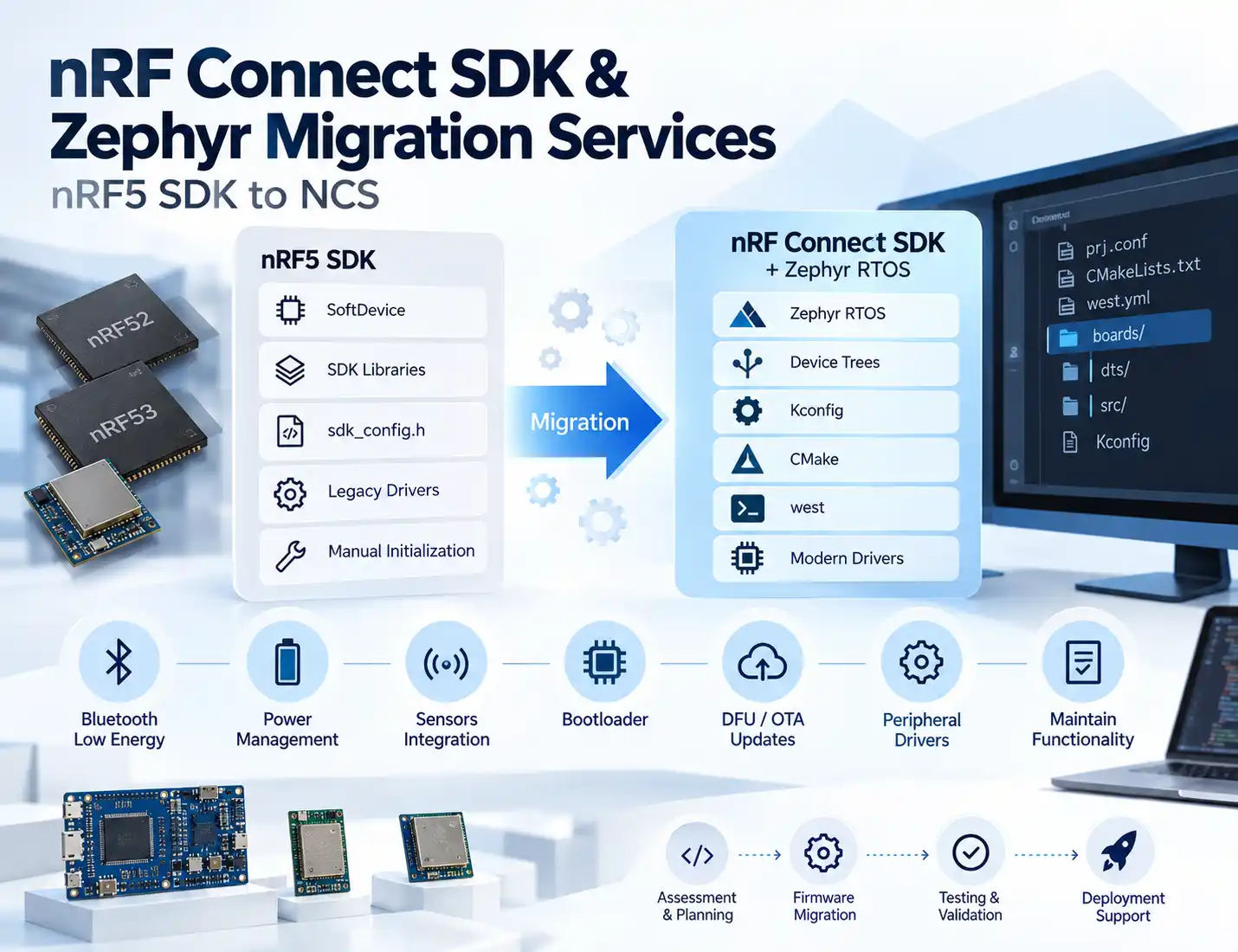
Why Migrate from nRF5 SDK to nRF Connect SDK?
Many established Nordic products were developed using the nRF5 SDK and have been deployed successfully for years.
However, maintaining an older firmware architecture can become increasingly difficult when a product needs new functionality, newer Nordic devices, modern security features, improved RTOS architecture or a longer-term firmware roadmap.
nRF Connect SDK is a platform that uses Zephyr RTOS as the basis of development and is capable of supporting the latest Nordic wireless developments. Transitioning to this platform can be a good choice to have a more solid base for the following product developments and iterations.
Examples of migration cases include:
Transfer of the previous application developed using nRF5 SDK to Zephyr RTOS Support of the new Nordic solutions nRF52/nRF53 Updating the old logical architecture of firmware Adding capabilities of BLE, Thread, Zigbee, etc. Improving multitasking and managing peripheral devices Preparing firmware for future OTA and device-management needs Involving new solutions developed by Nordic Reducing the degree of dependence on legacy applications Establishing a codebase that can be maintained for a long time to come.
Migration must be done with care as the change of the SDK and toolchain versions might lead to conflict in compatibility issues. Nordic provides tools for managing SDK/toolchain versions and verifying how all of them relate.
Our nRF5 SDK to NCS Migration Approach
1. Existing Firmware Assessment
We begin by reviewing the existing nRF5 SDK project rather than immediately rewriting the firmware.
Our engineers examine:
nRF SoC and board configuration nRF5 SDK version SoftDevice configuration BLE services and profiles GATT and GAP implementation sdk_config.h settings Peripheral drivers Interrupt handling Timers and application scheduling Power-management logic Flash and non-volatile storage Bootloader and DFU implementation External sensors and communication interfaces Custom libraries and third-party dependencies
This assessment helps determine which components can be directly reused, which require adaptation and which should be redesigned using Zephyr-native mechanisms.
2. Planning Migration Framework
Once the existing firmware is understood, we define the target NCS architecture.
Moving legacy software components to Zephyr threads, work queues, timers, drivers, and event interfaces are part and parcel of migration in many cases as well as converting hardware configuration into device tree format while organizing compile configuration in a Kconfig manner.
The Aim here is not to rewrite legacy software line by line. The goal is to keep the needed behavior of the product while creating a simpler architecture that can be maintained and expanded.
3. Peripheral and Driver Migration
Peripheral migration is often one of the most important parts of an nRF5 SDK modernization project.
We can migrate interfaces such as:
GPIO UART SPI I²C ADC PWM Timers PDM QSPI USB NFC External flash Sensors Displays Battery-management peripherals
Legacy Nordic drivers and application-specific wrappers are reviewed individually. Where appropriate, functionality is mapped to Zephyr APIs and supported Nordic drivers rather than creating unnecessary custom replacements.
4. Bluetooth Low Energy Migration
BLE is frequently at the center of nRF5 SDK applications. A migration must therefore preserve not only basic advertising and connections but also application-specific behavior.
Our BLE migration work can include:
Advertising and scanning GAP configuration GATT services Characteristics and descriptors Notifications and indications Pairing and bonding Security configuration Connection parameters Central/peripheral functionality BLE power optimization Custom BLE protocols Mobile application interoperability
Adequate Infosoft has practical Nordic BLE development experience. Our existing nRF52-powered smart lock project included BLE GATT services, secure pairing, encrypted command processing, motor control, OTA support and a firmware architecture using the Nordic SDK, with Zephyr considered for more advanced versions.
5. RTOS and Application Logic Migration
A legacy nRF5 SDK application may use main-loop processing, Nordic timers, scheduler mechanisms or custom state machines. During migration, these structures can be reorganized into Zephyr's RTOS architecture.
Depending on the application, we may use:
Threads Work queues Message queues Semaphores Mutexes Timers Events Interrupt-driven processing Device-driver abstractions
The objective is predictable execution, clear separation of responsibilities and easier future development.
6. Bootloader, DFU and OTA Migration
Firmware updates play a critical role in connected products. Therefore, migration has to be done carefully, taking into consideration the existing bootloader, firmware image design and the update process.
We evaluate the current DFU architecture and select the best approach based on NCS, depending on the product over which the migration is to take place. We also verify:
Generation of firmware images Versions management Bootloader performance Updating and rollback needs Bluetooth-based updating Updating in a secure way Flash partitioning process Application compatibility
It can be concluded that the final solution will depend on the type of architecture and update requirements in force.
Relevant Nordic Development Experience
Our Nordic work covers firmware, BLE, embedded systems, PCB design and product prototyping.
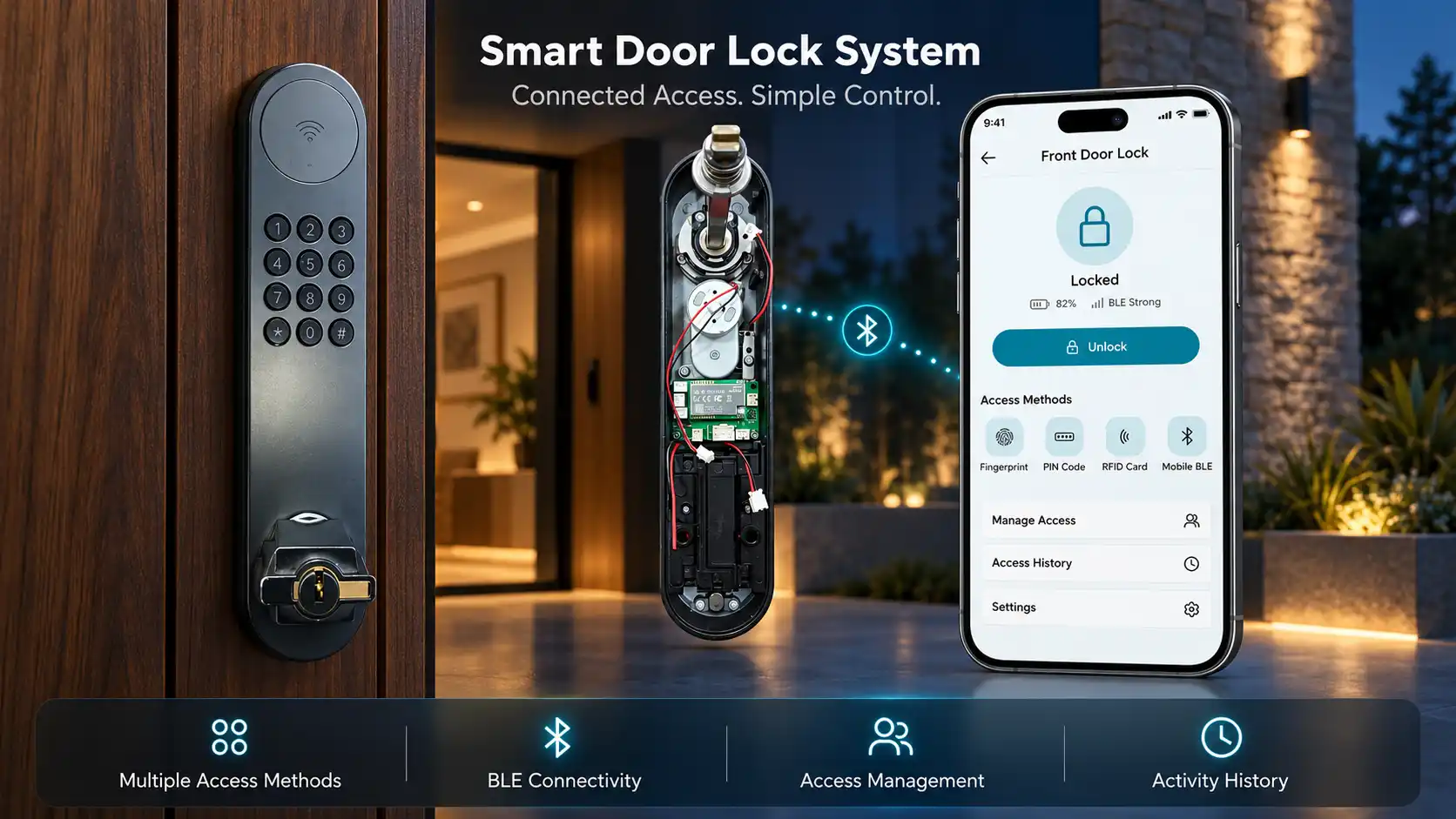
Nordic nRF52-powered BLE smart lock and access-control project
Our Nordic nRF52-based BLE smart lock and access-control initiative is one such example. Here, we engaged with Nordic technology and worked on BLE protocols, secure pairing practices, encrypted messaging, control of motors, battery management systems, and OTA-based firmware. Modular firmware was implemented in this project with an nRF5 SDK and Zephyr in mind.
Read Case Study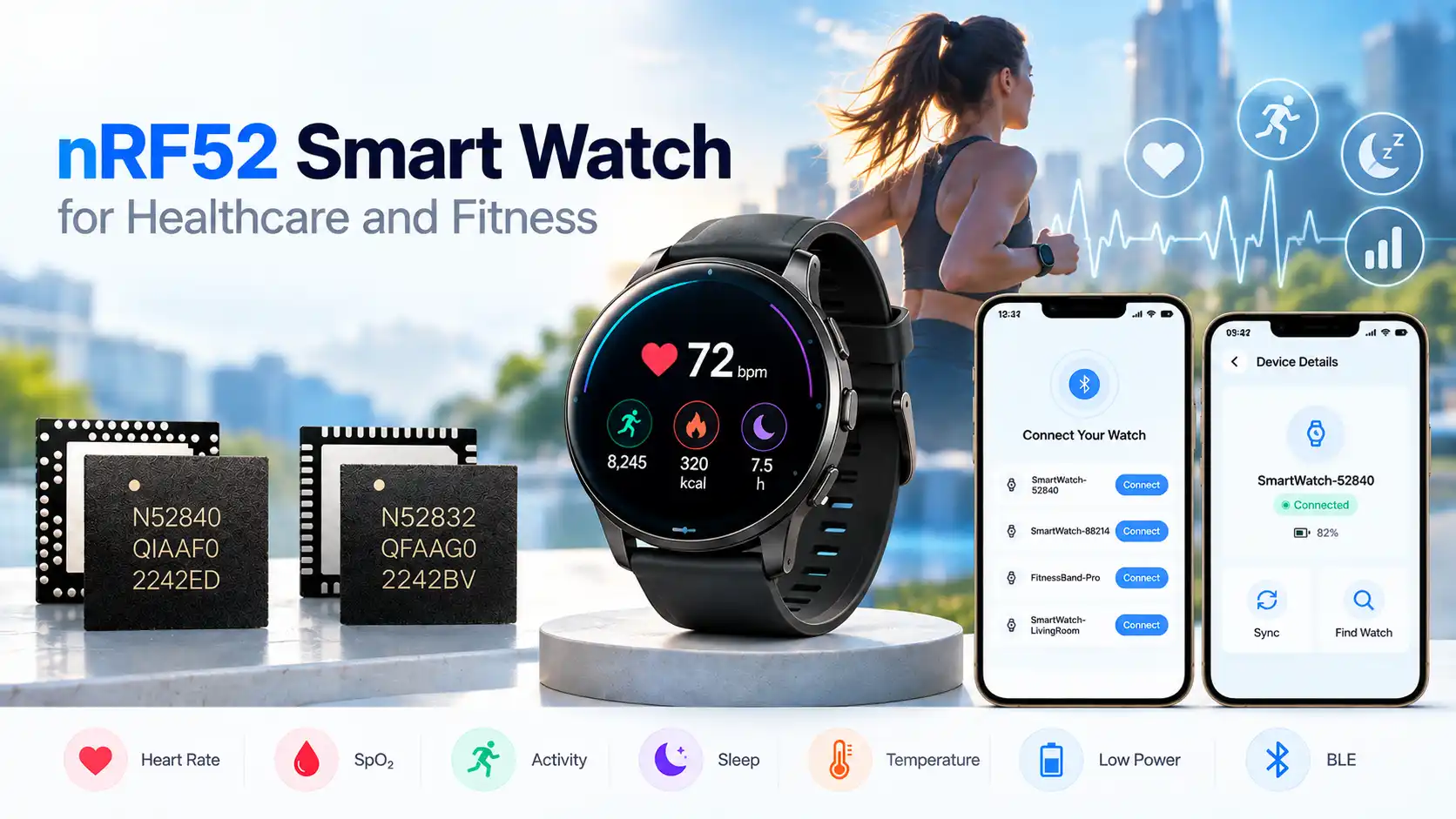
nRF52-based smart watch development project
Another example is our nRF52-based smart watch development project, involving nRF52840/nRF52832 platforms, sensor acquisition, BLE synchronization, power management, secure pairing and OTA-ready firmware architecture.
Read Case Study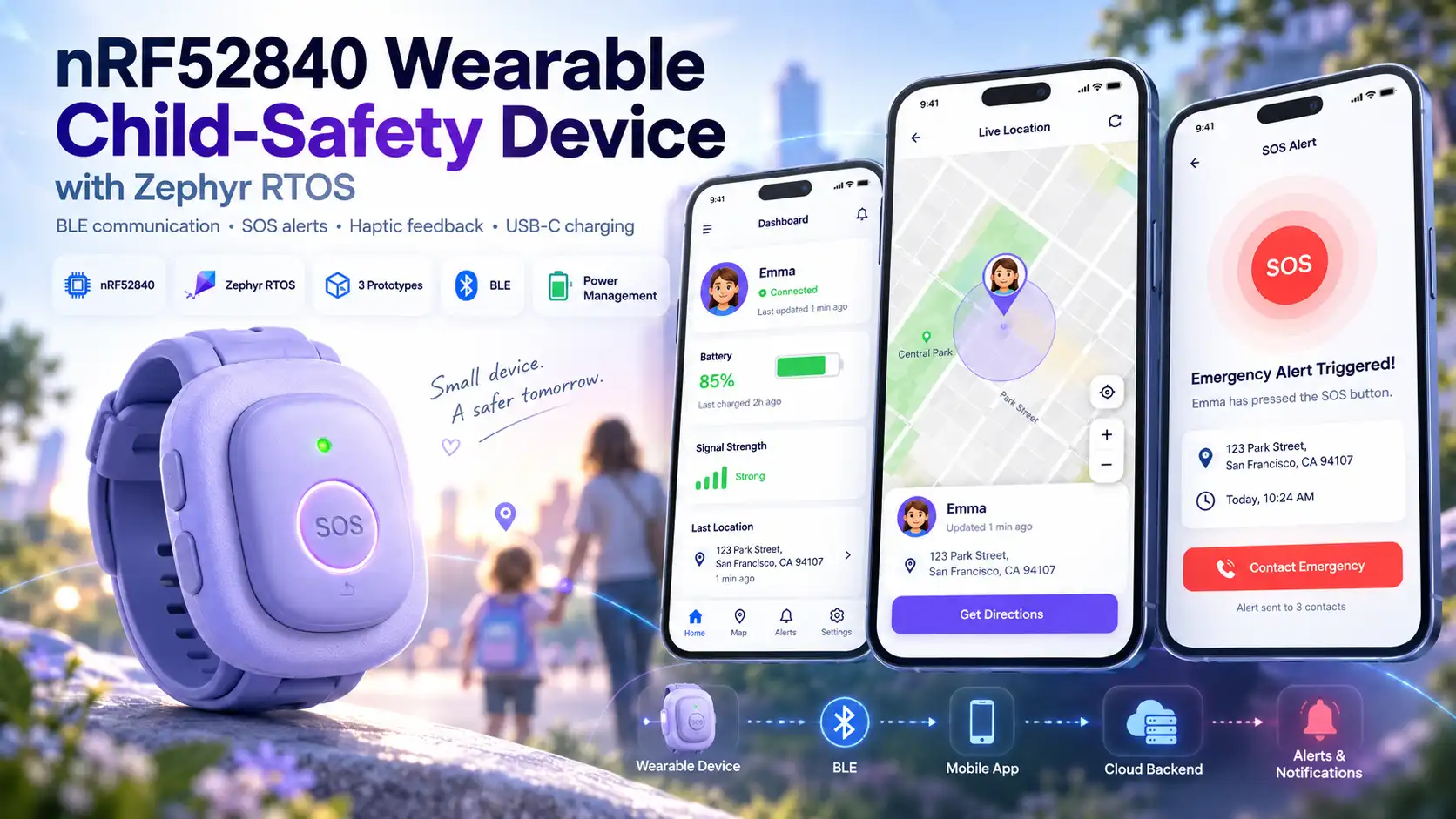
Nordic PCB and BLE prototyping services
Our Nordic PCB and BLE prototyping services extend this capability into hardware validation, current profiling, RF testing and production-oriented prototyping.
Read Case Study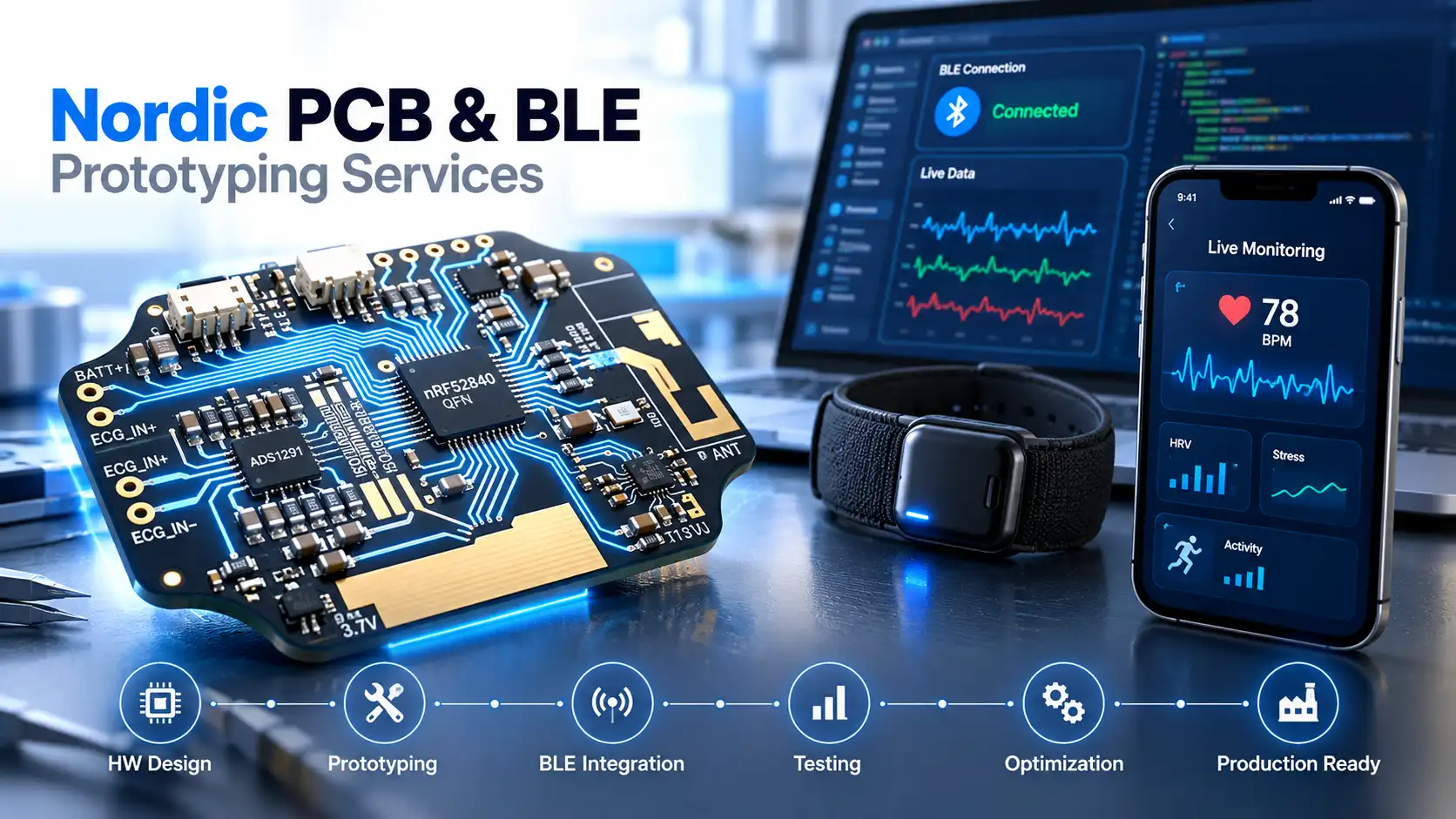
nRF52840 Wearable Child-Safety Device with Zephyr
We created a wearable device for kids' safety utilizing the Nordic nRF52840 chip and Zephyr RTOS platform for development. The work encompassed fabrication of custom circuits along with BLE communications, emergency button handling, provision of vibration alerts, and dynamic power management with rechargeable batteries and USB-C charger.
This experience is particularly relevant to nRF5 SDK-to-NCS migration because it demonstrates practical implementation of Nordic firmware within Zephyr's device-driver, Bluetooth, threading, and configuration model.
Read Case Study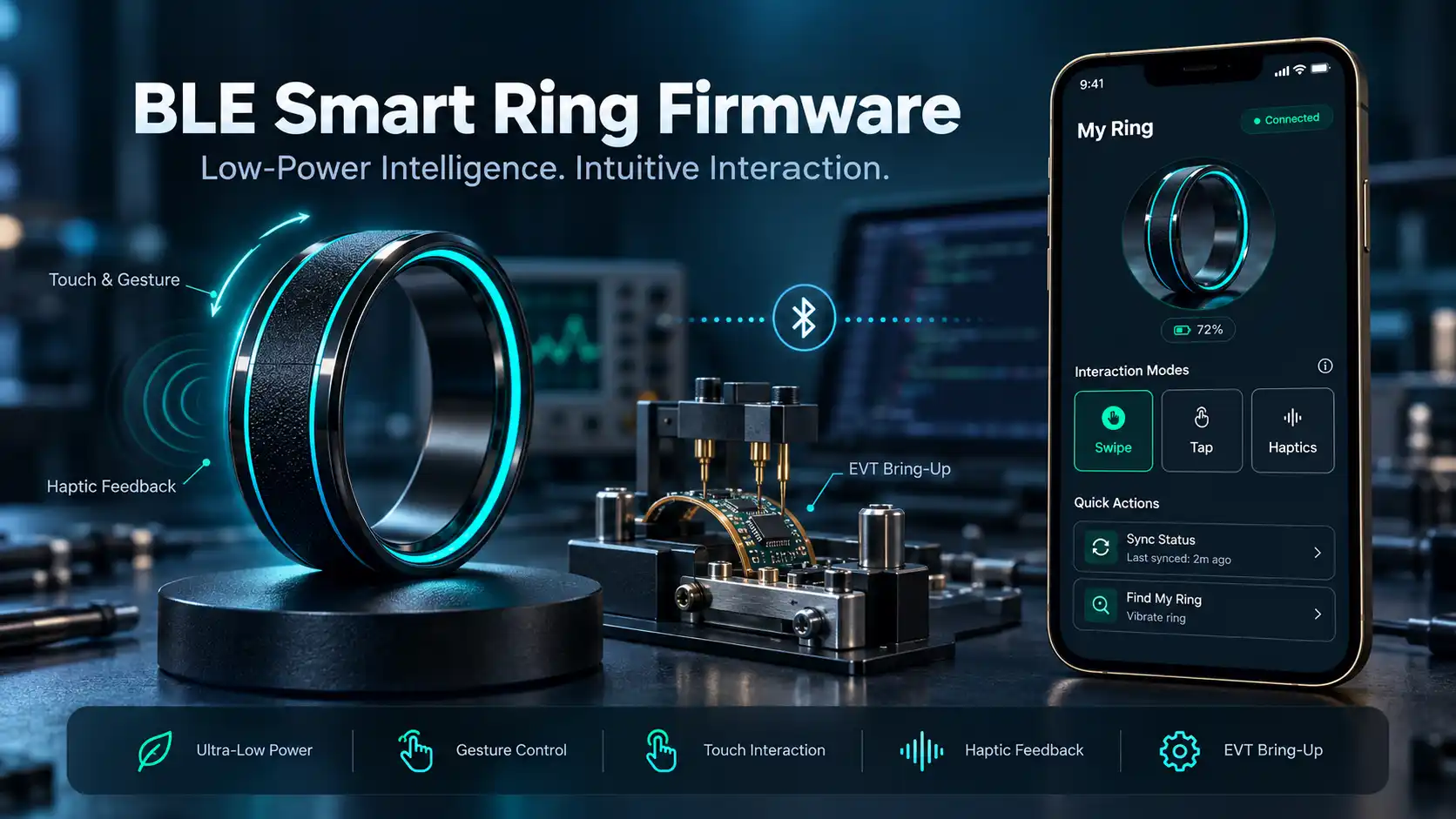
BLE Smart-Ring Firmware Using Nordic nRF52
We created the built-in firmware for an efficient smart ring that is utilizing Nordic nRF52 chip. The features of the device are capacitive sensing, motion detection, vibration control, lighting signaling, Bluetooth communication, and battery lifetime optimization. In addition to this task, we contributed to EVT hardware setup and testing.
The firmware was organized as a modular, RTOS-ready architecture, providing relevant experience for separating legacy application logic from SDK-specific components before rebuilding drivers, services, event handling, and power management in NCS and Zephyr.
Read Case Study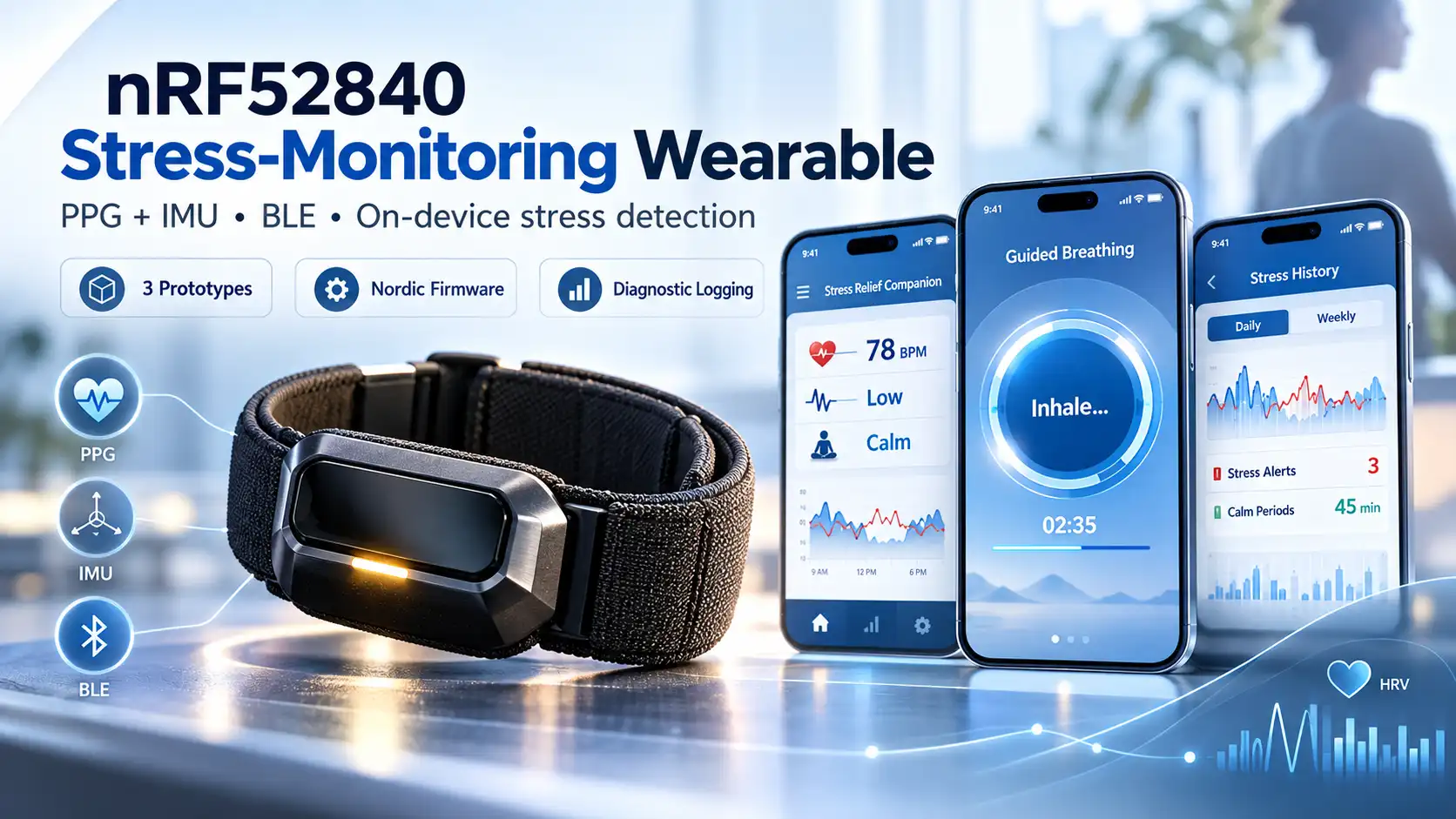
nRF52840 Stress-Monitoring Wearable
Using the nRF52840 chip, our group developed a palm strap that combined the PPG sensor to measure heart rate and heart rate variability with an IMU to filter out motion-induced artifacts. In addition, our embedded forest-based observer allowed for the detection of stress patterns while relying solely on local rules.
Within ten weeks, we produced three prototypes, firmware, schematics, a bill of materials, and a diagnostic logging interface. This work reflects our experience with sensor drivers, real-time processing, BLE, diagnostics, and resource-constrained Nordic firmware.
Read Case StudyTogether, these projects demonstrate the engineering capabilities required for a controlled nRF5 SDK-to-NCS migration: understanding existing firmware behavior, mapping proprietary SDK components to Zephyr subsystems, migrating BLE services and drivers, preserving low-power operation, implementing secure DFU, validating hardware behavior, and testing the migrated application on the target Nordic platform.
Power Optimization During Migration
Moving to a new RTOS should not compromise battery life. For battery-operated Nordic devices, we review active current, sleep behavior, peripheral activity, radio configuration and unnecessary wake-ups during migration.
We can profile different operating states and optimize firmware scheduling and peripheral usage.
Adequate Infosoft's Nordic development experience includes low-power wearable and BLE products.
In our nRF52-based smart watch project, the firmware architecture included sensor acquisition, BLE synchronization, secure pairing, power-state management and OTA-ready firmware. The project used nRF52840 and nRF52832 devices for different product configurations.
Hardware and Firmware Validation
Migration is incomplete until the new firmware has been validated on real hardware.
Our engineering workflow can include:
Build and compile validation Peripheral-level testing BLE interoperability testing Sensor and interface testing Power-consumption profiling Memory and CPU analysis Stress and long-duration testing OTA/DFU testing Regression testing against legacy firmware Production-oriented hardware validation
Adequate Infosoft also provides Nordic PCB and BLE prototyping services, including current profiling, RF testing and rapid PCB assembly. This allows firmware and hardware considerations to be evaluated together when a migration also involves board revisions.
Why Choose Adequate Infosoft?
Adequate Infosoft combines Nordic firmware development, BLE, embedded hardware, PCB design and IoT engineering capabilities. This matters when migration issues cross the boundary between software and hardware.
During the process of development, our engineers can analyze problems related to BLE behavior, timing of peripherals, consumption of energy, interfaces at the board level, performance of RF and architecture of the firmware.
Our objective is to achieve practical migration results: keeping things under control, reducing unnecessary redevelopment and providing a base NCS/Zephyr infrastructure for future features.