














 Mean Stack Development
 Vue JS Development
 Javascript Development
 React JS Development
 Angular JS Development
 Next JS development
 Java Development
 Python Development
 Django Development
 Cherrypy Development
 C# Development
 ASP.NET Development
 NodeJS Development
 Laravel Development
 CodeIgniter Development
 Zend Development
 Ruby on Rails Development
 CakePHP Development
 PHP Website Development
 Symfony Development
 Drupal Development
 Joomla Development
 Wordpress Development
 .NET Nuke Development
 Kentico
 Umbraco
 .NET MAUI Development
 Xamarin Application Development
 iOS Application Development
 Android Application Development
 Android Wear App Development
 Ionic Development
 iBeacon Application Development
 Universal Windows Platform (UWP)
 Kotlin Application Development
 Swift Application Development
 Flutter Application Development
 PWA Application Development
 Flutter Health Tech & Wearable App Development Company
 React Native Health Tech Wearable App Development
 Offshore Software Development
 Custom Application Development
 Front-End Development
 Full Stack Development
 AI & Machine Learning
 Custom CRM Solutions
 Flask Software Development
 Electron JS Development
 ChatGPT Development
 Telemedicine App Development
 Build Smart Telemedicine Platform
 Beauty & Salon App Solutions
 Hire Workato Experts
 Magento Development
 Magento 2.0 Development
 Magento Enterprise
 Shopping Cart Development
 Prestashop Development
 Shopify Development
 Open Cart Development
 WooCommerce Development
 BigCommerce Development
 NopCommerce Development
 Virto Commerce Development
 AspDotNetStorefront Development
 .NET Application Development
 Microsoft Dynamics CRM
 VB .NET Development
 Sharepoint Migration
 ASP.NET Core Development
 ASP.NET MVC Development
 AJAX Development
 Agile Development
 Microsoft Bot
 Microsoft Blazor
 Microsoft Azure Cognitive
 HTML 5
 UI/UX Design
 Graphic Design
 Adobe Photoshop
 XML Application Development
 Cloud Computing Solutions
 Azure Cloud App Development
 AWS Development
 Google Cloud Development
 Certified AWS IoT Services Developers
 DevOps Consulting & Development
 Kubernetes Consulting & Services
 SQL Programming Development
 MySQL Development
 MongoDB Development
 Big Data
 Robotic Process Automation
 Social Media Marketing
 Search Engine Optimization
 QA Testing
 Software Testing
 Software Security
 Maintenance And Support
 I.T. Consulting Services
 Business Intelligence
 YII Development
 Data Analysis
 Alexa Skills Development
 On Demand App for Mobile repairing services
 On Demand App for Car Service Booking
 On Demand App for Cleaning Services
 On Demand App for Pharmacy
 On Demand Dedicated Developers
 On Demand Lawyer App Development










 Nuki Smart Lock
 Salto Smart Lock
 TTlock Smart Lock
 NFC App Development
 Custom IOT Enabled Smart Lock
 Smart Locker Solutions
 Hospital Smart Lock Systems
 Hotel Smart Lock Systems
 Smart Home & Office Locks
 Smart Access for Schools & Colleges
 Unloc Smart Lock Integration
 Yale & August Smart Lock Integration
 Populife Smart Lock Integration
 Smart Lock Hardware Development
 Dairy IoT Solutions
 Agri IoT & AI Solutions
 Weather & Climate Solutions
 Water & Waste Management Solutions
 RaspBerry Pi
 Firmware Software Development
 ESP 32 Software Development
 Embedded Development
 Internet of Things
 Smart IoT Development
 IoT Sensor Integration & Development Solutions
 Smart IoT System Development for HVAC
 Tuya IoT App Development
 Particle IoT SDK
 IoT Development with AI
 Smart Pet GPS Tracker
 Dairy GPS Tracking Solutions
 GPS Fleet Management Software
 Car Rental & Subscription Solutions
 Car Buy & Sell Marketplace Development
 AI-Powered Car Wash App Development
 PCB Design & Fabrication
 IoT AC Automation
 AI–IoT Painting Solutions
 IoT Wearable Hardware & App Development
 HVAC Automation & AI Control Systems
 Smart Home IoT Engineering
 AI Embedded Systems
 AI Hardware Design Service
 Advanced IoT Hardware & Firmware Development
 Device Driver Development Services
 NXP i.MX RT Firmware & Hardware Services
 Microchip PIC & AVR Development
 Hire IoT Architects
 IoT Cloud & Infrastructure Solutions
 Infineon XMC / AURIX Development Services
 Matter & Thread IoT Services
 Native IoT Mobile App Development (BLE & Wi-Fi)
 Snapdragon IoT Firmware Development
 Renesas RA/RX Firmware Services
 Silicon Labs EFR32 Development Services
 Smart Wearable App Development
 Smart IoT Meters
 Smart Healthcare Wearable App Development
 Health Care Monitoring System
 Fitness Tracking App Development
 Smart Home Automation Apps
 nRF PCB Design
 ESP32 PCB Design
 Embedded Wearables Engineers
 Rental Property Management System
 Building Management System
 Smart Lighting Development
 Infineon Semiconductor Firmware Development Services
 Custom Camera Development: Hardware, Firmware & PCB Prototyping
 Smart Security Camera SDK
 Nordic Semiconductor SDK
 Infineon SDK
 Arduino SDK
 NFC Lock Integration
 Kerong Lock Integration
 IoT & AI Solutions for Manufacturing
 Smart Inventory & Logistics Solution
 Food & Beverage Industry Solutions
 Smart Hospitality Solutions
 Smart Property Management
 Custom Smart Home IOT SDK
 Smart IoT & AI in Healthcare
 AI-Powered Security Solutions
 Smart Home Safety & AI
 Veterinary Clinic Management (AI)
 Pet Care System (AI & IoT)
 Pet Training & Adoption (AI)
 Healthcare IoT Development
 Event Management Software
 Money Remittance App
 Money Lending App Development
 Utility and Bill Payment App
 IoT Mobile App Development (Flutter & React Native)
 AI & IoT Retail Solutions
 Smart EV App Development
 Smart Solar IoT & AI Solutions
 IoT-Based Energy Systems
 Smart Energy & Utilities Solutions
 6G Solutions
 IoT Security Solutions
 AI-Powered Lottery App Development
 AI-Sports Fitness Club Management
 Travel
 Real Estate
 Medical & Healthcare
 e-Learning
 Consumer Products
 Finance
 Automobile
 Media & Entertainment
 Billing Software
 Enterprise Resource Planning (ERP)
 Augumented & Virtual Reality
 Point of Sale(POS) Development
 Learning Management System
 EV Charging Solutions
 About Us
 Partners & Certifications
 Quality Assurance
 Our Clients & Testimonials
 Development Process
 Our Products
 Social Responsibility
 Work Ethics
 Vision & Mission
 Awards
 Live Project Demos
 Contact Us
 Case Studies
 Portfolio
 Blog
Blog
Jetson Orin Nano Super Robotic Arm with ROS 2 Vision-Guided Picking Development
A vision-guided robotic arm must do more than recognise an object. It has to locate that object in three dimensions, choose a grasp the gripper can execute, plan a collision-free path, and recover when the pick fails.
Adequate Infosoft is developing Jetson-based solutions that allow for the execution of such tasks with the help of ROS 2, depth sensing, edge AI, and motion planning.
The following is a case study explaining the architecture of the solution, and should be deemed just a case study, with no assumption made that the delivery of the robotic arm solution has already been conducted by Adequate Infosoft.
The study provides an explanation of how we would design and validate a Jetson Orin Nano Super picking cell. The criteria for the evaluation of the case study are provided later on.
Let's Work Together!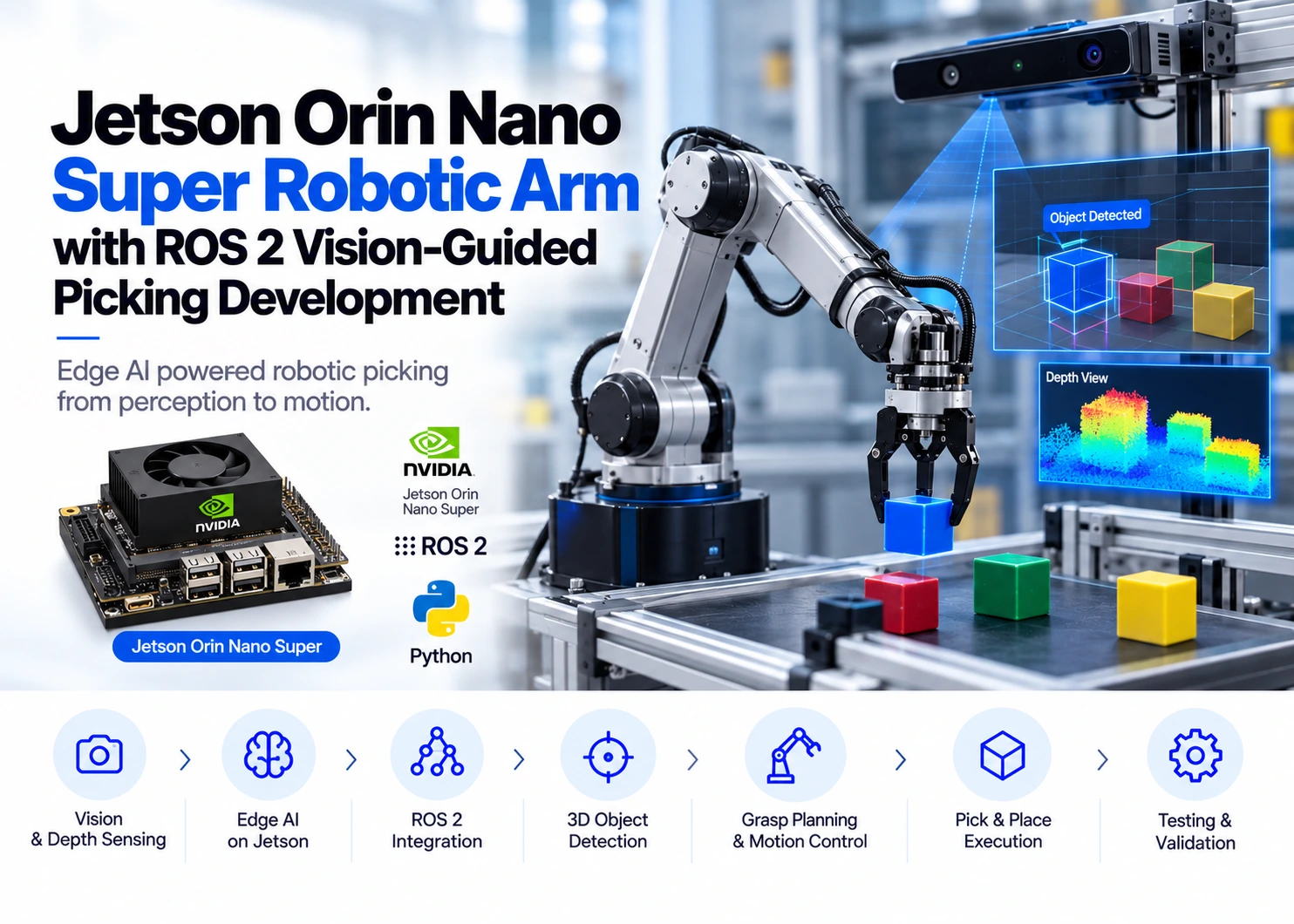
Reference Case Study: ROS 2 Vision-Guided Picking Cell
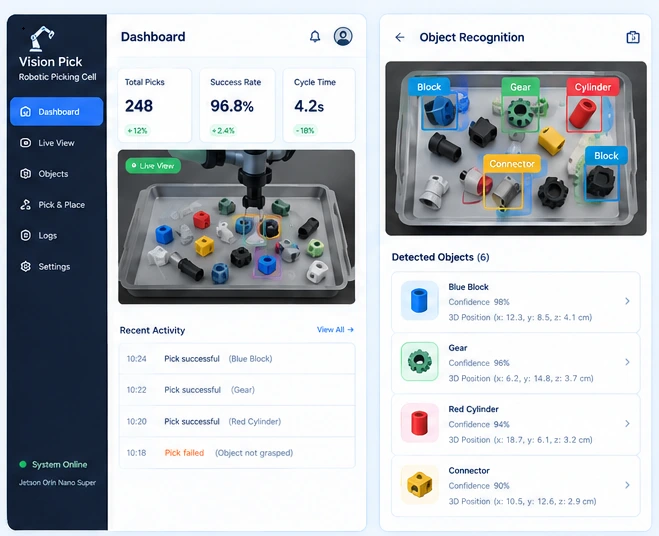
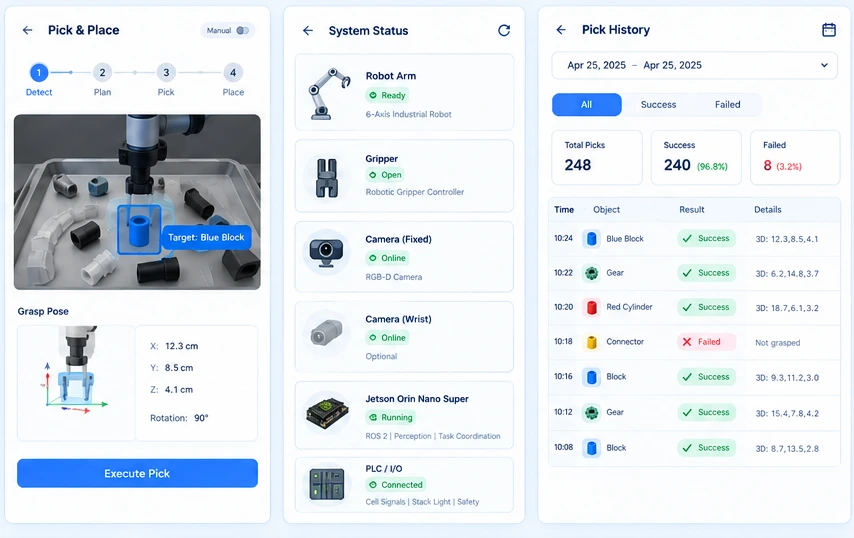
Imagine a producer who is getting a variety of small items in shallow containers. Presently, the workers identify each part manually, remove it with their hands, and insert it into the proper location. The producer wants a compact and efficient robotic workstation that can grasp parts which can be placed in random order.
Objects differ in shape and type of their surface, some partially overlap with others or are close to the container wall. A traditional algorithm based on fixed coordinates cannot be counted on to pick out a visible part or know how to orient the gripper correctly.
That is why the proposed solution should provide the ability to recognize objects locally, perform three-dimensional localization, plan movements, and identify a failed picking action.
The initial acceptance plan would define eligible part classes, tray presentation rules, minimum spacing, target placement tolerance, cycle-time range, and operator intervention conditions. This matters because “successful picking” is not a single model-accuracy figure: the vision system may identify a part correctly while the gripper still fails to acquire it.
Hardware and System Architecture
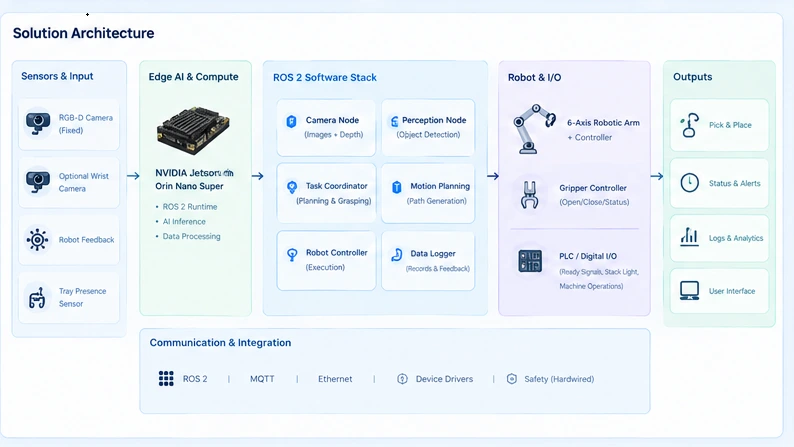
The reference cell contains a six-axis industrial or collaborative robotic arm together with its respective controller, changeable end effectors, and an RGB-D camera mounted vertically above the picking area. One of the cameras is fixed so that the tray can be easily scanned, and an optional camera mounted on the wrist can help examine difficult picks or verify placement.
Camera choice depends on working distance, field of view, depth accuracy, reflective surfaces, and the available mounting structure.
The NVIDIA Jetson Orin Nano Super runs the ROS 2 perception and task-coordination software locally.
NVIDIA describes the Super performance improvement as a software-enabled upgrade to the Orin Nano developer kit; the available compute does not by itself establish how many camera streams or picks per minute a particular application can support. Those figures must be measured with the chosen camera, model, planner, and robot.
One distinct controller is used to handle arm movements. There is a robotic gripper controller that tells us if it's opened, closed, or else states that p.
A PLC or digital I/O takes care of cell-ready signals, detection of being present on the tray, stack lights, and other machine operations necessary. Hardwired safety risks are treated separately from the application running on the Jetson.
ROS 2 Software Architecture
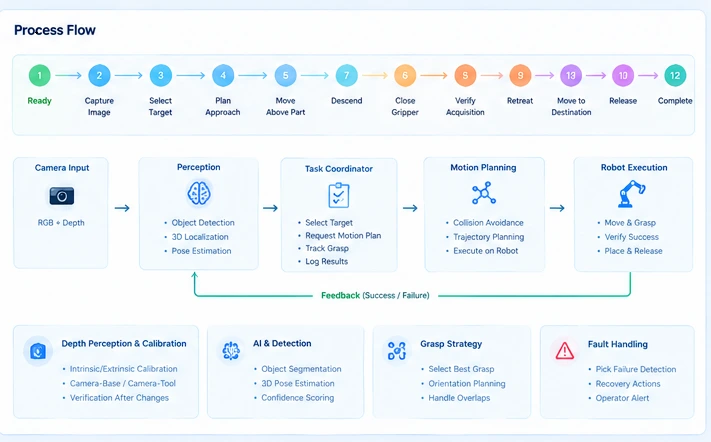
The graph of ROS 2 divides the process of vision acquisition of a camera, inferencing, selection of a target, motion control, and regulation of robots. Nodes of camera practice use the process of publishing the colour images with time stamps, depth images, and the details of the calibration process.
The node of perception publishes the information about objects that have been identified together with their characteristics such as type, verification level, location on the image, and an estimated three-dimensional position. The function of a task coordinator involves choosing a target, requesting for a motion plan, overseeing the process of grasping, and keeping appropriate records.
The design of the robots provides the details such as links, joints, programming the configuration of tools, limitations of joints, and the configuration of some special positions. Transform frames link elements such as a camera, the bottom part of a robot, tool center point, and tray. The operation of the Controller Interface allows to receive the data about the position of joints of a robot and to execute various commands.
This separation makes a critical fault visible: if the camera pose drifts, the team can inspect calibration rather than repeatedly retraining the detector. ROS 2's hardware-interface model provides the relevant command and state concepts for controller integration.
A state machine governs the cycle: confirm the cell is ready, acquire a fresh image, select a target, plan an approach, move above the part, descend, close the gripper, verify acquisition, retreat, move to the destination, release, and confirm completion.
Each transition has a timeout and a defined fault response. The system never assumes that a planned pick was physically successful merely because the motion command completed.
Depth Perception and Calibration
After calibrating the intrinsic parameters of the camera, the camera is accepted into the robot control system. When the camera is mounted overhead, calibration determines how the camera is linked to the robot's base.
However, when the camera installation is movable (eye-in-hand application), calibration needs to identify how the camera is related to the tool being operated. It is critical to ensure that calibration is tested every time the camera is altered or the tools being used have been modified.
The detector or segmenter identifies candidate objects in the colour image. Depth pixels associated with a candidate provide a point cloud or surface estimate.
The pipeline rejects invalid measurements, tray-wall artefacts, and points outside the permitted pickup area. Depending on the part, it estimates a centre and orientation from a segmented contour, a fitted geometric primitive, or a trained grasp proposal.
Depth sensing has limits. Glossy metal, transparent packaging, dark surfaces, occlusion, and closely stacked parts can produce unreliable geometry.
For these items, practical options include changed lighting, a different depth technology, multiple viewpoints, a known tray fixture, or declining the pick and requesting operator review. A reliable system should recognise when it lacks a usable grasp estimate.
Grasp Selection and Motion Planning
Grasp candidates are evaluated according to certain parameters like their confidence in the object position, surface area available for contact, width of the robot's hand or suction mechanism, distance from the walls of the tray, accessibility, and a probable requirement for wrist rotation. The grasp candidate will then be expressed in terms of the robot's coordinate frame and will be performed together with the approach pose, and the poses for picking and pulling away.
MoveIt 2 keeps a planning scene to contain the arm of the robot, the tools, tray, immobilizers, and other elements of collision. The motion planner compares all possible motions to the built model and specifications of the robot.
The software should check the results of the operation instead of relying on the planner's signal as if the operation was successful. Collision checking in the planning scene is described in the MoveIt 2 planning scene documentation.
For a crowded tray, the first reachable object may not be the best one. Picking a topmost item can expose another part and reduce collision risk on the next cycle. Conversely, a high-confidence detection near a tray wall may be rejected because the gripper cannot approach it safely. These decisions belong in the task logic, with rejection reasons recorded for later improvement.
Integration, Failures, and Field Validation
The status indicators of the supervisor are available for the overall production process, including ready, busy, completed and fault statuses. The operator console may include the camera's view, target chosen, robot's status, last fault and batch count.
It will permit designated personnel to put a hold on a certain cell, acknowledge a fault and initiate the process from a certain state with regards to safety systems.
Verification starts with filming and simulating the movement, moving into slow runs and controlled belt picking.
The testing set consists of empty racks, things that overlap, undesired items, taking into account received vision with insufficient depth, etc.
We will define the quality of detection success as well as the speed of gripper locking, placement accuracy, recovery quality and full cycle duration.
A pilot should run across the actual range of trays, shifts, lighting conditions, and part variations. Its outcome determines whether the next improvement is a model update, a revised grasp strategy, a better fixture, or a hardware change.
No throughput or reliability claim should be published until measured against an agreed test protocol on the physical cell.
NVIDIA Jetson Orin Nano Super Robotic Arm Development Services
Adequate Infosoft provides end-to-end development services for businesses building ROS 2-based, vision-guided robotic picking systems. Our engineering approach starts with defining the application requirements before selecting the hardware, perception architecture, gripper, camera configuration, and robot platform.
Robotic Picking System Requirements and Hardware Selection
We provide assistance in defining requirements related to vision-controlled robotic applications which must include object material and size, object presentation type, required picking speed, placement tolerance level, workspace to work within, permissible error level, as well as clearance procedures in cases when something goes wrong or the operator makes some mistake.
These requirements help to determine which system architecture to use:
Overhead or eye-in-hand camera types Measurements of the object with RGB-D or stereo depth cameras Vacuum or parallel-jaw type of gripper Type of robotic arm and its reach Lighting and other requirements for fixtures Use of conveyor, trays or bins and Utilization of Jetson device for Edge AI processing
ROS 2 Robotic Arm Software Development
Our services in the area of ROS 2 development offer the software components necessary for robot control, perception, motion planning, and application functions.
Our services include:
Robot description files and URDF modeling Coordinate frame and TF design Camera and gripper drivers ROS 2 perception and processing nodes Function orchestration and sequencing Diagnostics and system monitoring Vendor ROS packages ROS 2 hardware interfaces where applicable
In any case, safety functions of robots are realized through certified controllers and safety equipment. This does not mean that ROS 2 development solutions may take the place of emergency stop circuits or certified safety systems.
Vision-Guided Picking and Edge AI Development
For vision-guided picking, we integrate RGB-D or stereo cameras, configure suitable lighting, develop object-detection or segmentation datasets, and optimise AI models for local inference on the NVIDIA Jetson platform.
Our development process can include:
Object detection and segmentation Depth-based object localisation Camera-to-robot calibration 3D coordinate transformation Object orientation estimation Grasp-point generation and scoring Geometry-based picking Purpose-built fixtures for difficult objects
When object classification alone is insufficient to determine a reliable grasp location, we can incorporate geometry estimation, orientation analysis, grasp scoring, or application-specific fixtures.
MoveIt 2 Motion Planning and Robot Control
To perform motion planning, we employ MoveIt 2 software to model robots, create trajectories, check for collisions during the planning process and execute robot tasks.
We do the configuring of:
Robot models and URDF Joint limits Planning of scenes Calculation of collision geometry Approach and retreat trajectories Grasp and release plan Execution monitoring of tasks Recovery and retry movement
Industrial Automation and System Integration
The robotic picking system can be integrated with surrounding automation and business systems through appropriate industrial or application interfaces.
Depending on the project requirements, integrations may include:
PLC systems Conveyors Industrial machine vision MES platforms Operator dashboards Production monitoring systems Application and cloud backends
This allows the Jetson-based robotic system to operate as part of a larger automated production or material-handling workflow.
Testing Deploying Robotic Picking Performance
Our process of development does not stop with the demonstration of proof-of-concept. We analyse all stages of the picking cycle from camera to grip and measure performance metrics based on industrial production trials.
The testing covers:
Accuracy of perception Reliability of depth Picking success ratios Effectiveness of motion planning Part efficiency Cycle times Recovery Workability over extended periods
We keep track records of calibration procedures, versions of AI models, values of configuration parameters, diagnostic logs so as to differentiate faults of perception from those of motion planning, robot control, etc.
Jetson Hardware and Production Readiness
For deployment, we assess the complete Edge AI computing environment, including power requirements, thermal management, storage, enclosure protection, network connectivity, startup behaviour, and long-term maintainability.
The NVIDIA Jetson Orin Nano Super Developer Kit is intended for development rather than direct production deployment. Therefore, a production system should use an appropriate Jetson module and carrier-board architecture selected according to the application's performance, mechanical, thermal, power, and reliability requirements.
Build a Picking System Around the Real Parts
The Jetson Orin Nano Super, ROS 2, a depth camera, and MoveIt 2 provide a solid foundation for development. Still, the performance of the cell relies on calibration, part presentation, gripper design, controller integration, and recovery behaviour measurement.
Adequate Infosoft can help transform your picking idea into a practical robotic function. Engineering decisions will be documented from the first capture of the image by the camera until the last part is placed.
Editorial Resources