








 Mean Stack Development
 Vue JS Development
 Javascript Development
 React JS Development
 Angular JS Development
 Next JS development
 Java Development
 Python Development
 Django Development
 Cherrypy Development
 C# Development
 ASP.NET Development
 NodeJS Development
 Laravel Development
 CodeIgniter Development
 Zend Development
 Ruby on Rails Development
 CakePHP Development
 PHP Website Development
 Symfony Development
 Drupal Development
 Joomla Development
 Wordpress Development
 .NET Nuke Development
 Kentico
 Umbraco
 .NET MAUI Development
 Xamarin Application Development
 iOS Application Development
 Android Application Development
 Android Wear App Development
 Ionic Development
 iBeacon Application Development
 Universal Windows Platform (UWP)
 Kotlin Application Development
 Swift Application Development
 Flutter Application Development
 PWA Application Development
 Flutter Health Tech & Wearable App Development Company
 React Native Health Tech Wearable App Development
 Offshore Software Development
 Custom Application Development
 Front-End Development
 Full Stack Development
 AI & Machine Learning
 Custom CRM Solutions
 Flask Software Development
 Electron JS Development
 ChatGPT Development
 Telemedicine App Development
 Build Smart Telemedicine Platform
 Beauty & Salon App Solutions
 Hire Workato Experts
 Magento Development
 Magento 2.0 Development
 Magento Enterprise
 Shopping Cart Development
 Prestashop Development
 Shopify Development
 Open Cart Development
 WooCommerce Development
 BigCommerce Development
 NopCommerce Development
 Virto Commerce Development
 AspDotNetStorefront Development
 .NET Application Development
 Microsoft Dynamics CRM
 VB .NET Development
 Sharepoint Migration
 ASP.NET Core Development
 ASP.NET MVC Development
 AJAX Development
 Agile Development
 Microsoft Bot
 Microsoft Blazor
 Microsoft Azure Cognitive
 HTML 5
 UI/UX Design
 Graphic Design
 Adobe Photoshop
 XML Application Development
 Cloud Computing Solutions
 Azure Cloud App Development
 AWS Development
 Google Cloud Development
 Certified AWS IoT Services Developers
 DevOps Consulting & Development
 Kubernetes Consulting & Services
 SQL Programming Development
 MySQL Development
 MongoDB Development
 Big Data
 Robotic Process Automation
 Social Media Marketing
 Search Engine Optimization
 QA Testing
 Software Testing
 Software Security
 Maintenance And Support
 I.T. Consulting Services
 Business Intelligence
 YII Development
 Data Analysis
 Alexa Skills Development
 On Demand App for Mobile repairing services
 On Demand App for Car Service Booking
 On Demand App for Cleaning Services
 On Demand App for Pharmacy
 On Demand Dedicated Developers
 On Demand Lawyer App Development






 Nuki Smart Lock
 Salto Smart Lock
 TTlock Smart Lock
 NFC App Development
 Custom IOT Enabled Smart Lock
 Smart Locker Solutions
 Hospital Smart Lock Systems
 Hotel Smart Lock Systems
 Smart Home & Office Locks
 Smart Access for Schools & Colleges
 Unloc Smart Lock Integration
 Yale & August Smart Lock Integration
 Populife Smart Lock Integration
 Smart Lock Hardware Development
 Dairy IoT Solutions
 Agri IoT & AI Solutions
 Weather & Climate Solutions
 Water & Waste Management Solutions
 RaspBerry Pi
 Firmware Software Development
 ESP 32 Software Development
 Embedded Development
 Internet of Things
 Smart IoT Development
 IoT Sensor Integration & Development Solutions
 Smart IoT System Development for HVAC
 Tuya IoT App Development
 Particle IoT SDK
 IoT Development with AI
 Smart Pet GPS Tracker
 Dairy GPS Tracking Solutions
 GPS Fleet Management Software
 Car Rental & Subscription Solutions
 Car Buy & Sell Marketplace Development
 AI-Powered Car Wash App Development
 PCB Design & Fabrication
 IoT AC Automation
 AI–IoT Painting Solutions
 IoT Wearable Hardware & App Development
 HVAC Automation & AI Control Systems
 Smart Home IoT Engineering
 AI Embedded Systems
 AI Hardware Design Service
 Advanced IoT Hardware & Firmware Development
 Device Driver Development Services
 NXP i.MX RT Firmware & Hardware Services
 Microchip PIC & AVR Development
 Hire IoT Architects
 IoT Cloud & Infrastructure Solutions
 Infineon XMC / AURIX Development Services
 Matter & Thread IoT Services
 Native IoT Mobile App Development (BLE & Wi-Fi)
 Snapdragon IoT Firmware Development
 Renesas RA/RX Firmware Services
 Silicon Labs EFR32 Development Services
 Smart Wearable App Development
 Smart IoT Meters
 Smart Healthcare Wearable App Development
 Health Care Monitoring System
 Fitness Tracking App Development
 Smart Home Automation Apps
 nRF PCB Design
 ESP32 PCB Design
 Embedded Wearables Engineers
 Rental Property Management System
 Building Management System
 Smart Lighting Development
 Infineon Semiconductor Firmware Development Services
 Custom Camera Development: Hardware, Firmware & PCB Prototyping
 Smart Security Camera SDK
 Nordic Semiconductor SDK
 Infineon SDK
 Arduino SDK
 NFC Lock Integration
 Kerong Lock Integration
 IoT & AI Solutions for Manufacturing
 Smart Inventory & Logistics Solution
 Food & Beverage Industry Solutions
 Smart Hospitality Solutions
 Smart Property Management
 Custom Smart Home IOT SDK
 Smart IoT & AI in Healthcare
 AI-Powered Security Solutions
 Smart Home Safety & AI
 Veterinary Clinic Management (AI)
 Pet Care System (AI & IoT)
 Pet Training & Adoption (AI)
 Healthcare IoT Development
 Event Management Software
 Money Remittance App
 Money Lending App Development
 Utility and Bill Payment App
 IoT Mobile App Development (Flutter & React Native)
 AI & IoT Retail Solutions
 Smart EV App Development
 Smart Solar IoT & AI Solutions
 IoT-Based Energy Systems
 Smart Energy & Utilities Solutions
 6G Solutions
 IoT Security Solutions
 AI-Powered Lottery App Development
 AI-Sports Fitness Club Management
 Travel
 Real Estate
 Medical & Healthcare
 e-Learning
 Consumer Products
 Finance
 Automobile
 Media & Entertainment
 Billing Software
 Enterprise Resource Planning (ERP)
 Augumented & Virtual Reality
 Point of Sale(POS) Development
 Learning Management System
 EV Charging Solutions
 About Us
 Partners & Certifications
 Quality Assurance
 Our Clients & Testimonials
 Development Process
 Our Products
 Social Responsibility
 Work Ethics
 Vision & Mission
 Awards
 Live Project Demos
 Contact Us
 Case Studies
 Portfolio
 Blog
Blog
Jetson Orin NX Custom Carrier Board for Multi-Camera Edge AI Development
The term "multi-camera Edge AI" describes a product requiring more than just a sophisticated AI function. The development of a carrier board is an important task as it will ensure correct camera enumeration, good signal stabilization, thermal control, scalability in manufacturing, and servicing of the device.
Adequate Infosoft develops custom NVIDIA Jetson Orin NX carrier boards for vision AI, robotics, industrial inspection, smart mobility, retail analytics, safety monitoring, and other embedded AI products.
We combine hardware engineering, embedded Linux bring-up, camera integration, AI application support, and production validation into one practical development service.
The NVIDIA Jetson Orin NX series of devices is ideal for small devices that require local AI inference instead of processing in the cloud. Depending on the module and configuration chosen, it allows significant AI and GPU acceleration, all while consuming low power.
However, ensuring consistent functionality with multiple cameras requires extensive engineering. A carrier board will need to support the module's power rails, high-speed camera connections, PCIe devices, USB peripherals, Ethernet connections, and the cooling system.
Let's Work Together!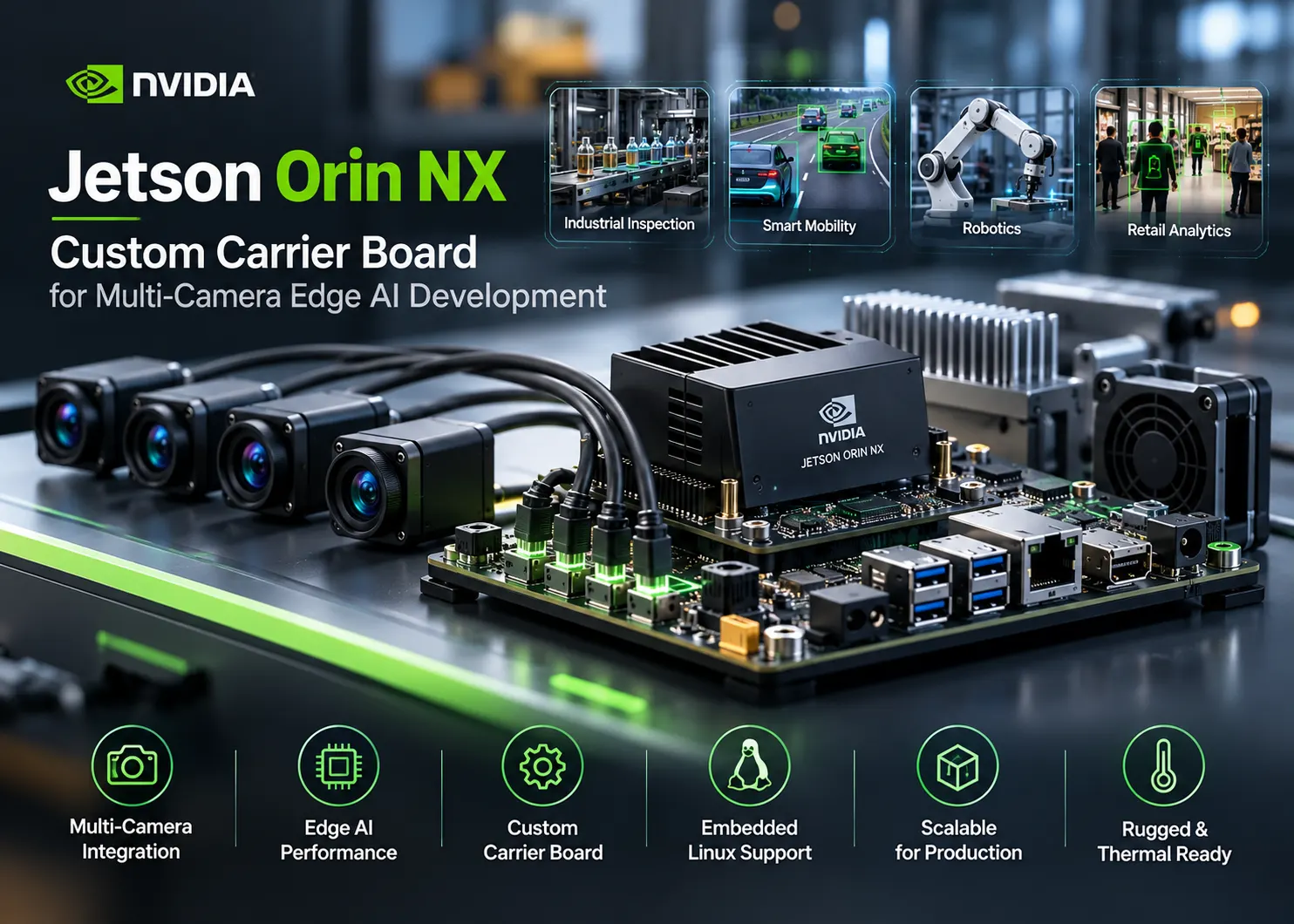
Custom NVIDIA Jetson Orin NX Carrier Board for Multi-Camera Edge AI – UK Client Case Study
Explore our real-world custom NVIDIA Jetson Orin NX carrier board development project delivered for a UK-based client.
This case shows our real experience with various NVIDIA products including hardware design, custom carrier board development, multi-camera integration, and Edge AI solutions.
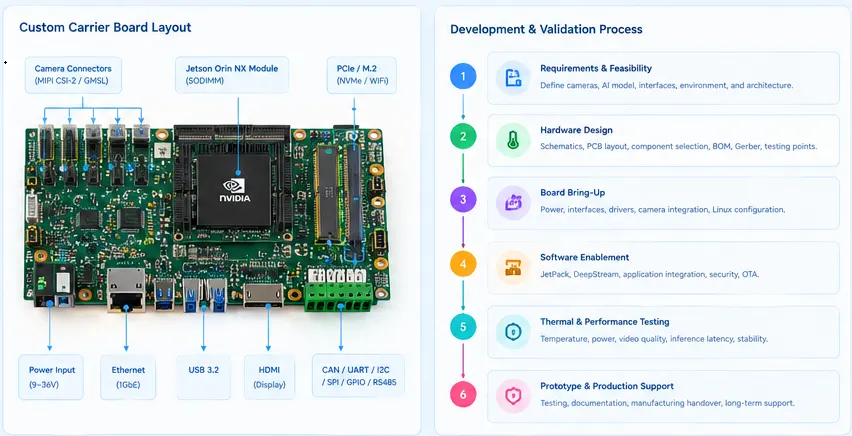
The case describes how we delivered the custom Jetson Orin NX carrier board for a multi-camera Edge AI product in terms of requirements and hardware architecture elaboration, PCB design, board bring-up, interface verification, and thermal testing.
The Product Requirement
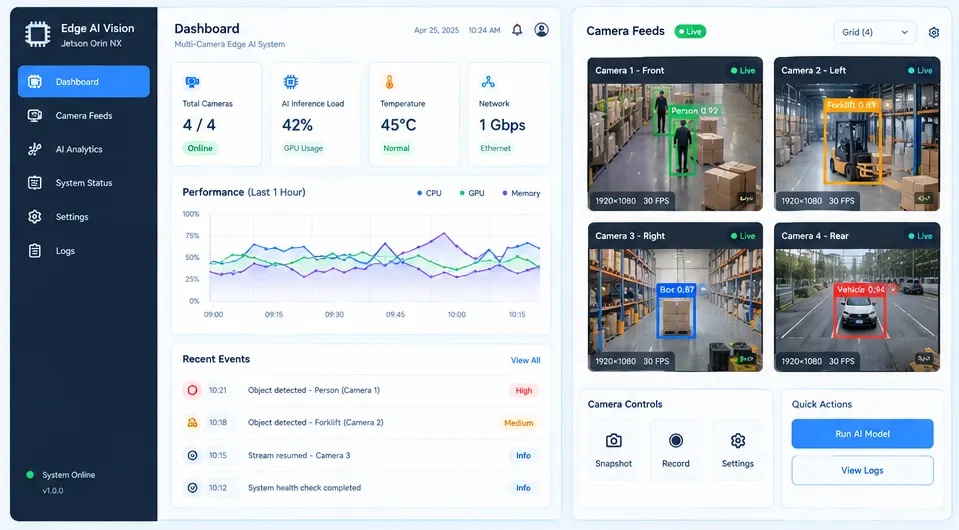
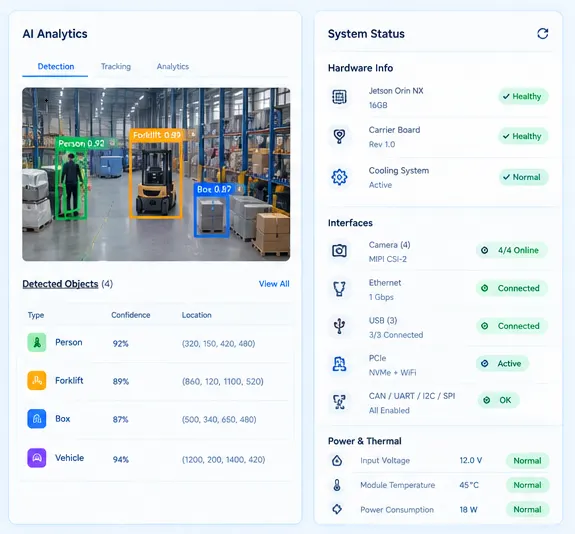
The planned product was a compact edge computer engineered to work with multiple live videos and perform the required computation, including object detection, classification, and tracking, as well as outputting event logic to timely respond to incoming data.
The finalized solution could serve various purposes such as quality control processes in manufacturing, safety supervision of fork-lifts and pedestrians, automated vehicle monitoring software, warehouse automation system, and smart access control.
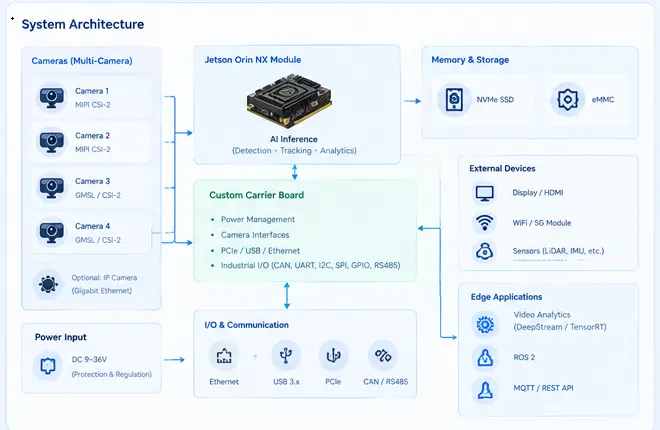
The following system requirements were mentioned:
Support for NVIDIA Jetson Orin NX module Either four synchronized camera inputs or four triggered camera inputs Connectivity for cameras, such as MIPI CSI-2 or GMSL Support for Gigabit Ethernet for network connection and IP cameras PCIe expansion capability for wireless connection, NVMe storage, or specialized I/O USB interfaces for servicing cameras and all-related accessories CAN, UART, I2C, SPI, GPIO, and RS485 for industrialization Input DC power for a large range with protection against polarity reversal, transients, and power instability Compact layout compatible with the enclosure Included Jetson software image, board support package configuration, and manufacturing test support
The primary goal of engineering was not just to make the board work, but to ensure that the board serves as a reliable platform, which can be implemented successfully in a real installation setup.
Architecture and Hardware Design Approach
The work on the design started with a workshop that involved interface and power-budget. The hardware and firmware teams mapped the specifications of all external devices, camera types, connector placement, length of cables, temperature range of work, AI load, storage requirement, and limitations of enclosure.
This work is crucial since camera systems can suffer failures for reasons that cannot be detected from an application prototype.
For instance, a camera may work properly when a short cable is used, but an unsuccessful operation may seem highly possible when it comes to using the system in a machine or vehicle enclosure or a noisy industrial cabinet.
The board architecture therefore considers signal integrity, grounding, cable shield termination, transient protection, power sequencing, and serviceability from the start.
For the camera subsystem, we evaluate the appropriate transport architecture before schematic capture. Direct MIPI CSI-2 is useful where image sensors are physically close to the carrier board. For longer cable runs or rugged installations, serializer/deserializer-based camera solutions such as GMSL can be more appropriate.
IP cameras may also be used where Ethernet infrastructure and software decoding capacity suit the use case. The selected approach depends on camera count, resolution, frame rate, latency target, synchronization needs, cable distance, and enclosure design.
The carrier board was designed around a production-capable power tree. A protected DC input stage supplied regulated rails for the Jetson module, cameras, Ethernet PHY or switch, storage, and external peripherals.
Inclusion of power-good monitoring, enable sequencing, reset behavior, current budget analysis, and key rail testing has made it easier to diagnose the prototype and minimized potential problems with the installation at the customer's location.
High-speed interfaces have been routed according to the criteria of impedance, length matching, reference plane connection, and return path connection. PCIe, USB 3.x, MIPI CSI-2, Ethernet, and display interfaces cannot be treated like other digital signals.
Layout affects link training, camera stabilization, electromagnetic compatibility, and long-term reliability.
Board Bring-Up and Software Enablement
Following fabrication and assembly of the PCB, bring-up is implemented in a systematic manner, and is not simply an arbitrary procedure. The first step here consists of carrying out tests on the power supplies, power sequencing, reset signal, clock, booting mode, and temperature of the module prior to any higher-level connections being made.
Once the module is powered on, the engineers proceed with configuring the Linux environment, device tree, pin multiplexing, interface drivers and peripherals. The following steps generally take place as part of the bring-up process:
NVMe or eMMC storage verification Ethernet throughput and link stability testing USB host and recovery interface testing CAN, UART, I2C, SPI, GPIO, and RS-485 functional checks Camera driver integration and sensor identification Camera stream stability, frame-rate, and image-quality checks Power-loss and controlled restart testing Application startup, logging, and remote-update preparation
For multi-camera systems, reliable capture is as important as AI inference performance. We validate each camera independently, then test concurrent streaming under expected operating conditions.
We look for frame drops, lane errors, sensor reset events, timestamp inconsistencies, thermal throttling, and throughput limits.
Where a project needs synchronized acquisition, we define the trigger, clocking, and software timestamp strategy early, rather than assuming software alone can correct an unsynchronised hardware design.
The platform is then prepared to run the edge application. This may include NVIDIA JetPack components, CUDA-accelerated processing, TensorRT inference optimisation, GStreamer pipelines, OpenCV workflows, DeepStream-based video analytics, ROS 2 nodes, MQTT communication, REST APIs, local database storage, or cloud integration. The final software stack should be selected according to the product objective—not because a framework is popular.
Thermal Design and Real-World Validation
Often, thermal design is the distinction that separates a successful demo from a reliable product. A multiple camera AI application works the CPU, GPU, memory, camera interfaces, and storage for a long time. Therefore, the carrier board should be planned together with the enclosure and cooling solution.
The thermal process starts with practical assumptions about all operative conditions: ambient temperature, type of enclosure, way of mounting, air flow, load of camera, inference rate, disk activity, and power mode. The thermal path is analyzed from the Jetson module to the heat spreader or heat sink including proximate components like regulators, Ethernet equipment, SSDs, and others.
When validation is conducted, the device undergoes evaluation while both cameras and AI workloads operate. We observe the module's temperature, clock behavior, electricity consumption, video quality, inference latency, and any indications of throttling.
The testing must include cold boot, continuous operation, restart cycles, voltage difference testing, and vibrations and electrical noise where applicable.
This engineering field tends to be particularly helpful for applications where safety and operations are of major importance. The vision systems used near forklifts, assembly lines, or restricted areas should give clear restrictions and be validated properly.
AI detection can help operators and automate processes, but should never be presented a substitute of full risk assessment, safety design, or required certification.
NVIDIA Jetson Orin NX Carrier Board Development Services
Adequate Infosoft offers end-to-end developer services for organisations building a new multi-camera Edge AI device or modernising an existing embedded platform.
Requirements, Feasibility and Architecture
We will start out this stage by defining the number of cameras, the sensor type, resolution, frame rate, type of AI model, latency, storage capacity, network, operating environment, and certification parameters for the product. Then we will suggest an optimal configuration of the Orin NX module and the system architecture.
This process may consist of system block diagrams, preliminary cost estimation, selection of the connectors, camera transport and device components, risk analysis, and planning. This helps avoid costly redesign in the case of the incomplete initial specification.
Custom Carrier-Board Engineering
Our hardware team develops the complete carrier-board package, including schematics, multilayer PCB layout, component selection, manufacturing outputs, BOM, Gerber files, assembly drawings, and test-point strategy.
When dealing with embedded interfaces, we work on various important technologies such as MIPI CSI-2, GMSL serializers/deserializers, ethernet, USB, PCIe, NVMe, CAN, UART, RS-485, I2C, SPI, GPIO, audio, display, etc. Whenever the device needs to work with automotive or industrial power, we design suitable power input and regulation according to the required electrical environment.
Camera Assimilation with Dependent Devices
Camera integration is the process related with picking the sensor or SerDes, enabling the drivers, configuring the device tree, testing the stream, verifying the image capture and testing the multicamera setup.
Moreover, we also integrate some additional devices for better performance: radar, LiDAR, IMU, GPS, scanner, relays, safety inputs, touch displays, and external controllers.
Good design implies that debugging needs are incorporated in the product from the outset - recovery interface, LEDs, console access, measuring points and test connections are integrated in the design.
Jetson Linux, AI Software and Edge Connectivity
The embedded software engineers we work with configure Jetson Linux, different boot settings and drivers, hardware support components needed for the operation of the software, as well as services for application installations.
We can create a video pipeline using GStreamer, OpenCV, DeepStream, TensorRT, and CUDA, and then link the device to the remote server or a cloud service via WebSocket, MQTT, and REST APIs, as well as to the client's platform.
For production products, we also help implement watchdog behaviour, health monitoring, secure remote-access design, application logging, device provisioning, containerised deployment, and OTA update strategy. Security is designed into the system through controlled credentials, signed releases, restricted ports, access roles, and an update process that can recover safely from failed deployments.
Prototype, Bring-Up and Manufacturing Support
The support offered by us includes prototype PCB procurement, assembly coordination, board bring-up, debugging and troubleshooting, and assistance in design updates and manufacturing comprehension reviews. In the pilot and production stages, we can also define functional tests, factory test software, serial number identification procedures, calibration processes, and give necessary engineering handover documentation.
Why Work with Adequate Infosoft
When choosing a carrier board, it is important to evaluate more than just basic functionality. Various factors, such as camera reliability, AI workload efficiency, thermal characteristics, recovery processes, ease of manufacture, and servicing capabilities should be taken into account.
With its expertise in embedded hardware, firmware, cloud solutions, etc., Adequate Infosoft can provide a full package of services necessary to develop any solution.
We will share the reasons for our technical decisions with you, prove our claims, and demonstrate all the theoretical claims, in order to provide an objective assessment of the risks associated with the software development process.
In case the idea involves a demo, customer project, or a commercial system, we can help you develop an NVIDIA Jetson Orin NX-based multi-camera Edge AI system of your dreams.
Editorial Resources