.NET MAUI Development
Xamarin Application Development
React Native App Development
iOS Application Development
Android Application Development
Android Wear App Development
Ionic Development
Universal Windows Platform (UWP)
Kotlin Application Development
Swift Application Development
Flutter Application Development
PWA Application Development
Hire Flutter Developers
Hire Certified React Native Developers
Flutter Health Tech & Wearable App Development Company
React Native Health Tech Wearable App Development
Offshore Software Development
Custom Application Development
Front-End Development
Full Stack Development
AI & Machine Learning
Custom CRM Solutions
Flask Software Development
Electron JS Development
ChatGPT Development
.NET Application Development
.NET Nuke Development
Microsoft Dynamics CRM
Microsoft Small Business Solution
VB .NET Development
C# Development
Sharepoint Migration
Sharepoint Development
ASP.NET Core Development
ASP.NET Development
ASP.NET MVC Development
Kentico CMS
Umbraco CMS
AJAX Development
Agile Development
Microsoft Bot
Microsoft Blazor
Microsoft Azure Cognitive
.Net Maui Healthcare Wearable App
Nuki Smart Lock
Salto Smart Lock
TTlock Smart Lock
NFC App Development
Smart Locker Solutions
Hospital Smart Lock Systems
Hotel Smart Lock Systems
Smart Home & Office Locks
Smart Access for Schools & Colleges
Unloc Smart Lock Integration
Yale & August Smart Lock Integration
Populife Smart Lock Integration
Smart Lock Hardware Development
RaspBerry Pi
Firmware Software Development
ESP 32 Software Development
Embedded Development
Internet of Things
IoT Sensor Integration & Development Solutions
Azure IOT Integration
Tuya IoT App Development
Particle IoT SDK
Hire IoT & Embedded Developers
STM32 Firmware & Hardware Development
IoT Development with AI
Dairy GPS Tracking Solutions
GPS Fleet Management Software
Car Rental & Subscription Solutions
Car Buy & Sell Marketplace Development
AI-Powered Car Wash App Development
PCB Design & Fabrication
IoT AC Automation
AI–IoT Painting Solutions
IoT Wearable Hardware & App Development
HVAC Automation & AI Control Systems
Smart Home IoT Engineering
AI Embedded Systems
AI Hardware Design Service
Advanced IoT Hardware & Firmware Development
Device Driver Development Services
Microchip PIC & AVR Development
Hire IoT Architects
IoT Cloud & Infrastructure Solutions
Infineon XMC / AURIX Development Services
Matter & Thread IoT Services
IoT Wearable Device Development
Native IoT Mobile App Development (BLE & Wi-Fi)
Snapdragon IoT Firmware Development
Renesas RA/RX Firmware Services
Smart Wearable App Development
Smart IoT Meters
Smart Healthcare Wearable App Development
Health Care Monitoring System
Fitness Tracking App Development
Smart Home Automation Apps
nRF PCB Design
ESP32 PCB Design
STM32 PCB Design
Embedded Wearables Engineers
Rental Property Management System
Smart Lighting Development
Infineon Semiconductor Firmware Development Services
Custom Camera Development: Hardware, Firmware & PCB Prototyping
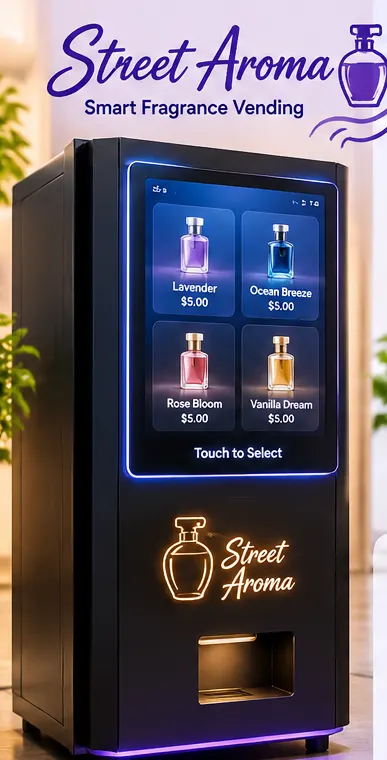
Adequate Infosoft has designed the Street Aroma, which is a perfume vending machine based on the ESP32 platform. It showcases the firm's expertise in various areas of technology, including IOT product development, custom PCB design, creation of embedded firmware, MQTT-based communication in machines, and backend creation. The Street Aroma incorporates such features of a modern vending machine as touchscreen interface, fragrance dispensing, and determining the price of the perfume.
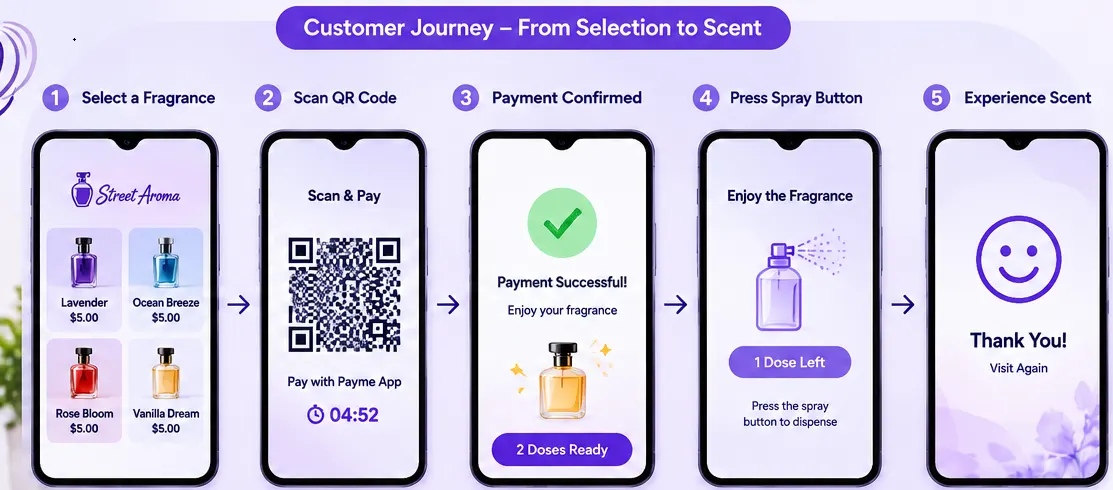
The Street Aroma vending machine sells perfumes in various locations, and it has become available to commercial use. Conventional vending machines can only accept cash bills or coins. However, in Street Aroma, the whole transaction process takes place digitally. The user chooses any of the four selected brands by just pressing the different buttons on the machine.
This selection generates a Payme QR code, which can be scanned by the user on his phone running the Payme app, after which he gets exactly two doses of the perfume.
Rather than a prototype, the solution represents a fully functional commercial entity comprising firmware, payment backend, remote price management, and hardware control.
One of the most important problems of engineering is a process reliability in the edge, i.e. the vending machine has no other options than to manage transactions and possible timeouts without relying on Wi-Fi connection and exposing secrets of the merchant.
The operations are conducted by Street Aroma via ESP32-based equipment operating on Python Flask server to validate the payment and capable to operate even in offline mode with NVS pricing system data.
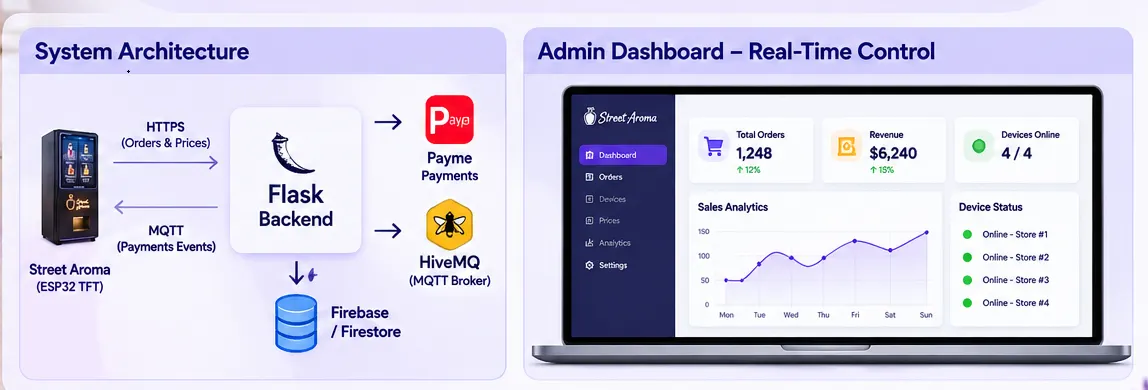
The Street Aroma system uses the device-broker-server architecture. Communication between the vending machine (ESP32) and Flask backend occurs via two separate communication channels: HTTPS for order creation and price synchronization, and MQTT for payment confirmation events.
The HiveMQ server acts as an MQTT broker (configurable as broker.hivemq.com), and topic namespace is limited to your merchant ID (payments/your_merchant_id). The Flask server acts as an intermediary between the device and Payme payments gateway.
It receives the JSON-RPC webhooks from Payme and converts payment events into MQTT messages to be consumed by the ESP32 vending machine.
The flow is the following: the customer clicks the product button; the ESP32 POSTs /create-order to the Flask server with product ID and its price; the server creates Payme checkout URL and publishes it using MQTT.
The ESP32 renders the URL on the TFT in a QR-code; the customer makes the payment, Payment sends a webhook to the server, the server publishes "confirmed" via MQTT, the ESP32 switches to the success page and gives two doses of the spray the customer clicks the spray button to dispense the dose, and the servo works once on each click until the counter runs out.
This approach guarantees that the ESP32 never stores the Payme credentials or checks the payment cryptographically. The device has to do nothing except displaying a URL, subscribing to a topic and responding to a boolean result.
The bill of materials is purposely kept simple: one ESP32 DevKit, one TFT ILI9488 320×480 screen, four SG90 servo motors, nine buttons, and four fragrance tanks with nozzles.
There are nine buttons in total that have been categorized into different types: four product selection buttons, four spray trigger buttons (one per fragrance), and one cancel button.
The pin mapping is clearly specified in the README file where the selection buttons are placed at GPIO pins 22, 23, 32, and 33, the spray buttons at GPIO pins 19, 21, 26, and 27, the cancel button at GPIO pin 25 and servos starting from GPIO pin 18 with three more spare pins.
A critical hardware–firmware coupling is the enablement of PSRAM. The QR code rendering pipeline allocates an RGB565 pixel buffer in PSRAM to generate the QR bitmap directly on the ESP32 without calling an external QR service.
This is not merely an optimization, it is what allows the device to operate as a standalone payment terminal rather than a thin client dependent on a third-party QR API.
The firmware is comprised of five separate source files each addressing their individual responsibilities: main.cpp for the main loop, LVGL tick, state machine, and timeout functions, payment.cpp for Wi-Fi, MQTT, QR code generation, order flow, and price synchronization, buttons_control.cpp for selecting products, cancellation, and spray function, Servo_controll.cpp for dose distribution; and tft_draw.cpp for the LVGL flush function to TFT_eSPI.
Shared defines, pin assignments, and variables live in Globals.h, and the project is built with PlatformIO (a platformio.ini is present) using a custom partition table (partitions_custom.csv).
LVGL 8.3 is used to develop the user interface which includes seven dedicated screens meant to control the entire process of vending including a main menu showing four scents along with their respective prices which change from time to time, a QR code screen used to make payment, an MQTT error screen, a loading screen, a payment success screen and a payment cancellation screen among others.
The infinite loop executes the LVGL tick and increments a finite state machine that monitors the life cycle of an order from idle to product choice, order making, QR code showing, payment validation, dispensing, and reset. The discipline imposed by the state machine is what makes race conditions impossible between MQTT callbacks, button interrupts, and timeouts.
It can be seen that the payment timeout policy is especially interesting from the perspective of edge device development. The machine will show a countdown for nine seconds in case the payment is not confirmed during five minutes.
In case the countdown is interrupted by any button presses, it continues to run, however, in case the countdown reaches zero, the order is automatically cancelled.
Thus, customers have enough time to perform their actions, but the machine should be released for another user in case of necessity. The error recovery policy for MQTT connection errors is non-blocking.
The Flask app (app.py) is an efficient, yet fully functional payment orchestration server. There are four functions associated with the Flask application. First, there is a Payme JSON-RPC webhook that provides the full cycle of transactions: CheckPerform, Create, Perform, and Cancel. The Flask application is the ultimate authority about the payment. The ESP32 will never decide about the payment success.
Second, it publishes created, confirmed, and cancelled events to the MQTT broker, which the ESP32 subscribes to. Third, it provides GET and POST /api/prices endpoints for remote price management. Fourth, it persists every order in orders.json, providing a lightweight audit trail without requiring a database.
The configuration of the server is done using environment variables which are loaded using the python-dotenv package, ensuring the security of these credentials is not compromised both within the firmware and source code repository. The dependencies for the server are flask, paho-mqtt, and python-dotenv. This minimalist setup can run on a cheap VPS or even a Raspberry Pi.
The most production-friendly aspect of the Street Aroma project is its price synchronization loop. Prices are fetched every 30 seconds by the ESP32, and they are stored in NVS (Non-Volatile Storage) with the help of the Arduino Preferences library.
Should the server become unavailable for some reason, the device will continue working with the latest available prices; this way, even in case of a network interruption, vending machine functionality will not be compromised. The prices are shown in the main menu and are updated rather often, allowing to update the prices via the POST /api/prices API endpoint.
This design choice reflects a broader principle: the ESP32 is treated as an intermittently connected edge node, not as a permanently online thin client.
The presence of NVS caching, reconnect code for MQTT and QR generation at the device level enables degradation in multiple failure scenarios such as server unavailability, MQTT broker disconnect, and Wi-Fi connectivity issues, yet still complete the physical dispensing operation after a payment has been made.
The dispensing subsystem follows a contract that allows only two doses payment-wise at a time. The system gives two doses according to each confirmed order, and there is a screen counter of the remaining doses. The servo motor works when the spray button is pressed having some doses left.
When the counter reads zero, there is no further action possible. The relevant function is carried out by the Servo_controller.cpp program with the involvement of a state machine specified in the main.cpp program, which prohibits the driving of physical actuators during unpaid sessions. The servo-fragrance association is pre-specified (GPIO 18 plus three other GPIOs), while the spray button uses GPIO 19, 21, 26, and 27.
Incorporating QR code payment method on an ESP32 requires a frame buffer and library. Street Aroma solves this problem with the help of qrcode library which utilizes RGB565 buffer allocated in PSRAM and goes on flushing the buffer conceived through LVGL library to the TFT. If PSRAM is not available, the frame buffer and QR buffer will compete for RAM in the internal SRAM of the ESP32.
Payme merchant key is not accessed by the ESP32. It is done by the Flask server which processes the JSON-RPC webhook call and announces the result as a boolean via MQTT. Hence, a hacked device cannot produce false payment results; it may just subscribe to it.
MQTT problems appear via an error display, whilst the firmware attempts to communicate repeatedly every 3 seconds with no interruption to the LVGL event loop. The distinction between the network and the user experience is further established by the 30-second sync intervals for value changes and the NVS cache.
With 5 minutes allowed to make a payment with a 9-second countdown and the possibility to prolong it via button press, proper coordination between timers, MQTT callbacks, and button interrupts is required. The finite state machine implemented in main.cpp makes sure that a late confirmation from MQTT won't be accepted after cancellation.
Using only a single ESP32 and a well-thought-out backend as seen in Street Aroma, you can create a high-quality vending machine. The device can generate QR codes, receive real-time payment notifications via the MQTT protocol, manage prices online while having a fall back to offline mode, and count dispenses accurately, all without the use of a mobile application, database, or payment SDK.
Firmware is modular (five source files + Globals.h), server, simple Flask web app with three libraries used, and hardware – ready-to-use components (ESP32 DevKit, ILI9488 TFT display, SG90 servos).
The most transferable aspect of this project is the design of its trust boundary, in which the payment authorizing logic is kept on the server, but the device needs only the bare minimum state to show the QR code, wait for MQTT verification, and actuate the servo. This design can be immediately applied to any edge device that requires digital payment capability.
Street Aroma is a scaled-down yet fully elaborated sample of edge IoT implementation.
Decisions taken by its creators, QR code generation based on PSRAM, payment verification through MQTT protocol, NVS caching of cost information, timings provided by state machine, and dosing done on servo level all look sound in themselves but jointly provide sound methodology of launching vending gadgets in the market.
A unique ESP32 firmware separates the module functioning from Flask and Payme and is the core thing in the whole architecture. It allows developers to make the device simple, inspectable, and effective while achieving the necessary real-time performance.
Project Repository: github.com/myseringan/Street-Aroma-Vending
Client satisfaction is our ultimate goal. Here are some kind words of our precious clients they have used to express their satisfaction with our service.
I came across Adequate Infosoft while searching for an IT company to design a virtual platform for my Telemedicine business. AI helped me to make my dream project a reality.
Frederick Hess
The price and professionalism of Adequate Infosoft's project team are the most appealing aspects of working with them. The team provides weekly progress reports and responds quickly to the concerns I have.
Kim Jespersen
My team is very satisfied with the professionalism shown by the Adequate Infosoft team during the project. We are looking forward to working with them again.
Óli Freysson
I contacted AI for an Android and iOS application and I am completely satisfied with their service.
Thomas Cheah
I am very satisfied with Adequate Infosoft. very helpful, positive, and quick communication so far. I am looking forward to further cooperation.
Great experience hiring them, understood the requirements very well, and were very effective and efficient in delivering the project. I will hire them for my next project as well and also recommend them to others.
Adequate Infosoft lead development team is efficient and provides the best IT solutions. If you're looking for quick and affordable software development, Adequate Infosoft is your go-to guru!
Adequate Infosoft has stood out to be the best company for providing IT services at affordable prices. Their rapid development approach works in line with our iterative process.
David Kattah
We have worked with Adequate Infosoft for 4 years and it has been a positive experience for me and my company.
Frank Eson
Adequate Infosoft has set a benchmark with its robust product development services. Their development team is highly professional that understands the value of time.
Exceptional service! The AI team guided me through the entire procedure and made it an enjoyable experience.
Kim Jespersen
As a small business, we were most attracted to Adequate Infosoft's competitive pricing and the ability to quickly scale up or down the number of developers supporting the application.
Mr. Aaron
It was a pleasure to collaborate with Adequate Infosoft. Their development team is comprised of true experts.
Adequate Infosoft helped us get the most from Ceraphi, with smooth setup, responsive support, and practical, effective solutions.
Adequate Infosoft helped us develop our smart lock solution, including both the mobile app and web app
The Adequate Infosoft team helped us deliver a custom IoT solution for our European customers very efficiently
Smart Controls
Adequate Infosoft did a great job, helping us implement energy-efficient solutions smoothly.
Australia Health Pty Ltd
The team understood our needs and delivered quality health tech solutions on time.
Adequate Infosoft felt like a true partner, very supportive team, clear communication, on-time delivery, and quality work we genuinely trust.
With a physical presence in over 15 countries and a global footprint spanning 25+ countries, we are ready to serve you anywhere. Location, language, or culture is never a barrier, because our global team can work with you in your language. Our strong international team ensures seamless collaboration across borders We have a strong tech team, highly recognized in their domains, with extensive technical expertise.
Architect & Solution-Level Expert | Recognized Thought Leader with 8k+ LinkedIn Followers
Certified Developer | Driving AI, ML & Data Science Solutions
17+ Years in AI & IoT | 7,000+ Followers | Recognized Technology Leader
20+ Years in Tech | AI & Cloud Architect | HealthTech Innovator | 3,000+ Followers
IoT4All | IoT & Hardware Expert | Established Reputation in Europe
Technology Director at AOTC Limited, certified in CISSP, TOGAF, and SAFe. Leading technical operations across UK, Australia & New Zealand. Former Principal Integration Architect at Vodafone. Available on WhatsApp: +44 7563 407814, +61 458 765 85.
Helping SMEs Overcome Digitalization Challenges | Startup Tech Expert
AI, Life Sciences, HealthTech & Robotics Expert | 8,000+ Followers
25+ Years in Tech | Cloud Consultant | Lead Developer
SFMC Consultant & Developer
Cloud & AI Consultant
Tech Consultant • Sr. Application Developer • IoT & Hardware Expert
AI, IoT & Cloud Expert | Software Consultant
SAP Developer • Technical Consultant | ERP Solutions Specialist
Database & Network Expert • Mobile & Web Architect
Java Developer | Backend & Application Specialist
Engineer & Technology Consultant
Developer • Technical Consultant | Solutions & Strategy Expert
Technical Consultant | IT Strategy & Solutions Specialist
Technical Consultant & Developer
Cloud Solutions Expert with 17+ Years of Experience | HBIT Graduate | AI, IoT & Scalable Architecture Specialist
Lead Architect, Java Developer specializing in RESTful Services & Mobile Applications
Technical Consulting & Speaking | ANZ Region
Product Leadership & AI Architecture
Product Engineer (Python, C#, JavaScript, SQL) | Software Engineer & Speaker
Specializing in servers, virtualization, and network infrastructure
IoT Leadership | Global Operations | Digital Transformation
PMP-Certified Expert in IoT, AMI & Smart Metering
Send your message in the form below and we will get back to you as early as possible.
Your request has been sent successfully!