















 Mean Stack Development
 Vue JS Development
 Javascript Development
 React JS Development
 Angular JS Development
 Next JS development
 Java Development
 Python Development
 Django Development
 Cherrypy Development
 C# Development
 ASP.NET Development
 NodeJS Development
 Laravel Development
 CodeIgniter Development
 Zend Development
 Ruby on Rails Development
 CakePHP Development
 PHP Website Development
 Symfony Development
 Drupal Development
 Joomla Development
 Wordpress Development
 .NET Nuke Development
 Kentico
 Umbraco
 .NET MAUI Development
 Xamarin Application Development
 iOS Application Development
 Android Application Development
 Android Wear App Development
 Ionic Development
 iBeacon Application Development
 Universal Windows Platform (UWP)
 Kotlin Application Development
 Swift Application Development
 Flutter Application Development
 PWA Application Development
 Flutter Health Tech & Wearable App Development Company
 React Native Health Tech Wearable App Development
 Offshore Software Development
 Custom Application Development
 Front-End Development
 Full Stack Development
 AI & Machine Learning
 Custom CRM Solutions
 Flask Software Development
 Electron JS Development
 ChatGPT Development
 Telemedicine App Development
 Build Smart Telemedicine Platform
 Beauty & Salon App Solutions
 Hire Workato Experts
 Magento Development
 Magento 2.0 Development
 Magento Enterprise
 Shopping Cart Development
 Prestashop Development
 Shopify Development
 Open Cart Development
 WooCommerce Development
 BigCommerce Development
 NopCommerce Development
 Virto Commerce Development
 AspDotNetStorefront Development
 .NET Application Development
 Microsoft Dynamics CRM
 VB .NET Development
 Sharepoint Migration
 ASP.NET Core Development
 ASP.NET MVC Development
 AJAX Development
 Agile Development
 Microsoft Bot
 Microsoft Blazor
 Microsoft Azure Cognitive
 HTML 5
 UI/UX Design
 Graphic Design
 Adobe Photoshop
 XML Application Development
 Cloud Computing Solutions
 Azure Cloud App Development
 AWS Development
 Google Cloud Development
 Certified AWS IoT Services Developers
 DevOps Consulting & Development
 Kubernetes Consulting & Services
 SQL Programming Development
 MySQL Development
 MongoDB Development
 Big Data
 Robotic Process Automation
 Social Media Marketing
 Search Engine Optimization
 QA Testing
 Software Testing
 Software Security
 Maintenance And Support
 I.T. Consulting Services
 Business Intelligence
 YII Development
 Data Analysis
 Alexa Skills Development
 On Demand App for Mobile repairing services
 On Demand App for Car Service Booking
 On Demand App for Cleaning Services
 On Demand App for Pharmacy
 On Demand Dedicated Developers
 On Demand Lawyer App Development











 Nuki Smart Lock
 Salto Smart Lock
 TTlock Smart Lock
 NFC App Development
 Custom IOT Enabled Smart Lock
 Smart Locker Solutions
 Hospital Smart Lock Systems
 Hotel Smart Lock Systems
 Smart Home & Office Locks
 Smart Access for Schools & Colleges
 Unloc Smart Lock Integration
 Yale & August Smart Lock Integration
 Populife Smart Lock Integration
 Smart Lock Hardware Development
 Dairy IoT Solutions
 Agri IoT & AI Solutions
 Weather & Climate Solutions
 Water & Waste Management Solutions
 RaspBerry Pi
 Firmware Software Development
 ESP 32 Software Development
 Embedded Development
 Internet of Things
 Smart IoT Development
 IoT Sensor Integration & Development Solutions
 Smart IoT System Development for HVAC
 Tuya IoT App Development
 Particle IoT SDK
 IoT Development with AI
 Smart Pet GPS Tracker
 Dairy GPS Tracking Solutions
 GPS Fleet Management Software
 Car Rental & Subscription Solutions
 Car Buy & Sell Marketplace Development
 AI-Powered Car Wash App Development
 PCB Design & Fabrication
 IoT AC Automation
 AI–IoT Painting Solutions
 IoT Wearable Hardware & App Development
 HVAC Automation & AI Control Systems
 Smart Home IoT Engineering
 AI Embedded Systems
 AI Hardware Design Service
 Advanced IoT Hardware & Firmware Development
 Device Driver Development Services
 NXP i.MX RT Firmware & Hardware Services
 Microchip PIC & AVR Development
 Hire IoT Architects
 IoT Cloud & Infrastructure Solutions
 Infineon XMC / AURIX Development Services
 Matter & Thread IoT Services
 Native IoT Mobile App Development (BLE & Wi-Fi)
 Snapdragon IoT Firmware Development
 Renesas RA/RX Firmware Services
 Silicon Labs EFR32 Development Services
 Smart Wearable App Development
 Smart IoT Meters
 Smart Healthcare Wearable App Development
 Health Care Monitoring System
 Fitness Tracking App Development
 Smart Home Automation Apps
 nRF PCB Design
 ESP32 PCB Design
 Embedded Wearables Engineers
 Rental Property Management System
 Building Management System
 Smart Lighting Development
 Infineon Semiconductor Firmware Development Services
 Custom Camera Development: Hardware, Firmware & PCB Prototyping
 Smart Security Camera SDK
 Nordic Semiconductor SDK
 Infineon SDK
 Arduino SDK
 NFC Lock Integration
 Kerong Lock Integration
 IoT & AI Solutions for Manufacturing
 Smart Inventory & Logistics Solution
 Food & Beverage Industry Solutions
 Smart Hospitality Solutions
 Smart Property Management
 Custom Smart Home IOT SDK
 Smart IoT & AI in Healthcare
 AI-Powered Security Solutions
 Smart Home Safety & AI
 Veterinary Clinic Management (AI)
 Pet Care System (AI & IoT)
 Pet Training & Adoption (AI)
 Healthcare IoT Development
 Event Management Software
 Money Remittance App
 Money Lending App Development
 Utility and Bill Payment App
 IoT Mobile App Development (Flutter & React Native)
 AI & IoT Retail Solutions
 Smart EV App Development
 Smart Solar IoT & AI Solutions
 IoT-Based Energy Systems
 Smart Energy & Utilities Solutions
 6G Solutions
 IoT Security Solutions
 AI-Powered Lottery App Development
 AI-Sports Fitness Club Management
 Travel
 Real Estate
 Medical & Healthcare
 e-Learning
 Consumer Products
 Finance
 Automobile
 Media & Entertainment
 Billing Software
 Enterprise Resource Planning (ERP)
 Augumented & Virtual Reality
 Point of Sale(POS) Development
 Learning Management System
 EV Charging Solutions
 About Us
 Partners & Certifications
 Quality Assurance
 Our Clients & Testimonials
 Development Process
 Our Products
 Social Responsibility
 Work Ethics
 Vision & Mission
 Awards
 Live Project Demos
 Contact Us
 Case Studies
 Portfolio
 Blog
Blog
Apollo510 Acoustic Event Detector for Industrial Equipment Development
Industrial equipment typically produces sounds before any obvious deterioration happens. Loose shields can make noise, bearing may develop an unusual tone, a pump begins cavitating, a valve can rattle, and a compressor may work in an unexpected way acoustically.
However, it is challenging to make sense of production machine sounds without the need for recording every machine sound and conversation continuously or depending on a permanent connection to the cloud.
Adequate Infosoft develops low-power acoustic event detectors using Ambiq Apollo510 technology for industrial equipment monitoring, condition-based maintenance support, worker safety alerts, and machine-status detection.
We combine embedded electronics, digital microphone integration, edge AI firmware, BLE or gateway connectivity, cloud dashboards, and field testing into a complete product-development service.
Apollo510 has been built for efficient edge AI applications and comes with Arm's Cortex-M55 processor architecture, Helium vector processing capabilities, and available memory while also running embedded AI development kit from Ambiq for building very small audio classification devices that are not energy consuming.
But in terms of industrial products, having a capable chip is just the beginning. Successful acoustic monitoring will involve the usage of plenty of sophisticated technologies like proper microphone placement, careful mechanical design, audio preprocessing, appropriate training datasets, noise testing, certainty thresholds, and effective response procedures in place before it can work properly.
This case study explains how a battery-conscious or externally powered Apollo510 acoustic detector can be designed for real industrial environments.
Let's Work Together!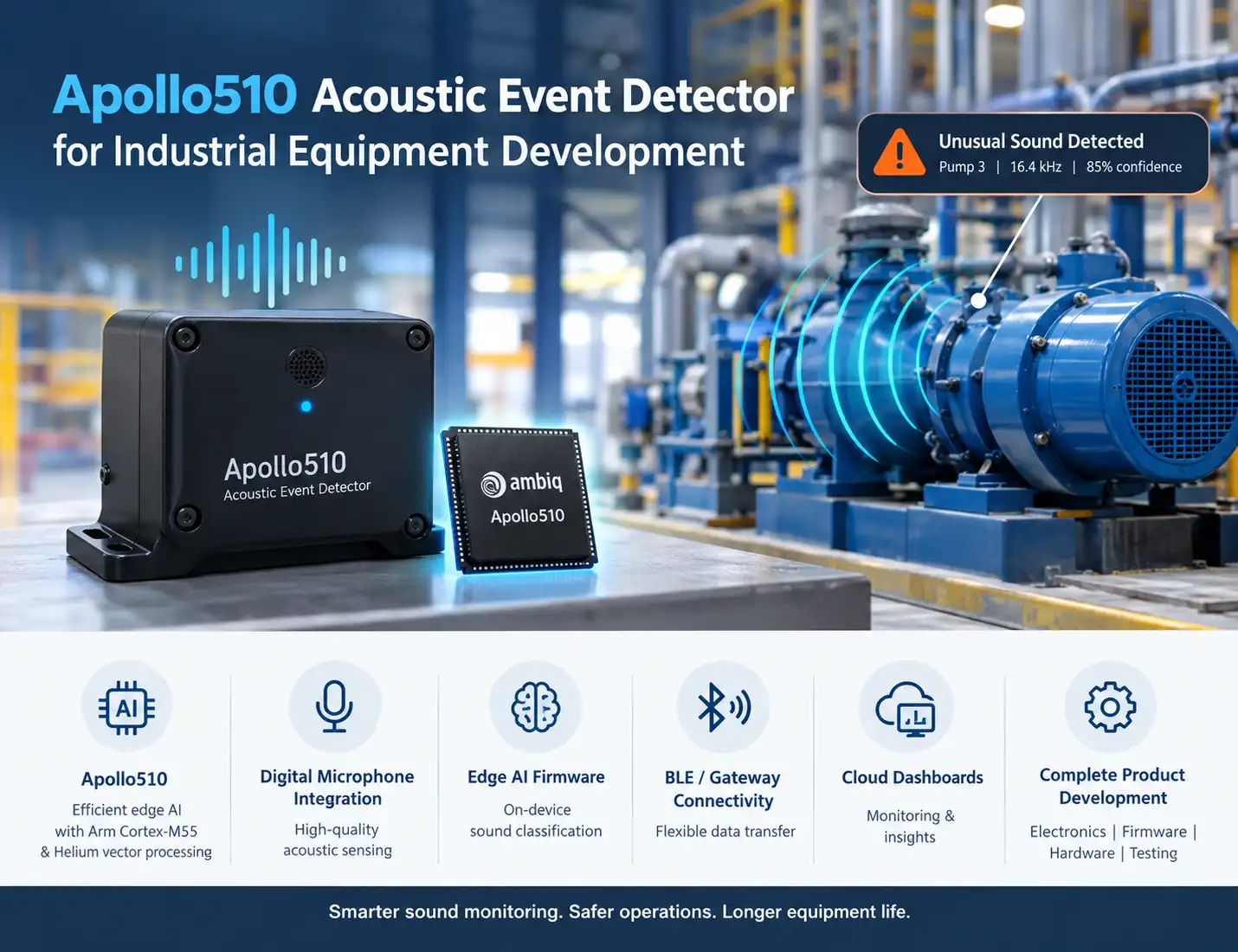
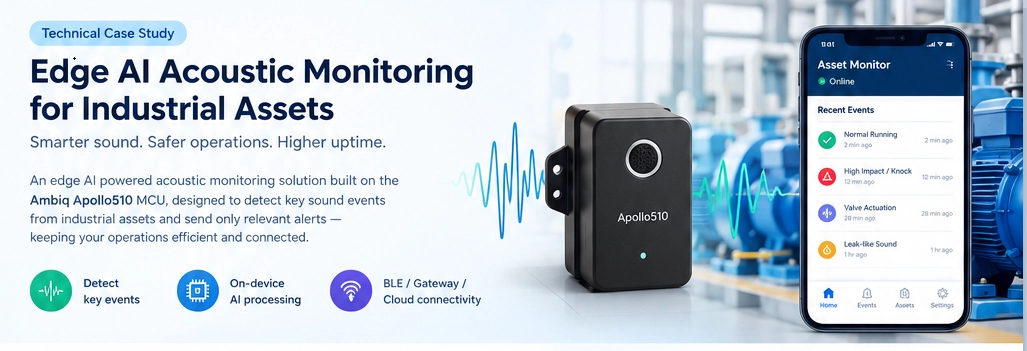
Technical Case Study: Edge AI Acoustic Monitoring for Industrial Assets
Product Goal and Detection Scope
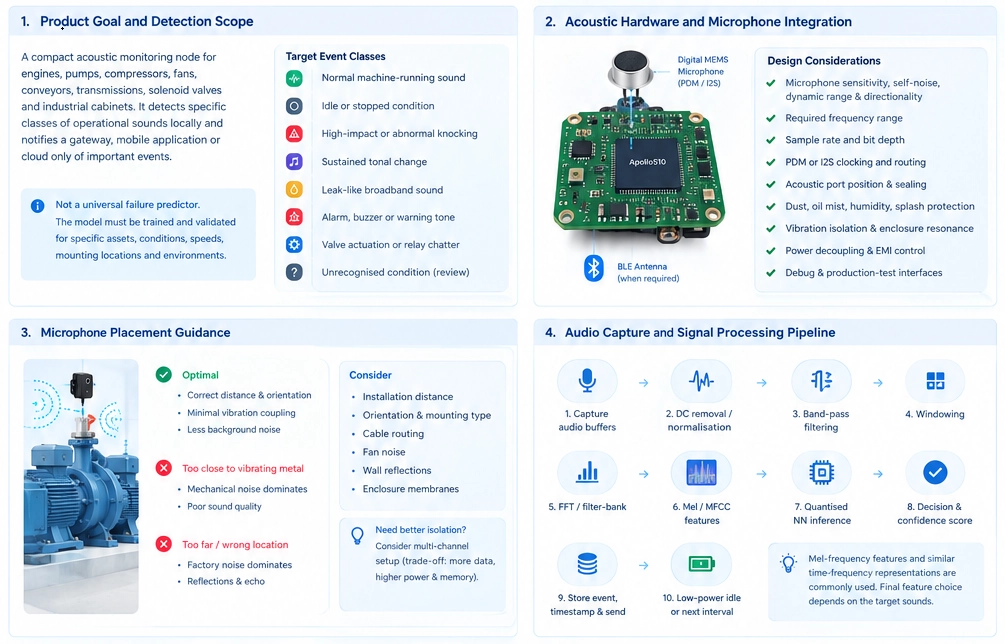
The purpose of the device was to serve as a small acoustic monitoring node for various equipment types, such as engines, pumps, compressors, fans, conveyors, transmissions, solenoid valves and industrial cabinets.
It was created to detect specific classes of operational sounds locally and notify a gateway, mobile application or cloud only of important events.
The system was not positioned as a universal machine-failure predictor. A responsible acoustic solution must be trained and validated for the specific assets, fault signatures, operating speeds, mounting locations, and environments in which it will run. Instead, the first release focused on clearly defined and testable classes, such as:
Normal machine-running sound Idle or stopped condition High-impact or abnormal knocking event Sustained tonal change Air or fluid-leak-like broadband sound Alarm, buzzer, or warning tone Valve actuation or relay chatter Unrecognised acoustic condition requiring review
This scope created a practical pathway to field validation. Rather than making unsupported claims from limited audio samples, the engineering team could gather evidence for each event type, tune thresholds, and progressively extend the model.
Acoustic Hardware and Microphone Integration
The electronics architecture revolves round the Apollo510 MCU, which is linked to the digital MEMS microphone using a digital audio protocol such as PDM or I2S, depending on the type of microphone and the design requirements.
Because they remove the number of components in the analogue signal path and reduce the susceptibility to noise caused by the PCB, digital microphones are more beneficial for small manufacturers of products.
The hardware design considered:
Microphone sensitivity, self-noise, dynamic range, and directionality Required frequency range for the target machine sounds Sample rate and bit depth appropriate to the classification task PDM or I2S clocking and data routing Acoustic port position and environmental sealing Protection against dust, oil mist, humidity, and accidental splash exposure Vibration isolation and enclosure resonance Power-supply decoupling and electromagnetic-noise control Debug interfaces and production-test connections BLE antenna placement where wireless connectivity is required
The placement of microphones is fundamental. If the microphone is placed very close to a vibrating metal body, it will pick up mechanical coupling noise without relevant airborne sound.
On the contrary, if the opening is too far from the active equipment, nearby factory noise will dominate the production.
We take into account installation distance, orientation, mounting type, cable routing, fan noise, and reflections from close walls, as well as the influence of enclosures membranes.
If better acoustic isolation or location-specific investigation is required, one may consider a multi-channel setup.
In summary, more channels lead to greater data acquisition/encryption rate, higher processing speed, more memory consumption, and greater power needs. The solution is chosen based on the specific problem and not only on the overall number of possible sensors.
Audio Capture and Signal Processing Pipeline
The embedded firmware uses a controlled audio-processing pipeline. Raw microphone samples are captured into buffers using an efficient transfer method, then processed in short time windows. The device does not need to store continuous audio in normal operation.
The standard processing flow includes:
Microphone initialisation and audio-buffer capture DC removal or signal normalisation where required Band-pass filtering to focus on useful frequency content Windowing of the audio frame Fast Fourier Transform or filter-bank processing Feature generation, commonly log-mel spectrogram or MFCC-style features Quantised neural-network inference Confidence-score evaluation and event decision Local event storage, timestamping, and communication Return to low-power idle or the next monitoring interval
Because of its ability to represent changing sound waves in a form that is suitable for compact machine learning classifiers, mel-frequency features and similar forms of time-frequency representation are among the most frequently employed features.
The final choice of features is determined by the nature of the sounds that the system needs to detect.
A high-frequency noise resembling a leak, the noise from a slowly rotating gearbox, and the noise of a regularly clicking valve do not require the same frame rate, frame length or range of filtering.
The model is trained off-device using labelled recordings, being afterwards translated into the target MCU form at the prescribed efficiency level.
The inference processing operates using quantized model variations and special memory limitations. Ambiq's neuralSPOT software can be used for the implementation of edge AI on compatible Apollo platforms while being tested with the real-life audio data and the customer's hardware configuration.
Dataset Development and Classification Model
Audio classification quality begins with the dataset. A model trained only with clean recordings from one machine is unlikely to perform consistently on a production floor. Our data-collection plan captures normal and abnormal operating conditions across meaningful variation, including:
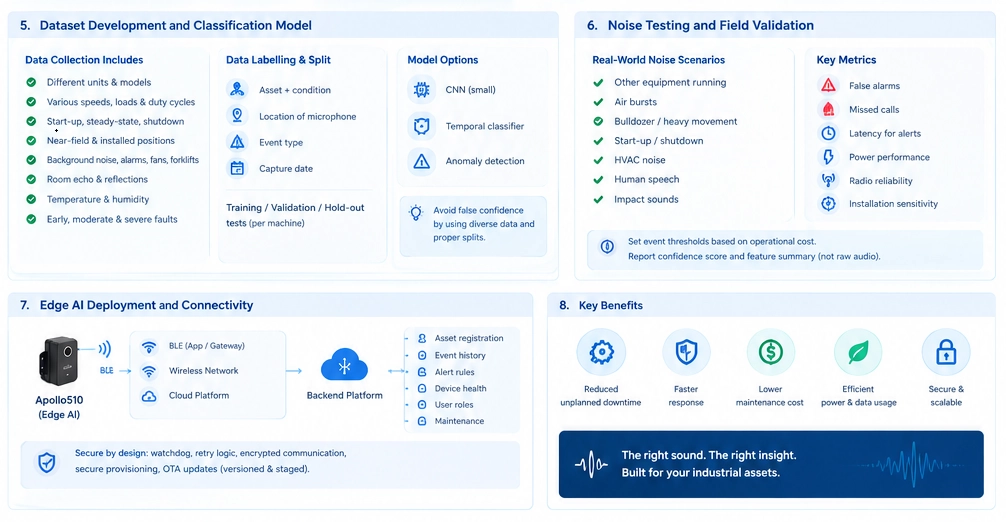
Different units of the same machine model Different motor speeds, loads, and duty cycles Start-up, steady-state, and shutdown operation Near-field and installed-device microphone positions Background conversations, alarms, fans, forklifts, and adjacent machinery Room echo, metal-panel reflections, and enclosure effects Temperature and humidity variation where relevant Early, moderate, and severe examples of the selected fault signature
Every recording is annotated with information like asset, working condition, location of microphone, known event type and capturing date. The recordings are split into groups such as training, validation and hold-out tests based on each machine wherever applicable.
This serves to eliminate the false confidence resulting from the model seeing almost identical recordings during training and tests of the model.
The model can take the form of a small convolution neural networks, a temporal classifier or an anomaly-detection architecture depending on if labelled failures exist.
In most cases, anomaly detection proves useful in many industries while supervised classifiers perform better in case the different sounds are already known and repeated.
Noise Testing and Field Validation
Just a model measurement in a laboratory is insufficient for an industrial acoustic device.
To make sure of the performance of our system, we put the actual detector through rigors of testing in real-life situations and measure all relevant figures: false alarms, missed calls, latency for alerts, power performance, radio reliability, and installation sensitivity.
In regards to noise testing, we conduct our recordings under controlled conditions with some live experiments which include other equipment working nearby, air bursts, movements of a bulldozer, starting up a machine, HVAC noise, human speak, impact sounds, etc.
The purpose is to understand what the product can distinguish and when the installation should be done differently.
Event thresholds are selected with the operational cost of false alerts and missed alerts in mind. A maintenance team may accept a small number of review alerts for a high-risk asset, while a high-volume production line may require a more conservative threshold to avoid alarm fatigue.
The device can report a confidence score and a short feature summary instead of raw audio, enabling operators to review patterns while maintaining a privacy-conscious design.
Edge AI Deployment and Connectivity
The Apollo510 carries out core classification at the edge, thus preventing the need for audio streaming to the cloud and lowering the dependence on communication networks, data transfer expenditure, and enabling faster decision making.
The Apollo510 will send only relevant events, health indicators, battery and supply status, version of the model, and diagnostics.
Connectivity could occur through BLE with an app or gateway located nearby, or via an external wireless network or clouds platforms, depending on the installation.
The backend platform will allow for asset registration, event history, rule set for alerts, device functioning, user roles, maintenance issues.
Firmware is designed with watchdog protection, bounded communication retries, secure provisioning, encrypted device communication where supported, and controlled OTA update procedures. Model and firmware updates should be versioned, tested, and rolled out in a staged manner so that a field device can recover safely from a failed update.
Apollo510 Acoustic Event Detector Development Services
Acoustic Feasibility, Asset Study, and Requirement Definition
The process of the Infosoft Adequate begins with a review of the target equipment, types of failure and events, installation site, power availability, communication needs, alert procedure workflow, and maintenance procedure. We help define what the first version of the product will be able to detect and what it should not be able to detect.
The process of the Infosoft Adequate begins with a review of the target equipment, types of failure and events, installation site, power availability, communication needs, alert procedure workflow, and maintenance procedure. We help define what the first version of the product will be able to detect and what it should not be able to detect.
This step includes a system block schema, microphone and soundproofing system recommendation, data-acquisition plan, method of supplying electric power, edge vs. cloud architecture, preliminary matter model, risk register, and product delivery plan.
Embedded Hardware, Microphone and Enclosure Engineering
Our hardware team develops custom Apollo510-based electronics, including schematic design, component selection, digital microphone interface, power circuit, battery or DC-input design, BLE antenna layout, industrial I/O options, prototype PCB layout, BOM, manufacturing files, and test documentation.
Our hardware team develops custom Apollo510-based electronics, including schematic design, component selection, digital microphone interface, power circuit, battery or DC-input design, BLE antenna layout, industrial I/O options, prototype PCB layout, BOM, manufacturing files, and test documentation.
Where necessary, we can integrate accelerometers, temperature sensors, current sensors, tachometer inputs, reed switches, vibration sensors, status LEDs, buzzers, secure elements, and external radio modules. Combining acoustic analysis with another sensor can improve event confidence for the correct industrial use case.
Audio Firmware, Edge AI, and Optimization of Models
Our developers are capable of developing drivers for microphones, DMA-based collection of audio, audio buffer management, audio filtering, as well as extracting features, performing on-device inference, knowing the thresholds of confidence, local logging of events, performing diagnostics, and doing communication.
Our developers are capable of developing drivers for microphones, DMA-based collection of audio, audio buffer management, audio filtering, as well as extracting features, performing on-device inference, knowing the thresholds of confidence, local logging of events, performing diagnostics, and doing communication.
We make contributions to the operation of the data that have been collected, using tools to record data, label datasets, estimate a model, optimize memory usage, and deploy models.
The method has been built with the help of the test results rather than general claims about AI.
Gateway, Cloud Dashboard and Mobile App Development
Adequate Infosoft can build the full connected-product ecosystem: BLE gateway integration, backend APIs, asset registry, notification service, web dashboard, mobile app, user and installer roles, alert history, maintenance workflow, and report generation.
Adequate Infosoft can build the full connected-product ecosystem: BLE gateway integration, backend APIs, asset registry, notification service, web dashboard, mobile app, user and installer roles, alert history, maintenance workflow, and report generation.
The platform can show device health, selected sound-class events, confidence values, event trends, firmware versions, model versions, and installation notes. It can also integrate with an existing CMMS, maintenance system, ERP platform, or customer API.
Prototype Verification and Manufacturing Assistance
We offer assistance in assembling prototypes, powering it up, assessing microphones, testing it in an acoustic chamber or in a specific location, carrying out environmental tests, measuring ranges, fixing firmware faults, measuring power consumption, modifying cases, designing tools for testing in a factory and handing over to production.
We offer assistance in assembling prototypes, powering it up, assessing microphones, testing it in an acoustic chamber or in a specific location, carrying out environmental tests, measuring ranges, fixing firmware faults, measuring power consumption, modifying cases, designing tools for testing in a factory and handing over to production.
Our approach yields a concise record of design solutions, test results and performance limits achieved. This provides companies with a good basis for pilot project launch and further full-scale production.
Why Choose Adequate Infosoft
An industrial acoustic detector must combine embedded hardware, digital audio, machine learning, wireless communication, industrial context, and realistic testing. Adequate Infosoft brings these capabilities together through one team.
We assist customers in the development of useful edge AI online products that have an established range of use, incorporate technical soundness in signal processing, as well as secure connections.
If you require a sound machine monitor, leakage detector, machine status sensor, or other similar predictive maintenance units, we can provide you with the Apollo510 solution from the idea to the prototype phase as well as manufacturing.
Editorial Resources