











 Mean Stack Development
 Vue JS Development
 Javascript Development
 React JS Development
 Angular JS Development
 Next JS development
 Java Development
 Python Development
 Django Development
 Cherrypy Development
 C# Development
 ASP.NET Development
 NodeJS Development
 Laravel Development
 CodeIgniter Development
 Zend Development
 Ruby on Rails Development
 CakePHP Development
 PHP Website Development
 Symfony Development
 Drupal Development
 Joomla Development
 Wordpress Development
 .NET Nuke Development
 Kentico
 Umbraco
 .NET MAUI Development
 Xamarin Application Development
 iOS Application Development
 Android Application Development
 Android Wear App Development
 Ionic Development
 iBeacon Application Development
 Universal Windows Platform (UWP)
 Kotlin Application Development
 Swift Application Development
 Flutter Application Development
 PWA Application Development
 Flutter Health Tech & Wearable App Development Company
 React Native Health Tech Wearable App Development
 Offshore Software Development
 Custom Application Development
 Front-End Development
 Full Stack Development
 AI & Machine Learning
 Custom CRM Solutions
 Flask Software Development
 Electron JS Development
 ChatGPT Development
 Telemedicine App Development
 Build Smart Telemedicine Platform
 Beauty & Salon App Solutions
 Hire Workato Experts
 Magento Development
 Magento 2.0 Development
 Magento Enterprise
 Shopping Cart Development
 Prestashop Development
 Shopify Development
 Open Cart Development
 WooCommerce Development
 BigCommerce Development
 NopCommerce Development
 Virto Commerce Development
 AspDotNetStorefront Development
 .NET Application Development
 Microsoft Dynamics CRM
 VB .NET Development
 Sharepoint Migration
 ASP.NET Core Development
 ASP.NET MVC Development
 AJAX Development
 Agile Development
 Microsoft Bot
 Microsoft Blazor
 Microsoft Azure Cognitive
 HTML 5
 UI/UX Design
 Graphic Design
 Adobe Photoshop
 XML Application Development
 Cloud Computing Solutions
 Azure Cloud App Development
 AWS Development
 Google Cloud Development
 Certified AWS IoT Services Developers
 DevOps Consulting & Development
 Kubernetes Consulting & Services
 SQL Programming Development
 MySQL Development
 MongoDB Development
 Big Data
 Robotic Process Automation
 Social Media Marketing
 Search Engine Optimization
 QA Testing
 Software Testing
 Software Security
 Maintenance And Support
 I.T. Consulting Services
 Business Intelligence
 YII Development
 Data Analysis
 Alexa Skills Development
 On Demand App for Mobile repairing services
 On Demand App for Car Service Booking
 On Demand App for Cleaning Services
 On Demand App for Pharmacy
 On Demand Dedicated Developers
 On Demand Lawyer App Development









 Nuki Smart Lock
 Salto Smart Lock
 TTlock Smart Lock
 NFC App Development
 Custom IOT Enabled Smart Lock
 Smart Locker Solutions
 Hospital Smart Lock Systems
 Hotel Smart Lock Systems
 Smart Home & Office Locks
 Smart Access for Schools & Colleges
 Unloc Smart Lock Integration
 Yale & August Smart Lock Integration
 Populife Smart Lock Integration
 Smart Lock Hardware Development
 Dairy IoT Solutions
 Agri IoT & AI Solutions
 Weather & Climate Solutions
 Water & Waste Management Solutions
 RaspBerry Pi
 Firmware Software Development
 ESP 32 Software Development
 Embedded Development
 Internet of Things
 Smart IoT Development
 IoT Sensor Integration & Development Solutions
 Smart IoT System Development for HVAC
 Tuya IoT App Development
 Particle IoT SDK
 IoT Development with AI
 Smart Pet GPS Tracker
 Dairy GPS Tracking Solutions
 GPS Fleet Management Software
 Car Rental & Subscription Solutions
 Car Buy & Sell Marketplace Development
 AI-Powered Car Wash App Development
 PCB Design & Fabrication
 IoT AC Automation
 AI–IoT Painting Solutions
 IoT Wearable Hardware & App Development
 HVAC Automation & AI Control Systems
 Smart Home IoT Engineering
 AI Embedded Systems
 AI Hardware Design Service
 Advanced IoT Hardware & Firmware Development
 Device Driver Development Services
 NXP i.MX RT Firmware & Hardware Services
 Microchip PIC & AVR Development
 Hire IoT Architects
 IoT Cloud & Infrastructure Solutions
 Infineon XMC / AURIX Development Services
 Matter & Thread IoT Services
 Native IoT Mobile App Development (BLE & Wi-Fi)
 Snapdragon IoT Firmware Development
 Renesas RA/RX Firmware Services
 Silicon Labs EFR32 Development Services
 Smart Wearable App Development
 Smart IoT Meters
 Smart Healthcare Wearable App Development
 Health Care Monitoring System
 Fitness Tracking App Development
 Smart Home Automation Apps
 nRF PCB Design
 ESP32 PCB Design
 Embedded Wearables Engineers
 Rental Property Management System
 Building Management System
 Smart Lighting Development
 Infineon Semiconductor Firmware Development Services
 Custom Camera Development: Hardware, Firmware & PCB Prototyping
 Smart Security Camera SDK
 Nordic Semiconductor SDK
 Infineon SDK
 Arduino SDK
 NFC Lock Integration
 Kerong Lock Integration
 IoT & AI Solutions for Manufacturing
 Smart Inventory & Logistics Solution
 Food & Beverage Industry Solutions
 Smart Hospitality Solutions
 Smart Property Management
 Custom Smart Home IOT SDK
 Smart IoT & AI in Healthcare
 AI-Powered Security Solutions
 Smart Home Safety & AI
 Veterinary Clinic Management (AI)
 Pet Care System (AI & IoT)
 Pet Training & Adoption (AI)
 Healthcare IoT Development
 Event Management Software
 Money Remittance App
 Money Lending App Development
 Utility and Bill Payment App
 IoT Mobile App Development (Flutter & React Native)
 AI & IoT Retail Solutions
 Smart EV App Development
 Smart Solar IoT & AI Solutions
 IoT-Based Energy Systems
 Smart Energy & Utilities Solutions
 6G Solutions
 IoT Security Solutions
 AI-Powered Lottery App Development
 AI-Sports Fitness Club Management
 Travel
 Real Estate
 Medical & Healthcare
 e-Learning
 Consumer Products
 Finance
 Automobile
 Media & Entertainment
 Billing Software
 Enterprise Resource Planning (ERP)
 Augumented & Virtual Reality
 Point of Sale(POS) Development
 Learning Management System
 EV Charging Solutions
 About Us
 Partners & Certifications
 Quality Assurance
 Our Clients & Testimonials
 Development Process
 Our Products
 Social Responsibility
 Work Ethics
 Vision & Mission
 Awards
 Live Project Demos
 Contact Us
 Case Studies
 Portfolio
 Blog
Blog
Jetson AGX Orin Autonomous Cart Development with Camera–LiDAR Sensor Fusion
With autonomous carts, repetitive tasks that involve material movement can be minimized, whether in warehouses, factories, hospitals, laboratories, or big retail locations. However, having carts that follow an established path is not sufficient in real-life operations. The carts require spatial awareness, ability to navigate, and safety decision-making capabilities.
Adequate Infosoft develops NVIDIA Jetson AGX Orin autonomous cart solutions that combine camera vision, LiDAR perception, robotic localization, navigation software and edge AI.
Our engineering approach covers the complete product journey: requirements analysis, sensor and compute selection, carrier-board or electrical integration, robotics middleware, AI model deployment, safety-oriented control logic, field validation and support for production deployment.
This article presents the case of development of an autonomous cart prototype that utilizes NVIDIA Jetson AGX Orin platform and camera-LiDAR sensor fusion.
The architecture can be used in applications such as goods-to-person logistics, intralogistics in factories, security inspections, delivery of supplies in hospitals, inspection carts and transportation support.
Let's Work Together!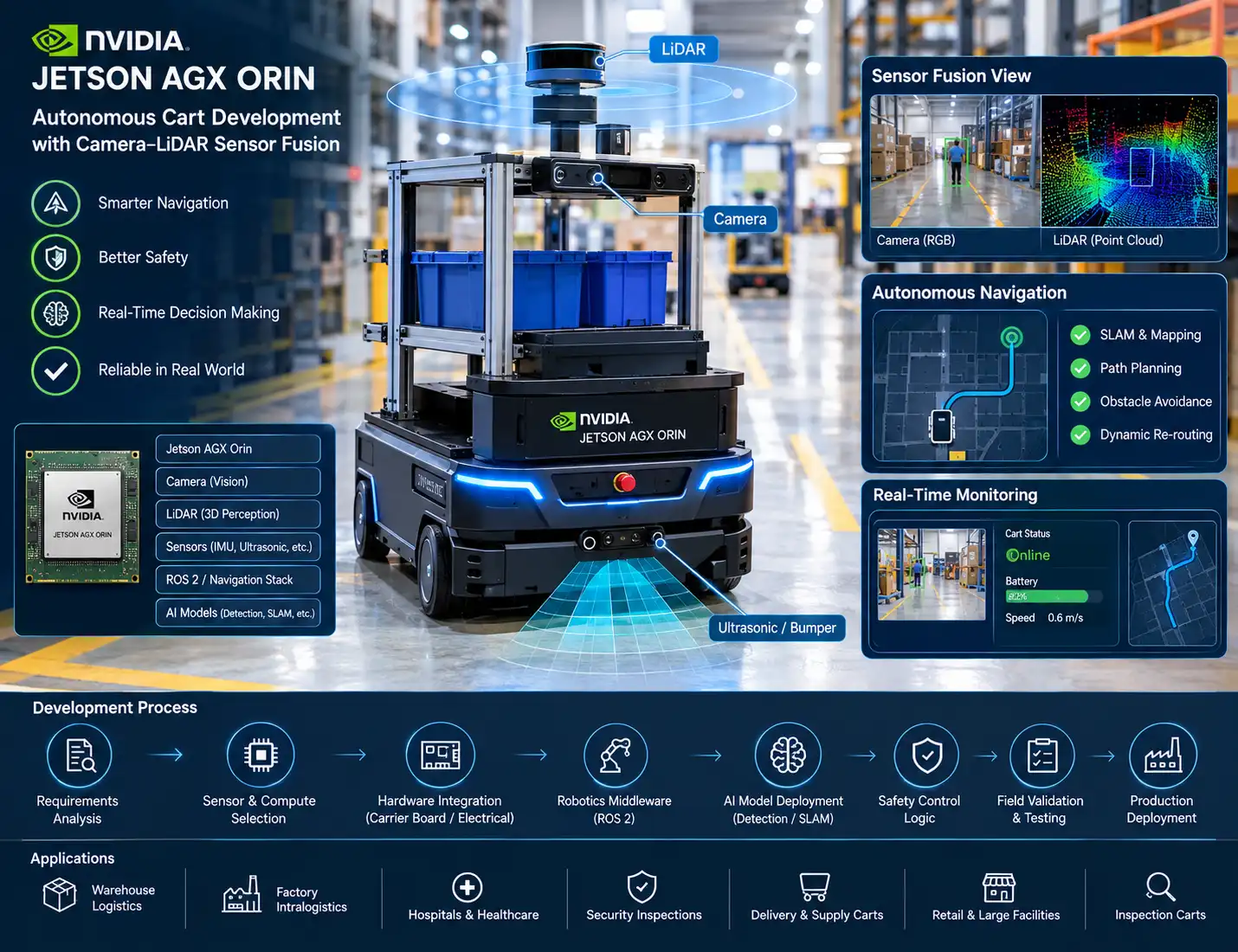
Autonomous Cart Development with Camera–LiDAR Sensor Fusion – U.S. Client Case Study
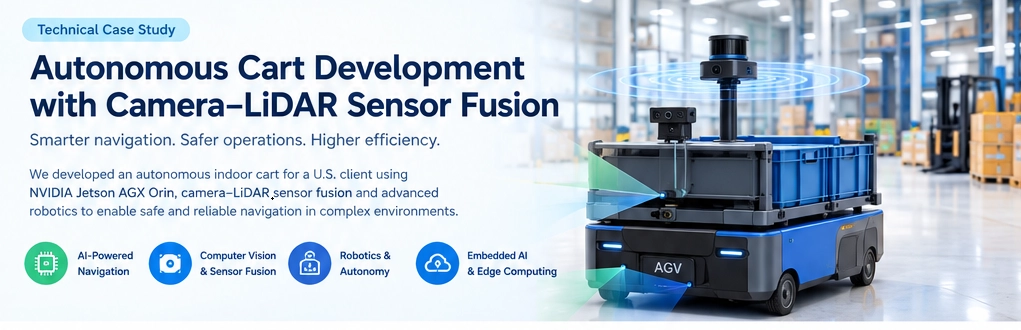
Discover our real-world project concerning autonomous carts developed for a United States client. The developed solution utilized NVIDIA Jetson AGX Orin, a sensor that fuses cameras with LiDAR sensors, along with autonomous navigation technology to enable operation indoors in complex settings.
From this case study, you will learn about our capacities in the sphere of embedded AI, computer vision, sensor integration, and autonomous systems creation.
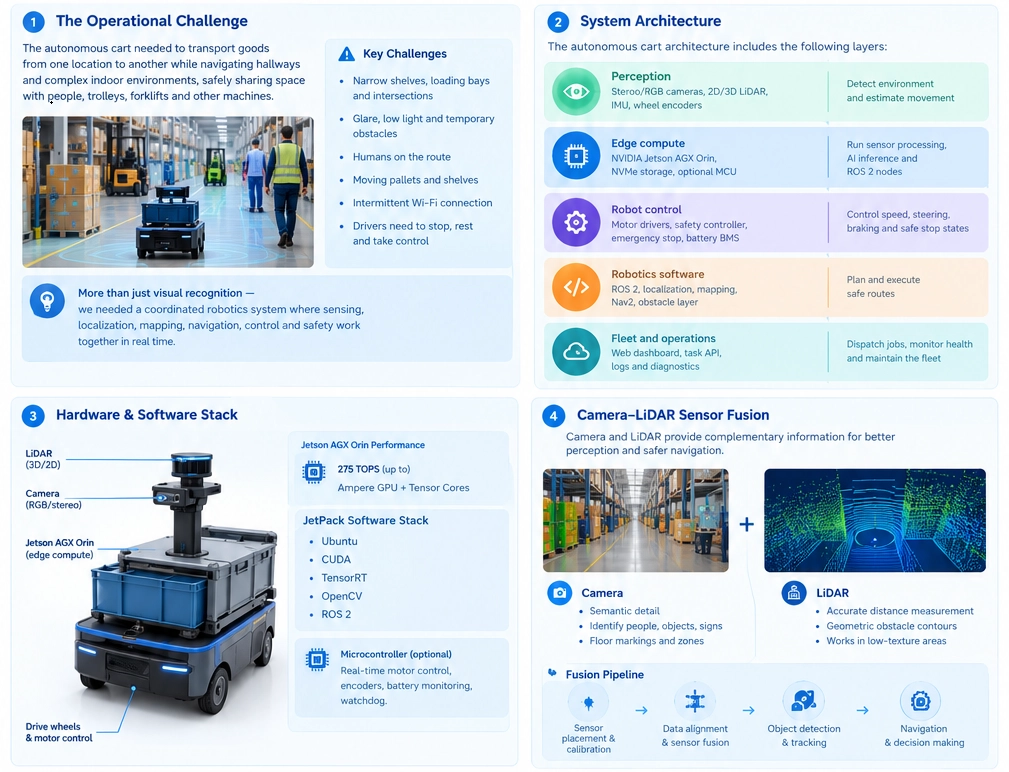
The Operational Challenge
The aim was to design a self-driven indoor cart for transporting goods from one location to another while navigating hallways and places alongside pedestrians, trolleys, forklifts, and other machines.
The cart was supposed to function successfully under unstable conditions of the environment. Some examples of such circumstances include the following:
Narrow shelves, loading bays, and points of intersection Glare from the floor, insufficient illumination, and difficulties arising out of temporary obstacles Humans walking on the route of the cart Moving pallets and shelves The cart losing connection with a Wi-Fi network from time to time The need for drivers to stop, rest, and take control of the cart.
Hence, an intelligent system was needed, which included more than just the visual recognition of objects. It must contain a well-coordinated robotics structure where the various components such as sensors, localization, mapping, navigation and control of wages and safety actions work together on a timely basis.
Architecture Plan: Implementing Jetson AGX Orin in Robotics
The developed system incorporates NVIDIA Jetson AGX Orin as AI and robotics 'main processor'.
The performance metrics indicate that Jetson AGX Orin can achieve the AI performance of up to 275 TOPS due to the use of an Ampere-based GPU equipped with Tensor Cores.
Such performance proves valuable when the autonomous robot is required to process several streams of images, perform neural network inference, and accomplish robotics tasks without cloud-based transfer of important perception data.
The autonomous cart architecture includes the following layers:
| Layer | Main components | Purpose |
|---|---|---|
| Perception | Stereo/RGB cameras, 2D or 3D LiDAR, IMU, wheel encoders | Detect the environment and estimate movement |
| Edge compute | NVIDIA Jetson AGX Orin, NVMe storage, optional MCU | Run sensor processing, AI inference and ROS 2 nodes |
| Robot control | Motor drivers, safety controller, emergency stop, battery BMS | Control speed, steering, braking and safe stop states |
| Robotics software | ROS 2, localization, mapping, Nav2, obstacle layer | Plan and execute safe routes |
| Fleet and operations | Web dashboard, task API, logs and diagnostics | Dispatch jobs, monitor health and maintain the fleet |
The Jetson platform utilizes the NVIDIA JetPack software which is based on Ubuntu, CUDA-based workloads, TensorRT model optimization, OpenCV processing together with ROS 2 application nodes.
A separate microcontroller can be used independently for real-time functions such as motor control, encoder data collection, monitoring of batteries and watchdog operations.
Camera–LiDAR Sensor Fusion Design
Camera and LiDAR sensors provide different but complementary information. LiDAR produces accurate distance measurements and geometric obstacle contours, often remaining useful where image texture is poor. Cameras provide semantic detail: they can help distinguish a person from a pallet, identify floor markings, interpret signs and classify relevant operating zones.
The sensor-fusion pipeline begins with physical sensor placement and calibration. LiDAR placement must minimize blind areas caused by the cart chassis, payload shelf or protective enclosure.
Cameras need a stable field of view and appropriate exposure control for bright doorways, low-light storage zones and flickering industrial lighting.
Engineers establish the geometric relationship between sensors through intrinsic and extrinsic calibration:
Camera intrinsics define focal length, optical center and lens-distortion parameters. LiDAR-to-camera extrinsics define rotation and translation between coordinate frames. The IMU and wheel encoder frames are aligned with the robot base frame. Timestamps are synchronized so sensor observations correspond to the same physical moment.
LiDAR points can be converted into coordinates of the camera frame as well as be projected on the image.
This makes it possible for the system to give a person/object a distance value. In this way camera detections can be sorted based on their importance and urgency taking into account the distance, direction of movement, and potential collision threats posed by confirmed detections.
In order to guarantee navigation safety, the robot is being updated with a local cost map that contains data about LiDAR returns, detected objects and other keep-out areas that have been arranged.
In case a person steps in the predicted path of the cart, it can slow down, malfunction, or change its route following the rules set beforehand.
Localization, Mapping and Navigation
An autonomous cart relies on accurate localization. If a robot is able to recognize various obstacles on its way, yet it does not know its own position, then carrying out a delivery task cannot be accomplished in a secure manner.
For the first-time operation of the cart, the engineering team needs to create a map for the area in which the cart will operate. The map is created with the use of SLAM-technology based on LiDAR technology.
During the process of operation of the cart, it works based on localization and created map.
A practical ROS 2 software structure can include:
robot_state_publisher for the cart's coordinate-frame model LiDAR, camera, IMU and encoder driver nodes Sensor fusion or state-estimation node for odometry SLAM or map-localization node Nav2 planner, controller, recovery and behavior-tree nodes Perception node for people, obstacles and zone awareness Motor-control bridge for commands, feedback and fault state reporting Fleet-management API client for tasks and telemetry
Nav2 provides the navigation framework for route planning and local obstacle avoidance. The global planner determines a route from the current location to the selected destination. The local controller continually updates motion commands using current sensor data.
This allows the cart to pause for a person, steer around a temporary trolley where permitted, or trigger a controlled recovery when the route is blocked.
For high-confidence use cases, the robot does not assume that every condition can be solved autonomously. It uses well-defined responses such as slow-down zones, stop zones, operator notifications, manual takeover, return-to-home behavior and safe fault states.
Edge AI Perception and Model Optimization
The Jetson AGX Orin platform provides the capability of executing perception models on the cart. In a common system, either YOLO object detection model or some specially trained model is used to detect people, pallets, vehicles, cones, or any delivery area signs.
The model used should comply with the working environment and cannot be considered as a universal model which doesn't require representative data and field validation.
As part of the proper Infosoft work on the AI implementation, we utilize image-data processing, model selection, development of the inference pipeline, conversion via TensorRT, and work on accuracy profiling and monitoring.
An FP16 or INT8 may be used depending on the latency and accuracy requirements.
The perception pipeline produces more than bounding boxes. It publishes tracked object locations, confidence values, estimated distance and motion context for use by the navigation and safety layers.
A human-detection event may reduce maximum speed before the cart reaches a stopping threshold. A persistent blocked aisle may generate a re-route request or an operator alert.
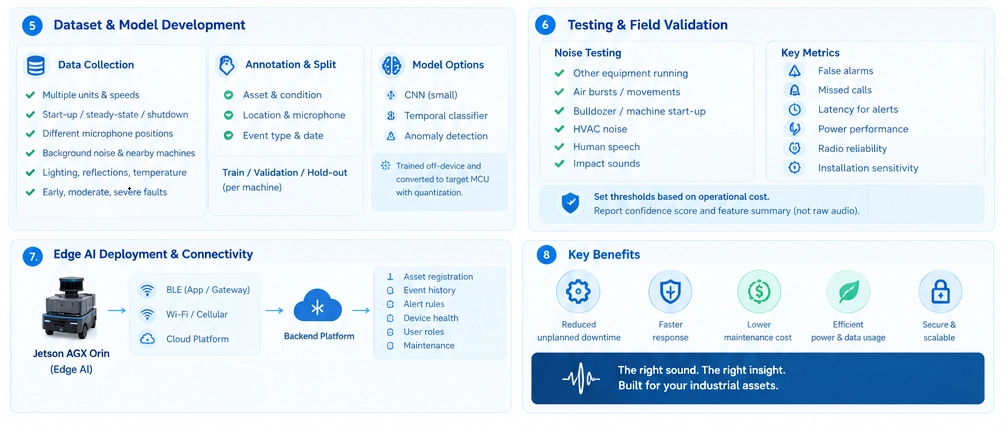
Field Testing and Validation
Field testing starts in an environment that is controlled before the real trial runs happen in operations.
The development team ensures that the various layers of hardware and software work in order. These layers include the following: sensor frames, timestamp synchronization, odometry drift, braking performance, emergency stop mechanism, recovery phase after network drop, and behavior of the system after detecting battery low.
Field validation plan includes the following elements:
Testing with static obstacles and free-path Crossing pedestrians and approach with obstacle avoidance at different speeds Testing in low light and under glare/reflection conditions Navigating narrow corridors and loading areas Simulations with obstacles, change of routes and recoveries Behavior under Wi-Fi drop and restart of services Repeated routes testing with log and ticketing Handover, remote monitoring and incident procedures
Production readiness is measured against agreed acceptance criteria such as route completion, localization stability, stop behavior, detection quality, recovery time and maintainability.
Safety validation must reflect the specific cart, payload, speed, operating area and applicable regional requirements. AI detection alone is not a substitute for appropriately engineered safety controls.
NVIDIA Jetson AGX Orin Autonomous Cart Development Services
Adequate Infosoft provides end-to-end development services for organizations building a new autonomous cart or modernizing an existing AGV/AMR platform.
Integration of Robotics Hardware and Electronics
The Jetson AGX Orin team of specialists will help you integrate the module, designing power systems, battery connections, wiring of sensors, USB, Ethernet and CAN communication and thermal management of the system. In addition, we can create PCBs for power supply, as well as required safety and sensor systems.
The Jetson AGX Orin team of specialists will help you integrate the module, designing power systems, battery connections, wiring of sensors, USB, Ethernet and CAN communication and thermal management of the system. In addition, we can create PCBs for power supply, as well as required safety and sensor systems.
ROS 2, Navigation and Localization Engineering
We develop ROS 2 robot architectures, URDF frame definitions, sensor drivers, LiDAR SLAM workflows, map management, localization tuning, Nav2 integration, mission behavior trees and recovery logic. The result is a maintainable robotics codebase rather than a collection of isolated scripts.
We develop ROS 2 robot architectures, URDF frame definitions, sensor drivers, LiDAR SLAM workflows, map management, localization tuning, Nav2 integration, mission behavior trees and recovery logic. The result is a maintainable robotics codebase rather than a collection of isolated scripts.
Computer Vision and LiDAR Fusion
Our engineers integrate camera pipelines, LiDAR processing, calibration utilities, object-detection models, tracking logic and obstacle layers. We optimize edge inference with NVIDIA TensorRT and design data logging that helps teams reproduce real-world failures instead of relying on assumptions from laboratory tests.
Our engineers integrate camera pipelines, LiDAR processing, calibration utilities, object-detection models, tracking logic and obstacle layers. We optimize edge inference with NVIDIA TensorRT and design data logging that helps teams reproduce real-world failures instead of relying on assumptions from laboratory tests.
Fleet, Cloud and Operator Software
It is essential for the supervisors to have real-time access to information about the cart's location, charge level, tasks, faults and maintenance history. Our team can create software for fleet dashboards, REST APIs, mobile applications and cloud telemetries using modern backend and frontend technologies.
It is essential for the supervisors to have real-time access to information about the cart's location, charge level, tasks, faults and maintenance history. Our team can create software for fleet dashboards, REST APIs, mobile applications and cloud telemetries using modern backend and frontend technologies.
Testing, Documentation and Production Support
The process of delivery includes testing documents, installation manuals, diagnostic tools, checklists and documentation. We cooperate with the customer to agree upon the acceptance criteria for the final product and prepare all appropriate documents on limitations and safety measures.
The process of delivery includes testing documents, installation manuals, diagnostic tools, checklists and documentation. We cooperate with the customer to agree upon the acceptance criteria for the final product and prepare all appropriate documents on limitations and safety measures.
Build a Safer, More Capable Autonomous Cart
The automated cart that was successful in its operation is a composite engineering entity that includes not just the AI model, the LiDAR sensor or the navigation software.
The efficiency of the system relies on perfect calibration of the sensors, appropriate computation architecture, sound design of the ROS 2 system, consistent behavior of the control system, high safety engineering and numerous validation tests in the field.
Adequate Infosoft assists businesses in obtaining an AMR system, based on the camera and LiDAR combination, that is fully functional and uses the most up-to-date technologies, such as NVIDIA Jetson AGX Orin, smart edge AI, localization, robotics and operational software.
Editorial Resources