












 Mean Stack Development
 Vue JS Development
 Javascript Development
 React JS Development
 Angular JS Development
 Next JS development
 Java Development
 Python Development
 Django Development
 Cherrypy Development
 C# Development
 ASP.NET Development
 NodeJS Development
 Laravel Development
 CodeIgniter Development
 Zend Development
 Ruby on Rails Development
 CakePHP Development
 PHP Website Development
 Symfony Development
 Drupal Development
 Joomla Development
 Wordpress Development
 .NET Nuke Development
 Kentico
 Umbraco
 .NET MAUI Development
 Xamarin Application Development
 iOS Application Development
 Android Application Development
 Android Wear App Development
 Ionic Development
 iBeacon Application Development
 Universal Windows Platform (UWP)
 Kotlin Application Development
 Swift Application Development
 Flutter Application Development
 PWA Application Development
 Flutter Health Tech & Wearable App Development Company
 React Native Health Tech Wearable App Development
 Offshore Software Development
 Custom Application Development
 Front-End Development
 Full Stack Development
 AI & Machine Learning
 Custom CRM Solutions
 Flask Software Development
 Electron JS Development
 ChatGPT Development
 Telemedicine App Development
 Build Smart Telemedicine Platform
 Beauty & Salon App Solutions
 Hire Workato Experts
 Magento Development
 Magento 2.0 Development
 Magento Enterprise
 Shopping Cart Development
 Prestashop Development
 Shopify Development
 Open Cart Development
 WooCommerce Development
 BigCommerce Development
 NopCommerce Development
 Virto Commerce Development
 AspDotNetStorefront Development
 .NET Application Development
 Microsoft Dynamics CRM
 VB .NET Development
 Sharepoint Migration
 ASP.NET Core Development
 ASP.NET MVC Development
 AJAX Development
 Agile Development
 Microsoft Bot
 Microsoft Blazor
 Microsoft Azure Cognitive
 HTML 5
 UI/UX Design
 Graphic Design
 Adobe Photoshop
 XML Application Development
 Cloud Computing Solutions
 Azure Cloud App Development
 AWS Development
 Google Cloud Development
 Certified AWS IoT Services Developers
 DevOps Consulting & Development
 Kubernetes Consulting & Services
 SQL Programming Development
 MySQL Development
 MongoDB Development
 Big Data
 Robotic Process Automation
 Social Media Marketing
 Search Engine Optimization
 QA Testing
 Software Testing
 Software Security
 Maintenance And Support
 I.T. Consulting Services
 Business Intelligence
 YII Development
 Data Analysis
 Alexa Skills Development
 On Demand App for Mobile repairing services
 On Demand App for Car Service Booking
 On Demand App for Cleaning Services
 On Demand App for Pharmacy
 On Demand Dedicated Developers
 On Demand Lawyer App Development





 Nuki Smart Lock
 Salto Smart Lock
 TTlock Smart Lock
 NFC App Development
 Custom IOT Enabled Smart Lock
 Smart Locker Solutions
 Hospital Smart Lock Systems
 Hotel Smart Lock Systems
 Smart Home & Office Locks
 Smart Access for Schools & Colleges
 Unloc Smart Lock Integration
 Yale & August Smart Lock Integration
 Populife Smart Lock Integration
 Smart Lock Hardware Development
 Dairy IoT Solutions
 Agri IoT & AI Solutions
 Weather & Climate Solutions
 Water & Waste Management Solutions
 RaspBerry Pi
 Firmware Software Development
 ESP 32 Software Development
 Embedded Development
 Internet of Things
 Smart IoT Development
 IoT Sensor Integration & Development Solutions
 Smart IoT System Development for HVAC
 Tuya IoT App Development
 Particle IoT SDK
 IoT Development with AI
 Smart Pet GPS Tracker
 Dairy GPS Tracking Solutions
 GPS Fleet Management Software
 Car Rental & Subscription Solutions
 Car Buy & Sell Marketplace Development
 AI-Powered Car Wash App Development
 PCB Design & Fabrication
 IoT AC Automation
 AI–IoT Painting Solutions
 IoT Wearable Hardware & App Development
 HVAC Automation & AI Control Systems
 Smart Home IoT Engineering
 AI Embedded Systems
 AI Hardware Design Service
 Advanced IoT Hardware & Firmware Development
 Device Driver Development Services
 NXP i.MX RT Firmware & Hardware Services
 Microchip PIC & AVR Development
 Hire IoT Architects
 IoT Cloud & Infrastructure Solutions
 Infineon XMC / AURIX Development Services
 Matter & Thread IoT Services
 Native IoT Mobile App Development (BLE & Wi-Fi)
 Snapdragon IoT Firmware Development
 Renesas RA/RX Firmware Services
 Silicon Labs EFR32 Development Services
 Smart Wearable App Development
 Smart IoT Meters
 Smart Healthcare Wearable App Development
 Health Care Monitoring System
 Fitness Tracking App Development
 Smart Home Automation Apps
 nRF PCB Design
 ESP32 PCB Design
 Embedded Wearables Engineers
 Rental Property Management System
 Building Management System
 Smart Lighting Development
 Infineon Semiconductor Firmware Development Services
 Custom Camera Development: Hardware, Firmware & PCB Prototyping
 Smart Security Camera SDK
 Nordic Semiconductor SDK
 Infineon SDK
 Arduino SDK
 NFC Lock Integration
 Kerong Lock Integration
 IoT & AI Solutions for Manufacturing
 Smart Inventory & Logistics Solution
 Food & Beverage Industry Solutions
 Smart Hospitality Solutions
 Smart Property Management
 Custom Smart Home IOT SDK
 Smart IoT & AI in Healthcare
 AI-Powered Security Solutions
 Smart Home Safety & AI
 Veterinary Clinic Management (AI)
 Pet Care System (AI & IoT)
 Pet Training & Adoption (AI)
 Healthcare IoT Development
 Event Management Software
 Money Remittance App
 Money Lending App Development
 Utility and Bill Payment App
 IoT Mobile App Development (Flutter & React Native)
 AI & IoT Retail Solutions
 Smart EV App Development
 Smart Solar IoT & AI Solutions
 IoT-Based Energy Systems
 Smart Energy & Utilities Solutions
 6G Solutions
 IoT Security Solutions
 AI-Powered Lottery App Development
 AI-Sports Fitness Club Management
 Travel
 Real Estate
 Medical & Healthcare
 e-Learning
 Consumer Products
 Finance
 Automobile
 Media & Entertainment
 Billing Software
 Enterprise Resource Planning (ERP)
 Augumented & Virtual Reality
 Point of Sale(POS) Development
 Learning Management System
 EV Charging Solutions
 About Us
 Partners & Certifications
 Quality Assurance
 Our Clients & Testimonials
 Development Process
 Our Products
 Social Responsibility
 Work Ethics
 Vision & Mission
 Awards
 Live Project Demos
 Contact Us
 Case Studies
 Portfolio
 Blog
Blog
STM32WBA6 Bluetooth LE Audio & Auracast Development Services
Adequate Infosoft develops complete STM32WBA6 Bluetooth LE Audio and Auracast solutions spanning audio architecture, firmware, RF and PCB design, companion applications, security, testing, and production handover.
We support wireless microphones, speakers, headsets, assistive-listening products, conference systems, TV audio adapters, venue transmitters, and wearables. Work can start with a concept, development kit, existing codebase, or prototype needing production optimization.
Connect with us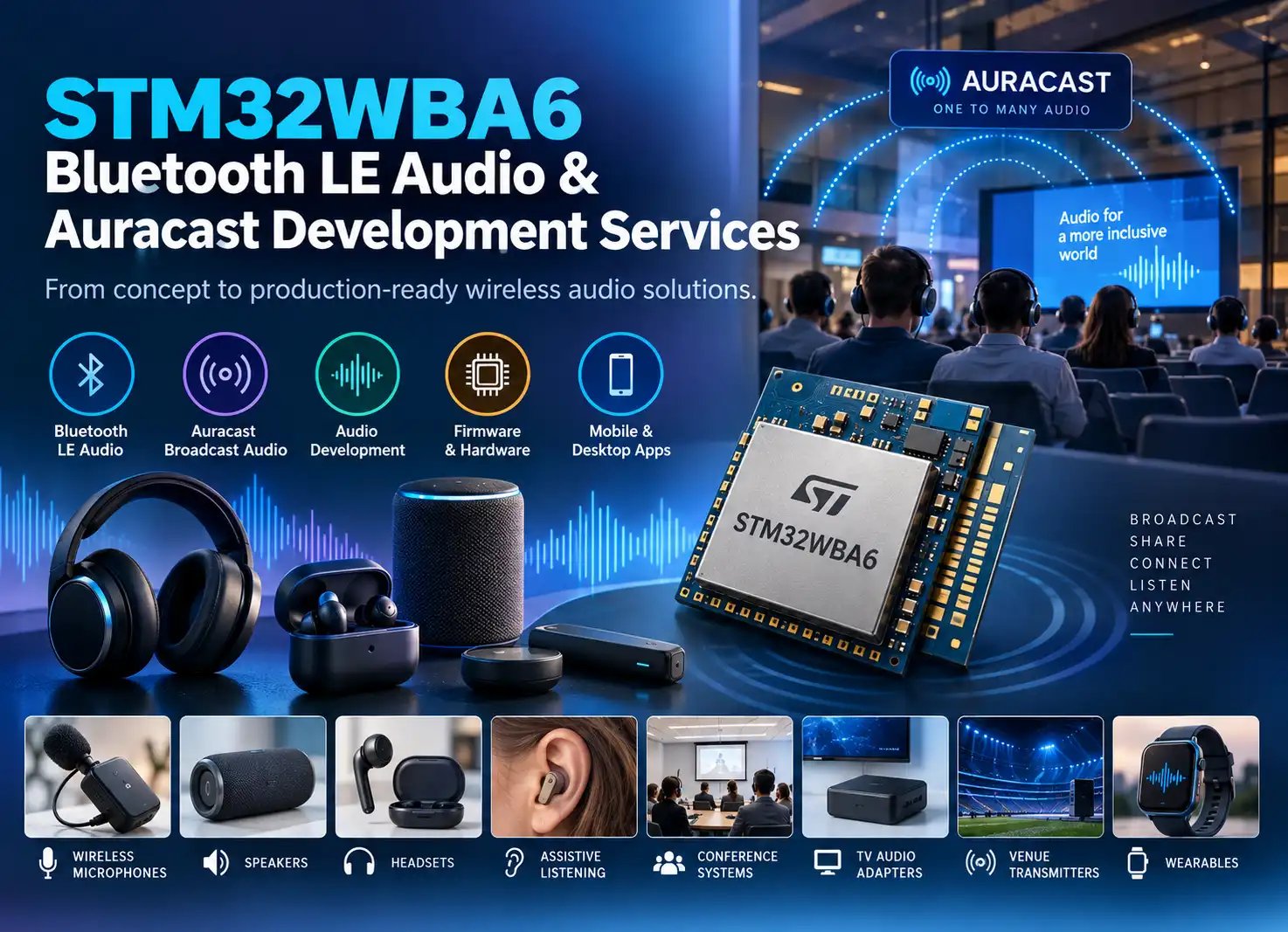
The Short Answer: What Can STM32WBA6 Do for LE Audio?
STM32WBA6 is an ultra-low-power wireless MCU family built around a 100 MHz Arm Cortex-M33 with DSP, floating-point processing, TrustZone, up to 2 MB flash, and 512 KB RAM. It supports Bluetooth LE isochronous channels and LE Audio, +10 dBm transmission, USB 2.0 High Speed, and IEEE 802.15.4 technologies. ST also lists SESIP3 and Arm PSA Level 3 device capability.
This can place connectivity, application control, selected signal processing, security, and peripherals on one MCU. Capacity depends on channel count, sample rate, codec settings, acoustic algorithms, UI, and concurrent protocols, so we benchmark the real workload.
LE Audio and Auracast Are Related, but Not Identical
Bluetooth LE Audio uses the LC3 codec and isochronous transport for unicast, multi-stream, and broadcast audio. Auracast is the Bluetooth SIG brand for broadcast audio: a source transmits streams that compatible receivers discover and join.
An Auracast system normally involves three logical roles:
| Role | Product responsibility | Example |
|---|---|---|
| Broadcast source | Captures or accepts audio, encodes it, publishes metadata, and transmits broadcast isochronous streams | TV adapter, lectern transmitter, public-address bridge |
| Broadcast sink | Discovers and decodes a selected stream, then renders it to a speaker, headset, or hearing device | Portable receiver, headset, assistive-listening accessory |
| Broadcast assistant | Helps a sink discover, select, and join a broadcast, including encrypted broadcasts | Smartphone app, tablet, venue controller |
Roles affect firmware, UI, testing, and qualification. Auracast is not ordinary BLE advertising and is not automatically compatible with Bluetooth Classic A2DP. The specification must identify supported receivers, phones, operating systems, and fallback behavior.
Our STM32WBA6 LE Audio Engineering Services
Product architecture and feasibility
We define roles, unicast or broadcast topology, mono or stereo, stream count, LC3 frame duration and bitrate, presentation delay, audio I/O, controls, privacy, range, battery, and coexistence requirements.
We define roles, unicast or broadcast topology, mono or stereo, stream count, LC3 frame duration and bitrate, presentation delay, audio I/O, controls, privacy, range, battery, and coexistence requirements.
A feasibility sprint can use the STM32WBA65I-DK1 with its digital microphone, OLED, audio jacks, USB-C, antenna, and debugger. We profile memory, CPU time, radio scheduling, current, packet loss, and end-to-end latency.
Auracast transmitter development
For transmitters, we implement audio acquisition, LC3 encoding, extended and periodic advertising, Broadcast Isochronous Groups and Streams, program metadata, and optional broadcast-code protection.
For transmitters, we implement audio acquisition, LC3 encoding, extended and periodic advertising, Broadcast Isochronous Groups and Streams, program metadata, and optional broadcast-code protection. Controls can cover naming, channel, gain, mute, input, access codes, and status.
We integrate line input, digital microphones, I2S/SAI codecs, USB audio, TV or mixer feeds, controls, displays, gateways, and configuration apps. For multilingual events, stream metadata helps listeners identify the right language.
LE Audio receiver and sink development
Receiver work includes discovery, synchronization, LC3 decoding, buffering, clock-drift handling, rendering, volume, reconnection, and power management for headphones, speakers, hearing-access accessories, tour systems, or industrial endpoints.
Receiver work includes discovery, synchronization, LC3 decoding, buffering, clock-drift handling, rendering, volume, reconnection, and power management for headphones, speakers, hearing-access accessories, tour systems, or industrial endpoints.
We also evaluate codec or DAC selection, amplifier noise, grounding, clocks, gain staging, microphone bias, enclosure acoustics, and RF coupling. Validation combines objective measurements with listening tests.
Unicast LE Audio, voice, and control
We develop point-to-point LE Audio for voice, media, microphones, intercoms, and accessories. Scope may include capability discovery, stream establishment, media and volume controls, and synchronized streams where supported.
We develop point-to-point LE Audio for voice, media, microphones, intercoms, and accessories. Scope may include capability discovery, stream establishment, media and volume controls, and synchronized streams where supported.
LE Audio can coexist with GATT services for battery, configuration, diagnostics, telemetry, and secure updates.
STM32 firmware and audio data path
Using STM32CubeWBA, STM32CubeMX, STM32CubeIDE, HAL or low-layer APIs, we develop boot, board-support, peripheral, wireless, application, and diagnostic firmware across PDM, I2S/SAI, SPI, I2C, UART, USB, DMA, and external flash.
Using STM32CubeWBA, STM32CubeMX, STM32CubeIDE, HAL or low-layer APIs, we develop boot, board-support, peripheral, wireless, application, and diagnostic firmware across PDM, I2S/SAI, SPI, I2C, UART, USB, DMA, and external flash.
We budget the real-time path across capture, LC3 processing, radio events, application tasks, and storage. Buffer ownership, interrupt priorities, DMA, queues, timing instrumentation, and recovery prevent underruns and lost synchronization.
Custom hardware, RF, and antenna design
We deliver component selection, schematics, multilayer PCB layout, antenna matching, codec and amplifier circuits, microphones, power, battery charging, USB, protection, debug access, and test points.
We deliver component selection, schematics, multilayer PCB layout, antenna matching, codec and amplifier circuits, microphones, power, battery charging, USB, protection, debug access, and test points.
RF performance is verified on the final form factor because enclosure materials, batteries, the user's body, cables, and ground layout affect range. We plan antenna keep-out and tuning access early.
Companion mobile, desktop, and operator applications
We build native iOS and Android, Flutter, React Native, .NET MAUI, web, or desktop interfaces. Apps can provision access, configure broadcasts, display programs, support assistant workflows, manage firmware, and collect diagnostics.
We build native iOS and Android, Flutter, React Native, .NET MAUI, web, or desktop interfaces. Apps can provision access, configure broadcasts, display programs, support assistant workflows, manage firmware, and collect diagnostics.
We verify the target device matrix and provide local controls or a dedicated receiver when a phone cannot perform the required role.
Security, Privacy, and Update Lifecycle
We design secure boot, signed firmware, protected keys, TrustZone separation, authenticated pairing, encrypted configuration, debug policy, anti-rollback controls, and secure provisioning.
Public streams should remain discoverable; protected broadcasts require secure delivery, storage, rotation, and revocation of broadcast codes. These decisions belong in the threat model.
Testing Beyond "It Connects"
Our validation matrix measures the experience under realistic conditions:
- Audio latency, synchronization, jitter, dropouts, distortion, noise, and intelligibility
- Discovery and join time for public and encrypted broadcasts
- Multiple sinks, multiple streams, metadata, language selection, and long-duration playback
- RF range, congestion, body blocking, enclosure detuning, and coexistence with other 2.4 GHz traffic
- Peak, average, advertising, connected, streaming, and sleep current
- Power interruption, corrupted settings, codec errors, update failure, and recovery
- Interoperability across agreed phones, assistants, receivers, headsets, and hearing devices
Bluetooth qualification, radio approvals, EMC, safety, accessibility, and market-specific compliance remain separate workstreams. We help define the applicable route, prepare evidence, resolve test findings, and avoid calling a prototype "certified" before the required assessments are complete.
Where STM32WBA6 Fits Best
Potential products include Auracast television transmitters, airport or transport announcement systems, theatres and houses of worship, conference translation devices, museum and guided-tour audio, classroom listening systems, silent screens in gyms and waiting rooms, wireless microphones, intercoms, medical communication accessories, smart speakers, and wearable voice devices.
STM32WBA6 fits products valuing MCU-level power control, deterministic firmware, embedded security, and integrated wireless. Heavy acoustic processing, many high-rate channels, Wi-Fi streaming, or complex graphics may justify a companion DSP, module, or application processor.
Relevant Adequate Infosoft Case Studies
These published projects demonstrate directly transferable experience. They are not presented as STM32WBA6 projects unless the case study explicitly says so.
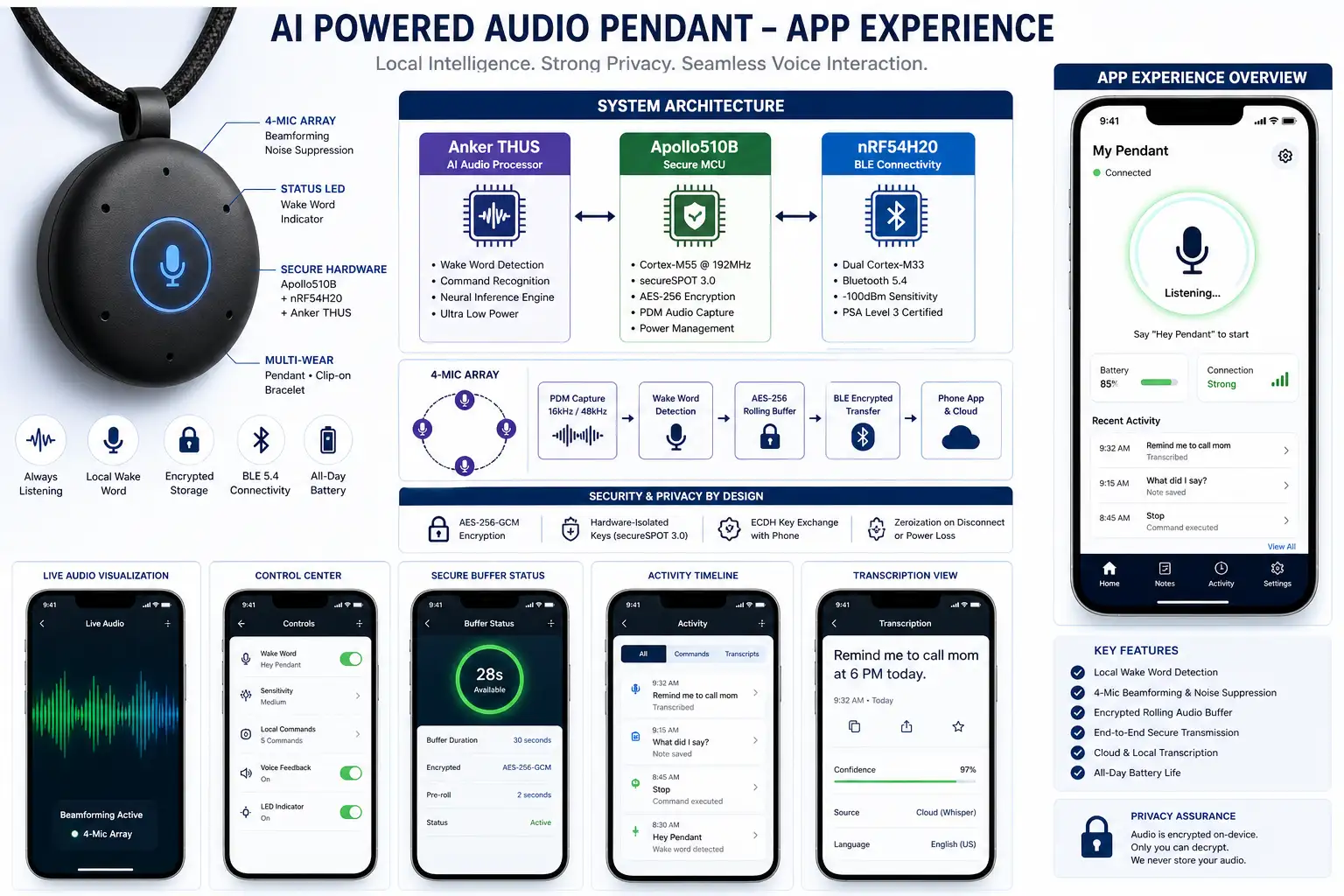
Wearable AI audio pendant with secure BLE
Adequate Infosoft developed a voice pendant with four microphones, local wake-word processing, encrypted rolling storage, Apollo510B control, and nRF54H20 BLE. Work covered hardware, firmware, audio buffering, privacy, mobile transfer, cloud transcription, and testing—experience relevant to secure STM32WBA6 audio paths.
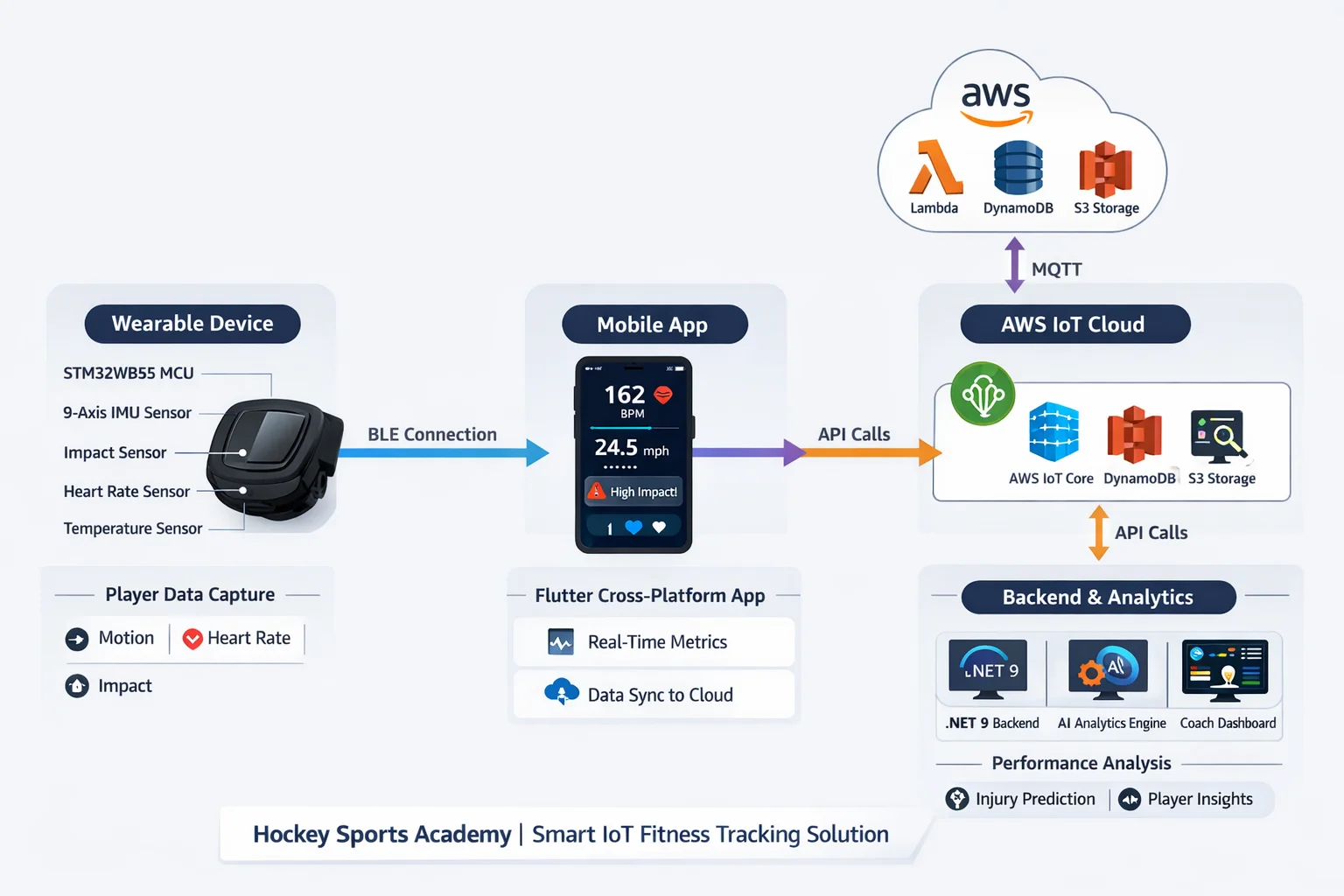
STM32WB55 sports wearable ecosystem
Our STM32WB55 sports wearable combined BLE, motion, impact and heart-rate sensing, Flutter, AWS IoT, and a .NET backend. It demonstrates ST wireless-MCU firmware, secure app communication, cloud integration, and battery-conscious design relevant to portable audio endpoints.
Native BLE wearable application
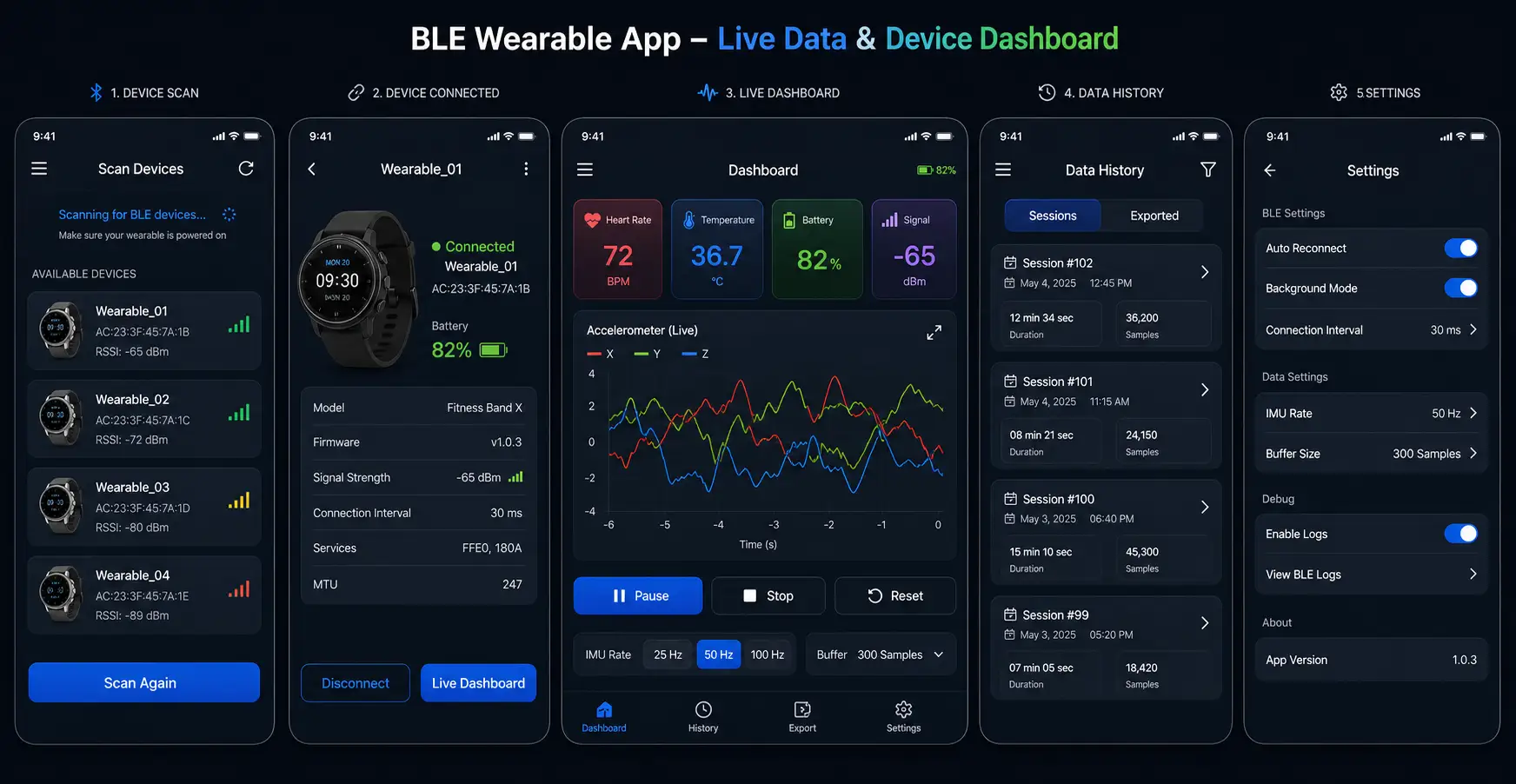
This project turned a hardware prototype into native iOS and Android BLE apps covering pairing, reconnection, real-time transfer, permissions, background behavior, updates, and device state. These disciplines matter when an audio app acts as configurator, diagnostic tool, or broadcast assistant.
A Delivery Process with Reviewable Evidence
An engagement normally progresses through requirements, risk review, development-board experiments, architecture approval, custom hardware, firmware integration, engineering validation, design validation, and manufacturing handover. At each gate, we compare results with agreed acceptance criteria rather than reporting only completed tasks.
The handover can include schematics, PCB and fabrication files, BOM and alternates, firmware source, build instructions, memory map, wireless and audio configuration, programming procedure, mobile-app source, API documentation, test plans, test results, known limitations, and production-test specifications. Firmware, hardware revision, configuration, and test data remain versioned together so a measured result can be reproduced. This evidence-led approach gives internal teams, investors, manufacturers, and certification laboratories a clear view of product readiness and remaining risk.
Frequently Asked Questions
Yes. STM32WBA6 supports Bluetooth LE isochronous channels and LE Audio. A complete product still requires the correct profiles, audio hardware, interoperability work, and qualification.
No. Auracast uses LE Audio broadcast transport. Classic A2DP receivers require compatible hardware, controller, host stack, profiles, and qualification—not merely a setting change.
Yes. We can own the connected product across architecture, STM32WBA6 firmware, RF and audio electronics, PCB, prototype bring-up, mobile or desktop software, security, validation, certification support, and manufacturing handover.
Yes. We develop both unicast point-to-point LE Audio (voice, media, microphones, intercoms) and Auracast broadcast scenarios.
Start Your STM32WBA6 Audio Project
Bring us the listening scenario, audio source, target receivers, range, channel count, latency, battery, enclosure, security, and market requirements. Adequate Infosoft will turn them into a testable STM32WBA6 architecture and a staged plan from evaluation-board proof of concept to production-ready hardware and firmware.
Editorial Sources