















 Mean Stack Development
 Vue JS Development
 Javascript Development
 React JS Development
 Angular JS Development
 Next JS development
 Java Development
 Python Development
 Django Development
 Cherrypy Development
 C# Development
 ASP.NET Development
 NodeJS Development
 Laravel Development
 CodeIgniter Development
 Zend Development
 Ruby on Rails Development
 CakePHP Development
 PHP Website Development
 Symfony Development
 Drupal Development
 Joomla Development
 Wordpress Development
 .NET Nuke Development
 Kentico
 Umbraco
 .NET MAUI Development
 Xamarin Application Development
 iOS Application Development
 Android Application Development
 Android Wear App Development
 Ionic Development
 iBeacon Application Development
 Universal Windows Platform (UWP)
 Kotlin Application Development
 Swift Application Development
 Flutter Application Development
 PWA Application Development
 Flutter Health Tech & Wearable App Development Company
 React Native Health Tech Wearable App Development
 Offshore Software Development
 Custom Application Development
 Front-End Development
 Full Stack Development
 AI & Machine Learning
 Custom CRM Solutions
 Flask Software Development
 Electron JS Development
 ChatGPT Development
 Telemedicine App Development
 Build Smart Telemedicine Platform
 Beauty & Salon App Solutions
 Hire Workato Experts
 Magento Development
 Magento 2.0 Development
 Magento Enterprise
 Shopping Cart Development
 Prestashop Development
 Shopify Development
 Open Cart Development
 WooCommerce Development
 BigCommerce Development
 NopCommerce Development
 Virto Commerce Development
 AspDotNetStorefront Development
 .NET Application Development
 Microsoft Dynamics CRM
 VB .NET Development
 Sharepoint Migration
 ASP.NET Core Development
 ASP.NET MVC Development
 AJAX Development
 Agile Development
 Microsoft Bot
 Microsoft Blazor
 Microsoft Azure Cognitive
 HTML 5
 UI/UX Design
 Graphic Design
 Adobe Photoshop
 XML Application Development
 Cloud Computing Solutions
 Azure Cloud App Development
 AWS Development
 Google Cloud Development
 Certified AWS IoT Services Developers
 DevOps Consulting & Development
 Kubernetes Consulting & Services
 SQL Programming Development
 MySQL Development
 MongoDB Development
 Big Data
 Robotic Process Automation
 Social Media Marketing
 Search Engine Optimization
 QA Testing
 Software Testing
 Software Security
 Maintenance And Support
 I.T. Consulting Services
 Business Intelligence
 YII Development
 Data Analysis
 Alexa Skills Development
 On Demand App for Mobile repairing services
 On Demand App for Car Service Booking
 On Demand App for Cleaning Services
 On Demand App for Pharmacy
 On Demand Dedicated Developers
 On Demand Lawyer App Development











 Nuki Smart Lock
 Salto Smart Lock
 TTlock Smart Lock
 NFC App Development
 Custom IOT Enabled Smart Lock
 Smart Locker Solutions
 Hospital Smart Lock Systems
 Hotel Smart Lock Systems
 Smart Home & Office Locks
 Smart Access for Schools & Colleges
 Unloc Smart Lock Integration
 Yale & August Smart Lock Integration
 Populife Smart Lock Integration
 Smart Lock Hardware Development
 Dairy IoT Solutions
 Agri IoT & AI Solutions
 Weather & Climate Solutions
 Water & Waste Management Solutions
 RaspBerry Pi
 Firmware Software Development
 ESP 32 Software Development
 Embedded Development
 Internet of Things
 Smart IoT Development
 IoT Sensor Integration & Development Solutions
 Smart IoT System Development for HVAC
 Tuya IoT App Development
 Particle IoT SDK
 IoT Development with AI
 Smart Pet GPS Tracker
 Dairy GPS Tracking Solutions
 GPS Fleet Management Software
 Car Rental & Subscription Solutions
 Car Buy & Sell Marketplace Development
 AI-Powered Car Wash App Development
 PCB Design & Fabrication
 IoT AC Automation
 AI–IoT Painting Solutions
 IoT Wearable Hardware & App Development
 HVAC Automation & AI Control Systems
 Smart Home IoT Engineering
 AI Embedded Systems
 AI Hardware Design Service
 Advanced IoT Hardware & Firmware Development
 Device Driver Development Services
 NXP i.MX RT Firmware & Hardware Services
 Microchip PIC & AVR Development
 Hire IoT Architects
 IoT Cloud & Infrastructure Solutions
 Infineon XMC / AURIX Development Services
 Matter & Thread IoT Services
 Native IoT Mobile App Development (BLE & Wi-Fi)
 Snapdragon IoT Firmware Development
 Renesas RA/RX Firmware Services
 Silicon Labs EFR32 Development Services
 Smart Wearable App Development
 Smart IoT Meters
 Smart Healthcare Wearable App Development
 Health Care Monitoring System
 Fitness Tracking App Development
 Smart Home Automation Apps
 nRF PCB Design
 ESP32 PCB Design
 Embedded Wearables Engineers
 Rental Property Management System
 Building Management System
 Smart Lighting Development
 Infineon Semiconductor Firmware Development Services
 Custom Camera Development: Hardware, Firmware & PCB Prototyping
 Smart Security Camera SDK
 Nordic Semiconductor SDK
 Infineon SDK
 Arduino SDK
 NFC Lock Integration
 Kerong Lock Integration
 IoT & AI Solutions for Manufacturing
 Smart Inventory & Logistics Solution
 Food & Beverage Industry Solutions
 Smart Hospitality Solutions
 Smart Property Management
 Custom Smart Home IOT SDK
 Smart IoT & AI in Healthcare
 AI-Powered Security Solutions
 Smart Home Safety & AI
 Veterinary Clinic Management (AI)
 Pet Care System (AI & IoT)
 Pet Training & Adoption (AI)
 Healthcare IoT Development
 Event Management Software
 Money Remittance App
 Money Lending App Development
 Utility and Bill Payment App
 IoT Mobile App Development (Flutter & React Native)
 AI & IoT Retail Solutions
 Smart EV App Development
 Smart Solar IoT & AI Solutions
 IoT-Based Energy Systems
 Smart Energy & Utilities Solutions
 6G Solutions
 IoT Security Solutions
 AI-Powered Lottery App Development
 AI-Sports Fitness Club Management
 Travel
 Real Estate
 Medical & Healthcare
 e-Learning
 Consumer Products
 Finance
 Automobile
 Media & Entertainment
 Billing Software
 Enterprise Resource Planning (ERP)
 Augumented & Virtual Reality
 Point of Sale(POS) Development
 Learning Management System
 EV Charging Solutions
 About Us
 Partners & Certifications
 Quality Assurance
 Our Clients & Testimonials
 Development Process
 Our Products
 Social Responsibility
 Work Ethics
 Vision & Mission
 Awards
 Live Project Demos
 Contact Us
 Case Studies
 Portfolio
 Blog
Blog
STM32 Ethernet & Modbus TCP Gateway Development Services
A factory may have reliable sensors, meters, drives, and PLCs but no consistent way to share their data with a supervisory application. Some devices expose RS-485 registers; others expect Modbus TCP over Ethernet.
An industry gateway links these systems, but a functioning demonstration is just one step. The production firmware must deal with a disconnected cord, a non-functioning serial device, two clients calling for the same register and losses of electric power during the updates.
Adequate Infosoft provides STM32 Ethernet development services across hardware, embedded firmware, protocol integration, and backend connectivity.
We build Modbus TCP clients and servers, Modbus RTU-to-TCP gateways, and custom industrial data-acquisition devices around a documented register map and a testable operating requirement. The aim is dependable data exchange that maintenance and operations teams can understand after installation.
Let's Work Together!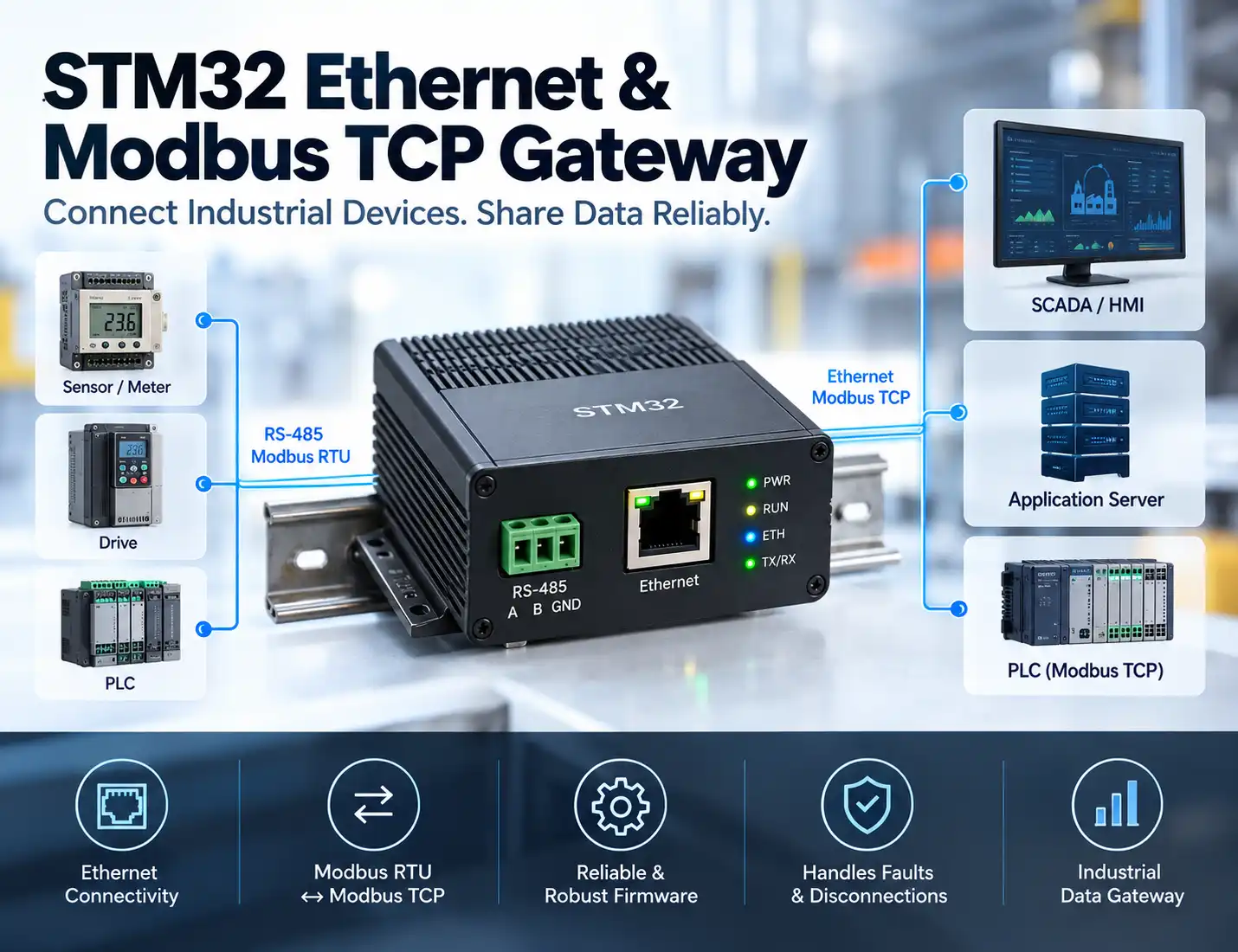
What the STM32 Industrial Gateway Does
Take an energy meter connected through an RS-485 interface and an energy management system connected via Ethernet as an illustration for what an STM32 industrial gateway does.
The STM32 gateway processes a Modbus TCP request, determines which device is being addressed, prepares and sends the relevant Modbus RTU request, waits for a response, and replies with the answer or an error code.
It is also able to continuously poll devices and send back data for a local application or a cloud service.
This process refers to protocol translation, rather than a simple electrical connection. When converting an Ethernet frame to RS-485, a new connector alone will not be sufficient.
The firmware must now be in a position to ensure that the transaction is accomplished successfully and that unit ID, function codes, timing, CRC checks done on the RTU, TCP connection lifecycle or error management can be guaranteed.
According to the Modbus Organization's specifications, it is necessary to differentiate between application protocol and messaging implementation within TCP client, server, and gateway context.
The registry table is part of the deliverable, everything pertaining to it must be documented. It means that any information available has to be seen as some form of register, specifying whether it is a coil, discrete input, input register, or holding register; as for its address, type of the data, order of the words, scaling, units, access rights, and error behavior - all that must be specified.
STM32 Ethernet Hardware and Firmware Engineering
The selection of an MCU is initiated with the specification of parameters like the number of Ethernet interfaces available in the MCU, the number of serial channels required, the maximum number of data connections, memory requirements, updating strategy, and environmental specifications.
An STM32 with Ethernet MAC needs to be configured with an appropriate external PHY, magnetics, connectors, clock, and also attention should be paid to PCB design. The choice of the specific STM32 and PHY does come together, the MII or RMII interface does need to be checked, and the requirements of protection and isolation need to be determined.
Getting a prototype board with a successful ping does not guarantee reliability in the field.
For TCP/IP firmware, ST's STM32CubeH7 package provides Ethernet and TCP/IP middleware and board examples. LwIP can support the required network functions, with or without an RTOS depending on concurrency and application complexity. We keep protocol work separate from time-critical acquisition and control, so a slow client cannot indefinitely block a sampling task or a safe local response.
On Cortex-M7-based STM32H7 designs, Ethernet DMA and data cache require deliberate memory placement and cache handling.
ST's Ethernet and LwIP implementation guide discusses descriptors, packet-buffer alignment, linker regions, and cache maintenance. A device that passes a short ping test can still fail under sustained traffic if these areas are wrong.
We validate throughput, packet integrity, recovery after link changes, and long-running operation on the selected board revision and software versions.
Modbus TCP Client, Server, and RTU Bridge Services
Modbus TCP Server Development
We provide real-time data such as measurement results, alarms, status of devices, and allowed configurations using a register map. We specifically differentiate between read-only data and write commands. Writing to the control register requires range checking, checking the state, approval policy and deciding what to do in case of disconnect from client.
Modbus TCP Client Development
We connect an STM32 device to existing PLCs, meters, drives, or I/O modules. Polling is scheduled around the required freshness and the capacity of each target. Responses are validated before a value is marked current; a timeout does not silently turn the previous reading into a new measurement.
Modbus RTU-to-TCP Gateway Development
The process of developing a Modbus RTU-to-TCP gateway allows us to consolidate RS-485 transceivers and control adapters such as the biasing and termination systems and isolate signals where necessary, apart from providing diagnostics to the serial bus.
The multiple Ethernet inquiries destined for one half-duplex RTU bus require the use of arbitration and sealed queues. The identification of TCP timeouts from downstream Modbus exceptions involves enough information gathering for troubleshooting sporadically malfunctioning field devices.
Multi-Protocol Data Integration
When useful, the gateway can translate approved measurements into MQTT or HTTPS for monitoring applications. That additional transport does not change the meaning of the underlying Modbus register. We maintain a versioned mapping so a firmware update cannot silently rename a point or change its units in the dashboard.
Reliability, Security, and Field Maintenance
Predictable performance is required from industrial gateway firmware in the case of input failure. We carry out tests on all sorts of conditions: unplugged Ethernet, PHY link going up and down, identical IP addresses, noise interference on RS-485, not fully transmitted messages, non-responsive devices, and client reconnecting.
Watchdogs are detecting why software fails, logs record resets, errors on the bus, rejected messages, and software version.
Modbus TCP is usually used in the controlled operating network, but it has a traditional form without application layer authentication and encryption. That's why we create the segmentation of the network, limited access, and definitely secure management interfaces based on the security model of the site.
If remote access is required, it should pass through an approved protected channel rather than exposing a control port directly to the internet. Firmware updates need authenticity checks, a rollback or recovery plan, and a record of what was deployed to each device.
A gateway is also an operational product. Installers need a clear way to set network parameters and unit IDs, verify wiring, see the last successful response, export diagnostics, and restore a known configuration. We design these functions into the device instead of treating every field fault as a reason to attach a debugger.
Relevant Adequate Infosoft Case Studies
STM32 Industrial Gas-Leak Detection
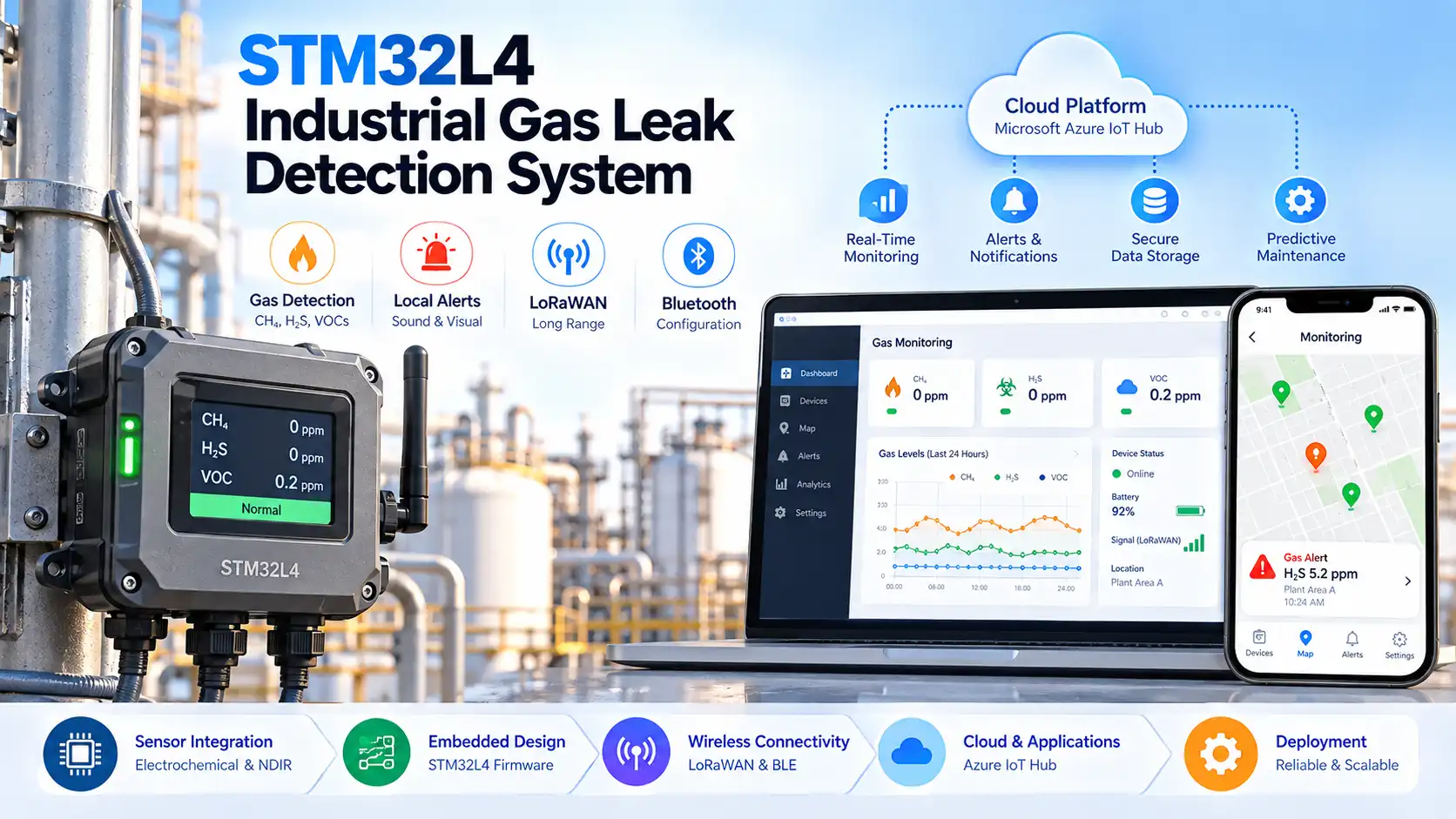
Our research on STM32 Industrial gas-leak detection presents STM32L4-based sensing electronics coupled with industrial PCB, local processing, and wireless and monitoring technologies. It is intended for rough-area sensing and edge-to-platform architecture.
The communication module communicates wirelessly, although no mention of Ethernet or Modbus TCP is made.
Read Case Study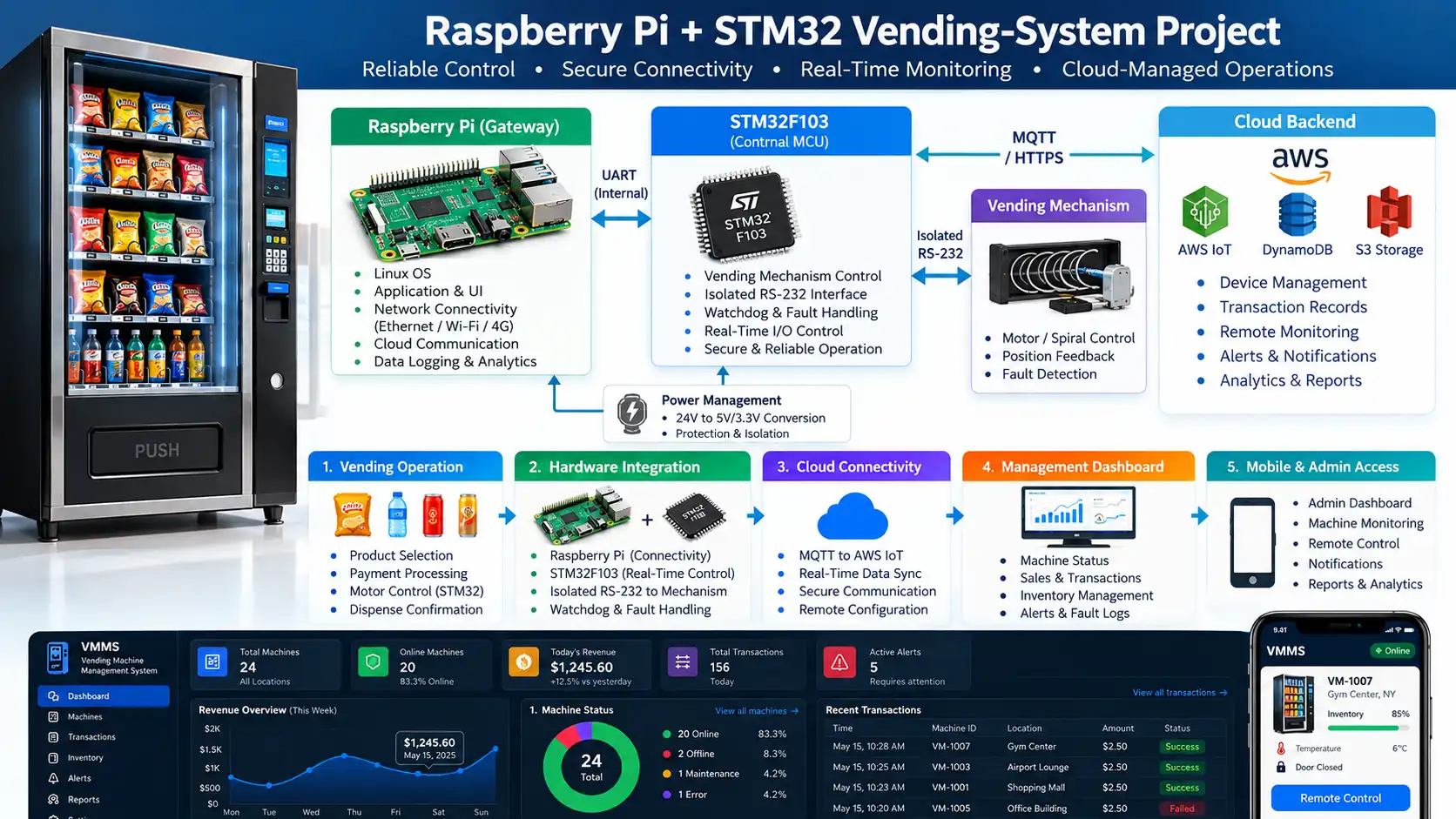
The Raspberry Pi and STM32 Vending-System Project
The Raspberry Pi and STM32 vending-system project shows how the team separated higher-level connectivity from time-sensitive STM32 control. The published design includes an STM32F103 co-processor, an isolated RS-232 connection to an external mechanism, watchdog supervision, and fault handling.
Those are useful integration lessons for a gateway, although RS-232 ASCII commands are not Modbus RTU and the Pi, not the STM32, handles Ethernet in that project.
Read Case Study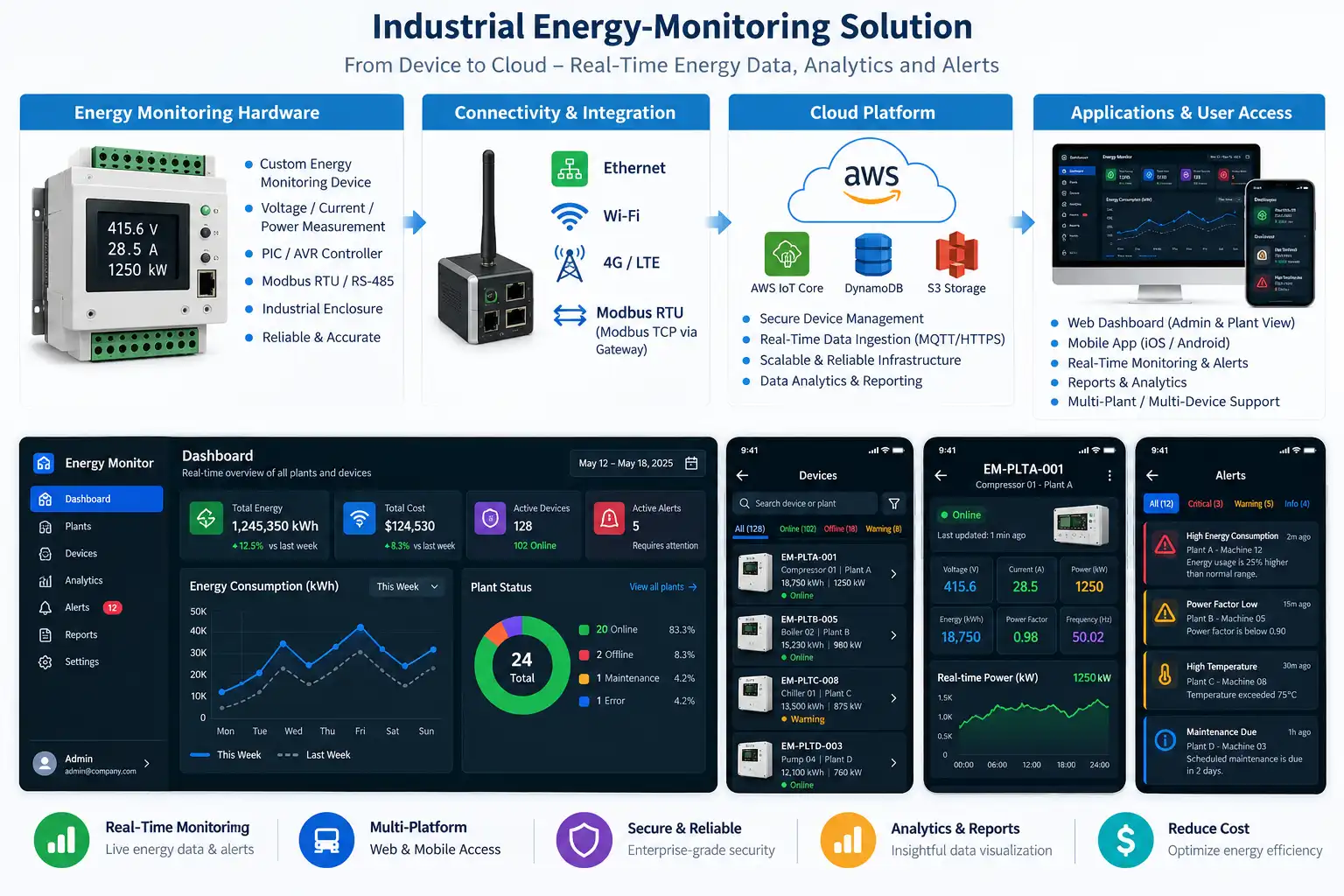
Industrial Energy-Monitoring
The case study of our energy monitoring software demonstrates the customized energy-monitoring hardware, backend services, dashboards, and the integration interfaces for the data of the plants.
The documented controllers used here are Microchip's PIC and AVR controller and not STM32. The previously-mentioned projects form the support of our expertise in embedded systems and industrial integration without being mentioned as proof of implementation of STM32 Modbus TCP gateway.
Read Case StudyA Practical Development and Validation Process
To begin, we first need to take stock of all equipment - including model numbers, user manuals, register tables, baud rates, network rules, and the system that will be utilizing the data.
Next, we need to clarify which party is initiating requests, the expected "freshness" of data, acceptable retraining time, permission for writes, and how many TCP clients will be used simultaneously.
The first prototype will provide us with physical interfaces working with actual equipment. We will be able to obtain requests, responses, and the correct interpretation of register values.
Using a bench simulator is very helpful for testing faults, however, it cannot be used as a substitute for actual instruments and their specific behavior.
Before delivery, we run sustained polling, reconnect and power-cycle tests, malformed-request tests, serial-bus fault tests, and update-recovery checks.
We provide source and build information, schematics and PCB files when hardware is in scope, a register-map document, configuration instructions, and an acceptance report. This gives the client's team a maintainable basis for commissioning and later expansion.
Frequently Asked Questions
Yes. Some selected STM32 microcontrollers can be used along with TCP/IP stack, Ethernet hardware, and application of right size to build Modbus TCP server or client. Although Linux can be used in case multiple applications are required and complex services are expected.
No. Both can run over Ethernet, but they are different industrial protocols. We confirm the exact protocol supported by each PLC, drive, or supervisory system before designing an interface.
Yes, subject to serial-bus design, addressing, device response times, polling load, and the required data freshness. Several TCP clients do not make a single half-duplex RS-485 bus process several RTU requests simultaneously.
You should provide a set of desired device models, statistics for the registers, number of their RS-485 or Ethernet connections, expected polling time, constraints for the environment and the type of monitoring or control.
Editorial Resources