











 Mean Stack Development
 Vue JS Development
 Javascript Development
 React JS Development
 Angular JS Development
 Next JS development
 Java Development
 Python Development
 Django Development
 Cherrypy Development
 C# Development
 ASP.NET Development
 NodeJS Development
 Laravel Development
 CodeIgniter Development
 Zend Development
 Ruby on Rails Development
 CakePHP Development
 PHP Website Development
 Symfony Development
 Drupal Development
 Joomla Development
 Wordpress Development
 .NET Nuke Development
 Kentico
 Umbraco
 .NET MAUI Development
 Xamarin Application Development
 iOS Application Development
 Android Application Development
 Android Wear App Development
 Ionic Development
 iBeacon Application Development
 Universal Windows Platform (UWP)
 Kotlin Application Development
 Swift Application Development
 Flutter Application Development
 PWA Application Development
 Flutter Health Tech & Wearable App Development Company
 React Native Health Tech Wearable App Development
 Offshore Software Development
 Custom Application Development
 Front-End Development
 Full Stack Development
 AI & Machine Learning
 Custom CRM Solutions
 Flask Software Development
 Electron JS Development
 ChatGPT Development
 Telemedicine App Development
 Build Smart Telemedicine Platform
 Beauty & Salon App Solutions
 Hire Workato Experts
 Magento Development
 Magento 2.0 Development
 Magento Enterprise
 Shopping Cart Development
 Prestashop Development
 Shopify Development
 Open Cart Development
 WooCommerce Development
 BigCommerce Development
 NopCommerce Development
 Virto Commerce Development
 AspDotNetStorefront Development
 .NET Application Development
 Microsoft Dynamics CRM
 VB .NET Development
 Sharepoint Migration
 ASP.NET Core Development
 ASP.NET MVC Development
 AJAX Development
 Agile Development
 Microsoft Bot
 Microsoft Blazor
 Microsoft Azure Cognitive
 HTML 5
 UI/UX Design
 Graphic Design
 Adobe Photoshop
 XML Application Development
 Cloud Computing Solutions
 Azure Cloud App Development
 AWS Development
 Google Cloud Development
 Certified AWS IoT Services Developers
 DevOps Consulting & Development
 Kubernetes Consulting & Services
 SQL Programming Development
 MySQL Development
 MongoDB Development
 Big Data
 Robotic Process Automation
 Social Media Marketing
 Search Engine Optimization
 QA Testing
 Software Testing
 Software Security
 Maintenance And Support
 I.T. Consulting Services
 Business Intelligence
 YII Development
 Data Analysis
 Alexa Skills Development
 On Demand App for Mobile repairing services
 On Demand App for Car Service Booking
 On Demand App for Cleaning Services
 On Demand App for Pharmacy
 On Demand Dedicated Developers
 On Demand Lawyer App Development






 Nuki Smart Lock
 Salto Smart Lock
 TTlock Smart Lock
 NFC App Development
 Custom IOT Enabled Smart Lock
 Smart Locker Solutions
 Hospital Smart Lock Systems
 Hotel Smart Lock Systems
 Smart Home & Office Locks
 Smart Access for Schools & Colleges
 Unloc Smart Lock Integration
 Yale & August Smart Lock Integration
 Populife Smart Lock Integration
 Smart Lock Hardware Development
 Dairy IoT Solutions
 Agri IoT & AI Solutions
 Weather & Climate Solutions
 Water & Waste Management Solutions
 RaspBerry Pi
 Firmware Software Development
 ESP 32 Software Development
 Embedded Development
 Internet of Things
 Smart IoT Development
 IoT Sensor Integration & Development Solutions
 Smart IoT System Development for HVAC
 Tuya IoT App Development
 Particle IoT SDK
 IoT Development with AI
 Smart Pet GPS Tracker
 Dairy GPS Tracking Solutions
 GPS Fleet Management Software
 Car Rental & Subscription Solutions
 Car Buy & Sell Marketplace Development
 AI-Powered Car Wash App Development
 PCB Design & Fabrication
 IoT AC Automation
 AI–IoT Painting Solutions
 IoT Wearable Hardware & App Development
 HVAC Automation & AI Control Systems
 Smart Home IoT Engineering
 AI Embedded Systems
 AI Hardware Design Service
 Advanced IoT Hardware & Firmware Development
 Device Driver Development Services
 NXP i.MX RT Firmware & Hardware Services
 Microchip PIC & AVR Development
 Hire IoT Architects
 IoT Cloud & Infrastructure Solutions
 Infineon XMC / AURIX Development Services
 Matter & Thread IoT Services
 Native IoT Mobile App Development (BLE & Wi-Fi)
 Snapdragon IoT Firmware Development
 Renesas RA/RX Firmware Services
 Silicon Labs EFR32 Development Services
 Smart Wearable App Development
 Smart IoT Meters
 Smart Healthcare Wearable App Development
 Health Care Monitoring System
 Fitness Tracking App Development
 Smart Home Automation Apps
 nRF PCB Design
 ESP32 PCB Design
 Embedded Wearables Engineers
 Rental Property Management System
 Building Management System
 Smart Lighting Development
 Infineon Semiconductor Firmware Development Services
 Custom Camera Development: Hardware, Firmware & PCB Prototyping
 Smart Security Camera SDK
 Nordic Semiconductor SDK
 Infineon SDK
 Arduino SDK
 NFC Lock Integration
 Kerong Lock Integration
 IoT & AI Solutions for Manufacturing
 Smart Inventory & Logistics Solution
 Food & Beverage Industry Solutions
 Smart Hospitality Solutions
 Smart Property Management
 Custom Smart Home IOT SDK
 Smart IoT & AI in Healthcare
 AI-Powered Security Solutions
 Smart Home Safety & AI
 Veterinary Clinic Management (AI)
 Pet Care System (AI & IoT)
 Pet Training & Adoption (AI)
 Healthcare IoT Development
 Event Management Software
 Money Remittance App
 Money Lending App Development
 Utility and Bill Payment App
 IoT Mobile App Development (Flutter & React Native)
 AI & IoT Retail Solutions
 Smart EV App Development
 Smart Solar IoT & AI Solutions
 IoT-Based Energy Systems
 Smart Energy & Utilities Solutions
 6G Solutions
 IoT Security Solutions
 AI-Powered Lottery App Development
 AI-Sports Fitness Club Management
 Travel
 Real Estate
 Medical & Healthcare
 e-Learning
 Consumer Products
 Finance
 Automobile
 Media & Entertainment
 Billing Software
 Enterprise Resource Planning (ERP)
 Augumented & Virtual Reality
 Point of Sale(POS) Development
 Learning Management System
 EV Charging Solutions
 About Us
 Partners & Certifications
 Quality Assurance
 Our Clients & Testimonials
 Development Process
 Our Products
 Social Responsibility
 Work Ethics
 Vision & Mission
 Awards
 Live Project Demos
 Contact Us
 Case Studies
 Portfolio
 Blog
Blog
nRF54 Matter & Thread Product Development Services
A smart-home device is not finished when it joins one laboratory network. It must commission reliably, expose the correct Matter data model, remain reachable through different Thread topologies, behave predictably with major ecosystems and recover safely after power loss or an interrupted update.
Adequate Infosoft provides nRF54 Matter development services spanning architecture, nRF Connect SDK firmware, Thread, BLE commissioning, hardware, apps, cloud integration, security, interoperability testing and certification preparation.
We offer products such as: switches, locks, sensors, thermostats, lighting controllers, curtains and sockets.
nRF54L15 is the SoC with ultra-low power consumption that supports protocols: Bluetooth LE, Matter, Thread, Zigbee and proprietary protocols in the range of 2.4 GHz.
Moreover, it has Arm Cortex-M33 with a speed of 128 MHz; 1.5 MB of NVM, 256 KB of RAM, built-in TrustZone isolation and cryptographic acceleration technology.
The final choice will depend on factors such as the complexity of the endpoint, memory, peripherals, package and roadmap.
Let's Work Together!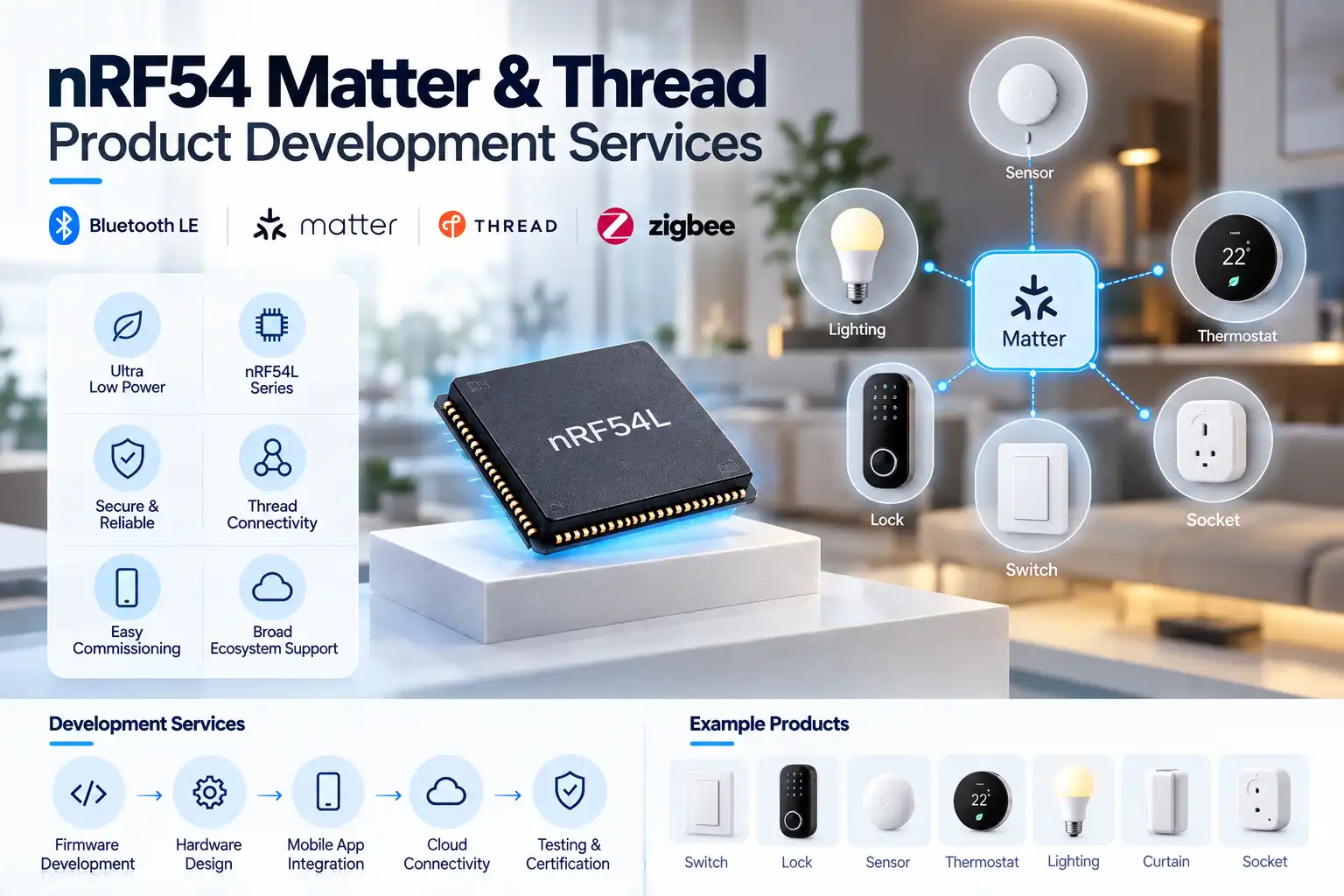
Matter and Thread Solve Different Parts of the Product
The concept of Matter is defined through an IP-based application layer that specifies various factors including device types, clusters, attributes, commands, events, security and commissioning.
Thread is an energy-efficient way to implement mesh networking using IEEE 802.15.4. Matter can function via Thread, Wi-Fi or Ethernet; whereas Thread can be used for any other applications apart from Matter.
In the case of a typical Matter-supported device operating through Thread, the connection process is accomplished using BLE technology followed by data exchange taking place via Thread. Connectivity between the mesh and other IP networks is achieved with the help of a Thread Border Router. It can share the same consumer hub with the Matter controller.
| Product decision | Practical consequence |
|---|---|
| Matter endpoint type | Determines mandatory clusters, commands and certification behavior |
| Sleepy End Device | Best for many battery sensors; parent polling and latency must suit the use case |
| Thread router-capable device | Helps mesh routing but usually needs continuous power |
| Border Router dependency | Must be included in deployment and interoperability planning |
| Multi-admin support | Enables a device to join more than one Matter ecosystem or fabric |
| Bridged legacy device | Can expose a non-Matter product through a Matter bridge, with mapping limitations |
Matter improves interoperability; it does not make every vendor experience identical or replace product diagnostics and support.
Relevant Adequate Infosoft Case Studies
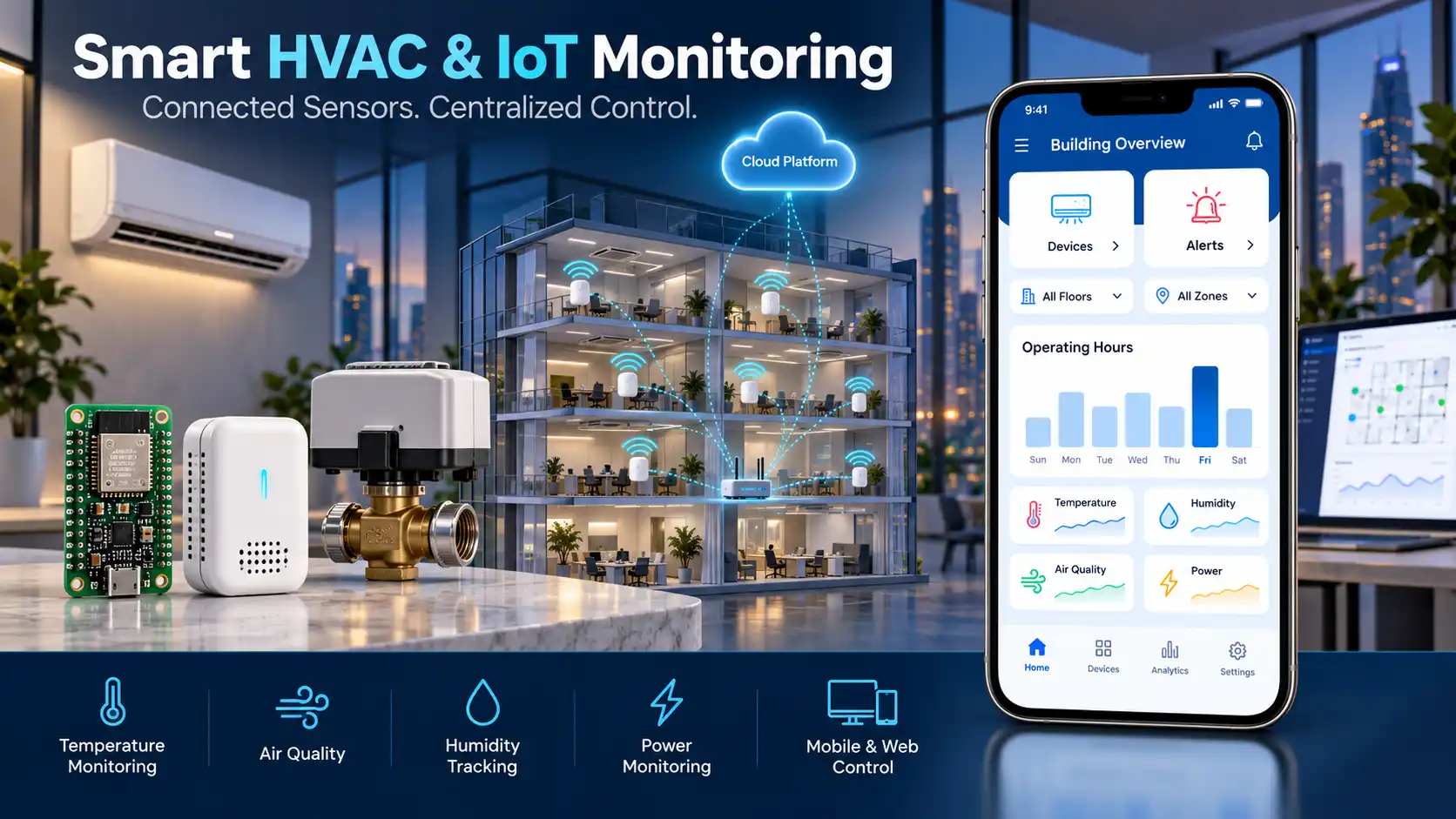
Automatic HVAC System Operating on Thread Mesh
Our case study features an automated HVAC system developed with ESP32 technology and implements the concepts of distributed zone controllers, firmware, Thread technology and cloud services.
The paper illustrates Thread layout and logic but employs ESP32 chip instead of nRF54 and is not compliant with Matter being focused on the relevance of Thread technology and building technology.
Read Case Study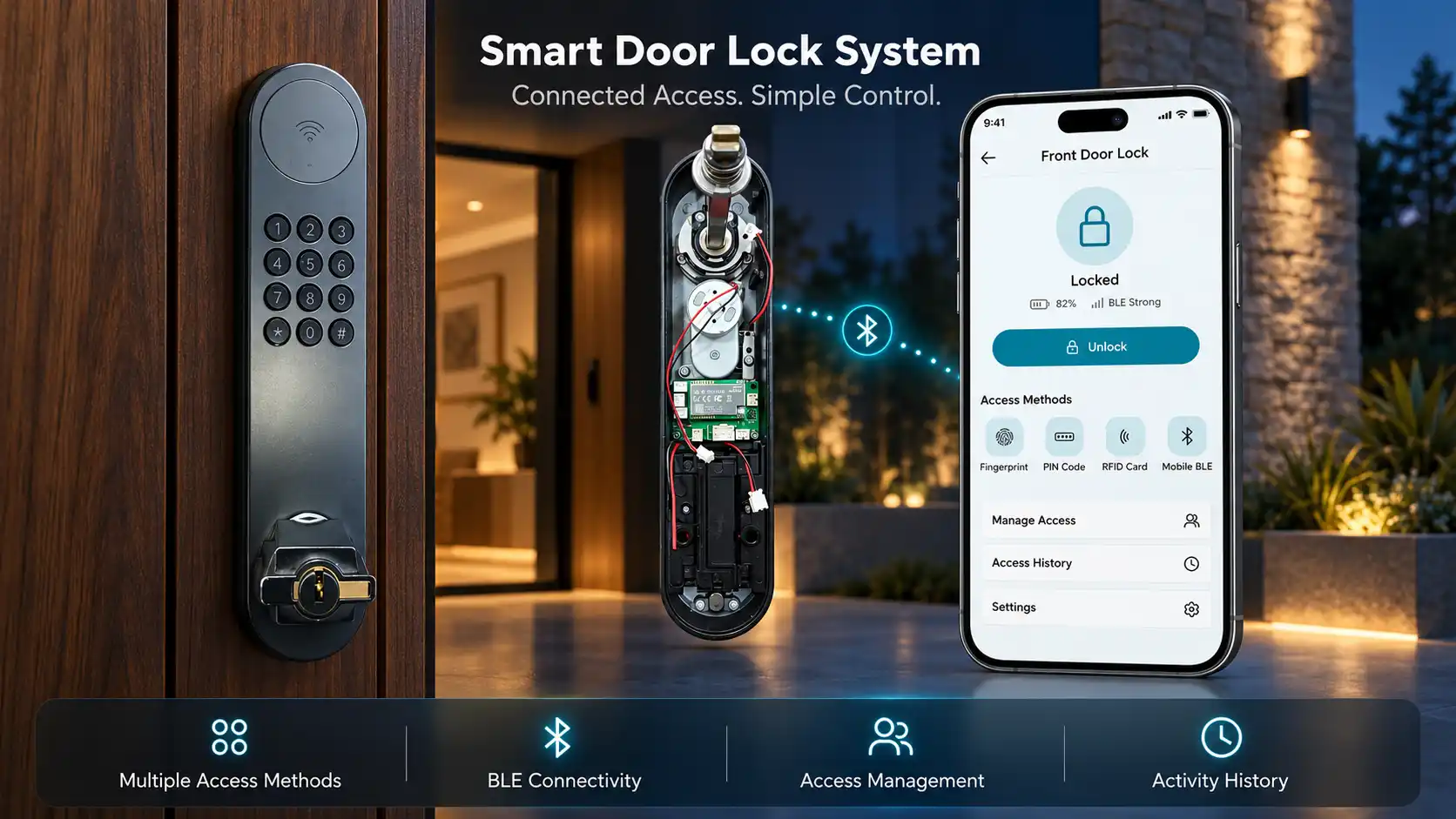
Multi-brand smart-lock platform
Our case study presents an innovative European-based platform unifying different variants of smart locks, mobile applications, time-defined codes and alerts for bookings.
In this case, neither nRF54 nor Matter was used, making the project relevant for setting rules of access and ownership, remote operation and consistent interface of the devices and the application.
Read Case StudyOur nRF54 Matter and Thread Development Services
Matter firmware for application
We utilize the nRF Connect SDK by Nordic and its demonstration applications. Matter firmware has endpoints, callbacks from clusters, attributes that stay put, possible events, subscription, identify behavior, binding in terms of groups, scenes and device algorithms in general.
We utilize the nRF Connect SDK by Nordic and its demonstration applications. Matter firmware has endpoints, callbacks from clusters, attributes that stay put, possible events, subscription, identify behavior, binding in terms of groups, scenes and device algorithms in general.
Hardware is independent of Matter specification. Switches, engines, sensors and locks provide access to controlled interfaces.
Thread networking and field resilience
We configure the OpenThread role, child timeout, polling, radio and coexistence. Tests cover attachment, parent loss, partition changes, border-router replacement, weak links, crowded channels and power cycles.
We configure the OpenThread role, child timeout, polling, radio and coexistence. Tests cover attachment, parent loss, partition changes, border-router replacement, weak links, crowded channels and power cycles.
Thread is mesh-capable, but metal enclosures, detuning, poor router density and interference can still cause failures. We use packet analysis, controlled attenuation and floor-plan trials rather than treating mesh as a range guarantee.
Commissioning and user experience
We implement commissioning, setup payloads, QR/manual codes, BLE advertising, onboarding windows, fail-safe behavior and reset. Tests use named controller, app and regional versions.
We implement commissioning, setup payloads, QR/manual codes, BLE advertising, onboarding windows, fail-safe behavior and reset. Tests use named controller, app and regional versions.
A branded app can add installation guidance, diagnostics, firmware status and services on iOS or Android. Its account model must not conflict with Matter fabric ownership.
PCB, antenna and low-power engineering
The hardware domain covers schematic designs, chip selection such as nRF54, power supply system, sensor application, driver implementation, and safety features, as well as configuration and assembly of hardware boards.
The hardware domain covers schematic designs, chip selection such as nRF54, power supply system, sensor application, driver implementation, and safety features, as well as configuration and assembly of hardware boards.
Antenna matching tests are performed inside the casing of the module. The module has the potential to lessen the effect of RF systems, whereas the chip-down approach enhances the power economization.
Battery calculations take into account different working modes, such as sleeping mode, sensor mode, commissioning mode, Thread mode, polling, communication, error handling, flash storage, and updates. Ascertain that power traces address both healthy device conditions and its lost parents.
Security, credentials and OTA updates
Matter commissioning sets up operational credentials. Device Attestation helps confirm product identity. Factory provisioning includes unique device data, protected keys, setup info and traceable records. Dev credentials do not mean production.
Matter commissioning sets up operational credentials. Device Attestation helps confirm product identity. Factory provisioning includes unique device data, protected keys, setup info and traceable records. Dev credentials do not mean production.
Firmware security can include secure boot, signed images, protected storage, rollback policy and resilient OTA. Testing includes eligibility, interruption, verification, installation, health confirmation and recovery. Signing and attestation keys remain controlled assets.
Border router, gateway and cloud integration
A product may depend on the consumer ecosystem or the Gateway or a specific manufacturer cloud. The document defines the local versus the internet-dependent operations.
A product may depend on the consumer ecosystem or the Gateway or a specific manufacturer cloud. The document defines the local versus the internet-dependent operations. The scope may include functions like the Border Router validation, bridging, telemetry, inventory, and remote support.
Matter fabrics differ from the accounts of the cloud. Functions of consent, mapping, deletion and ownership transfer must avoid conflict.
Interoperability and Certification Readiness
Certification starts with reviewing architecture. Requirements are determined according to the type of device and Matter version. The necessary evidence for the CSA process must be prepared. Nevertheless, the final approval belongs to an accredited program and laboratory.
The verification can be comprised of:
commissioning according to QR and manual code by taking into account failures and absence of validity; behavior of cluster, attribute, command, event, and subscription; margin of operations with multiple managers and getting rid of fabric; Thread joining, a change of parent, and recovery of the border router; verification of access control, wrong messages, and limits of orientation; factory reset, deleting data, and rebooting; OTA success, refusal, interference of events, and rollback; long-time tests, memory-oriented tests, tests with power and repeating process; and test in the environment of the Apple company or Google, Amazon, Samsung, etc.
The report notes the versions of the software used on the controller, hub, app, firmware, and SDK since the performance of the ecosystem may modify.
Interoperability failures: What do we analyze?
A failed commissioning process does not necessarily mean there is a problem with the radio. We distinguish between the different phases of interoperability including BLE discovery, setup-code decoding, attestation, operational credential exchange, Thread dataset transfer, creating access to the network, and CASE session establishment.
Packet captures, serial monitoring and measuring of the highlighting counters can locate the cause of the failure without leaving credentials exposed in production logs.
Operational problems are treated in a similar way. A command timeout can be the result of a child sleeping too long, lost subscription, outdated route, border-router behavior, access-control entry, or starvation of the task in the application.
We recreate the situation, collect the network topology information and confirm the repair of the service after the power outage. The process of diagnosis stage by stage is more effective than simply increasing the power or number of attempts.
From Evaluation Kit to Manufacturable Product
A typical engagement covers device modeling, SDK proof of concept, hardware, bring-up, firmware, power/RF optimization, interoperability, certification preparation and manufacturing handoff. Memory, sleepy-device latency, actuator safety and ecosystem risks are tested before tooling.
Deliverables can include source, build instructions, hardware files, commissioning workflow, API documentation, tests, power/RF reports, factory firmware, provisioning tools, release notes and limitations. Version pinning supports later upgrades.
Start Your nRF54 Matter Product
Communicate the desired type of device, power source, ecosystem, actuator/sensor specifications, countries of purpose. Adequate Infosoft can formulate nRF54 Matter-over-Thread architecture with measurable attributes for commissioning, interoperability, security and battery life.
Frequently Asked Questions
No. Matter refers to a standard on application layer, while Thread refers to a networking technology based on IPv6 mesh networking. The protocol nRF54L15 supports Matter via Thread, and Bluetooth LE is often used in the commissioning process.
It needs a Thread Border Router and Matter controller. Consumer hubs may combine these roles, but availability must be confirmed for each ecosystem.
Yes, subject to source, SDK, peripherals, memory, radio and certification strategy. We preserve behavior, then revalidate commissioning, Thread, security and power.
Matter supports the process of multi-admin making it possible for devices to join several fabrics if it is used correctly. We test the required combinations and share the results of the workflow and removal processes instead of assuming that we will get the same results in different ecosystems.
Editorial Resources
- Nordic Semiconductor — nRF54L15 product overview
- Nordic Semiconductor — Matter protocol overview
- Nordic Semiconductor — Thread protocol overview
- Nordic Developer Academy — Matter Fundamentals for nRF54L Series and nRF Connect SDK
- Connectivity Standards Alliance — Matter
- Thread Group — Thread technical overview