














 Mean Stack Development
 Vue JS Development
 Javascript Development
 React JS Development
 Angular JS Development
 Next JS development
 Java Development
 Python Development
 Django Development
 Cherrypy Development
 C# Development
 ASP.NET Development
 NodeJS Development
 Laravel Development
 CodeIgniter Development
 Zend Development
 Ruby on Rails Development
 CakePHP Development
 PHP Website Development
 Symfony Development
 Drupal Development
 Joomla Development
 Wordpress Development
 .NET Nuke Development
 Kentico
 Umbraco
 .NET MAUI Development
 Xamarin Application Development
 iOS Application Development
 Android Application Development
 Android Wear App Development
 Ionic Development
 iBeacon Application Development
 Universal Windows Platform (UWP)
 Kotlin Application Development
 Swift Application Development
 Flutter Application Development
 PWA Application Development
 Flutter Health Tech & Wearable App Development Company
 React Native Health Tech Wearable App Development
 Offshore Software Development
 Custom Application Development
 Front-End Development
 Full Stack Development
 AI & Machine Learning
 Custom CRM Solutions
 Flask Software Development
 Electron JS Development
 ChatGPT Development
 Telemedicine App Development
 Build Smart Telemedicine Platform
 Beauty & Salon App Solutions
 Hire Workato Experts
 Magento Development
 Magento 2.0 Development
 Magento Enterprise
 Shopping Cart Development
 Prestashop Development
 Shopify Development
 Open Cart Development
 WooCommerce Development
 BigCommerce Development
 NopCommerce Development
 Virto Commerce Development
 AspDotNetStorefront Development
 .NET Application Development
 Microsoft Dynamics CRM
 VB .NET Development
 Sharepoint Migration
 ASP.NET Core Development
 ASP.NET MVC Development
 AJAX Development
 Agile Development
 Microsoft Bot
 Microsoft Blazor
 Microsoft Azure Cognitive
 HTML 5
 UI/UX Design
 Graphic Design
 Adobe Photoshop
 XML Application Development
 Cloud Computing Solutions
 Azure Cloud App Development
 AWS Development
 Google Cloud Development
 Certified AWS IoT Services Developers
 DevOps Consulting & Development
 Kubernetes Consulting & Services
 SQL Programming Development
 MySQL Development
 MongoDB Development
 Big Data
 Robotic Process Automation
 Social Media Marketing
 Search Engine Optimization
 QA Testing
 Software Testing
 Software Security
 Maintenance And Support
 I.T. Consulting Services
 Business Intelligence
 YII Development
 Data Analysis
 Alexa Skills Development
 On Demand App for Mobile repairing services
 On Demand App for Car Service Booking
 On Demand App for Cleaning Services
 On Demand App for Pharmacy
 On Demand Dedicated Developers
 On Demand Lawyer App Development








 Nuki Smart Lock
 Salto Smart Lock
 TTlock Smart Lock
 NFC App Development
 Custom IOT Enabled Smart Lock
 Smart Locker Solutions
 Hospital Smart Lock Systems
 Hotel Smart Lock Systems
 Smart Home & Office Locks
 Smart Access for Schools & Colleges
 Unloc Smart Lock Integration
 Yale & August Smart Lock Integration
 Populife Smart Lock Integration
 Smart Lock Hardware Development
 Dairy IoT Solutions
 Agri IoT & AI Solutions
 Weather & Climate Solutions
 Water & Waste Management Solutions
 RaspBerry Pi
 Firmware Software Development
 ESP 32 Software Development
 Embedded Development
 Internet of Things
 Smart IoT Development
 IoT Sensor Integration & Development Solutions
 Smart IoT System Development for HVAC
 Tuya IoT App Development
 Particle IoT SDK
 IoT Development with AI
 Smart Pet GPS Tracker
 Dairy GPS Tracking Solutions
 GPS Fleet Management Software
 Car Rental & Subscription Solutions
 Car Buy & Sell Marketplace Development
 AI-Powered Car Wash App Development
 PCB Design & Fabrication
 IoT AC Automation
 AI–IoT Painting Solutions
 IoT Wearable Hardware & App Development
 HVAC Automation & AI Control Systems
 Smart Home IoT Engineering
 AI Embedded Systems
 AI Hardware Design Service
 Advanced IoT Hardware & Firmware Development
 Device Driver Development Services
 NXP i.MX RT Firmware & Hardware Services
 Microchip PIC & AVR Development
 Hire IoT Architects
 IoT Cloud & Infrastructure Solutions
 Infineon XMC / AURIX Development Services
 Matter & Thread IoT Services
 Native IoT Mobile App Development (BLE & Wi-Fi)
 Snapdragon IoT Firmware Development
 Renesas RA/RX Firmware Services
 Silicon Labs EFR32 Development Services
 Smart Wearable App Development
 Smart IoT Meters
 Smart Healthcare Wearable App Development
 Health Care Monitoring System
 Fitness Tracking App Development
 Smart Home Automation Apps
 nRF PCB Design
 ESP32 PCB Design
 Embedded Wearables Engineers
 Rental Property Management System
 Building Management System
 Smart Lighting Development
 Infineon Semiconductor Firmware Development Services
 Custom Camera Development: Hardware, Firmware & PCB Prototyping
 Smart Security Camera SDK
 Nordic Semiconductor SDK
 Infineon SDK
 Arduino SDK
 NFC Lock Integration
 Kerong Lock Integration
 IoT & AI Solutions for Manufacturing
 Smart Inventory & Logistics Solution
 Food & Beverage Industry Solutions
 Smart Hospitality Solutions
 Smart Property Management
 Custom Smart Home IOT SDK
 Smart IoT & AI in Healthcare
 AI-Powered Security Solutions
 Smart Home Safety & AI
 Veterinary Clinic Management (AI)
 Pet Care System (AI & IoT)
 Pet Training & Adoption (AI)
 Healthcare IoT Development
 Event Management Software
 Money Remittance App
 Money Lending App Development
 Utility and Bill Payment App
 IoT Mobile App Development (Flutter & React Native)
 AI & IoT Retail Solutions
 Smart EV App Development
 Smart Solar IoT & AI Solutions
 IoT-Based Energy Systems
 Smart Energy & Utilities Solutions
 6G Solutions
 IoT Security Solutions
 AI-Powered Lottery App Development
 AI-Sports Fitness Club Management
 Travel
 Real Estate
 Medical & Healthcare
 e-Learning
 Consumer Products
 Finance
 Automobile
 Media & Entertainment
 Billing Software
 Enterprise Resource Planning (ERP)
 Augumented & Virtual Reality
 Point of Sale(POS) Development
 Learning Management System
 EV Charging Solutions
 About Us
 Partners & Certifications
 Quality Assurance
 Our Clients & Testimonials
 Development Process
 Our Products
 Social Responsibility
 Work Ethics
 Vision & Mission
 Awards
 Live Project Demos
 Contact Us
 Case Studies
 Portfolio
 Blog
Blog
ESP32 Wearable and Medical Device Development Company
Connected health products must collect clean sensor data, protect sensitive information, operate on a small battery, and communicate reliably with a phone or cloud platform. A weak early hardware or firmware decision can become an expensive problem when the product moves from proof of concept to field testing.
Adequate Infosoft is an ESP32 wearable and medical device development company helping startups, healthcare technology businesses, OEMs, and research teams turn product concepts into dependable connected devices.
We operate in a variety of sectors including electronics, embedded software, Bluetooth and Wi-Fi, mobile apps, cloud connectivity, testing, and material preparation.
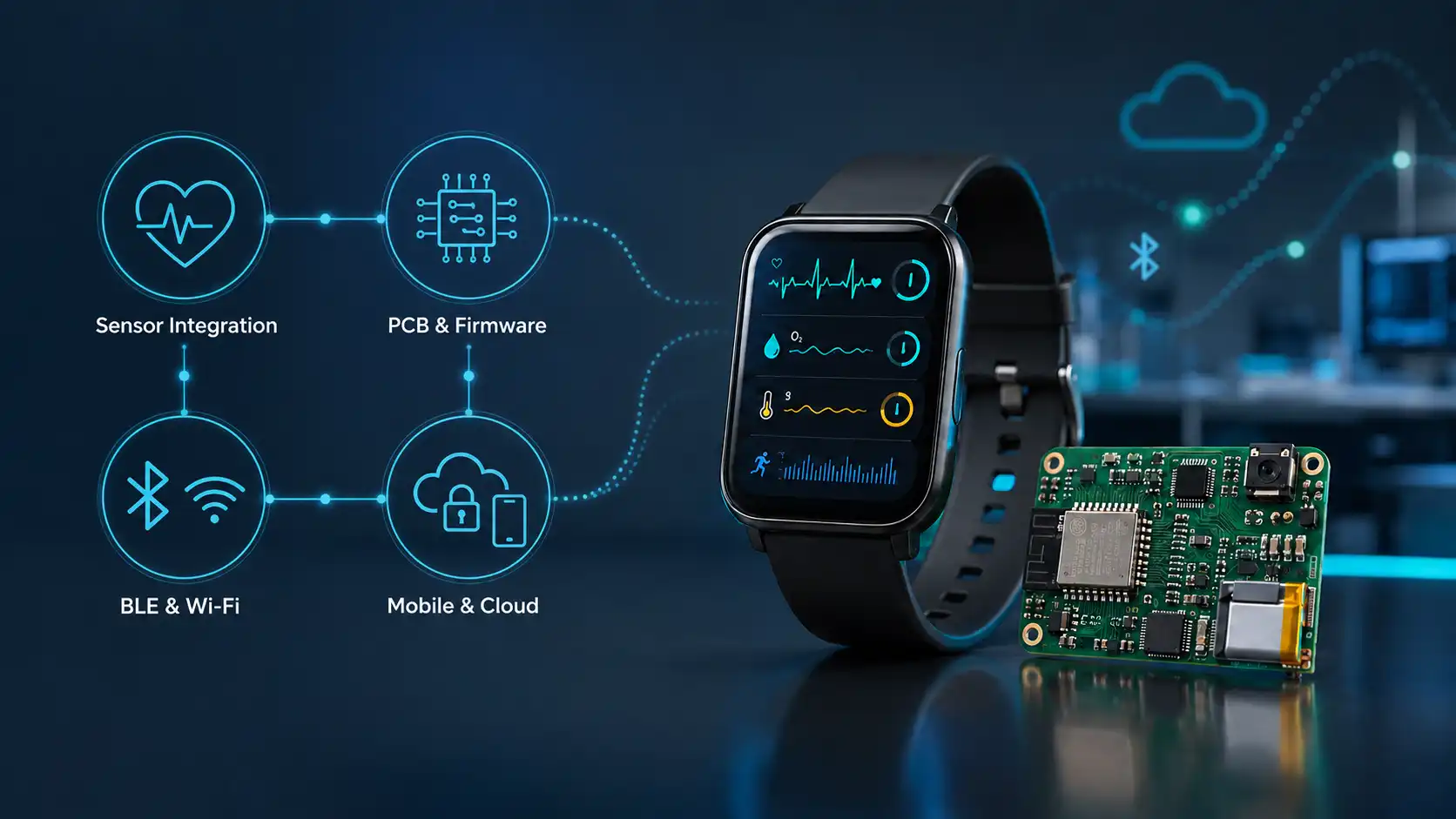
We design the whole path of the data flow, from the sensor in the hands of the user to the data board used by the doctor, the caregiver, or the client. Systematic design guarantees that the development of the solution is easier to test, support, produce, and scale.
Why Use ESP32 for Wearable and Medical Device Development?
The ESP32 family combines processing, wireless communication, flexible peripherals, and a mature software ecosystem in a compact platform. Depending on the model, a product can use Bluetooth Low Energy for phone connectivity, Wi-Fi for direct cloud communication, or both.
For the purposes of many new applications, the ESP32-S3 is a very useful chip. It has 2.4 GHz Wi-Fi and Bluetooth Low Energy built in, along with both a dual-core microcontroller and a power-saving coprocessor, as well as functionalities for speeding up the data processing.
This feature set allows the device to process data from sensors, recognize correlation in motion data, perform some basic calculation on board, or compress the data before transmitting it in relevant situations.
Choosing an ESP32 is only the beginning. Wearable performance also depends on antenna placement, enclosure materials, sensor contact, sampling strategy, radio duty cycles, and sleep-state design. We evaluate these factors together.
Our ESP32 Wearable and Medical Device Development Services
Product Discovery and Technical Planning
We define the intended use, user, operating environment, and consequences of a wrong reading or alert. The product idea then becomes system requirements, hardware blocks, communication flows, power targets, security needs, and an achievable roadmap.
ESP32 Hardware and PCB Design
Our engineers develop prototypes for PCBs with complex designs for compact battery operated products.
The designs may incorporate an ESP32 module, sensors (including optical and temperature sensors), an IMU, analog frontend circuits, displays, haptic feedback modules, buttons, parts for charging, battery protection units, external memory components, and debugging access.
We consider antenna clearance, RF noise, grounding, sensor isolation, heat sources, skin-contact areas, and design for manufacturing. Early builds can begin with an evaluation-board prototype before moving to a custom PCB.
Embedded Firmware Development
We create firmware that can be kept up-to-date using techniques such as ESP-IDF and, when applicable, FreeRTOS tasks.
Typical tasks that we work on include creating sensor drivers, settling on the sampling and calibration logic, digital filtering, local data storage, managing the power state, error control, restoring the device after a possible crash or failure, and coding Bluetooth GATT services and Wi-Fi onboarding as well as over-the-air update of firmware.
We define clear interfaces between sensing, processing, storage, connectivity, and updates so faults can be traced and features changed without destabilizing the device.
Bluetooth, Wi-Fi, Mobile App, and Cloud Integration
Bluetooth Low Energy technology is used in various wearable devices when coupled with an Android or iOS app. A home-monitoring device may also upload its readings using the Wi-Fi network without the need for a phone. When designing communication systems, the developers consider several factors, including power consumption, size of data payloads, connection frequency, how to function offline, and overall customer experience.
Our team can deliver the companion mobile app, device onboarding, account management, live readings, historical charts, reminders, notifications, and secure cloud APIs. We also integrate devices with healthcare portals, remote monitoring dashboards, or an existing IoT platform.
Power Optimization for Wearable Products
Battery life cannot be fixed at the end of development. Instead we quantify the current consumption for sensor sampling, processing, advertising, connection, transmitting of data, idle, and sleep period. Accordingly, firmware scheduling can be optimized so that power consuming components are only active when required.
Options include event-driven wake-up, buffered transmissions, adaptive sampling, Bluetooth tuning, or a Wi-Fi-enabled charging dock. The right approach depends on whether monitoring is continuous, periodic, or on demand.
Security and Reliable Updates of Devices
Connected medical and wellness devices need security from the device manager, application, API, and operations side. Secure boot is good to prevent unauthorized firmware running on supported ESP32 devices, and flash encryption would limit risks connected with code or sensitive information extraction through external flash.
Safe device identity, authentication, secured communications, storage of the rights, secured OTA transfer, backup, access restrictions, logging and vulnerability handling are in our plans for security.
Prototype Testing and Production Support
We evaluate another alternative other than the regular route. Our examination can include loss of connection to sensors, battery discharge, disrupted updates, damaged packets, unavailable internet connection, reconnection of application, limits of memory, extended operation period, and return after sudden power restoration.
With the design progresses, we lend support in the areas of component selection, analyses of BOM. testing apparatuses, developing of manufacturing software, installation, test productions, and field investigations. We cooperate with enclosure designers, laboratories, manufacturers, and authorities.
Project We Delivered: ESP32-S3 Remote Health Monitoring Wearable
The Product Challenge
A customer dealing in digital health contacted us regarding an idea of a monitoring device meant to be worn on the wrist for supervised home care programs. The features needed to consist of pulse-related optical data, blood-oxygen reading, skin temperature trends, and information about movement. The users of this device were supposed to wear it all day long without the possibility of being connected to the phone.
The first proof of concept could display sensor values, but it was not ready for a pilot. Readings became unstable when the wearer moved, Bluetooth synchronization occasionally stopped after the phone changed state, and the battery drained too quickly. The client also needed a practical method for updating firmware after devices had been issued.
Hardware and Firmware Solution
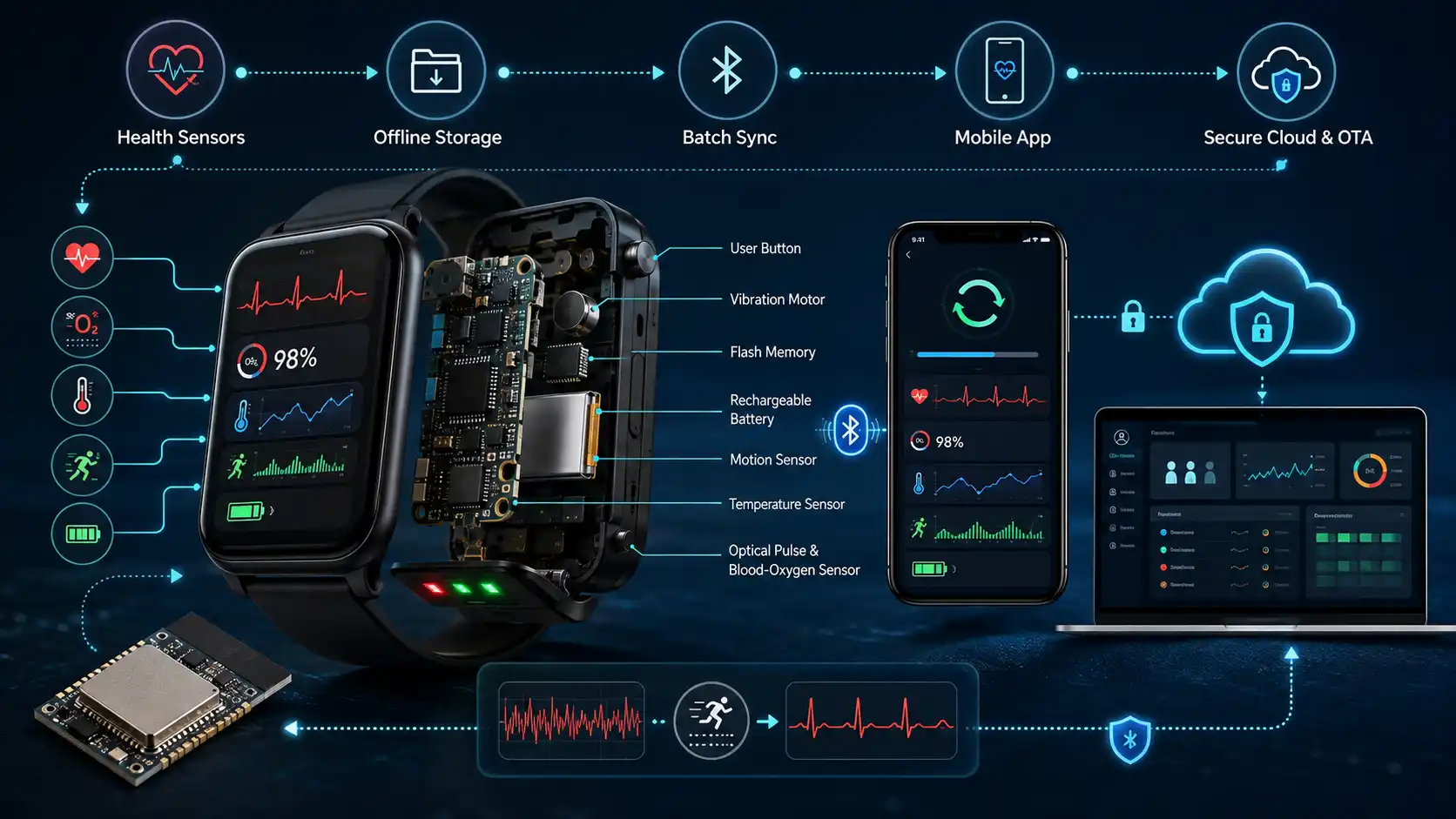
We redesigned the prototype based on an ESP32-S3 module and a customized compact PCB. The circuit board involved an optical sensor, a skin temperature sensor, a motion sensor, a rechargeable battery, a protection and charging circuit, local flash memory, a vibration motor, and a user button.
Component placement was reviewed to reduce interference between the optical measurement area, power circuitry, and radio section.
On the firmware side, we created separate modules for sensor acquisition, time stamped storage, motion-aware filtering, Bluetooth communication, device health, and power control. Motion data was used to tag periods in which optical readings were more likely to be affected by movement.
Rather than transmitting every raw sample, the device stored structured measurement windows and synchronised them in batches. This made reconnection more predictable and reduced radio-on time.
Mobile, Cloud, and Update Workflow
A mobile companion workflow was created and had multiple functions, including: onboarding, background syncing, information on the wearer, measurement history, battery life, and updates for the firmware.
If the phone is not available, the device saves the information locally and resumes uploading data with the last transmitted piece. Cloud APIs processed the synced information and stored it for upcoming role-based monitoring.
For maintainability, we added signed over-the-air firmware updates with version checks, staged installation, and recovery handling. Production configuration separated development credentials from device-specific identities.
We also prepared test cases covering interrupted synchronization, full local storage, low battery, sensor errors, reset recovery, and failed update attempts.
Project Outcome
The result was a pilot-ready connected wearable platform with more stable data capture, reliable offline storage, resembles synchronization, and a firmware architecture that the client could extend.
We delivered the hardware architecture set, inbuilt firmware, integration with mobile systems, links to the cloud, testing documents, and materials to assist in production. Since the project was secret, there are no indications of the client and product.
Real-Life Projects That Showcase Our ESP32 Expertise
Our ESP32 wearable and medical devices showcase our complete capabilities in design, sensor integration, PCB design, firmware development, power consumption optimization, wireless communication, mobile application development, cloud solutions, prototypes, testing, and manufacturing documentation.
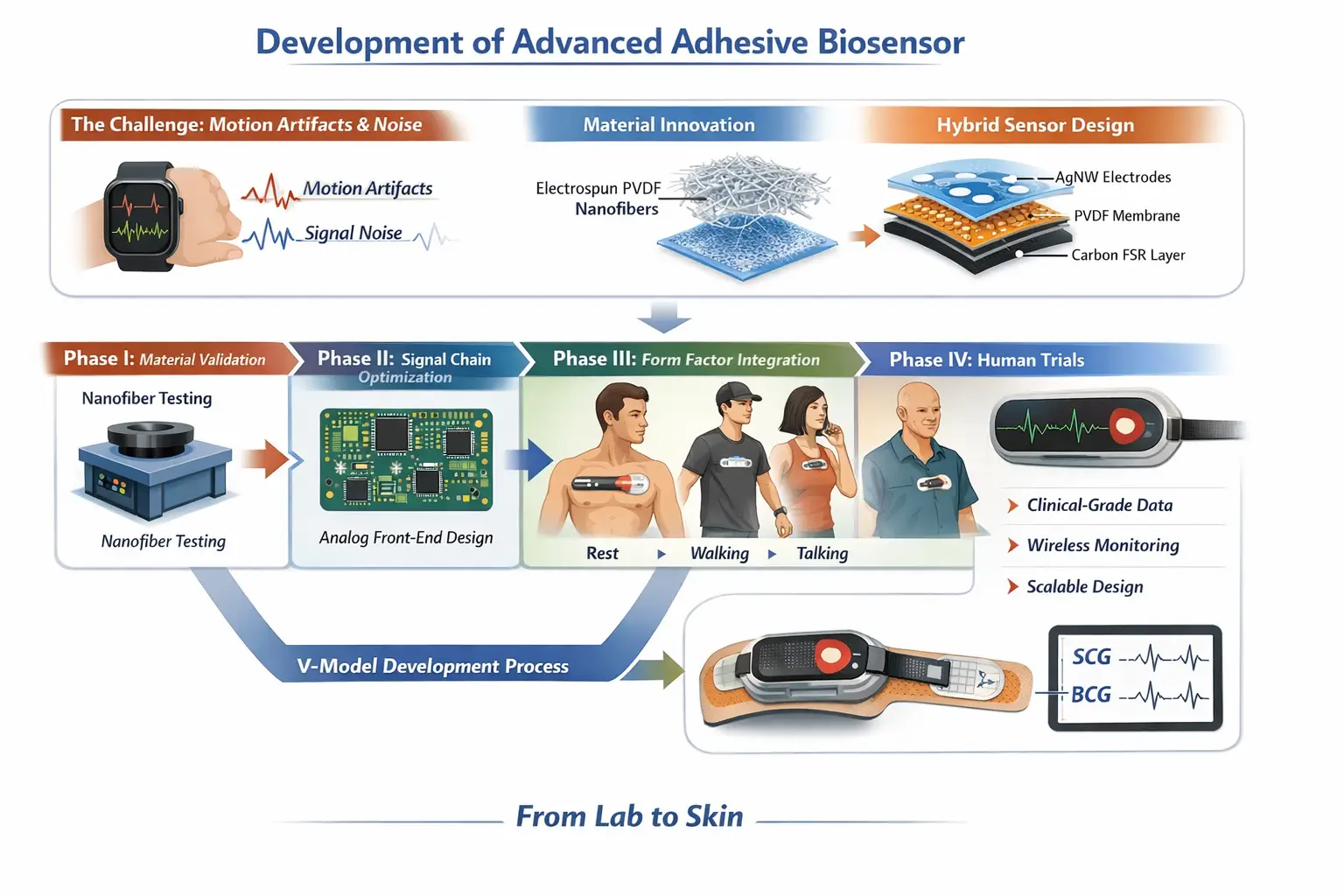
1. Wearable Adhesive Biosensor Using PVDF Nanofibers and ESP32-S3
We developed a flexible biosensor that adapts to the contours of the skin via the combination of electrospun PVDF nanofibers and an ESP32-S3 for continuous physiological monitoring.
The re-useable electronics module consists of an INA128 instrumentation amplifier, an ADS1256 24-bit ADC, real-time digital filtering, BLE 5.0 transmission and LiPo power management among other features.
Our work covered sensor architecture, analog signal-chain optimization, embedded firmware, PCB refinement, motion-noise reduction, prototype integration, and validation, resulting in an investor-ready platform capable of capturing subtle cardiac and muscular signals during movement and clinical research workflows.
View Case Study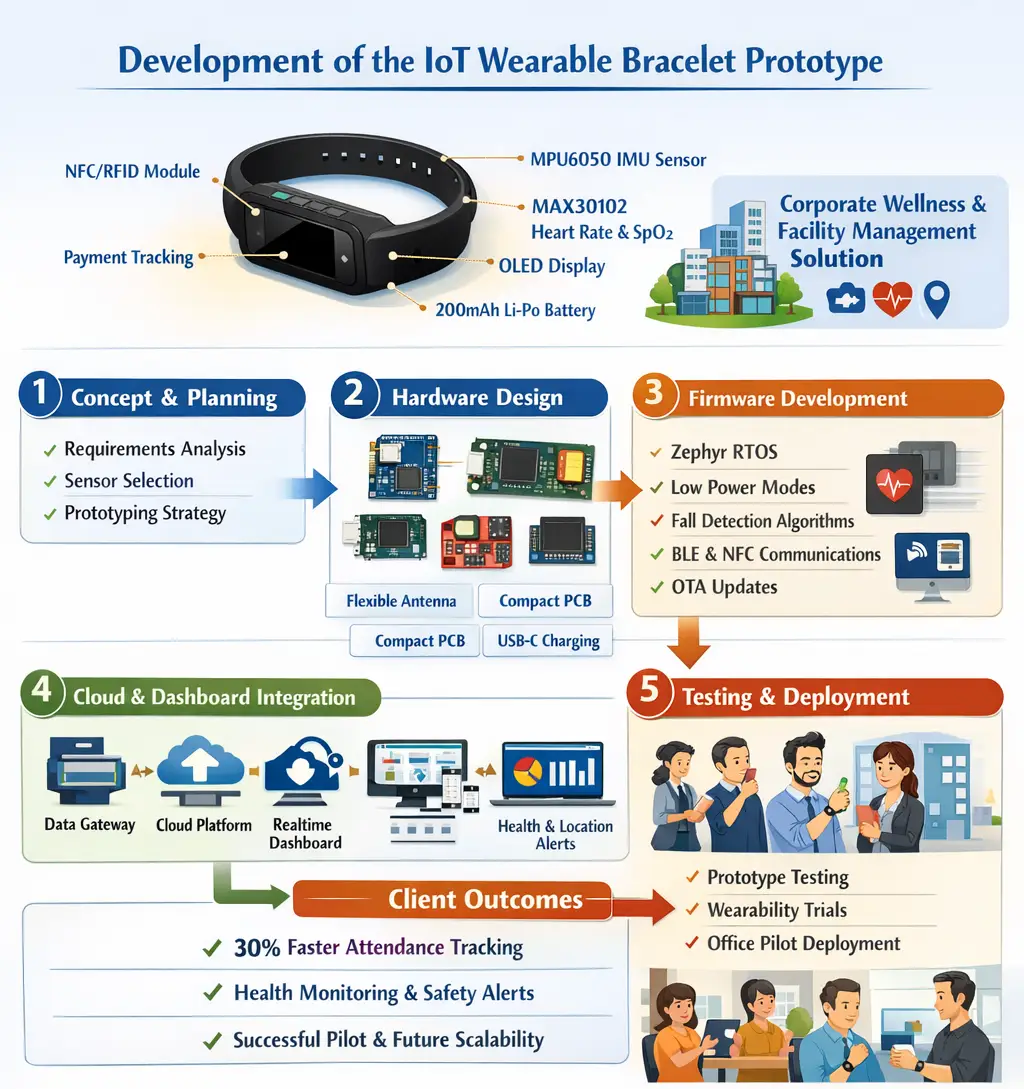
2. IoT Wearable Bracelet Prototype Using ESP32-S3
An ESP32-S3 wearable wristband was design for use in corporate wellness management, workplace safety management, attendance monitoring, and indoor positioning system operation. The small-sized device is capable of measuring heart rate and SpO2 levels, detecting motion and fall, and supporting BLE, Wi-Fi, and NFC communications.
Our specialists worked on the system architecture, component selection, PCB design, embedded software development, power optimization, integration with dashboards, mobile embedded protocol, as well as prototyping and testing of the device.
The resulting scalable prototype delivered more than 48 hours of operation while supporting real-time health, activity, proximity, and attendance data at scale.
View Case Study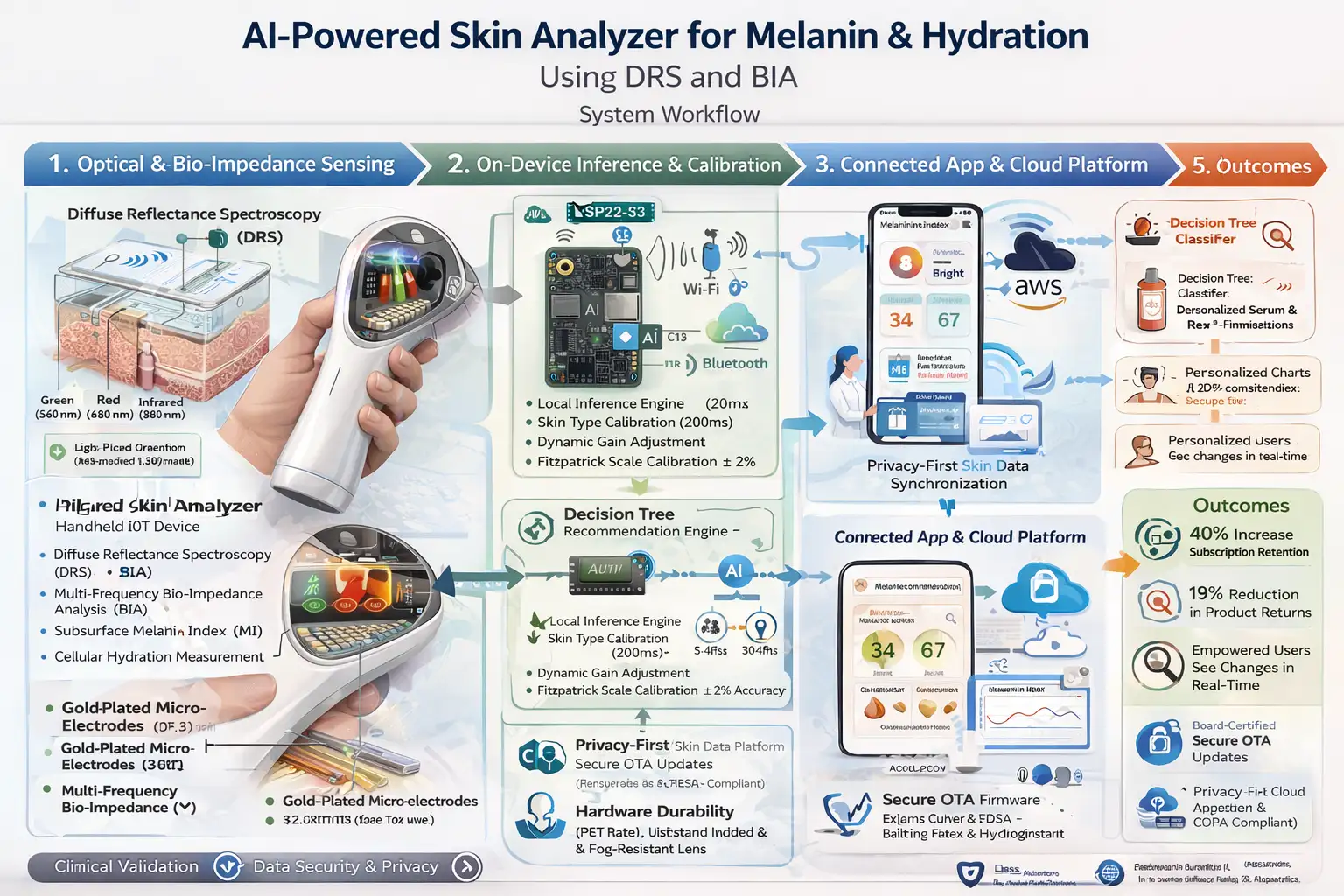
3. ESP32-S3 Skin Biometrics Device for Melanin and Hydration Analysis
We've created a portable ESP32-S3 skin analysis tool for an Australian skincare client that can measure melanin and hydration levels without any invasive methods.
The technology utilizes different wavelengths of diffuse reflectance spectroscopy, bio-impedance analysis, and non-intrusive light shielding technology.
We have engineered the sensing architecture, PCB, ESP-IDF firmware, Bluetooth, and Wi-Fi communication, vibration signals, secure over-the-air updates, synchronization with mobile devices, and a cloud recommendation system.
The prototype produced fast, repeatable readings across diverse skin tones and supported personalized dermatology and skincare recommendations for connected care workflows and monitoring.
View Case Study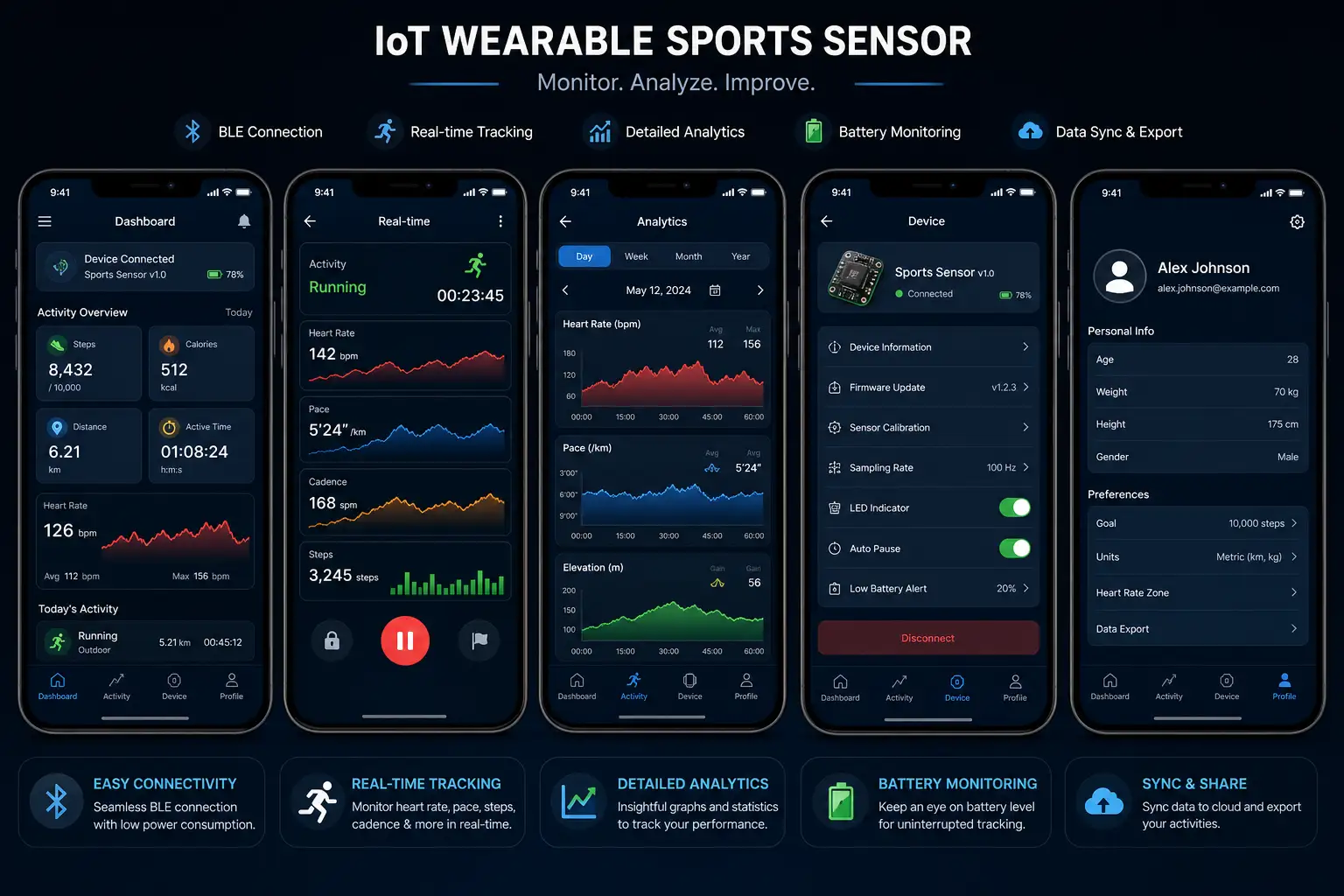
4. ESP32-Based IoT Wearable Sports Sensor
Our designed product is an ESP32-based portable sports sensor designed for fitness and sports enthusiasts. This custom PCB design consists of an ESP32-S3 microcontroller, a six- or nine-axis IMU sensor, a battery management system, a USB-C connector for programming and charging, and Bluetooth and Wi-Fi communication modules.
Our design process involved the selection of the components, creation of schematics, PCB layout, placement considering RF issues, and power circuits engineering; as well as the preparation of the manufacturing process.
We delivered production-ready schematics, Gerber files, a sourced bill of materials, and pick-and-place data suitable for prototype runs and scalable manufacturing from initial prototypes through volume production.
View Case StudyEngineering for Medical, Wellness, and Research Use Cases
ESP32 technology is the basis for various categories of connected devices, including activity and recovery monitors, rehabilitation wearables, medication reminders, temperature sensors, home-care devices, connected diagnostic instruments, elderly-safety products, employee wellness monitors, and research loggers.
The intended use matters. A general wellness device and a regulated medical device may use similar sensors, but they do not carry the same evidence, risk, documentation, or regulatory obligations. We help teams define the boundary early and design with traceability in mind.
Where applicable, development activities can be aligned with a client's quality and risk processes, including ISO 13485, ISO 14971, IEC 62304, usability engineering, cyber security, and market-specific regulatory expectations. Product certification or regulatory clearance remains the responsibility of the legal manufacturer and relevant authorized specialists.
Why Work with Adequate Infosoft?
Wearable development often becomes fragmented: one vendor designs the board, another writes firmware, and a third builds the app without understanding device constraints. Our team brings these disciplines together. That reduces integration gaps and gives the client one engineering partner for the connected product as a whole.
Our services extend from conducting feasibility studies and rescuing prototypes to building custom PCBs, embedded software, applications, and cloud services, as well as testing and production handoff. We can also work on existing designs.
We can analyze an ESP32 prototype, identify battery and connectivity problems, modify code, implement security updates, or prepare the product for the next construction.
Build Your ESP32 Wearable or Connected Health Product
If you have a project in mind that involves creating an ESP32 device for your health-related product or wearable technology, please get in touch with us.
Share your intended use, sensor requirements, expected battery life, connectivity needs, enclosure constraints, and current prototype status with our team.
Contact Adequate Infosoft to discuss ESP32 wearable and medical device development, from initial architecture to a production-ready connected product.