














 Mean Stack Development
 Vue JS Development
 Javascript Development
 React JS Development
 Angular JS Development
 Next JS development
 Java Development
 Python Development
 Django Development
 Cherrypy Development
 C# Development
 ASP.NET Development
 NodeJS Development
 Laravel Development
 CodeIgniter Development
 Zend Development
 Ruby on Rails Development
 CakePHP Development
 PHP Website Development
 Symfony Development
 Drupal Development
 Joomla Development
 Wordpress Development
 .NET Nuke Development
 Kentico
 Umbraco
 .NET MAUI Development
 Xamarin Application Development
 iOS Application Development
 Android Application Development
 Android Wear App Development
 Ionic Development
 iBeacon Application Development
 Universal Windows Platform (UWP)
 Kotlin Application Development
 Swift Application Development
 Flutter Application Development
 PWA Application Development
 Flutter Health Tech & Wearable App Development Company
 React Native Health Tech Wearable App Development
 Offshore Software Development
 Custom Application Development
 Front-End Development
 Full Stack Development
 AI & Machine Learning
 Custom CRM Solutions
 Flask Software Development
 Electron JS Development
 ChatGPT Development
 Telemedicine App Development
 Build Smart Telemedicine Platform
 Beauty & Salon App Solutions
 Hire Workato Experts
 Magento Development
 Magento 2.0 Development
 Magento Enterprise
 Shopping Cart Development
 Prestashop Development
 Shopify Development
 Open Cart Development
 WooCommerce Development
 BigCommerce Development
 NopCommerce Development
 Virto Commerce Development
 AspDotNetStorefront Development
 .NET Application Development
 Microsoft Dynamics CRM
 VB .NET Development
 Sharepoint Migration
 ASP.NET Core Development
 ASP.NET MVC Development
 AJAX Development
 Agile Development
 Microsoft Bot
 Microsoft Blazor
 Microsoft Azure Cognitive
 HTML 5
 UI/UX Design
 Graphic Design
 Adobe Photoshop
 XML Application Development
 Cloud Computing Solutions
 Azure Cloud App Development
 AWS Development
 Google Cloud Development
 Certified AWS IoT Services Developers
 DevOps Consulting & Development
 Kubernetes Consulting & Services
 SQL Programming Development
 MySQL Development
 MongoDB Development
 Big Data
 Robotic Process Automation
 Social Media Marketing
 Search Engine Optimization
 QA Testing
 Software Testing
 Software Security
 Maintenance And Support
 I.T. Consulting Services
 Business Intelligence
 YII Development
 Data Analysis
 Alexa Skills Development
 On Demand App for Mobile repairing services
 On Demand App for Car Service Booking
 On Demand App for Cleaning Services
 On Demand App for Pharmacy
 On Demand Dedicated Developers
 On Demand Lawyer App Development







 Nuki Smart Lock
 Salto Smart Lock
 TTlock Smart Lock
 NFC App Development
 Custom IOT Enabled Smart Lock
 Smart Locker Solutions
 Hospital Smart Lock Systems
 Hotel Smart Lock Systems
 Smart Home & Office Locks
 Smart Access for Schools & Colleges
 Unloc Smart Lock Integration
 Yale & August Smart Lock Integration
 Populife Smart Lock Integration
 Smart Lock Hardware Development
 Dairy IoT Solutions
 Agri IoT & AI Solutions
 Weather & Climate Solutions
 Water & Waste Management Solutions
 RaspBerry Pi
 Firmware Software Development
 ESP 32 Software Development
 Embedded Development
 Internet of Things
 Smart IoT Development
 IoT Sensor Integration & Development Solutions
 Smart IoT System Development for HVAC
 Tuya IoT App Development
 Particle IoT SDK
 IoT Development with AI
 Smart Pet GPS Tracker
 Dairy GPS Tracking Solutions
 GPS Fleet Management Software
 Car Rental & Subscription Solutions
 Car Buy & Sell Marketplace Development
 AI-Powered Car Wash App Development
 PCB Design & Fabrication
 IoT AC Automation
 AI–IoT Painting Solutions
 IoT Wearable Hardware & App Development
 HVAC Automation & AI Control Systems
 Smart Home IoT Engineering
 AI Embedded Systems
 AI Hardware Design Service
 Advanced IoT Hardware & Firmware Development
 Device Driver Development Services
 NXP i.MX RT Firmware & Hardware Services
 Microchip PIC & AVR Development
 Hire IoT Architects
 IoT Cloud & Infrastructure Solutions
 Infineon XMC / AURIX Development Services
 Matter & Thread IoT Services
 Native IoT Mobile App Development (BLE & Wi-Fi)
 Snapdragon IoT Firmware Development
 Renesas RA/RX Firmware Services
 Silicon Labs EFR32 Development Services
 Smart Wearable App Development
 Smart IoT Meters
 Smart Healthcare Wearable App Development
 Health Care Monitoring System
 Fitness Tracking App Development
 Smart Home Automation Apps
 nRF PCB Design
 ESP32 PCB Design
 Embedded Wearables Engineers
 Rental Property Management System
 Building Management System
 Smart Lighting Development
 Infineon Semiconductor Firmware Development Services
 Custom Camera Development: Hardware, Firmware & PCB Prototyping
 Smart Security Camera SDK
 Nordic Semiconductor SDK
 Infineon SDK
 Arduino SDK
 NFC Lock Integration
 Kerong Lock Integration
 IoT & AI Solutions for Manufacturing
 Smart Inventory & Logistics Solution
 Food & Beverage Industry Solutions
 Smart Hospitality Solutions
 Smart Property Management
 Custom Smart Home IOT SDK
 Smart IoT & AI in Healthcare
 AI-Powered Security Solutions
 Smart Home Safety & AI
 Veterinary Clinic Management (AI)
 Pet Care System (AI & IoT)
 Pet Training & Adoption (AI)
 Healthcare IoT Development
 Event Management Software
 Money Remittance App
 Money Lending App Development
 Utility and Bill Payment App
 IoT Mobile App Development (Flutter & React Native)
 AI & IoT Retail Solutions
 Smart EV App Development
 Smart Solar IoT & AI Solutions
 IoT-Based Energy Systems
 Smart Energy & Utilities Solutions
 6G Solutions
 IoT Security Solutions
 AI-Powered Lottery App Development
 AI-Sports Fitness Club Management
 Travel
 Real Estate
 Medical & Healthcare
 e-Learning
 Consumer Products
 Finance
 Automobile
 Media & Entertainment
 Billing Software
 Enterprise Resource Planning (ERP)
 Augumented & Virtual Reality
 Point of Sale(POS) Development
 Learning Management System
 EV Charging Solutions
 About Us
 Partners & Certifications
 Quality Assurance
 Our Clients & Testimonials
 Development Process
 Our Products
 Social Responsibility
 Work Ethics
 Vision & Mission
 Awards
 Live Project Demos
 Contact Us
 Case Studies
 Portfolio
 Blog
Blog
ESP32-Based Smart-Lock Development Company
Adequate Infosoft is an ESP32-based smart-lock development company helping lock manufacturers, property technology businesses, startups, hospitality providers, and access-control companies build connected locking products.
Our work covers product architecture, electronics, PCB design, embedded firmware, Bluetooth and Wi-Fi communication, mobile applications, cloud platforms, security, testing, and production support.
A smart lock utilizes both hardware and software, security measures, and the way people normally behave. Its reaction must occur rapidly and it must also operate without the need for internet, be able to protect sensitive information, and work for a few months just using some battery power.
In addition, it should also offer some guarantee of retrieval of access codes in case of loss of the phone, the battery running out, or technical failure.
We can either create a new concept or improve an existing prototype. An ESP32 controller, an app, and a cloud service functioning together as one access system were developed to provide clear ownership of codes, commands, events, and failures.
Why Choose ESP32 for Smart-Lock Development?
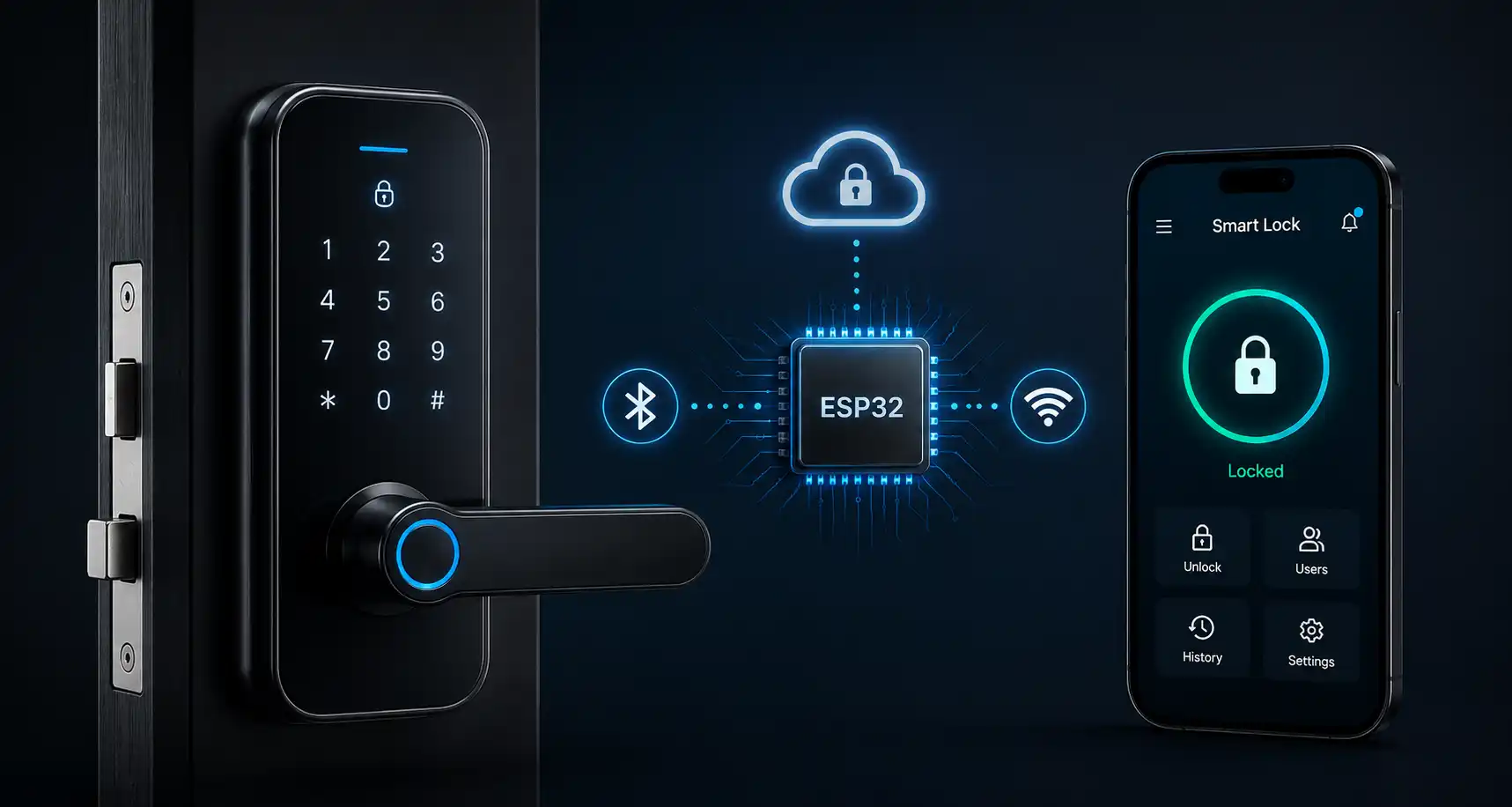
The ESP32 family includes processors, hybrid peripherals, Bluetooth Low Energy and Wi-Fi on the majority of its variations, power management options, and a proper ESP-IDF programming platform. As a result, the group meets the requirements for locks that provide local phone access, those which are managed via the Internet, or both.
Bluetooth Low Energy allows nearby app access without depending on the building's internet. Wi-Fi can support remote commands, audit uploads, health reporting, time updates, and firmware delivery.
Architecture may use Wi-Fi in every lock, activate it only when required, or place continuous connectivity in a gateway to protect battery life.
ESP32 is the control platform, not the entire product. A dependable lock also needs a suitable motor, protected driver circuitry, position sensing, battery measurement, emergency access, and an appropriate enclosure. Decisions depend on the door, users, access volume, and risk.
Our ESP32 Smart-Lock Development Services
Product Architecture and Feasibility
We first define the lock type, whether it uses a phone, PIN, RFID or NFC credential, fingerprint, remote administrator, or several methods, and what must happen during a network or battery failure.
The answers become a system architecture, power budget, hardware plan, security requirements, prototype roadmap, and preliminary bill of materials. Feasibility testing confirms motor torque, antenna behaviour, sensors, and expected energy use.
Electronics and Custom PCB Design
Our engineers develop schematics and compact PCB layouts around the selected ESP32 variant. A board may include motor drivers, current sensing, Hall-effect or limit sensors, keypad inputs, an external NFC reader, fingerprint module, buzzer, LEDs, tamper switch, battery protection, charging circuitry, external flash, and secure peripheral components where required.
Layout work considers RF clearance, motor noise, transient protection, grounding, power paths, programming access, heat, and manufacturing tests. We coordinate with the mechanical design so all components fit correctly.
ESP32 Firmware Development
We build structured firmware with ESP-IDF and FreeRTOS facilities where appropriate. Typical components include lock-state management, motor control, obstruction detection, position calibration, credential validation, Bluetooth GATT services, Wi-Fi provisioning, local event storage, time handling, battery monitoring, watchdog recovery, and over-the-air updates.
The locking logic is structured as an explicit state machine. This prevents the issuing of contradictory instructions and makes testing the rarer events such as jams while locking, sensor inconsistencies or a initialization during the motion safer and easier.
Mobile App and Cloud Platform Development
We create applications for Android and iOS to manage setups, verification, nearby unlocking, remote access to permissions, history logs, and alerts for low battery, and firmware updates. The technology is helpful to homeowners, installers, property managers, residents, visitors or cleaning crew members.
We build APIs and portals for sites, doors, locks, users, roles, schedules, temporary permissions, audit events, alerts, and device status. Integrations can connect booking systems, property software, alarms, identity providers, or an existing IoT cloud.
Multiple Access Methods and Scheduling
A lock may support owners, recurring staff, one-time visitors, time-limited guests, and emergency access. We keep local credential behavior consistent with the cloud record.
Depending on the hardware, access can include mobile keys, PIN codes, RFID or NFC cards, fingerprints, remote commands, and traditional mechanical override. We also plan revocation, expired access, time-zone changes, daylight-saving transitions, clock correction, and behavior when the lock has been offline.
Security from Device to Cloud
Smart lock safety does not hinge on the concept of hiding a Bluetooth command or having the same password for all devices.
Our company offers identity specific to the device, verified provisioning, permissions based on roles, protected storage of credentials, secured means of communication, validating commands, repulsion of replications, limiting rates, and security-related auditing events.
Supported ESP32 devices can use secure boot to reject unauthorized firmware and flash encryption to reduce exposure of code and data stored in external flash.
We can also implement signed OTA packages, controlled rollback, per-environment keys, production provisioning, debug-interface restrictions, and a process for security updates after deployment.
Battery-Life and Connectivity Optimization
Radio use, motor current, operating sensors, indicators, and consumption during idle mode have a cumulative effect on battery life. Instead of relying on component data sheets, we measure the actual cycle of operation.
Firmware is capable of managing radios and peripherals in sleeping mode and revive them when a button is pressed or when a touch event occurs.
Where locks receive heavy traffic or must report continuously, a mains-powered gateway may be more appropriate than direct Wi-Fi. We help select the design that balances response time, infrastructure cost, battery life, and offline capability.
Project We Delivered: ESP32 Smart Lock for Managed Apartments
The Client's Challenge
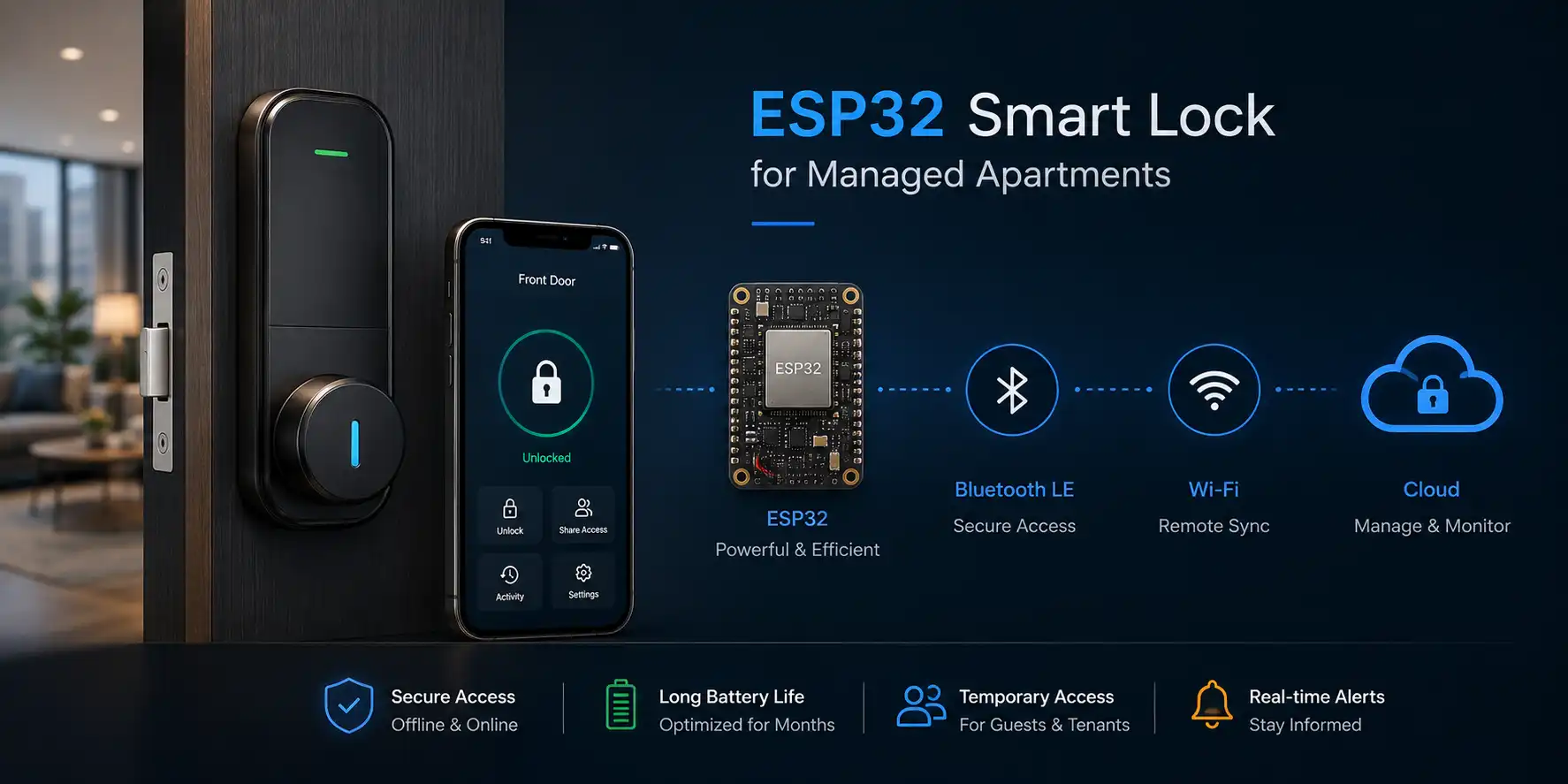
A prop-tech personal brand asked us for a connected retrofit lock development for managed apartments and short-term rentals. Its previous prototype was capable of rotating the thumb-turn from a mobile application. However, it was not easy to provision, it required long-term battery consumption, and it might lose the position after manual rotations.
The business also needed temporary guest access without requiring a permanent internet connection at every door.
Hardware and Embedded Development
We have created a small controller based on ESP32 module utilizing Bluetooth Low Energy as well as Wi-Fi. Hardware components comprise, among other things, geared-motor driver, current measurement device, position sensors, status input, tamper detection system, battery monitoring, local switch, and safe wiring for programming.
The mechanical and firmware teams worked in tandem to establish the calibration settings for various door types.
The firmware used a clear lock-state model covering locked, unlocked, moving, jammed, calibrating, and low-battery conditions. Motor current and position feedback were evaluated together, allowing the device to stop movement when it reached its limit or encountered an obstruction. A manual thumb turn updated the electronic state rather than leaving the app with outdated information.
Access, Offline Behavior, and Applications
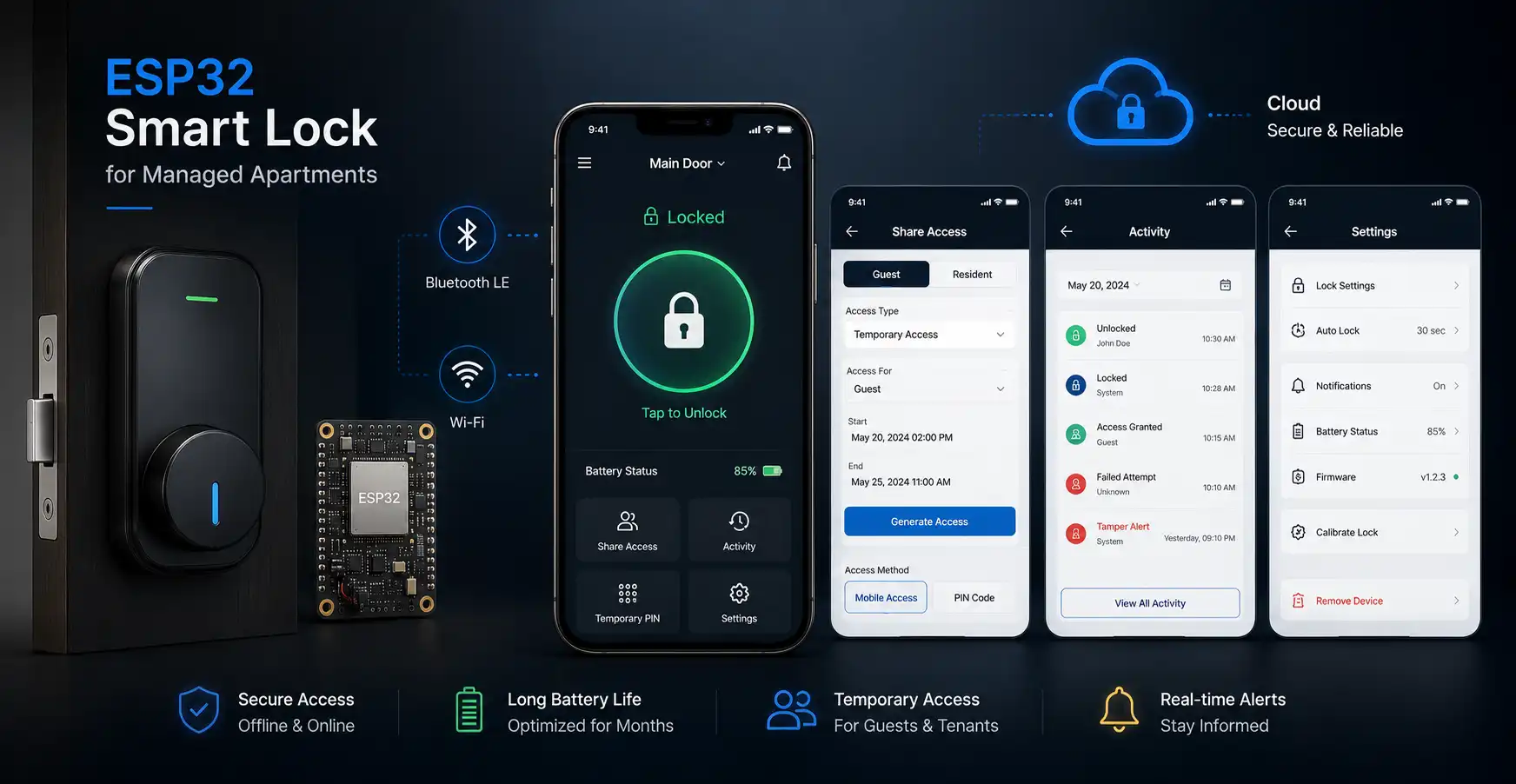
We implemented secure mobile onboarding and nearby Bluetooth unlocking. Owners and property managers could issue time-limited mobile permissions and PIN credentials from a web portal.
The lock stored the permissions needed for upcoming stays, so authorized access continued when Wi-Fi or cloud services were unavailable. Events were kept locally with sequence information and uploaded when communication returned.
The companion apps covered installation, calibration, lock control, guest sharing, battery status, and activity history. A management portal allowed staff to organize buildings, apartments, users, roles, and access periods. We added alerts for repeated failed attempts, tamper events, low battery, and a lock that did not reach its expected position.
Security, Updates, and Result
The production peripherals were assigned with their own device identifiers and did not have any credentials on a fleet basis. The firmware versions were verified, delivered to devices through an OTA process, and installed only when conditions connected with battery safety were satisfactory.
In the course of testing, we executed the test case scenarios that included interrupted updates, expired access, phone change, time modifications, offline usage, motor obstacles, sensor mismatch, manual operation, and restoration after a reset.
The completed platform gave the client a pilot-ready smart lock with reliable state tracking, temporary offline access, central property management, and a maintainable update path. We delivered the PCB package, embedded firmware, mobile integration, cloud APIs, portal features, test documentation, and production-provisioning workflow. Client-identifying details are omitted because the engagement was confidential.
Testing and Production Preparation
We examine repeated motor cycles, low voltage operation, blocking, sensor faults, communication suspension, command duplication, unauthorized attack, storage fullness, power shutdown, and reset recovery. A series of tests has shown memory, timing issues, reconnection problems, and event queue status.
For production, we support component reviews, manufacturing test firmware, fixtures, serial-number and identity provisioning, release configuration, pilot builds, and field diagnostics. Certification needs vary by radio module, market, lock type, and installation, so we coordinate with the client's laboratories and compliance specialists rather than making blanket certification claims.
Why Work with Adequate Infosoft
A connected lock succeeds only when mechanics, electronics, firmware, apps, cloud services, and security agree about the door's state and the user's authority. Our multidisciplinary team works across those boundaries. That reduces gaps between vendors and makes failures easier to investigate.
We assist homeowners with their products, rental access solutions, hospitality technology, office locks, cabinet locks, storage products, industrial enclosures, and white-label solutions. The collaboration can commence through initial discussions, rapid prototyping, reviewing existing designs, or complete product development programs.
Start Your ESP32 Smart-Lock Project
If you are working on an ESP32 smart lock or modernizing today's version of an internet of things device, please share what kind of lock it is, what kind of mechanical arrangement it uses, what kind of credentials are used or preferred, and how many accesses are expected. Give us a clear idea of your connectivity needs, battery goals, and prototype development stage.
Contact Adequate Infosoft to discuss ESP32-based smart-lock development, from early architecture and PCB design to firmware, mobile apps, cloud management, testing, and production support.