














 Mean Stack Development
 Vue JS Development
 Javascript Development
 React JS Development
 Angular JS Development
 Next JS development
 Java Development
 Python Development
 Django Development
 Cherrypy Development
 C# Development
 ASP.NET Development
 NodeJS Development
 Laravel Development
 CodeIgniter Development
 Zend Development
 Ruby on Rails Development
 CakePHP Development
 PHP Website Development
 Symfony Development
 Drupal Development
 Joomla Development
 Wordpress Development
 .NET Nuke Development
 Kentico
 Umbraco
 .NET MAUI Development
 Xamarin Application Development
 iOS Application Development
 Android Application Development
 Android Wear App Development
 Ionic Development
 iBeacon Application Development
 Universal Windows Platform (UWP)
 Kotlin Application Development
 Swift Application Development
 Flutter Application Development
 PWA Application Development
 Flutter Health Tech & Wearable App Development Company
 React Native Health Tech Wearable App Development
 Offshore Software Development
 Custom Application Development
 Front-End Development
 Full Stack Development
 AI & Machine Learning
 Custom CRM Solutions
 Flask Software Development
 Electron JS Development
 ChatGPT Development
 Telemedicine App Development
 Build Smart Telemedicine Platform
 Beauty & Salon App Solutions
 Hire Workato Experts
 Magento Development
 Magento 2.0 Development
 Magento Enterprise
 Shopping Cart Development
 Prestashop Development
 Shopify Development
 Open Cart Development
 WooCommerce Development
 BigCommerce Development
 NopCommerce Development
 Virto Commerce Development
 AspDotNetStorefront Development
 .NET Application Development
 Microsoft Dynamics CRM
 VB .NET Development
 Sharepoint Migration
 ASP.NET Core Development
 ASP.NET MVC Development
 AJAX Development
 Agile Development
 Microsoft Bot
 Microsoft Blazor
 Microsoft Azure Cognitive
 HTML 5
 UI/UX Design
 Graphic Design
 Adobe Photoshop
 XML Application Development
 Cloud Computing Solutions
 Azure Cloud App Development
 AWS Development
 Google Cloud Development
 Certified AWS IoT Services Developers
 DevOps Consulting & Development
 Kubernetes Consulting & Services
 SQL Programming Development
 MySQL Development
 MongoDB Development
 Big Data
 Robotic Process Automation
 Social Media Marketing
 Search Engine Optimization
 QA Testing
 Software Testing
 Software Security
 Maintenance And Support
 I.T. Consulting Services
 Business Intelligence
 YII Development
 Data Analysis
 Alexa Skills Development
 On Demand App for Mobile repairing services
 On Demand App for Car Service Booking
 On Demand App for Cleaning Services
 On Demand App for Pharmacy
 On Demand Dedicated Developers
 On Demand Lawyer App Development









 Nuki Smart Lock
 Salto Smart Lock
 TTlock Smart Lock
 NFC App Development
 Custom IOT Enabled Smart Lock
 Smart Locker Solutions
 Hospital Smart Lock Systems
 Hotel Smart Lock Systems
 Smart Home & Office Locks
 Smart Access for Schools & Colleges
 Unloc Smart Lock Integration
 Yale & August Smart Lock Integration
 Populife Smart Lock Integration
 Smart Lock Hardware Development
 Dairy IoT Solutions
 Agri IoT & AI Solutions
 Weather & Climate Solutions
 Water & Waste Management Solutions
 RaspBerry Pi
 Firmware Software Development
 ESP 32 Software Development
 Embedded Development
 Internet of Things
 Smart IoT Development
 IoT Sensor Integration & Development Solutions
 Smart IoT System Development for HVAC
 Tuya IoT App Development
 Particle IoT SDK
 IoT Development with AI
 Smart Pet GPS Tracker
 Dairy GPS Tracking Solutions
 GPS Fleet Management Software
 Car Rental & Subscription Solutions
 Car Buy & Sell Marketplace Development
 AI-Powered Car Wash App Development
 PCB Design & Fabrication
 IoT AC Automation
 AI–IoT Painting Solutions
 IoT Wearable Hardware & App Development
 HVAC Automation & AI Control Systems
 Smart Home IoT Engineering
 AI Embedded Systems
 AI Hardware Design Service
 Advanced IoT Hardware & Firmware Development
 Device Driver Development Services
 NXP i.MX RT Firmware & Hardware Services
 Microchip PIC & AVR Development
 Hire IoT Architects
 IoT Cloud & Infrastructure Solutions
 Infineon XMC / AURIX Development Services
 Matter & Thread IoT Services
 Native IoT Mobile App Development (BLE & Wi-Fi)
 Snapdragon IoT Firmware Development
 Renesas RA/RX Firmware Services
 Silicon Labs EFR32 Development Services
 Smart Wearable App Development
 Smart IoT Meters
 Smart Healthcare Wearable App Development
 Health Care Monitoring System
 Fitness Tracking App Development
 Smart Home Automation Apps
 nRF PCB Design
 ESP32 PCB Design
 Embedded Wearables Engineers
 Rental Property Management System
 Building Management System
 Smart Lighting Development
 Infineon Semiconductor Firmware Development Services
 Custom Camera Development: Hardware, Firmware & PCB Prototyping
 Smart Security Camera SDK
 Nordic Semiconductor SDK
 Infineon SDK
 Arduino SDK
 NFC Lock Integration
 Kerong Lock Integration
 IoT & AI Solutions for Manufacturing
 Smart Inventory & Logistics Solution
 Food & Beverage Industry Solutions
 Smart Hospitality Solutions
 Smart Property Management
 Custom Smart Home IOT SDK
 Smart IoT & AI in Healthcare
 AI-Powered Security Solutions
 Smart Home Safety & AI
 Veterinary Clinic Management (AI)
 Pet Care System (AI & IoT)
 Pet Training & Adoption (AI)
 Healthcare IoT Development
 Event Management Software
 Money Remittance App
 Money Lending App Development
 Utility and Bill Payment App
 IoT Mobile App Development (Flutter & React Native)
 AI & IoT Retail Solutions
 Smart EV App Development
 Smart Solar IoT & AI Solutions
 IoT-Based Energy Systems
 Smart Energy & Utilities Solutions
 6G Solutions
 IoT Security Solutions
 AI-Powered Lottery App Development
 AI-Sports Fitness Club Management
 Travel
 Real Estate
 Medical & Healthcare
 e-Learning
 Consumer Products
 Finance
 Automobile
 Media & Entertainment
 Billing Software
 Enterprise Resource Planning (ERP)
 Augumented & Virtual Reality
 Point of Sale(POS) Development
 Learning Management System
 EV Charging Solutions
 About Us
 Partners & Certifications
 Quality Assurance
 Our Clients & Testimonials
 Development Process
 Our Products
 Social Responsibility
 Work Ethics
 Vision & Mission
 Awards
 Live Project Demos
 Contact Us
 Case Studies
 Portfolio
 Blog
Blog
ESP32-H4 Wearable and BLE Audio Development Company
At Adequate Infosoft, we provide ESP32-H4 wearable and Bluetooth LE Audio development services for startups, healthcare technology companies, consumer electronics manufacturers, and established product businesses.
We develop connected products from the initial technical concept through hardware design, embedded firmware, mobile applications, testing, and production preparation.
Wearable products have difficult engineering requirements. They must be small enough to remain comfortable, responsive enough to feel polished, and efficient enough to run for long periods from a compact battery.
If the product also handles wireless audio, health data, touch controls, or continuous sensor readings, every hardware and firmware decision becomes more important.
Engineers in our team focus on electronics, Bluetooth integration, audio, power management, security, mobile apps, and cloud computing. Therefore, this helps us in being able to come out with a product that is fully finished and not just assemble different components like hardware, firmware, and app.
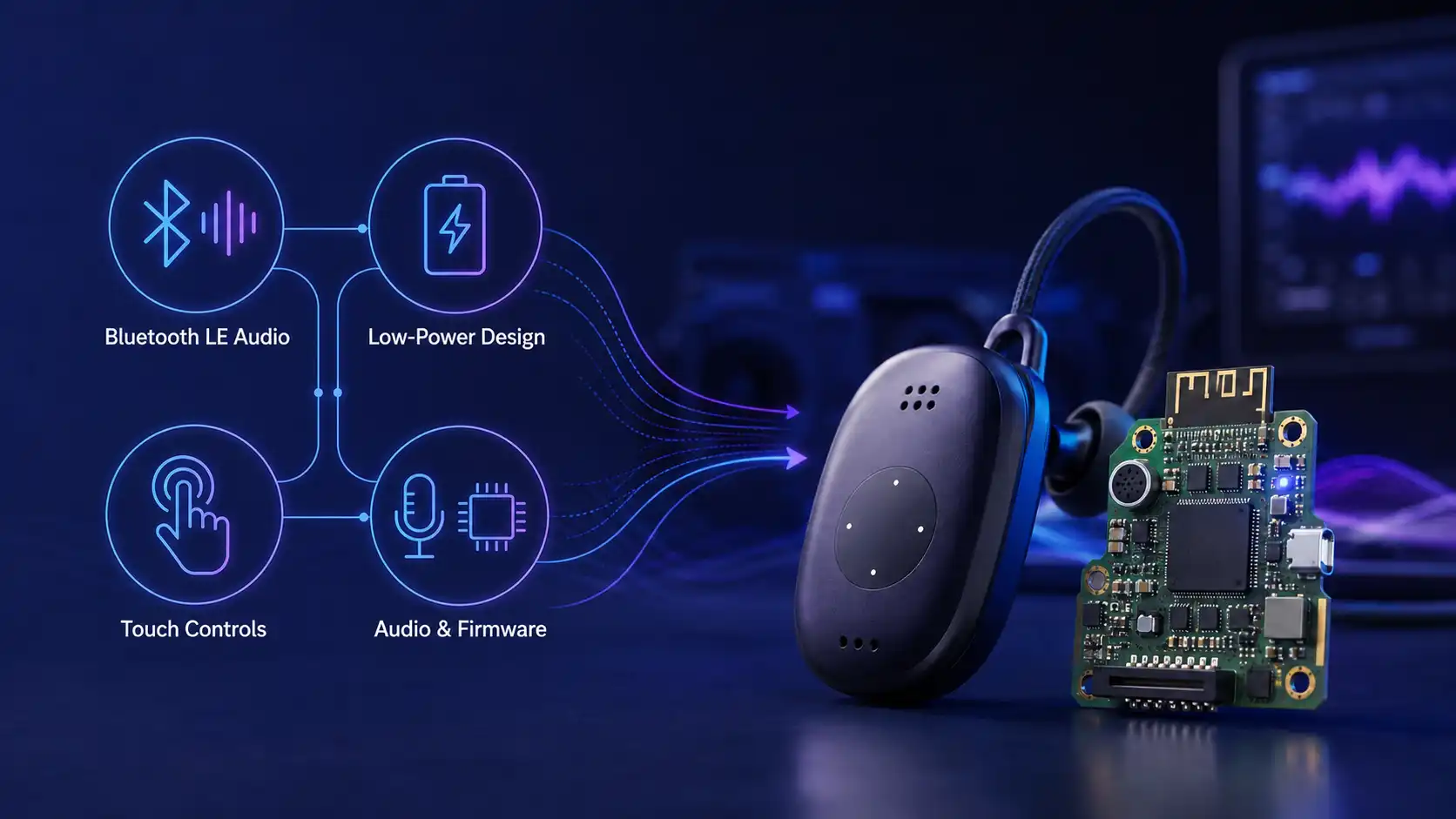
Why Use the ESP32-H4 for Wearable Development?
The ESP32-H4 is designed for battery-powered wireless products. It combines a dual-core 32-bit RISC-V microcontroller running at up to 96 MHz with Bluetooth Low Energy connectivity and hardware features intended to reduce energy consumption.
This chip consists of 384 KB of SRAM and 128 KB of ROM. If an application requires larger audio buffers or memory for its operation, external PSRAM support can be enabled.
The chip features an imbedded DC-DC converter, capability of performing various low-power modes, advanced energy saving options, along with the ability to conduct uncomplicated advertising operations without the need of turning the CPU on.
ESP32-H4 supports Bluetooth 5.4 LE features and has passed Bluetooth 6.0 certification. Its wireless capabilities include LE Audio, Connected and Broadcast Isochronous Streams, Connection Subrating, Periodic Advertising with Responses, and Bluetooth Direction Finding.
Up to 40 GPIOs and multiple interfaces including I2C, I2S, SPI, UART, ADC, USB OTG, PWM, DMA, and TWAI are also available. Fifteen touch-based GPIOs can be applied to build buttons, sliders, or other compact controls without the help of mechanical switches.
Project We Completed: ESP32-H4 Wearable Audio Assistance Prototype
The Product Requirement
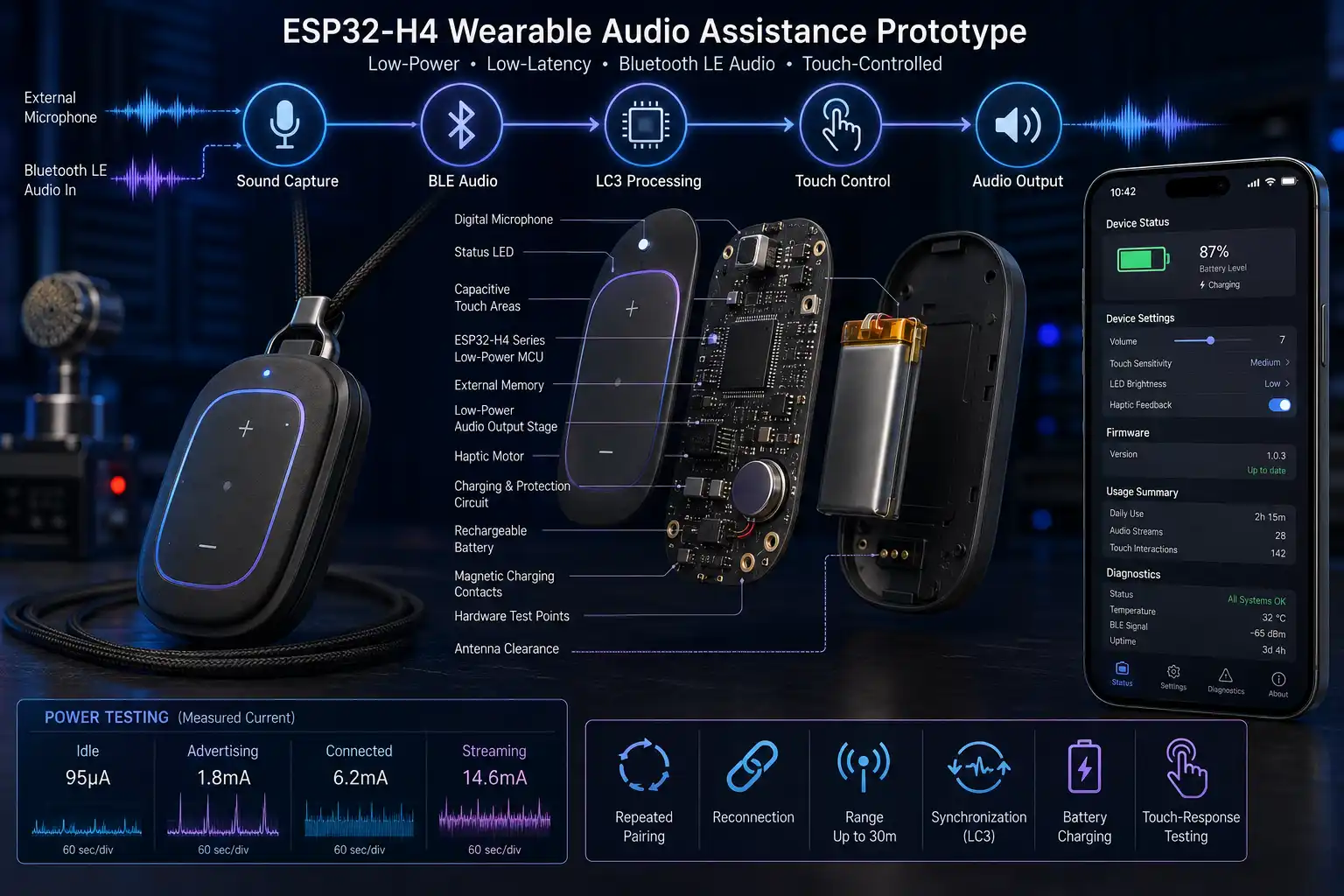
A healthcare technology company asked us to develop an engineering prototype for a lightweight wearable audio-assistance device. The proposed product was intended for conversations, training sessions, and small group environments where a user might benefit from clearer speech and a compact wireless form factor.
The system was required to pick up sound from outside the device and acquire the Bluetooth LE Audio signal, synthesize the audio with very low latency, and have touch controls for adjusting the volume level. It was prescribed to record a minimum of information related to usage and battery state to be accessed in the corresponding application on a mobile device.
Because ESP32-H4 samples had only recently become available, the client wanted to validate the platform before committing to a custom production enclosure and certification programme.
Hardware and Audio Architecture
We developed a compact prototype board around the ESP32-H4. The design included a digital microphone interface, low-power audio output stage, rechargeable battery, charging and protection circuit, status LED, haptic motor, and touch-control areas.
External memory was included for audio buffering and diagnostic data. We separated sensitive audio paths from switching and charging circuitry, while the antenna area was positioned to reduce interference from the battery and enclosure components.
A magnetic charging arrangement was used so the enclosure would not require a large external connector. Hardware test points were included for current measurement, programming, and audio-path troubleshooting.
BLE Audio and Wearable Firmware
The ESP-IDF Bluetooth LE Audio framework was utilized for the firmware to create the LE Audio profile layer with the isochronous transport.
For the purpose of the prototype, we designed the device as an audio listener with configured audio capabilities, control over the stream, the volume functions, and the LC3 processing flow.
The application managed pairing, stream start and stop events, buffer handling, audio output, touch input, battery reporting, and fault recovery. To keep the interface simple, one touch area controlled volume while another handled connection and operating modes.
We also implemented a conventional BLE service for battery status, firmware information, device settings, and diagnostic data. The mobile application used this service without interfering with the active audio stream.
Testing and Outcome
Testing included repeated pairing, audio-stream reconnection, distance, synchronization, touch response, charging characteristics, battery reporting, and performance at different signal levels.
We measured the actual power consumption at idle, advertising, connected, and streaming states rather than using one average number.
The completed prototype demonstrated the required audio path and gave the client measurable information about performance, battery size, memory requirements, and enclosure constraints.
It also identified the areas requiring further development before commercialization, including acoustic tuning, extended compatibility testing, production component selection, and formal certification.
Our Projects That Showcase Our Expertise
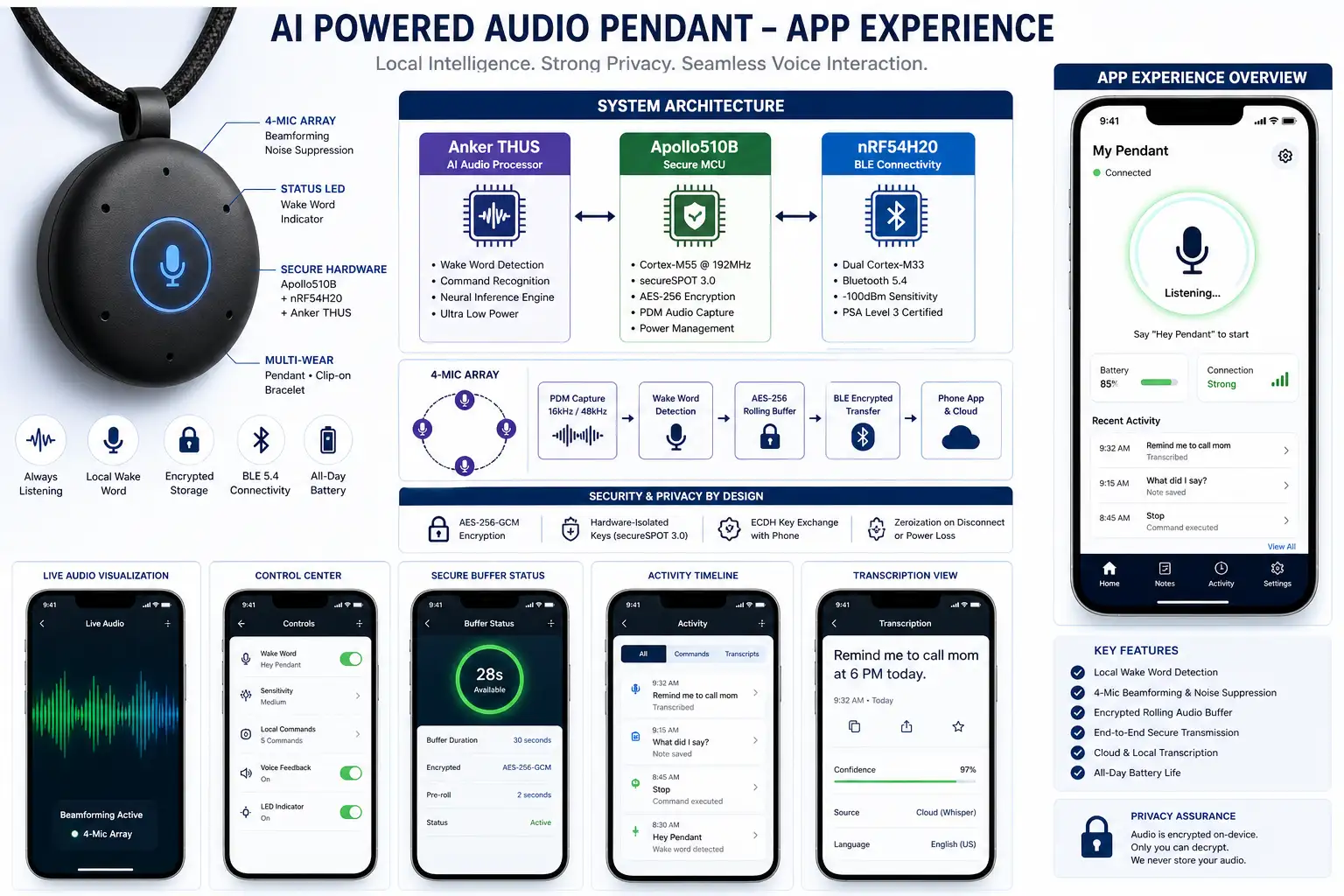
1. Wearable AI Audio Pendant with Local Wake Word and Encrypted Audio
An audio-enabled pendant, designed to protect your privacy, was made by us using Apollo510B, Nordic nRF54H20 and Anker THUS audio processor.
This final prototype incorporated the design features like four microphone array, beamforming, on-device wake word, on-device command, BLE connectivity, AES-256 encrypted rolling audio, power management and cloud transcription.
Our team delivered hardware integration, embedded firmware, audio processing, security architecture, testing, and production validation processes.
View Case Study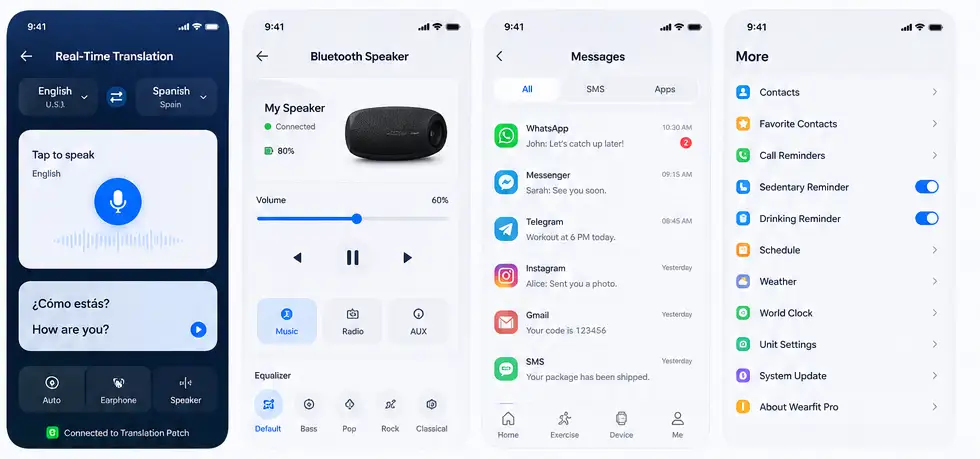
2. Smart Wearable Ecosystem App with Bluetooth Audio Integration
Our cross-platform wearable app ecosystem included functionalities for smartwatches, Bluetooth speakers, and translation patches.
Using React Native and Node.js, we can handle classic and BLE Bluetooth connection, speaker control, synchronization of notifications, translation, fitness tracking, Apple HealthKit connectivity, subscriptions, and cloud computing.
This project demonstrates our ability to create companion applications for connected audio products and multifunction wearable device ecosystems development.
View Case Study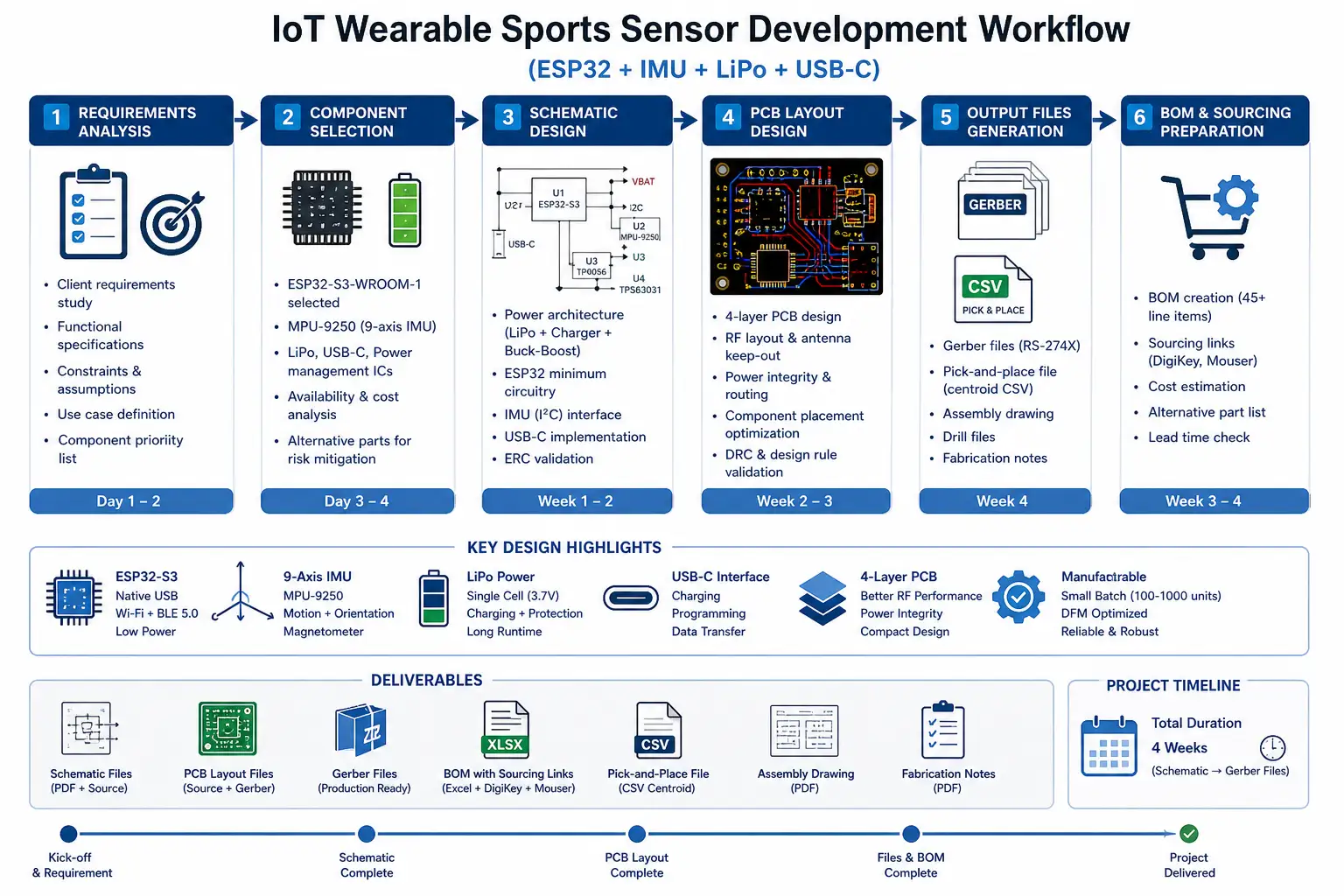
3. ESP32-Based IoT Wearable Sports Sensor
An ESP32-S3 sports sensor was designed to be worn by athletes and users of fitness equipment. The custom circuit design included an IMU (six-axis or nine-axis), BLE and WiFi, battery charging and management, USB-C for charging and programming.
Our deliverables included part selection, schematics, RF aware PCB layout, power optimization, validation, Gerber files for manufacturing, and a sourced bill of materials.
View Case Study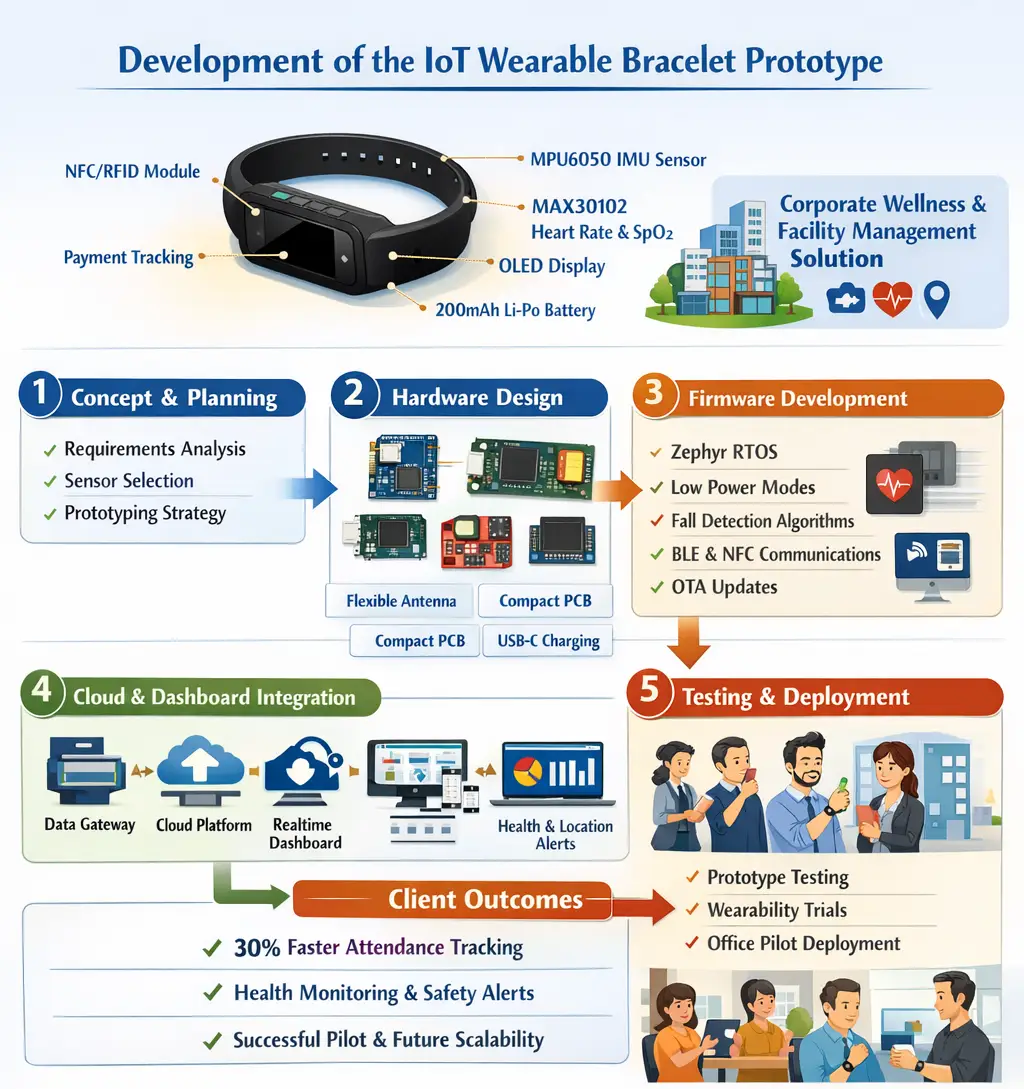
4. ESP32-S3 IoT Wearable Bracelet Development
A multi-purpose wearable bracelet for monitoring, attendance, workplace safety, and indoor location tracking was created using the ESP32-S3.
The project included features such as heart rate and SpO2 sensing, activity/fall detection, Bluetooth low energy, WiFi, NFC, secure cloud connectivity, dashboards, and mobile applications.
The job of our team was to design the architecture and customize the PCB for the project along with the embedded firmware, power management, and prototyping.
View Case StudyESP32-H4 Wearable Product Development Services
Wearable Hardware and PCB Design
Wearable hardware must fit within tight mechanical constraints while maintaining dependable radio performance. Our hardware engineers develop schematics and compact multilayer PCB layouts around the ESP32-H4 and the peripherals required by the product.
A typical design may include motion sensors, temperature sensors, optical heart-rate components, microphones, speakers, haptic motors, touch controls, displays, battery-management circuits, charging components, and external flash or PSRAM.
We consider antenna placement, ground clearance, enclosure materials, battery location, audio routing, switching noise, and heat-generating components during the PCB design process. These details can materially affect Bluetooth range, sensor accuracy, audio quality, and user comfort.
Bluetooth LE Audio Development
Bluetooth LE Audio is not simply a lower-power version of conventional Bluetooth audio. It introduces a different transport and profile architecture based on LE Isochronous Channels, the LC3 codec, and the Generic Audio Framework.
We develop ESP32-H4 products for both unicast and broadcast audio applications. Unicast audio uses Connected Isochronous Streams, or CIS, for communication between connected devices. It can support products such as headsets, wearable communication devices, hearing-assistance products, and wireless microphones.
Broadcast audio uses Broadcast Isochronous Streams, or BIS. It allows compatible receivers to synchronize with an audio broadcast without forming an individual connection for every listener. Potential applications include assistive listening devices, shared television audio, guided-tour receivers, conference products, and public information systems.
Our development work can include audio endpoint configuration, stream establishment, codec and quality-of-service settings, synchronization, volume control, media control, microphone control, device coordination, and recovery after a connection interruption.
Wearable Sensor and Health Device Integration
Numerous wearable devices integrate wireless technology with sensing processes that are either perpetual or arranged. We incorporate accelerometers, gyroscopes, optical sensors, skin-temperature sensors, pressure sensors, environmental sensors, and other components tailored to the applications.
The firmware can sift and evaluate results from sensors without sending data to either the mobile device or the gateway.
Local processing reduces unnecessary radio activity and can improve battery life. It may also provide faster alerts because the product does not need to wait for a cloud response.
For wellness and healthcare-related devices, we design data handling carefully and document the intended behaviour. A product intended for regulated medical use requires additional risk management, verification, clinical, cybersecurity, and regulatory activities beyond general consumer wearable development.
Low-Power Firmware Engineering
Battery life cannot be solved by selecting a low-power chip and enabling deep sleep at the end of development. It must be considered throughout the architecture.
Energy budgets for sensing, processing capability, display activity, audio function, Bluetooth transfer, memory access, and idle times are developed. Firmware is then structured so that dormant devices can be switched off and background operations can proceed in a highly efficient way.
Our engineers optimize advertising intervals, connection parameters, sensor sampling rates, data batching, clock use, audio buffers, and wake-up sources. Connection Subrating can also help suitable products move between responsive and lower-power connection behaviour without repeatedly disconnecting and reconnecting.
Security and Secure Firmware Updates
Wearable products may store personal information, pairing credentials, usage history, or health-related readings. The ESP32-H4 provides hardware capabilities including secure boot, external memory encryption, ECDSA digital-signature support, cryptographic accelerators, and a true random number generator.
We use appropriate security controls to protect device identity, firmware, stored information, and communication.
Depending on the product, this may include signed updates, encrypted storage, authenticated commands, secure provisioning, controlled debugging, key protection, and protection against firmware rollback.
We also design recovery procedures for interrupted updates. A wearable should not become permanently unusable because its battery ran out halfway through a firmware installation.
Mobile App Development for ESP32-H4 Wearables
We develop Android and iOS companion applications for onboarding, device configuration, battery monitoring, sensor data, firmware updates, audio settings, and user support.
The mobile application should offer users options and features that are relevant to them while keeping the diagnostic mode for engineers. Furthermore, it is possible to create secure user accounts, cloud APIs, notifications, device functionality histories, administrative dashboards, and fleet management systems where needed.
For privacy-sensitive products, we determine which information actually needs to leave the device. Local storage and processing may be more appropriate than sending every measurement or user action to a cloud platform.
Applications for ESP32-H4
ESP32-H4 can be considered for a broad range of battery-powered products, including:
Prototype, Testing and Production Support
We support ESP32-H4 projects through architecture definition, proof-of-concept development, custom PCB design, firmware development, enclosure coordination, mobile app development, and prototype testing.
Once the design gets developed, we may assist in optimizing components, in conducting reviews of the design for manufacturing, in providing test fixtures, in developing firmware for manufacturing and for provisioning the device, in pilot production, and in investigating problems found during compliance tests.
Because the ESP32-H4 is a recently introduced platform, we also verify the current availability of samples, modules, ESP-IDF components, profile support, and development tools against the project schedule. This prevents an early prototype assumption from becoming a production risk later.
Work With an ESP32-H4 Development Team
A successful wearable product depends on the interaction between its battery, enclosure, sensors, antenna, firmware, audio system, and user interface. Optimizing only one of these areas is rarely enough.
At Adequate Infosoft, our specialists in ESP32-H4 wearables and BLE sound technology merge both fields in one engineering process.
Whether you need a prototype, a custom-designed PCB for your wearable device, FLAudio firmware, a companion app or assistance with bringing the design to production, we can develop a project plan based on your specifications.
Contact us to discuss your ESP32-H4 wearable or Bluetooth LE Audio product and take the next step from concept to a tested, production-focused solution.